
If you run a cross-border business selling charging products, such as 65W USB-C chargers and fast charging cables, to the EU and Japan, you will most likely hear the terms “CE certification” and “PSE certification” at the same time. Many people default to assuming both are “official safety certifications” and that obtaining one will work universally, only to end up with goods detained at customs or removed from platforms. In fact, the nature, scope of control, and application logic of these two marks are very different; even for the same charging cable, the compliance requirements in the two regions may be completely different.
First, a clarification: the commonly used terms “CE certification” and “PSE certification” are customary business names, and their natures are not both traditional “official/third-party issued” certifications. To avoid biased conclusions, all conclusions in this article apply to consumer wall-plug chargers, power adapters, and USB/USB-C charging/data cables, based on currently effective regulations as of 2024, excluding industrial, medical, military special-purpose products and non-circulating test samples.
First Things First: Core Positioning of the Two Marks
CE Mark: Market Access Compliance Mark for the EU Market
The CE mark is not a quality certification certificate, nor is it a declaration document. It is a compliance mark used by the manufacturer after completing the applicable conformity assessment and confirming that the product meets all applicable EU harmonized regulations. The manufacturer also needs to separately sign the EU Declaration of Conformity (DoC for short), which is the declaration document signed by the manufacturer.
Its scope of application covers the 27 EU member states, plus Norway, Iceland, and Liechtenstein in the European Economic Area (EEA), totaling about 30 countries and regions. For charging products, CE control is not a single rule, but falls under different EU directives: the Low Voltage Directive (LVD) for electrical safety, the EMC Directive for electromagnetic compatibility, the RoHS Directive for hazardous substances, etc. As long as a product falls within the scope of the corresponding directives, it must meet the requirements and bear the CE mark.
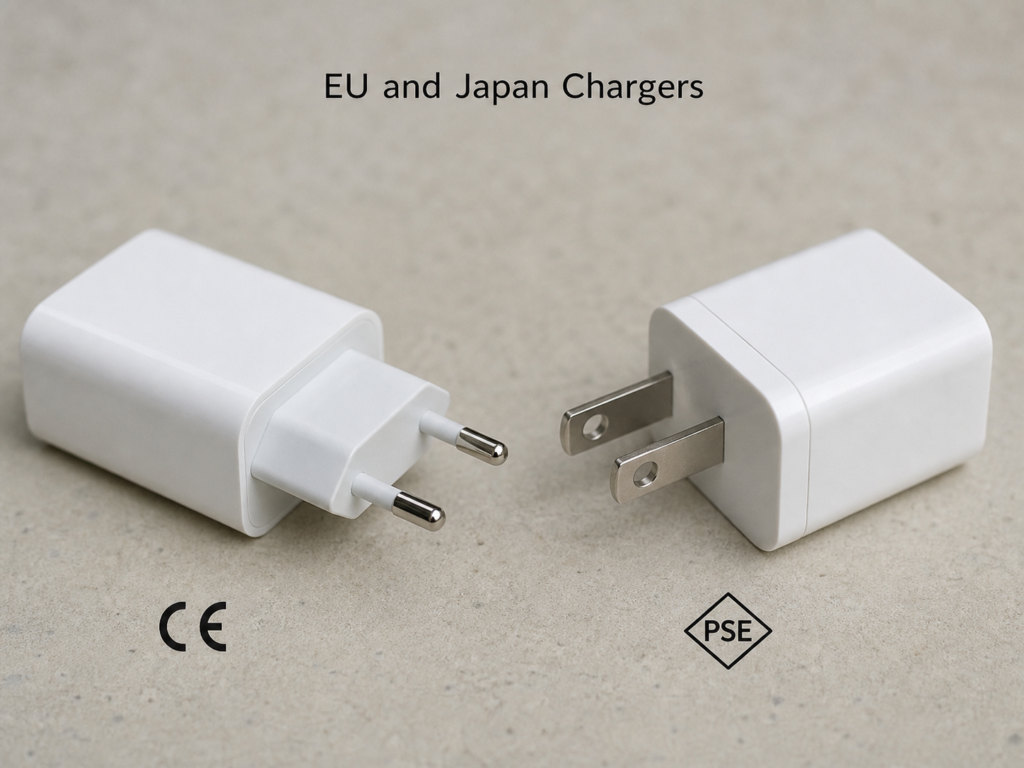
PSE Mark: Safety Compliance Mark for Japanese Electrical Appliances and Materials
PSE is Japan’s safety mark for electrical appliances and materials, regulated under the Electrical Appliance and Material Safety Act (DENAN for short), and overseen by the Ministry of Economy, Trade and Industry (METI) of Japan. It applies only to the Japanese market.
Different from the general coverage logic of CE, PSE divides electrical appliances and materials into two categories:
- Specified Electrical Appliances and Materials (Diamond PSE): Higher-risk products that must undergo conformity inspection by a METI-registered third-party organization, and the diamond PSE mark can only be affixed after passing the inspection;
- Non-Specified Electrical Appliances and Materials (Circular PSE): Relatively lower-risk products for which enterprises can complete conformity inspection on their own and keep records, then affix the circular PSE mark.
Special note: PSE itself only controls electrical safety and statutory marking; requirements such as electromagnetic compatibility, wireless, and environmental protection are covered by other Japanese regulations and do not fall within the scope of PSE.
Why Must Charging Product Businesses Pay Attention to These Two Compliance Requirements?
First, they are hard requirements for market access: applicable products must bear the corresponding marks before being placed on the market, and violations may result in customs detention, fines, or even mandatory recalls. Second, they have practical safety value: compliance testing covers items such as insulation, flame resistance, and temperature rise, which can reduce risks such as electric shock and fire. Finally, they serve an identification function: consumers and purchasers can quickly judge the basic compliance of products through the marks, and they are also a basic requirement for listing on cross-border platforms.
Scope of Application: How to Determine If Your Product Needs Compliance?
Many people’s first reaction when judging compliance is “My product is a charger/charging cable, does it need CE/PSE?” In fact, the answer is not a one-size-fits-all based on product category, but must be judged in combination with multiple conditions.
CE Coverage Logic: Check If It Falls Within the Scope of Directives
The core basis for CE judgment is whether the product meets the applicable requirements of the corresponding EU directives. For charging products, the mandatory covered categories include:
- Wall-plug chargers and power adapters;
- USB-C cables with active circuits that meet the voltage threshold;
- Charging products with wireless functions.
The voltage threshold here refers to the scope of application of the LVD Directive: LVD generally applies to electrical equipment designed for use with a rated input or output voltage between 50 V and 1000 V AC and between 75 V and 1500 V DC. When judging a charger, you cannot only look at its low-voltage USB output; you must also check whether its AC input and the product as a whole fall within the scope of LVD.
Many people ask: “Are purely passive low-voltage charging cables definitely exempt from CE?” The answer is that it cannot be directly determined. Exemption needs to be confirmed in combination with multiple regulations such as LVD, EMC, and RoHS, and you cannot directly conclude that compliance is not required just because the product is “low-voltage” or “chip-free”.
PSE Coverage Logic: Check If It Is in the Official Catalog
PSE judgment is more straightforward: the core is to check whether the product is in the official catalog of the Electrical Appliance and Material Safety Act and meets the definition of the corresponding product. When making a judgment, you can start from these dimensions: whether it is a DC power supply device, whether it has an AC input, whether the plug/power cord is separately regulated, and whether it is only a low-voltage connecting cable.
- Diamond PSE Coverage: Wall-plug chargers and power adapters directly connected to Japan’s 100V mains supply, if they fall under DC power supply devices among specified electrical appliances and materials according to the catalog and product definition, require third-party conformity inspection;
- Circular PSE Coverage: Needs to be confirmed by checking the catalog. For example, car chargers and some charging cables with electronic components need to be verified against product definitions to see if they are non-specified electrical appliances and materials;
- Exemption Situations: Purely passive low-voltage connecting cables need to be checked against the catalog, and those meeting the conditions can be exempted.
Core Differences in the Scope of Application of the Two
| Comparison Dimension | CE (EU) | PSE (Japan) |
|---|---|---|
| Coverage Logic | General coverage per EU directives, judged in combination with product attributes | Judged by classification based on the official catalog of the Electrical Appliance and Material Safety Act + product definition |
| Cable Control Rules | Not judged solely by whether there is a chip; confirmed in combination with voltage, circuit, and applicable directives | Not judged solely by whether there is a chip; confirmed in combination with catalog and product definition |
| Geographical Scope | Covers about 30 European countries/regions | Only the single Japanese market |
Key Conditions That Can Change Compliance Conclusions
Whether it is CE or PSE, if the following conditions change, the applicable conclusion may be completely different:
- Whether it is directly connected to AC mains;
- Whether it has active electronic components (such as chips, wireless modules, power management circuits);
- Whether the rated voltage and power exceed the classification threshold;
- Whether it is sold independently or as an accessory of other products;
- Whether it belongs to the exempt product category of the corresponding regulations.
For example: for the same USB-C fast charging cable with an E-marker chip, the compliance requirements may differ when sold independently versus sold as a charger accessory with the whole device; even if it is just placed in a gift box as a free gift, compliance obligations cannot be exempted.
Core Requirements: What Exactly Do the Two Regions Regulate and Test?
After clarifying the scope of application, let’s look at the specific regulatory content of the two regions, what is common, and what is locally specific.
Core CE Control Requirements (for Charging Products)
CE is a multi-dimensional access requirement. For charging products, there are three core controls, plus some conditional additional requirements:
- Electrical Safety (LVD): Specific test items are determined by the harmonized standards applicable to the product, and usually may include insulation, withstand voltage, temperature rise, abnormal operation, mechanical and fire protection items; drop resistance or interface safety cannot be listed as unified items for all products;
- Electromagnetic Compatibility (EMC): Applicable equipment must meet the basic requirements of EMC regulations, that is, the product must not cause unacceptable interference to other electronic equipment when operating, nor can it fail to operate normally due to common electromagnetic interference. However, this does not mean that all products must be tested by third-party organizations; whether a notified body is required depends on the specific regulations and applicable conformity assessment procedures;
- Environmental Protection Requirements (RoHS): The content of 10 types of hazardous substances such as lead, mercury, and cadmium is mandatorily restricted. All applicable products must comply, and exemptions need to be checked against the latest regulations.
In addition, specific products have additional requirements: if a charger is an accompanying charger for radio equipment covered by the EU common charger rules, or is sold with related equipment, it must also meet the corresponding USB-C interface and charging communication requirements per applicable rules; the energy efficiency requirements for independent external power supplies shall be judged separately per applicable ecodesign regulations. Products with wireless charging functions must also comply with the Radio Equipment Directive (RED).
Core PSE Control Requirements (for Charging Products)
The scope of PSE’s own control is very clear: it only covers electrical safety and statutory marking under the Electrical Appliance and Material Safety Act; all other requirements do not fall within the scope of PSE:
- Diamond PSE Test Items: Mainly include structural safety, flame resistance, insulation performance, compliance of Japanese domestic plug dimensions, temperature rise, etc.;
- Circular PSE Test Items: Conduct electrical safety conformity inspection per catalog requirements; no third-party certification is required, and enterprises only need to keep test records on their own.
Many people confuse other Japanese regulations with PSE, so let’s clarify here:
- In terms of EMC: Japan’s VCCI is a voluntary industry rule for specific information technology equipment, not a statutory requirement for all categories, and does not belong to PSE;
- In terms of wireless: Products with wireless functions must be judged per Japan’s Radio Act, handled by designated organizations of the Ministry of Internal Affairs and Communications (MIC), and rules vary for different wireless categories;
- In terms of chemical substances: Japan’s J-MOSS targets specified categories of electronic products, requiring marking or information disclosure on the content of specified chemical substances such as lead and mercury, with a focus on information marking, which is not equivalent to the EU RoHS unified substance limit system. Specific products and obligations should be checked against applicable Japanese regulations and JIS C 0950.
Commonalities and Differences in Core Requirements
In fact, the safety tests in both regions have a common foundation: both reference the basic standards of the IEC (International Electrotechnical Commission), and the overall approach to safety testing is similar. The differences mainly come from local actual conditions: the EU mains voltage is 230V, while Japan’s is 100V; plug specifications are different, and local safety preferences also differ, so there are some localized requirements. For example, for PSE specified electrical appliances and materials, the requirements for Japanese domestic plug specifications and flame-retardant materials are more detailed than those of CE.
For products with USB-C interfaces, some international standards for USB-C interfaces can serve as a common design basis, but the applicable regulations, product classifications, rated conditions, and test standards in the two regions are different. The EU common charger rules may also involve charging communication requirements such as USB Power Delivery for specific radio equipment; PSE is mainly based on the product classification and technical requirements of Japan’s Electrical Appliance and Material Safety Act. Whether test data can be shared must be confirmed item by item by the applicable standards and assessment bodies; it cannot be directly reused just because the interface is the same, nor can it replace the conformity assessment of another market.
For your quick reference, we have compiled a comparison table of core requirements:
| Comparison Dimension | CE (EU) | PSE (Japan) |
|---|---|---|
| Core Control | Multi-dimensional access compliance including electrical safety, electromagnetic compatibility, and hazardous substance restriction | Only electrical safety and statutory marking; EMC/wireless/environmental protection are covered by other regulations |
| Scope of Application Judgment Logic | General coverage per EU directives, judged in combination with product attributes | Judged by classification based on the official catalog of the Electrical Appliance and Material Safety Act + product definition |
| Electrical Safety Requirements | Reference IEC basic standards, adapted to EU 230V mains and plug specifications | Reference IEC basic standards, adapted to Japan 100V mains and domestic plug/flame resistance requirements |
| EMC Requirements | Applicable products must meet EMC requirements, but this does not mean all must be tested by third parties | Not covered; VCCI is a voluntary industry rule for specific categories |
| Chemical Substance Requirements | RoHS mandatorily restricts 10 types of hazardous substances | J-MOSS requires marking or information disclosure on the content of specified chemical substances for specific products, not equivalent to the RoHS unified limit system |
| Conditional Additional Regulations | Energy efficiency, common charger rules, Radio Equipment Directive (for products with wireless functions), etc. | Radio Act (for products with wireless functions), chemical substance marking, etc. (all not within the scope of PSE) |
Practical Process: How to Apply and What to Note?
After understanding the regulatory content, let’s talk about the practical issues that everyone cares about most: what the application steps are, what affects the cost and cycle, and what to do if the product is modified.
CE Compliance Application Process
The core of CE application is “the manufacturer completes the conformity assessment, signs the DoC, and keeps documents for inspection”; there is no need for unified official filing. The specific steps are:
- Confirm applicable directives and harmonized standards: First determine which EU directives the product falls under and which harmonized standards correspond to it;
- Complete conformity assessment: Low-risk charging products can undergo internal production control and self-assessment per applicable regulations; EU notified bodies are only required when explicitly required by regulations;
- Compile technical documentation and sign the Declaration of Conformity (DoC): The technical documentation must include test reports, risk assessments, etc. The DoC is a declaration document signed by the manufacturer certifying that the product meets EU requirements;
- Affix the CE mark and keep documents for inspection: The technical documentation does not need to be submitted to the authorities; just keep it on hand and produce it when regulatory authorities conduct spot checks.
Special note: Overseas manufacturers must designate an economic operator within the EU (such as an importer or authorized representative) as the responsible party for EU regulatory liaison.
PSE Mark Application Process
PSE is divided into diamond and circular types, and the application processes are very different:
Diamond PSE (Specified Electrical Appliances and Materials)
- First confirm that the product is in the specified electrical appliances and materials catalog and meets the corresponding product definition;
- Entrust a METI-registered conformity inspection body to conduct testing and issue a certificate;
- The importer or manufacturer within Japan submits the “Notification of Electrical Appliance and Material Manufacturing/Import Business”;
- Keep technical documentation and certificates, and affix the diamond PSE mark.
Circular PSE (Non-Specified Electrical Appliances and Materials)
- Confirm that the product falls within the scope of the non-specified catalog;
- The enterprise completes the conformity inspection on its own or entrusts a third party, and keeps test records;
- Submit business notification as required (applicable to some categories);
- Affix the circular PSE mark and keep technical documentation for inspection.
Many people think that PSE requires test reports to be submitted to METI for filing, but that is not the case. Japan’s rule is “business notification + enterprise self-retention of documents”, and there is no unified filing requirement.
Factors Affecting Cost and Cycle
Many people directly ask “How much does CE/PSE cost and how long does it take?” In fact, there is no fixed statutory price. Core influencing factors include: product category, rated power, whether it has wireless functions, number of samples, number of rectifications, qualification of the testing body, etc. Market quotations can only be used as a reference for preliminary estimation, and the specific cost and cycle must be determined in combination with the actual situation of the product.
What to Do If the Product Is Modified?
Compliance is not a one-time fix; product modifications may require re-evaluation:
- CE has no fixed validity period; as long as regulations are not updated and product design and core components are not changed, it remains valid long-term;
- The validity period of PSE diamond certificates is determined by specific categories; circular PSE has no fixed certificate, but requires continuous tracking of standard updates.
If the core safety components of the product are changed, such as transformers, MOS tubes, fuses, PCB boards, flame-retardant housings, plug cords, etc., both CE and PSE require re-evaluation of compliance, and supplementary testing if necessary.
Mark Identification: How to Affix Marks Compliantly? How to Quickly Verify Authenticity?
Marks are an intuitive reflection of compliance. Whether you affix them yourself or purchase products from others, you need to know the specification requirements and be able to initially judge authenticity.
Specification Requirements for CE Marking
The style of the CE mark has clear regulations: the letters “CE” must be drawn in the specified proportion, with a height usually not less than 5mm, with exceptions under specific regulations.
In addition to the CE mark itself, the manufacturer’s name, registered trade name or trademark, and contactable address must be marked per all applicable EU regulations, and product identification information required by regulations such as model, batch, and serial number must be provided; if applicable, information on the importer or other economic operators must also be marked. Different EU regulations may have different requirements for the specific form and placement of this information, and it cannot be simply understood that all charging products must be marked with all items at the same time in exactly the same way.
If the product’s conformity assessment module requires the participation of a notified body, the notified body number must be marked; not all CE marks need to have it.
The preferred placement is on the product itself, but it can also be placed on the minimum sales packaging or in the instruction manual, depending on the requirements of the corresponding regulations.
Specification Requirements for PSE Marking
PSE is divided into diamond and circular types, with different requirements:
- Diamond PSE: In addition to the diamond mark, statutory items specified by DENAN such as rated voltage, rated power or rated current, name of the producer or importer, and model must be marked according to the category of electrical appliances and materials, and the name or number of the conformity inspection body must be marked as required;
- Circular PSE: In addition to the circular mark, statutory items specified by DENAN such as rated parameters, name of the producer or importer, and model must also be marked according to the specific category of electrical appliances and materials.
The specific marking content and format shall be subject to the technical requirements of the corresponding product and the provisions of the Electrical Appliance and Material Safety Act. Per the provisions of the act, the mark must be affixed to the product itself or the minimum sales packaging, and cannot only be placed in the instruction manual.
Differences in Compliance Responsible Entities
EU compliance responsibility is shared by multiple economic operators: manufacturers, importers, authorized representatives, etc. bear their respective obligations per regulations, and market surveillance authorities of each member state conduct random spot checks.
Japan’s compliance responsibility is divided among different entities per the Electrical Appliance and Material Safety Act: there are clear requirements for the manufacturer/importer that submits the business notification, the entity that affixes the mark, the entity that keeps technical documentation, and the entity responsible for recalls. Usually, an importer or manufacturer within Japan is required as the core responsible party.
Quick Tips for Verifying the Authenticity of Charging Product Marks
You don’t need to go to a professional organization; you can make an initial judgment through a few simple points:
- CE Mark: You can ask the other party to provide the DoC and corresponding technical documentation. If they only have the mark but cannot produce the documents, it is most likely non-compliant. The so-called “China Export” is not the legal meaning of the EU CE mark; however, the appearance of the mark can only be used for preliminary inspection and cannot replace the verification of the DoC and technical documentation;
- PSE Mark: For chargers directly connected to mains, check if there is a diamond PSE and corresponding organization information; for products in the catalog that are not connected to mains, check for circular PSE, and at the same time verify statutory marking content such as rated parameters, producer or importer information, and model;
- Common counterfeiting signals: Deformed marks, no corresponding model/manufacturer information, and low-cost no-name products that only have the mark printed but cannot produce any compliance documents.
Practical Case Studies: Compliance Judgment for Common Charging Products
After talking about so many rules, it may still be a bit abstract. Let’s take several of the most common charging products, combine them with actual scenarios to make judgments, and then give you a set of quick decision-making tools.
5 Core Questions for Quick Judgment
When encountering a product you are unsure about, you can ask yourself these 5 questions in order, and you can basically correspond to the compliance requirements:
| No. | Core Question | Judgment Function |
|---|---|---|
| 1 | Is the target sales market the EU, Japan, or both? | Determine the applicable compliance system |
| 2 | Is the product directly connected to AC mains? | Initially judge whether it belongs to a high-risk controlled category |
| 3 | What are the input/output voltage/power parameters? | Check whether the voltage/power threshold is reached |
| 4 | Does it contain wireless/active circuits? | Judge whether additional control is required (such as EMC, radio) |
| 5 | Is it sold independently or as an accessory of other products? | Confirm whether independent compliance is required |
Compliance Conclusions for Typical Charging Products
We take 4 of the most common products as examples to help you correspond to the rules:
- 65W USB-C Wall-Plug Charger
- CE: Needs to comply with LVD (electrical safety) + EMC + RoHS. If the charger is sold with or as an accompanying charger for portable radio equipment within the scope of the EU common charger rules, it must also meet the corresponding USB-C interface and charging communication requirements per applicable rules; the energy efficiency requirements for independent external power supplies shall be judged separately per applicable ecodesign regulations;
- PSE: If it falls under DC power supply devices among specified electrical appliances and materials per Japan’s DENAN catalog and product definition, it needs to obtain a conformity certificate from a registered conformity inspection body and affix the diamond PSE mark; classification cannot be directly determined solely by the 65W or USB-C name.
- 100W USB-C Fast Charging Cable with E-marker
- CE: Applicable directives must be judged in combination with voltage and circuit attributes; it cannot be determined that compliance is mandatory or unnecessary solely based on “having a chip”;
- PSE: Must be checked against the Electrical Appliance and Material Safety Act catalog and product definition; control attributes cannot be determined solely based on having an E-marker.
- Ordinary Chip-Free USB-A Charging Cable
- CE: Exemption must be judged in combination with applicable regulations; it cannot be directly concluded that compliance is not required solely based on “low voltage, chip-free”;
- PSE: Pure low-voltage passive connecting cables can be checked against the catalog, and those meeting the conditions can be exempted.
- Charger with Wireless Charging Function
- CE: In addition to basic requirements, testing for the Radio Equipment Directive (RED) is also required;
- PSE: In addition to the requirements of the Electrical Appliance and Material Safety Act, it is also necessary to judge per the Radio Act whether a technical standards conformity certificate is required, with multi-dimensional assessment.
Boundary Scenarios Prone to Misjudgment
In actual operation, there are several boundary scenarios that are most prone to errors:
- Free gifts/accessories: Compliance obligations cannot be exempted just because they are free gifts. Independently sold products must be independently compliant, and accessories given away with the whole device must also meet the corresponding requirements;
- Multi-region universal version: If making a universal model for both the EU and Japanese markets, it needs to meet the plug, voltage, marking, and document requirements of both regions at the same time, and one set of certification documents cannot be shared;
- Non-commercial use products: Products for non-commercial import, samples, exhibits, and research purposes may have special regulatory arrangements, but they must absolutely not be used for sale, nor can they be used to evade statutory obligations.
List of Charging Product Compliance Document Packages
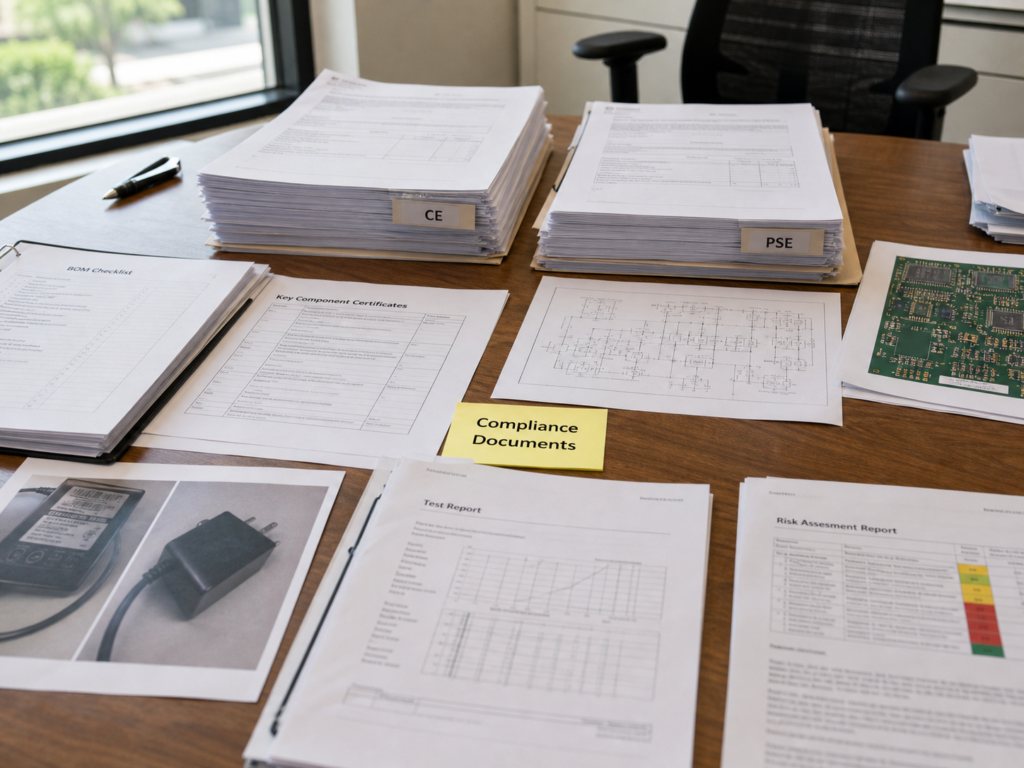
Whether it is CE or PSE, complete technical documentation must be kept. Basic required documents include: BOM (Bill of Materials), key component certificates, circuit schematics, PCB diagrams, label photos, test reports, and risk assessment reports.
Region-specific documents: CE requires supplementary EU Declaration of Conformity (DoC) and EU economic operator information; PSE requires supplementary conformity certificates/test records and Japanese importer information.
Pitfall Avoidance Guide: Common Misconceptions and High-Frequency Risks
Many people fall into pitfalls not because their products are unqualified, but because of cognitive errors. We have compiled the most common misconceptions and high-frequency risks to help you avoid them in advance.
Common Misconceptions About CE
- Misconception: CE is an official quality certification
Correction: CE is the EU’s market access compliance mark, used by the manufacturer after completing the applicable conformity assessment and signing the DoC. It is not an official quality certificate, nor does it represent how good the product quality is. - Misconception: CE is universally valid worldwide
Correction: CE only applies to regions that adopt EU harmonized regulations; other countries will not automatically recognize it. For example, Japan and the United States have their own compliance requirements. - Misconception: Purely passive low-voltage copper cables are definitely exempt from CE
Correction: Multiple applicable regulations such as LVD, EMC, and RoHS need to be verified; exemption cannot be directly determined solely based on “passive, low-voltage”. - Misconception: CE is a “China Export” mark
Correction: In EU regulations, CE refers to the CE mark indicating compliance with applicable requirements, not “China Export”; the so-called “China Export” is not the legal meaning of the EU CE mark. The appearance of the mark can only be used for preliminary inspection and cannot replace the verification of the DoC and technical documentation.
Common Misconceptions About PSE
- Misconception: All PSE requires mandatory third-party certification
Correction: Only specified electrical appliances and materials (diamond PSE) require third-party conformity inspection; non-specified products (circular PSE) are the responsibility of the enterprise itself, which only needs to keep records. - Misconception: Passing CE means you can directly pass PSE
Correction: There are differences in standards between the two regions, such as plug specifications, flame resistance requirements, and local responsible entity requirements. Test reports cannot be directly reused; it is necessary to evaluate whether supplementary testing of local difference items is required in combination with the target product and applicable requirements. - Misconception: Circular PSE is a fake certification
Correction: Circular PSE is a legal mark clearly stipulated in the Electrical Appliance and Material Safety Act, targeting lower-risk non-specified electrical appliances and materials, and is not a fake certification. - Misconception: Overseas factories can directly apply for and hold PSE
Correction: Overseas manufacturers can participate in testing, but the PSE business notification needs to be submitted by an importer or manufacturer within Japan; overseas factories cannot directly hold PSE as the notification entity.
High-Frequency Compliance Risks for Charging Products
In addition to cognitive misconceptions, there are several high-frequency practical risks to note:
- Inconsistent mark and product model: Products of the same series with different powers share the same mark, which cannot correspond to specific compliance documents during spot checks, resulting in a direct violation judgment;
- Only testing the main unit but not accessories: The charger is compliant, but the matching charging cable sold with it is not, so the whole set will still be judged as non-compliant;
- Unstable responsible entity: For example, if PSE uses a temporary Japanese importer, once the importer changes, the business notification needs to be reprocessed, which can easily lead to invalidation of compliance;
- Exaggerated publicity: For example, promoting “global certification” or “officially issued” but being unable to produce corresponding compliance documents will result in penalties from platforms or regulatory authorities.
Decision Reference: Efficient Choices for Single/Dual Market Compliance
If you are planning a compliance plan, whether for a single market or dual markets, you can refer to the following ideas to avoid detours and control costs.
Selection Logic for Single Market Compliance
- Only targeting the EU market: Complete CE compliance, choose a laboratory with testing capabilities for the corresponding harmonized standards, keep complete technical documentation and DoC, and arrange an economic operator within the EU in advance. There is no need to blindly seek certification from a notified body; most low-risk charging products can be self-declared, as long as the documents are complete, there is no problem;
- Only targeting the Japanese market: First confirm the PSE classification of the product. Specified electrical appliances and materials must apply for diamond PSE and be tested by a METI-registered organization; products in the non-specified catalog must fulfill the corresponding obligations of circular PSE and arrange a notification entity within Japan.
Path for Transferring Existing Compliance to Another Market
If you have already completed compliance for one market and want to expand to another, you can reuse some basic data to reduce costs, but you cannot directly assume that the two systems can replace each other:
- Transferring from existing CE to Japan: First confirm the PSE classification, then review existing test data according to the product classification, applicable standards, rated conditions, and assessment procedures of the Japanese target market. Only after the target market organization confirms acceptability can repeated testing be reduced; it cannot be promised in advance that only supplementary testing of items such as plugs, 100V, or flame resistance is needed;
- Transferring from existing PSE to the EU: First confirm the applicable combination of EU directives, then review existing data according to EU regulations, standard versions, rated conditions, and conformity assessment procedures. Requirements not covered by PSE such as EMC, RoHS, and energy efficiency may require supplementary assessment or testing, but this does not necessarily mean only one supplementary test; RoHS and energy efficiency also involve technical documentation and judgment of regulatory applicability.
Cost-Saving Tips for Simultaneous Dual Compliance Processing
If targeting both the EU and Japanese markets, simultaneous processing can save a lot of time and cost:
- Choose a laboratory that has both CE testing capabilities and PSE accreditation qualifications to share part of the basic safety test data;
- Prepare samples and materials simultaneously to avoid repeated testing and rectification;
- Note: The regulatory systems, responsible entities, and document requirements of the two regions are different, so they cannot be completely merged into one project; documents that need to be separate must still be separate.
Notes for Selecting Service Providers
When choosing a compliance service provider, don’t just look at the price; focus on the following points:
- Qualification confirmation: For PSE specified categories, you must choose a METI-registered organization; for CE, choose a laboratory with testing capabilities for the corresponding harmonized standards; do not use unqualified intermediaries;
- Service scope: Confirm whether the quotation includes full-process services such as document preparation, mark review, and rectification guidance. Some low-price quotations only include testing, and additional fees are required for subsequent documents and rectification;
- Experience first: Prioritize organizations with compliance experience in charging products (chargers, USB-C cables, wireless chargers), which are more familiar with products and rules, and can reduce a lot of communication costs and rectification times.
Summary
After reading this article, you should have mastered the core differences between CE and PSE, and will no longer confuse the two. Let’s briefly review the key takeaways:
First, you can distinguish the nature of the two: CE is the EU compliance mark used by the manufacturer after completing the applicable conformity assessment and signing the DoC, covering multi-dimensional requirements; PSE is Japan’s electrical safety mark, divided into diamond and circular types, and only controls electrical safety.
Second, you can judge the applicable requirements of common charging products in the two regions through 5 core questions (sales market, whether connected to mains, voltage/power, whether there are active circuits, sales method).
Third, you can quickly identify the marking specifications of CE and PSE, and initially judge authenticity through “whether there are corresponding documents” and “whether the marking information is complete”.
Fourth, you can avoid common pitfalls such as “one certification works globally” and “buying a mark equals compliance”, and will not fall into traps due to cognitive errors.
Fifth, you can formulate a suitable single-market or dual-market compliance path based on the target market and existing compliance foundation, control costs, and improve efficiency.
Compliance for charging products may seem complicated, but in fact, as long as you grasp the core logic and make judgments based on the actual situation of the product, you can avoid many detours.