
If you sell chargers, USB-C cables via cross-border e-commerce, or supply charging products to overseas customers, you will most likely cannot avoid third-party testing — either because the platform requires test reports for listing, or customs clearance needs compliance documents, or bulk procurement requires inspection and quality control. When many people look for a laboratory for the first time, they either go for cheap options and get reports that are not recognized by platforms or customs at all, or waste money on a bunch of useless tests, and even miss the market launch window.
This guide starts from the actual scenarios of consumer charging products, from basic common sense to practical pitfall avoidance, to help you step by step select a reliable third-party testing laboratory, so that you neither waste money nor fail to meet compliance requirements.
Step 1 of Selection: Clarify Your Compliance Path First
The first reaction of many people when looking for a laboratory is “how much does it cost to do CE certification”, but in fact, they have not even figured out what category their products belong to and what requirements they need to meet, so they are easily led by salespeople. Before choosing a laboratory, clarifying the compliance path first can save you a lot of detours.
First, classify your charging products. Compliance requirements vary greatly for different categories. Common charging products can be divided into 5 types:
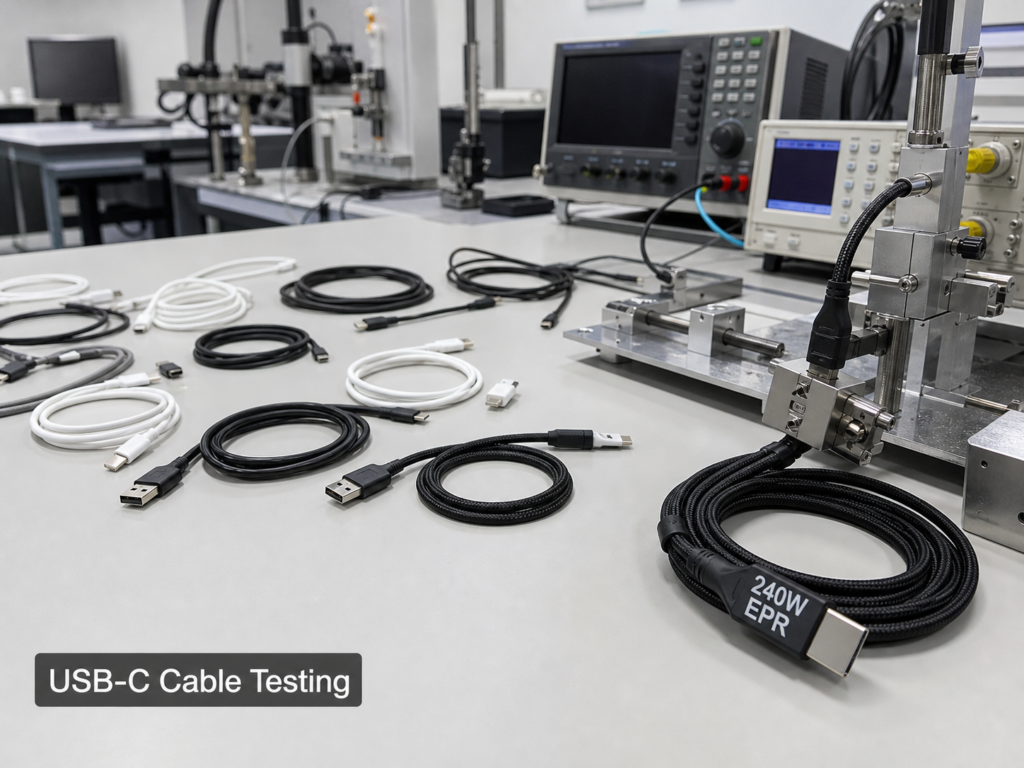
The first type is pure USB/USB-C cables, including ordinary data cables and high-power charging cables (such as 240W EPR cables). This type of product has no power conversion circuit, and the test focuses on interface performance, mechanical durability, and safety.
The second type is external power supplies/chargers, which are wall-plugged power adapters usually used, including GaN (gallium nitride) chargers and multi-port chargers. As long as they do not have wireless transmission functions, they all fall into this category. The test focuses on safety standards, EMC (electromagnetic compatibility), and energy efficiency.
The third type is charging products with wireless transmission functions, such as wireless chargers and smart chargers with Bluetooth or WiFi. Because this type of product has wireless signals, additional radio frequency (RF) testing is required, and the compliance requirements are more complex.
The fourth type is car chargers, which are charging products plugged into car cigarette lighters, with an input voltage of 12V/24V vehicle power supply. The test standards are different from those of wall-plugged chargers.
The fifth type is charging combo kits, such as kits consisting of a charger, cables, and connectors. For this type of product, the compliance requirements of each component in the kit must be considered at the same time. In some cases, they can be tested together, and in some cases, they need to be tested separately.
After clarifying the product category, use four elements to determine your compliance path:
The first is the statutory and regulatory requirements of the target market. For example, products sold to the EU must meet CE-related directives, and products sold to the US must meet FCC requirements.
The second is the additional rules of sales platforms or purchasers. For example, some Amazon categories require NRTL certification, and some major clients require additional performance tests.
The third is the type of compliance documents you need: test reports, declarations of conformity, or certificates. Different documents correspond to different laboratory capability requirements.
The fourth is the corresponding capabilities required of the laboratory. For example, to do FCC certification for wireless products, the laboratory must have FCC-recognized RF testing qualifications.
By stringing these four elements together, you can roughly know what kind of laboratory you need to look for, and will not consult blindly.
Must-Know Basics: Fundamental Knowledge of Third-Party Testing
Before formally selecting a laboratory, first understand a few basic concepts, which can help you avoid 90% of low-level pitfalls.
First, the difference between first-party, second-party, and third-party testing:
First-party testing is when factories test their own products, mainly used for R&D and internal quality control. Some regulations allow manufacturers to conduct testing or conformity assessment on their own, but whether it is accepted by customs, platforms, or customers must be confirmed according to the regulations of the target market and its document requirements.
Second-party testing is when purchasers or entrusted inspection agencies go to the factory for inspection. The results are only responsible to the buyer, used to determine whether the batch of goods meets procurement requirements, and cannot be directly used as statutory compliance documents.
Third-party testing is testing conducted by laboratories independent of both the buyer and the seller, with a neutral stance. The reports issued can be used for compliance declaration, platform listing, dispute evidence, and also for internal quality control. This is also the most common source of “test reports” we usually refer to.
Many people cannot distinguish the difference between test reports, declarations of conformity, and certificates, and even think that laboratories can issue “CE certificates”. In fact, the boundaries between the three are very clear:
A test report is a result document issued by the laboratory after testing the submitted samples, recording the test results of the submitted samples under the items and methods listed in the report. It can be used as one of the technical bases for a declaration of conformity or certification application, but does not alone equate to the overall compliance of the product.
A Declaration of Conformity (such as the EU DoC for the European Union) is a document signed by the manufacturer itself, promising that its products meet the regulatory requirements of the target market. The third-party test report is the technical document supporting this declaration, but the declaration itself is not issued by the laboratory.
A certificate is issued after review by a certification body, such as Japan’s PSE certificate and South Korea’s KC certificate. Its validity depends on the regulations of the target region; some are mandatory, and some are required by channels.
Two common international mutual recognition documents should also be mentioned here: one is the CB report/certificate, which is an international mutual recognition document under the IECEE system, and can be used to convert to certifications of multiple countries, reducing redundant testing; the other is NRTL. NRTL is OSHA’s Nationally Recognized Testing Laboratory program, and the specific certification mark is used by the corresponding OSHA-recognized NRTL body. U.S. regulations do not universally mandate the NRTL mark for all consumer charging products, but workplaces, purchasers, retailers, or platforms may impose this requirement.
In simple terms, the division of labor among the three is: laboratories are responsible for testing samples and issuing reports, certification bodies are responsible for review and certificate issuance, and regulatory authorities (such as customs and market supervision) are responsible for verifying whether products are compliant.
Two easily confusing points require special attention: First, having testing capability does not mean the report is officially recognized. Many laboratories can conduct tests, but without corresponding qualification accreditation, the report may not meet the requirements for specific uses. Second, testing intermediaries are not the same as laboratories with their own facilities. Many who contact you are intermediary companies that do not have their own laboratories and will subcontract projects out. The qualification of the laboratory that finally issues the report may not meet the requirements.
How important is it to choose the right laboratory? Charging products involve electrical safety. Some e-commerce platforms, purchasers, or regulatory procedures may require third-party reports or documents issued by designated bodies, but whether they are accepted must be confirmed item by item based on the target market, product category, platform rules, and report scope. If you choose the wrong laboratory, at best, the report is invalid, delaying product launch; at worst, key safety items are omitted from testing, and problems such as fire or electric leakage occur after the product is sold, requiring compensation liability; some laboratories quote low prices at first, then charge various hidden fees later, making the total cost far exceed the budget.
Clarify Before Selection: 4 Core Requirements
After understanding the basic concepts, don’t rush to find a laboratory. Sort out your 4 core requirements first, so that you can screen accurately and avoid wasting money.
Item 1: Clarify the Purpose of Testing
Different testing purposes have completely different requirements for laboratory qualifications:
If it is compliance testing, such as for customs clearance and platform listing, you must have qualifications and report formats recognized by the target market, and cannot just find any laboratory to test.
If it is quality control testing, such as internal R&D quality control and assessing supplier product quality, you can relax qualification requirements, and focus on the laboratory’s testing capability and data accuracy.
If it is for dispute evidence or pre-certification testing, you must find a laboratory with complete qualifications and reports with corresponding legal effect, otherwise the report cannot be used as evidence or certification support.
Item 2: Clarify the Target Market and Compliance Requirements
This is the most core requirement. Rules vary greatly across different markets. Let’s break them down into several categories:
Statutory Mandatory/Semi-Mandatory Compliance Requirements
These are mandatory, otherwise customs clearance or listing may not be possible:
- European Union: For CE certification of ordinary charging products, most do not require the involvement of a Notified Body (NB), and manufacturers can sign the EU DoC on their own. Manufacturers need to complete conformity assessment in accordance with applicable regulations, establish technical documentation, and sign the EU DoC. Tests such as LVD (Low Voltage Directive) and EMC (Electromagnetic Compatibility) can be completed by the manufacturer’s internal or external laboratories; whether an ISO/IEC 17025 accredited laboratory must be used should be confirmed based on specific regulations, standards, customer or platform requirements. The involvement of a Notified Body for RED depends on the conformity assessment procedure adopted by the manufacturer and the applicability of harmonized standards, and cannot be judged solely based on whether the product has wireless functions.
- United States: For FCC equipment, it is first necessary to determine whether to use SDoC or Certification based on the equipment category. SDoC also involves the responsible party, compliance declaration, test records, and applicable technical rules; Certification must be completed by an accredited testing laboratory and a certification application must be submitted in accordance with FCC requirements. In addition, there is no mandatory legal requirement for safety certification in the United States, but many platforms and retailers require the NRTL mark.
- Japan: First check whether the product is in the catalog of PSE (Electrical Appliance and Material Safety Law). It is divided into specified electrical appliances and non-specified electrical appliances. Specified electrical appliances must undergo prescribed conformity inspection by a Japan-registered conformity assessment body and obtain certification; for non-specified electrical appliances, in principle, operators such as manufacturers shall implement self-inspection and affix the PSE mark as required. Whether to entrust third-party testing should be confirmed based on product and document requirements.
- South Korea: First confirm the certification, testing, or self-confirmation requirements in accordance with the applicable KC system and product catalog in South Korea, then verify the corresponding designated/accredited bodies, testing standards, factory inspection, and certificate requirements; the same laboratory qualification rule cannot cover all KC products.
There are also energy efficiency requirements, such as the U.S. DOE/CEC energy efficiency and the EU’s ErP Directive. These do not apply to all products, and whether they need to be done should be confirmed based on the regulations of the sales location and the specific parameters of the product (such as power and energy efficiency grade).
Ecosystem/Trademark Certifications (Non-Statutory)
These are not statutorily mandatory and can be selected as needed: for example, USB-IF certification, Apple MFi certification, Qualcomm QC certification, etc., which belong to industry or brand ecosystem licenses. After obtaining them, you can use the corresponding trademarks to enhance product competitiveness. Whether to do it depends on your platform requirements, customer requirements, or brand planning.
Performance and Interoperability Verification (Non-Statutory)
These are also non-statutory, such as USB PD/PPS fast charging testing, fast charging compatibility testing, and data transmission performance testing, which mainly verify the function and compatibility of the product. Whether to do it depends on your product positioning and customer requirements. For example, for products focusing on high-power fast charging, doing a PD3.1 performance test is more convincing.
If you plan to sell your products to multiple countries and regions, you can prioritize laboratories with CBTL qualifications, that is, testing laboratories under the IECEE CB system. The CB report can be used to convert to certifications of multiple countries, without the need to redo the full set of tests in each country, which can reduce costs. However, note that: CB only covers products and standards within the IECEE system; when converting certification, you need to supplement national difference tests of the target country, factory inspection, or local audit, and it cannot be automatically converted to local certification.
Item 3: Clarify the Test Product and Core Dimensions
First determine your product type: charger, USB cable, connector, or charging kit, and whether there are special requirements, such as high power, multi-port, or wireless functions.
Then determine the core testing dimensions. Common ones include safety standards (electrical safety), EMC (electromagnetic compatibility), charging/data performance, mechanical durability, environmental protection and energy efficiency. You don’t need to do all of them, just choose as needed. For example, if you only test fast charging compatibility internally, you don’t need to do the full set of safety tests.
Item 4: Clarify the Time and Budget Range
The budget is mainly affected by three factors: the power and complexity of the product (for example, a 240W multi-port GaN charger is much more expensive than an ordinary 5W charger), the number of test items, and the qualification level of the laboratory.
When making a budget, don’t just look at the quoted testing fee, but also include potential expenses such as retesting fees, expediting fees, sample shipping fees, and certification fees, otherwise it is easy to overspend.
Be sure to leave a buffer in terms of time. It is recommended to reserve time for rectification and retesting, especially for products that are tested for the first time, which are likely to have non-conformities. Don’t count backwards from the launch date, as rectification may delay things if needed.
How to Check Hard Thresholds: Laboratory Qualification Verification Methods
After clarifying your needs, you can start screening laboratories. The first step is to check the hard threshold – qualification, which is the prerequisite for the validity of the report. Don’t just believe the salesperson when they say “we have qualifications”, you have to check it yourself.
First, the general core qualifications: ISO/IEC 17025 + ILAC-MRA.
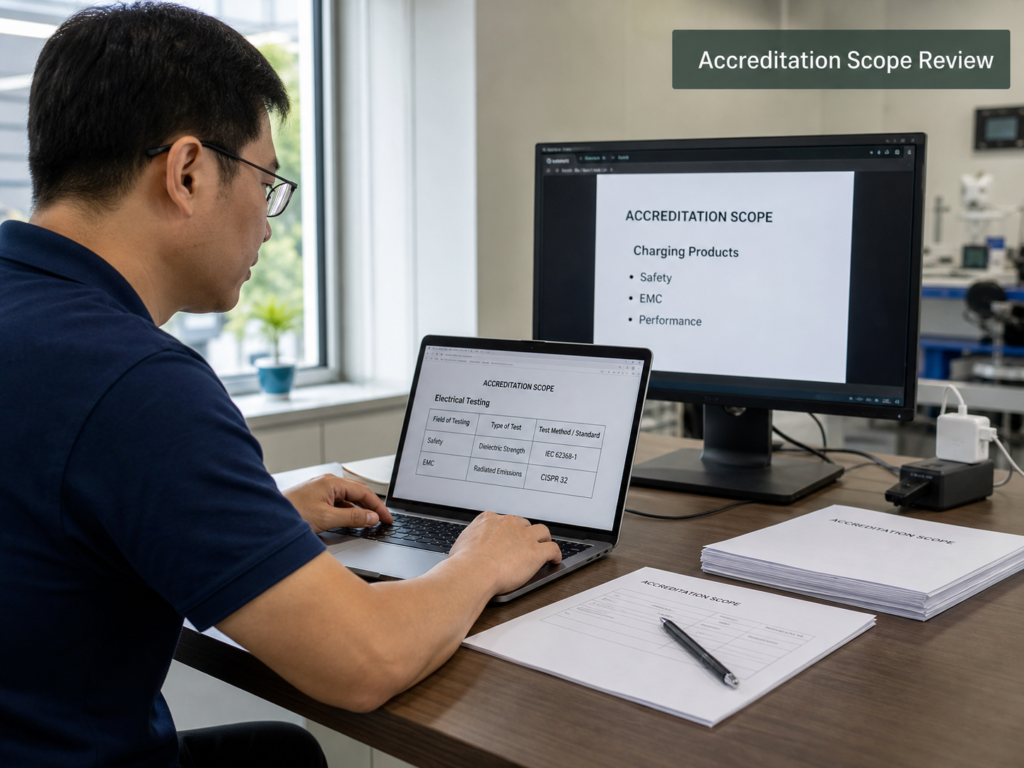
Let’s briefly explain: ISO/IEC 17025 accreditation indicates that the laboratory has corresponding technical and management capabilities within the scope of accreditation; ILAC-MRA facilitates mutual recognition among accreditation bodies, but whether the report is accepted by specific regulations, regulatory authorities, platforms, or customers still requires checking the accreditation scope and purpose.
How to check qualifications reliably? Here’s a three-level query method, step by step:
Level 1: First confirm whether the accreditation body that issues qualifications to the laboratory is a signatory of the ILAC MRA. For example, China’s CNAS, the United States’ A2LA, and the European Union’s DAkkS are all official signatories. If the accreditation body is not on the list, the applicability of the qualification requires special verification.
Level 2: Check whether the laboratory’s 17025 qualification certificate is within the validity period and whether it has been suspended or revoked.
Level 3, which is also the most critical step: download the laboratory’s accreditation schedule and carefully check the test location, test standards/methods, product fields, and whether there are restrictive conditions. Many people think that with a 17025 certificate, all items can be done, but that’s not the case. The accreditation schedule is the real “capability list”, and only the standards and product categories listed in the schedule are accredited.
In addition to general qualifications, you also need to check the exclusive qualifications of the target market, as requirements vary across different markets:
- European Union: For ordinary CE testing, manufacturers need to complete conformity assessment, establish technical documentation, and sign the EU DoC in accordance with applicable regulations. LVD and EMC tests can be completed by the manufacturer’s internal or external laboratories; whether an ISO/IEC 17025 accredited laboratory must be used should be confirmed based on specific regulations, standards, customer or platform requirements. If it is a scenario that requires the involvement of a Notified Body (NB), it is also necessary to check the authorization scope of the NB to see if it has the qualification for the corresponding product.
- United States: For FCC equipment, it is first necessary to determine whether to use SDoC or Certification based on the equipment category. SDoC also involves the responsible party, compliance declaration, test records, and applicable technical rules; Certification must be completed by an accredited testing laboratory and a certification application must be submitted in accordance with FCC requirements.
- Japan: For PSE specified products, check whether the laboratory is a Japan-registered conformity assessment body; for non-specified electrical appliances, in principle, operators such as manufacturers shall implement self-inspection and affix the PSE mark as required. Whether to entrust third-party testing should be confirmed based on product and document requirements.
- South Korea: First confirm the certification, testing, or self-confirmation requirements in accordance with the applicable KC system and product catalog in South Korea, then verify the corresponding designated/accredited bodies, testing standards, factory inspection, and certificate requirements; the same laboratory qualification rule cannot cover all KC products.
- If you need a CB report, you must check whether the laboratory is an IECEE-accredited CB Testing Laboratory (CBTL) and that it covers your corresponding product standards.
When checking qualifications, also pay attention to two key points:
First, you must check the official accreditation schedule, not just the words “qualified”. You need to verify two core points: first, whether there are the test standards you need; reports issued beyond the scope do not meet the corresponding accreditation requirements. Second, whether there is accreditation for the corresponding product category. For example, some laboratories only have safety qualifications for home appliances, not for power adapters, so the charger report they issue may not be suitable for your purpose.
Second, ask clearly whether there are subcontracted items, that is, whether the laboratory will outsource some test items to other laboratories. If there is subcontracting, the subcontracting laboratory must also have the qualification for the corresponding items and be recognized by the target market, otherwise the test results of this part may not be accepted.
How to identify qualification fraud or edge-cutting? There are several signs to be alert to: no official query channel, the test standard you need cannot be found in the accreditation schedule, the report header is inconsistent with the actual testing body, and confusing management system certification such as ISO9001 with ISO17025 testing accreditation – ISO9001 proves that the company’s management is standardized, which is not the same as testing capability. Don’t be fooled.
How to Evaluate Soft Capabilities: Judgment of Adaptability for Charging Products
Qualifications are hard thresholds. After passing the hard thresholds, you also need to look at the laboratory’s soft capabilities, that is, whether it can adapt to your charging product needs. After all, having qualifications does not mean being good at charging product testing.
First, look at testing experience. Prioritize laboratories with actual testing cases of similar products. For example, if you want to test 240W PD EPR cables, look for those that often do high-power USB cable testing, not those that have only done ordinary data cables; if you want to test 65W multi-port GaN chargers, look for those with experience in GaN charger testing. Also check whether they have experience in special tests such as USB-IF, MFi, and fast charging protocols. Special tests have higher requirements for equipment and personnel, and experienced laboratories can help you avoid many detours.
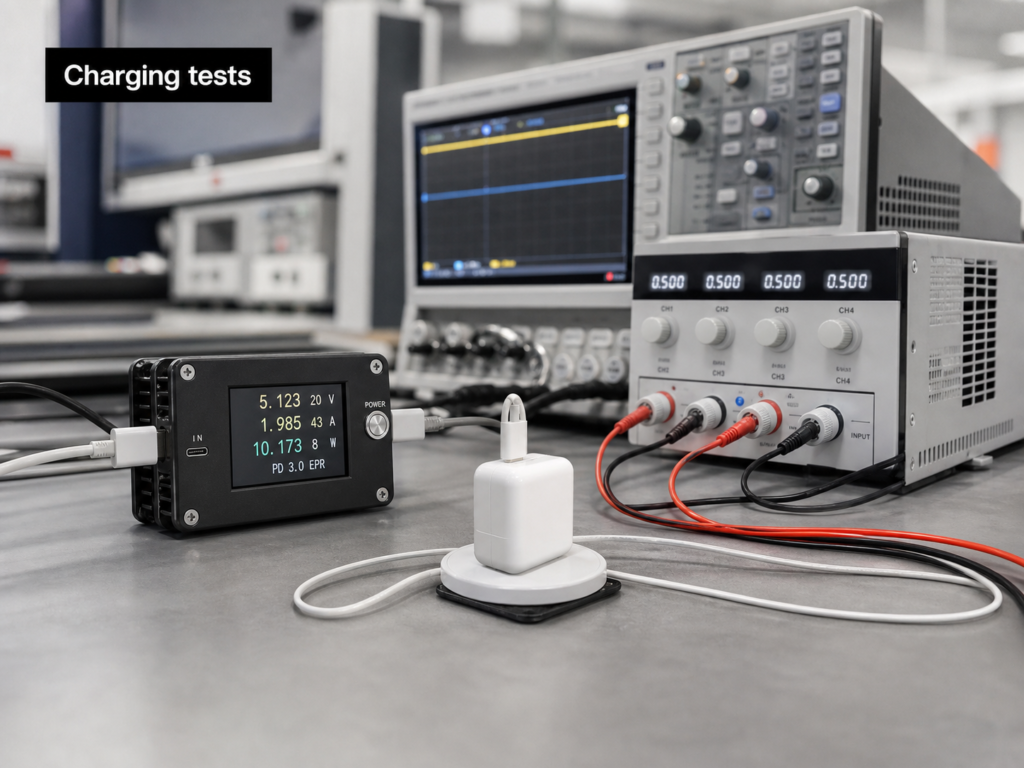
Then look at the coverage capability of equipment and testing methods. Don’t just look at the marketing cases on the laboratory’s official website, but ask the other party to confirm in writing whether they can cover the special items you need, such as high-power PD3.1/EPR testing, PPS programmable power supply testing, multi-port combined load testing, etc. Special testing of charging products requires specialized equipment, such as PD protocol testers and multi-channel electronic loads. If the laboratory does not have the corresponding equipment, it cannot measure accurate data at all.
Next, check whether the testing cycle and scheduling can match your plan. Don’t wait until you send the samples to find out that you have to wait in line for a month, delaying the launch. When confirming, ask clearly about four key dates: the date of receipt of complete samples (the date when all your samples and materials are received), the start date of testing, the completion date of testing, and the date of report issuance.
There are many factors affecting the cycle: the laboratory’s scheduling, the number of samples you send, the number of test items, the number of rectifications, and the minimum test duration specified by the standard. Some standards will specify the time and conditions for tests such as temperature rise, durability, abnormal operation, or continuous operation. The specific duration must be based on the applicable standard and the confirmed test plan, and cannot be replaced by a unified “burn-in hours”.
If you need expedited service, be sure to ask clearly about the expediting rules. Formal expediting usually only means priority scheduling and compressing the internal review time that is allowed to be compressed, and cannot skip the testing, technical review, and report issuance processes specified by applicable standards. For projects that claim an extremely short cycle, you should check the test items, the duration specified by the standard, original records, technical review, and report issuance processes; if the cycle is too short to meet the conditions specified by the standard, it cannot be accepted, and you cannot judge the report invalid solely based on the date.
Also pay attention to the impact of peak seasons. For example, during the stocking period before Black Friday and Christmas, the laboratory’s scheduling will be 1-2 weeks longer than usual. If you are rushing for goods for the peak season, be sure to plan ahead and don’t send samples at the last minute.
Finally, look at overseas adaptation and service capabilities. After all, you are doing overseas markets, and poor service will be very troublesome:
- Language support: Whether they can issue English reports and whether there are English-speaking contact personnel. Some platforms or customers only accept English reports.
- Logistics and samples: The location of the laboratory will affect the shipping cost and transportation time of samples. For example, if you are in China, choosing an Asian laboratory is much better in terms of shipping cost and timeliness than choosing a North American one. Also ask clearly about the sample handling rules, such as whether samples are sent back, destroyed, or retained after testing.
- Confidentiality service: Whether they can sign an NDA (Non-Disclosure Agreement) to protect your product design and test data, especially for new products that have not yet been launched.
- Platform recognition: Whether the laboratory’s reports are accepted by mainstream cross-border platforms such as Amazon, Temu, and AliExpress. Some platforms have their own lists of recognized laboratories, which should be confirmed in advance.
- Certification conversion support: Confirm whether the laboratory’s report can be used as technical data for target market conformity assessment, FCC application, or USB-IF authorized testing process; at the same time, clarify the responsible entity of CE and FCC SDoC and USB-IF’s own certification procedures.
- Value-added services: Whether there are services such as pre-testing, rectification suggestions, report modification, and supplementary testing, which are very useful for novices. For example, pre-testing can detect product problems in advance and avoid retesting fees if the formal test fails.
Quotation and Contract: The Key to Avoiding Pitfalls
After screening out 2-3 qualified laboratories, you can compare quotations, but don’t just compare the total price. Many pitfalls are hidden in the details of the quotation.
First, unify the quotation caliber, otherwise comparing the total price is meaningless. When aligning the caliber, confirm the following contents: test standards and version numbers, covered model range, required number of samples, agreement on destructive testing (such as which tests will damage samples and whether supplementary samples are needed), retesting rules, and whether document review fees are included.
Also clarify the boundary of costs, that is, what is included and what is not included in the quotation: common costs include testing fees, certification/registration fees, factory inspection fees, annual fees/supervision fees, platform template fees, translation fees, and taxes. All these must be asked clearly, don’t wait until you sign the contract to be told there are additional fees.
The correct way to compare prices is to compare details under the same caliber, not the total price. For example, Laboratory A quotes $1,000, including one free retest, and Laboratory B quotes $800, with a retest fee of $500. If your product fails the first test, the total cost of Laboratory B will be higher instead.
Next, be alert to two common low-price traps:
The first is that the quotation is far lower than the market price. This is most likely problematic: either the report is issued beyond the scope (that is, there is no corresponding qualification, and the report does not meet the corresponding purpose), or key test items are omitted. For example, the withstand voltage test is skipped in safety testing. It seems cheap, but the product has safety hazards, and the report is not recognized.
The second is the “guaranteed pass” promise. Formal laboratories will never say “guaranteed pass”, because testing is strictly based on standards, and if the product is unqualified, it is unqualified. Those who say “guaranteed pass” either cut corners without following the standards, resulting in unreliable reports; or deliberately let you fail the first time, then charge high retesting fees, and the final total cost is much higher.
After determining the intended laboratory, be sure to sign a formal contract, and the contract must clarify these core clauses to avoid later disputes:
First, Test basis: Clearly write the standard name, version number, and specific list of test items to avoid the laboratory saying later “this item is not included in the quotation, you need to pay extra”.
Second, Delivery rules: Clarify the delivery time, language, number of copies of the report, and the liability for overdue delivery, such as how much compensation is paid for one day overdue, or whether a refund is possible.
Third, Retesting rules: Clarify the charging standard for retesting, under what circumstances free retesting is available, and the maximum number of retests. For example, if the first test fails, whether the retest after rectification is free or charged at half price.
Fourth, Guarantee clauses: Including confidentiality obligations, commitment to the authenticity of laboratory qualifications, and whether a refund or free retest is available if the report does not meet the requirements (such as not being recognized by the platform).
Fifth, Samples and data: Clarify the ownership and handling method of samples, whether they are sent back or destroyed after testing, as well as the confidentiality and storage rules of test data, and your product data cannot be disclosed casually.
Sixth, Cost boundary: Clarify all service contents included in the quotation, and how to charge for additional services not listed, such as how much to charge for modifying the report content, and how to charge for adding test items.
Practical Implementation: The Full Process from Screening to Acceptance
With so many knowledge points mentioned earlier, now we string them into actionable steps. You can follow this process step by step, which is less likely to fall into pitfalls:
- Sort out needs + judge compliance path: First organize your product parameters, target market, testing purpose, cycle, and budget, then clarify your compliance path and required laboratory qualifications based on the content mentioned earlier.
- Preliminary screening of qualifications: Use the hard thresholds of ISO 17025 + ILAC-MRA + target market exclusive qualifications to first screen out 5-8 qualified laboratories. You can find them through platform recommendations, industry friend referrals, or official accreditation directories.
- Match soft capabilities: Check the charging product testing experience, equipment coverage capability, testing cycle, and overseas service capabilities of these laboratories, and narrow down the scope to 2-3.
- Compare prices under the same caliber: Ask these 2-3 laboratories to quote detailed prices under a unified caliber, compare service contents and prices, and select the most suitable one.
- Confirm sample submission materials and representative models: Organize the material package required for sample submission, establish a model difference table, and the laboratory or certification body will evaluate the product family and representative models based on structure, key components, input/output parameters, ports, software/wireless functions, and labels. You cannot default that the model with the highest power or the most complete functions can cover other models; if necessary, separate testing or supplementary testing must be carried out.
- Sign contract, send samples + report acceptance: Sign the contract and send samples after checking the contract clauses. After receiving the report, be sure to review it against the checklist, and archive all materials after there are no problems.
For your convenience in checking, here are several practical checklists that you can use directly for comparison:
Laboratory Selection Checklist
- Qualifications: Has ISO/IEC 17025 + ILAC-MRA accreditation and is within the validity period; has exclusive qualifications required by the target market; the accreditation schedule includes corresponding test standards and product categories.
- Capabilities: Has testing cases of similar charging products; equipment can cover the special test items you need; testing cycle meets your launch plan.
- Risks: Quotation details are clear, no hidden consumption; core clauses such as standard version, delivery rules, and retesting rules are clarified in the contract.
Sample Submission Material Package Checklist
- Basic materials: Model difference table, product specification sheet, BOM/key component list, nameplate and label draft, product manual.
- Technical materials: Circuit diagram/PCB materials (partial content can be provided according to confidentiality requirements), adapter plug version description.
- Historical materials: Previous test reports and product change records.
Report Acceptance and Document Archiving Checklist
- Report acceptance items: Report number, information of all parties (laboratory, manufacturer), sample information, test standards and versions, whether there are test deviations, test date, whether the accreditation mark and scope of use are correct.
- Document archiving items: Demand sorting table, laboratory qualification query records, quotation, contract, sample submission material package, test report, acceptance record, subsequent product change evaluation records. These materials should be stored properly, and can be taken out at any time whether it is a platform spot check or a customer request.
Common Misconceptions and Applicable Boundaries
Finally, let’s talk about several common pitfalls that people are most likely to fall into, as well as the scope of application, to avoid you using the wrong method.
6 Typical Selection Misconceptions
- The more qualifications the better? No. Laboratories have costs to maintain qualifications, and redundant qualifications will be passed on to the quotation. You only need to confirm that it has the qualifications you need, and you don’t have to pursue more qualifications.
- Having the ISO 17025 mark means all items are accredited? No. You must check the accreditation schedule. Many laboratories’ 17025 qualifications only cover some standards and products. Items not listed in the schedule, even if they can be tested, are not accredited.
- Test report equals certificate? No. A test report only records the test results of the submitted samples under the items and methods listed in the report, and is not a certificate; compliance is determined according to the regulations of the target market. For example, EU CE is the manufacturer signing the DoC on its own, and the report is only a supporting document, not a “CE certificate”.
- Choosing the cheapest is the most cost-effective? No. If the report is invalid, delaying the launch, or being detained by customs, or removed from the platform, the loss will be far more than the testing fee, and the comprehensive cost will be higher instead.
- ILAC mutual recognition means reports are accepted in all scenarios? No. ILAC mutual recognition is only an agreement between accreditation bodies of various countries. Whether it is specifically accepted depends on the purpose, the regulations of the target market, and the rules of the platform. For example, some platforms only recognize reports from local laboratories, even with ILAC mutual recognition.
- CB reports can be automatically converted to multi-country certifications? No. The CB report is only the basis for mutual recognition. When converting certification, you need to supplement national difference tests of the target country, factory inspection, or local audit, and it cannot be converted automatically.
Applicable Boundaries and Change Rules
Not all situations require third-party testing: if it is for internal R&D trial production verification, small-batch self-use without compliance requirements, or just simple functional verification, you don’t need to find third-party testing. You can test it yourself or find a laboratory that can test it, without pursuing qualifications.
The scope of application of this guide is consumer charging electronic products, such as charging cables, chargers, power adapters, wireless chargers, etc. It does not apply to medical-grade, automotive-grade, or industrial-grade charging products. These products have special standards and qualification requirements, and additional special qualifications need to be verified.
There is also a very important point: after product changes, can the original test report still be used? It depends on the content of the change. If the change will affect safety, EMC, energy efficiency, protocol performance, labeling, or certification coverage, such as replacing key components, modifying the insulation system, or changing the output power, then re-evaluation is required, and supplementary testing or even retesting may be necessary.
Only appearance or packaging changes that are confirmed by change evaluation not to affect the safety structure, materials, EMC, energy efficiency, protocol performance, regulatory labeling, and certification coverage may not require retesting; evaluation records should be retained and documents should be updated according to the requirements of the target market. For example, if the change in shell color involves flame-retardant materials, coatings, or label visibility, or changes in packaging or labels affect mandatory regulatory information, ratings, warnings, certification marks, and model identification, change evaluation is still required.
Summary
After reading this guide, you should be able to master these core capabilities: independently judge the compliance path and testing needs of charging products, instead of randomly looking for laboratories at the beginning; use the three-level query method to verify the qualifications of the laboratory and judge whether it meets the requirements of the target market, without being fooled by fake qualifications; avoid common pitfalls in selection, complete the whole process from demand sorting to contract signing, and avoid wasting money; independently prepare sample submission materials for charging products, complete report acceptance and document archiving; correctly evaluate the impact of product changes on the validity of test reports, and know when supplementary testing is required.
Choosing a third-party testing laboratory is essentially finding a reliable compliance partner. It’s not that the cheaper the better, nor the more expensive the better. What suits your own needs is the most important.