
Do you have mobile phone chargers, router power supplies, and laptop adapters plugged into your sockets all year round? Many people do not unplug the power supply after use, thinking it does not consume much electricity. A study by the EU Directorate-General for Environment (DG Environment) on household standby and shutdown energy consumption shows that the total energy consumption of devices in standby and shutdown states in households accounts for about 5%-10 of annual household electricity consumption, among which external power supplies that are plugged in all year round are one of the important contributing categories. This is exactly the core background for the EU to formulate special ErP energy-saving regulations for external power supplies. Whether you are an ordinary consumer buying external power supplies in the EU, or an entry-level seller who has just entered the EU market, you can sort out the basic rules, scope of application, core requirements and compliance judgment methods of ErP through this article, and avoid common cognitive misconceptions.
Basic Knowledge: First Understand What ErP for External Power Supplies Is
Let’s first explain a few core concepts in plain terms to avoid subsequent understanding deviations.
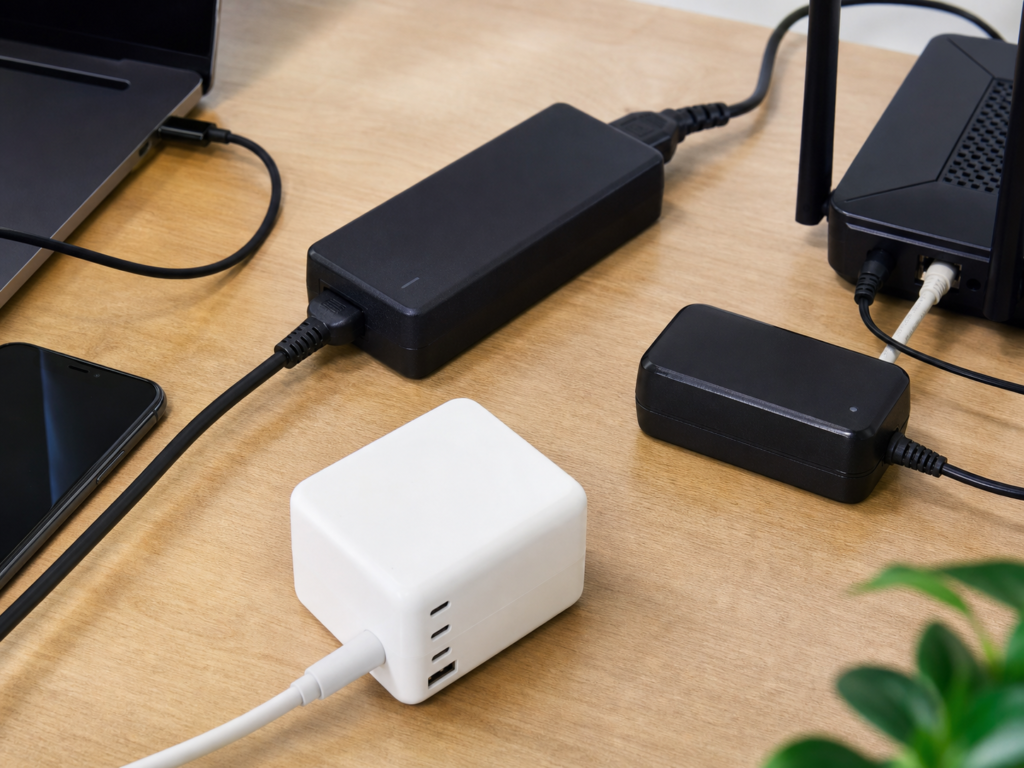
The external power supply we often refer to is an independent external device that plugs into a household mains socket and converts the alternating current (AC) from the power grid into low-voltage electricity usable by electronic devices. Its core feature is that it has an independent housing and can be completely separated from the main powered equipment. Common mobile phone chargers, laptop adapters, and power supplies for routers and set-top boxes all fall into this category. It should be noted that the EU household mains standard is 230V, 50Hz. Products supporting wide-voltage input only need to cover this voltage range to meet the input source requirements, and will not be excluded because they also support other voltages such as 110V.
ErP is the EU’s mandatory energy-saving and environmental protection requirement for all energy-using products. In essence, it is an “energy-saving threshold” set by the EU for power-consuming products, and is part of the CE access requirements that must be met to enter the EU market. The CE mark is a mark for manufacturers to self-declare that their products comply with all applicable EU regulations. It is not a “certification certificate” issued by a third-party institution. It can be affixed as long as it is supported by a full set of compliance documents, and false declarations will face regulatory penalties.
It should be noted in advance that ErP only sets requirements for energy consumption and ecological performance, and does not involve safety performance such as electric shock and fire. Safety-related requirements fall under the scope of the LVD Low Voltage Directive. The two are mutually independent CE access requirements, and the specific differences will be elaborated in the subsequent section on common misconceptions.
Legal Basis and Implementation Time
The upper framework of all ErP special regulations is the EU Ecodesign Framework Directive (Directive 2009/125/EC). The current special rule for external power supplies is the European Commission Regulation (EU) 2019/1782, and the old version Regulation (EC) No 278/2009 has been repealed with the entry into force of the new version.
The implementation date of the new regulation is April 1, 2020: external power supplies first placed on the EU market (i.e., first entering the EU market for sale or use) after this date must comply with all requirements of 2019/1782. For old-version compliant products and second-hand products that were legally placed on the EU market before April 1, 2020, they are usually handled in accordance with the rules for products already placed on the market and the market supervision requirements of each member state; whether they can continue to circulate and the details of regulatory verification need to be determined in combination with the law enforcement rules of member states and the actual status of the products.
Scope of Application and Exemptions: Which External Power Supplies Need to Comply with ErP
To determine whether an external power supply needs to comply with ErP, you must first confirm whether the product meets the statutory applicable requirements, then check whether it belongs to the exempt category. There is no need to memorize the legal provisions by rote, just check them one by one according to the rules.
Statutory Applicable Requirements
External power supplies subject to the control of Regulation 2019/1782 must meet the following 6 conditions simultaneously:
- Input requirement: Connected to the household AC mains grid (EU nominal 230V, 50Hz; wide-voltage products that cover this range are compliant);
- Output requirement: Output low-voltage alternating current (AC) or direct current (DC). Among them, “low-voltage external power supply” specifically refers to products whose output voltage meets the threshold specified in the regulation. According to the general definition of 2019/1782, it usually refers to external power supplies with a nameplate output voltage lower than 6V and a rated output current of not less than 550mA; the specific classification shall be subject to the definitions in the appendix of 2019/1782;
- Structural requirement: Has an independent housing and can be completely separated from the main powered equipment (power supplies built into the equipment do not fall into the category of external power supplies);
- Connection requirement: Connected to the main equipment for power supply through cables or connectors;
- Power upper limit: Rated output power ≤ 250W;
- Usage requirement: Designed to power household or office electrical and electronic equipment.
Note: Do not interpret 0.3W as the lower power limit of the applicable scope; whether an external power supply is subject to control only depends on the above requirements such as rated output power, usage, structure, and the exemption list. 0.3W is only a reference value for some no-load limits in the old version of the regulation. The current no-load power consumption limit needs to be judged separately according to the classification and power segments of 2019/1782.
Statutorily Exempt Categories
The regulation clearly lists several types of external power supply-related products that do not need to comply with ErP requirements:
- Voltage converters, uninterruptible power supplies (UPS);
- Lighting-specific converters/drivers, PoE injectors;
- External power supplies for medical equipment, external power supplies for welding equipment;
- Charging bases for cordless devices, independent battery chargers.
It is particularly reminded that power supplies for industrial use cannot be generally exempted directly. They must be judged one by one against the applicable requirements and exemption list in combination with actual functions and usage scenarios, and can only be excluded from control if they meet the exemption requirements. In addition, the exemption list is subject to the latest official update of the EU, please do not use outdated information for judgment.
Quick Judgment Steps for Uncertain Products
When encountering ambiguous products, you can check according to the three-step method:
Step 1: Confirm whether the product can be independently plugged into the mains and can be completely separated from the powered equipment. If it is a built-in power supply, it is directly excluded from the category of external power supplies;
Step 2: Check whether the input type, output power, and usage scenario meet the above 6 statutory applicable requirements;
Step 3: Check against the exemption list to confirm whether it belongs to a clearly exempt category.
Note: Judgment cannot be made solely based on the product names “charger” or “adapter”; the actual function and usage shall prevail. For example, some products named “charger” are actually power supplies that directly power equipment, and may still fall within the scope of ErP control.
Typical Product Judgment Examples
Combined with common daily products, the corresponding rules can be used for quick judgment:
- Mobile phone USB charger: meets all applicable requirements, and must meet ErP requirements when placed on the EU market;
- 65W USB-C PD multi-port adapter: meets applicable requirements, belongs to multi-voltage and multi-output type, and its limit requirements are different from single-voltage products;
- 12V desktop adapter for routers: meets applicable requirements and belongs to the most common single-voltage AC-DC type;
- Wireless charging power supply set: needs to be judged separately. If the power adapter in it meets the applicable requirements for external power supplies, it must separately meet ErP requirements; a wireless charging base is only exempt if it fully complies with the regulation’s definition of “cordless device charging base” (designed exclusively for charging the batteries of cordless devices, integrated with charging interfaces or contacts, and has no independent low-voltage output function). It cannot be directly judged as exempt solely based on the product name “wireless charging”;
- Lighting LED driver: belongs to lighting-specific converters and is within the exemption scope;
- Power supplies for medical equipment: clearly listed as exempt in the regulation;
- Industrial customized power supplies: cannot be generally exempted directly. It is necessary to check the input type, output power, end use, and whether they belong to statutorily exempt categories one by one. Those that meet all applicable requirements and are not on the exemption list still need to meet ErP requirements.
Core Requirements: ErP Assessment Indicators and Limits
After confirming that the product is within the control scope, the next step is to clarify the ErP assessment indicators and corresponding limits. There are two core indicators, which are very easy to understand.
Two Core Assessment Indicators
The first indicator is no-load power consumption: it refers to the invalid power consumed by the power supply itself when the power supply is plugged into the mains socket but no load is connected to the output end (or there is no power demand after the device is fully charged). The unit is watt (W). The lower the value, the more power-saving it is, which can be commonly understood as the “standby power consumption” of the power supply.
The second indicator is average active efficiency: it refers to the ratio of the useful power output to the device to the total power drawn from the power grid when the power supply normally powers the device, expressed as a percentage. The higher the value, the more power-saving. For example, for a power supply with 80% efficiency, after 100W of power is input, 80W is supplied to the device for use, and the remaining 20W is wasted in the form of heat.
Here is a key reminder: many merchants will promote “90% full-load efficiency”, but ErP does not assess the efficiency of a single full-load point, but the average efficiency of multiple common load points (usually 25%, 50%, 75%, 100% load). Therefore, high full-load efficiency alone is not enough to meet the standard. If the efficiency is low during the commonly used low-load stage, it may still fail to meet the requirements.
Classification and Tiered Limit Rules
The 2019/1782 version of the regulation divides external power supplies into 4 categories according to output characteristics, with different limit requirements for different categories. The specific classification basis and common examples are as follows:
| Regulation Category | Classification Basis | Common Examples |
|---|---|---|
| Single-voltage AC-DC | Inputs AC mains, outputs a single fixed-voltage direct current | 12V power supply for ordinary routers, old 5V single-port chargers |
| Single-voltage AC-AC | Inputs AC mains, outputs a single fixed-voltage alternating current | AC power adapters for some old-fashioned audio systems |
| Low-voltage external power supply | AC-DC or AC-AC power supplies whose output voltage meets the low-voltage threshold specified in the regulation | Low-voltage power supplies for some small digital devices |
| Multi-voltage external power supply | Power supplies supporting two or more nominal output voltages (regardless of the number of ports) | USB-C PD fast chargers (single-port multi-voltage), multi-port multi-protocol chargers |
Note: Multiple output ports are a hardware configuration feature, not an independent regulation category. Products with single-voltage multi-port and multi-voltage multi-port correspond to the limits of single-voltage or multi-voltage categories respectively, and must also meet the multi-port test rules.
The overall tiered logic of the limits is: the lower the power of the power supply, the stricter the no-load power consumption requirement (because low-power power supplies are more likely to be plugged in all year round); the higher the power of the power supply, the higher the average active efficiency requirement (because the waste per unit time of high-power power supplies is more obvious).
The limits in the regulation change continuously with the rated output power, and there are not only a few fixed tiers. The specific values need to be queried against the official formulas or complete power correspondence tables in the appendix of 2019/1782. The following are reference values for typical power segments of two types of common products, which are only for preliminary screening and cannot be used as the final basis for compliance judgment:
- Ordinary single-voltage AC-DC power supply: for the ≤10W power segment, no-load power consumption ≤ 0.075W, average active efficiency ≥ 82.5%; for the >49W power segment, no-load power consumption ≤ 0.15W, average active efficiency ≥ 88.0%;
- Low-voltage external power supply: for the >49W power segment, average active efficiency ≥ 87.0%, slightly lower than ordinary single-voltage AC-DC power supplies of the same power segment.
Take a simple verification example: a single-voltage router adapter with a rated output of 12V DC and 10W belongs to the ordinary single-voltage AC-DC category. According to the regulation requirements, its no-load power consumption limit is ≤ 0.075W, and the average active efficiency limit is ≥ 82.5%; during testing, the efficiency must be tested at four load points of 25%, 50%, 75%, and 100% as specified in the regulation, the average value is compared with the limit, and the no-load power consumption is also tested. Both items must meet the standards to be compliant.
Special Rules for Multi-output/Fast Charging Products
For common products such as multi-port chargers and USB-C PD fast chargers, the test rules are more special due to the involvement of multi-port or multi-voltage configurations:
Products with multiple output ports and multiple voltage levels must be tested strictly in accordance with the rated output configuration and load combinations specified in the appendix of Regulation 2019/1782, covering all nominal output voltage levels and port load combinations required by the regulation. It is not necessary to exhaust all possible connection methods in actual user use, but missing test results cannot be used as valid evidence of compliance.
For example, a single-port USB-C PD fast charger (supporting 5V/9V/20V) needs to be tested separately covering all nominal voltage levels; a multi-port multi-voltage charger needs to be tested for overall efficiency according to the port load combination specified in the regulation, and cannot only test the full-load state of a single port and single voltage.
Test Basis and Information Disclosure Requirements
Test Basis
The EU standard EN 50563:2014+A1:2017 is a commonly used harmonized standard for energy efficiency testing of external power supplies. It can be used as a technical reference only when its test scope and test conditions are completely consistent with the requirements of the appendix of Regulation 2019/1782. The final basis for compliance judgment is always the test methods and limits specified in the appendix of Regulation 2019/1782. Compliance cannot be directly judged solely by the standard number on the report. It is also necessary to check whether the product model, input conditions, output configuration, load combination, instrument calibration records and original test data in the report meet the regulation requirements.
Information Disclosure Requirements
The regulation has different information requirements for different levels, and it is necessary to distinguish between mandatory and non-mandatory, public and non-public:
- Product body/nameplate: It is mandatory to mark basic parameters such as rated input voltage/frequency, rated output voltage/current/power, manufacturer name or trademark, which is a general EU product identification requirement;
- CE mark: In principle, it should be clearly, visibly, legibly and durably marked on the product body; if it cannot be achieved due to the product’s own nature such as too small volume or unprintable surface material, it can be placed on the packaging or accompanying documents in accordance with relevant EU rules;
- Publicly available information: According to the information disclosure requirements of Regulation 2019/1782, the product manual (if applicable) and the public websites of manufacturers, importers or EU authorized representatives should provide core ErP parameters such as rated output power, average active efficiency, low-load efficiency, and no-load power consumption; the regulation does not mandate that all ErP parameters be directly printed on the outer packaging of the product, and some brands may choose to mark core energy efficiency indicators on the packaging for consumer reference;
- Technical documents: Test data, calculation processes, design basis, etc. of no-load power consumption and average active efficiency must be fully included in the technical documents, which shall be kept by the responsible subject for market supervision and verification.
Compliance Verification: Operable Judgment Methods
To judge whether an external power supply complies with ErP, the order of “first determine the scope, then determine the requirements, and finally verify the evidence” must be followed: the first step is to confirm whether the product is within the applicable scope and whether it is exempt; the second step is to clarify the product category, rated power, and output configuration to find the corresponding limit requirements; the third step is to check the test data and compliance documents. Conclusions cannot be drawn just by looking at the CE mark or promotional parameters.
Method 1: Check the Nameplate and Product Description (Fastest Preliminary Screening)
This is the most suitable preliminary screening method for ordinary consumers:
First, check whether the product has a standardized CE mark;
Then check the rated parameters, such as whether the power exceeds 250W, whether it is for lighting use, etc., first exclude products that are obviously out of scope or belong to exempt categories;
If the product actively marks parameters such as no-load power consumption and average efficiency, it is necessary to first confirm whether its test conditions and product category are consistent with the regulation requirements, and then use the corresponding limits of the official regulation as a preliminary reference.
It should be noted that this is only a preliminary screening and cannot be used as the final basis for compliance, because there may be cases of false parameter marking or inconsistent test conditions.
Method 2: Check ErP Test Data and Reports (Core Technical Evidence)
For accurate technical judgment, the core support is test data and reports that meet the regulation requirements.
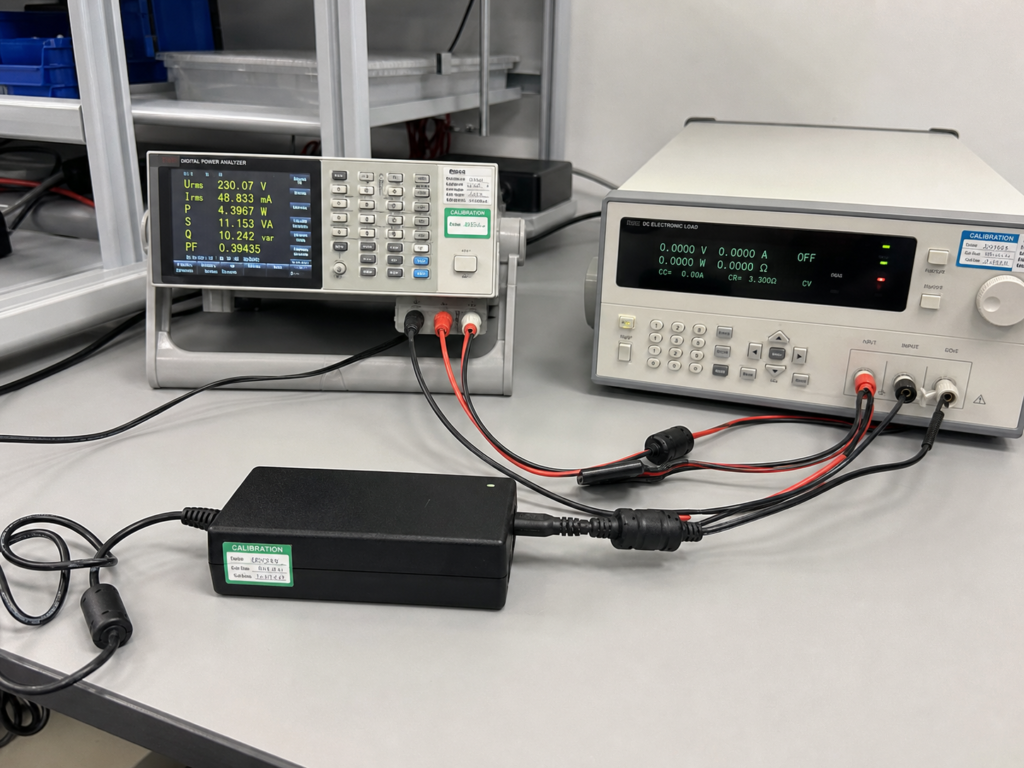
The ErP regulation does not mandate that reports must be issued by third-party testing institutions. Manufacturers can carry out compliance tests in internal laboratories with corresponding testing capabilities, or entrust third-party laboratories to conduct tests. Either way, the test must be carried out strictly in accordance with the methods specified in the appendix of Regulation 2019/1782, with complete original data, equipment calibration records and traceability, and finally included in the technical documents.
For entry-level sellers and cross-border sales scenarios, in practice, priority should be given to entrusting professional testing institutions that are familiar with the test methods of EN 50563/A1 and the appendix of 2019/1782, and have a complete calibration system and original data traceability capabilities to issue reports, so as to reduce the risk of test non-compliance.
The test data or report must cover all output types, power levels and statutory test configurations of the product in accordance with the aforementioned port, voltage, and load combination coverage rules for multi-output/fast charging products. Missing test results are invalid.
Method 3: Check EU Declaration of Conformity and Technical Documents (Legal Basis)
From a legal perspective, the core legal documents for compliance are the EU Declaration of Conformity (EU DoC for short) and supporting technical documents.
The EU DoC is signed by the manufacturer, explicitly declaring that the product complies with all applicable EU regulations. For ErP requirements, it must include the Ecodesign Framework Directive 2009/125/EC and the special regulation for external power supplies (EU) 2019/1782; in addition, external power supplies usually need to comply with the LVD Low Voltage Directive, EMC Electromagnetic Compatibility Directive, RoHS Restriction of Hazardous Substances Directive, etc. The specific applicability must be confirmed item by item according to the product’s functions and parameters. Listing only the ErP regulation cannot be regarded as completing the CE compliance declaration.
Technical documents are the full set of materials supporting the declaration, including test reports, design calculation materials, product descriptions, etc., which are prepared and kept by the manufacturer. If the manufacturer has designated an EU authorized representative, the authorized representative shall assume obligations such as keeping documents and cooperating with regulatory verification within the scope agreed in the entrustment agreement, and shall not automatically assume all responsibilities of the manufacturer.
Importers must verify whether the compliance documents of imported products are complete and ensure that they can be provided to market supervision authorities; distributors must check whether product labels are compliant, must not sell products that are obviously non-compliant, and cooperate in providing relevant materials as required by supervision.
Non-professional Reference Tips (Only for Quality Reference, Not as Compliance Basis)
Two quality risk tips that ordinary people can refer to, but it must be clear: these two can only be used to roughly judge quality risks, and absolutely cannot be used as a basis for judging whether ErP meets the standards.
First, obvious heating when plugged in under no-load only indicates possible design or quality problems, and cannot directly indicate that ErP is not up to standard, because there is no absolute correspondence between heating and energy efficiency;
Second, products with significantly lighter weight in the same power segment may have the risk of simplified materials, but non-compliance cannot be judged solely by weight. In the end, test reports and compliance documents shall prevail.
Analysis of Common Misconceptions
In the process of judging compliance, many people are prone to fall into cognitive pitfalls. The following are the most common types of misconceptions:
Misconceptions about Regulation Boundaries
- Having a CE mark ≠ necessarily complying with ErP, and CE ≠ third-party certification: CE is a manufacturer’s self-declaration mark, which does not require mandatory certification by a third-party institution, but must be supported by complete technical documents; some merchants may only have made declarations for other regulations such as safety (LVD), which do not cover ErP. Therefore, ErP compliance cannot be judged just by looking at the CE mark. It is necessary to check whether the list of regulations in the EU DoC includes 2009/125/EC and 2019/1782.
- ErP ≠ safety certification: ErP only assesses energy consumption and ecology-related indicators, and does not involve safety performance at all. Safety is under the jurisdiction of the LVD Directive. The two are independent and cannot replace each other.
- Safety/LVD report ≠ ErP report: LVD reports focus on safety risks such as electric shock, fire prevention, and insulation, while ErP reports focus on no-load power consumption, average active efficiency and multi-load point testing. The test items and conclusions of the two are completely independent and cannot replace each other.
- ErP ≠ RoHS/EMC: RoHS governs the restriction of hazardous substances in products, and EMC governs electromagnetic interference. All three are CE access requirements, but they are independent of each other and cannot replace each other.
- US DOE energy efficiency ≠ EU ErP: The test methods and limit requirements of the two countries are different, and US energy efficiency certification cannot be used as a compliance certificate for EU ErP.
- Compliance of external power supply ≠ compliance of the supporting complete machine: For example, if the power supply of a router complies with ErP, it does not mean that the router itself is compliant. The complete machine also has its own ErP requirements such as standby and shutdown energy consumption, which need to be evaluated separately.
Misconceptions about Indicator Concepts
- Rated output power ≠ actual power consumption: Rated power is the maximum output capacity of the power supply, not the power consumption during actual use. Actual power consumption is determined by the current load;
- No-load power consumption of external power supply ≠ standby power consumption of the complete machine: The former is the power consumption of the power supply itself when there is no load, and the latter is the overall power consumption of the complete machine when it is on standby. The two are not the same thing;
- Nominal full-load efficiency ≠ average active efficiency: ErP assesses the average value of multiple common load points. Meeting the standard at a single full-load point does not mean overall compliance;
- Qualified single-port/single-voltage test ≠ compliance of multi-output products: Multi-port and multi-voltage products need to cover all nominal output configurations required by the regulation, and missing tests are invalid.
Misconceptions about Compliance Operations
- Old version/other national standard reports cannot replace the special test of 2019/1782: The old version of Regulation 278/2009 has been repealed, and the test methods and limits of energy efficiency standards in other countries are different, so they cannot be used as a basis for compliance;
- Using test reports/compliance documents of other models is a violation: Each model of product needs to have corresponding compliance documents, and misappropriation may face regulatory penalties;
- CE marks with falsely marked parameters and no technical document support are false declarations: CE marks cannot be affixed arbitrarily, and must be supported by complete technical documents and DoC.
Practical Guide: ErP Application Methods for Different Groups
Ordinary Consumers: How to Choose External Power Supplies in the EU
If you are an ordinary consumer living in the EU, you don’t need to memorize regulations when choosing an external power supply. Just remember a few simple principles:
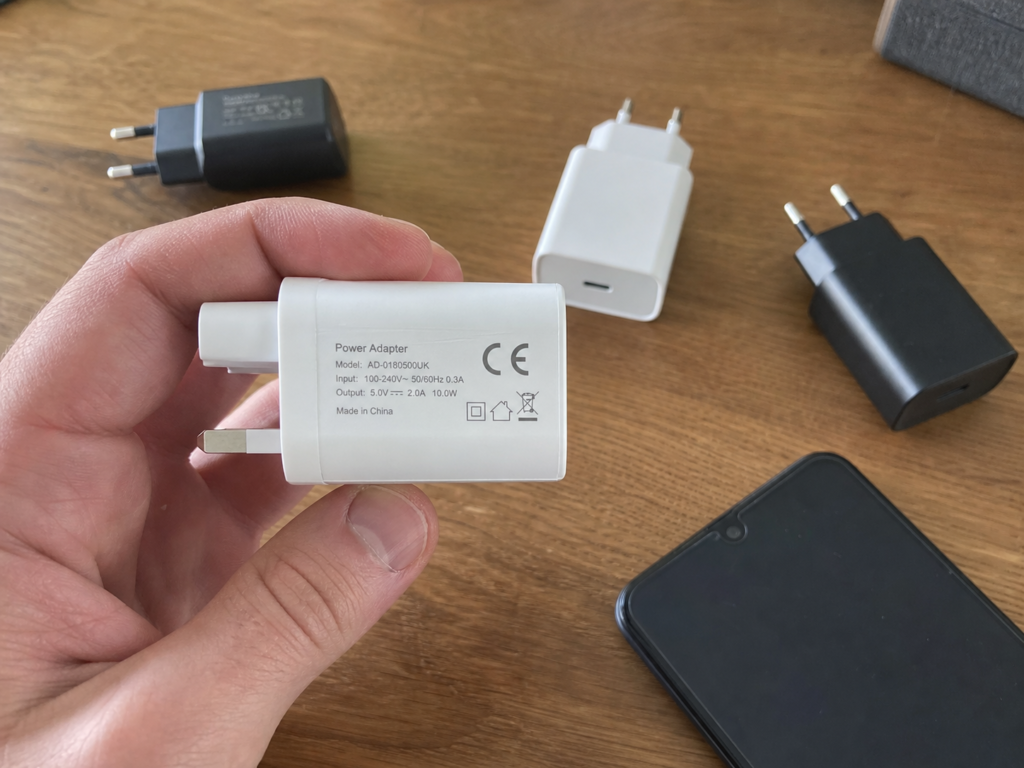
Give priority to branded products with complete parameter markings and formal CE marks. Those unbranded products whose manufacturers and rated parameters are not clearly printed are high-risk products whose compliance cannot be confirmed through existing markings. Not only is their ErP compliance questionable, but they may also have safety hazards. It is best not to touch them.
If the product actively discloses parameters such as no-load power consumption and average active efficiency, it can be used as a reference for energy saving performance, but these parameters cannot replace compliance document verification.
There is no need to blindly pursue high power. For example, if your phone only supports 20W fast charging, there is no need to spend a lot of money on a 100W multi-port charger. It is not only a waste of money, but also the efficiency in daily use may not be higher than that of a suitable power. Just match your device needs.
If you are purchasing from non-EU cross-border e-commerce platforms, it is recommended to confirm in advance whether the product is marked with EU ErP regulation compliance and CE compliance information. Some non-EU versions are not designed or tested in accordance with (EU) 2019/1782, and may have risks of non-compliance or limited after-sales service.
Ordinary consumers cannot 100% confirm ErP compliance solely by the CE mark, appearance or promotional parameters. If verification is needed, they can request the EU Declaration of Conformity and related product information from the seller or manufacturer.
Entry-level Cross-border Sellers/Small Merchants: Full Compliance Process for Export to the EU
If you are a new cross-border small merchant who wants to sell external power supplies to the EU, the compliance process can be advanced in order:
Step 1: Scope determination. Check against the applicable requirements and exemption list to confirm whether the product is within the ErP control scope, so as to avoid wasting test fees.
Step 2: Clarify requirements. Confirm the regulation category, rated power and output configuration of the product, such as whether it is single-voltage AC-DC or multi-voltage fast charging, and find the corresponding limit requirements and test rules in the regulation.
Step 3: Conduct testing. It can be tested by an internal laboratory with testing capabilities, or entrusted to a third-party institution; for entry-level sellers, in practice, priority is given to professional testing institutions that are familiar with the appendix methods of 2019/1782 and the EN 50563/A1 standard, and have calibration and data traceability capabilities. The test must cover all output ports, voltage levels and statutory load conditions in accordance with the aforementioned coverage rules for multi-output/fast charging products, and obtain complete and qualified test data.
Step 4: Prepare documents. Prepare a full set of technical documents, including test reports, design descriptions, product parameters, etc., and sign the EU Declaration of Conformity (DoC), clearly listing all EU regulation numbers applicable to the product.
Step 5: Label standardization. Affix the CE mark in accordance with the specifications, ensure that the input, output and other parameter markings on the product body or nameplate are clear and complete, and importers must also affix their own information as required.
Step 6: Keep materials. Keep all compliance documents properly. EU market supervision will conduct random spot checks. Both importers and sellers must be able to cooperate with regulatory requirements to provide relevant documents.
Division of Compliance Responsibilities for Different Entities
Different roles have different focuses on compliance responsibilities, which need to be confirmed according to their actual identity in the supply chain:
- Manufacturer: Responsible for product design, conformity assessment, preparation of technical documents and EU DoC, and bears primary responsibility for product compliance;
- EU authorized representative: Designated by the manufacturer, undertakes obligations such as compliance docking, document retention, and cooperation with supervision within the EU in accordance with the entrustment agreement, and the scope of responsibility is subject to the entrustment agreement;
- Importer: The entity that introduces products into the EU market, needs to verify the integrity of product compliance documents, affix importer information on the products, and cooperate with regulatory verification;
- Distributor: The entity engaged in product sales, needs to ensure that the labels of the products sold are compliant, does not sell obviously non-compliant products, and reports problems in a timely manner;
- Cross-border sellers/online platforms: Cross-border sellers are not independent legal liability subjects, and their responsibilities depend on their actual identity. If they are private brand manufacturers, they bear manufacturer responsibilities; if they are importers, they bear importer responsibilities; if they are distributors, they bear distributor responsibilities. The requirement of online platforms to upload compliance documents is the platform’s own rule, which is not equivalent to all statutory compliance obligations. Sellers still need to perform corresponding responsibilities according to their legal identity.
General Compliance Pitfall Avoidance Reminders
The following are pitfalls that all market entities must avoid:
Do not use old version reports, standard reports from other countries, or complete machine test reports to pass off as ErP compliance certificates, as problems are easily discovered during regulatory verification.
Do not falsely mark parameters such as efficiency and no-load power consumption, nor use compliance documents of other models. EU market supervision will conduct random spot checks. If non-compliance is found, it may face consequences such as product removal, administrative penalties or recalls, depending on the violation facts and the law enforcement rules of member states.
Summary
In general, the EU ErP compliance judgment for external power supplies can be advanced in three steps:
Step 1: Determine scope and exemptions: Check against the 6 statutory applicable requirements and exemption list to confirm whether the product is within the control scope of 2019/1782. Conclusions cannot be drawn solely based on the product name, nor should 0.3W be mistakenly regarded as the lower limit of applicable power;
Step 2: Clarify categories and limits: According to the product’s output type, voltage configuration, and rated power, confirm the requirements against the official limits and test methods in the appendix of the regulation. Typical reference values can only be used for preliminary screening;
Step 3: Verify compliance evidence: Confirm compliance through the EU Declaration of Conformity, technical documents and corresponding test reports. Compliance cannot be judged solely by the CE mark or promotional parameters.
For ordinary consumers, when purchasing, they can give priority to branded products with clear parameter markings and formal CE marks, and avoid unmarked high-risk products; for entry-level cross-border sellers, advancing according to the process of scope determination, testing, document preparation, and data retention, and clarifying their own legal responsibilities, can basically meet the compliance requirements.