
Anyone selling products in the EU market—whether cross-border e-commerce sellers, brand owners, or importers—has most likely heard the term “ErP testing”. Some say all electrical products require it, some say it only tests power consumption, and others claim full compliance with just a single report. What exactly is ErP testing? Does your product need it? How do you verify the authenticity of a report? This article starts with basic concepts; you don’t need to memorize complex standard numbers to understand the core rules of EU ErP testing, meeting the needs of beginner use and basic compliance judgment.
Beginner Basics: What Is ErP Testing, and Does It Apply to You
Many people new to this topic mistake ErP testing for “energy consumption testing”, but its scope is much broader. You can think of ErP testing as the “unified exam rules” set by the EU for Energy-related Products (abbreviated as ErP): it’s not just a matter of finding any lab to run tests, but using a unified method recognized across the EU to verify whether products meet the mandatory requirements of ecodesign.
From a legal perspective, passing testing using harmonized standards cited in the Official Journal of the European Union (OJ) and within their applicable date gives rise to a presumption of conformity within the scope of the measurements or specific technical requirements covered by that standard. However, this is not equivalent to meeting all requirements of the entire ErP Directive; you still need to verify other obligations such as limits in implementing regulations, information disclosure, technical documentation, and Declaration of Conformity (DoC). Special note: A test report is only one piece of compliance evidence, not a “certificate of conformity”, and cannot be used directly as proof of CE marking.
Many people are confused about what EU regulations and standards each govern; a school exam analogy makes it clear: EU framework directives and implementing regulations are equivalent to the “exam syllabus”, stipulating “what requirements must be met”—for example, what the energy consumption limit is, which materials are prohibited, and what information must be marked on packaging. These are mandatory legal requirements. Test standards, on the other hand, are equivalent to “exam rules”, stipulating “how to test, under what conditions to test, and how to calculate results”—for example, what ambient temperature to set for testing refrigerator energy consumption, how long to test continuously, and how to convert annual energy consumption. These are unified measurement methods.
The entire compliance evidence chain is: first there are regulatory requirements, then testing is carried out according to the corresponding standards. After obtaining the test report, the legally responsible entity issues a Declaration of Conformity (DoC), and only then is the ErP compliance process completed. A core principle to remember here: regulatory requirements take priority. You can’t just focus on test methods and forget the conformity limits in regulations, otherwise after testing for a long time, the product may not even meet the threshold.
The definition of the responsible entity needs to be judged in combination with the actual role: generally speaking, the party that places a product on the EU market under its own name or trademark, or carries out substantial modification of the product, is the manufacturer bearing primary conformity assessment responsibility. Regardless of whether it is located within the EU, it is responsible for establishing technical documentation and issuing the DoC. Importers must verify product compliance and retain relevant documents. Authorized representatives and distributors only bear the cooperation or verification obligations explicitly stipulated in corresponding regulations; not all roles have the right to sign the DoC, and the specific boundaries of responsibilities shall be subject to the provisions of applicable regulations.
This is the question that beginner users care about most: “Does my product need ErP testing?” You don’t need to memorize complex lists; you can make a rough judgment in 3 steps:
Step 1: First confirm whether it is an energy-related product. Either the product itself directly consumes energy such as electricity, gas, or oil—like light bulbs, refrigerators, water heaters; or the product affects the energy consumption of other products—like heating thermostatic valves and water heater mixing valves, which do not consume electricity themselves but change energy use efficiency, also count as energy-related products.
Step 2: Check whether there is a corresponding EU product implementing regulation. Not all energy-related products require ErP testing; only categories for which the EU has explicitly issued special implementing regulations are mandatory. For example, the categories currently regulated by the EU include lighting, large household appliances, IT and display equipment, external power supplies, motors and fans, etc. Products not on the regulated list do not need testing even if they are electrical.
Step 3: Verify the exclusion clauses and applicable conditions of the corresponding implementing regulations. Military/aeronautical and maritime special equipment, customized medical special equipment, second-hand products, and R&D prototypes are only typical scenarios that may involve exclusion in some regulations, not a universal exemption list for all categories. Specific applicability must be subject to the original provisions of the corresponding implementing regulations. For example, “customized medical special use” refers to special equipment customized specifically for medical institutions, not all household products with health functions. Components that are only internal parts of equipment and not placed separately for end consumers also need to be judged for applicability in combination with regulatory definitions. If you are unsure, be sure to check the original text of the specific regulation.
People new to compliance often confuse ErP with CE and RoHS, but the positioning of the three is completely different:
First, the difference from CE marking. CE is not a separate “certification”, but the overall marking for multiple EU mandatory regulations—for example, selling a refrigerator requires meeting multiple requirements such as the Low Voltage Directive, RoHS Directive, and ErP Directive at the same time, and only after all are met can the CE mark be affixed. ErP is just one of the many regulations covered by CE, requiring a separate test report as compliance evidence. You can’t say “I have a CE certificate so I don’t need ErP testing”.
Next, the difference from RoHS. RoHS has a very single regulatory scope, only restricting hazardous chemical substances in products, such as lead, mercury, and cadmium. ErP, on the other hand, covers ecological requirements for the entire product life cycle, from energy consumption and standby power consumption to performance retention, recyclability, and even requirements for the ecological impact of firmware updates, with a much broader scope.
Core Test Content: What Is Tested, and How Do Key Points Differ by Category
Ecodesign requirements for ErP can generally be understood from 5 dimensions. Whether they apply specifically and what the test requirements are depend on the implementing regulations for the corresponding category; not all products need to test all items:
The first is energy efficiency, which simply means “how much utility can be produced per unit of energy consumption”—for example, the luminous efficacy of a light bulb is how many lumens of light are emitted per watt of electricity, and the higher the value, the more power is saved. The energy efficiency of a washing machine is the power consumption per unit weight of laundry washed, and the lower the value, the more energy-efficient it is. Energy efficiency indicators vary by category, but the core is to measure whether energy is used efficiently enough, and it is the core test item for most electrical ErP products.
The second is standby/off power consumption, which is the “invisible power consumption” when the product is plugged in but not working. Many products now have networking functions, such as TVs connected to Wi-Fi waiting to be woken up, and smart speakers on standby; the power consumption of this networked standby is also within the test scope. Don’t underestimate this fraction of a watt of power consumption; the total electricity wasted by products across the EU every year is very considerable, so this is also a key focus of EU regulation. Specific limits and mode requirements are stipulated by category regulations.
The third is performance retention, which is designed to prevent manufacturers from sacrificing product user experience to save power. For example, you can’t make a light bulb extremely dim to meet its energy efficiency standard, and you can’t make a washing machine use less water but not clean clothes properly. Therefore, ErP testing must measure both energy consumption and whether the product’s basic performance meets requirements, to avoid the situation of “energy-saving but not useful”. It is only included in the assessment when required by corresponding regulations.
The fourth is resource efficiency, which is a requirement stipulated only in the implementing regulations of some categories. It mainly focuses on resource utilization throughout the product life cycle, such as the proportion of recyclable materials, ease of disassembly, and spare parts supply period, etc. Specific requirements vary by category. Some regulations also impose constraints on software updates: Firmware updates must not cause products to no longer meet specified energy efficiency or performance requirements. In addition, core data such as energy consumption, efficiency, and performance on energy labels usually come from energy efficiency and performance test results required by corresponding regulations; resource efficiency requirements are more used for ecodesign compliance judgments such as maintenance, spare parts supply, ease of disassembly, and material composition. Whether they will be included in the public information on energy labels depends on the regulatory requirements of the specific category.
The fifth is information marking, which verifies whether the energy efficiency parameters marked on product packaging, manuals, and nameplates are consistent with the test results, to prevent false parameter marking from misleading consumers. Specific marking requirements shall be implemented in accordance with corresponding regulations.
When you get an ErP report or energy label, you only need to focus on several common types of indicators; specific definitions need to be confirmed in combination with the corresponding category regulations:
First is energy efficiency class: Some product groups have gradually adopted recalibrated A-G grading (A is most energy-efficient, G is least energy-efficient) since 2021. Whether a specific product category applies this and when the new grading takes effect shall be subject to the energy label regulation corresponding to that category. Energy efficiency classes can only be compared within the same category; for example, a Class A refrigerator and a Class A TV are not comparable, because the benchmarks for different categories are completely different.
Next is standby/networked standby power consumption, in watts (W). The lower the value, the more power the product saves when plugged in and not in use. Limit requirements vary for different products, different operating modes, and different regulation versions. When reading a report, focus on whether the measured value is lower than the limit for the corresponding category and mode.
Then there is annual energy consumption. This value is estimated according to the “typical use pattern” stipulated by the EU—for example, calculated based on how many times a refrigerator door is opened and closed per day, and how many hours a TV is watched per day. It is not the actual electricity bill of a user’s household, but only a reference for comparison within the same category.
There are also energy efficiency-related indices: Regulations for different categories may use different indicators such as EEI (Energy Efficiency Index), coefficient of performance, and energy efficiency ratio. Definitions and judgment criteria shall be subject to the corresponding implementing regulations; just compare with regulatory requirements when checking the report.
For products of different categories, the focus of testing varies greatly. The core test focuses of common categories can be referred to in the table below. The table only lists common concerns and does not represent all mandatory test items for that category; whether items such as lifespan, flicker, color rendering, and on-state efficiency are tested and how they are judged must be verified item by item against implementing regulations, energy label regulations, and measurement methods. Among them, external power supplies/chargers only apply to products included in the scope of the ErP external power supply implementing regulation; not all charging devices need to be tested according to these rules.
| Product Category | Core Test Focuses |
|---|---|
| Lighting products | Luminous efficacy, lifespan, standby power consumption, color rendering, flicker |
| Large household appliances | Operating energy consumption, water consumption, durability, cleaning/cooling/heating performance |
| IT/Display products | Standby/sleep/networked standby power consumption, on-state energy efficiency ratio, brightness setting |
| External power supplies/chargers | No-load power consumption, average operating efficiency |
| Motors/pumps/fans | Rated load efficiency, partial load efficiency |
Coordination Logic of Standards and Regulations: No Need to Memorize Numbers, Know How to Find Valid Versions
Many people get a headache when they hear EN standard numbers, but actually there’s no need to memorize them at all. You just need to understand the division of labor between regulations and standards, and the method for judging valid versions. First, it must be clear: All mandatory ErP requirements (including energy consumption limits, prohibition requirements, information disclosure rules, and scope of application) are stipulated in EU framework directives and category-specific implementing regulations; the core function of test standards is to stipulate unified measurement and calculation methods to ensure that results from different products are comparable.
Many people think ErP standards have a two-tier structure of “general basic standards + category-specific special standards”, but this is not actually the case—the EU does not have a set of general test standards covering all products. The correct application logic can be divided into two tiers, with priority from high to low:
The first tier is the mandatory rules in the implementing regulations for each category, including scope of application, limit requirements, and designated measurement methods. This is the highest-priority basis, and all tests must first meet the explicit requirements of the regulations.
The second tier is harmonized standards cited in the Official Journal of the European Union (OJ): If an EN standard is cited by the OJ for a specific version and specific scope of application, it is a harmonized standard. Completing testing using a harmonized standard within its applicable date gives a direct presumption of conformity with the corresponding regulatory requirements within the scope of the measurement or technical requirements it covers, without additional proof.
If there is no applicable harmonized standard, other measurement methods stipulated in the implementing regulations may be used, while complete technical demonstration documents shall be retained as compliance evidence.
Special note: Rules for specific categories always take priority; you cannot use so-called “general standards” to supplement test items not explicitly stipulated in regulations.
There are two common pitfalls to note here: First, not all EN standards are harmonized standards, and the latest version published by the publisher is not necessarily valid—technical updates of standards are actions of the publisher. Only versions officially cited by the OJ and within the applicable date range can enjoy the conformity presumption effect of harmonized standards. Standards not cited by the OJ can be used as technical documentation or test basis on the premise of meeting regulatory requirements, but cannot automatically presume compliance. Second, there are no general test rules applicable to all ErP products; all test conditions and methods shall be subject to the implementing regulations and designated measurement methods of the corresponding category.
How do you confirm that the standard you are using is valid before sending for testing? Remember 3 key verification points:
First, verify the citation source and scope of application. The standard version and applicable product scope cited in the implementing regulations in the OJ announcement shall prevail; do not judge validity solely by the publication year on the standard cover. For example, a standard was published by the European Committee for Standardization in 2020, but the EU only included its specific version in the OJ citation list in 2023. Then the effective date of this version as a harmonized standard shall be subject to the date of the OJ announcement, not the standard publication date. At the same time, note that the OJ may impose restrictions on the scope of application and exemptions of the standard, which need to be checked together.
Second, verify key dates. Check the citation effective date, replacement date, revocation date of the standard in the OJ announcement, as well as the transition provisions of the corresponding implementing regulations—transition arrangements for different standards vary greatly, there is no unified transition period, and they need to be verified one by one.
Third, verify the applicable time point. Standard updates will not directly invalidate the test reports of all products already placed on the market. However, whether subsequently newly placed products and products sold from inventory still comply with currently valid regulations needs to be comprehensively judged in combination with the limit changes of new regulations, the replacement date of harmonized standards, and transition arrangements. If the product itself undergoes revision, replacement of key components, or firmware update, regardless of whether the standard changes, compliance must be re-evaluated, and re-tested if necessary.
You don’t have to memorize standard numbers by rote; you can query the most authoritative valid information through the following path:
- First, through the official EU ErP column, find the corresponding implementing regulations by product category, and confirm the scope of application, limits, and measurement method requirements;
- Then query the harmonized standard list in the EU OJ to verify the valid standard version, applicable date, and restriction conditions for the corresponding category;
- At the same time, pay attention to the transition provisions in the implementing regulations to confirm the switching time between old and new rules.
Full Testing Process: Key Nodes from Sample Submission to Report Issuance
Many people don’t know what to prepare or what the process is when sending samples for testing for the first time. In fact, the whole process is not complicated, with only a few key nodes.
First is pre-test preparation, which includes two parts: samples and documentation. In terms of samples, they must be the final mass-produced version, not hand-made prototypes, otherwise the test results will be different from mass-produced goods, which means the test is wasted. For conventional categories, you can first prepare 2-5 units, but this is only a common preliminary reference, not a unified legal quantity. The final sample quantity, repeated measurement requirements, whether additional durability/lifespan test samples are needed, and sampling methods shall all be subject to the corresponding implementing regulations, applicable measurement methods, and the laboratory’s formal test plan, which must be clearly confirmed with the laboratory before sample submission.
For series products, testing one model does not mean it can be used for the entire series—only on the premise that corresponding regulations and measurement methods allow series coverage, and the differences between different models do not affect energy efficiency or ecologically related test results, can representative models be selected for testing. At the same time, complete equivalence demonstration documents must be provided, clearly listing the differences of all covered models (such as appearance color, printed logo, packaging differences, etc.). Usually, power, internal structure, key materials, power supply solutions, and control software are the core factors for evaluating whether differences affect results, but specific judgment still needs to be subject to the regulatory requirements of the corresponding category. You cannot assume that reports can be shared just because the appearance is similar.
In terms of documentation, you need to provide the laboratory with product manuals, design parameter tables, key component lists (such as model parameters of power chips and LED beads), and default setting descriptions—for example, the default brightness of a TV and the default program of a washing machine, because default settings will directly affect the results of energy consumption tests.
You may be curious why ErP testing stipulates unified environmental and operating conditions. Because environmental parameters, power supply conditions, and preprocessing methods will directly affect the product’s energy consumption test results—for example, the higher the ambient temperature, the higher the operating frequency of the refrigerator compressor, and the higher the energy consumption. Different power supply voltages will also cause differences in the brightness and power consumption of light bulbs. If conditions are not unified, test results from different laboratories and different products will not be comparable, and it will be impossible to fairly judge whether they meet the limits.
Common test conditions for some ordinary electrical products may be close to 20-25°C, about 50% humidity, and 230V/50Hz, but these values do not apply to all categories. Actual testing must be carried out strictly in accordance with the voltage, temperature, load, preprocessing, and stabilization time required by the corresponding implementing regulations or applicable measurement methods. Test equipment must be calibrated as required, and samples must complete the specified preprocessing or warm-up process to ensure stable test conditions.
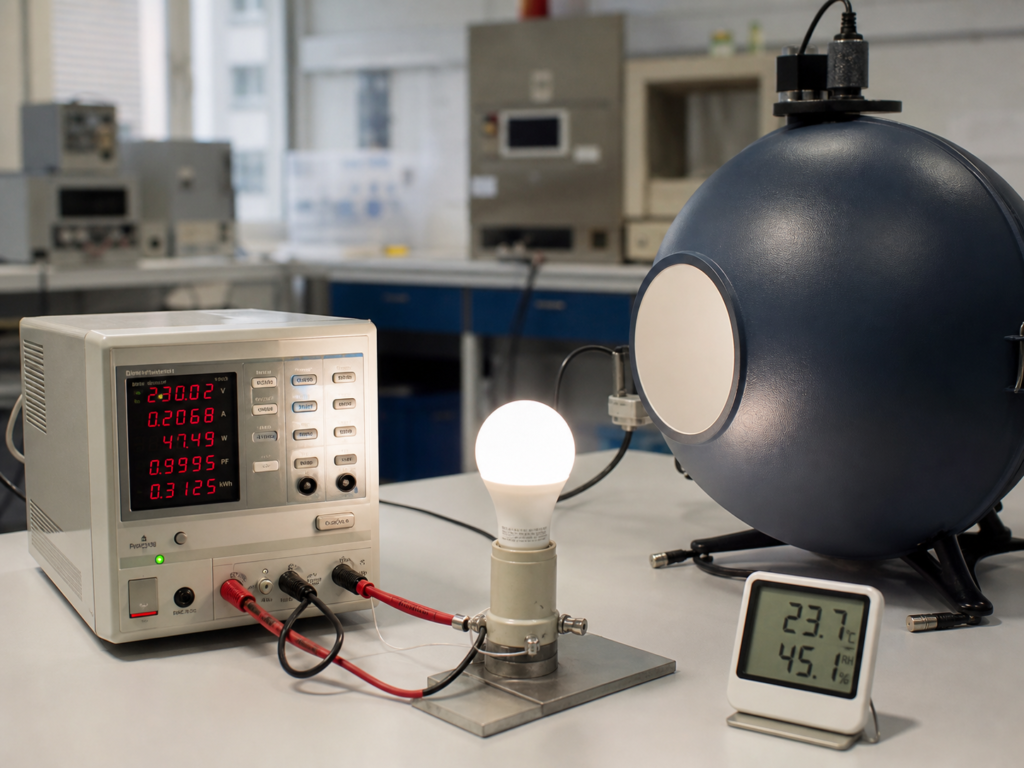
Formal ErP testing generally follows 5 core steps:
Step 1: Sample and documentation review. After receiving the samples and documentation, the laboratory first confirms which category the product belongs to, which implementing regulation it corresponds to, and which items need to be tested, to avoid testing the wrong category or missing test items.
Step 2: Equipment calibration and environment setup. Before formal testing, the laboratory will first calibrate all test equipment and adjust the ambient temperature, humidity, and voltage to the state required by the standard to ensure test conditions meet regulations.
Step 3: Full-item testing. In accordance with the requirements of applicable measurement methods, complete all specified test items, including all modes such as on-state operation, standby, off, and networked standby, without missing any items.
Step 4: Data calculation. The raw data obtained from testing cannot be used directly; the final indicators, such as annual energy consumption and energy efficiency-related indices, must be calculated according to the formulas and conversion methods stipulated in standards or regulations.
Step 5: Issuance of test report. The laboratory issues a formal report including test methods, raw/processed data, and calculation process. If the entrusted scope includes conformity assessment, the laboratory can give result judgments for corresponding test items against specified limits. However, note: The test report is only responsible for the test results of the submitted samples, and the overall ErP compliance responsibility for the product still rests with the legally responsible entity such as the manufacturer.
The testing cycle depends on the complexity of the product. For ordinary small household appliances and lighting products, the conventional reference cycle is 1-2 weeks; for complex large household appliances and industrial products, such as refrigerators and large motors, due to long testing time, it may take 3-4 weeks. If the test fails and rectification is needed, the number of samples is insufficient, or there are too many items to test, the cycle will be extended. Therefore, be sure to leave enough time when sending samples for testing, and don’t submit them right on the launch deadline.
Report Interpretation and Validity Judgment: How to Verify Authenticity and Read Results
Many people get an ErP report from a supplier and don’t know if it’s real or usable. In fact, you can systematically verify it from three dimensions to quickly judge the basic validity of the report:
The first dimension is verifying the product and coverage. The model, brand, key parameters, and sample photos on the report must be completely consistent with the product you actually sell. If it is a series of models, the report must clearly list all covered models, as well as the description of differences between different models and the basis for equivalence demonstration. If the report only lists one model and you sell another, then this report is invalid for you.
The second dimension is verifying the basis and timeline. First, confirm that the regulations cited in the report correspond to your category, and the cited standard version must be in valid and applicable state when the product is planned to be placed on the EU market. Second, make a comprehensive judgment in combination with the OJ citation status of the standard, replacement/revocation date, and regulatory transition provisions. Finally, confirm that the report targets the product version at the time of testing; if the product revision occurs after the test, the original report cannot be directly applied and needs to be re-evaluated.
The third dimension is verifying content and traceability. First, check whether the test items cover all mandatory test items required by regulations; you can’t say all items are qualified after only testing one or two core items. Second, there must be complete raw test data, calculation process, and judgment results against corresponding limits, not just the word “qualified”. Also confirm that the laboratory has the testing capability for the corresponding product, standard, and test items, which can be confirmed by checking its ISO/IEC 17025 accreditation scope or other verifiable capability certification documents. Finally, there must be a unique report number, as well as the official seal of the laboratory or the signature of an authorized signatory, to ensure traceability if problems arise.
It should be noted that ErP belongs to the manufacturer’s self-conformity assessment system. Third-party test reports are only part of the compliance evidence. ISO/IEC 17025 accreditation can enhance the credibility of evidence, but cannot alone prove that the product meets regulatory requirements. Manufacturers still need to establish complete technical documentation and issue a Declaration of Conformity (DoC) as required.
There are several common situations where reports are invalid or cannot support compliance, which need to be avoided:
- The standard version used has been revoked and cannot be supported by other applicable bases stipulated in regulations; unless the regulation explicitly allows the use of this version or there are applicable transition arrangements, it cannot be used as a basis for presumption of conformity of harmonized standards.
- The product model, brand, and key parameters in the report are inconsistent with the actually sold product, or there is no clear difference description and equivalence demonstration for series models.
- The laboratory does not have the capability for the corresponding test items, or the entrusted test scope only covers part of the items, but claims full compliance.
- The report is of a preliminary or pre-assessment nature, has not completed full-item testing in accordance with formal compliance requirements, or the test process does not comply with regulatory provisions.
- The regulations on which the report is based have not yet taken effect on the product’s applicable date, or the old report is still used after the product revision without re-evaluation.
If your test result is just near the limit—for example, a specific regulation stipulates a 0.5W limit for a certain mode, and the measured value of the submitted sample is 0.49W—don’t think everything is fine just because it barely passes. Because there is measurement uncertainty in the test itself, component tolerances during mass production, and production fluctuations in factories, it is very likely that some of the batch products will exceed the limit, resulting in non-compliance.
At this time, a comprehensive judgment should be made in combination with the factory’s mass production consistency level, measurement uncertainty range, and regulatory sampling inspection judgment rules. If the factory’s quality control is average and consistency is poor, it is best to leave enough margin during design—for example, make the standby power consumption lower—so that even if there are fluctuations in mass production, it will not exceed the limit, which is more reliable.
Common Misconceptions and Basic Compliance Decisions: Know How to Avoid Pitfalls and Make Judgments
When first getting into ErP, it’s easy to fall into some cognitive pitfalls. There are 6 main types of common misconceptions that require special attention:
Misconception 1: All electrical products require ErP testing. In fact, only energy-related products on the EU’s regulated list need it; those not on the list do not need it even if they are electrical. Whether ErP is required cannot be judged only by whether it is electrical, but by whether it falls within the product scope defined by the corresponding implementing regulations. For example, some components that are only internal parts of equipment and not placed separately for end consumers may not apply, but lamps and light sources sold independently as finished products usually need to check regulatory requirements according to lighting category rules.
Misconception 2: ErP only tests operating power consumption. ErP covers multiple ecodesign dimensions such as energy efficiency, standby power consumption, performance retention, resource efficiency, and information marking, far more than just operating energy consumption. Specific test items are stipulated by category regulations.
Misconception 3: Testing one model of a series product can be used for the entire series. Only on the premise that regulations and measurement methods allow it, model differences do not affect test results, and there is a complete equivalence demonstration, can representative model testing be adopted. Products with only similar appearance but different core parameters (such as power, power supply solution, control software) cannot share reports.
Misconception 4: A passing test is valid for life. If the standard is updated, or the product is revised, key components are replaced, or firmware is updated, compliance must be re-evaluated, and re-testing is required if necessary. It is not a one-time test that lasts forever.
Misconception 5: Test data from the US DOE or Energy Star can be directly used in the EU. No, many US energy efficiency tests (such as DOE and Energy Star related projects) often use 120V/60Hz as the basic test condition, while ErP tests for most EU electrical products often use 230V/50Hz as the basis, but specific parameters must be confirmed according to corresponding regulations and test modes. The two systems have differences in test modes, calculation methods, and limit requirements, so US test data cannot be directly used for EU ErP compliance.
Misconception 6: Non-EU manufacturers don’t need to worry about ErP. As long as the product is to be placed on the EU market, different roles bear their respective compliance responsibilities: the manufacturer that places the product under its own name is the primary responsible party for conformity assessment, responsible for ensuring the product meets requirements, establishing technical documentation, and issuing the DoC. Importers must verify product compliance and retain relevant documents. Distributors must ensure that the products they sell meet requirements such as labeling; it is not only EU-local companies that need to take care. Note that distributors usually do not bear the primary responsibility for DoC signing or technical documentation establishment; do not confuse the obligations of different roles.
For beginner users new to this, you can control risks by stage without memorizing too many complex rules:
- Before sample submission: Confirm that the laboratory has testing capability for the corresponding category, standard, and items; clarify the regulation and standard versions used for testing, which must meet the valid requirements when the product is planned to be placed on the market; use final mass-produced samples, and confirm the sample quantity, preprocessing requirements, and representative model selection rules in advance.
- When receiving the report: Confirm the validity of the report against the three verification dimensions, confirm that test items cover all regulatory requirements, and product information is consistent with the actually sold version.
- When using the report: For series products, confirm that the coverage includes all sold models; for reports provided by suppliers, verify whether your own brand and model are within the coverage, and that there is complete equivalence demonstration support.
- Change review: When product design, key components, default settings, or firmware change, timely evaluate whether it affects ErP compliance; when regulations or standards are updated, verify whether it affects the compliance status of products on sale or to be sold.
If the test fails, don’t panic. First distinguish the cause and then handle it targeted. Common failing items mainly include energy efficiency not meeting standards, too high standby power consumption, insufficient proportion of recyclable materials, performance not meeting standards, and incorrect information marking.
When handling, proceed according to the following logic:
- First check for test errors: For example, whether the sample is faulty, whether the test environment meets requirements, whether there are operational errors. If it is a problem in the testing link, correct it and then reconfirm whether re-testing is needed.
- If it is a product design or performance problem: After targeted rectification, re-test the affected items; if the rectification involves core components or the overall structure, full-item re-testing may be required.
- If it is a problem with labels, manuals, or calculation documents: First evaluate whether the error affects the validity of the test results and whether it violates the information requirements of regulations—if it is only a clerical error in the document and does not affect the test conclusion, it can be corrected as required and then supplemented with verification; if the error stems from test data or product parameter deviations, it is necessary to decide on supplementary testing or re-evaluation based on the actual situation.
The specific remedial method needs to be determined in combination with regulatory requirements and the severity of the problem; there is no unified rule of “only re-testing a certain item”.
There are several scenarios with particularly high compliance risks that require special attention: The first is multi-model shared reports with insufficient difference descriptions and no equivalence demonstration. When EU regulatory authorities inspect, you can’t clearly explain which models can use the report and which can’t, and it’s easy to be judged as non-compliant. The second is that test results are close to the limit, but the factory’s mass production consistency is not guaranteed, making it easy for batch products to exceed the limit. The third is that after product firmware updates, power consumption or operating modes change—for example, after a new firmware update, standby power consumption increases, but no re-testing is done, which is also non-compliant. The fourth is that when selling via e-commerce, the product information listed is inconsistent with that in the report—for example, wrong model number or false parameter marking. EU e-commerce platforms are now conducting stricter inspections; once caught in a random check, the lightest consequence is product removal, and the heaviest is fines.
Learning Summary
After reading this article, you should have mastered the basic knowledge and basic judgment ability of ErP test standards, specifically being able to:
- Quickly judge whether a certain type of product requires ErP testing through the 3-step method
- Clearly explain the common ecodesign requirement dimensions of ErP and the differences in test focuses between different categories
- Judge the basic validity and core parameters of ErP test reports through three-dimensional verification
- Avoid 6 types of high-frequency cognitive misconceptions and make basic compliance decisions
- Identify common invalid report situations and high-risk compliance scenarios
- Know the query path for standards and regulations, without having to memorize standard numbers by rote
Of course, ErP regulations and standards are constantly being updated. If you encounter situations with vague product boundaries or uncertainty about regulatory updates, don’t guess on your own. It’s best to confirm with a professional third-party laboratory or regulatory consultant to avoid unnecessary pitfalls.