
Importers and e-commerce sellers doing business in the EU have most likely heard of the term EPR, but many people are confused when they first encounter it: Is this a new certification? Or another tax to pay? I’m just an importer, not a manufacturing factory, why am I responsible?
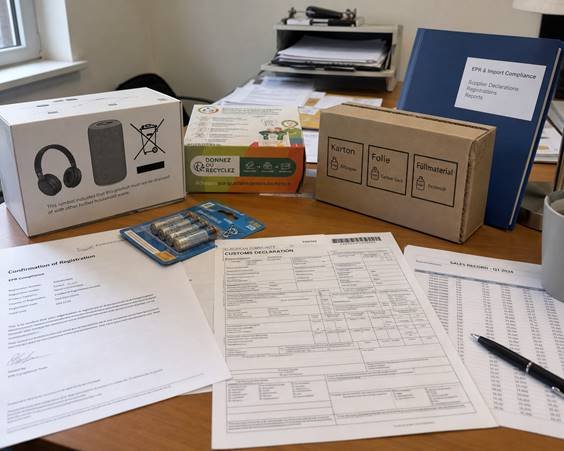
The core logic of EPR is not complicated, but it is not a single unified EU system — different categories such as packaging, WEEE, and batteries are respectively subject to EU framework rules and member state implementation regulations, with large differences in requirements between countries. Coupled with numerous terms, it is easy to cause confusion. This article breaks down EPR responsibilities from the perspective of importers: from basic definitions and identity determination to compliance obligations and risk avoidance, to help you build a clear judgment framework. Note: All specific rules are subject to the latest requirements of the competent authorities and official registration systems of the target member states. This article is an introductory reference and does not constitute legal advice.
1. Basic Introduction: Core Logic and Basic Concepts of EPR
The full name of EPR is “Extended Producer Responsibility”. You don’t have to memorize the term by force; the core logic can be simply understood first as: Whoever first places a product on the EU market for commercial purposes is usually responsible for the recycling and treatment costs of the product after it is discarded. However, it should be specially noted that this is only general logic. Specifically, who is the responsible entity and what obligations they must bear must be judged one by one according to the target member state, product category, and sales model. There is no EU-wide unified conclusion.
The original intention of this rule is to transfer waste disposal costs from taxpayers to market placing parties, forcing enterprises to reduce the use of hard-to-recycle materials, promote resource recycling, and reduce waste generation from the source. Let’s clarify a basic understanding first: EPR is neither a product quality certification (such as CE) nor a tax requirement (such as VAT). It is an environmental protection recycling responsibility for the product waste stage, and is independent of other compliance requirements.
EPR rules are divided into two levels:
At the EU level, framework rules are issued. Among them, “directives” need to be transposed into national laws by each member state before implementation, while “regulations” are directly effective across the EU — for example, the Battery Regulation (Regulation (EU) 2023/1542) is a unified regulation that is directly applicable, and the upcoming Packaging and Packaging Waste Regulation (PPWR) will also unify some core rules in the future. But even with a unified framework, member states can formulate stricter implementation rules. Therefore, EPR has no EU-wide universal registration number and no unified fee standard. You just need to remember the core compliance principle: Confirm requirements one by one according to “target country of placement + product category”.
Many people will ask: I’m just an importer, I didn’t produce the product, why should I bear EPR responsibility? This is determined by the EU’s regulatory logic: overseas producers are not within the EU’s judicial jurisdiction, making it difficult for regulators to trace directly, while importers are often the first traceable market placing entity after goods enter the EU. Therefore, in many scenarios, importers who first place overseas products on the market of a member state will be included in the “producer” responsibility scope under the EPR framework — note that the “producer” here does not refer to the factory that produces the product, but is a concept of responsible entity under EPR law. Its specific definition varies by category and member state rules, and not all importers are necessarily responsible entities.
Before continuing, let’s clarify several frequently occurring concepts to avoid confusion later:
• Producer Responsibility Organization (PRO): You can understand it as a “recycling performance agency” recognized by the member state or the corresponding competent system. Every EU country has PROs for corresponding categories. For small and medium-sized enterprises, there is usually no need to build a recycling system on their own. After joining the corresponding PRO and paying fees, the PRO will provide performance support such as recycling system organization, fee collection, and partial declaration assistance; however, the registration obligation, the authenticity of the declared data, and the final legal responsibility are still borne by the statutory producer/importer. Whether the PRO declares on behalf of the enterprise depends on the rules of the corresponding country and category.
• EU Authorized Representative (EU AR): This is an entity in the field of product safety compliance, whose core responsibility is to help overseas merchants connect with EU product safety supervision (such as CE-related compliance docking). It does not default to bearing EPR responsibilities, and not all EPR categories require the appointment of an EU authorized representative.
• EPR Producer Designated Representative / Authorized Representative: This is an EU-based entity required by some EPR systems (such as the EU’s new Battery Regulation, and some countries’ packaging laws) for non-EU producers to appoint, responsible for EPR compliance docking of corresponding categories. Its scope of application and responsibilities are independent of the EU authorized representative in the field of product safety.
• Placing on the market / making available on the market: It does not mean that goods entering the EU count; it refers to products entering the EU for commercial purposes such as sale, rental, or free provision; personal use, temporary entry and final removal from the EU do not count — this is the core prerequisite for triggering EPR responsibilities.
• Eco-contribution fee: The recycling and treatment fee paid by enterprises based on the quantity and weight of placed products/packaging. There is no EU-wide unified standard, and the rates may vary by country, category, and material.
Finally, let’s make a clear distinction between EPR and other compliance requirements that people often hear about to avoid confusion:
• Difference from VAT: VAT is value-added tax, which is a tax obligation; EPR is an environmental protection recycling obligation. The two are completely independent. Having a VAT number does not mean EPR compliance, and vice versa.
• Difference from CE certification: CE is a product safety access requirement, which governs the safety of the product during the use stage; EPR governs the recycling of products after they are discarded, which is a compliance requirement for different stages.
• Difference from platform compliance: E-commerce platforms only check sellers’ EPR qualifications and may withhold fees in some scenarios, but platforms will not bear the legal responsibility of EPR on behalf of merchants. The final responsibility is still borne by the market placing entity.
2. Identity Determination: Whether You Are an EPR Importer Who Needs to Bear Responsibility
The core of judging whether you need to bear EPR responsibility is not what you call yourself externally — importer, distributor, or seller — but a comprehensive judgment based on three factors: legal identity, actual operational role, and target country rules. The core reference standard is: Are you the responsible entity that first places the corresponding product/packaging on the market within the target member state?
Common reference dimensions for determination include: who signs the procurement contract with the upstream, who arranges import customs clearance, who holds the ownership of the product during customs clearance, who first provides the product in the target country in its own name, whether it is a non-EU distance seller, and whether an upstream producer or designated representative has already fulfilled the corresponding obligations.
Also note: EPR registration in most countries needs to be handled by an EU-based entity (which can be the importer itself, the producer’s designated representative, or an authorized PRO/service provider). Overseas entities usually cannot register directly on their own, but agents only provide process services and do not transfer the final legal responsibility.
Entities with different identities have different responsibility determination logics. You can refer to your own situation:
| Entity Type | Key Points of Responsibility Determination |
| Overseas manufacturer/brand owner | Usually does not directly bear EPR regulatory responsibilities within the EU, but some countries list them as joint responsible persons; performance must be completed through an EU-based entity |
| EU importer (holds product ownership during customs clearance) | In most cases, it is the responsible entity for first placing on the market and needs to bear EPR obligations; specific circumstances still need to be confirmed in combination with the target country’s rules and whether there is an upstream compliant entity |
| EU-based brand owner (affixes its own brand) | If it is the entity that first places on the market, it needs to bear responsibility; if it purchases goods from a compliant importer and does not change the product/packaging, it needs to confirm whether duplicate obligations can be exempted according to the target country’s rules |
| EU-based distributor/retailer | If it purchases goods from a compliant upstream and does not change the product/packaging, it usually does not need to bear responsibility; if it purchases goods from overseas on its own, replaces packaging or affixes its own brand before placing on the market, it needs to bear corresponding responsibilities |
| E-commerce platform seller | Those who arrange imports on their own and send goods to FBA/overseas warehouses (as the first placing entity) need to bear responsibility; those who purchase goods from compliant importers need to confirm whether they do not need to bear duplicate responsibilities according to the target country’s rules |
| FBA/overseas warehouse operator | Those who only provide warehousing services do not bear responsibility; if they are also responsible for customs clearance and act as the first placing entity, they need to bear corresponding responsibilities |
| DDP customs clearance entity | The DDP trade term itself does not directly determine the ownership of EPR responsibility; if it also holds product ownership and is the first placing entity, it needs to bear responsibility; those who only handle customs clearance procedures on behalf of others do not bear responsibility |
| EU-based white label/private label merchant | Those who place on the market under their own brand need to bear responsibility; they can agree on cost sharing with the upstream, but external legal responsibility is determined according to the statutory entity |
If divided by common trade modes, a preliminary judgment can be made first:
• General trade B2B: If the EU purchaser is the entity that first places the product on its domestic market, it usually bears EPR responsibility.
• Overseas warehouse/FBA mode: The party responsible for arranging imports and acting as the first placing entity shall bear responsibility; platforms or warehouse enterprises that only provide warehousing services do not bear responsibility.
• Self-shipping small parcel direct mail: If it is a commercial act of providing products to the target country’s market, it is usually required to fulfill EPR obligations; the responsibility attribution of non-EU distance sellers needs to be confirmed according to the rules of the corresponding category in the target country, and the exemption rules for very low-value, very small-quantity parcels are also subject to local requirements.
• Private label/white label sales: The trademark holder and the importer can privately agree on cost sharing, but the external legal responsibility is still determined according to the statutory first placing entity.
If you want to do a quick preliminary screening, you can ask yourself three questions. If all three answers are “yes”, you will most likely need to bear the corresponding responsibility, but the final confirmation still needs to be based on the target country’s rules:
1. Do the goods enter an EU member state and are used for commercial sale, rental, or other commercial purposes?
2. Are you the first batch of responsible entities to place the product/packaging on the market of that country?
3. Has the product/packaging category been included in the mandatory EPR scope in the target country?
3. Coverage: Which Products and Scenarios Trigger EPR Responsibilities
EPR covers many categories. From highest to lowest trigger probability, the most common are the following categories:
1. Packaging EPR
Packaging is the most frequently triggered EPR category in import business. You can make a preliminary judgment according to the logic of “first divide into three categories, then look at the flow”, and the final definition is subject to the definition of “making packaging available on the country’s market” in the target country’s packaging law:
First, there are three common packaging levels:
• Sales packaging: Packaging that directly contacts the product, such as product outer boxes and plastic seals, is mandatory in almost all member states;
• Secondary/collective packaging: Packaging used to combine multiple products, such as inner boxes and middle cartons;
• Transport packaging: Packaging used for transportation protection, such as outer boxes, pallets, and fillers.
Then look at the flow of goods: If packaging is delivered to consumers along with the goods (B2C scenario), most countries require it to be included in the declaration; if it is only used in B2B circulation links and does not enter the consumer end, some countries may exempt it; the declaration rules for reusable packaging also vary from country to country.
2. WEEE (Waste Electrical and Electronic Equipment)
Many people think that “products with plugs, batteries, or electronic functions all count as WEEE”. In fact, this is only a preliminary screening clue. Whether a product is regulated electrical and electronic equipment (EEE) ultimately needs to be judged based on several core conditions:
• The main function of the product relies on electric current or electromagnetic fields to be realized;
• Meets the corresponding voltage range (AC no more than 1000V, DC no more than 1500V, specific subject to target country rules);
• Does not fall under statutory exclusions (such as military equipment, specific medical equipment, large fixed industrial equipment, embedded electronic components, etc., which are excluded in some countries).
WEEE is declared according to the EU’s unified 6 major equipment categories. All EU member states have implemented the WEEE system, but the specific exclusion scope and declaration caliber still have country-specific differences.
Note: Products that only come with batteries but whose core functions do not rely on electricity do not necessarily fall under WEEE regulation, and need to be checked against the target country’s list.
3. Battery EPR
All types of batteries (including accumulators) are basically covered by EPR, including: batteries sold separately, batteries built into products, and batteries included with products.
Battery classification dimensions usually include:
• By usage scenario: portable batteries, industrial batteries, automotive batteries, electric vehicle batteries;
• By chemical system: lithium, alkaline manganese, lead-acid, nickel-cadmium, etc.;
• By usage type: disposable (primary batteries), rechargeable (accumulators).
All EU member states have implemented the battery EPR system, but the declaration requirements and rates for different types of batteries vary greatly.
Note: Electronic products with batteries may trigger both WEEE and battery EPR. The obligations of the two categories must be fulfilled separately and cannot replace each other.
4. Emerging Categories
In addition to the above three core categories, textiles, furniture, tires, single-use plastics, fishing gear, etc. are also gradually being included in the EPR scope, but not all EU countries have legislated, and they only take effect in member states that have implemented corresponding rules — for example, France has implemented categories such as textiles, furniture, and single-use plastics, and Germany has implemented the textile category.
Here’s a point that’s easy to miss: a product may trigger multiple EPR categories at the same time. For example, a Bluetooth headset with a built-in battery has sales packaging, its core function relies on electricity, and it has a built-in battery, so it may need to fulfill EPR obligations for three categories: packaging, WEEE, and battery at the same time. Each category must be registered and declared separately, and one category cannot cover all.
The judgment method is very simple: disassemble all components of the product (including packaging), and check them one by one against the EPR category list of the target country. As long as they fall under the regulatory scope of the corresponding category, the corresponding obligations must be fulfilled.
There are also several special scenarios where many people are unsure whether to fulfill EPR. Here is a general judgment idea, and the specific implementation is subject to the target country’s rules:
• Samples, gifts, test products: If provided to third parties in the EU market for commercial promotion or conversion, and not taken out of the EU, they usually count as placing on the market and require fulfillment of EPR responsibilities; if only used for internal enterprise testing and not provided externally, they do not trigger EPR.
• Temporary import (for exhibitions/testing): If only used for exhibition display and testing, and all are taken out of the EU after use without being sold or given away locally, it does not constitute placing on the market and no EPR fulfillment is required; if some products remain in the EU (such as given to visitors or sold locally), the corresponding part needs to be compliant.
• Spare parts/repair parts: If sold separately and belong to EPR-regulated categories, they need to be declared separately; if provided together with the main product and are part of the main product, they are usually already included in the declaration scope of the main product.
• Personal luggage, temporarily carried items: Personal items for non-commercial use in reasonable quantities for personal use are generally exempt from EPR obligations.
4. Core Obligations: 6 EPR Responsibilities That Importers Must Fulfill
If you confirm that you need to bear EPR responsibilities, you usually need to fulfill the following 6 core obligations. Specific requirements must be implemented in accordance with the rules of the target country and corresponding category:
1. Complete EPR Registration by Category and Country
You need to register EPR for the corresponding category separately in each member state where the product is placed. There is no EU-wide universal registration number.
Registration in most countries is handled through officially recognized PROs, and some countries also require prior filing in the official system of the competent authority — for example, the German Packaging Act requires first registration in the LUCID system of the Federal Environment Agency, then joining the corresponding PRO.
Note: No matter who handles the registration on your behalf, the final legal responsibility is borne by the importer (i.e., the statutory responsible entity), and the agent only provides process services.
2. Declare Placement Data on Time
After registration is completed, you need to declare the product/packaging data placed in the country according to the specified cycle. The declaration cycle varies by country and category, most are annual declarations, and some are quarterly or semi-annual declarations.
The common declaration calibers for different categories are as follows, the final shall be subject to the requirements of the official declaration system of the target country:
• Packaging EPR: Usually declared based on the weight of placed packaging, which needs to be classified by material (paper, plastic, glass, metal, wood, etc.), and the specific packaging levels to be covered shall be implemented in accordance with local rules.
• WEEE EPR: Usually declared by equipment category. Some countries require reporting both the number of units placed and weight, while others only require reporting weight.
• Battery EPR: Usually declared by battery type (portable/industrial/automotive, etc.), chemical system, weight, and quantity. Built-in, external, and included batteries all need to be included according to rules.
Also note: Zero declaration needs to meet local applicable conditions and be submitted on time; some countries allow estimated declaration first, and then correction based on actual data at the end of the year.
3. Pay Eco-contribution Fees in Full
After the declaration is completed, you need to pay the eco-contribution fee (i.e., recycling and treatment fee) based on the declared placement volume. The fee is usually calculated based on category, weight, material, and recycling difficulty, and there is no EU-wide unified standard: materials that are difficult to recycle and contain hazardous substances have higher rates; rates in competitive PRO markets can be compared and selected, while monopoly PRO markets implement unified rates.
If you underreport or fail to report the placement volume, you will usually need to pay the fee in arrears after being verified, and may be charged late fees. The specific rules depend on the target country.
4. Use Labels and Publicize Information as Required
After confirming the requirements of the target country and corresponding category, then decide whether it is necessary to use recycling labels, sorting information, or publicize the EPR registration number on products, packaging, sales pages, or invoices.
Labels are mainly divided into two categories:
• Labels uniformly required at the EU level: such as the “crossed-out wheeled bin” label for WEEE and battery recycling labels, which are only used when required by EU regulations or member state regulations for the corresponding category. Specific size, position, and color requirements still need to be implemented in accordance with target country rules.
• Member state-specific labels: such as France’s Triman + Info-tri label, Germany’s packaging classification label, etc., which only apply to the corresponding country.
Note: Whether the registration number needs to be displayed, the display position (packaging/sales page/invoice), language requirements, etc., all need to be checked country by country, and one template cannot be applied to all countries.
5. Retain Compliance Vouchers for Inspection
All EPR-related vouchers need to be properly retained for regulatory spot checks. Common retained contents include: import customs declarations, sales records, packaging/product material descriptions, EPR registration certificates, declaration receipts, payment vouchers, etc.
The core requirement for retention is data traceability, that is, the declared placement data must be able to be verified with import records and sales records. The retention period is usually 3-5 years, and the specific duration depends on the target country’s rules.
6. Cooperate with Supervision and Recycling System Requirements
The last obligation is to cooperate with spot checks and audits by competent authorities and PROs, and provide consumers with accurate recycling channel information; if the product is involved in a recall, it is also necessary to cooperate in completing the recycling and treatment of waste products.
5. Responsibility Boundaries: Division of Responsibilities Between Importers and Other Entities
Many importers struggle with: Is this responsibility mine, or the upstream/downstream’s? The core judgment logic is still what was said before: Whoever is the entity that first places the corresponding product/packaging on the market within the target country bears the primary responsibility. But for different entities, the responsibility boundaries need to be confirmed one by one in combination with the rules:
1. Division of Responsibilities with Overseas/EU-based Producers (Brand Owners)
If there is a producer or brand owner upstream, you cannot directly default to “since the other party is compliant, I don’t need to worry about it”. Whether you need to fulfill the obligation repeatedly must be confirmed according to the rules of the target country and category. Usually, the following points need to be verified:
1. Whether the upstream entity is a statutory producer under this category in the target country and whether it has legal registration qualifications;
2. Whether its registration covers the same product, the same category, the corresponding packaging level, and the time period of your placement;
3. Whether there are formal compliance certification documents, and the documents are within the validity period;
4. Whether its declared data includes the part of products/packaging that you place.
Only when all the conditions required by the target country’s rules are met can your duplicate registration obligation be exempted, and you need to keep all certification documents for spot checks.
Some countries (such as Germany and France) may list overseas brand owners and trademark holders as joint responsible persons, but importers, as the primary traceable entities within the EU, are usually still the primary targets of regulatory accountability. As for the cost sharing agreement between you and the brand owner, it is an internal civil agreement and cannot override the statutory responsibility requirements of the regulatory authority.
2. Division of Responsibilities with Domestic Distributors/Downstream Sellers
If a downstream distributor purchases goods from you who are already compliant and does not change the original form of the product and packaging, it usually does not need to bear EPR responsibility repeatedly; but if the distributor purchases goods from overseas on its own, or replaces packaging, affixes its own brand and then places it on the market again, it needs to bear the corresponding EPR responsibility.
If it is cross-member state resale, such as selling goods from Germany to France: if it involves “re-placing on the market” operations such as repackaging and labeling, it is usually necessary to comply separately in the target country; if it is only transit resale and does not change the product form, whether repeated compliance is required needs to be determined according to the target country’s rules.
3. Division of Responsibilities with EU Authorized Representatives and EPR Designated Representatives
Let’s clarify again: the EU Authorized Representative (EU AR) in the field of product safety does not default to bearing EPR responsibilities, and its core responsibility is to handle product safety compliance matters.
Only when the EU AR also acts as the first entity to place on the market (such as holding product ownership and being responsible for customs clearance and placement) does it need to fulfill the corresponding EPR obligations; if the EU AR only provides EPR registration and declaration services on behalf of others, the final responsibility is still borne by the importer.
The producer designated representative required by some EPR systems is only responsible for EPR compliance docking of corresponding categories, and its scope of responsibility is stipulated by corresponding regulations, and does not involve obligations in other fields such as product safety.
4. Division of Responsibilities with Third-party EPR Service Providers and PROs
Third-party service providers and PROs only provide services such as handling procedures on behalf of others and recycling performance, and will not replace importers to bear statutory EPR responsibilities. If there are violations such as underreporting or failure to report, the regulator will still first hold the statutory responsible entity accountable.
5. Division of Responsibilities with E-commerce Platforms
E-commerce platforms are only responsible for checking sellers’ EPR qualifications and may withhold corresponding fees in some scenarios, but platforms do not bear the main responsibility of EPR. You cannot ignore compliance just because the platform does not have mandatory requirements. The final consequences of violations are still borne by the merchants themselves.

6. Country Differences: Why Compliance in One Country Cannot Cover the Entire EU
Many people who are new to EPR will fall into a pit: I registered in Germany, can it be used across the EU? The answer is no, because the EU’s EPR system is implemented independently by each country — the EU only issues framework rules, and the specific implementation rules are formulated by each member state on its own. Therefore, registration numbers, declaration requirements, fee standards, and labeling requirements are not universal. The core judgment principle is still the same sentence: Confirm requirements one by one according to “target country of placement + product category”.
Common Dimensions of Country Differences
The differences in EPR rules among countries are mainly reflected in the following aspects:
1. Differences in PRO types: Some countries implement a monopoly PRO system (only one officially designated agency), and some countries implement a competitive PRO system (multiple options, with differences in rates and services).
2. Differences in declaration thresholds: Some countries have minimum declaration requirements or small-scale simplification mechanisms, and some countries have no thresholds at all, requiring declaration even for small placement volumes; there is no EU-wide unified exemption rule.
3. Differences in declaration caliber: Whether packaging is subdivided by material, whether WEEE is declared by number of units or weight, the classification dimensions of batteries, etc., may vary by country.
4. Differences in labels and penalties: The format of labels, publicity requirements, penalty standards, etc., are all formulated by each country on its own, with large differences.
Quick Overview of Core EPR Features of Key Countries
The following are the core EPR features of several EU countries that Chinese merchants often involve:
Germany
• Competent framework: Packaging Act, WEEE Act, Battery Act, etc. have all been implemented, with overall supervision by the Federal Environment Agency.
• Registration features: Packaging EPR requires first completing producer registration in the LUCID system of the Federal Environment Agency, then joining an officially recognized PRO; WEEE producer registration is handled by Stiftung EAR (EAR Foundation); battery EPR also requires registration in the corresponding official system before joining a PRO.
• Declaration requirements: No minimum declaration threshold, all placement volumes must be declared as required.
• Notes: The registration and performance systems of the three categories are independent of each other: packaging usually focuses on LUCID registration and PRO contracts; WEEE usually focuses on EAR registration and category declaration; batteries must comply with the requirements of Germany’s battery-related registration/recycling system, and cannot be replaced by packaging or WEEE registration.
France
• Competent framework: Many EPR categories have been implemented, including packaging, WEEE, batteries, textiles, furniture, single-use plastics, etc., supervised by the Ministry of Ecological Transition.
• Registration features: Each category has a corresponding officially recognized PRO, and registration must be handled through the PRO.
• Declaration requirements: Some categories such as packaging have a small-scale simplified declaration mechanism, but there is no absolute exemption.
• Notes: Many consumer-oriented EPR categories in France involve Triman and Info-tri sorting information requirements, which are high-risk points for compliance. However, their scope of application, graphic format, language requirements, online display rules, and transition period need to be confirmed according to specific categories and the latest PRO/competent authority rules.
Spain
• Competent framework: Packaging, WEEE, and battery EPR have all been implemented, supervised by the Ministry of Ecological Transition.
• Registration features: The choice of performance agencies for some categories may be relatively limited. Enterprises need to register in the corresponding competent system according to the category, or handle it through an officially recognized collective performance system; collective performance agencies, declaration calibers, and language material requirements vary by category.
• Declaration requirements: The overall declaration requirements are relatively simplified, implemented in accordance with the rules of the corresponding category.
• Notes: Packaging, WEEE, and batteries still need to complete registration, declaration, and payment separately according to Spanish local rules, and EPR registration numbers from other countries cannot replace local Spanish compliance requirements.
Italy
• Competent framework: Packaging, WEEE, and battery EPR have all been implemented, supervised by the Ministry of Environment and Energy Security.
• Registration features: Packaging EPR can be handled through officially recognized PROs such as CONAI; categories such as WEEE and batteries still need to check their respective registration systems, PRO/collective systems, and declaration calibers. CONAI cannot be regarded as a universal entry for all EPR categories.
• Declaration requirements: Implemented in accordance with the rules of the corresponding category.
• Notes: Labels usually need to be accompanied by Italian instructions.
Netherlands
• Competent framework: Packaging, WEEE, and battery EPR have all been implemented, supervised by the Ministry of Infrastructure and Water Management.
• Registration features: There are a large number of competitive PROs, you can choose different PROs to handle, and the rates are relatively transparent.
• Declaration requirements: Implemented in accordance with the rules of the corresponding category.
• Notes: Even though the Netherlands’ rules are relatively mature and transparent, packaging, WEEE, and batteries still need to independently complete registration, declaration, and payment according to the Netherlands’ own system. Registration information from other countries such as Germany’s LUCID and France’s UIN cannot replace local Dutch EPR obligations.
High-frequency Pitfalls of Cross-border Sales
Sellers doing cross-border e-commerce are most likely to fall into these three pits, so special attention should be paid:
1. Only registered in the country where the warehouse is located, ignoring the compliance requirements of other member states where the product is ultimately sold — as long as the product is placed on the market of the corresponding country, local compliance is usually required.
2. Applying the label template of Country A to Country B, for example, using German packaging labels to ship orders to France, which does not meet local label requirements and is prone to penalties.
3. Thinking that having an EU VAT number can be used universally for EPR. The two are completely independent compliance systems with no connection.
7. Pitfall Avoidance Guide: Common Misconceptions and Violation Risks
I have sorted out 7 cognitive misconceptions that people are most likely to fall into, to help you avoid common cognitive biases:
1. Misconception: EPR is a unified EU standard, and registration in one country is valid across the EU → Wrong. Each country’s detailed rules are independent, and compliance must be done country by country and category by category.
2. Misconception: If I find a PRO or third-party service provider, I don’t have to bear responsibility → Wrong. Service providers only provide agency services, and legal responsibility is still borne by the statutory responsible entity.
3. Misconception: The platform will handle all EPR matters, I don’t need to worry → Wrong. The platform only checks qualifications or withholds some fees, and the main responsibility is still with the merchant.
4. Misconception: Small-batch, low-value imports don’t need EPR → Wrong. Most countries have no absolute value/quantity exemption, only some countries have a small-scale simplified declaration mechanism. The specific situation needs to be confirmed according to the target country’s rules.
5. Misconception: I’m just an importer, not a producer, so I don’t need to bear EPR responsibility → Wrong. In the EPR rules of most member states, importers who first place products on the market will be included in the scope of “producer” responsible entities and need to bear corresponding obligations.
6. Misconception: If there is a producer/brand owner in the EU, I definitely don’t need to bear responsibility → Wrong. It is necessary to verify whether the upstream compliance covers the products, categories, time periods, and target countries you place, and it must meet local rule requirements. You cannot be exempted solely based on upstream promises.
7. Misconception: The EU AR defaults to bearing EPR responsibility → Wrong. The EU AR is mainly responsible for product safety compliance, and only needs to bear corresponding EPR responsibility when it also acts as the first entity to place on the market.
Common Consequences of Violations
The specific consequences of EPR violations depend on the member state, category, illegal circumstances, and regulatory authority. Common types include:
1. Compliance rectification: Requiring supplementary registration, supplementary declaration, and payment of overdue eco-contribution fees, and late fees may be added in some cases;
2. Administrative penalties: The amount of administrative fines varies greatly, ranging from thousands of euros to hundreds of thousands of euros. In serious cases, sales bans may also be imposed. The specific standards are subject to local current regulations;
3. Platform restrictions: E-commerce platforms may remove violating links, restrict sales permissions, and even freeze sales funds;
4. Regulatory linkage: In specific scenarios in some member states, non-compliant goods may face customs clearance obstacles, and in serious cases, may be included in the regulatory dishonesty list.
High-risk Signals Prone to Spot Checks
The following situations are more likely to be spot-checked by regulators or PROs, you can check yourself against them:
• The declared volume is zero for a long time, but sales actually continue in the target country;
• Selling in multiple EU countries, but only registered EPR in one of them;
• Products contain electronic components or batteries, but have not registered EPR for the corresponding category;
• The declared packaging weight and material are obviously inconsistent with actual logistics and sales data;
• Registered with a non-EU address, without a qualified local responsible entity;
• Labels do not meet the format, position, and language requirements of the target country.
Basic Pitfall Avoidance Methods
Doing the following four things well can avoid the vast majority of EPR risks:
1. Verify requirements first, then handle procedures: First confirm the EPR requirements of the imported category and target country, then start the handling. Do not blindly follow the trend to register unnecessary categories or countries.
2. Choose formal service providers: Verify whether the service provider has the official authorization of the PRO in the corresponding country, confirm the service content and fee details, and avoid unqualified intermediaries.
3. Retain all vouchers: Properly keep all records of registration, declaration, payment, import, and sales to ensure data traceability for spot checks.
4. Update rules regularly: Check the regulatory changes of the target country every year, such as whether new categories are added, thresholds or label requirements are adjusted, to avoid violations due to rule updates.
8. Introductory Practice: Steps and Self-check Logic for First-time EPR Processing
If you are new to EPR and don’t know where to start, you can proceed in the following four steps:
Step 1: Sort Out Your Own Business Situation
Don’t rush to find an agent first, first sort out your own business situation:
1. Use the three self-test questions mentioned earlier to preliminarily judge whether you are an EPR responsible entity that needs to bear responsibility;
2. Statistics of imported categories, target sales countries, estimated annual placement volume (including quantity, weight, material and other information, for example, packaging should be statistically classified by material, batteries by type and chemical system);
3. Check the EPR requirements of each target country’s corresponding category one by one, including registration process, declaration cycle, label requirements, whether a local representative is needed, etc., so that you have a clear idea.
Step 2: Choose a Compliant Performance Method
For the vast majority of small and medium-sized enterprises, it is preferred to join an officially recognized PRO. The threshold for building a recycling system on your own is extremely high and is not recommended.
When choosing a PRO or service provider, you need to verify several core points:
1. Whether there is official authorization from the PRO of the corresponding country and corresponding category;
2. Whether the covered categories and service content meet your needs;
3. Whether the fee details are clear (how much are the registration fee, declaration fee, and eco-contribution fee respectively, whether there are hidden fees);
4. Whether it can provide supporting services such as subsequent declaration and label guidance.
If you do not have an entity within the EU, whether you need to appoint a local representative depends on the rules of the target country and corresponding category: for example, the EU’s new Battery Regulation requires non-EU producers to appoint an authorized representative within the EU; some countries’ packaging laws allow registration through PROs or local agents, but agents do not default to bearing the producer’s legal responsibility, which needs to be confirmed according to the corresponding rules.
Step 3: Complete Registration and Basic Compliance
After selecting the service provider, submit the corresponding materials to apply for the EPR registration number of the target country and corresponding category.
After getting the registration number, display the registration number, recycling label, or sorting information on products, packaging, e-commerce sales pages, invoices, or accompanying documents as required by the target country, and do not miss the required publicity scenarios.
Finally, create a declaration calendar to note down the declaration deadline of each country and each category to avoid late fees caused by missed declarations.
Step 4: Establish Daily Compliance Internal Control
Completion of registration is not the end of compliance. You also need to do a good job of internal control in daily work:
1. Retain all import, sales, declaration, and payment vouchers within the time limit required by each country to ensure data traceability;
2. Before each declaration, check the data caliber clearly (for example, by weight or number of pieces, which packaging levels are covered, whether to report import volume or sales volume) to avoid false declarations;
3. If you want to change the PRO or local representative, do a good job of connecting the registration number and compliance qualifications in advance to avoid a compliance gap period;
4. Regularly review the regulatory updates of the target country, for example, check the EPR category list and rule adjustments of the year at the beginning of each year.
If your situation is relatively complex, it is recommended to seek the help of a professional compliance agency to avoid errors in self-judgment:
• Selling in 3 or more EU countries at the same time;
• Products involve 3 or more EPR categories at the same time;
• Uncertain about your own identity as a responsible entity or responsibility boundaries;
• Received a notice from the competent authority, a platform removal warning, or a customs inquiry.
Finally, the core judgment logic of EPR importer responsibilities is condensed into four steps, which you can check against at any time:
1. First judge identity: Are you the responsible entity that first places the corresponding product/packaging on the market within the target member state?
2. Then judge the scope: Are the categories you place and the target countries within the mandatory scope of EPR?
3. Then divide responsibilities: Confirm whether other compliant entities have already borne the corresponding obligations to avoid duplicate registration and also avoid missing responsibilities;
4. Finally implement: Complete the five core actions of registration, declaration, payment, labeling, and voucher retention as required.
Overall, although EPR seems to have many terms and complicated rules in various countries, the core logic is clear: whoever first places a product on the EU market is responsible for the recycling of the product after it is discarded. For importers, there is no need to think it too complicated, nor can they take it lightly — compliance is the foundation of long-term EU business. Sorting out the rules in advance and doing what needs to be done well is far more worry-free than remedial measures afterwards.