
If you often buy charging products from countries such as Russia and Kazakhstan, or run a small business selling chargers and charging cables to these regions, you must have seen the three letters “EAC” on the packaging or products. Many people think it is a fast charging logo or a certification of a certain brand, but in fact, it is the unified market circulation mark used for products covered by the technical regulations of the Eurasian Economic Union. A product can only use this mark after it falls under the applicable technical regulations and completes the required conformity assessment. In this article, we will start from the most basic definition, and combine common products such as chargers, charging cables, and adapters to clearly explain the usage rules, judgment methods, and common pitfalls of the EAC mark. Whether you are an ordinary consumer or a new seller, you can understand and apply it.
How to Determine Whether a Charging Product Needs an EAC Mark?
To understand this problem, you must first know where the EAC rules come from, and then judge step by step according to the process.
Core Basis of the Rules
All usage rules for the EAC mark are corely derived from Decision No. 711 issued by the Eurasian Economic Commission on July 15, 2011 (subsequently revised, the current version shall prevail). For charging products, TR CU 004/2011 and TR CU 020/2011 are common technical regulations for many charging devices, but the actual applicable regulations still need to be confirmed item by item in combination with product definitions, functions, rated parameters, and exclusions of each regulation.
Many people think that checking the HS code can determine whether EAC is required, but that is not correct: the HS code is only for auxiliary customs clearance classification. Whether a product needs to comply with the regulations is subject to the regulatory scope of current regulations, the officially released list of regulated products, and the conformity assessment scheme, and cannot be judged solely by the HS code.
General Judgment Process for Charging Products
Take the charger and charging cable in your hand as an example, you can judge whether an EAC mark is needed in this order:
1. First clarify the definition and purpose of the product: is it sold separately, or given as a gift when buying something else? Does it have power conversion function (for example, charging heads have it, ordinary charging cables do not)?
2. Check the core parameters: what is the rated voltage? What type of interface is it? What is the structure?
3. Compare with technical regulations to see if it is within the regulatory scope.
4. Determine the type of compliance document required: is it a certificate of conformity issued by a third-party institution, or a declaration of conformity made by the enterprise itself (this is determined by the regulations and assessment scheme, the enterprise cannot choose by itself).
5. Determine where the mark should be affixed: on the product body, the minimum sales package, or in the accompanying documents.
6. Finally, check whether the information on the product itself, the compliance document, and the official registration system is completely consistent.
These Conditions Must Be Met Before Affixing the EAC Mark
It is not allowed to just print an EAC and stick it on. There are several rigid prerequisites for the legal use of the mark, and none of them can be missing.
First, Have Legally Valid Compliance Documents
EAC compliance documents mainly include two forms:
• EAC Certificate of Conformity: issued by an accredited certification body in accordance with the applicable conformity assessment scheme.
• EAC Declaration of Conformity: made and registered by the applicant specified in the regulations based on required technical documents, test reports and other evidence.
Whether to use a certificate of conformity or a declaration of conformity is not chosen by the enterprise based on its subjective judgment of product risk, but is determined by the applicable technical regulations and conformity assessment scheme.
The core prerequisite for using the mark is: the product model, parameters, manufacturer, and responsible subjects such as the applicable applicant, importer, or authorized representative within the Eurasian Economic Union shall be consistent with the compliance documents and technical documents. The actual required subjects shall be subject to the applicable regulations and product placement arrangements. Borrowing certificates, buying certificates, and fraudulently using others’ certificates are all illegal, and products not covered by the documents must never be marked.
Let me emphasize again: only test reports and enterprise self-inspection results cannot be used as the basis for affixing EAC. A declaration of conformity is not a simple enterprise self-inspection document; it usually requires the preservation of technical documents, test or other evidence in accordance with regulations, and the completion of the required registration procedures.
How to Check the Coverage of Documents?
Many people think that a certificate can be used for all products of the same brand, but that is not correct. It is necessary to check whether the product is within the coverage of the document:
• Core judgment standard: whether the product’s model, parameters, and variants are clearly listed in the compliance document and its attachments.
• Situations that can be covered: products of the same series, with exactly the same structure, and differences that do not affect safety, and must clearly indicate the covered models or series in the document.
• Situations that absolutely cannot be directly deemed as covered: output power/current changes, interface type changes, key safety components replaced, fast charging protocol changes, plug form changes — as long as any one of these changes, it must be rechecked, and the original certificate cannot be used directly.
• Products sold in sets: confirm that the compliance document covers all components of the whole set. If a component inside will be sold separately, that component must be separately compliant.
Don’t just look at the appearance and brand name and think there is no problem. You must check the details in the documents and technical documents.
Certificate Validity Period and Status Rules
Many people ask how many years the EAC certificate is valid for. In fact, there is no unified standard answer: the validity period and the rules for placing products on the market shall be determined according to the specific regulations, assessment schemes, document types, production/import time, and decisions of the regulatory authority, and cannot be generalized.
If the compliance document is suspended or revoked, the use of the EAC mark must be stopped immediately; products already in circulation on the market shall be disposed of in accordance with the requirements of regulations and regulatory authorities.
In addition, some transitional arrangements, special rules for batch documents and continuous production documents shall be subject to the corresponding regulations and official notices, and do not take it for granted.
How to Verify Whether a Certificate Is Genuine?
EAC compliance documents usually need to be registered in the official registration system in accordance with regulations. You can verify the following items through the public system:
1. Whether the registration number, document type (certificate/declaration), and current status (valid/suspended/revoked) are correct.
2. Whether the information of the applicant, manufacturer, production address, and authorized representative is consistent with the content marked on the product.
3. Whether the list of trademarks, models, parameters, and variants covered by the document includes the product you want to check.
4. Whether the applicable technical regulations (such as TR CU 004/2011, TR CU 020/2011) match.
5. Whether the validity period and the information of the issuing body are compliant.
If it cannot be found in the public system, the status is abnormal, or the public record is different from the paper document in your hand, you must ask the issuing body or the responsible subject to provide a written clarification, and do not use it casually.
Situations Where EAC Must Never Be Affixed
There are several situations where the use of the mark is absolutely prohibited, and you must not touch them:
• Products that have not obtained valid compliance documents.
• Revised or remodeled products that exceed the coverage of compliance documents.
• Products whose responsible subjects are inconsistent with those recorded in the documents.
• Samples and unshaped products for testing.
Where to Affix the EAC Mark? Wrong Position Is Also Not Allowed
The position of the mark cannot be determined solely by experience. The specific carrier and marking method depend on the applicable technical regulations.
General Rules for Marking Position
The EAC mark shall be marked on the carrier and in the manner specified by the applicable technical regulations. When regulations require marking on the product body, it cannot be replaced only by packaging or accompanying documents; when regulations allow the use of packaging or accompanying documents due to product size, nature and other reasons, the corresponding alternative carrier can be used in accordance with regulations.
Therefore, there is no three-stage priority of “product body – minimum sales package – accompanying document” that is uniformly applicable to all charging products, nor can “space on the body” be used as a general legal standard.
No matter where the mark is placed, it must meet the requirements of applicable regulations on clarity, identifiability and durability, and must not affect product safety.
Marking Positions of Common Charging Products
Specifically for charging products, you can prioritize positions that are allowed by regulations, flat, clear and not easy to wear:
• Chargers and power adapters: usually the side with input and output parameters, the area close to other certification information, which is convenient for verification, but the final shall be subject to the provisions of applicable regulations.
• USB/USB-C charging cables: positions allowed by regulations and that can remain clear and durable under specified conditions, such as flat areas such as connector sheaths. Do not regard internal enterprise placement suggestions as the legal position uniformly applicable to all charging cables.
• Charging adapters and plugs: the body or other specified carriers allowed by regulations shall be selected, and the specific judgment cannot be separated from the product structure and applicable regulations.
• Multi-port chargers: if applicable regulations require the whole machine to be marked, it is usually not necessary to repeatedly affix the mark next to each port; but the number, carrier and position of the mark shall still be subject to regulatory requirements.
For products whose body cannot be marked due to volume, structure or use state, it shall be confirmed according to applicable regulations whether packaging or accompanying documents can be used as alternative carriers.
Packaging and Accompanying Document Requirements
• Minimum sales package: if the applicable technical regulations require or allow marking on the minimum sales package, the mark shall be placed on the packaging carrier that can be identified and kept clear in accordance with the regulations; whether it must be marked on the product body at the same time, or under what circumstances packaging can be used as a substitute, cannot be judged without specific regulations.
• Accompanying manuals (including electronic manuals): whether to print the EAC mark and where to print it depends on the requirements of specific regulations, and there is no unified rule that it must be printed on the first page or the last page.
• Simple packaging for cross-border e-commerce (such as bubble bags): if the product body has been marked with EAC in accordance with regulatory requirements, whether the packaging still needs to be marked shall be confirmed in accordance with applicable regulations, platform and importer rules.
Positions Not Suitable for Use
The following positions are usually difficult to meet the requirements of clarity, durability or identifiability, but whether they constitute a violation shall still be judged in combination with applicable technical regulations:
1. Removable plastic sealing film and protective film — there is no mark on the product after removal, which may not meet the regulations.
2. Outer shipping cartons — when only the outer carton has the mark, and the product body or minimum sales package has no mark, it may not meet the applicable marking requirements.
3. Contact parts that are completely invisible after insertion and use — for example, the pin surface of the charging head, the contact surface of the plug blade, which is usually not conducive to identification.
4. Areas that are easy to wear, easy to fall off, and cannot remain clear.
Supporting Labels and Language Requirements, Don’t Miss Them
Many people think that as long as there is an EAC mark, it is enough, but there are also requirements for other label information on the product. These are legal requirements for product labels. Although they are not part of the EAC mark itself, they must be done simultaneously in accordance with regulations, otherwise they will also be violations.
Basic Rules for Supporting Labels
First of all, it is clear that the number of the EAC compliance document does not have to be marked in the same area as the EAC mark for all products. Whether it needs to be marked and where to mark it depends on the requirements of the corresponding regulations.
Generally speaking, the labels of charging products should at least check the following information:
• Product model, core specification parameters, manufacturer information.
• Responsible subject information: mark the importer, authorized representative within the Eurasian Economic Union, etc. as required by regulations. The actual subjects that need to be marked shall be subject to applicable regulations and product placement methods.
• Compliance document number: it only needs to be marked when the regulations clearly require it, and the position shall comply with the regulations.
Several Practical Non-Mandatory Suggestions
Although they are not mandatory requirements, doing so can reduce a lot of verification troubles:
• Chargers and power adapters: place the input and output electrical parameters next to the EAC mark, and be consistent with the parameters in the certification document, which is convenient for customs or platform spot checks.
• USB/USB-C charging cables: it is recommended to mark the maximum current/power (such as 60W, 100W), and it must be consistent with the certification parameters to avoid misleading.
• Multi-port chargers: it is recommended to mark the peak power of a single port and the total power of multiple ports at the same time. Do not only mark the highest power of a single port, which is easy to be judged as misleading consumers.
Language Requirements
EAC is a graphic mark, which does not need to be translated itself, and is the same all over the world. However, the language requirements for product labels, warnings, and manuals shall be confirmed according to the applicable technical regulations and the domestic laws of the destination country.
For example, products entering the Russian market usually need to focus on checking whether the Russian language information meets the requirements; some member states may additionally require marking in their own national language.
Common Label Errors
These label errors are very common, don’t step on them:
1. Lack of responsible subject information required by regulations, such as no marking of importer or authorized representative.
2. The marked power and current parameters are inconsistent with those in the certification document.
3. The compliance document number is wrong, expired, or does not match the product model.
4. Failure to mark warnings or explanatory information in the official language of the destination country as required.
Compliance Judgment for 7 Common Scenarios
After talking about so many rules, let’s practice with several common scenarios of charging products to help you consolidate.
1. Can 20W and 25W single-port chargers with the same appearance share one EAC document?
No direct conclusion can be drawn. The difference in output power is a parameter change that needs to be checked emphatically, and the coverage of the compliance document must be checked. If the document does not clearly cover both powers at the same time, the same document cannot be shared and the same EAC mark cannot be affixed.
2. For a 65W 2C1A multi-port PD charger, does EAC need to be affixed next to each port?
Usually not. If applicable regulations require the whole machine to be marked, the EAC mark only needs to be clearly identifiable on the product body, and it is not necessary to affix it next to each port. However, it should be noted that the product parameters must be consistent with the scope covered by the compliance document, and the position and carrier of the mark shall still be subject to applicable regulations.
3. The laptop has EAC certification, so the matching power adapter does not need to be separately compliant?
No. Accessories must be separately judged whether they are within the regulatory scope and whether they are clearly covered by the compliance document of the whole machine. You cannot default that the adapter is also compliant just because the connected device has EAC.
4. How to judge whether different types of USB-C charging cables need EAC marks?
You can’t just look at whether there is an E-Marker chip. You need to make a comprehensive judgment based on the 5-dimensional judgment matrix:
• Passive ordinary charging cables: if sold independently, judge whether they are within the regulatory scope according to the rated voltage and the regulatory list of regulations.
• Fast charging cables with E-Marker chips: judge in combination with functions, rated voltage, and regulatory lists, because E-Marker is just an information chip and is not equivalent to a power conversion circuit.
• Adapter cables with conversion circuits (such as USB-C to MagSafe): if sold independently, judge whether they are within the regulatory scope in combination with parameters and regulatory lists.
5. The body of a mini USB-C adapter is too small to affix the mark. Is it a violation?
Not necessarily. First of all, it is necessary to judge whether the adapter is within the regulatory scope and whether it needs a mark; if it really needs to be affixed and the body is too small to mark, the mark can be transferred to the minimum sales package in accordance with regulatory requirements, which is not a violation.
6. The EAC certificate is suspended, can the previously produced inventory still be sold?
During the suspension period, new products must not be produced, marked and sold. As for whether the already produced inventory can continue to circulate, there is no unified general conclusion. It shall be determined according to the specific regulations, the reason for the suspension, and the formal decision of the regulatory authority.
7. For a power bank + charging cable in combined packaging, is it enough to just affix EAC on the whole machine?
No. First of all, the power bank itself must be judged for compliance separately; if the charging cable inside is given as a random gift and meets the three conditions of “non-independent sales unit, covered by the whole machine compliance document, and not sold separately”, then it does not need to be marked separately, otherwise it still needs to be separately compliant.
Common Misconceptions and 9-Step Self-Inspection Method
5 Most Frequent Cognitive Misconceptions
Let’s sort out the 5 points that everyone is most likely to get wrong, don’t step on the pit again:
1. ❌ All USB charging cables sold separately need EAC marks: wrong, it needs to be comprehensively judged according to the 5-dimensional matrix.
2. ❌ Mini charging heads are small in size, so the mark can be made smaller: wrong, it must meet the minimum size requirements of the regulations, unless otherwise specified in the current rules.
3. ❌ If you buy someone else’s EAC certificate, your own product can be marked: wrong, the product must be clearly covered by the document and the responsible subject is consistent. Borrowing or buying certificates is invalid and illegal.
4. ❌ The charging cable in the set can directly use the EAC qualification of the charger: wrong, it is necessary to confirm whether the certification document covers all components of the whole set.
5. ❌ The EAC mark can only be black: wrong, there is no mandatory requirement for color, as long as it has enough contrast with the background and is clearly identifiable.
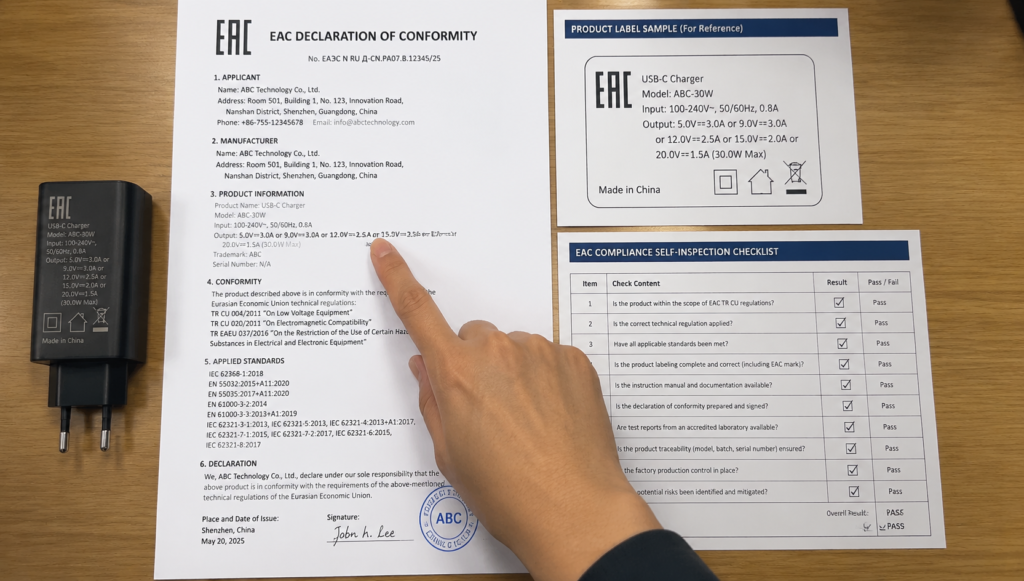
9-Step Compliance Self-Inspection Form
If you are a seller, or want to check whether the product you bought is compliant, you can check one by one according to these 9 steps:
| Self-Inspection Step | Inspection Content |
| 1. Check regulatory scope | Confirm whether the product type, parameters, and purpose fall within the regulatory scope according to the judgment matrix |
| 2. Check document validity | Confirm that the compliance document is within the validity period and in normal status, and verify it through the official public registration system |
| 3. Check coverage | Verify that models, parameters, and variants are clearly covered by the document, and keep document scans and technical documents properly |
| 4. Check responsible subjects | Confirm that subjects such as manufacturer, importer, and authorized representative are consistent with those recorded in the document, and there is no certificate borrowing or fraudulent use |
| 5. Check mark style | Check against the official template to confirm that the letters, proportions, dimensions, and colors meet the requirements and are clearly identifiable |
| 6. Check marking position | Confirm that the carrier and position of the mark comply with applicable technical regulations, and are not placed in areas that cannot remain clear or are difficult to identify |
| 7. Check supporting labels | Confirm that label parameters, responsible subject information, etc. are consistent with the certification document and meet the requirements of applicable regulations |
| 8. Check language requirements | Confirm that labels, warnings, and manuals meet the language requirements of the destination country (for example, Russian is required for the Russian market) |
| 9. Check change control | Confirm that compliance has been rechecked after changes to key components, appearance, and parameters of the product, and the minimum sales unit meets the requirements |
What to Do If There Is a Problem?
If you find a problem with the mark, don’t take a chance to continue selling, deal with it according to this logic:
1. First suspend sales or shipment to avoid the expansion of violation risks.
2. First check the type of problem: is it a mark printing error, the product exceeds the certification scope, or the label information or language is wrong?
3. If it is just a printing or label error, replace it with a durable label that meets the requirements, and then re-verify that there is no problem before selling.
4. If it is beyond the certification scope or the responsible subject is inconsistent, it is necessary to supplement the certification or adjust the subject before marking and selling.
5. All compliance evidence must be kept properly: scans of compliance documents, label photos, authorization documents, public registration verification records, which can be produced to prove in case of spot checks by platforms or customs.
Final Summary: 6 Things You Can Independently Judge
After reading this article, whether you are an ordinary consumer or a new seller, you can at least do the following 6 preliminary screenings and document checks:
1. Preliminarily identify whether the EAC mark of chargers and charging cables meets the requirements of style, position and clarity, and find obvious fake or wrong marks.
2. According to the 5-dimensional judgment matrix, preliminarily judge whether a certain charging product may need an EAC mark.
3. Through the official public registration system, check the validity and coverage of EAC compliance documents, and preliminarily judge the qualification to use the mark.
4. Check the EAC compliance of charging products according to the 9-step self-inspection method to avoid the risk of customs detention and platform penalties.
5. Identify common fake compliance problems in Russian EAC certification, such as mismatched certificates and product parameters, certificate borrowing, etc.
6. Check whether the label language and responsible subject information meet the requirements of the Eurasian Union and the destination country.
When it involves disputes over the scope of application of regulations, product exclusions, document coverage or responsible subjects, this article cannot be used as the final legal judgment. The applicable technical regulations, official registration information, and opinions of certification bodies or professional compliance personnel shall prevail.
Frequently Asked Questions
What Is the Minimum Size of the EAC Mark?
Usually the minimum height is 5mm, and the specific shall be subject to the applicable current regulations; if it is a very small volume product and the body cannot be clearly marked, it can be transferred to the minimum sales package in accordance with regulations.
Can EAC Be Printed on the Packaging?
It depends on the specific requirements of the applicable technical regulations. When regulations require marking on the product body, it cannot be replaced only by packaging; if regulations allow the use of packaging or accompanying documents due to product size, nature and other reasons, the corresponding carrier can be used in accordance with regulations. There is no packaging substitution rule that is uniformly applicable to all charging products.
Does a USB-C Cable with E-Marker Definitely Need EAC Certification?
Not necessarily. It needs to be comprehensively judged in combination with product functions, rated voltage, whether it is included in the regulatory list of regulations, etc. It cannot be judged solely by whether it has an E-Marker chip — E-Marker is just an information identification chip and is not equivalent to a power conversion circuit.
Can the CE Mark Replace EAC?
No. CE is the market access mark of the European Union, which belongs to a different market system from EAC and does not replace each other. At present, there is basically no cross-system mutual recognition for charging products.
After the EAC Certificate Is Suspended, Can Inventory Products Still Be Sold?
During the suspension period, new products shall not be produced, marked and sold; whether already produced inventory products can continue to circulate shall be subject to specific regulations, the reason for suspension and the formal decision of the regulatory authority, and there is no unified general conclusion.