
Sellers of chargers and charging cables looking to expand into Eurasian markets such as Russia and Kazakhstan will most likely encounter EAC certification as the first threshold. But if you ask a few service providers casually, quotes range from several thousand to tens of thousands, and lead times are said to be anywhere from one week to two months, leaving you completely confused: who is telling the truth? How much will my product cost, and how long will I have to wait to get the certificate?
In fact, there is no unified price for the cost and lead time of EAC certification; the core depends on your product type, applicable regulations, conformity assessment mode, and even the speed at which you prepare documents. In this article, we will start with the most basic question of “whether EAC is required”, and thoroughly explain the cost composition, lead time influencing factors, pitfall avoidance tips, and verification methods for EAC certification of charging products. After reading it, you will be able to judge whether a quote is reliable on your own, and also save a lot of money and time while staying compliant.
First, Clarify: Does Your Product Actually Require EAC?
Many people ask about the price right away, but in fact, the first step should be to determine whether your product requires EAC compliance, otherwise all the asking will be for nothing.
First of all, it must be clear that EAC is not a single certificate, but the conformity assessment mark of the Eurasian Economic Union (EAEU for short, which currently includes 5 member states: Russia, Kazakhstan, Belarus, Kyrgyzstan, and Armenia). Only when the product meets the corresponding technical regulation requirements and completes the conformity assessment process can the EAC mark be affixed to the product; it is an intuitive indicator of product compliance. Without the corresponding compliance documents, goods may be detained during customs clearance, e-commerce platforms may refuse to list them, and you may face fines during market spot checks.
Next are the classification and applicable regulations for charging products, which are the core of judging whether EAC is required and what needs to be done. There are two technical regulations most commonly involved in charging products: TR CU 004/2011 (safety regulations, that is, the electrical safety requirements for products to prevent risks such as electric shock and fire) and TR CU 020/2011 (electromagnetic compatibility, EMC for short, which simply means that the product will not interfere with other equipment when working, nor will it be affected by electromagnetic interference from other equipment). Some products may also involve other regulations such as TR EAEU 037/2016 (Restriction of the Use of Hazardous Substances in Electrical and Electronic Products), depending on the function and parameters of the product.
Requirements vary greatly for different charging products. We have sorted them by common categories:
• Chargers and power adapters: As long as they have internal circuits, they basically need to meet both safety and EMC requirements, and are the most common category requiring EAC certification.
• Charging cables: Whether EAC conformity assessment applies cannot be judged solely by whether they have an E-Marker chip or protection circuit. You should first check their rated voltage, function, and whether they are included in the applicable scope or product list of regulations such as TR CU 004/2011, TR CU 020/2011, and TR EAEU 037/2016; ordinary low-voltage USB cables and cables with electronic functions may be subject to different requirements.
• Conversion plugs: Pure physical adapters cannot be automatically excluded from conformity assessment just because they contain no electronic components; their applicability and required documents should be confirmed based on rated parameters, intended use, TR CU 004/2011, and the current unified product list.
• Wireless chargers and car chargers: Due to their special structure and usage scenarios, the applicable regulations and assessment schemes need to be verified separately, and the requirements for ordinary chargers cannot be directly applied.
In addition to the product itself, the import scenario also affects compliance requirements—not all products exported to the EAEU are required to have EAC certification. There is currently no unified exemption quantity standard, and it shall be subject to the current customs rules:
• Personal use: If it is a small quantity of products purchased by an individual for their own use, compliance requirements may be exempted, but this does not apply if the quantity obviously exceeds the scope of personal use.
• Commercial samples: If it is a small quantity of test samples sent to customers, exemption may be possible considering the import purpose, quantity, and transportation method, but this does not apply if the quantity is large or the samples are for sale.
• Bulk import and cross-border e-commerce sales: Such products for commercial sale usually need to complete conformity assessment, that is, they must have corresponding EAC compliance documents.
Here we first correct several most common cognitive misconceptions to avoid going astray at the very beginning:
First, do not think that EAC is a single certificate. It is just a conformity mark, which may correspond to different documents such as a declaration of conformity or a certificate of conformity, and may cover multiple technical regulations, so it cannot be generalized.
Second, do not think that the requirements for all charging products are the same. The product structure, rated parameters, and applicable standards of an 18W ordinary charger and a 100W fast charger may be different, and the requirements for charging cables with electronic functions and pure wire cables may also be different.
Third, do not think that having a CE or CB report can be used directly. The CE mark, EU Declaration of Conformity, and IECEE CB certificate/test report cannot replace the EAEU certificate of conformity or declaration of conformity. Relevant test data can be submitted as technical evidence, but whether it is accepted and whether supplementary testing is still required shall be assessed by the applicable scheme, certification body, and laboratory based on the standard version and product consistency.
Fourth, do not think that EAC is mandatory for all exports to Eurasia. Scenarios such as personal use and small quantities of commercial samples may be exempted, so there is no need to blindly apply for certification.
Conformity Assessment Modes: The Core Determinant of Cost and Lead Time
After confirming that your product requires EAC certification, the next step is to understand the conformity assessment mode—this is the core variable affecting cost and lead time. The type of conformity assessment document required for a product is determined by applicable regulations and product lists; the specific scheme adopted for the certificate or declaration shall be determined according to statutory conditions such as continuous production, batch or single-piece supply, and evidence basis, and cannot be applied arbitrarily.
First, let’s look at the core differences between the two types of mandatory conformity assessment documents, which many people confuse:
• EAC Declaration of Conformity (DoC for short): Registered by an applicant registered in the EAEU, and supporting materials are formed in accordance with the applicable declaration scheme; some schemes allow the use of the applicant’s own evidence, while some require test reports from accredited testing laboratories. Overseas manufacturers usually need to handle this through a qualified applicant or authorized representative within the EAEU.
• EAC Certificate of Conformity (CoC for short): Issued by a certification body accredited by the accreditation system of EAEU member states and included in the unified register. It not only requires passing the test, but also requires document review by the body. Some schemes also require factory inspection or sampling testing, with stricter requirements, higher costs, and longer lead times.
In addition to the document type, the supply method covered by the document and the validity period also affect the cost. Common situations include the following categories, and the final shall still be subject to regulations and schemes:
• Assessment for specific batches: Only corresponds to the specific batch of products identified in the document, suitable for one-time orders, such as the situation where only one batch of goods is shipped and no longer sold later.
• Assessment for continuous or series production: Suitable for products sold long-term and produced continuously. The validity period of continuous production documents is determined according to applicable regulations and schemes, usually not exceeding 5 years; within the validity period, corresponding products can be supplied within the scope of the document.
• Merging of series products: If multiple models of products technically belong to the same series, they can be assessed jointly within the scope permitted by regulations and the body, sharing the cost per model, which is suitable for sellers with multiple similar products.
Many people care about how to judge whether series assessment can be merged. There is no absolute unified rule here, and the final shall be subject to the requirements of the body and regulations, but the core basis is “technical identity”—that is, the core circuit, key components, rated parameters, product structure, and test representativeness must be consistent.
Common differences such as different interface types (one USB-A, one USB-C), different supported fast charging protocols, and different plug specifications (Russian standard/European standard) do not mean that merging is absolutely impossible. As long as the core circuit and parameters are consistent and the body deems the test representative after assessment, merging may be possible. However, if only the product names are similar, and the core parameters and structure are completely different (for example, one is 18W and the other is 100W), merging is usually not possible.
There is another particularly easy pitfall: even if chargers and charging cables are sold as a set, they may need to be assessed separately and cannot be merged into one series on your own, because they belong to different product categories and may be subject to different regulatory requirements.
Cost Composition and Market Reference
Next, let’s talk about the cost issue that everyone is most concerned about. First of all, it must be clear that there is no official unified pricing for EAC certification. All fees are market charges from service providers and laboratories, and the differences mainly come from test items, service content, and body qualifications. When inquiring about prices, you should not only compare the total price, but also clarify the service scope, applicable regulations, adopted scheme, whether sample testing is required, and whether follow-up services are included.
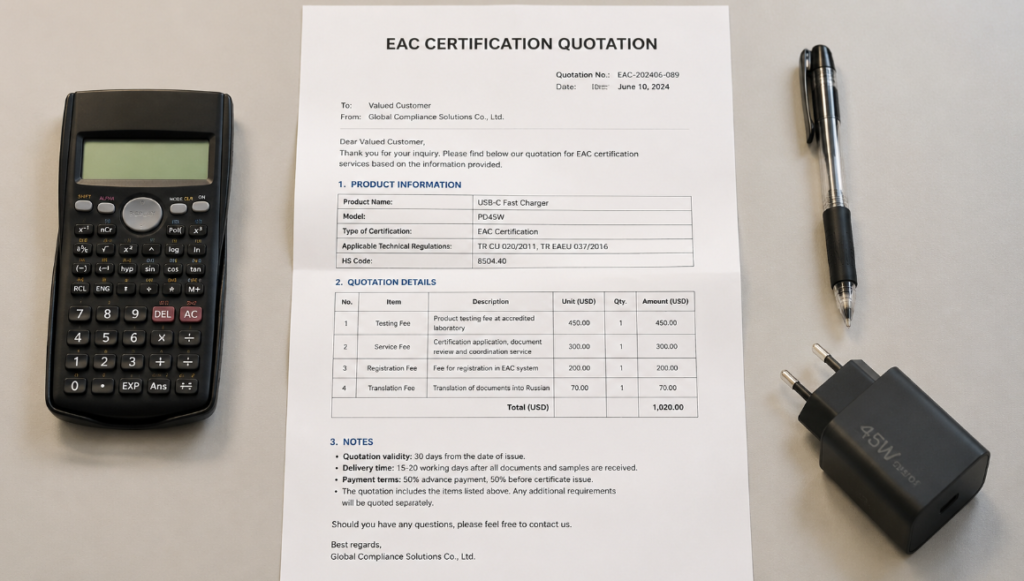
The first part is testing service fees, which are usually a major expense item:
• Common test items: Whether tests such as safety and EMC are required shall be judged according to the applicable regulations of the product, product structure, and rated parameters.
• Test scope: Shall be determined by applicable technical regulations, product structure, rated input and output parameters, and standards adopted by the certification body or laboratory. Whether PD/QC protocol, USB-C interface, power or cable performance tests are required shall be subject to applicable standards and the product’s declared functions, and shall not be used as general independent EAC test items or a basis for quote judgment.
• Rectification and retesting fees: If the first test fails and retesting is required after rectification, this fee will be incurred. Common problems with charging products include insufficient creepage distance, that is, insufficient insulation distance between two live parts on the circuit board, which may increase the risk of short circuit and electric shock; there may also be situations such as EMC tests failing to meet requirements. Many quotes do not include this fee, which easily leads to budget overruns later.
The second part is compliance service fees:
• Assessment service fees from laboratories and certification bodies: For example, fees for post-test assessment, document review, etc.
• EAEU domestic applicant or authorized service fees: When a non-EAEU manufacturer applies, the applicant shall be a legal person or individual operator legally registered in an EAEU member state and authorized by the manufacturer to assume compliance responsibilities, and related services may incur fees.
• Technical service fees: For example, fees for document translation, data sorting, compliance classification judgment, system registration operation, etc.
• Additional CoC fees: If applying for a Certificate of Conformity (CoC) and the scheme requires factory inspection or sampling, additional factory inspection fees, sampling fees, etc. shall be paid.
The third part is on-demand additional fees, which are not incurred by everyone:
• Sample transportation and customs clearance fees: Freight and customs clearance fees for sending test samples to the laboratory.
• Annual supervision and audit fees: Some continuous production assessment schemes require supervision and audit, and this fee needs to be paid, depending on the assessment scheme.
• Document change or reprocessing fees: For example, adding new models later, changing product information, or reprocessing conformity assessment before the document expires may incur additional fees.
• Urgent service fee: If you are in a hurry and need urgent processing, you need to pay an urgent fee.
Quotes from different service providers may vary greatly. You cannot directly judge which document to apply for, how complex the test will be, or that the cost will definitely fall within a certain fixed range solely based on product power, USB interface type, or whether it has an E-Marker. A more reliable approach is to require the service provider to provide a written breakdown based on the product model, applicable regulations, supply method, and proposed scheme.
To judge whether a quote is reliable, mainly look at three points:
First, look at the breakdown. A formal quote will list all chargeable items clearly, such as which items are included in the test fee, what content is included in the service fee, and whether the EAEU domestic applicant service fee and translation fee are included. If there is only a “one-price” offer without any breakdown, you should specially confirm whether there are any unincluded items later.
Second, look at the service scope. If the quote is obviously low, you should check whether key tests, registration, translation, samples, supervision and audit, or change services are missing, and also verify whether the final document will be registered in accordance with the law. You cannot assume the document is invalid just because of a low price, but when the price is abnormal, you should require clear handling basis and written explanation.
Third, look at qualifications. Certification bodies and testing laboratories should be verifiable in the unified register and the accreditation information of relevant member states, and it is best to have experience in handling similar charging products. If the service provider cannot provide the body information, or cannot tell which laboratory it is, you cannot choose it easily no matter how cheap it is.
Lead Time Composition and Market Reference
After talking about costs, let’s talk about lead times. The lead times quoted by many service providers vary greatly: some say it is very fast, others say it takes a long time. In fact, the core is whether preparation time is included, whether testing or supplementary evidence is required, whether rectification occurs, and the scheduling situation of the certification body and laboratory.
Regulations do not stipulate a unified number of processing days applicable to all products and bodies; the actual lead time depends on the applicable document type and scheme, technical data and samples, whether testing or supplementary evidence is required, rectification situation, and the scheduling of the specific certification body and laboratory, and shall be confirmed by a written project plan.
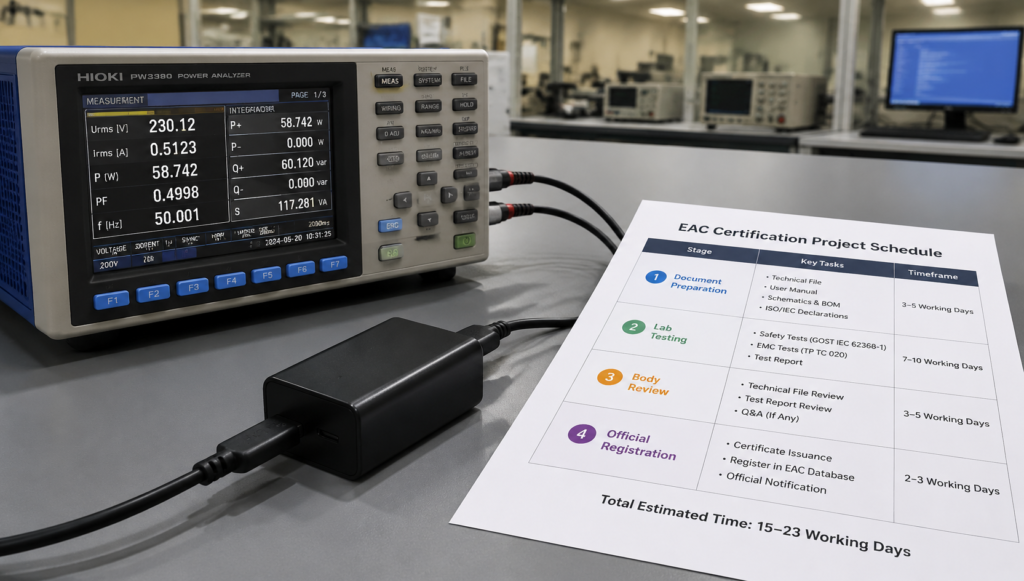
The complete process usually includes the following stages:
1. Document and sample preparation: The applicant sorts out documents, confirms the model range, prepares and sends samples. The more complete the document preparation and the more timely the sample delivery, the less subsequent waiting there will usually be.
2. Testing and assessment: Whether testing is required and how the test scope is determined depend on the applicable regulations of the product, the adopted scheme, and the acceptability of existing evidence. Fast charging products, products with multiple interfaces, or product series may not necessarily have a longer lead time, but when there are many differences in data and technology, the assessment work may increase.
3. Review and registration: The certification body or applicant completes review and registration in accordance with the corresponding procedures. The processing and registration methods for certificates and declarations of conformity are different and cannot be generalized.
4. Subsequent changes: For example, adding models, changing information, reprocessing, etc., are on-demand matters and are not included in the lead time for the first document processing.
There are four core variables that affect the lead time, which is why the lead times for different people vary greatly:
First is the applicant’s preparation efficiency. Procrastinating in submitting incomplete documents, sending wrong or late samples will directly extend the lead time, which is the most common cause of delay.
Second is the test pass rate. If non-conformities are found during the test, rectification, supplementary materials, re-sending samples, or retesting are required, the processing time will naturally increase. How long the rectification takes depends on the nature of the problem, the difficulty of product modification, and the laboratory’s arrangement, and cannot be simply estimated by a fixed number of days.
Third is body scheduling. Laboratories and certification bodies have different schedules at different times. Before processing, you should confirm the currently available test and review time, and reserve a buffer for listing, shipping, and customs clearance.
Fourth is the reuse of existing data. If there are qualified test data such as CB, IEC, and CE, they can be submitted to the body or laboratory for assessment. Whether the data is acceptable and whether supplementary testing is still required depends on the standard version, product consistency, applicable scheme, and accreditation status.
Here we also correct a misconception about lead time: when the processing lead time is abnormally short, you should focus on checking whether the register records, applicant, manufacturer, model, and regulations are consistent with the actual product, as well as whether the evidence documents and issuing entity are compliant; you cannot deem the document invalid solely because it takes less than a certain number of days.
Pitfall Avoidance and Optimization Tips
Now that we know the factors affecting cost and lead time, let’s talk about common pitfalls and how to save money and time while staying compliant.
First, let’s talk about 3 low-price traps in quotes, which you must avoid:
The first is the “all-inclusive one-price” trap. It sounds very cost-effective, covering everything, but the actual quote may not include supervision and audit fees, rectification fees, translation fees, factory inspection fees, etc. After you pay and start the process, they will ask you to add money for various reasons, and will not issue the certificate if you don’t pay more, resulting in a higher total cost in the end.
The second is the “ultra-low price” trap. The quote is far below the normal service scope, may omit necessary items, or may fail to provide verifiable registration documents or real body information. During customs clearance or market spot checks, official registration records and document content shall prevail.
The third is the “quote per single model” trap. Obviously, your multiple models meet the conditions for series assessment and can be processed jointly, but the service provider deliberately quotes per single model, charging several times more money, and sellers who don’t understand are easily cheated.
Next, let’s talk about 2 time traps in lead times:
The first is the “promise to get the certificate in X days” trap. The X days mentioned by the service provider often start counting only after the samples arrive at the laboratory and the documents are complete, and may not include the time for supplementary documents, rectification, or retesting. When asking about the lead time, you must make it clear: when is the starting point, which steps are included, and what situations will cause the plan to change.
The second is the “unspecified schedule” trap. The service provider does not explain the actual current schedule of the laboratory and certification body, and only promises the time based on ideal conditions. As a result, you cannot get the document on time, delaying your listing or customs clearance. Before applying, you should require the other party to confirm a written project plan and reserve buffer time.
Next are 4 ways to save costs for charging products, provided that they must meet regulatory requirements, and you cannot violate regulations just to save money:
First, prioritize series assessment. If your multiple models have the same core circuit and parameters and meet the conditions for series assessment, you can apply for joint assessment to share the cost per model, which is more cost-effective than processing each model separately.
Second, reuse valid data. Sort out your existing test data such as CB, IEC, and CE in advance, and submit them to the certification body or laboratory for assessment. If the data meets the requirements, the scope of repeated testing or supplementary work may be reduced, but you cannot assume in advance that it will definitely be waived.
Third, conduct pre-testing in advance. Do pre-testing or self-inspection against common non-conformity items, such as creepage distance and EMC radiation, and rectify them in advance to avoid failing the formal test and incurring additional retesting fees.
Fourth, match the assessment mode. Determine the document type and scheme according to regulatory requirements and actual supply methods, and do not actively apply for a higher-requirement mode that is not needed. For example, when a declaration of conformity is applicable according to regulations and product lists, you should not pursue a certificate of conformity extra just for psychological reasons.
Then there are 4 ways to save time:
First, prepare all documents in advance. Prepare the documents required for the application in advance, such as operating instructions, circuit diagrams, BOM of key components, certificates of key components, etc. Don’t start looking for them when the service provider asks for them, which wastes time. Documents such as operating instructions shall be in Russian; if the laws of the target member state require the use of its national language, the corresponding language requirements shall also be met.
Second, self-inspect samples in advance. Check the samples before sending them to ensure that the parameters and structure of the samples are consistent with the documents and there are no obvious problems, so as to avoid finding that the samples are unqualified after sending them and needing to resend and retest.
Third, confirm the schedule in advance. If the project has a clear listing, shipping, or customs clearance plan, you should confirm the schedule with the laboratory and certification body as early as possible, and leave time for document supplementation, rectification, or retesting.
Fourth, assess data reuse in advance. Send your existing test reports to the service provider at the initial stage of the application to confirm in advance whether they can be used as technical evidence and whether supplementary testing is still required. Don’t mention it after the test starts, which will require going through the process again and wasting time.
Document Requirements, Certificate Verification and Post-Certification Maintenance
Many people think that everything is fine once they get the certificate. In fact, document preparation before application, and verification and maintenance after getting the certificate are also important parts of compliance. Otherwise, the documents you paid for may be unusable, or even suspended or terminated.
First, let’s talk about the core document and labeling requirements for the application, which are common to charging products, and the specific shall be subject to the requirements of the body:
• Entity documents: Basic information of the manufacturer. When a non-EAEU manufacturer applies, the applicant shall be a legal person or individual operator legally registered in an EAEU member state and authorized by the manufacturer to assume compliance responsibilities.
• Product documents: Model list, rated parameters, BOM of key components, circuit diagrams, product photos, product manuals, etc.
• Labeling requirements: The EAC mark shall comply with the unified mark rules, including being clear, identifiable, readable, and usually having a minimum height of 5mm. The specific labeling content on the product body, packaging, and accompanying documents shall be confirmed according to applicable technical regulations and the requirements of the target member state respectively; do not regard packaging traceability information such as batch numbers as a unified EAC requirement for all charging products.
• Supplementary documents: Existing conformity documents related to the CE mark, IECEE CB certificates or test reports, etc., can be submitted together for the certification body or laboratory to assess whether they can be used as technical evidence.
After getting the document, the first thing to do is to verify its validity. Don’t be unaware that you have a problematic document. Verification can be done in these four steps:
Step 1: Check the registration number. The query systems for EAC declarations of conformity and certificates of conformity may be different. You need to find the corresponding official registration system of the EAEU or member state, enter the document number, and see if you can find the record.
Step 2: Verify the status and validity period. Confirm that the status of the document is valid, not expired, and not suspended, terminated, or revoked.
Step 3: Check product information. Verify that the manufacturer, applicant, product model, rated parameters, and applicable regulations on the document are completely consistent with your actual product; even one mismatched item is not acceptable.
Step 4: Verify the issuing body. For certificates of conformity, it shall be confirmed that the information of the issuing certification body and the relevant testing laboratory can be verified in the unified register and the accreditation information of relevant member states. For declarations of conformity, it shall also be checked whether the registration entity is consistent with the registration information.
It should be reminded here that scanned copies, screenshots, or certificate samples alone cannot prove validity. The query results of the official registration system and the content of the document shall prevail, after all, it is not difficult to forge a document.
Finally, there are precautions for post-certification maintenance. The document is not a once-and-for-all thing once you get it:
• Model expansion and information change: If you need to add new models later, or change information such as the manufacturer’s address and product parameters, you should first assess whether it affects the registered documents according to applicable regulations and registration rules; you must not alter them without authorization. Certificates are handled by the issuing certification body according to the rules, and declarations are handled by the applicant according to the registration rules. Major changes may require reprocessing.
• Annual supervision: If the continuous production assessment scheme has annual supervision requirements, you must cooperate with the body’s audit, such as factory inspection, sampling, etc., otherwise the document may be suspended, terminated, or revoked.
• Document expiration: Before the document expires, time should be reserved for re-conformity assessment and registration, rather than assuming that it can be renewed directly. At that time, the processing requirements shall be reconfirmed according to effective regulations, product conditions, and evidence materials.
• Response to spot checks: When market regulatory authorities conduct spot checks, you must be able to provide compliance documents and corresponding technical data, so the data must be properly stored and not lost.
Quick Estimation and Full-Process Checklist
Finally, we provide two quick estimation methods and a full-process checklist to facilitate your own preliminary judgment, so you don’t have to only ask for a total price or a fixed lead time every time.
First, let’s talk about 3 steps for quick cost estimation, which is only a preliminary estimate, and the final shall be subject to the written quote of the service provider:
Step 1: Determine your product type, applicable regulations, document type, and supply method. For example, even for 65W USB-C chargers, the cost composition may be different due to different model structures, target member states, and supply methods of continuous production or specific batches.
Step 2: Assess whether your existing data can be reused. For example, existing CB certificates, test reports, or other technical data may reduce repeated work, but this shall be subject to the assessment results of the certification body or laboratory.
Step 3: Reserve a certain amount of contingency funds to cope with possible rectification and retesting, sample transportation, translation, supervision and audit, or additional document fees, to avoid budget overruns.
Next, let’s talk about 3 steps for quick lead time estimation, which is also a preliminary estimate, and the final shall be subject to the written project plan and the body’s schedule:
Step 1: Determine the product type, applicable regulations, assessment scheme, and whether testing is required, and correspondingly confirm the stages of document preparation, testing, review, and registration.
Step 2: Assess the rectification risk and the space for data reuse. If the product already has relatively complete technical data and the product is consistent with the report sample, there may be less subsequent supplementary work; if it is the first time processing, the data is incomplete, or the product has not completed self-inspection, more time should be reserved.
Step 3: Confirm the current schedule with the certification body and laboratory in advance, and reserve buffer time for sample transportation, document supplementation, rectification, and retesting.
Finally, there is the full-process checklist. From before application to after getting the certificate, you can check against it and won’t miss anything:
• Before application: Confirm the applicable regulations, document type, and assessment scheme of the product, clarify the target market, and sort out existing technical data.
• When inquiring about prices: Confirm the detailed items of the quote, the starting point of the lead time, whether the quote includes rectification fees, supervision and audit fees, and translation fees, and verify the relevant qualifications and similar product experience of the certification body, laboratory, and service provider.
• After getting the certificate: First verify the validity of the document in the official system, confirm that the product label and operating instructions meet applicable requirements, and keep the technical data properly for future reference.
Generally speaking, the cost and lead time of EAC certification are not mysterious. The core is to first figure out what category your product belongs to, what regulations and schemes apply, then judge whether it is reasonable against the written quote and project plan, and avoid low-price traps and time traps. As long as you prepare in advance and make reasonable use of series assessment and existing technical data, you can control costs and time within a more predictable range while staying compliant.
After reading this, you should be able to independently judge: whether your charging product requires EAC compliance, what regulations generally apply, whether the service provider’s quotes and promises are reliable, how to save money and time while staying compliant, and how to verify the authenticity of documents and do a good job in post-certification maintenance. If it is your first time doing it, it is recommended to compare two or three regular bodies with experience in charging products, don’t just look at the low price, compliance and effectiveness are the top priority.