
Sellers of charging products who want to enter Eurasian markets such as Russia and Kazakhstan will almost always encounter questions about EAC certification: Do I need to apply for it at all? How much does it cost? How long does it take to get it done? Will I run into pitfalls? In this article, we will start with the most basic judgment and explain the entire EAC certification process thoroughly. Even if this is your first time dealing with it, you will be able to figure out what you need to do and how to avoid pitfalls.
First, Figure It Out: Does Your Product Need EAC Certification?
Many people go straight to agencies to ask for quotes, but in fact, the first step should be to determine whether your product actually needs EAC certification, so as to avoid wasting effort.
The EAC mark is a unified circulation mark used when products comply with applicable technical regulations of the Eurasian Economic Union (EAEU). Member states of the EAEU include Russia, Belarus, Kazakhstan, Armenia, and Kyrgyzstan. You can think of it as one of the “entry thresholds” that products may need to meet when entering the relevant markets — it is essentially a proof that the product meets applicable safety and compliance requirements, not an award for quality or performance grade. There is no need to think that a product with EAC certification is a “high-end product”.
However, it cannot be simply understood that all products must be certified, and that one document is unconditionally valid in all five countries. Whether a product requires a certificate or declaration, which technical regulations apply, and whether it can be circulated in member states must be confirmed based on product classification, intended use, rated parameters, structure, and import and regulatory requirements that may be separately applicable in member states.
Boundary of Requirement/Exemption for Charging Products
Specifically for charging products, conclusions cannot be drawn solely based on “whether it is for commercial sale” or the product name. For chargers, USB/USB-C power adapters, cables, conversion adapters with electronic components, and products with wireless charging or Bluetooth functions, whether regulations such as low-voltage safety, electromagnetic compatibility (EMC), and restriction of hazardous substances apply, and whether a certificate or declaration is required, must be confirmed item by item based on the product’s intended use, rated parameters, structure, and the product list of the corresponding regulations.
Special attention should be paid to products with wireless charging, Bluetooth, etc.: in addition to possibly involving product safety and EMC requirements, they may also involve radio frequency and encryption import requirements of the target member state. Having a charging port or Bluetooth function does not automatically mean that a certain fixed EAC document must be applied for.
For purely mechanical decorative conversion adapters with no conductive function, they usually do not fall within the scope of conformity assessment for electrical products; cables that are purely for data transmission and have no power supply function may also not be subject to relevant electrical regulations, but the final judgment still needs to be combined with the HS code, product functions, and actual import requirements.
Personal articles for non-commercial use, as well as exhibition or test samples not placed on the market, may not be subject to pre-market conformity assessment, but must meet the specific conditions of applicable technical regulations and customs procedures. There is no unified standard that “purchasing 1-2 pieces for personal use automatically grants exemption”. Customs usually make a comprehensive judgment based on factors such as intended use, quantity, and method of carriage or delivery.
If a product that should have completed conformity assessment is sold in the Union market without it, the consequences are straightforward: customs may detain the goods or order return shipment, and you will have to bear additional storage fees and freight costs; e-commerce platforms may delist the products, and you may even face fines or sales restrictions; in severe cases, it may trigger product recalls and damage brand reputation, which is not worth the loss.
Several Most Common Beginner Misconceptions
Let’s first clarify a few points that people most often get wrong, to avoid taking detours later:
First, overseas certifications such as CE, CB, and FCC usually cannot directly replace the EAC conformity assessment required by applicable EAEU technical regulations. They can be used as reference for technical documentation, but you cannot skip locally applicable regulatory requirements just because you already have CE or FCC certification.
Second, EAC is not only applicable to Russia. Products that have completed conformity assessment in accordance with applicable Union technical regulations can usually be circulated within the territory of Union member states; however, import, radio frequency, encryption notification, hygiene, or other domestic requirements of member states may still require separate confirmation.
Third, there is no unified commercial sales exemption rule for small-batch e-commerce parcels. As long as a product falls within the regulated scope and is placed on the market, it cannot be automatically exempted from requirements just because the quantity is small.
Fourth, for products already covered by applicable Union technical regulations, EAC conformity assessment shall be carried out in accordance with those technical regulations; however, products not covered by Union technical regulations may still be subject to national-level conformity assessment requirements of Russia or other member states. Do not simply assume that “ordinary consumer electronics only recognize EAC”, nor use inapplicable old documents to replace the currently required documents.
Choose the Right Certification Form to Avoid Wasting Money
After confirming that you need to apply, the next place where you are most likely to waste money is mistakenly thinking that you can choose the certification type at will. Many people think there is only one type of EAC certificate, but in fact, there are two common core conformity assessment documents: the Certificate of Conformity (CoC) and the Declaration of Conformity (DoC).
The first is Certificate of Conformity (CoC), which is issued by a certification body in accordance with applicable regulations and certification schemes. Depending on the specific scheme, it may involve requirements such as sample testing, production status analysis, or follow-up supervision.
The second is Declaration of Conformity (DoC), for which the applicant entity registered within the EAEU territory usually bears the responsibility for declaring product conformity, supported by evidence required by applicable regulations and declaration schemes. The required test reports and other evidence are not completely fixed: some schemes require testing by accredited laboratories, while others allow the use of the applicant’s own evidence or combined evidence.
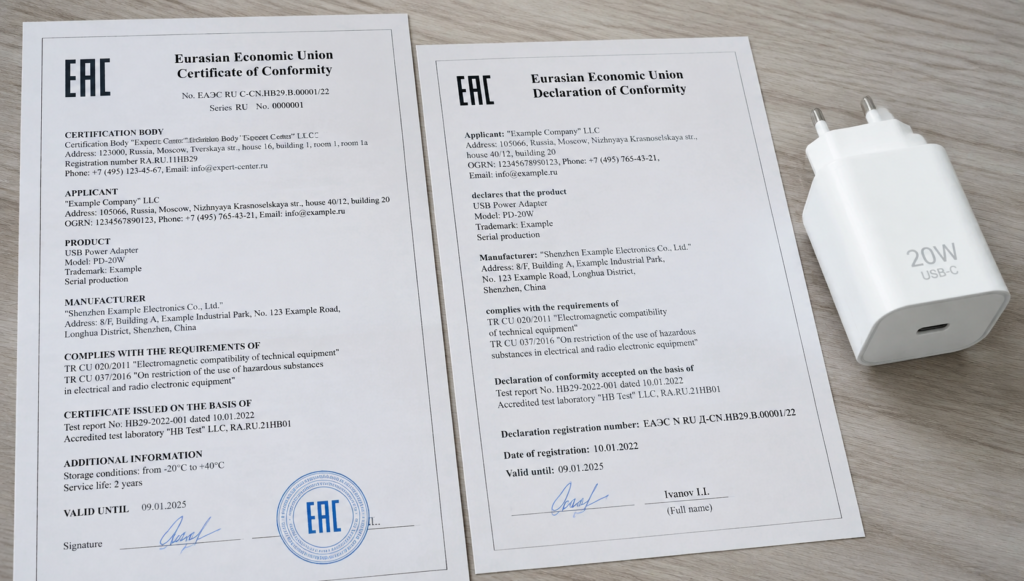
Both CoC and DoC are legal conformity assessment documents that may be specified in technical regulations, but it is not the case that “one is more authoritative and the other is lower-level”, nor can they be freely chosen based on risk level, cost, or processing speed. Whether a specific product must use a certificate or a declaration depends on the applicable technical regulations, annexed product lists, and conformity assessment schemes.
Which One to Choose for Charging Products?
For chargers, power adapters, and cables, you cannot directly presuppose that “ordinary products all apply for DoC” or “only high-power products apply for CoC”. The correct approach is to classify products separately and check the applicable scope, annexed product lists, and specified assessment forms of regulations such as low-voltage safety, EMC, and restriction of hazardous substances.
That is to say, whether a CoC is required cannot be judged solely by power, industrial grade, or special use; RoHS-type restriction of hazardous substances requirements also do not automatically apply to all “charging products”. The actual structure, rated parameters, intended use, and regulatory classification of the product are the key factors.
If the charging product has wireless charging or Bluetooth functions, in addition to confirming the basic product regulations, you must also check the radio frequency and encryption import requirements of the target member state. Before applying, you should truthfully provide information such as the product’s wireless module, frequency band, and communication functions to the service provider or importer.
There is also another document called the State Registration Certificate (SGR). Ordinary charging products are usually not within the common applicable scope of SGR, but whether an SGR is required still needs to be confirmed based on the applicable product list. If the product is a medical device, you should also check the medical device registration rules separately, and cannot make a simple judgment solely based on “claimed medical function” or “contact with food”.
Single Batch or Batch Production? Depends on Your Sales Model
In addition to the certification type, you also need to choose the application scheme: whether to apply for a single-batch scheme or a continuous production batch scheme.
• Single-batch certification is usually tied to a specific batch or contract, and can only be used for the corresponding one-time import or specific batch, suitable for sellers who ship goods occasionally;
• Continuous production certification usually has a certain validity period, during which multiple shipments can be made, suitable for sellers who operate in the Eurasian market for a long time.
The selection logic is simple: for occasional exports, you can consider the single-batch scheme, and for long-term sales, the continuous production scheme is more suitable. However, the specific validity period, applicable scope, and processing arrangements of the document still depend on applicable regulations and certification schemes, and cannot be decided solely based on “how many weeks faster” or “how much cheaper”.
3 Steps to Quickly Judge What You Should Choose
If you are still unsure, you can follow these 3 steps:
Step 1: Check product attributes. First clarify whether it is a charger, power adapter, cable, conversion adapter, or a product with a wireless communication module, then check the specific intended use and structure;
Step 2: Check voltage range. Equipment with AC voltage between 50-1000V and DC voltage between 75-1500V may fall within the applicable scope of low-voltage regulations, but this needs to be confirmed in combination with the specific product list;
Step 3: Check sales model. Whether it is a one-time shipment or long-term sales will affect whether you are suitable for the single-batch or continuous production scheme.
Common Misconceptions About Choosing Types
Let’s correct a few common wrong ideas here:
First, it is not true that there is only one type of EAC certificate, nor that you can apply for whichever type you want. CoC or DoC must be determined in accordance with applicable technical regulations, product lists, and conformity assessment schemes;
Second, not all models with different power or interfaces can be randomly combined for certification. Random combination will result in failed review, which will instead delay time;
Third, the same product usually does not need to apply for both CoC and DoC at the same time, but the actual situation shall be subject to applicable regulatory requirements. Do not be tricked by unscrupulous service providers into spending extra money.
Preparations Before Application: Doing These Well Can Save Half the Time
After choosing the certification type, don’t rush to submit the application. Doing sufficient preparation work can avoid a lot of trouble from back-and-forth revisions.
First, Figure It Out: Who Can Be the Applicant Entity?
This is the point that many overseas sellers most often get wrong: the applicant entity for EAC conformity assessment should usually be a legal person or individual entrepreneur registered within the territory of EAEU member states, such as an importer, distributor, or a compliant agent that meets the requirements.
If you are a manufacturer, individual, or overseas enterprise from China or other foreign countries, you usually cannot directly serve as the applicant entity. There must be formal authorization documents between the overseas manufacturer and the domestic applicant. Whether notarization, certification, or other forms of documents are required specifically must be confirmed in advance in accordance with applicable regulations and application schemes.
List of Required Technical Documentation
The materials that need to be submitted when applying can be roughly divided into three categories:
• Basic information: model list, rated parameters, interface types, product photos;
• Technical documents: nameplate design draft, Russian user manual, circuit diagrams, Bill of Materials (BOM);
• Reference materials: if you already have CE or CB reports, you can submit them together as reference, but they cannot automatically replace the testing or other evidence required by the applicable scheme.
Can Multiple Models Be Combined? Check These Points
Many sellers have products of several models and want to combine the application to save money. The core point for whether they can be combined is: the appearance can be different, but the internal circuit, rated parameters, and safety structure must be exactly the same, and only products of the same series can be combined.
If the input and output power are different, the number of interfaces is different, the internal circuit scheme is different, or the shell material is too different, it is not advisable to simply combine them. The final confirmation of whether they can be combined shall be subject to the certification body. Do not arbitrarily combine them yourself to save money, otherwise the review will fail and delay time instead.
Precautions for Sample Preparation (Exclusive for Charging Products)
You must pay attention to the samples for testing. Many people fail the test or get stuck because the samples are not prepared correctly:
• In terms of quantity: generally 1-3 units for chargers and power adapters, 2-5 pieces for charging cables. The specific quantity can be adjusted according to actual testing requirements;
• The most important thing is consistency: samples must be exactly the same as the final mass-produced version. There must be no differences in plug specifications, cable length, shell material, or internal circuit. Do not use engineering samples for testing. Otherwise, if changes are made during mass production and inconsistency is found during customs clearance, the goods will be directly detained;
• Self-check in advance: for products connected to the mains, confirm that the input rated parameters match the actual power supply conditions of the target member state. The target market usually adopts conditions such as nominal 230V, 50Hz and allowable deviations. “220V 50Hz” should not be simply regarded as a unified label or testing threshold.
Modify Labels and Manuals in Advance
Non-compliant labels and manuals are also very common reasons for getting stuck. There are several special requirements for charging products to note:
• The minimum height of the EAC mark shall not be less than 5 mm, and it shall be clear and legible;
• The product nameplate usually needs to have basic information such as model, input and output parameters, manufacturer, and country of origin, and Russian content shall be prepared in accordance with applicable regulations;
• For multi-port chargers, the output parameters of each port or combined use shall be clearly marked, for example, “USB-C1: 5V/3A, 9V/2.22A, 20W”;
• The labels and manuals of charging cables shall fill in the manufacturer, model or type, and necessary basic parameters in accordance with applicable technical regulations; if maximum power, USB PD, or other protocols are voluntarily marked, it shall be ensured that they are consistent with the actual capabilities of the product and the technical documentation.
These are best modified during the preparation stage, otherwise modifying the nameplate later will delay time again.
How to Choose a Compliant Service Provider: Avoid Fake Certificates and Hidden Costs
Finding the right service provider is half the success of EAC application; if you find an unreliable one, not only will you spend money, but you may also get invalid documents, and the goods will be directly detained during customs clearance.
Judgment Criteria for Compliant Service Providers
A formal compliant service provider must meet at least the following conditions:
First, it can clarify the certification bodies and laboratories actually participating in the project, and can assist in verifying whether these institutions are in the accreditation or registration system of the corresponding member state, and whether the accreditation scope covers relevant testing. The service provider itself can be a coordination agent and does not necessarily have its own laboratory, but it cannot forge or replace documents of certification bodies and laboratories;
Second, it can assist in completing document registration in accordance with regulations, and the final certificate or declaration can be verified in the Union’s unified register or the official registration resources of the issuing member state;
Third, it has experience in handling similar charging products, especially USB-C and fast charging products, and knows where such products are prone to problems;
Fourth, it will not only use “fast certification” and “low price” as selling points. The key to whether a document is real and valid depends on the actual issuing body, registration status, applicable regulations, and technical documentation, not just on the promised time.
Be Sure to Ask About These 5 Boundary Items in the Quote
Many people only look at the total price when looking for service providers, and end up being charged extra for various hidden costs. When asking for a quote, be sure to ask 5 questions clearly:
1. Does the quote include the full-process costs of sample testing, document sorting, and official registration?
2. Does it include the costs of Russian translation, label review, and basic rectification guidance?
3. If the test fails, how are the costs of supplementary testing and retesting calculated?
4. What is the additional fee for adding models of the same series?
5. Does it include follow-up services such as authenticity verification and validity period reminders?
Asking these clearly and then comparing the prices of different service providers will give you the real cost. Otherwise, it may seem cheap, but you may end up spending more.
Bonus Points for Charging Product Service Providers
If the service provider also has the following characteristics, it is more reliable: it is familiar with potentially applicable regulations such as EAEU low-voltage safety, EMC, and restriction of hazardous substances, understands the key document points of products related to USB-C interfaces and fast charging protocols, and can also conduct a pre-assessment of common non-conformity items for charging products in advance, helping you fix problems before sending samples, so as to avoid rectification after test failure.
Full EAC Application Process (With Checkpoints)
After the preparation work is done, you can officially start the application. The entire process can be divided into 6 clear steps, each with corresponding checkpoints. You can follow along to check and avoid detours.
Step 1: Submit Application and Preliminary Document Review
First, the domestic applicant or agent shall submit the application form, full set of technical documentation, and product information to the certification body. After receiving them, the body will first conduct a preliminary review to confirm which category of regulations your product is subject to, which form of conformity assessment is suitable, and whether to adopt the single-batch or continuous production scheme.
Checkpoint: All submitted materials must be exactly consistent with the actual product, and all models to be exported must be listed. If any are missing, it will be very troublesome to add them later.
Step 2: Prepare Samples, Evidence and Rectification
After passing the preliminary review, samples and evidence shall be prepared in accordance with applicable technical regulations and the selected conformity assessment scheme. Whether samples need to be sent, which laboratory to send them to, and how to use the test report shall all be determined according to specific regulations and schemes.
When a product falls within the scope of regulations such as low-voltage safety, EMC, and restriction of hazardous substances at the same time, it needs to meet the corresponding requirements respectively. Low-voltage safety usually focuses on insulation, electric shock protection, abnormal heating, etc.; EMC, simply put, means that the product will not excessively interfere with other equipment when working, nor will it fail to operate normally due to common electromagnetic environments; restriction of hazardous substances involves content requirements for restricted substances such as lead and mercury.
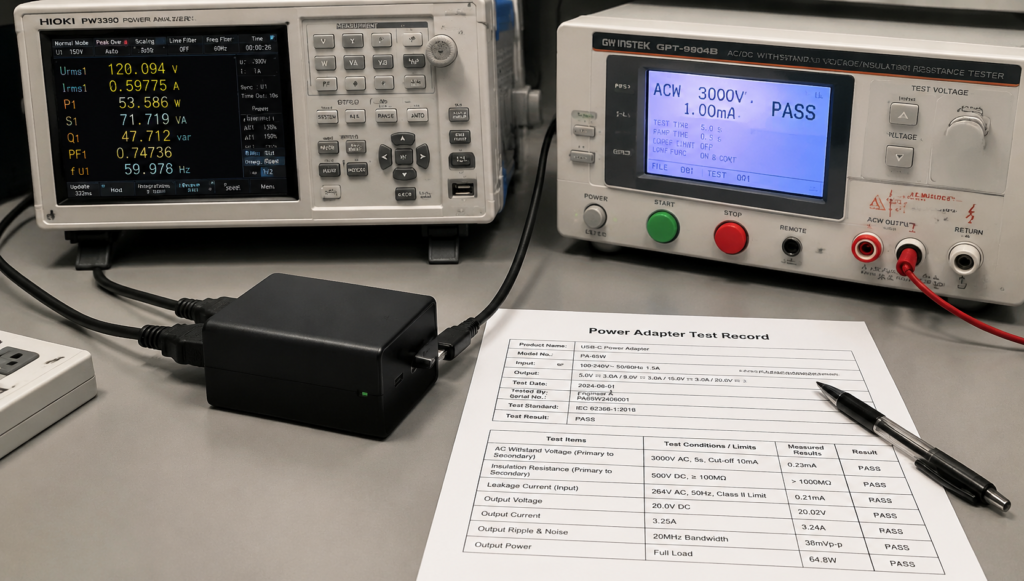
Common reasons for non-conformity are mostly insufficient insulation distance, substandard shell flame retardant performance, false labeling of output parameters, etc. If the test fails, the product design or components must be rectified before retesting. Absolutely do not only modify the test report — once found out, it will be a fake certificate, and the consequences will be very serious.
Checkpoint: Only after obtaining complete and valid conformity evidence in accordance with applicable regulations and schemes, and ensuring that it is consistent with the actual product, can you proceed to the next step.
Step 3: Production Status Analysis or Factory Audit (Only Required for Some Schemes)
Many people worry about whether a factory audit is needed, but this cannot be generalized. Whether to conduct production status analysis, supervision audit, or production control shall be determined in accordance with applicable technical regulations and certificate/declaration schemes.
For example, some CoC schemes for continuous production may require production status analysis; batch or single-piece schemes may not. DoC usually does not involve factory audits by certification bodies, but the declarant still needs to bear the responsibility for production control and product consistency in accordance with the corresponding scheme.
If production status analysis is indeed required, the focus is usually on production consistency, traceability system for key components, and quality control processes. As long as there are no major non-conformity items, the process can usually continue after the problems are rectified and closed.
Checkpoint: No major non-conformity items, all problems are rectified and closed.
Step 4: Complete Registration in Accordance with the Procedures of the Issuing Member State
After testing or other conformity evidence is prepared, registration shall be handled in accordance with the document type and the prescribed procedures of the issuing member state. The Certificate of Conformity is usually issued by the certification body and registered in the registration system of the corresponding member state; the Declaration of Conformity is registered by the applicant or relevant entity in the information system prescribed by the local authority.
The EAEU provides a unified registration information resource for subsequent verification, but it is not a single application portal where all applicants directly submit materials.
Checkpoint: All information submitted or registered must be exactly consistent with the test report, product materials, and information of the applicant and manufacturer. There must be no discrepancies, otherwise it may be sent back for revision.
Step 5: Obtain Certification Documents and Verify
After the review or registration is completed, the document will form a record in the corresponding registration system and have a corresponding number. The document usually specifies the product model or description, applicant information, manufacturer information, validity period, applicable regulatory scope, etc.
After receiving the document, be sure to check it on the official registration resources yourself. Priority is given to verifying with the certificate or declaration number in the Union’s unified register and the official registration system of the issuing member state, and at the same time checking the current status of the document, issuing body, applicant, manufacturer, product description, and applicable regulations.
It should be noted that having a record in the register does not mean that the physical product is automatically compliant. Whether the mass-produced product is consistent with the document, samples, and technical documentation also needs to be checked.
Checkpoint: Official registration information is queryable, current status is normal, and the issuing body, applicant, manufacturer, product description, and applicable regulations all match the actual product.
Step 6: Affix the EAC Mark and Prepare for Shipment
The final step is to affix the EAC mark on the product and prepare for shipment. The EAC mark shall be affixed to the product, packaging, and accompanying documents in accordance with the requirements of applicable technical regulations; if it cannot be directly affixed to the product due to product characteristics, it can be affixed to the packaging and accompanying documents.
The mark shall be clear, legible, and remain identifiable throughout the entire service life of the product. Other marks such as CE and FCC may appear at the same time, but shall not be blocked, confused, or falsely imply the conformity status of the product.
Checkpoint: The mark is clear and not deformed, and its position and usage method meet applicable requirements.
Estimation of Cycle and Cost (Exclusive for Charging Products)
What many people care about most is how long it takes to get it done and how much it costs. In fact, there is no fixed answer to either, which mainly depends on several core factors.
Core Factors Affecting the Cycle
First is the number of product models: the more models, the longer the time for document sorting and testing; then is the test pass rate: if non-conformity requires rectification, the cycle will naturally be extended; also is the completeness of materials: missing materials and incorrect information will delay the review progress; in addition, the certification form and scheme also have an impact: some continuous production CoC schemes may involve production status analysis or follow-up arrangements.
Union regulations do not stipulate a unified processing cycle for charging cables, chargers, or CoC. The actual duration depends on applicable regulations, conformity assessment schemes, document completeness, sample logistics, testing arrangements, production status analysis, workload of the certification body, and member state registration procedures.
Therefore, a more reliable approach is to request a written schedule from the certification bodies and laboratories actually participating in the project, and ask them to state the estimated time based on the specific product, applicable regulations, certification scheme, and testing scope, instead of only believing the general promise of “certification in a few days”.
Core Factors Affecting Cost
The factors affecting cost are similar: in terms of product type, the testing and document work for power adapters may be more than that for simple cables; in terms of number of models, the cost of adding models of the same series is usually lower than applying for a brand-new product again; in terms of application scheme, the work content of the continuous production scheme and the single-batch scheme may be different; in addition, it depends on the service content, whether it includes testing, agency, rectification, translation, etc.
Cost Pitfall Reminders
Three pitfalls are specially reminded here:
First, you cannot directly conclude that the document is fake or valid just because the quote is very low or the certification is very fast. Authenticity shall be subject to the official registration status, issuing body, applicable regulations, applicant information, and technical documentation;
Second, low-price quotes may hide hidden costs such as supplementary testing fees, registration fees, and translation fees, which will make you add money step by step after you pay;
Third, if the certification body, laboratory, or document registration status cannot be verified, the risks of customs clearance and market sales will be very high. Never choose an unreliable one to save a little money, as the loss from goods detention will be much more than the certification fee.
Post-certification Maintenance and Troubleshooting of Common Issues
Getting the document does not mean everything is fine. There are still many things to pay attention to later, otherwise the certification may be wasted.
How to Check the Authenticity of EAC Certification
The most authoritative query method is to prioritize using the certificate or declaration number to verify in the EAEU unified register and the official registration system of the issuing member state.
When judging, do not only look at “whether it can be queried”, but also check whether the current status is valid, whether the issuing body is normal, and whether information such as the applicant, manufacturer, product description, applicable regulations, and validity period is consistent with the actual product.
At the same time, remember: registration records can only prove the existence of the document and its registration status, and cannot replace the judgment of physical consistency, labels, and the true compliance of the product.
In Which Cases Do You Need to Re-apply/Update?
If the following situations occur, you need to re-apply for or update the certification:
• Changes to core product parameters, such as power changed from 20W to 65W, interface changed from USB-A to USB-C, or fast charging protocol changed;
• Changes to key components, such as replacement of transformers, fuse components, or shell flame retardant materials;
• Change of the applicant entity, or change of the production factory;
• The certification validity period expires.
Application Failed/Stuck? Troubleshoot from These Aspects
If the application is stuck or fails halfway, you can look for the following common reasons:
First, inconsistent materials: the model and parameters on the application materials do not match the nameplate and test samples, which is the most common reason;
Second, test failure: actually applicable items such as safety and EMC do not meet the standards;
Third, non-compliant applicant entity: for example, an overseas entity applies directly, or the applicant within the member state does not meet the requirements of the applicable scheme;
Fourth, label problems: for example, missing required Russian content, incomplete parameter labeling, insufficient EAC mark size, or non-compliant usage method.
What to Pay Attention to in Post-market Supervision
After the product is launched on the market, the mass-produced version must be exactly the same as the certified samples and technical documentation, and cannot be modified at will. Customs and market regulatory authorities may conduct random inspections to check the authenticity of the certificate, product consistency, and label compliance.
Whether supervision is implemented for continuous production CoC and at what frequency shall be determined in accordance with applicable technical regulations, certification schemes, and certificate conditions; single-batch or single-piece CoC usually does not apply to annual supervision. DoC generally does not have regular supervision audits by certification bodies, but may still be subject to national regulatory random inspections. Therefore, the full set of technical documentation and conformity evidence must also be properly kept for inspection.
Overall, EAC certification seems to have many processes and complicated details, but as long as you figure out the rules in advance, confirm the applicable regulations and conformity assessment form according to the actual classification of the product, choose the right service provider, and prepare the materials and samples in advance, it is actually not that difficult. After reading this article, you should be able to quickly judge whether your charging products may need EAC conformity assessment, understand the difference between CoC and DoC, prepare materials and samples in advance to avoid delaying progress, judge whether the service provider is compliant, avoid fake certificates and hidden costs, query the document status by yourself, and know when to update. These capabilities are sufficient for you to meet the basic compliance needs of most charging products when entering the Eurasian market.