
For merchants selling wireless chargers in the Japanese market, one of the most common questions they struggle with is: do both TELEC and PSE certifications have to be obtained? Some say all wireless products require TELEC, some say only wall-plugged products need PSE, and others say having Qi certification is enough. With all kinds of conflicting statements, it gets more confusing the more you read. Today we will explain this matter thoroughly from basic judgment to pitfall avoidance verification, so that both newcomers who have just entered the industry and sellers who want to supplement their compliance knowledge can understand it.
Core Conclusion First: It Is Not Mandatory to Obtain Both at the Same Time; Judgment Is Based on 3 Conditions
Let’s give the direct answer first: these two certifications regulate completely different dimensions, and there is no mandatory requirement that “both must be applied for at the same time”. Whether to apply, and which one to apply for, shall be evaluated separately based on three factors: **sales market, whether the product has wireless communication functions, and power supply structure**.
First, there is a major premise: when a product is intended to be manufactured, imported, sold, installed, or used in Japan, it shall be verified against the applicable conditions of PSE and the respectively. PSE mainly depends on whether the product is a DENAN-listed electrical appliance and material, as well as the specific arrangements for manufacturing, import, and sales; Giteki mainly depends on whether the wireless function falls under the specified radio equipment stipulated in the . For non-sales scenarios such as display, samples, gifts, and testing, confirmation shall be made based on specific use, quantity, whether the wireless function is enabled, and other conditions. Other Asia-Pacific countries and regions also have their own compliance requirements, and Japanese rules cannot be directly applied.
We have sorted out 4 most common wireless charger product scenarios, and you can first conduct a preliminary screening against them:
| Product Scenario | Certifications to Be Evaluated |
| Sold in Japan, integrated wall-plug design, with wireless communication function | Evaluate both Giteki (commonly known as TELEC) + PSE |
| Sold in Japan, USB/DC low-voltage input, with wireless communication function | Only evaluate Giteki (the matching power adapter must separately comply with PSE) |
| Sold in Japan, integrated wall-plug design, no additional wireless communication function | Only evaluate PSE (need to check the DENAN List of Electrical Appliances and Materials) |
| Product not sold/used within Japan | No need to apply for these two certifications; re-verification is required if the product enters Japan later |
First Step of Judgment: First Confirm Whether Japanese Compliance Obligations Are Triggered
After understanding the difference between the two certifications, we can judge step by step whether our product needs certification and which one to apply for. The first and most basic step is to confirm whether your product triggers Japanese compliance obligations.
Many people think that compliance is only required for formal sales on platforms such as Amazon Japan and Rakuten, but this is not the case. If wireless chargers are to be manufactured, imported, or sold in Japan, it is necessary to confirm PSE and obligations according to product categories and actual commercial arrangements. For scenarios such as offline store sales, cross-border direct delivery to individual Japanese consumers, and stocking in overseas warehouses, verification cannot be skipped due to different sales channels. As for exhibition display in Japan, distribution as gifts, import of samples, or commercial testing, judgment shall be made on a case-by-case basis in combination with factors such as whether the product is actually used, product category, quantity, and the enabled status of wireless functions.
Another point to clarify: regarding PSE, business operators that manufacture or import DENAN-listed electrical appliances and materials in Japan and sell them in Japan shall confirm obligations such as notification, technical conformity confirmation, inspection records, and labeling; cross-border sales models usually also need to clarify the actual responsibility arrangements for import and sales. Regarding Giteki, equipment manufacturers and other entities may apply to Japanese registered certification bodies for the corresponding technical standards conformity certificate, and the applicant entity is not uniformly limited to companies located in Japan.
Conversely, if your product never enters Japan throughout the process and is only sold and used in other countries and regions, there is no need to apply for these two certifications at all.
As for non-commercial sales products such as samples and R&D test equipment, can they be exempted? Here is a special reminder: do not arbitrarily determine exemption by yourself. Whether compliance is required depends on whether the product will be used in Japan, whether it has a wireless transmission function, and the quantity and purpose of import. You must confirm with the Japanese importer or a professional regulatory agency in advance, and do not wait until the goods are detained to rush to deal with it.
Third Step of Judgment: Is PSE Electrical Safety Certification Required?
After judging Giteki, the third step is to see whether PSE certification is required. The judgment logic of PSE is different from that of Giteki: it does not depend on whether there is a wireless function, but on the electrical structure of the product, whether it is directly connected to the mains supply, and whether it is a listed product in Japan’s .
General Principle of Judgment: Disassemble the Product First, Then Check Against the List
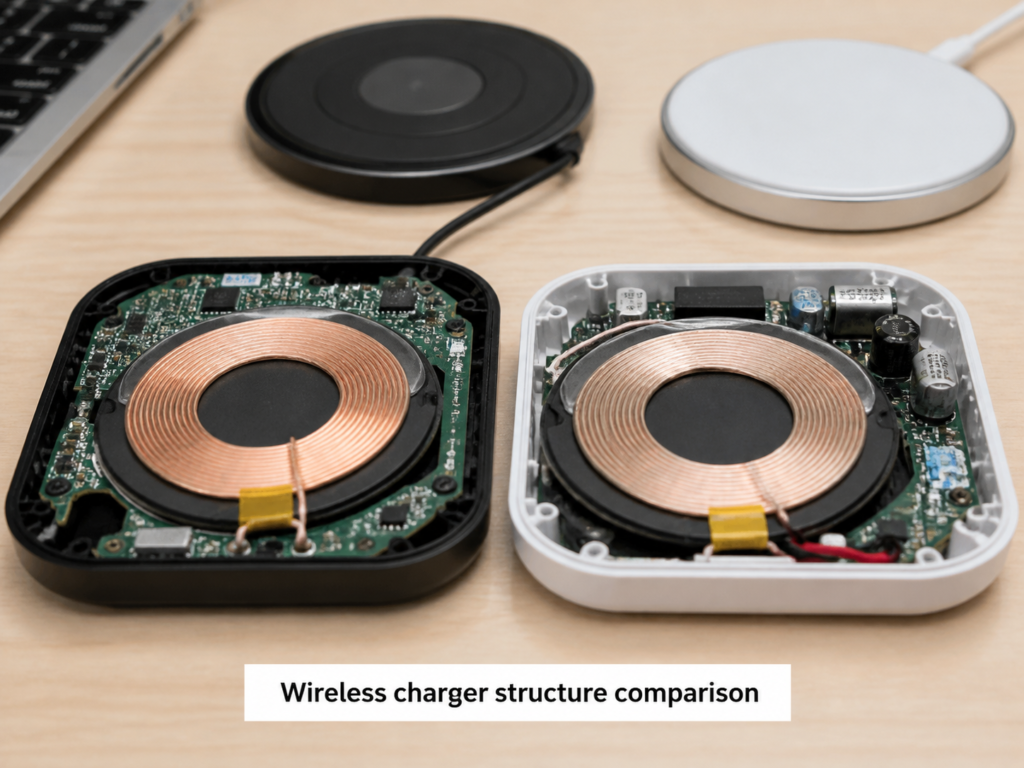
The general principle of judgment is: first disassemble the product into various components – such as the charging pad, built-in AC power supply, integrated plug, external adapter, USB cable, and communication module – then verify against the DENAN list of electrical appliances and materials and the sales unit; it is not just a matter of checking whether there is a plug. The final judgment shall be confirmed in combination with product classification, rated parameters, structure, and sales unit.
Which products should be prioritized for PSE list verification?
The first type is integrated wall-plug wireless chargers with a built-in Japanese standard AC plug. Because they are directly connected to the mains supply, they will most likely need to be checked against the list classification;
The second type is Japanese standard AC power adapters and USB chargers sold together with the set. These themselves are common PSE-regulated products.
These Situations Usually Do Not Require Separate PSE Application (Verification Still Required)
There are two situations where the charging pad usually does not need to apply for PSE separately, but note that this is only “usually”, and the final judgment shall be subject to the list:
The first is the charging pad itself that only has low-voltage DC input such as USB, USB-C, or car cigarette lighter, because it is not directly connected to the mains supply, and the power comes from an external adapter;
The second is when the AC adapter in the split set already has compliant PSE, and the model, parameters, and responsible entity are all consistent, the charging pad does not need to apply for PSE separately.
But there is an exception here: if it is an integrated wall-plug wireless charger, even if the internal adapter module used is certified, the list classification must be verified based on the whole machine, and you cannot claim the whole machine is compliant solely by relying on the module’s certificate.
Here is a quick preliminary screening tip: first check whether the product’s input is a mains AC plug, not whether it has USB output – of course, this is only a reference for preliminary screening, and the final decision shall be subject to the list.
What Is the Difference Between Diamond PSE and Round PSE?
Many people cannot distinguish between diamond and round PSE. In fact, the core difference is the risk level:
• Diamond PSE: corresponds to “specified electrical appliances and materials”, that is, products with relatively high risks. They must be inspected by a Japanese registered certification body, and the diamond mark can only be affixed after obtaining the certificate;
• Round PSE: corresponds to “non-specified electrical appliances and materials”, with relatively lower risks, but it does not mean no management is required – the responsible entity still needs to complete technical confirmation and product inspection, and keep all records before affixing the round mark.
Whether it is diamond or round, affixing the PSE mark on your own without completing the compliance procedure is a violation.
Common Certification Misconceptions to Avoid
When applying for wireless charger certifications for the Japanese market, the pitfalls many sellers have encountered are actually similar. We have compiled 7 of the most common misconceptions, so you can avoid them in advance:
1. Scope Misconception: Thinking They Are Asia-Pacific Universal Certifications
Many people think TELEC and PSE are Asia-Pacific universal certifications, but they are not – both are Japan-exclusive market access requirements. Other Asia-Pacific countries and regions such as South Korea, Singapore, and Australia have their own safety and wireless certification rules, which cannot replace each other.
2. Mutual Substitution Misconception: Thinking the Two Certifications Can Replace Each Other
Some people think that if you have one, you don’t need the other, which is also wrong. The two certifications regulate completely different dimensions: one manages wireless interference, the other manages electrical safety. Neither can replace the other, and whichever is required must be applied for.
3. Qi Certification Misconception: Thinking Having Qi Certification Eliminates the Need for Statutory Certifications
Many sellers will say, “I have Qi certification, why do I still need to apply for TELEC or PSE?” This is confusing industry compatibility certification with statutory access certification. Qi Certified is an industry conformity certification carried out by the Wireless Power Consortium (WPC) based on the Qi specification, covering interoperability and related performance and safety requirements specified in the specification. The specific test scope depends on the Qi version and product category. However, it is not a Japanese PSE mark or a technical standards conformity certificate under the , and cannot replace the corresponding statutory obligations.
4. Module Certification Misconception: Thinking a Certified Module Means the Whole Machine Is Compliant
This is the most easy-to-fall-into pitfall – many suppliers say, “My wireless module already has a TELEC certificate, so the whole machine doesn’t need to be certified.” In fact, a module obtaining a technical standards conformity certificate does not mean it is still compliant after being installed in any whole machine. To reuse the module’s Giteki certification materials, the key points to verify are:
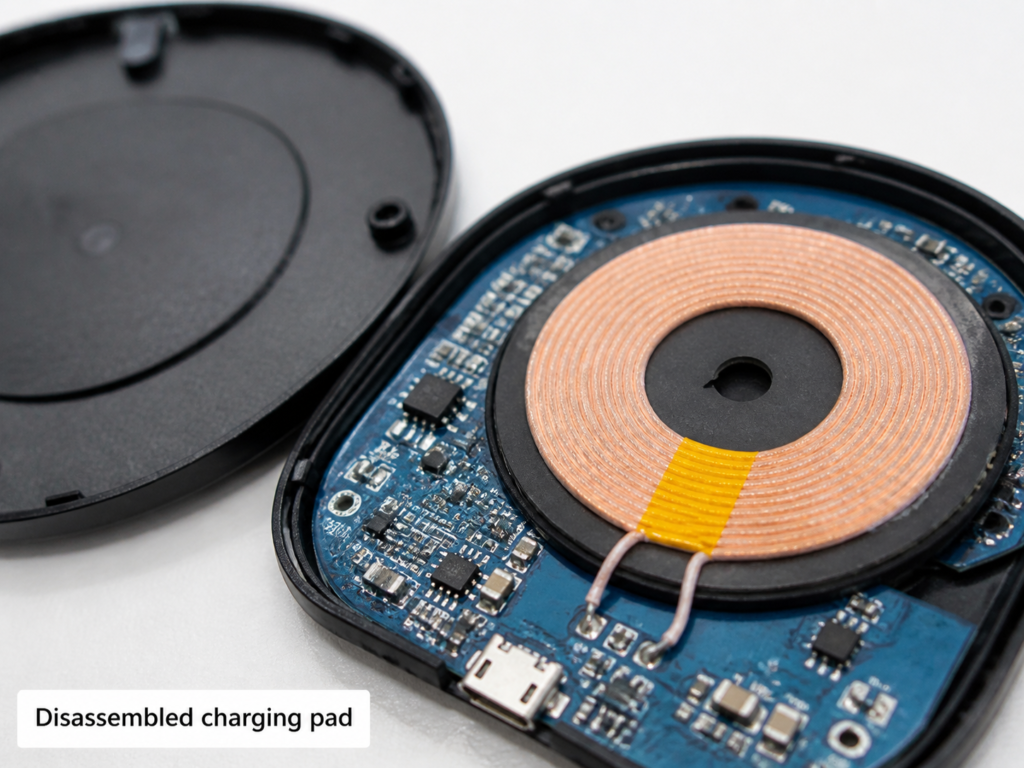
• Whether the frequency bands and transmission modes covered by the certificate and technical materials are consistent with those actually used by the whole machine;
• The antenna model and gain are the same as those filed for certification;
• The installation position and isolation conditions of the module meet the certification requirements;
• The firmware version and regional version are consistent with those at the time of certification;
• The host device has not changed RF exposure and antenna characteristics;
• Whether the Giteki mark is labeled as required;
• Any design change requires re-verification of compliance.
If the host integration changes the conditions of the certified device, or the certificate and technical materials do not cover the actual configuration, reconfirmation shall be made with the registered certification body or competent authority. Do not take “the host whole machine model must be listed in the module certificate” as a general premise of the Japanese system.
5. Hidden Function Misconception: Thinking Disabling Wireless Functions Eliminates the Need for Certification
Some people play tricks and say, “I have disabled the Bluetooth function with firmware, so users can’t see it, so there’s no need to apply for Giteki.” Software disabling alone cannot be used as a basis for automatic inapplicability. If a product can enable regulated radio transmission functions through APP, firmware upgrade, hidden menu, or other foreseeable ways when sold, installed, or used in Japan, the requirements of the shall be re-verified according to the actual available configuration.
Conversely, if the function has been permanently removed from the product configuration and is indeed unenableable, confirmation shall also be made with the certification body or competent authority based on specific technical facts, rather than making a uniform conclusion solely based on the hardware’s potential capability.
6. Set Misconception: Thinking Only One Certification Is Needed for a Set
Many people sell sets of wireless charger + adapter, thinking that only one certification is needed. If it is a split set, the compliance requirements of each component shall be judged separately: the adapter must comply with PSE, and the charging pad shall be judged according to its own situation; if it is an integrated wall-plug model, the requirements shall be met based on the whole machine, and cannot be calculated separately.
7. Document Verification Misconception: Only Checking “Whether There Is a Certificate” Without Verifying Details
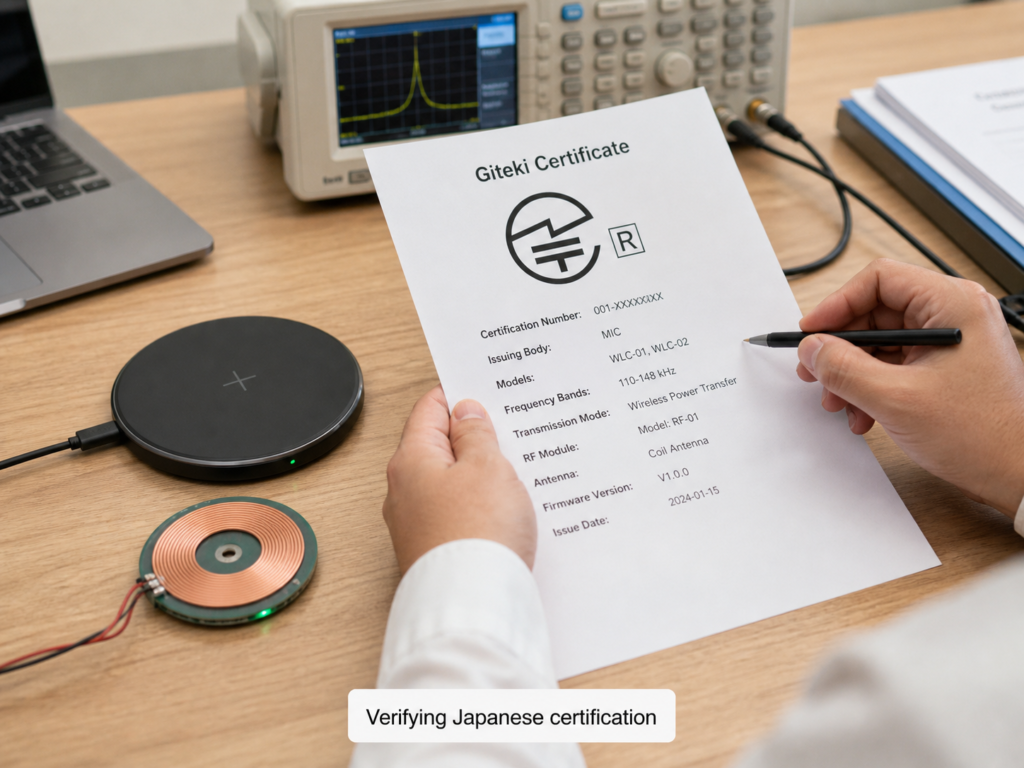
Many people ask suppliers for certificates and only check “whether there is a certificate” without verifying the details at all. As a result, they find the certificate is incorrect when it is inspected by customs or the platform. When verifying a Giteki certificate, it is necessary to check whether the certification number and issuing body are valid, whether the covered models, frequency bands, and transmission modes are correct, and whether the RF module, antenna, and firmware parameters are consistent with those filed; Giteki does not have a regular validity period, but it is necessary to confirm that the installation conditions and design changes are consistent with those at the time of certification; it is also necessary to confirm that the technical standards conformity mark is labeled as required by the and is consistent with the certified device. Usually, it shall be labeled on the device in the prescribed manner; for modules, small devices, or devices that are difficult to label directly, it shall be confirmed according to applicable rules whether allowed alternative methods such as packaging, manuals, or electronic display can be used.
When verifying a PSE certificate, it is necessary to check whether the mark is diamond or round and whether it matches the product category; the rated voltage, frequency, and power are consistent with the product; the name and mark of the responsible entity are consistent with those filed; the product model is consistent with the certification/technical documents; inspection and conformity documents are complete; if it is a set, the adapter model must be completely consistent with the label and certification documents.
Implementation Action List
After reading the above content, you may already have a preliminary judgment. Next, let’s talk about what needs to be done for actual implementation:
First, after the preliminary screening, you need to prepare the following materials to facilitate subsequent evaluation by the agency: product specification sheet (which must clearly state input and output parameters and wireless function description), circuit block diagram, RF module parameters (to be provided if there is a wireless function), product structure description (whether it is integrated or split, what the input interface is, BOM composition), sales form description (whether it is a single product or a set, what components are in the set), target sales channels, and information on the responsible entity within Japan.
Then, before selling in the Japanese market, several things must be done: first, confirm the PSE-related responsibility arrangements for manufacturing, import, and sales; second, entrust a Japanese registered certification body or a professional regulatory consultant to make the final category judgment, and do not make a decision on your own; third, complete the Giteki or PSE compliance procedure as required and affix the mark correctly; fourth, keep the full set of conformity documents for inspection by the platform, customs, and regulatory authorities.
Finally, it should be reminded that if the product has undergone design changes, compliance must be re-verified: if the RF module, firmware, antenna, or wireless function is changed, Giteki must be re-verified; if the power supply structure, input parameters, AC plug, or sales unit is changed, PSE must be re-verified; any design change that may affect compliance requires advance confirmation of whether re-application is needed, and do not wait until a problem occurs to remedy it.
Frequently Asked Questions
**Can Qi certification replace Japanese TELEC or PSE?**
No. Qi Certified is an industry conformity certification carried out by WPC based on the Qi specification, covering interoperability and related performance and safety requirements specified in the specification. However, it is not a Japanese statutory access certification and cannot replace Giteki or PSE.
**The wireless charger module has a TELEC certificate, does the whole machine still need certification?**
It is necessary to verify the coverage of the module certificate and technical materials, and confirm whether the actual frequency band, transmission conditions, antenna, installation status, and software and hardware configurations are consistent. If the certified conditions are changed after integration, or the materials do not cover the actual configuration, reconfirmation with the certification body or competent authority is required.
**Can the round PSE mark be affixed without testing?**
No. Round PSE corresponds to non-specified electrical appliances and materials. Although it does not require a third-party agency to issue a certificate, the responsible entity still needs to complete technical confirmation and product inspection, and keep all records before affixing the round PSE mark; it cannot be affixed casually.
**Do wireless chargers shipped directly to Japan via cross-border e-commerce also need to comply with these certifications?**
For cross-border direct shipping, overseas warehouse stocking, or local sales in Japan, PSE and obligations shall be confirmed separately based on whether the product is a DENAN-listed electrical appliance and material, whether it contains regulated radio transmission functions, and the actual import and sales arrangements. Compliance requirements cannot be directly excluded just because it is cross-border sales.
In general, there is no one-size-fits-all answer to whether wireless chargers need both TELEC and PSE certifications. The core depends on the product’s function, structure, and sales market. You can first conduct a preliminary screening according to the steps we mentioned, but in the end, you must find a professional Japanese compliance agency to confirm. Do not make judgments on your own based on experience or scattered information on the Internet, to avoid unnecessary losses.