
Sellers of charging products targeting the Japanese market have most likely had this thought: since they already have UL reports or UL certifications for the North American market, can they directly convert them to PSE certification to save a large amount of testing fees? Some intermediaries even promote slogans like “Convert UL to PSE, get the certificate in one week”, which sounds very attractive.
Let’s first state the core conclusion clearly: **There is no official direct channel for converting UL to PSE certification**. UL documents cannot be directly exchanged for a PSE certificate, nor can products be sold with labels directly based on them. However, this does not mean that UL documents are completely useless—if the documents are qualified, the product is compatible, and the process is compliant, part of UL’s test data can be accepted by PSE certification bodies to reduce the cost of repeated testing. Especially for charging products such as AC chargers and power adapters, since the safety standards on both sides have a high degree of homology, the probability of data reuse is relatively higher.
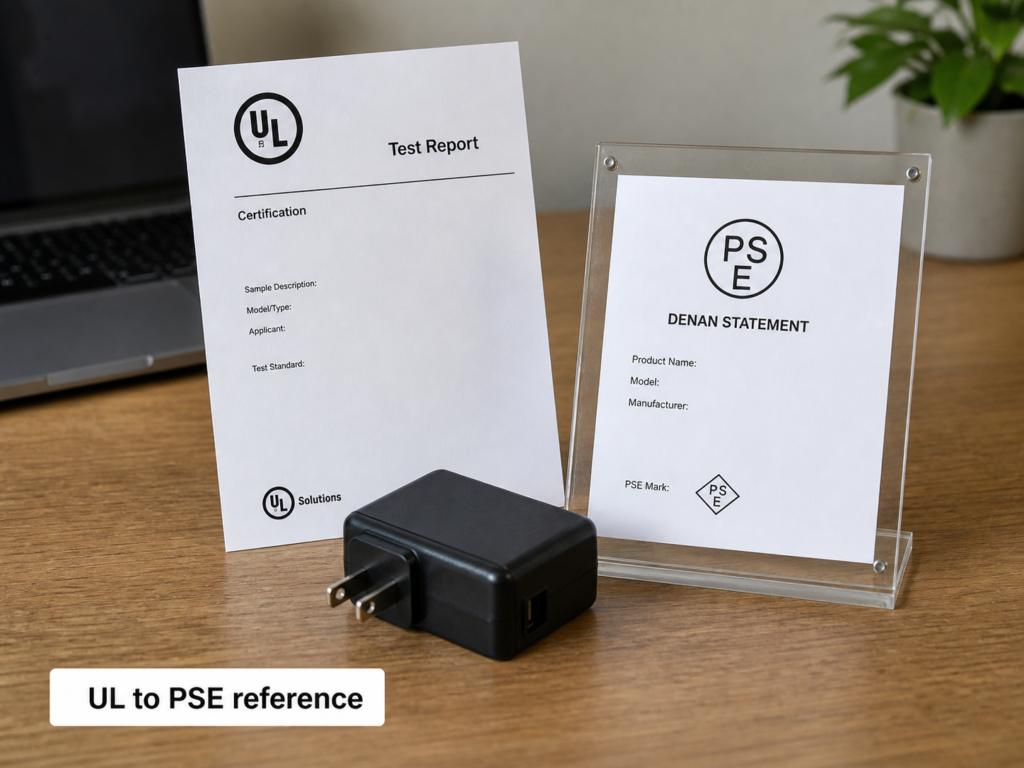
Next, let’s clarify two concepts that are most easily confused, which is also where many intermediaries take advantage of loopholes: what many people call “UL to PSE conversion” is actually “reusing UL test data”, not “direct certificate conversion”. The misconception is that submitting a UL report can directly get a PSE certificate, without going through the formal PSE process, and products can be sold with labels directly; the actual logic is that UL documents can only be used as a technical reference when applying for PSE, for difference assessment—even if part of the data is accepted, it does not mean automatic exemption from all requirements. The complete PSE application process must still be followed, and all required supplementary tests and procedures are indispensable.
The reuse rules discussed in this article mainly target charging-related products such as AC chargers, power adapters, and USB charging cables with active circuits; whether ordinary passive USB cables and data cables can use these rules needs to be judged first according to Japan’s statutory product categories; non-charging products such as toys and large household appliances are not applicable to the conclusions of this article. In addition, note that the reuse mentioned here only involves the electrical safety requirements of PSE. Other requirements such as Japan’s Radio Law and battery regulations need to be confirmed separately, and UL documents do not cover these.
First, let’s clarify what “UL documents” mentioned in this article refer to: they refer to all technical documents on product safety performance issued by the UL system, including UL test reports, UL listing certificates, etc. Different types of UL documents have very different reusability, which will be explained in detail later. Let’s mention here first: if you only have UL listing information or official website screenshots, you should contact the customer of the UL certification file, the certificate holder, or its authorized party to obtain technical documents available for assessment. UL public inquiry information usually cannot replace complete technical documents; which specific documents are acceptable and whether supplementary testing is required should be confirmed by the body responsible for conformity assessment or the Japanese importer based on the product and applicable technical standards.
Application Prerequisite: First Conduct PSE Product Category Determination
Before considering whether UL documents can be reused, there is a more important prerequisite: does your product need PSE certification at all? This requires first conducting product category determination. If the product is not in the PSE regulated product categories at all, there is no question of reusing UL documents.
Core Logic of Product Category Determination
The core logic of product category determination is: first confirm whether the product is in the listed product categories of the ; if it is, then determine whether it belongs to diamond-shaped specified electrical appliances or circular non-specified electrical appliances.
When making the determination, you cannot only look at the product name; you must make a comprehensive judgment from the dimensions of product category, rated parameters, structure and function, and sales form. For example, you cannot assume that a product does not need PSE just because it is called a “charging cable”, nor can you assume that it must need PSE just because it has a chip. You need to see what the chip is used for, whether it is connected to the mains, and what the power is. Ordinary users can first make a preliminary judgment based on the following reference for charging products, but the final result must be subject to the official product category list or the conclusion of RCAB. Do not make random judgments on your own and waste money.
Preliminary Determination Reference for Charging Products
For the charging products that everyone most commonly deals with, we have compiled a preliminary determination reference, which you can check first:
1. AC chargers and power adapters directly connected to the mains: almost all are in the listed product categories, and most belong to diamond PSE (specified electrical appliances).
2. Passive USB cables (only wires and connectors, no circuits at all): most are not in the mandatory regulation scope and do not need PSE.
3. USB-C cables with only E-Marker chips (the chip is only used to identify the power of low-voltage charging, without boost or voltage regulation functions): usually not in the listed product categories either.
4. Charging cables with active boost/voltage regulation circuits (for example, cables that can raise low voltage to high voltage to charge laptops): need to be specifically judged in combination with circuit structure and rated parameters, and cannot be generalized.
5. Cords and extension cords directly connected to the mains side: need to be evaluated separately according to the wire and cable product category, and are not considered accessories.
As the saying goes: this is only a preliminary reference, and the final determination is subject to the official product category list and the confirmation of RCAB or the Japanese responsible entity.
Document Package to Prepare for Product Category Determination
If you want to find a body or Japanese importer to conduct product category determination, preparing these documents in advance can save a lot of time:
• Basic product information: rated input/output parameters, plug/power cord specifications, whether it is directly connected to the mains, whether it has an AC socket;
• Product certification materials: photos from all angles, principle block diagram, BOM list of key components;
• Sales information: whether it is sold separately or as a set, what is included in the set, whether it has a built-in battery or wireless charging module.
Practical Operation Process for Charging Products (Taking Mains AC Chargers as an Example)
After talking about the rules, you may still not know how to do it specifically. Next, we will take the most common mains AC charger as an example to walk you through the practical operation process. Other charging products can also refer to this logic.
Step 1: Pre-Self-Check (Can Save a Lot of Time and Money)
Before officially contacting a body, do a self-check first. If you can’t even meet the basic conditions, there’s no need to waste time:
1. First complete PSE product category determination: confirm whether the product is within the regulation scope, and whether it is diamond or circular PSE;
2. Check UL documents: whether they are complete, whether the standards match, whether the authenticity can be traced;
3. Complete sample consistency check: against the core comparison items mentioned earlier, confirm item by item whether the configuration of the product applying for PSE is consistent with the UL test sample; if there are differences, prepare difference analysis documents;
4. Confirm compliance foundation: whether there is a local Japanese statutory responsible entity, and whether the product parameters can cover Japan’s 100V/50-60Hz mains.
Step 2: Submit Documents for Difference Assessment
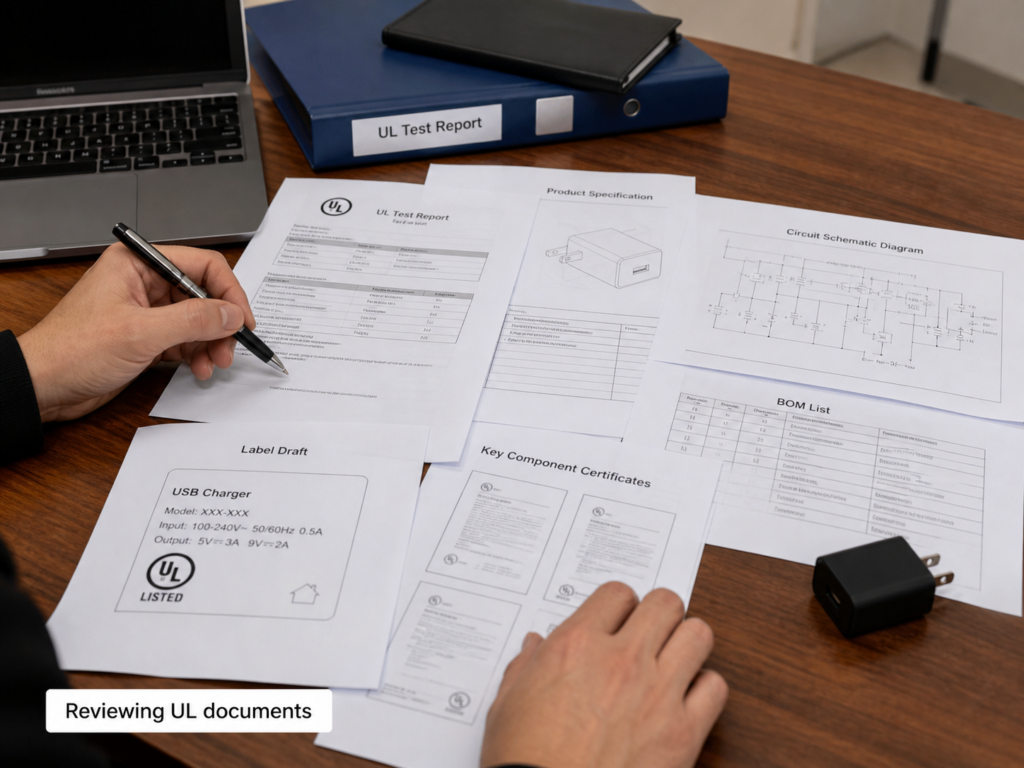
If there is no problem with the self-check, for diamond PSE products, the documents can be submitted to RCAB for technical confirmation or difference assessment before the suitability inspection; for circular PSE products, the entity responsible for manufacturing or import and handling business notification can confirm by itself, or entrust a laboratory or consultant to conduct difference analysis as needed.
The documents that need to be submitted generally include: complete UL test report, product specification, circuit schematic diagram, BOM list, key component certificates, and label draft.
After the assessment is completed, the body will generally provide you with the following contents: confirmation of product category and applicable standards, the reusable scope of UL documents, the list of tests or documents that need to be supplemented, specific process requirements, estimated cycle and required sample quantity.
Here is a reminder: some bodies provide difference assessment for free, some charge for it, and some only state the differences verbally without issuing a written list. It is best to ask clearly about the charging method and output content before entrusting, to avoid disputes later.
To facilitate your own preliminary check, we have compiled the core difference check dimensions between UL and PSE:
| Check Dimension | Specific Check Content |
| Standard Version and National Differences | What is the standard version of the UL report, whether it includes Japanese national differences, and whether the standard applicable to PSE is currently valid |
| Rated Operating Conditions | Whether the input covers 100V/50-60Hz, and whether the output parameters meet Japanese requirements |
| Structural Components | Whether the plug/power cord complies with Japanese standards, and whether key safety components meet PSE component requirements |
| Labeling Requirements | Whether the PSE mark and the statutory labeling items specified for this product category are complete, and whether their position and specifications meet the requirements; and confirm whether Japanese instructions, warnings or labels are required according to the product category and other applicable regulations |
| Document Requirements | Whether there are complete BOM, circuit schematic diagram, key component certificates, etc. |
Step 3: Supplement Difference Items (If Any)
After the assessment, there are usually difference items that need to be supplemented. Common difference items include: testing under 100V input operating conditions, testing of Japanese standard plugs, Japan-exclusive technical requirements, and labeling compliance review.
Supplementary test samples should be able to represent the final mass production configuration; if there are differences in model, key components, structure, rated parameters or factory between the test sample and the mass-produced product, the difference analysis must be completed first, and documents or tests should be supplemented according to the impact of the differences, and the relevant data can only be used after the coverage scope is confirmed.
As before: there is no fixed reuse ratio. How much can be reused specifically depends on the quality of the UL report, the consistency of the samples, and the size of the technical differences. Some products may only need to supplement a few tests, while some may need to supplement most of them, which is all normal.
Step 4: Complete the Compliance Process (Divided into Diamond/Circular)
After supplementing the differences, you can proceed with the formal compliance process. The processes for diamond and circular PSE are different:
• **Diamond PSE**: RCAB will review all documents and supplementary test reports, and some also require factory inspection—note here that UL follow-up inspection cannot directly replace PSE factory inspection. Whether it is required and how to conduct it are subject to RCAB’s requirements. After passing the review, a suitability inspection certificate will be issued, and you can affix the diamond PSE mark on the product.
• **Circular PSE**: The entity responsible for manufacturing or import in accordance with the law and handling business notification shall organize all technical documents (including UL reports and supplementary test documents), complete conformity confirmation, implement statutory inspection and keep records, and then affix the circular PSE mark as required. How responsibilities are allocated and the specific requirements for notification shall be confirmed by the local Japanese compliance entity. Overseas sellers should not mess around on their own.
Step 5: Subsequent Compliance Maintenance
After obtaining PSE certification or completing self-confirmation, it is not once and for all:
• If there are changes to the product, such as replacing key components, modifying the structure, or changing parameters, be sure to re-evaluate the compliance in advance, and no unauthorized changes are allowed;
• Diamond PSE also needs to accept subsequent supervision and inspection according to RCAB’s requirements;
• If the applicable standards or regulations are updated, the validity of existing documents should also be re-evaluated to avoid non-compliance.
Quick Judgment and Summary
After talking so much, you may find it a bit complicated. Here we have compiled a 3-step quick self-check method, you can first make a preliminary judgment by yourself:
Step 1: First conduct product category determination to confirm whether the product is within the PSE regulation scope, and whether it is diamond or circular PSE;
Step 2: Check UL documents and products: whether the UL documents are complete and traceable, whether the configuration of the product applying for PSE is consistent with the UL test sample, whether the difference analysis has been completed if there are differences, and whether the product parameters meet Japanese requirements;
Step 3: For diamond PSE products, you should find an RCAB registered with METI to conduct suitability inspection and related technical confirmation; for circular PSE products, the entity responsible for manufacturing or import in accordance with the law and handling business notification shall confirm compliance with technical standards, and may entrust a laboratory or consultant to conduct difference analysis when necessary. Self-judgment can only be used as a reference.
If you are going to consult a certification body, preparing these documents in advance can save a lot of time:
• Product information: model sold in Japan, rated parameters, plug specifications, sales form, product photos, structure description;
• UL documents: complete report or certification documents, standard version, test date, key component list, model difference table (if any);
• Core questions you need to confirm: product category classification, reusable scope of UL documents, items that need to be supplemented, specific process, cycle and cost.
Another point to remind: some products do not need to apply for PSE. For example, products confirmed by category determination not to be within the scope listed in the , such as ordinary passive USB cables, do not need to apply, nor can they falsely label the PSE mark or claim to have obtained PSE certification for marketing purposes. Of course, if products not within the PSE scope are sold in combination with other regulated products, the overall safety requirements must still be confirmed, and non-compliant products cannot be casually tied for sale.
Finally, to summarize:
UL reports or UL certification documents are only technical references for PSE applications, and there is no official direct conversion mechanism. Qualified UL documents can indeed reduce the cost of repeated testing, but the specific reuse amount is subject to the conclusion of the party responsible for conformity assessment, and there is no fixed ratio. For charging products, due to the high homology of standards, the reuse probability of UL documents is relatively higher, but it is not 100% reusable. The final compliance must still meet the technical requirements of Japan’s and corresponding product categories, and no cutting corners is allowed.
After reading this article, you can at least distinguish the essential difference between UL documents and PSE certification, and will not be fooled by the “direct certificate conversion” propaganda; you can also preliminarily complete PSE product category determination by yourself to avoid unnecessary certification costs; you can also check whether the UL documents you have meet the basic conditions for PSE application, judge the reuse possibility for different charging products, avoid common certification pitfalls, and take fewer detours.