
Sellers of charging products targeting the Japanese market often encounter an unavoidable question: I already have a PSE certificate, do I still need to do METI filing? Many people, because they cannot clarify the relationship between the two, either waste unnecessary money, or only regret it when their goods are detained by customs or removed from platforms.
Let’s first give you the most straightforward conclusion: **Before DENAN-regulated products are sold in Japan, they shall meet the applicable PSE compliance and labeling requirements; business operators that actually engage in the manufacturing or import of such products shall also complete METI manufacturing/import business notification. When a seller is also the manufacturer or importer, it usually needs to fulfill both types of obligations at the same time.**
The core judgment rule is actually very simple: as long as the product falls under the regulation scope of Japan’s (abbreviated as DENAN), the applicable PSE compliance and labeling requirements must be confirmed; if a local Japanese business operator actually engages in the manufacturing or import of the product, it also needs to complete METI filing. The division of labor between the two is completely different: PSE governs whether the product itself is safe, and METI filing governs who in Japan bears the statutory responsibility for the manufacturing or import link. Simply selling products that have been imported or manufactured by qualified notification business operators does not necessarily require the seller to make a separate notification, but it is still prohibited to sell products that do not meet DENAN labeling and other requirements.
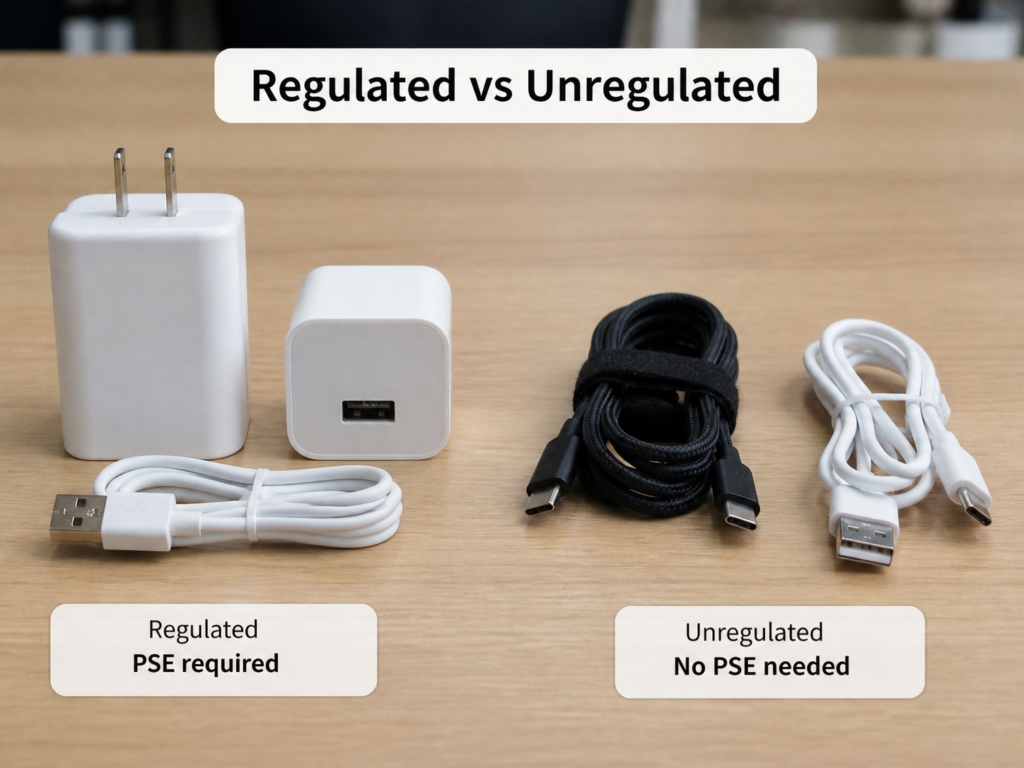
You can first make a preliminary judgment on common charging products (the final result shall be subject to the official DENAN catalog): most chargers with AC input and power adapters are regulated products, commonly applicable to round PSE; Japanese business operators that actually import such products need to complete METI filing; ordinary passive USB/USB-C charging cables and data cables require neither PSE nor METI filing; for charging sets, the regulated components sold independently inside need to be compliant, and non-regulated components can be judged according to their own attributes and sales forms.
First Understand the Two Core Concepts
Many people’s understanding of “PSE certificate” and “METI certification” is quite far from Japan’s statutory requirements. Let’s clarify the two concepts first, and the subsequent logic will naturally become clear.
PSE Compliance: Product Safety Access Threshold
The core role of PSE compliance is to standardize the safety performance of the product itself, and it is the basic safety compliance requirement for electrical appliances listed in the DENAN catalog when they are manufactured, imported and sold in Japan. The commonly said “PSE certificate” is only a general term in the market. At the statutory level, there are actually two categories, which are completely different:
• **Diamond PSE (specified electrical appliances)**: For high-risk products, safety inspection (officially called “conformity inspection”) must be carried out by a METI-registered conformity assessment body. After passing the inspection, the body will issue a statutory conformity inspection certificate, which is commonly known as the “diamond PSE certificate”.
• **Round PSE (non-specified electrical appliances)**: For products with lower risk, **there is no officially issued “certificate”**; Japanese business operators that have completed METI filing (also known as “notification business operators”; “notification” means “declaration and filing” in Japanese) self-confirm that the product meets safety standards, and keeping inspection records on file counts as compliance.
Whether a specific product belongs to diamond or round PSE is completely divided according to the risk level, subject to the attached table catalog of DENAN, and is not chosen by the enterprise itself.
METI Filing: Responsibility Declaration of Business Entities
The statutory full name of METI filing is “electrical appliance manufacturing/import business notification”, which is required by the Japanese Ministry of Economy, Trade and Industry (METI for short). Its essence is **the declaration obligation of the business entity, not product certification** — it neither conducts safety approval for individual products nor issues product-level certificates.
Its core role is very clear: to clarify the responsible entity engaged in manufacturing or import business in Japan. In case of safety problems with the product, the government can directly find the corresponding Japanese business operator to be responsible for follow-up matters such as traceability and recall, which is equivalent to finding a local Japanese “safety responsible person” for the product.
Why Can’t the Two Replace Each Other?
After understanding the concepts, you will understand that PSE and METI filing are completely two lines of regulatory requirements. For business operators that actually manufacture or import DENAN-regulated products, both requirements usually need to be met. We have sorted out the core differences into a table for your quick comparison:
| Comparison Dimension | PSE Compliance | METI Filing |
| Regulatory Object | Safety performance of the product itself | Responsibility declaration of local Japanese manufacturing or import business operators |
| Obligation Subject | Overseas factories and brands can cooperate to complete | Submitted by local Japanese business operators that actually engage in manufacturing or import business |
| Core Voucher | For diamond PSE: conformity inspection certificate issued by a registered conformity assessment body; for round PSE: compliance inspection records | Notification declaration documents and acceptance vouchers |
| Approval Attribute | Diamond PSE involves statutory conformity inspection implemented by a registered conformity assessment body; round PSE involves self-confirmation by the subject and performance of statutory inspection | No product-level approval, only subject information declaration |
Many people fall into two common misconceptions: either they think that PSE certificates can be borrowed across entities, and as long as the product has a certificate, it is the same for anyone to sell; or they think that METI filing is a product certification with a public query system. Both of these cognitions are wrong, and we will explain the pitfall avoidance methods in detail later.
Dual Compliance Is Required Throughout the Entire Chain
Don’t think that compliance is only for passing customs; the entire Japanese sales chain will conduct verification:
• **Customs clearance**: When importing, it shall be ensured that the import subject, applicable items, PSE labeling and related compliance materials meet DENAN requirements. Customs or competent authorities may require notification, conformity inspection or other compliance materials during specific inspection, review or other procedures; they shall be submitted according to actual requirements and the information shall be consistent.
• **E-commerce platform listing**: Platforms such as Amazon Japan and Rakuten may require uploading of compliance vouchers, authorization letters, etc. when listing regulated electrical products, and listing is not allowed if the review fails.
• **Regulatory authority spot checks**: The Japanese Ministry of Economy, Trade and Industry and local regulatory authorities will conduct irregular spot checks. Enterprises that are sampled need to provide corresponding product compliance files and filing certificates, and non-compliance may face penalties and product recalls.
A special reminder here: **passing platform review and customs release does not mean that statutory compliance has been completed**. Many sellers think that everything is fine after passing these two levels, but as a result, they are later sampled by regulatory inspections and still fined due to incomplete materials or inconsistent information. This risk must be paid attention to in advance.
3-Step Compliance Judgment Method for Charging Products
For charging products, you can follow the 3 steps below to judge step by step whether you need to do METI filing, without asking around everywhere.
Step 1: First Determine Whether the Product Is Under DENAN Regulation
This is the premise of all compliance. Before judgment, 6 core product information need to be collected first, and missing any one may lead to wrong judgment:
1. The real name and actual function of the product (cannot just write “digital accessories”, must be a specific name like “20W USB-C power adapter”);
2. Whether it is directly connected to AC mains (that is, whether it can be directly plugged into a household wall socket);
3. Parameters such as rated input/output voltage and current (the numbers marked on the product nameplate);
4. Whether it includes AC/DC conversion or charging management functions;
5. Whether it is sold separately or as an accessory of a set;
6. Product model, structure, key components and manufacturing factory information.
After collecting all of them, verify one by one against the item scope of the DENAN attached table, and you can determine whether it is a regulated product. Several boundary cases that people often ask about can be referred to first:
• Charging/USB-powered devices with built-in power supply: judged according to the overall function and rated parameters. For example, a power bank with an AC plug cannot be classified only as a “power bank”, but must be judged in combination with the input function.
• Cable products: ordinary passive USB/USB-C cables are not regulated products; even with an E-Marker chip, it does not necessarily trigger PSE requirements. Only when the cable integrates independent regulated functions such as power conversion and AC plug modules, further confirmation is needed.
• Charging sets: if the regulated components in the set (such as chargers) are imported and sold independently, the filing items of the corresponding business operators need to cover the product; non-regulated components (such as data cables) can be judged according to their own attributes and sales forms.
If you are not sure, don’t guess blindly. It is recommended to entrust a formal compliance service provider or a Japanese accredited institution to conduct attribute judgment to avoid subsequent problems.
Step 2: Confirm the Corresponding PSE Compliance Obligation Type
After confirming that it is a regulated product, first clarify the corresponding PSE compliance type:
• If it is diamond PSE (specified electrical appliances): it is necessary to complete the conformity inspection of a Japanese registered institution and keep a complete technical file.
• If it is round PSE (non-specified electrical appliances): the Japanese notification business operator confirms that the product meets the technical standards, implements factory/batch inspection and keeps records. Note: the test report of a third-party laboratory is only evidence of compliance, not equivalent to statutory approval; it is not that “having a report equals having round PSE”.
• If it is not a DENAN-regulated product: no PSE-related obligations need to be fulfilled.
Whether it is diamond or round PSE, **PSE document consistency check must be performed**: verify whether the applicant, manufacturing factory, model (including derivative models), rated parameters, key components, applicable standards, and issuing institution status are all matched. In particular, the conformity inspection certificate of diamond PSE must not be borrowed across factories, product structures, or responsible subjects.
Step 3: Confirm Whether METI Filing Obligation Needs to Be Fulfilled
The last step to judge whether filing is needed can be divided into three categories according to scenarios:
• **Filing is mandatory**: Local Japanese business operators that actually engage in the manufacturing or import of DENAN-regulated products need to fulfill the METI filing obligation. In scenarios such as offline distribution, Japanese warehouse delivery, and FBA warehousing, it shall be confirmed who is responsible for filing in combination with the actual import subject; if the seller is also the manufacturer or importer, it usually needs to complete both PSE compliance and METI filing at the same time.
• **Confirmed on a case-by-case basis**: For scenarios that are not clearly commercial circulation, such as personal carry-on, exhibition samples, test prototypes, and cross-border direct mail, it cannot be directly judged whether it is needed or not. It needs to be comprehensively judged in combination with the import declaration name, ownership of goods, logistics path, and whether it is for personal use. You can quickly sort it out with four questions: Who imports in what name? When does the ownership of goods transfer? Is it first stored in a Japanese warehouse/FBA? Is the consumer using it for personal use? Don’t draw a conclusion directly based only on the store registration location, platform name, or logistics model.
• **No filing required**: If the product itself does not fall under the DENAN regulation scope, naturally there is no need for METI filing; simply selling products that have been manufactured or imported by qualified notification business operators also does not necessarily require the seller to make a separate notification.
How to Find the Responsible Subject? Responsibility Division Under Different Transaction Models
Many people will ask: I am an overseas seller and do not have a Japanese company, who will do the METI filing? This requires first clarifying the statutory responsible subject: **Notification business operators that actually engage in the manufacturing or import of electrical appliances may be legal persons or individual operators, and shall bear their statutory responsibilities for notification, compliance with technical standards, inspection, labeling and related safety. Other sales subjects shall also abide by statutory obligations such as not selling products that do not meet DENAN requirements.**
The responsibility division under common transaction models can be referred to:
• **Own Japanese legal person**: use your own Japanese company as the responsible subject, fulfill the filing obligation by yourself, and bear the corresponding statutory responsibility.
• **Cooperation with local Japanese distributors/importers**: if the cooperating importer actually engages in import business, it shall complete the filing as the statutory responsible subject, and both parties shall agree on rights and responsibilities in advance.
• **Cross-border e-commerce FBA/platform model**: usually requires local Japanese business operators that actually engage in import business to fulfill the filing obligation, which shall be specifically confirmed in combination with the import declaration subject and the node of goods ownership transfer.
• **Third-party service provider declaration on behalf**: the service provider only assists in submitting materials and does not replace the statutory responsibility. If there is a real problem, the notification subject that actually undertakes the manufacturing or import business shall bear the corresponding responsibility.
When verifying the responsible subject, you must pay attention to two points: first, confirm that the Japanese subject is a legally registered enterprise with normal operating status; second, keep the written agreement on responsibility division to avoid subsequent rights and responsibilities disputes.
METI Filing and Compliance File Management
Filing is not done after submitting the materials. Subsequent file management and change handling are equally important, otherwise it is easy to waste all previous efforts.
Basic Requirements for Filing
The statutory processing time limit is **within 30 days after the start of the electrical appliance manufacturing/import business**. In practice, it is recommended to complete item confirmation, material preparation and submission before the business starts, to avoid customs or platform blocking due to unfinished filing.
Filing shall be submitted to the Japanese Ministry of Economy, Trade and Industry or the corresponding Bureau of Economy, Trade and Industry according to the jurisdiction, and the specific method shall be subject to the current official guidelines. It should be noted that METI filing has no fixed processing cycle, because it does not conduct product-level approval, but only the declaration of subject information.
Four Types of Compliance Files Must Be Distinguished
Many sellers pile up all compliance materials together, and are in a hurry when it comes to spot checks. In fact, they can be divided into four categories according to their uses, and the requirements for each category are very clear:
1. **Notification declaration materials**: used to prove that the business entity has completed the statutory declaration. Typical documents include Japanese subject registration certificate, business item classification description, and notification acceptance voucher. It is required that the subject information and business items match the actually sold products.
2. **PSE compliance evidence**: used to prove that the product meets the safety technical standards. Typical documents include diamond PSE conformity inspection certificate, round PSE test report/compliance declaration, specification sheet, key component list, and nameplate photo. It is required that the model, factory, rated parameters, and key components are consistent with the actual product.
3. **Statutory inspection records**: used to prove that the business operator has fulfilled the factory/batch inspection obligation. Typical documents include batch inspection reports and factory inspection records. It is required that the inspection items and judgment results meet the technical requirements of the corresponding items.
4. **Platform/customs clearance additional materials**: used to meet the requirements of commercial customs clearance and platform listing. Typical documents include filing receipts, authorization letters, and product compliance commitment letters. It is required that the information is consistent with the statutory compliance files, and fraud is prohibited.
These materials shall be managed and stored separately according to document categories with corresponding retention periods. Among them, Article 8 of DENAN requires notification business operators to keep statutory inspection records for 3 years from the date of inspection; for conformity inspection certificates, notification materials, technical materials and platform materials, the retention period shall be determined respectively according to applicable regulations, certificate conditions, requirements of competent authorities and commercial contracts, and shall not be uniformly calculated as 3 years after the cessation of manufacturing or import.
Labeling Requirements and Consistency Check
Only electrical appliances regulated by DENAN need to be marked with corresponding labels as required. DENAN labels shall at least indicate the corresponding PSE mark, the name of the notification business operator (or the prescribed abbreviation), as well as the rated voltage, rated power and other information required by the item according to the applicable item. Whether it is necessary to mark the address or other information shall be confirmed according to the applicable DENAN enforcement rules, item requirements and other applicable regulations.
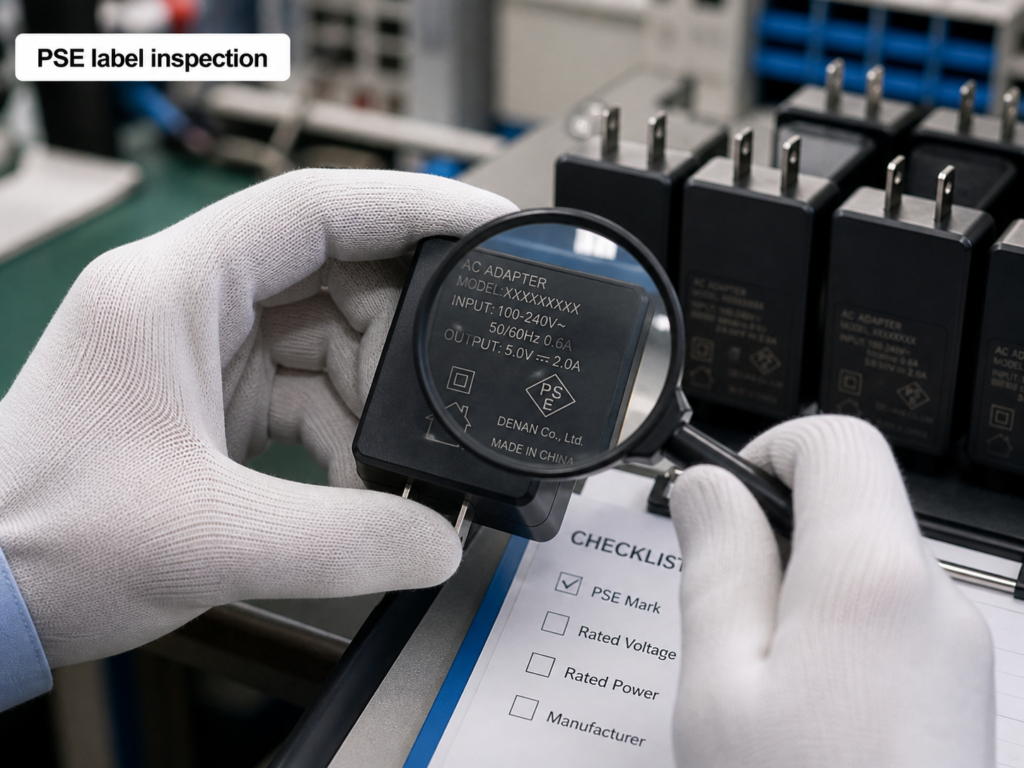
Special attention should be paid to consistency: the category of the label, business operator information, rated parameters, and model must be completely consistent with the physical product, manual, test report, and sales page. Details such as the location and readability of the label shall also be implemented according to the technical standards of the corresponding item.
Changes Must Be Handled in a Timely Manner
Don’t think that filing once is a permanent solution. Whether the subject information changes or the product changes, it must be evaluated and handled in a timely manner:
• **Changes to notification matters**: when statutory notification matters such as the name, address, and manufacturing or import items of the notification business operator change, a change notification shall be handled in accordance with regulations; when the manufacturing or import business is stopped, a cessation notification shall be handled. Changes in brands or labels themselves do not necessarily constitute changes to notification matters, but if they change the notification business operator, applicable items, statutory labeling subject or product technical compliance, corresponding notifications shall be handled respectively, labels shall be updated, and PSE compliance shall be rechecked.
• **Product technical changes**: if the product model, rated parameters change, or key components (PCB, transformer, fuse, housing material, plug, power cord, etc.) change, or the product structure and function change, the PSE compliance shall be rechecked first. If safety is affected, the technical file shall be updated, and the conformity inspection shall be re-conducted if necessary.
High-Frequency Pitfall Avoidance Guide
Fake Materials Pit
Some bad service providers provide forged filing receipts or PSE documents, which look decent, but in fact have no official records and no compliance support, and the consequences are serious once investigated.
To avoid this pit, you can use the “four-piece set for filing authenticity verification”: copy of the notification letter and related acceptance materials (including correction records), Japanese legal/business registration information of the notification subject, corresponding explanation of the notified items and actually sold products, and consistency between the physical label and PSE test/conformity inspection documents.
A special reminder here: **There is no unified public query system for METI notifications**, and the authenticity cannot be judged solely based on “cannot be found online”, but must be comprehensively verified in combination with the above four materials.
Subject Invalidation Pit
When the notification subject intends to stop business, cancel registration or cannot continue to bear import and manufacturing responsibilities, it cannot be simply considered that all previous products will automatically become invalid, but it cannot be left unattended either. It shall be verified whether it is necessary to handle the cessation notification, how to dispose of inventory, who will import subsequently, and whether the sales arrangement has changed.
If a new subject subsequently engages in manufacturing or import business, the subject shall fulfill the corresponding METI notification and PSE obligations; whether existing inventory can continue to be sold cannot be judged solely based on the status of the original notification subject, but needs to be confirmed in combination with inventory ownership, transaction arrangements and actual import and manufacturing activities.
Information Inconsistency Pit
If the filed business items, actually sold products and compliance files are inconsistent, for example, the filed item is “power adapter” but the actually sold product is a power strip with charging function, it will definitely be unqualified during spot checks.
To avoid this pit: check the items and product information one by one before submitting materials, and update the compliance file in time when the product changes.
5 Most Common Cognitive Misconceptions
We will clarify the most frequently asked misconceptions at once:
1. **Misconception: Round PSE products do not need METI filing** — Wrong. If round PSE products are actually manufactured or imported by Japanese business operators, such operators also need to fulfill the METI filing obligation; however, simply selling products that have been manufactured or imported by qualified notification business operators does not necessarily require the seller to file separately.
2. **Misconception: The supplier’s PSE certificate/filing can be used directly** — Wrong. PSE requires consistency check and cannot be borrowed across factories or subjects; METI filing is bound to the Japanese subject that actually manufactures or imports, and cannot be sublet or borrowed.
3. **Misconception: METI filing has an independent validity period, and you just need to renew it when it expires** — Wrong. METI filing has no unified validity period, and only needs to be updated when notification matters change.
4. **Misconception: METI filing is an approval certification for a single product** — Wrong. It is a declaration obligation of the business subject, with no product-level approval and no product certificate issued.
5. **Misconception: Passing platform review / customs release means compliance** — Wrong. Passing commercial links does not mean meeting statutory requirements; regulatory authorities will still conduct spot checks later, and will hold responsible parties accountable if problems arise.
Quick Self-Check and Capability Summary
1-Minute Self-Check List for Charging Products
You can quickly self-check against the list below to see if your compliance is in place:
□ 6 items of product information have been collected, and the regulatory attribute has been judged against the DENAN catalog
□ The corresponding PSE compliance obligation type (diamond/round/not required) has been confirmed
□ PSE documents have been checked to be consistent with the factory, model, rated parameters, and key components
□ The Japanese sales scenario has been confirmed, and the actual import/manufacturing business operator has been clarified
□ A legal and valid local Japanese responsible subject has been determined
□ The actual import/manufacturing subject has completed the METI filing declaration
□ Complete four types of compliance technical files have been kept
□ The labels and parameter information on the product nameplate, manual, and sales page are consistent
□ Product or subject changes have triggered compliance recheck
Core Capabilities You Have Mastered
After reading this article, you should be able to:
• Distinguish the role, nature and logical relationship between PSE compliance and METI filing, and no longer confuse the two;
• Quickly judge whether charging products need METI filing according to the 3-step judgment method;
• Clarify the filing responsible subject under different transaction models, and will not find the wrong responsible person;
• Master the basic requirements, material classification and change rules of METI filing, and know how to manage compliance files;
• Identify 5 types of common compliance pitfalls and avoid most non-compliance risks;
• Understand the core compliance logic of Japanese charging products going on the market, and will not be fooled by various “certifications”.
In general, PSE and METI filing are two important links in the compliance of Japanese electrical products: PSE mainly manages the safety and labeling of products listed in the DENAN catalog, and METI filing mainly manages the responsibility of business operators that actually manufacture or import such products. For sellers who also engage in manufacturing or import, both obligations usually need to be judged and prepared in advance; for pure sellers, they also need to confirm that the products they sell meet DENAN’s labeling and other requirements to avoid affecting normal sales due to compliance issues.