
Many friends engaged in charging product export and cross-border e-commerce have been confused by marks such as CE, UKCA, and UKNI since the UK’s Brexit: can CE still be used in the UK now? Is it mandatory to switch to UKCA? What special rules apply to Northern Ireland?
This article focuses on ordinary consumer electronic charging products such as chargers, USB-C cables, power adapters, and wireless chargers. Combined with the latest 2025 rules, it explains the usage rules of CE in the UK from quick assessment to detailed pitfall avoidance. Entry-level users can resolve most compliance issues on their own after reading and avoid common pitfalls.
Let’s first mention two core points that are most easily misunderstood: First, CE is not a government-issued certification certificate, but a conformity declaration mark signed by the manufacturer itself. Second, after Brexit, the UK has not completely banned CE; instead, there are different recognition rules by region, not a one-size-fits-all approach.
Quick Overview of Core Conclusions
If you are in a hurry, first read these 3 core conclusions, which can basically cover 80% of scenarios:
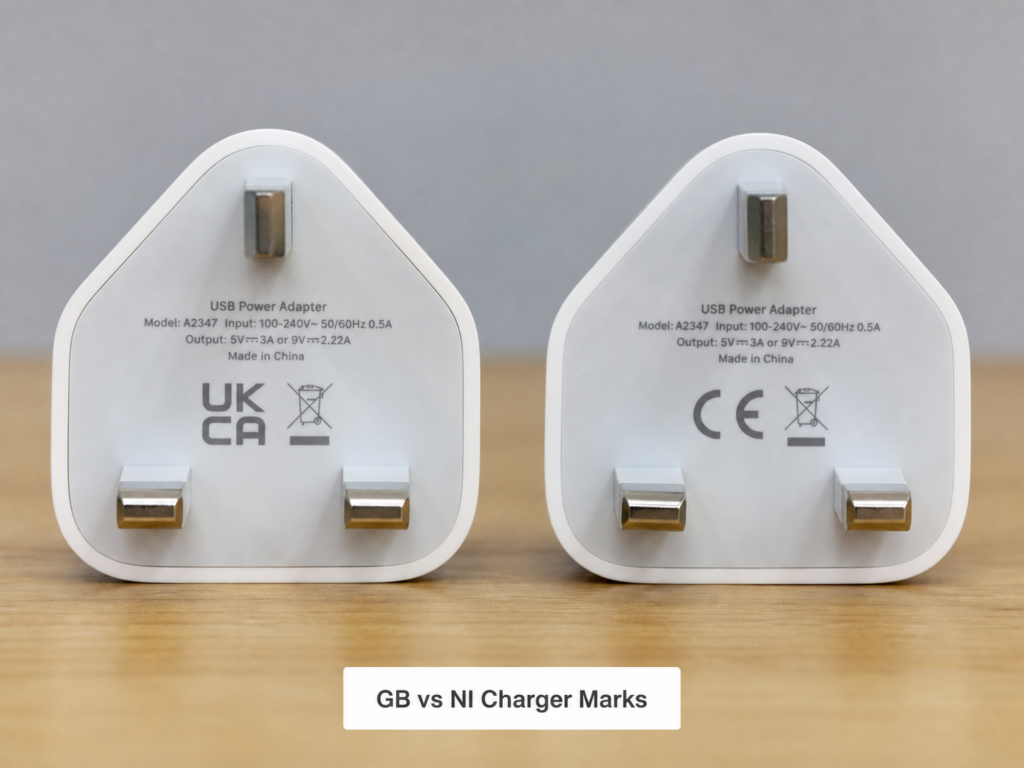
1. **Rule Basis**: The scope of discussion in this article is limited to ordinary charging products (chargers, charging cables, power adapters, etc.), with rules updated to 2025. Special categories such as medical and construction products have independent rules and are not covered by this article.
2. **Regional Conclusions**:
• Great Britain (GB, including England, Scotland, Wales): For regulatory areas covered by the GB indefinite CE recognition policy, products that meet applicable EU requirements and simultaneously fulfill relevant GB market placement, labeling, and operator obligations may use CE or UKCA as one of the marking pathways; whether only CE can be affixed must be confirmed according to specific applicable regulations.
• Northern Ireland (NI): The CE mark is the core, and the vast majority of ordinary charging products only need CE; the CE+UKNI mark is only required when the product requires third-party assessment carried out by a UK approved body. If the assessment is conducted by an EU notified body, only CE is needed.
3. **Cross-Region Reminder**: The CE mark can cover the EU, Northern Ireland, and the designated scope of GB, but supporting documents, labels, and local responsible entities need to be adjusted according to different regions; you cannot use one set of materials for all regions.
To facilitate quick comparison, we have compiled the mark recognition rules for different regions:
| Region | Recognized Compliance Mark Combinations | Non-Recognized Marks |
| GB (Great Britain) | CE and UKCA within the designated scope (either one is acceptable) | UKCA alone cannot be used in NI or the EU |
| NI (Northern Ireland) | Normally only CE is required; CE+UKNI is required for third-party assessment by UK bodies | UKCA alone, UKNI alone |
| 27 EU Member States | Only CE is recognized | UKCA, UKNI (regardless of whether they are paired with CE) |
Basic Common Sense: Why Are the UK’s Marking Rules So Complex?
Some people may ask: it’s just the UK, why is it divided into GB and Northern Ireland with different marks? This starts with the arrangements after the UK’s Brexit.
Before Brexit, the entire UK was part of the EU single market, and the CE mark was valid across the whole territory. After Brexit, the UK originally planned to launch its own UKCA mark to gradually replace the validity of CE in the GB region, but the policy was later adjusted: for products covered by 18 designated regulations, the CE mark is recognized indefinitely, and there is no longer a mandatory requirement to switch to UKCA.
Due to the special arrangements of the Windsor Framework, Northern Ireland continues to apply the product rules of the EU single market, so its compliance requirements are different from those of GB, which is equivalent to having two independent product compliance regions within the UK.
Here we explain the three common marks clearly in plain language:
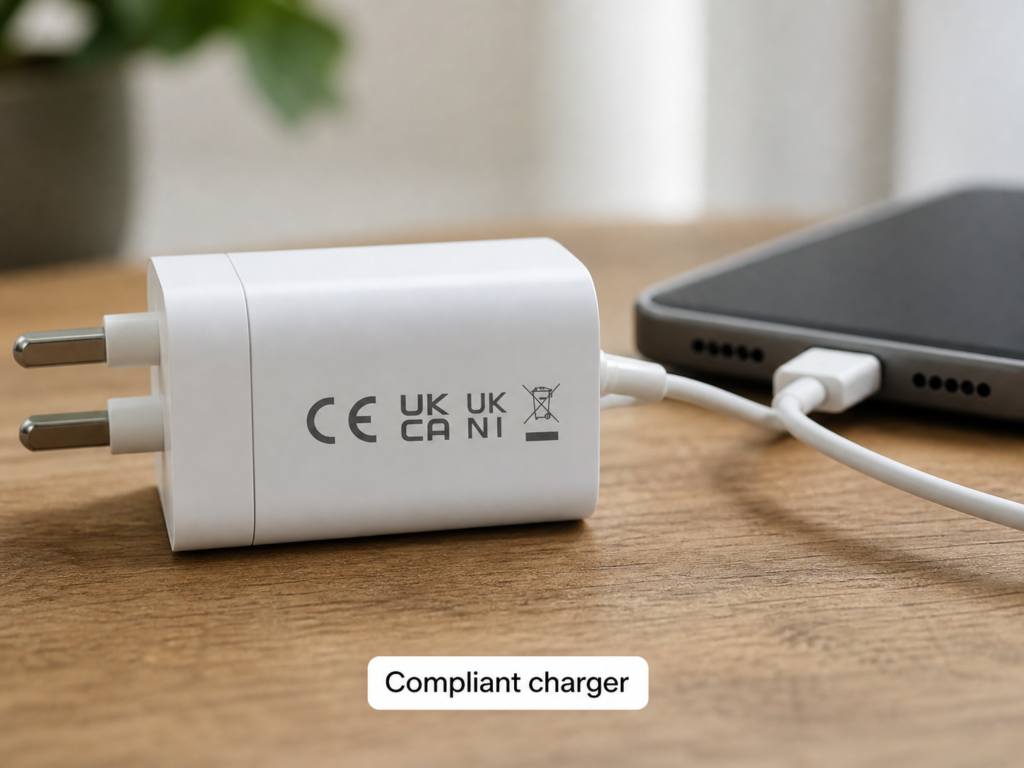
• **CE**: The EU’s compliance declaration mark, representing the manufacturer’s commitment that the product meets relevant EU regulatory requirements such as safety, electromagnetic compatibility, and restriction of hazardous substances. It is a self-declaration, not a government-issued certificate.
• **UKCA**: The local conformity mark for the GB region, valid only in GB. A standalone UKCA mark cannot be used to sell products in Northern Ireland or the EU.
• **UKNI**: A supplementary mark exclusive to Northern Ireland, which cannot be used alone and must be paired with the CE mark. Ordinary charging products almost never need this mark.
Core Compliance Rules by Region
With the basic background understood, we will separately explain the specific rules for GB and Northern Ireland, as well as issues that need attention for cross-region operations.
CE Usage Rules for Great Britain (GB)
First, for the GB region that everyone is most concerned about, whether CE can be used depends on whether the product is within the designated regulatory scope. For ordinary charging products, they are mainly covered by 4 regulations:
1. **Electrical Equipment (Safety) Regulations 2016**: Covers mains-powered charging equipment with a rated voltage between 50-1000V AC and 75-1500V DC, such as commonly used wall-plug GaN chargers and desktop power adapters, which are basically within this scope.
2. **Electromagnetic Compatibility Regulations 2016**: Covers all charging products that generate electromagnetic interference or are susceptible to interference. Simply put, as long as it is a charging product that works with electricity, it basically needs to meet this requirement.
3. **Restriction of Hazardous Substances Regulations 2012**: Covers the vast majority of electronic and electrical charging products and accessories, such as charging cables, chargers, and wireless chargers, which must meet RoHS requirements to limit the content of toxic substances such as lead, mercury, and cadmium.
4. **Radio Equipment Regulations 2017**: Covers charging devices with wireless functions such as Bluetooth and WiFi, such as Bluetooth-enabled wireless chargers and WiFi-enabled smart multi-port chargers.
Whether your specific product is applicable must ultimately be confirmed based on the product’s function and intended use, not just on whether it has a chip.
To use CE in GB, the following conditions must be met:
• The policy is based on the provisions of the UK Department for Business and Trade (DBT): products under the designated 18 regulations have indefinite CE recognition. The previously circulated claim that “CE will expire in 2027” is an old policy that has been abolished.
• There are three prerequisites for applicability: the product falls within the above-mentioned recognition scope, meets applicable EU requirements, and simultaneously fulfills relevant GB market placement, labeling, and operator obligations, and the CE mark is correctly affixed.
• Exceptional cases: Special categories such as medical devices and construction products have their own independent rules. Ordinary charging products are basically within the recognition scope, so there is no need to worry too much.
• A very important pitfall to note: document pathways cannot be mixed. CE corresponds to the EU Declaration of Conformity (EU DoC, the formal compliance certification document signed by the manufacturer), and UKCA corresponds to the UK Declaration of Conformity (UK DoC). It is not in compliance with the rules to force CE-marked products to provide a UK DoC just because the product is sold to GB.
• Finally, UKCA is the statutory mark for GB, but enterprises can choose to use CE or UKCA according to specific applicable regulations and their own compliance pathways.
CE Usage Rules for Northern Ireland (NI)
Since Northern Ireland applies the product rules of the EU single market, the CE mark has a more core status:
• For the vast majority of ordinary charging products, only the CE mark is required for sale in the NI market, no UKCA or UKNI is needed.
• When is UKNI required? Only when your product requires third-party assessment and this assessment is carried out by a UK approved body (not an EU notified body) do you need to affix the CE+UKNI mark. Most ordinary charging products are self-declared by the manufacturer and do not require mandatory third-party assessment, so this situation is almost never triggered.
• UKNI is not an independent mark; it must be affixed side by side with the CE mark and cannot be used alone. Moreover, products with UKNI usually cannot directly enter the EU market, which should be noted.
• Products only affixed with UKCA shall not be placed on the Northern Ireland market as compliant products; regulatory authorities may, depending on the specific situation, require rectification, restrict or prohibit supply, withdraw or recall products, and may take other enforcement measures.
Boundary Reminders for Cross-Region Compliance
If the same product is to be sold in multiple regions such as the EU, GB, and NI, do not assume that everything is fine just because you have CE. You must also separately verify the regulatory requirements, label information, qualifications of local responsible entities, and document versions for each region; you cannot use one set of materials for all regions. In addition, compliance rules may be updated, so you should regularly pay attention to official updates to avoid non-compliance caused by rule changes.
Specific Compliance Requirements for Charging Products
After covering regional rules, let’s turn to specific charging products: how to determine which requirements your product must meet, and what exactly is needed for CE compliance.
4 Core Compliance Regulations
Compliance for ordinary charging products basically cannot avoid the following 4 types of regulations, explained in plain language:
1. **Electrical Safety**: The Electrical Equipment (Safety) Regulations 2016 usually apply to electrical equipment with a rated voltage between 50-1000V AC or 75-1500V DC, such as wall-plug chargers. Products below this voltage range may not be subject to this regulation, but this does not mean there are no other safety or product regulatory obligations; general product safety, EMC, RoHS, RED, and other applicable requirements must still be assessed.
2. **Electromagnetic Compatibility (EMC)**: Products must not interfere with other equipment when working, nor be interfered with by other equipment to the point of being unusable. For example, a charger must not cause obvious static noise on a nearby radio.
3. **Restriction of Hazardous Substances (RoHS)**: Restricts the content of toxic and hazardous substances such as lead, mercury, and cadmium in products. Almost all electronic charging products and accessories must comply with this.
4. **Radio Equipment Directive (RED)**: Only required for products with wireless functions such as Bluetooth and WiFi, such as Bluetooth-enabled wireless chargers.
Quickly Match Regulations by Product Function
Many people do not know which regulations their products must comply with. Remember this priority for judgment: **first look at function → then whether it is active (whether it needs to be powered on to work actively) → then rated voltage → finally intended use**, do not only look at whether there is a chip.
We have compiled a reference for common charging products:
• **Mains-input chargers (GaN chargers, desktop chargers, power adapters)**: Usually need to meet three requirements: electrical safety, EMC, and RoHS.
• **USB-C cable products**: Divided into three situations:
• Passive cables (ordinary charging cables without active chips): Usually not subject to electrical equipment safety regulations and EMC, but when falling within the scope of RoHS, they must still fulfill RoHS obligations, and general product safety and other applicable requirements must be assessed according to the product situation.
• Cables with E-Marker chips (such as cables supporting 100W fast charging): Need to assess whether EMC is triggered, usually still need to comply with RoHS, and other applicable requirements should be assessed according to function.
• Active/conversion cables (such as USB-C to HDMI with power supply, adapter cables with active chips): Usually need to comply with EMC and RoHS, specific requirements need to be assessed individually.
• **Wireless charging devices**: Usually need to comply with EMC and RoHS; low-voltage wireless charger bodies are usually not subject to electrical equipment safety regulations, but general product safety, EMC, RoHS, RED, and other applicable requirements must still be assessed item by item. The matching power adapter must also be assessed separately as an adapter.
• **Charging accessories with Bluetooth/WiFi**: For example, smart multi-port chargers with Bluetooth, in addition to basic requirements, must additionally meet RED requirements.
• **Composite products (docking stations, multi-port chargers)**: Assessed separately for each function, and obligations are cumulative. For example, if a docking station has charging, data transmission, and Bluetooth functions, all corresponding regulations must be included.
Is a Third-Party Institution Required to Participate?
Many people think that you must find a third-party institution to do CE, but that is not the case:
• For products such as ordinary mains chargers and conventional cables, manufacturers can conduct self-assessment. Third-party test reports are not statutory “CE certificates” — because CE is a self-declaration system, test reports are only one of the evidences to prove product compliance, and the core document is the DoC signed by the manufacturer.
• For products with wireless functions, it is necessary to check the requirements of the RED module to confirm whether an EU notified body or UK approved body is required to participate.
An Important Difference Between NI and GB: Universal Charger Requirements
Here we mention a point that many people get confused about: Northern Ireland applies the EU universal charger rules. From December 28, 2024, the rules apply to relevant radio equipment that can be recharged via wired charging among the categories listed in the regulations, and require them to meet provisions such as the USB-C port; laptop computers are subject to the rules from April 28, 2026. Specific categories, technical conditions, and exemptions shall be verified against the regulations authorized under RED; not all cables and chargers are subject to mandatory USB-C requirements. The GB region does not automatically apply this EU requirement, and there are currently no mandatory USB-C provisions.
Prerequisites for CE Compliance
To legally affix the CE mark, you cannot just print it casually; the following conditions must be met:
1. Completed conformity assessment for all applicable regulations;
2. Compiled complete technical documentation and signed the DoC for the corresponding pathway (EU DoC for CE, UK DoC for UKCA);
3. Test reports, risk assessments, design documents, etc. can all be used as technical evidence and kept for inspection;
4. The CE mark should preferably be affixed to the product body, be clear and permanent, with a minimum height of usually 5mm; if the product is too small to affix the mark, it can be placed on the packaging or accompanying documents.
Compliance Document and Labeling Requirements
Compliance is not just about affixing a mark; documents and labels are also very important:
• **Core documents**: Prepare the DoC according to the compliance pathway. Technical documentation should include test evidence, risk assessment, and other materials. The retention period is usually 10 years after the last batch of products is placed on the market, subject to specific regulatory requirements.
• **Regional labels**: Labeling requirements shall be determined according to applicable regulations and the actual supply chain role. Manufacturers shall mark their name or trade name and contact address in accordance with relevant regulations; when there is an importer, the importer shall fulfill corresponding labeling obligations. For products sold to NI, if EU market economic operator requirements apply, it shall be ensured that the establishment location and labeling of the corresponding economic operator comply with the provisions; an authorized representative is only applicable when required by regulations or when the manufacturer chooses to appoint one.
• **Instructions**: Instructions and safety information shall be provided in the language required by the target market according to specific applicable regulations. Not all cables that are only subject to regulations such as RoHS are automatically subject to the same requirements.
Responsibilities of All Parties in the Supply Chain
Compliance is not only the responsibility of the manufacturer; the entire supply chain has responsibilities:
• Manufacturer: Responsible for product compliance, issuing DoC, retaining technical documentation, and affixing compliance marks.
• Importer/Authorized Representative: Verify whether the product is compliant, mark their own information as required, retain documents, cooperate with supervision, and recall or stop sales if problems are found.
• Distributor: Ensure that product marks are correct, do not sell known non-compliant products, and cooperate with regulatory traceability.
Scenario-Based Practical Operations and Common Misconceptions
After covering the rules, let’s turn to actual scenarios and the most common pitfalls people encounter.
Compliance Requirements for Different Scenarios
Boundary Between Personal Carriage and Commercial Sale
First, it must be clarified that all the compliance rules we mentioned apply to business scenarios such as commercial placement and cross-border e-commerce. If it is personal carriage or mailing for non-commercial purposes, such as bringing a few chargers for personal use when traveling to the UK, or sending a charging cable to a friend as a gift, customs will exercise discretionary judgment and will not directly apply commercial compliance rules. However, if it is for sale, even cross-border e-commerce dropshipping, it is considered commercial sale and must strictly comply with the regulations of the target market.
Cross-Border E-Commerce Online Sales
Friends who sell on platforms such as Amazon and eBay should note:
• Legally speaking, CE products within the GB recognition scope can be sold on the UK site (GB region).
• However, platforms may have their own additional requirements, such as requiring the upload of DoC, technical evidence, importer information, etc. Even if regulations do not mandate platform review, platforms may have their own rules.
• Therefore, when operating, you must conduct double verification: comply with both official regulations and platform requirements. The detail page must truthfully display compliance information and must not be falsely marked.
Asia-Pacific Manufacturers Exporting to the UK
Many domestic charging product manufacturers are most concerned about: I already have CE, do I still need to do UKCA?
• If the product has completed a valid CE conformity assessment, has technical documentation and EU DoC, and falls within the scope of GB’s CE recognition, after meeting other applicable GB obligations, it can use CE to sell to GB, and UKCA is not necessarily required.
• If the customer requires UKCA, or if you have other needs to do UKCA, it is not necessary to retest everything: existing test evidence can be reused as part of the technical documentation only when the product model, version, test scope, applicable requirements, and standard version all match; supplementary assessment or testing should still be conducted when necessary. UKCA is also a self-declaration system, and there is no need to find an institution to issue a “certificate”.
• In addition, local responsible entities (such as importers, authorized representatives) must be established according to the target region. An authorized representative is only required when explicitly stipulated by regulations, and is not required for all products.
• If your products are only sold to the GB market, you can choose whether to affix UKCA according to customer needs; it is not mandatory.
Pitfall Avoidance for 5 Common Misconceptions
We have compiled 5 questions that people most often get wrong. Avoiding these can help you steer clear of 90% of pitfalls:
1. **Misconception 1: CE cannot be used in the UK at all after Brexit**
Correction: CE is indefinitely recognized for products within the designated scope of GB, and Northern Ireland even takes CE as the core. The previously circulated claim that “CE will expire in 2027” is an old policy that has long been abolished.
2. **Misconception 2: Printing CE casually counts as compliance**
Correction: The CE mark can only be affixed after all compliance assessments are completed, technical documentation is compiled, and the DoC is signed. Printing the CE mark casually without supporting materials is a violation, and may face regulatory measures such as rectification requirements, restriction or prohibition of supply, withdrawal, recall, and penalties, depending on the risk, the circumstances of the violation, and the case-by-case decision of the competent authority.
3. **Misconception 3: All tests must be redone when converting CE to UKCA**
Correction: If the UKCA pathway is chosen, existing CE test evidence can be reused as part of the technical documentation only when the product model, version, test scope, applicable basic requirements, and standard version all match; if the product or regulatory requirements are different, supplementary assessment or testing may still be required.
4. **Misconception 4: Rules are the same across all regions of the UK**
Correction: The compliance rules for GB and Northern Ireland are different, and products with only UKCA cannot be placed on the Northern Ireland market as compliant products. Non-compliant products may face regulatory measures such as rectification requirements, restriction or prohibition of supply, withdrawal, recall, and penalties, depending on the risk, the circumstances of the violation, and the case-by-case decision of the competent authority. Be sure to confirm whether the destination is GB or NI before shipping.
5. **Misconception 5: A third-party test report is CE certification**
Correction: CE is a self-declaration system, there is no so-called “government-issued CE certificate”. A third-party test report is only one of the evidences to prove product compliance, and the core document is the DoC signed by the manufacturer.
Quick Judgment and Shipment Inspection Checklist
If you are shipping goods or judging whether your product can use CE, you can follow the steps and checklist below, no need to look up information everywhere.
Four-Step Quick Judgment Method
Follow this order and you won’t go wrong:
1. **Confirm the destination region**: First clarify whether it is sold to GB, Northern Ireland, or the EU, and confirm the corresponding mark scope.
2. **Confirm product functions**: Match applicable regulations according to the priority of “function → whether it is active → rated voltage → intended use”, and confirm whether it is within the CE recognition scope.
3. **Verify compliance validity**: Check whether there is a DoC, whether technical evidence is complete, whether the mark is correctly affixed, and whether there is information on the local responsible entity.
4. **Verify additional channel requirements**: If selling through platforms or logistics, also confirm whether the platform or logistics has additional compliance requirements, such as whether documents need to be uploaded.
Pre-Shipment Inspection Checklist for Charging Products
Check against these items before shipment, and you can basically avoid basic compliance risks:
• The destination region and corresponding mark requirements have been confirmed
• All functions of the product have been matched with applicable regulations, and compliance assessment has been completed
• The position, size, and clarity of the compliance mark meet requirements
• The DoC and technical documentation for the corresponding pathway are complete and consistent with product information
• According to specific applicable regulations and actual supply chain roles, information of the manufacturer, importer, or other economic operators has been marked on the product or packaging
• Required instructions and safety information have been provided in the language required by the target market in accordance with applicable regulations
In fact, for entry-level users, as long as you master the above rules, you can completely do these 3 things independently:
1. Judge whether CE can be used according to the sales region and product function;
2. Distinguish compliance requirements for different scenarios and avoid common misconceptions;
3. Verify the compliance validity of products according to the checklist to avoid basic risks.
Common Long-Tail FAQ
Finally, we have compiled a few of the most frequently asked long-tail questions and provide quick answers:
Can Only CE Be Affixed in GB?
Yes, but it must be confirmed according to specific applicable regulations. For regulatory areas covered by the GB indefinite CE recognition policy, when products meet applicable EU requirements and simultaneously fulfill relevant GB market placement, labeling, and operator obligations, CE can be used as the marking pathway, and there is no need to affix UKCA. For specific rules, please refer to the previous section “CE Usage Rules for GB”.
When Is UKNI Required in Northern Ireland?
The CE+UKNI mark is only required when the product requires third-party assessment and this assessment is carried out by a UK approved body. Most ordinary charging products are self-declared by the manufacturer, so this situation is almost never triggered. For specific rules, please refer to the previous section “CE Usage Rules for NI”.
Is CE Mandatory for USB-C Cables?
Not necessarily. Applicable regulations must be assessed in the order of “function → whether it is active → rated voltage → intended use”. For example, passive ordinary USB-C charging cables may not be subject to electrical equipment safety regulations and EMC, but when falling within the scope of RoHS, they must still fulfill RoHS obligations, and general product safety and other applicable requirements must be assessed according to the product situation; cables with active functions need to meet more requirements. For details, please refer to the previous section “Identifying Regulations by Product Function”.
Is UKCA Still Required If I Already Have a CE Report?
A test report itself does not equal a completed CE conformity assessment. If the product has completed a valid CE conformity assessment, has technical documentation and EU DoC, and falls within the recognition scope of GB, it can use CE after meeting other applicable GB obligations, and UKCA is not necessarily required. If UKCA is indeed needed, existing test evidence can only be reused when the product, applicable requirements, and standard version all match; supplementary assessment or testing is still required when necessary. For details, please refer to the previous section “Scenario of Asia-Pacific Manufacturers Exporting to the UK”.
It should be reminded that compliance rules may be adjusted over time. If you are dealing with high-risk products or complex products that you are unsure about, it is recommended to check the latest rules through official channels, such as the CE/UKCA compliance guidelines of the UK Department for Business and Trade (DBT), the guidelines of the UK product safety authority, the Northern Ireland product placement guidelines, and the relevant guidelines of the EU Your Europe portal. If necessary, you can seek professional compliance personnel to assist with review.
Overall, the UK has not completely banned the CE mark after Brexit. For common consumer electronic products such as ordinary charging products, as long as you first clarify whether the sales region is GB or Northern Ireland, then match the regulations according to product functions, confirm whether CE falls within the recognition scope of GB, and fulfill supporting document, labeling, and market placement obligations, you can basically avoid most compliance pitfalls and there is no need to blindly waste money on additional certifications.