
Many Asia-Pacific sellers of charging products, when first entering the UK market, get stuck on one question: Do I have to pay a third-party body to get UKCA certification? Can I declare my product compliant on my own?
The answer to this question is not a simple “yes” or “no” — it depends on your product type, intended use, and whether you can meet the corresponding compliance requirements. We will put the core conclusions first, then break down the details step by step.
Core Conclusions First
1. Eligible products can follow the “Internal Production Control (Module A)” route, which is commonly known as self-declaration, without requiring review and certification by a UK officially designated body. Conventional products such as standard mains chargers and consumer-grade PD fast chargers usually meet the conditions for self-declaration.
2. For ordinary charging products, UKCA is not the only market access mark for the Great Britain (GB) market — as long as the UK’s recognition conditions for the CE mark are met, CE can still be used to enter the GB market, and the specific requirements shall be subject to the latest official guidelines.
3. If a product is first placed on the GB market from outside the UK by an entity established in GB, that entity is considered an importer and must fulfill the importer obligations under applicable regulations. Overseas manufacturers cannot change their actual importer status merely through nominal “designation”; EU authorized representatives cannot replace UK compliance roles either. Non-UK manufacturers of medical devices must also appoint a UK Responsible Person in accordance with medical device regulations.
4. For charging products for special purposes such as medical use and explosion-proof applications, whether self-declaration is allowed shall be judged based on product classification; some high-risk categories require the participation of a UK officially designated conformity assessment body (Approved Body).
Entering the UK Market: Choose CE or UKCA?
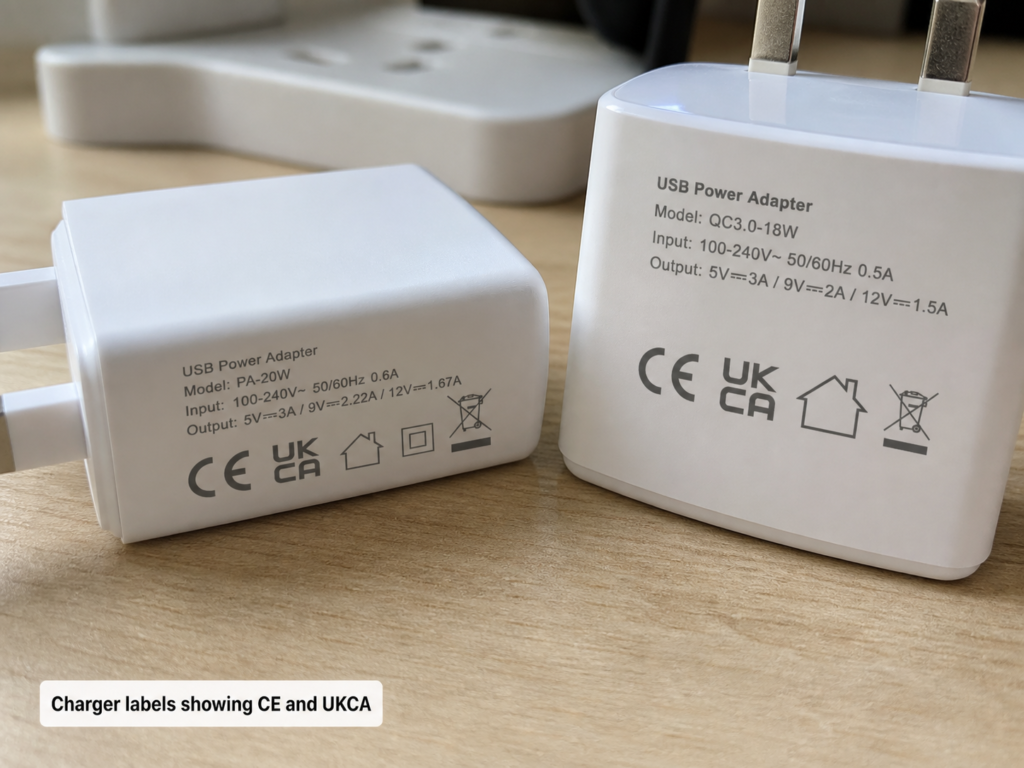
Many people think “now that the UK has left the EU, the CE mark is completely useless”, but that is not the case. At least for ordinary charging products, CE is still valid for now, but its scope of application is being dynamically adjusted.
Current General Rules
For ordinary charging products (covered by regulations such as electrical safety, electromagnetic compatibility (EMC), UK RoHS, and radio equipment), as long as they meet the UK’s recognition conditions for the CE mark, they can enter the GB market with CE; UKCA is not a mandatory requirement for all ordinary charging products.
Note that the UK’s CE recognition policy is subject to adjustment. Before launching a product, you must check the latest guidelines and the specific regulatory requirements applicable to your product on the official UK government website.
Scenarios Where UKCA Is Mandatory/Prioritized
If any of the following applies, it is recommended to prioritize UKCA:
1. The regulations applicable to your product explicitly require UKCA and no longer recognize CE;
2. Your customers, the e-commerce platforms you settle on, or your sales channels explicitly require the UKCA mark;
3. Your products are sold exclusively to the GB market, and you want to reduce the risks brought by future policy changes.
Scenarios Where CE Can Continue to Be Used
If any of the following applies, you can continue to use the CE mark:
1. All regulations applicable to your product are still within the UK’s CE recognition scope;
2. Your products are sold to both the EU and the GB market, and you want to share one set of compliance materials to reduce costs.
But remember: if you use the CE mark, the product must comply with both the corresponding EU regulations and the UK’s current recognition conditions for the CE mark — it must meet the requirements of both sides.
What Requirements Must Be Met for Self-Declaration?
Once you know whether your product is eligible for self-declaration, the next step is to figure out exactly what requirements self-declaration must meet to be legal. We divide the requirements into three parts: compliance requirements for the product itself, technical documentation requirements, and entity qualification and obligation requirements.
Barriers the Product Itself Must Pass
UKCA compliance for charging products has three layers of logic, from mandatory to optional:
1. **Mandatory regulatory requirements**: These are the core basis for UKCA compliance, such as electrical safety, EMC, and UK RoHS. All of them must be met, with no room for negotiation.
2. **Officially designated standards**: These are the designated standards published by the UK government. If the fully adopted designated standards cover the relevant essential requirements, a presumption of conformity can usually be obtained within the scope covered by the standards, saving a lot of trouble of self-demonstration. However, note that this does not mean the entire product automatically complies with all regulatory requirements. Manufacturers still must complete the conformity assessment required by applicable regulations, and retain evidence for risks or requirements not covered by the standards. Adopting standards will not automatically issue you a UKCA certificate either.
3. **Industry protocol verification**: Industry standards such as USB PD/PPS and Qi are not mandatory requirements for UKCA, and are subject to voluntary verification by manufacturers.
Specifically for charging products, the core mandatory requirements include:
• **Electrical safety**: Protection against electric shock, overheating, and fire; structural safety; compliance of insulation/electrical strength; compliance of creepage distance and clearance; overcurrent/short circuit protection, etc.
• **Electromagnetic compatibility (EMC)**: The product’s radiated interference must not exceed the limit, and it must also be able to resist external electromagnetic interference so that it does not malfunction due to interference.
• **Environmental requirements**: Comply with the hazardous substance restriction requirements of UK RoHS, for example, the content of hazardous substances such as lead, mercury, and cadmium must not exceed the limit.
• **Other requirements**: Such as energy efficiency and labeling specifications, which apply according to specific product categories.
What Technical Documents Need to Be Prepared?
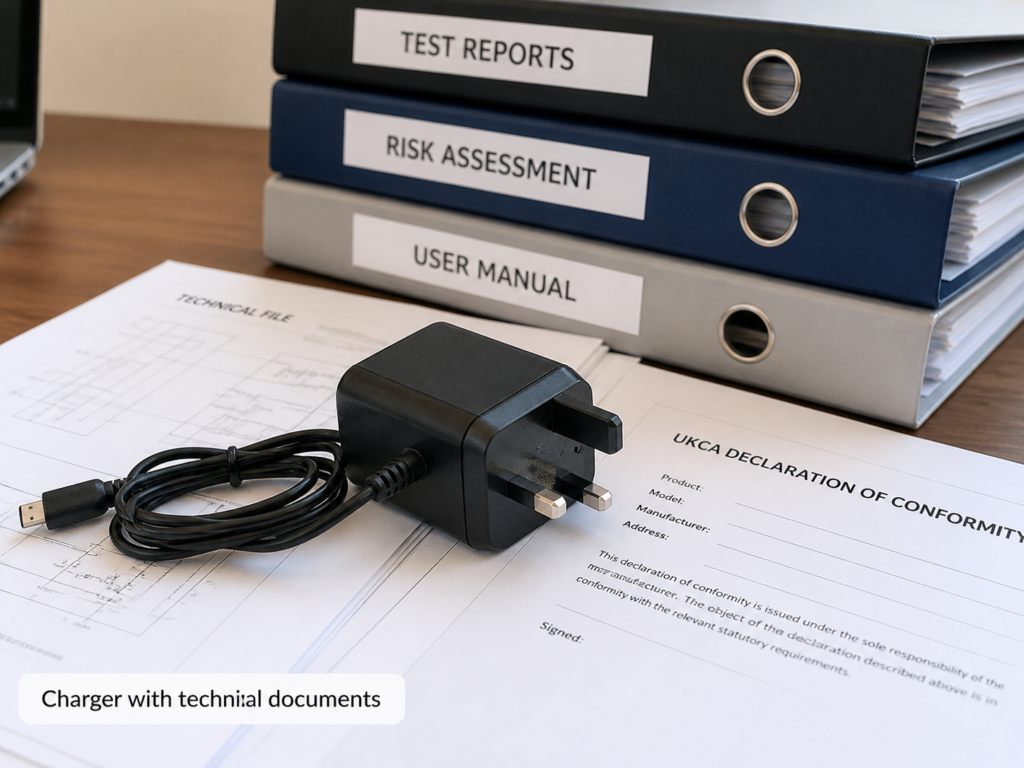
Self-declaration is not just empty talk; it must be supported by a complete set of technical documents that can be produced during regulatory spot checks.
Conformity Evidence Materials
These are the core materials proving product compliance:
• **Test reports**: Can be done in-house or commissioned from a capable third-party laboratory; no need for issuance by an Approved Body. Test reports can serve as important conformity evidence in technical documents, but they cannot alone replace the overall conformity assessment. Manufacturers should also confirm that the reports cover the actual sold products and all applicable requirements, complete risk and design assessments and production consistency control, and sign the DoC accordingly.
• **Risk assessment report**: Identifies possible risks of the product in terms of safety, EMC, etc., and explains how you control these risks.
• **List of key components and compliance certificates**: For example, the list of core components such as transformers, MOSFETs, and safety capacitors, and their compliance certificates, to ensure that core components are qualified.
• **Production consistency control records**: Prove that your mass-produced products are consistent with the originally verified qualified samples, so that there will be no situation where samples are qualified but bulk goods are not.
• **Other materials**: Such as design drawings, calculation/assessment records, etc. Any materials that can support product compliance can be included.
UK Declaration of Conformity (UK DoC)
The DoC is the core voucher for self-declaration. It is an official document signed by the manufacturer itself, not provided by a third-party laboratory, nor a certificate issued by an Approved Body.
A qualified UK DoC shall, in the format specified by each applicable regulation, include information such as the manufacturer’s name and address, product traceability identifiers (model, batch, etc.), the manufacturer’s declaration under its sole responsibility, as well as the applicable regulations and adopted standards. Do not generally require the manufacturer’s address to be in GB; if applicable, additional GB entity requirements such as importer labeling or UK Responsible Person for medical devices must also be met.
Product Accompanying Materials
That is, the materials that reach the user together with the product, such as user manuals, safety warnings, and rated parameter labels. These must also comply with UK regulatory requirements.
Who Is Eligible to Make the Declaration? What Obligations Must Be Fulfilled?
• **Declaring entity**: Can be the product manufacturer, or a responsible party formally authorized in writing by the manufacturer.
• **Statutory obligations of importers in GB**: If a product is first placed on the GB market from outside the UK by an entity established in GB, that entity is considered an importer. It shall verify the authenticity of product labels and the DoC, retain the DoC within the statutory period, and cooperate with regulatory authorities in providing documents. Overseas manufacturers cannot change their actual importer status merely through nominal “designation”. Note that importers are not required to retain a full copy of the technical documents; they only need to keep the DoC and verification records.
• **UK authorized representative**: Is an optional arrangement. It performs part of the compliance obligations on behalf of the manufacturer according to the commission agreement signed with the manufacturer, but cannot replace the actual importer. We emphasize again here: EU authorized representatives cannot directly act as UK compliance entities; the two are separate. For medical devices, non-UK manufacturers must also appoint a UK Responsible Person in accordance with special rules.
Pitfall Avoidance Guide: Don’t Step on These Landmines
Self-declaration looks simple, but many people easily fall into pitfalls, ranging from product removal to fines and recalls. We list the most common pitfalls to help you avoid them.
How Great Is the Legal Liability for Self-Declaration?
Many people think self-declaration “won’t be inspected” and just do it casually, which is completely wrong.
Manufacturers are the first responsible parties for product compliance and bear full legal responsibility for the authenticity of the DoC. UK regulatory authorities conduct spot checks after products are launched. If non-compliance is found, the consequences range from product removal, fines, and recalls to criminal liability in serious cases.
Not only manufacturers, but also importers and distributors shall bear corresponding verification obligations; no one can escape responsibility when problems arise.
The Four Most Common Misconceptions
We have compiled four of the most common mistakes people make, which you must keep in mind:
1. **Misconception 1: Self-declaration = casual labeling / no testing needed**
Wrong. Self-declaration must have complete supporting compliance materials, a formal DoC must be signed, and the manufacturer bears full responsibility for compliance. It is not just a matter of sticking a label casually.
2. **Misconception 2: UKCA is the only access mark for the GB market / CE is completely invalid**
Wrong. Whether CE can be used requires item-by-item verification of the UK’s CE recognition status according to the specific regulations applicable to the product; not all products must use UKCA.
3. **Misconception 3: Overseas manufacturers must appoint a UK authorized representative**
Wrong. A UK authorized representative is optional, not mandatory. For products first placed on the GB market from overseas, the GB importer that actually performs the import act in the supply chain shall be confirmed and its statutory obligations shall be implemented; for medical devices, a UK Responsible Person shall also be appointed in accordance with special rules.
4. **Misconception 4: Industrial-grade products cannot be self-declared under any circumstances**
Wrong. Whether self-declaration is allowed shall be judged based on the product’s actual functions, intended use, and applicable regulations; it is not that industrial-grade products are definitely ineligible.
If the Product Is Revised, Do I Need to Redo Everything?
It is inevitable that products will be revised during sales. Not all revisions require retesting and updating the DoC. We have listed the judgment criteria for you:
Common Changes That Require Supplementary Testing / DoC Update
• Changes in electrical parameters: For example, adjustments to rated power, input/output voltage, PD/PPS protocol configuration;
• Changes in key components: For example, replacement of transformers, MOSFETs, safety capacitors, plugs, fuses, wireless modules;
• Structural/material changes: For example, PCB layout adjustment, housing flame-retardant material change, insulation structure modification.
These changes will affect the safety and compliance of the product, so reassessment is mandatory, with supplementary testing and DoC update if necessary.
Changes That Usually Do Not Trigger Retesting
• Non-critical appearance modifications, packaging text adjustments (those not involving safety/compliance content);
• But even for these changes, a change impact assessment must be carried out to confirm that they will not affect regulatory compliance, traceability, and existing risk conclusions. If necessary, labels and the DoC must also be updated.
Exclusive Notes for Asia-Pacific Sellers
For manufacturers and sellers in the Asia-Pacific region, there are several special precautions and common route options for UKCA self-declaration, which we have specially compiled.
Key Points for Asia-Pacific Manufacturers to Pay Special Attention To
1. **Entity arrangement**: The GB importer that actually first places overseas products on the GB market in the supply chain shall be confirmed, and its statutory obligations shall be implemented. A UK authorized representative can be appointed as needed, but the authorized representative cannot replace the actual importer, and EU authorized representatives cannot replace UK compliance entities either. Non-UK manufacturers of medical devices must also appoint a UK Responsible Person in accordance with medical device regulations.
2. **Language requirements**: User manuals and safety warnings for end users usually need to be in English; the language of technical documents and the DoC shall be confirmed according to applicable regulations and regulatory requirements.
3. **Direct mail rules**: If you are engaged in commercial sales of products directly mailed from the Asia-Pacific region to UK consumers, you are not exempt from GB product compliance obligations. You shall determine whether to use CE or UKCA, and whether self-declaration is allowed, in accordance with all applicable regulations for the product, the current GB recognition conditions for CE, and the corresponding conformity assessment routes. Products such as medical devices shall also meet their special GB responsible entity and registration requirements.
4. **Test report recognition**: Test reports issued by laboratories in the Asia-Pacific region can be used as supporting compliance materials for self-declaration as long as they are conducted in accordance with applicable UK regulations and standards and the laboratory has corresponding testing capabilities; it is not necessary to use a UK local laboratory for testing.
How to Choose Among the Three Common Operation Routes?
Depending on their own situation, Asia-Pacific sellers can choose three different operation routes:
• **Low-cost route**: Complete compliance verification in-house + issue DoC in-house + confirm the actual GB importer in the supply chain and implement its statutory obligations; if applicable, additionally appoint a UK authorized representative or UK Responsible Person. Suitable for factories with their own testing capabilities and compliance teams, with the lowest cost.
• **Medium-cost route**: Commission a third-party laboratory to test samples + issue DoC in-house + confirm the actual GB importer in the supply chain and implement its statutory obligations; if applicable, additionally appoint a UK authorized representative or UK Responsible Person. Suitable for most small and medium-sized sellers who do not have their own testing capabilities, who find a third-party laboratory for testing and sign the DoC themselves, with moderate cost.
• **Full-service route**: Commission a compliance service provider to handle the entire process. Suitable for new sellers who have just entered the industry and do not have a compliance team; it is worry-free but has the highest cost.
How to Verify When You Are Unsure?
Matters You Can Judge Independently
After reading this article, you should be able to judge these things on your own:
• Whether your charging products need to use the UKCA mark, and whether they can follow the self-declaration route;
• Whether your ordinary charging products can continue to use the CE mark to enter the GB market;
• The core conditions and legal procedures that UKCA self-declaration must meet;
• Whether to reassess compliance when the product is revised;
• The core requirements and pitfall avoidance points for Asia-Pacific sellers doing self-declaration.
Verification Order for When You Are Really Unsure
If you encounter complex products, or are really unsure, verifying in this order is the safest:
1. **Step 1: Confirm the target market**: First figure out whether you are entering GB, Northern Ireland, or the EU; different markets have completely different rules.
2. **Step 2: Clarify all functions and intended use of the product**: Do not miss any function, such as whether it has wireless communication or is for special use — these will affect the result.
3. **Step 3: Check the official UK government website**: Find the applicable regulations and conformity assessment routes for the corresponding product; official information is the most accurate.
4. **Step 4: Consult professionals**: If you still don’t understand after checking, you can consult the actual GB importer in the supply chain, professional compliance institutions, or a UK Approved Body.
Remember one core principle: Do not force self-declaration just to save money or trouble. Once compliance problems arise, the losses will be much greater.