
Sellers of charging products who are new to the North American market can easily fall into a trap: they assume that the US FCC certification and Canadian ISED certification are “universally valid for North America”, and ship products with FCC certification directly to Canada, only to have the goods detained by customs, resulting in significant losses. These two certifications are indeed often mentioned together, and their regulatory content has considerable overlap, but they are essentially two completely independent sets of market access rules. Today, we will focus on charging products, from introductory concepts to practical judgment, to thoroughly explain the differences between the two.
First, Understand What the Two Certifications Are for Beginners
First, sort out the basic information of the two certifications to avoid confusion at the very beginning.
ISED certification is the official Canadian market access requirement for electronic and wireless products, under the supervision of Innovation, Science and Economic Development Canada. It also has an older name, “IC certification”, which many long-time sellers still use. It has two core regulatory directions: first, the electromagnetic interference of products must not exceed the limit; second, the wireless transmission function must comply with local regulations. For charging products, charging devices with wireless functions (such as wireless chargers, smart charging power strips) are regulated, and the electromagnetic leakage of ordinary wired chargers is also within the scope of regulation.
FCC certification is the official US market access requirement for electronic and wireless products, under the supervision of the Federal Communications Commission. Its core regulation also covers electromagnetic interference and wireless transmission compliance, and its regulatory scope for charging products highly overlaps with that of ISED, except that its applicable scope is limited to the US market.
There are three main reasons why these two certifications are often mentioned together: first, the US and Canada are both part of the North American market, with interconnected supply chains and logistics, so most sellers lay out their business in both markets simultaneously; second, the product types and test items regulated by the two have a high degree of overlap, making it easy to treat them as the same thing; third, cross-border platforms such as Amazon often require sellers to provide compliance documents for both markets at the same time, further deepening the misunderstanding that “the two are interchangeable”.
Let’s nail down the most core introductory conclusion first: ISED only applies to Canada, and FCC only applies to the US. The two do not recognize each other and cannot replace each other. To sell products in a country, you must comply with that country’s requirements.
In addition, we need to draw a clear regulatory boundary in advance to avoid confusion with other certifications: both ISED and FCC only regulate content related to wireless transmission and electromagnetic interference, and do not involve safety regulations (such as plug shape, electrical safety, shell flame retardancy, battery safety) or energy efficiency (such as energy efficiency grade, standby power consumption). They are only part of the multiple compliance systems that charging products need to meet.
First Unify the Basic Caliber for Comparison
To compare the differences between the two, we must first unify two core concepts and the product scope, otherwise the comparison will easily become more and more confusing.
First, let’s explain the two most easily confused basic concepts in plain language:
• Unintentional radiator equipment: Equipment that does not actively transmit wireless signals to achieve its function, but only leaks a small amount of electromagnetic noise when the circuit is working, similar to the slight noise of home appliances when they are operating. The compliance focus of this type of equipment is that “the leaked noise must not interfere with other electrical appliances”. Ordinary wired chargers, fast charging cables with E-Marker chips, and power banks without wireless functions all fall into this category.
• Intentional radiator equipment: Equipment that relies on active wireless signal transmission to achieve its core functions. The compliance focus is that “the frequency used and the transmission power must comply with local regulations, and unauthorized transmission is not allowed”. Smart charging devices with Bluetooth/Wi-Fi, charging power strips with wireless communication functions, and wireless chargers all fall into this category.
The scope of charging products we compare today covers the above two categories, excluding three types of products that are not within the scope of discussion: ordinary passive charging cables without chips (both sides exempt wireless certification), industrial-grade power supplies, and pure telecommunications equipment.
We also explain the comparison dimensions first: we will not talk about laboratory-level test details or standard clauses only used by engineers, but only the core dimensions that ordinary users and sellers really care about: applicable market, regulatory requirements, process and cycle, cost, labeling and documentation, validity period, and authenticity verification.
Comparison of Core Differences
We first organize the core differences into a concise comparison table for your quick reference, and then elaborate on the details later:
| Comparison Dimension | ISED (Canada) | FCC (United States) |
| Applicable market | Across Canada, regulated by federal department | Across the United States, regulated by federal department |
| Requirements for unintentional radiators | Self-declaration, different electromagnetic interference limits | Self-declaration, different electromagnetic interference limits |
| Requirements for intentional radiators | ISED ID application required; frequency band/power requirements vary by standard | FCC ID application required; frequency band/power requirements vary by standard |
| Cycle for intentional radiators | 4-8 weeks | 3-6 weeks |
| Labeling language requirement | User compliance information must be in both English and French | English only is sufficient |
| Authenticity inquiry channel | Canadian Radio Equipment Database | FCC official database |
Applicable Market and Regulatory Body
Both are regulated by the federal government departments of their respective countries, covering the entire territory without any exceptions — as long as a product enters the corresponding country for sale or use, it must comply with local certification requirements. Take the most common pitfall scenario: a wireless charger stored in a US overseas warehouse and shipped directly to Canadian consumers will still be detained by Canadian customs if it has not completed certification in accordance with ISED requirements, even if it has FCC-related compliance documents. Do not take any chances.
Regulatory Requirements for Charging Products
First, let’s look at the commonalities of unintentional radiators: both ISED and FCC follow the “Supplier’s Declaration of Conformity” (commonly known as “self-declaration”) path — enterprises complete compliance tests in accordance with corresponding standards, sign the declaration of conformity on their own after confirming compliance, take full responsibility for the results, and do not need official certification issuance, nor is there an official unified certificate number.
It should be particularly clear here: self-declaration does not mean “just say you are compliant on your own”. You must keep test reports that meet the requirements on file for inspection, and you will still be penalized if you are found without a report during a random inspection.
The difference between the two lies in the different limit standards for electromagnetic interference. Reports from the other market cannot be directly used as complete compliance reports for the local market; if tested by a laboratory recognized by both parties, and the standard version, prototype configuration, and test setup meet the requirements of the target market, some test items or data can be reused after evaluation, and the rest need supplementary testing.
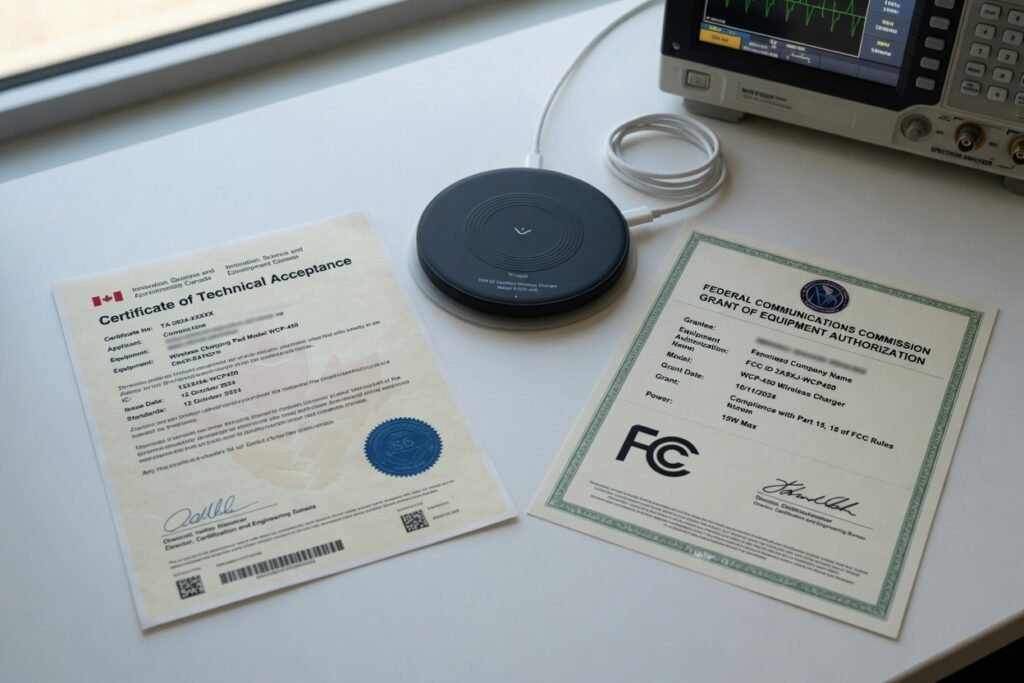
Now let’s look at the commonalities of intentional radiators: this type of product requires applying for a unique certification ID from the official authority (namely ISED ID and FCC ID). This ID can be publicly queried in the official database and is the official proof of product compliance. For the charging products discussed in this article, typically including wireless chargers, magnetic charging pads, smart charging devices with Bluetooth/Wi-Fi, and charging power strips with wireless functions, it is usually necessary to obtain FCC ID or ISED ID respectively.
The difference between the two is that Canada and the United States have different regulations on the allowed use range and power thresholds of some wireless frequency bands. Some products may pass FCC certification smoothly but fail to meet ISED requirements. Moreover, the higher the wireless power of the product and the more functions it has (for example, with Bluetooth, Wi-Fi, and wireless charging communication functions at the same time), the greater the difference in regulatory requirements between the two, and the more items that need supplementary testing.
Certification Process and Cycle
The process logic for unintentional radiators is basically the same on both sides: first complete compliance tests in accordance with the applicable standards of the target market, confirm in advance that the laboratory qualification, test standard version, and report format meet the requirements of local regulators and sales platforms → after passing the test, the enterprise signs the declaration of conformity on its own → the full set of documents is kept on file for inspection, and there is no need to submit them to the official authority for review.
Supplementary note: The FCC SDoC (Supplier’s Declaration of Conformity) path also requires clarifying a US-based responsible party and keeping the compliance information declaration on file; for ISED ICES (Interference-Causing Equipment Standard) devices, test reports, compliance declarations, and labeling documents must be kept on file in accordance with corresponding standards.
The overall cycle is generally 1-2 weeks, but the corresponding compliance process must be completed in accordance with the standards of the target market, and the complete report of the other market cannot be directly applied.
There is an obvious difference in the cycle for intentional radiators: FCC ID generally takes 3-6 weeks, while ISED ID takes 4-8 weeks, which is slightly longer. If you have already obtained the FCC ID, you can reuse part of the test data when applying for ISED, without retesting all items, but you cannot directly “transfer the certification”. You still have to go through the complete ISED application process to obtain the exclusive ISED ID.
The cycle is not fixed. The more wireless functions the product has and the fuller the schedule of the certification body, the longer the cycle will be. If you are rushing for the peak sales season, it is best to reserve time in advance.
Cost Range (Reference for Charging Products)
There is no unified official pricing for certification fees, which are regulated by the market and specifically depend on product complexity and laboratory qualification. Here is a common reference range for charging products:
• Unintentional radiators (such as 20W USB-C wired chargers): FCC fees range from a few hundred to over 1,000 US dollars, and common ISED quotations may be slightly higher, fluctuating by about 5%;
• Intentional radiators (such as 15W magnetic wireless chargers with communication functions): FCC fees are several thousand US dollars. In common cases, ISED fees may be about 10%-20% higher. For smart charging devices with multi-band Wi-Fi and multiple wireless modules, ISED requires more supplementary test items, and the cost gap will further widen.
*The above are common market reference values, excluding rectification fees, agency fees, expediting fees, and differential test fees for multiple models. Actual costs may fluctuate greatly depending on products and service contents. A reminder here: do not be greedy for cheap and choose laboratories with quotations far below the market price. If the report is not officially recognized, it is a waste of money and will also delay the product launch time.
Product Labeling and Documentation Requirements
The general rule is: for intentional radiator products, the corresponding official ID (FCC ID or ISED ID) must be marked on the product body; unintentional radiator products usually do not need to be marked with the official ID, but still need to provide compliance information declarations or corresponding labels on the product body, packaging, or instructions in accordance with product categories and applicable standards. The specific requirements depend on the product type, and there is no complete exemption from labeling obligations.
The core difference between the two lies in language: ISED requires that user-facing natural language compliance information such as user manuals, warnings, and mandatory compliance declarations usually be provided in both English and French; label information such as certification numbers, model numbers, and technical parameters can be marked in accordance with the format specified by ISED, and all content is not required to be bilingual. This is one of the most common pitfalls for sellers on the Canadian site. Many people have their goods directly detained by customs or their products removed from the platform because the instructions are only in English and lack French compliance declarations.
For products that are too small to print complete labels, such as mini chargers, both sides allow the use of alternative methods such as packaging, instructions, or electronic labels in accordance with the rules, but it should be clear that the small-size exemption usually only allows the transfer of IDs, declarations, or warnings that cannot fit on the product body to carriers such as packaging, instructions, and electronic labels, provided that they meet the requirements of visibility, accessibility, and the format specified by regulations; it does not mean exemption from labeling or bilingual documentation obligations. Among them, ISED’s exemption conditions are stricter than those of FCC, so it is necessary to confirm in advance whether they meet the requirements.
The most common labeling errors for charging products are mixing up FCC ID and ISED ID, or the lack of French content in the compliance documents of ISED products. These problems may lead to direct detention of goods.
Validity Period and Authenticity Verification
Many people ask how long the validity period of certification is. In fact, neither FCC ID nor ISED ID has a fixed validity period — as long as the product itself has not changed and the regulations and standards of the corresponding market have not been updated, it can be used all the time.
There are two situations that require re-evaluation or application: first, the product’s hardware, wireless functions, or model changes; second, the regulations and standards of the corresponding market are updated. Take two common examples of charging products: if the power of a wireless charger is upgraded from 15W to 20W, compliance must be re-evaluated; when replacing the shell, structure, or material of an ordinary charger, it should first be submitted to the laboratory for change evaluation. If the evaluation confirms that it does not affect the electromagnetic compatibility results, only the technical documents or report information can be updated. If the change involves factors that may affect radiated/conducted emissions, such as shielding structure, opening position, and cable layout, corresponding items need supplementary testing.
Authenticity verification is also simple: FCC ID can be checked by entering the number in the FCC official database, and ISED ID can be queried in the Canadian Radio Equipment Database. All information is public, and you can verify it yourself when selecting suppliers or purchasing goods to avoid getting fake certifications.
Certification Judgment for Common Charging Products
After talking about the overall differences, we will explain how to judge certification requirements one by one for several types of the most common charging products, and you can directly compare them with your own products.
Ordinary Wired Chargers/Power Adapters
They belong to unintentional radiators, and the self-declaration path is sufficient. For ordinary wired chargers, safety regulations, plug standards, and energy efficiency are the core compliance requirements, while the wireless-related requirements of ISED/FCC are not the most core, but qualified test reports must still be kept on file as required to avoid penalties during random inspections.
Charging Cables/USB-C Cables
There are two situations: ordinary passive charging cables without chips are exempt from wireless certification on both sides, and no certification is needed; fast charging cables with E-Marker chips (that is, PD fast charging cables that can negotiate high power, such as 100W fast charging cables) belong to unintentional radiators and require self-declaration.
There is also an accessory judgment rule: if the charging cable is sold together with the complete device (such as with a charger or mobile phone), the compliance requirements follow the complete device; if it is sold separately, it is judged according to its own functions.
Wireless Chargers/Magnetic Charging Pads
Such charging devices that actively generate radio frequency energy or have superimposed wireless communication functions should first be treated as intentional radiators and apply for the corresponding official ID. Which specific rules apply, such as FCC Part 15/Part 18 or ISED RSS/ICES, shall be confirmed by a qualified laboratory, but this cannot be used to skip the compliance authorization or documentation requirements of the target market.
If the product also has multiple wireless functions such as Bluetooth, Wi-Fi, NFC, and App control, the certification items will increase accordingly, and the cost and cycle will also rise. It is recommended to let the laboratory confirm the specific authorization path in advance to avoid wrong or missing certification.
Smart Charging Devices (with Bluetooth/Wi-Fi)
For example, smart charging power strips, App-controlled power banks, and wireless chargers with positioning functions. These products clearly have active wireless communication functions, belong to intentional radiators, and usually require application for an official certification ID. There is a very common misunderstanding here: many people think that if the built-in wireless module already has certification, the complete device does not need certification. This is wrong — the antenna design, shell material, and usage method of the complete device will all affect wireless transmission parameters. A certified module does not mean the complete device is compliant, and complete device certification is still required.
Special Requirements of Cross-Border Platforms
If you sell on cross-border platforms such as Amazon, note that the platform’s requirements are often stricter than customs clearance. Usually, charging products are required to upload certification documents in advance before they can be listed. For example, wireless chargers on Amazon Canada must upload valid ISED-related compliance documents before they can be listed, otherwise they will be directly removed. Be sure to confirm the specific requirements of the platform in advance before listing, and do not wait until the product is removed to make up the certification.
6 Most Common Pitfalls in Charging Product Certification
We have sorted out the 6 most common types of certification pitfalls in the North American charging product market. Avoiding these can help you save a lot of money and time.
First, using a single-market certification to sell directly across the entire North American market. The most common scenario is that wireless chargers from the US site are shipped directly to Canada and detained by customs due to lack of ISED compliance documents. To enter the corresponding market, you must complete local compliance requirements. Do not take any chances.
Second, thinking that all charging products require an official ID. Only intentional radiators need to apply for an official ID; unintentional radiators only need self-declaration; passive ordinary charging cables are even exempt from wireless certification. Don’t waste money, just pay attention to keeping test reports on file as required.
Third, directly using FCC reports as ISED reports. The two have different test standards and frequency band limits, and the official authority does not recognize direct reuse of complete reports. The correct approach is to find a formal laboratory for evaluation, reuse items that can be reused, and conduct supplementary tests for items that cannot be reused. For example, for common 65W gallium nitride chargers, most conducted tests can be reused, while radiated tests usually need to be retested. The specific results shall be subject to the laboratory’s evaluation.
Fourth, ignoring the English-French bilingual requirement when doing ISED. ISED mandates that user-facing natural language content such as user manuals, warnings, and mandatory compliance declarations be bilingual in English and French. Even if the product is too small to print labels, alternative carriers must be used in accordance with the rules, and the compliance declaration in the paper manual must be bilingual. Many sellers have their goods detained by customs and products removed from platforms due to lack of French content, which is not worth the loss for delaying peak season sales.
Fifth, thinking that having a certification ID is foolproof. The certification ID is not a universal pass; it only corresponds to a specific model, hardware version, and sales region. If you add new wireless functions to the product, replace the wireless module, or adjust the transmission power, the original certification will automatically become invalid and you need to reapply.
Sixth, confusing wireless certification with safety and energy efficiency certification. ISED and FCC only regulate electromagnetic interference and wireless transmission compliance, not safety regulations, energy efficiency, or whether the plug shape meets local standards. For charging products to be sold legally, they also need to meet multiple sets of requirements such as safety regulations, energy efficiency, and plug standards. Don’t miss them.
Five-Step Decision-Making Method for Charging Product Certification Selection
Finally, we have sorted out a clear set of decision-making logic for you. Following the steps will not go wrong, and can save as much money and time as possible.
Step 1: First determine the target market. If you only do the US market, only do the corresponding FCC self-declaration or ID certification; if you only do the Canadian market, only do the corresponding ISED certification; if you do both the US and Canadian markets, prioritize finding a laboratory recognized by both sides for combined testing, which has the opportunity to save part of the repeated testing costs. The specific range depends on the overlap of test items, the consistency of prototype configuration, and laboratory qualification, and is not a fixed ratio.
Step 2: Judge whether wireless certification is needed. There is a very simple and quick judgment standard: check whether the product has the function of actively transmitting wireless signals — Wi-Fi, Bluetooth, wireless charging communication, and NFC all count. As long as there is one, it is considered to have wireless functions. If there is no wireless function, there is no need to apply for an official ID, and the focus should be on safety regulations, energy efficiency, and plug compliance, but products that belong to unintentional radiators still need self-declaration; if there is a wireless function, proceed to the next step to judge the certification path. Here is a special case: although fast charging cables with E-Marker chips do not have active transmission functions, they belong to unintentional radiators and require self-declaration. Don’t miss it.
Step 3: Judge the specific certification path. Unintentional radiators follow self-declaration, no official certification is required; intentional radiator products must apply for an official certification ID. If you are not sure which category the product belongs to or what path to take, do not judge by yourself. Find a formal certification body for evaluation, so as not to waste money on wrong certification.
Step 4: Make good use of money-saving and time-saving skills. If you do both markets simultaneously, find a dual-recognized laboratory for one test and issue two reports that meet the requirements of both sides to reduce repeated testing costs; if you already have FCC certification and then do ISED, submit the complete FCC report to the laboratory for evaluation, and items that meet the requirements can be directly reused without retesting all items; do not choose laboratories with quotations far below the market price, because if the report is not recognized, the money is wasted and time is delayed.
Step 5: Do a good job in post-launch maintenance. The full set of documents (test reports, declarations of conformity, label drawings, ID certificates) should be kept properly, so that they can be produced during customs random inspections or platform audits; any changes to the product (hardware, wireless functions, model, sales region) require re-evaluation of compliance; usually pay attention to the regulatory updates of the corresponding market, and timely supplement tests or update documents when necessary to avoid certification invalidation.
In general, although ISED and FCC both belong to the category of North American wireless compliance and have a high degree of overlap in regulatory content, they are two independent sets of market access rules. The core of North American compliance for charging products is to first clarify the target market, then judge the radiation type and wireless functions of the product, complete testing and document retention according to the corresponding path, and avoid common misunderstandings at the same time. If you have questions about product classification or certification path, it is recommended to have a laboratory or certification body with corresponding qualifications evaluate and confirm in advance to avoid compliance risks.