
Many sellers of charging accessories targeting the South Korean market, after finally obtaining KC Certification, find their products taken down shortly after listing due to lack of EPR compliance, and even face fines. When many people first hear about EPR, they confuse it with safety certification and energy efficiency requirements, and are not sure whether their chargers and charging cables need to comply. In this article, we will explain South Korea’s e-waste EPR system in depth from basics to practical operation, especially the applicable rules, responsible entities, compliance steps and common risks for charging products, to help you sort out the core logic and practical key points.
I. First, Understand What EPR Is: What It Regulates and Who Is in Charge
The plain-language explanation of EPR is very simple: whoever puts products on the South Korean market for sale shall bear the statutory responsibility for recycling and disposal of the products after they are scrapped. Its full name is Extended Producer Responsibility. The core is to transfer the cost of recycling and disposal from the government and consumers to the production and import side of products, push enterprises to consider recycling issues from the design stage, ultimately reduce landfilling and incineration, and improve the resource recovery rate.
For merchants engaged in charging products, EPR is not an optional “environmental add-on”, but a mandatory access requirement for legal entry into the South Korean market. Without it, products cannot be sold normally at all.
The management framework of South Korea’s EPR is very clear:
- The competent authority is the Ministry of Environment (MOE) of South Korea, which is responsible for formulating rules, standards and statutory recycling targets;
- Implementation and declaration-related matters are usually handled through South Korean official designated institutions, systems or recognized recycling organizations. The Korea Environment Corporation (KORCA) undertakes the implementation and management functions. The specific criteria for registration, fee collection and declaration shall be subject to the latest announcements of MOE and KORCA;
- The legal basis is the Act on Resource Circulation of Electrical and Electronic Products and its supporting detailed rules. Finished electronic and electrical products such as small chargers and power adapters usually fall within the scope of management; fast-charging cables and adapters with chips or control circuits need to be confirmed according to official classification; large appliances such as refrigerators and televisions are also typical objects in South Korea’s e-waste management system.
Many people who are new to this tend to confuse EPR with other compliance requirements. Here is a table to clarify the differences:
| Comparison Item | Core Function | Responsible Entity | Supervision Stage |
|---|---|---|---|
| South Korea EPR | Bear the responsibility for recycling and disposal of products after scrapping | Producer/Importer | Product scrapping stage |
| KC Certification | Verify product safety and electromagnetic compatibility | Producer/Importer | Pre-market access |
| Energy Efficiency Label | Indicate the power consumption level of the product during use | Producer/Importer | Use stage |
| Ordinary Waste Sorting | Regulate consumers’ waste disposal behavior | Consumers | Waste disposal stage |
| EU WEEE | E-waste recycling responsibility within the EU | Producers/importers within the EU | Scrapping stage |
A special reminder here: although the core logic of EU WEEE and South Korea EPR is similar, their labeling, fee rates and declaration rules are completely different. EU qualifications cannot be directly used in the South Korean market, and the two are not mutually applicable.
II. Does Your Charging Product Need EPR? Scope of Application and Boundary Judgment
This is the issue that everyone is most concerned about. Let’s first clarify which charging products are definitely subject to EPR management:
- Charging equipment category: wall chargers, car chargers, wireless chargers, power adapters, multi-port charging stations, plugs with charging function — all count as long as they are finished products sold separately;
- Active accessories category: charging cables with chips or control circuits, USB-C adapters with fast charging/data protocols — “active” here means that the product has electronic components inside, not passive accessories that only conduct electricity. For example, USB-C fast charging cables with E-Marker chips fall into this category;
- Battery-included charging category: power banks, magnetic wireless chargers with built-in batteries — such products involve two recycling obligations: e-waste and waste batteries, which will be explained in detail later.
What situations can be exempted? There are also clear boundaries:
- Pure parts category: non-finished parts such as separately sold USB female sockets, ordinary plug metal sheets, etc., do not need to be included;
- Non-circulation category: temporarily imported test and display samples (not for sale), accessories imported in small quantities for personal use — for example, tourists bringing two chargers to South Korea for their own use do not need to comply;
- Pure passive accessories: ordinary adapters without electronic components, pure copper core passive charging cables — note here that you cannot decide by yourself whether a product is purely passive; it needs to be confirmed through official classification to avoid misjudgment.
There is only one core criterion for judging whether a product needs EPR: whether it is a finished electronic and electrical product entering the South Korean commercial circulation market. In addition, the sales form will also affect the attribution of responsibility: if the accessory is sold separately, the seller/importer of the accessory shall complete compliance separately; if it is included as a bonus with complete devices such as mobile phones and computers, the responsible party of the complete device shall bear the EPR obligation, and the accessory manufacturer does not need to handle it separately, provided that the accessory is put on the South Korean market by the same responsible entity as part of the complete device sales package; if the accessory is imported separately, sold separately, sold as after-sales spare parts or as an independent gift package, the judgment shall still be based on the actual first placement entity.
If you are not sure, the safest way is to use KORCA’s online classification tool to inquire, and follow the official judgment — don’t guess by yourself.
People who are new to this are prone to several common misunderstandings, which are corrected here at once:
- It is not only complete devices such as mobile phones and computers that need EPR; all finished charging accessories must comply;
- Applicability only depends on the product category, and has nothing to do with the product’s power, price, or size. Even a 5W mini charger needs EPR as long as it is sold as a finished product;
- Not all charging cables are ordinary cables; active charging cables with chips must be included in EPR management.
III. Who Is Responsible? EPR Responsible Entities and Operation Logic
The logic for determining EPR responsibility is very clear: the entity that first introduces the product into the South Korean circulation market bears the main responsibility.
There are three common types of responsible entities:
- South Korean domestic producers;
- Importers within South Korea;
- Overseas cross-border sellers — such entities usually need to handle it through a responsible entity within South Korea or an officially recognized agent, and the specific rules shall be subject to KORCA’s latest acceptance rules.
Many merchants engaged in OEM private label will ask: I am a contract manufacturer producing goods for the brand owner, am I responsible? The answer is: the brand owner or the entity that first puts the product on the market is the responsible person. Even if the contract between the two parties stipulates that the contract manufacturer shall bear the responsibility, it cannot exclude the obligations stipulated by law — the contract is only a civil agreement between the two parties and cannot override statutory responsibilities.
The responsibility boundaries of other relevant parties are also very clear, so you don’t have to take unnecessary responsibility:
- Distributors: if they only distribute and do not import by themselves, they have no main responsibility; but if they import and sell by themselves, they are responsible entities;
- E-commerce platforms: if they only provide settlement services for third-party sellers, they do not need to bear responsibility; but if they operate self-operated businesses and import and sell by themselves, they shall bear EPR obligations;
- Consumers: they only need to sort and dispose of waste products as required, and do not need to bear the payment and declaration responsibilities of the producer side.
How to fulfill the responsibility specifically? There are two ways:
- Join an officially recognized Producer Responsibility Organization (PRO): the PRO is uniformly responsible for recycling, declaration and other matters. It is suitable for small and medium-sized sellers and importers, as they do not need to build a recycling system by themselves, which saves trouble;
- Self-operated recycling: enterprises build a recycling system that meets the requirements by themselves. It is only suitable for large brand owners with extremely large annual placement volume, and the cost is very high.
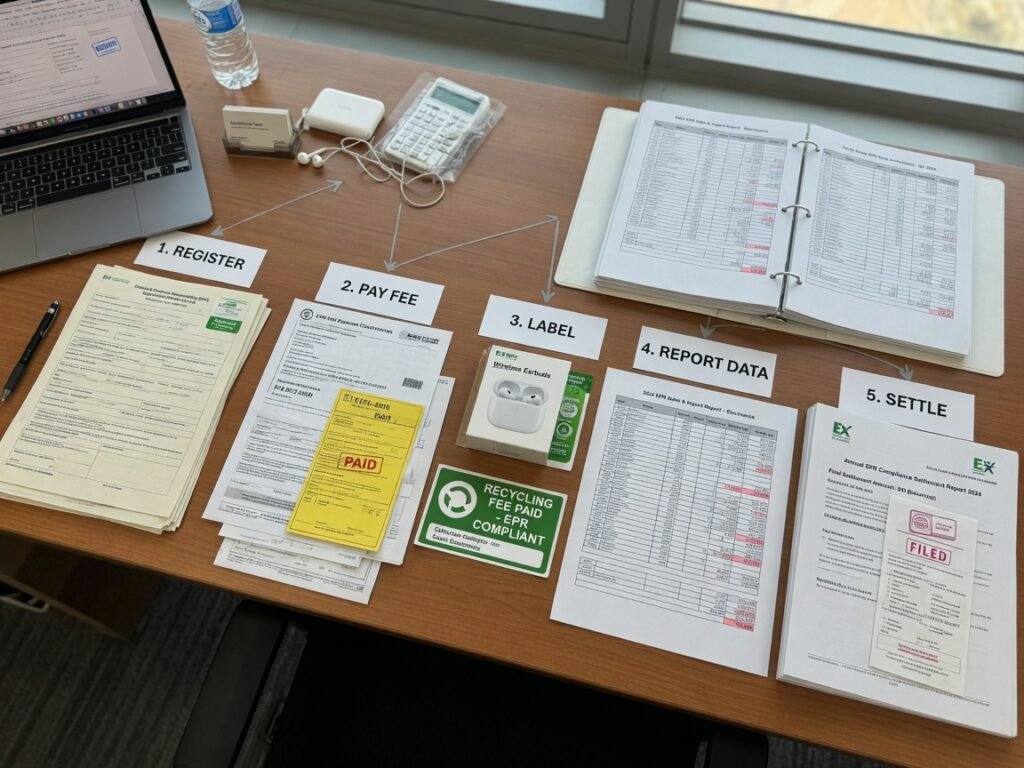
No matter which method you choose, the basic annual process is five fixed steps:
Step 1: Before the first sale of the product, EPR registration must be completed;
Step 2: Pre-pay the recycling and disposal fee based on the estimated annual sales volume;
Step 3: Affix a compliant recycling label on the product or packaging;
Step 4: Declare the actual sales/import data of the previous year in the following year;
Step 5: Settle the fee based on the actual sales volume — if the pre-paid amount is more than the actual amount, the excess will be refunded; if it is less, the difference shall be made up.
IV. Basic Practical Operation: Core Requirements for EPR Compliance
Now that we know whether it is needed and who is responsible, let’s talk about what needs to be done specifically, with four core requirements:
1. Registration Requirements
First of all, the applicant entity must be a legal person within South Korea, or an officially recognized local agent; overseas entities cannot apply directly.
The registration must be completed before the product first enters the South Korean market — you cannot sell first and make up for it later. Moreover, registration is renewed annually, not valid for life with one registration.
Materials to be prepared for registration include: product category, unit weight, estimated annual sales volume, and entity qualification certificate.
2. Recycling Label Requirements
South Korean officially recognized e-waste recycling related labels shall be used, and cannot be replaced by EU WEEE or labels of other countries/regions; the style, size, and posting position (product body or outer packaging) of the label shall comply with the latest South Korean label specifications, and be implemented in combination with the actual size of the product. In principle, it shall be clearly visible and not covered.
Common mistakes include labels that are too small, posted in hidden positions, or use unofficial styles — all of these are violations.
3. Fee Payment Requirements
The recycling and disposal fee is calculated based on the product weight of the same category, the difficulty of material disposal, and whether it contains batteries — the more difficult to dispose, the heavier the weight, and the products with batteries, the higher the fee.
The payment rule is annual pre-payment, and the excess will be refunded and the deficiency made up based on the actual sales volume at the end of the year. The specific fee rate shall be subject to the standard officially announced in the current year, which may be adjusted annually.
It should be noted that paying the fee is not the end of the matter. If the statutory recycling target is not met, additional difference fees need to be paid. For small charging accessories, the cost per unit is very low, but the total cost will increase with the increase of sales volume.
4. Data Declaration Requirements
The declaration cycle is once a year, declaring the actual sales or import data of the previous year.
The declaration content includes the category, quantity, and total weight of charging products. The data must be true and traceable, and import vouchers and sales records must be kept for future reference.
The determination of recycling volume must be based on the recycling certificate issued by the PRO or official institution; self-counted recycling volume is not valid.
In addition to the above four points, there are also relevant requirements for product design and materials: try to adopt structures that are easy to disassemble, such as using less irreversible glue and unifying screw specifications; try to use a single recyclable material to avoid mixed plastics that are difficult to separate; at the same time, the restriction of hazardous substances shall be coordinated with South Korea RoHS and KC safety requirements to meet all relevant regulations.
V. Advanced Judgment: How to Make Decisions on Boundary Products and Compliance
For sellers with certain experience, they often encounter problems such as boundary products and choice of responsibility fulfillment methods. This part of the content can help you make more accurate judgments.
1. Accurate Judgment of Boundary Products
For easily confused products such as charging cables and adapters, a three-step method can be used for judgment:
Step 1: First check whether there are active electronic components, such as chips and control circuits. If there are, it is highly likely to be an active accessory and needs to be included;
Step 2: Check the sales form — whether it is sold separately or included with complete devices. If sold separately, you are responsible; if included with complete devices, the complete device party is responsible;
Step 3: Finally confirm according to the official classification result.
The classification of several special categories can be remembered in advance: GaN multi-port chargers are classified as ordinary chargers. The heavier the weight, the higher the fee rate, which has nothing to do with the technology used; car chargers and wireless chargers are clearly included in the EPR scope, without exception.
In special sales scenarios, such as after-sales spare parts, second-hand/refurbished products, the entity that actually puts the product into the circulation market is responsible. For example, if you sell refurbished power banks, you are the responsible entity, which has nothing to do with the original brand owner.
2. Logic for Choosing Responsibility Fulfillment Methods
Self-operated recycling is only suitable for enterprises that meet three conditions: extremely large annual placement volume, complete recycling outlets in South Korea, and ability to independently complete declaration and verification. Small and medium-sized sellers basically do not need to consider it, as the cost is much higher than joining a PRO.
When choosing a PRO, there are four core dimensions to look at: fee transparency, service coverage, declaration convenience, and whether there is service experience with charging products — try to choose a PRO that is familiar with small electronic accessories to avoid declaration errors due to unfamiliarity with the category.
A special pitfall to avoid here: you must choose a PRO officially recognized by the South Korean Ministry of Environment. Certificates issued by unqualified institutions are completely invalid, which is a waste of money.
3. Cross-Judgment of Multiple Environmental Obligations (Exclusive to Charging Products)
Charging products often involve multiple environmental obligations, and you cannot only fulfill one:
- Battery-included charging products (such as power banks, wireless chargers with batteries) need to meet two obligations at the same time: e-waste EPR and waste battery recycling, which are independent of each other;
- For packaged charging products, packaging waste recycling is another independent obligation, which is not included in e-waste EPR and requires separate compliance;
- EPR and other compliance requirements such as KC, energy efficiency, and RoHS are all independent, and need to be handled separately — they cannot replace each other.
4. Influencing Factors of Fee Differences
Why are some EPR fees high and some low for the same charging products? It is mainly affected by four factors:
- Product weight: The heavier the charger and adapter, the higher the disposal fee. For example, usually higher-power adapters may have higher fees due to larger volume and weight, but the final calculation is still based on weight, material, and whether it contains batteries;
- Material composition: Products containing circuit boards, rare metals, and non-degradable plastics have higher disposal difficulty and higher fee rates;
- Whether it contains batteries: Products containing lithium batteries require additional waste battery disposal fees, so power banks of the same weight are more expensive than ordinary chargers;
- Product category: Active electronic accessories have higher fee rates than passive accessories (if included), because the disposal process of electronic components is more complicated.
VI. Common Risks and Pitfall Avoidance Guide
1. High-Frequency Violation Scenarios and Consequences for Sellers
The most common violation pitfalls for sellers are: selling without completing EPR registration, failing to affix the correct recycling label as required, falsely reporting or concealing data or failing to make annual declarations, entrusting unqualified institutions to handle it on their behalf, and judging product exemption by themselves without retaining supporting materials.
The consequences of violations are more serious than many people think:
- Economic penalties: Calculated based on the duration of the violation and the value of the goods, the maximum can be several times the payable fee — it is not something that can be solved just by making up the money;
- Market penalties: Products being taken down, import bans, and market access restrictions, which is equivalent to directly losing the South Korean market;
- Platform-level impact: Relevant platforms may take down, restrict sales, or impose other penalties on violating products in accordance with their own rules.
2. Exclusive Pitfall Avoidance Checklist for Sellers
There are several high-frequency pitfalls that are particularly easy to fall into, and you must avoid them:
- Don’t treat fast-charging cables with chips as ordinary passive cables and skip EPR — cables with E-Marker chips that support fast charging protocols are active accessories and must comply;
- Don’t think that cross-border direct mail of small parcels does not need EPR — as long as it is commercial sales, even dropshipping directly to South Korean consumers requires compliance;
- Don’t think that with KC certification you don’t need EPR — KC and EPR are independent of each other, and the two compliances need to be completed separately;
- Don’t think that you can ignore historical declarations after the product is discontinued — products that have been put on the market still need to complete the declaration for the corresponding period; you can’t stop declaring just because you don’t sell them anymore.
3. How Consumers Judge and Handle
For ordinary consumers, there are also two practical knowledge points:
- Judging compliant products: You can check whether there is a South Korean official e-waste recycling label on the product or packaging, and whether there is clear importer information; when the official recycling label or importer information is missing, you should further verify through official channels, and cannot draw a conclusion directly based on this alone;
- Disposal of waste chargers: Do not mix them with domestic waste. Put them into special e-waste recycling bins in communities or on the street, or at designated recycling points; if battery-included products such as power banks are bulging or overheating, do not squeeze or disassemble them by yourself. Dispose of them through the special channel for waste batteries to avoid danger.
4. Three-Step Quick Self-Inspection Method for Sellers

If you are not sure whether you are compliant, you can quickly self-inspect according to these three steps:
Step 1: First confirm whether the product is within the scope of EPR and whether you are the responsible entity;
Step 2: Check whether the EPR registration qualification, recycling label, and payment voucher are complete and compliant;
Step 3: Check whether the declared data is consistent with the actual sales volume, and all supporting documents must be kept for future reference.
South Korea’s EPR may seem like an environmental requirement, but it is essentially a mandatory access threshold for the South Korean market. Especially for sellers of charging accessories, you should not take chances. When completing basic judgments, sellers should at least be able to clarify the differences between EPR, KC, energy efficiency, and waste sorting, list common applicable categories such as wall chargers, car chargers, wireless chargers, adapters, and active fast-charging cables, judge whether they are the first placement entity, and verify through official channels when in doubt; when further promoting compliance, they should also be able to choose PRO or self-operated recycling methods based on their own sales volume and local South Korean resources, and retain materials such as registration, labeling, payment, declaration, and classification certificates to reduce risks related to product takedown, supplementary payment, and annual declaration.