
Recently, many cross-border sellers operating in the South Korean market, supply chain practitioners, and ordinary consumers concerned about product environmental protection have heard the news that K-RoHS will be fully implemented in 2028. Is this claim reliable? What does K-RoHS regulate? What specific impacts does it have on commonly used electronic products such as chargers and charging cables? In this article, we start from the most basic concepts, and combine verifiable official regulations to clarify the current rules, rumored content, and practical operation methods.
1. Basic Understanding of K-RoHS and Verification of the 2028 Timeline Authenticity
1.1 What Exactly is K-RoHS
Put simply, K-RoHS is South Korea’s environmental control regulation for electrical and electronic products, with the core of restricting hazardous substances in product materials, reducing environmental pollution caused by e-waste, and lowering the long-term health risks of hazardous substances to the human body. Its competent authority is the Ministry of Environment (MOE) of South Korea. As verified before the publication of this article, its core legal sources are the Act on Resource Circulation of Electrical/Electronic Products and Automobiles and its supporting enforcement decrees and enforcement rules, which have legal effect and are not industry self-regulatory standards.
This regulation is most closely related to two groups of people: one is cross-border sellers and supply chain practitioners operating in the South Korean market, where K-RoHS compliance directly determines whether products can be legally sold in South Korea; the other is ordinary consumers and overseas online shoppers, as products compliant with K-RoHS have more guaranteed environmental friendliness of materials and are safer to use.
1.2 How to Verify the Authenticity of the 2028 Timeline
First, clarify the core conclusion: according to official verification results before the publication of this article, the claim that K-RoHS will be fully implemented in 2028 is still a market rumor, and there is no official legal document issued by the South Korean government to confirm it.
If you want to verify the authenticity of relevant information by yourself, do not trust third-party second-hand information, and query directly through two official channels: first, the National Legal Information Center of South Korea (official website domain: law.go.kr, supports Korean search); second, the announcement section of the official website of the Ministry of Environment of South Korea. When querying, focus on checking the following core fields. Only formal decrees with complete information of these fields are valid regulations:
- Official name and revision number of the decree
- Promulgation date and official effective date
- Applicable product scope and transitional provisions
- List of restricted substances and limit values
- Exemption clauses and labeling requirements
If a revised version with the corresponding effective date is really issued in the future, there are three main variables of transitional rules that are widely discussed in the industry (all are non-established content, for reference only):
First is the distinction of applicable objects. Generally, it will be divided according to the date of production, import, or placement on the South Korean market of products. Requirements may differ for old products already in circulation and newly produced or newly imported products;
Second is the determination of old inventory. Whether previously produced inventory can continue to be sold usually requires providing proof of the first placement date, inventory vouchers, and model consistency certificates, and then judging against specific transitional provisions;
Third is the determination of revised products. Whether the product only has changed packaging or minor details, or has changed materials or structure, it is necessary to confirm whether a re-compliance assessment is required according to the scope of change and model rules.
1.3 Differences from KC Safety and South Korea’s Energy Efficiency Regulations
Many people easily confuse K-RoHS with two other common product systems in South Korea: KC safety certification and energy efficiency labeling. The three are under different competent authorities, have completely different control directions, and are not mutually recognized. A product may need to meet all three requirements at the same time.
| System Name | Competent Authority | Core Control Direction | Relationship with K-RoHS |
|---|---|---|---|
| K-RoHS | Ministry of Environment (MOE) of South Korea | Hazardous substances in materials and environmental friendliness of electrical and electronic products | Independent system, not mutually recognized |
| KC Safety Certification | Korean Agency for Technology and Standards (KATS) | Product safety risks, such as electric shock, fire, and mechanical injury | Independent system, completely different control direction |
| South Korea Energy Efficiency Labeling | Korea Energy Corporation | Product energy consumption and standby power consumption (only applicable to products in the official catalog) | Irrelevant to material environmental protection, implemented independently |
2. Core Control Rules: Substances, Limit Values, and Homogeneous Materials
The core logic of K-RoHS is to control the content of hazardous substances, but the judgment criteria are different from what many people think. We will break them down one by one.
2.1 Restricted Substances and Limit Values
The list of restricted substances is divided into two situations, which must be clearly distinguished:
One is currently confirmed rules: The following content is subject to the valid provisions of South Korea’s Act on Resource Circulation of Electrical/Electronic Products and Automobiles and its supporting enforcement decrees as of the verification date of this article. Currently, K-RoHS controls 6 conventional hazardous substances, and all limit values are for the mass fraction of homogeneous materials (that is, the proportion of hazardous substances in a smallest single material, not the average content of the entire product). Specifically:
- Lead (Pb): 0.1% (1000 ppm, that is, the lead content in 1 kilogram of homogeneous material does not exceed 1 gram)
- Mercury (Hg): 0.1% (1000 ppm)
- Cadmium (Cd): 0.01% (100 ppm)
- Hexavalent chromium (Cr(VI)): 0.1% (1000 ppm)
- Polybrominated biphenyls (PBB, a type of flame retardant): 0.1% (1000 ppm)
- Polybrominated diphenyl ethers (PBDE, a type of flame retardant): 0.1% (1000 ppm)
The other is unconfirmed revision rumors: There is news that the revised version will add 4 phthalate substances (commonly used plastic softeners, long-term exposure may affect health), namely DEHP, BBP, DBP, and DIBP (this is a market rumor and has not been officially confirmed).
Here, remember the most core premise: all limit values are for the mass fraction of homogeneous materials, not calculated as the average of the entire product.
2.2 What is a Homogeneous Material
A so-called homogeneous material, in plain terms, is the smallest unit of a single material that cannot be further disassembled using ordinary mechanical tools such as pliers and screwdrivers. Here are some common examples of charging products: the plastic shell of a charger, solder on a PCB board, the metal plating of a USB interface, the PVC sheath of a charging cable, and the alloy material of plug pins. These are all typical homogeneous materials.
The logic for judging compliance is very simple: as long as the content of hazardous substances in any homogeneous material exceeds the limit value, the entire product is considered non-compliant. Even if the average content of the entire product is very low, if a small part exceeds the standard, it still does not meet the requirements.
2.3 Boundary Details of Testing and Judgment
Regarding testing and judgment, there are two details that are easy to fall into pitfalls:
First is the validity of “not detected”. Many suppliers will say that hazardous substances in the product are not detected, but this statement must be viewed in combination with the detection limit of the testing method — if the detection limit of the testing method is higher than the regulatory limit, then this “not detected” is meaningless, equivalent to inaccurate testing. Only when the detection limit is lower than the regulatory limit of the corresponding substance does the “not detected” result have reference value.
Second is the special judgment of hexavalent chromium. The detection of hexavalent chromium cannot be replaced by total chromium content. It must be comprehensively judged based on the standard methods cited in current South Korean decrees (such as the surface corrosion method for metal plating, the extraction method for polymers, etc.) combined with the existing form of the material (surface plating / overall substrate). The specific method number and scope of application shall be subject to the testing standards supporting the decree, and general methods cannot be used casually for testing.
3. Applicable Scope for Charging Products: Three-Step Judgment Method and Boundaries
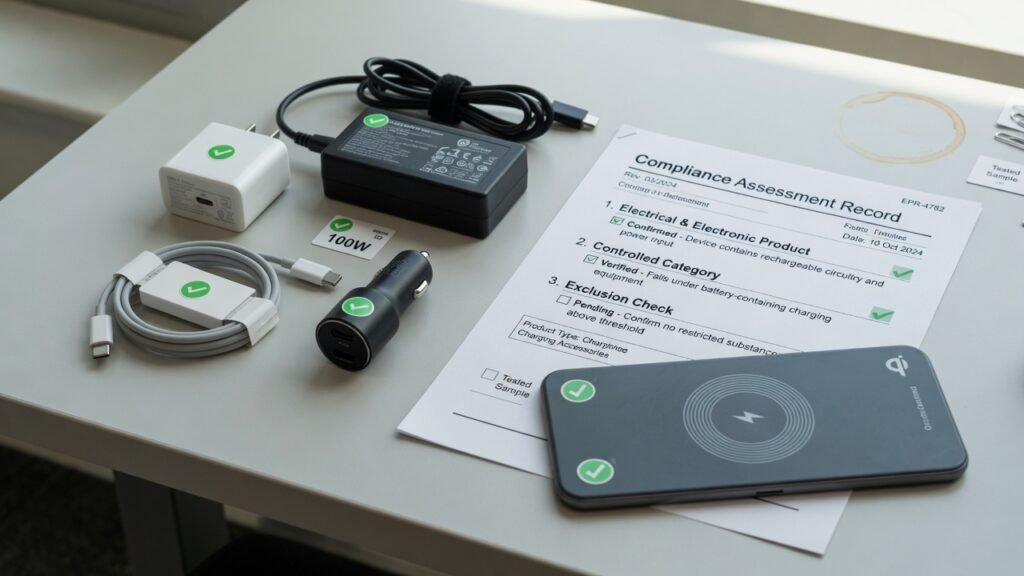
Many sellers of charging products are most concerned: is my product within the control scope of K-RoHS? Here is a statutory three-step judgment method, which can be checked in order:
Step 1: Confirm whether the product is an “electrical and electronic product”, that is, a product that works by electric current or electromagnetic field. This is the major premise;
Step 2: Check against the latest Catalog of Controlled Categories of Electrical and Electronic Products published by the Ministry of Environment of South Korea (available by searching keywords on the official website of the Ministry of Environment) to see if the product is in the catalog — K-RoHS does not control all electrical appliances, but is implemented according to a clear catalog;
Step 3: Confirm that the product is not within the statutory exclusion scope. For example, industrial, military, and medical special products that meet the explicit exclusion conditions of the decree are not within the consumer-level control scope, but the corresponding specific exclusion clauses must be checked, and you cannot classify them casually by yourself.
3.1 Control Status of Common Charging Products
We have sorted out the control status of common charging products. All statuses need to be rechecked against the latest official catalog, and the final result shall be subject to official documents:
| Status Category | Common Products | Verification Instructions |
|---|---|---|
| Currently usually included (recheck required) | Mobile phone/tablet chargers, laptop power adapters, independently sold charging cables, car chargers, wireless charging pads | Need to be confirmed after checking the corresponding Korean statutory category name, catalog entry number, and product placement form (independent sale / bundled with main product) against the latest controlled category catalog of the Ministry of Environment of South Korea; under current rules, such independently sold charging products are usually included in control, and the final result shall be subject to official formal documents |
| Rumored to be added (not officially confirmed) | Low-power simple adapters, charging components for portable power banks, low-power bundled charging cables | This is only a market rumor, and whether they will be included shall be subject to formal revision documents |
| Requires case-by-case judgment | Built-in interface components, repair and replacement parts, bundled gift accessories | Need to be judged based on factors such as whether the product is placed independently, its category, and usage scenarios |
Supplementary boundary explanation: Independently sold charging cables are verified against the catalog as independent products; for low-power cables supplied with the main product, whether they are separately included in control or judged together with the main product shall be subject to the official formal catalog and supporting rules; interface components placed on the market for separate sale (such as individually packaged adapters) need to be checked against the control catalog separately; interfaces that are built-in components of the product and not sold separately (such as the built-in USB-C female socket of a charger) are subject to compliance judgment together with the whole machine, and do not need to perform compliance obligations as independent products separately.
3.2 Boundary Between Gift Accessories and Exemptions
Many sellers give accessories with the main product, such as giving an adapter when buying a charger. Do these gifts need to be compliant? There is no general “gift exemption” rule, and it needs to be comprehensively judged based on three dimensions:
First, whether the accessory itself is in the control category catalog;
Second, whether the accessory is a standard component of the main product or an additional independent sales unit given as a gift;
Third, whether the responsible entity for market placement is the same entity.
If it is a standard accessory of the main product (such as a charging cable included with a charger at the factory), it is judged for compliance together with the main product; if it is an additional individually packaged accessory given as a gift and itself belongs to the control category, it needs to meet compliance requirements separately, and cannot be automatically exempted just because it is a gift.
As for the exemption situation that people often ask about, the core principle is: there is no general exemption. All exemptions must be included in the valid exemption list of the Ministry of Environment of South Korea. You cannot just listen to the supplier’s verbal statement that “ours is exempt”. A valid exemption clause must contain the following fields: name of restricted substance, application scenario, applicable product scope, clause number, and validity period. For example, regarding the exemption of high-temperature solder and contact alloy that many people ask about, there are no universally applicable relevant clauses in K-RoHS, and they must be checked one by one against the latest official list.
3.3 Boundary Situations Prone to Misjudgment
There are several other boundary situations that are easy to fall into pitfalls, and everyone should pay attention:
First is repair and replacement parts: not all repair parts are exempt. It is necessary to check the latest official rules and judge based on factors such as whether the parts are placed independently and whether they belong to the control category;
Second is industrial, military, and medical special chargers: only products that fully meet the explicit exclusion clauses of the decree (such as those only used in military facilities, those that have obtained medical device licenses, those specially matched for industrial production equipment, etc.) are not subject to consumer-level K-RoHS rules. You cannot directly determine exclusion just because the product is advertised as “special” or sold to professional users. Ordinary consumer-grade chargers, even if sold to industrial users, are not within the statutory exclusion scope;
Third is small-batch sales / personal carrying: products sold in small batches or carried into the country by individuals need to be judged against the specific rules of South Korea’s import circulation supervision. There is no natural small-batch exemption, and the specific requirements shall be subject to the customs and competent authorities.
4. Comparison of Regulatory Differences
4.1 Current K-RoHS vs Unconfirmed Revised Version (Rumor)
The following revised contents are all market rumors, without official confirmation, for reference only for advance preparation:
| Comparison Item | Current K-RoHS | Unconfirmed Revised Version (Rumor) |
|---|---|---|
| Controlled substances | 6 conventional hazardous substances | Plans to add 4 phthalates, totaling 10 (not officially confirmed) |
| Applicable scope | Implemented according to the officially published control catalog | Plans to expand the scope of categories such as low-power charging accessories (not officially confirmed) |
| Supervision requirements | Implemented according to current rules | Rumored to adjust the proportion of market spot checks, increase penalties for violations, and optimize environmental labeling rules. Specific contents are unknown (all are market rumors, not officially confirmed) |
4.2 K-RoHS vs EU RoHS
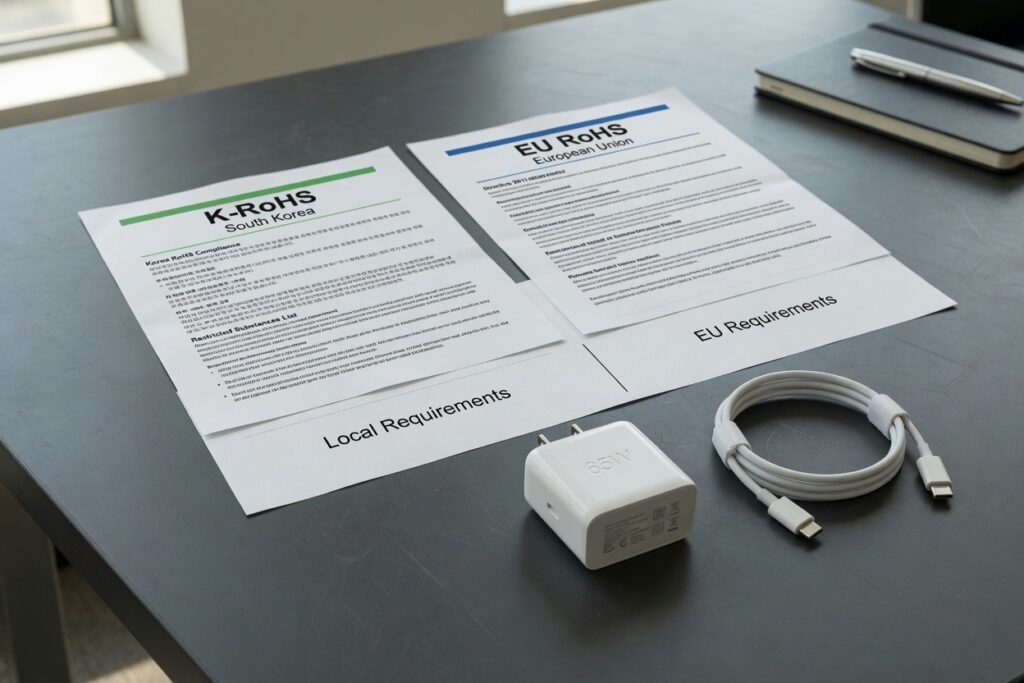
Many sellers have EU RoHS reports and think they can be used directly in the South Korean market, but in fact, there are quite a few differences between the two:
| Comparison Item | K-RoHS (Current) | EU RoHS |
|---|---|---|
| Restricted substances | 6 types | 10 types (including 4 phthalates) |
| Exemption list | Formulated separately by South Korea, the exempted materials, components, and scenarios are different from those of the EU | Uniformly formulated by the EU |
| Compliance requirements | There are local rules for the declaration process, labeling format, and document requirements of different categories | Uniform requirements of the EU |
The core conclusion is very clear: EU RoHS reports can only be used as technical reference, and cannot automatically meet the statutory obligations of South Korea’s K-RoHS. The necessary local compliance still needs to be done. Even if K-RoHS is revised to add 4 phthalates in the future, and the types of restricted substances basically overlap with those of the EU, there are still differences in other rules, and they cannot be directly used universally.
5. Compliance Verification Methods
After talking about the rules, let’s talk about how to verify whether a product complies with K-RoHS. It is divided into entry-level (ordinary consumers / small purchasers) and advanced-level (sellers / supply chain). You can match according to your own identity.
5.1 Entry-Level: 2-Step Quick Verification for Ordinary Consumers / Purchasers
If you are just an ordinary consumer or a small purchaser, and want to quickly judge the compliance risk of a product, two steps are enough:
Step 1: Check whether the product label, manual, and packaging have complete South Korean importer information and the environmental compliance statement marked by the enterprise — Note: Mandatory labeling requirements vary by product category, and not all categories have unified K-RoHS labeling requirements, but if there is no even importer information, the risk is definitely high;
Step 2: If the category of the product has a publicly available environmental compliance query system from the South Korean government, you can enter the product model for auxiliary verification — the coverage of the query system is subject to official announcement, and products not included in the system do not mean they are non-compliant.
If a product has neither clear importer information nor any compliance-related instructions, and no relevant information can be found, then the risk of non-compliance is very high, and it is recommended to purchase or procure with caution.
5.2 Advanced-Level: Compliance Evidence Verification for Sellers / Supply Chain
If you are a seller or supply chain practitioner and need to formally verify the compliance of a product, first of all, it must be clear that K-RoHS compliance certification is a complete set of evidence chain. Different documents assume different compliance roles and need to be cross-verified to form a complete closed loop. There is no single “universal proof”. According to their roles, they can be divided into three categories:
- Liability documents: The core is the statutory declaration of conformity (DoC) required by applicable categories — if the regulations of the corresponding category explicitly require the provision of DoC, then this declaration is the formal commitment of the market placement entity that the product meets K-RoHS requirements, and it shall bear corresponding legal responsibility for the authenticity of the content. In addition, it also includes the product applicable scope judgment record (that is, the check record confirming whether the product is within the control scope against the official catalog), which is the prerequisite and basis for compliance.
- Supply chain traceability documents: Including supplier material declarations, BOM (Bill of Materials), and homogeneous material disassembly lists, which are used to trace the material composition from the supply chain end and prove the consistency between mass-produced products and compliance assessment samples. They are the core basis connecting test reports and actual products.
- Technical testing documents: That is, third-party test reports, which use measured data to prove the content of hazardous substances in homogeneous materials, and are the core technical support for compliance.
When verifying test reports, focus on the following points:
- Qualification and method: The laboratory must have the qualification accreditation for the corresponding testing items (such as South Korea KOLAS accreditation or internationally recognized testing qualifications, specific requirements shall be subject to regulatory provisions), and the testing method must comply with the standards cited in the decree;
- Sample consistency: The tested sample must be consistent with the actual mass-produced materials and BOM version, and a complete homogeneous material disassembly list must be attached to prove that the tested product is exactly the product you want to sell;
- Data validity: The detection limit of the testing method must be lower than the regulatory limit of the corresponding substance, and the test values of all homogeneous materials must meet the requirements. You cannot only look at the average value of the entire product;
- Coverage scope: The report must cover all product models and specifications you want to sell, including supporting cables, adapters and other accessories. You cannot only test the main unit but not the accessories;
- Exemption compliance: If a component claims to meet the exemption conditions, the clause number and basis of the official exemption must be clearly marked, and you cannot just make empty claims.
As for the retention period of compliance documents, current regulations do not stipulate a unified retention period for all categories. It needs to be determined according to the regulatory requirements of the corresponding category, platform rules, contract agreements, and the enterprise’s own quality system requirements.
6. Full Implementation Process for Importers / Sellers
For importers and sellers who want to operate in the South Korean market, implementing K-RoHS compliance can follow the process below.
6.1 3-Step Compliance Self-Inspection
First is the basic self-inspection, which can be completed in three steps:
Step 1: Check against the official control catalog and use the three-step judgment method mentioned earlier to confirm whether your products (including all supporting accessories) are within the control scope;
Step 2: Request the corresponding version of compliance documents from the supplier, including BOM, homogeneous material disassembly list, supplier declaration, test report, enterprise compliance declaration (if required), etc. Note that you must clearly state that it is a K-RoHS requirement, not just “RoHS”, otherwise the supplier may give you EU or other versions of documents;
Step 3: Check the substance limit values and exemption conditions, confirm that all homogeneous materials meet the requirements, and do not miss any small part.
6.2 Supply Chain and Change Management
Compliance is not a one-time thing. Changes in the supply chain may affect compliance at any time. Pay attention to the following points:
- When communicating with suppliers, be sure to clearly state the K-RoHS version that needs to be complied with, whether it is the current 6 items or the possible 10 items in the future (if preparing for the revised version in advance). Do not vaguely say “compliant with RoHS” to avoid communication deviations;
- As long as the following changes occur, compliance must be re-verified: BOM change, material replacement, supplier switch, product structure iteration and upgrade. Old test reports cannot be automatically used;
- If the materials are rectified, re-verification must be carried out after rectification, and mass production can only start after confirming that the standards are met. Do not take it for granted that there is no problem after the change.
6.3 Regulatory Consequences of Non-Compliance
Many people ask what happens if there is non-compliance. Specific regulatory measures vary according to the circumstances of the violation, product category, and applicable clauses. There is no unified penalty standard. Common consequences are divided into two links:
- Import link: The regulatory measures when products enter the customs are comprehensively determined by competent authorities such as South Korea Customs and the Ministry of Environment according to the corresponding product category, import batch size, whether compliance certificates are required to be attached, and the severity of the illegal facts. Not all K-RoHS non-compliance situations will trigger inspection at the customs entry link. If you are required to provide compliance certificates but cannot provide them, or if it is confirmed after verification that they do not meet the requirements, the products may be detained, returned, and unable to enter the South Korean market;
- Market supervision link: If non-compliance is found in the market, you may be required to rectify, remove the product from shelves, or be prohibited from selling. In serious cases, you will also face administrative penalties.
Specific measures and penalty standards shall be checked against the corresponding clauses of the decree, and cannot be generalized.
6.4 Advance Preparation Suggestions for Revision Rumors
Although the effective time and specific content of the new version of the rules have not been officially confirmed, you don’t have to wait for the official documents to be released before starting to prepare, because supply chain adjustment, testing, and document sorting all take time. This cycle is an empirical value of enterprise project planning, not a statutory period. The specific duration depends on factors such as the complexity of the product BOM, the response speed of suppliers, the scheduling of testing institutions, and the number of rectification and retests. It is usually divided into four stages:
- Material sorting and supplier communication (1-3 months): Sort out the full product BOM, clarify compliance requirements to suppliers, and collect preliminary material declarations;
- Risk screening and identification (1-2 months): Conduct pre-testing or risk investigation on high-risk materials such as charging cable sheaths and plastic shells;
- Formal testing and document sorting (1-3 months): Complete the testing of all homogeneous materials and sort out a complete set of compliance evidence chain;
- Rectification and retest (1-3 months): If there are materials exceeding the standard, conduct a retest after completing supplier replacement or material adjustment.
The overall cycle usually ranges from 6 to 12 months. It is recommended to sort out supply chain materials in advance, focus on screening the compliance of rumored new phthalate substances, and make quick adjustments after official documents are released to avoid temporary rush work.
7. Common Misconceptions and High-Risk Parts
7.1 Table of Cognitive Misconceptions to Avoid Pitfalls
We have sorted out 6 cognitive misconceptions that people are most likely to fall into, to help everyone avoid pitfalls:
| Misconception | Correct Conclusion | Corresponding Action |
|---|---|---|
| Having KC / energy efficiency label equals compliance with K-RoHS | The three have completely different control directions and competent authorities, are independent of each other, and are not mutually recognized | Check the three compliance requirements separately, do not confuse them |
| It is okay if the average hazardous substance content of the entire product meets the standard | The limit values are for homogeneous materials, and need to be judged separately for each smallest material | Require suppliers to provide a homogeneous material disassembly list and corresponding test data |
| Gifts / small-batch products do not need to be compliant | As long as they are controlled categories circulating in the South Korean market, they need to be compliant, and there is no general exemption | All controlled categories placed on the South Korean market need to undergo compliance verification |
| No need to prepare before the new rules take effect | The cycle of supply chain rectification, testing, and document sorting is long, and it may be too late to prepare after official release | Sort out materials in advance and screen the compliance of rumored new substances |
| Having an EU RoHS report equals compliance with K-RoHS | The two have different exemption lists, compliance processes, and document requirements | Prepare K-RoHS compliance documents separately, do not directly use EU reports |
| It is valid if the supplier says it is exempt | All exemptions must be in the official exemption list of the Ministry of Environment of South Korea | Check the clause number, validity period, and applicable scenario of the latest official exemption list |
7.2 Tips on High-Risk Parts of Charging Products
We have sorted out the parts with relatively high non-compliance risks in charging products, which you can focus on during verification (this is only a risk reminder and does not mean that they must exceed the standard):
- High-risk parts for the current 6 substances: Solder on the PCB board of the charger (prone to lead exceeding the standard), plating of the USB interface (prone to cadmium and hexavalent chromium exceeding the standard), alloy of plug pins (prone to lead exceeding the standard);
- High-risk parts for unconfirmed new phthalates (rumor): PVC/TPU sheath of charging cables, softeners in plastic shells, adhesives for braided cables;
- Easily overlooked small parts and additives: Labels on the product body, heat shrink tubes, as well as pigments and additives of various components. These inconspicuous parts may also contain hazardous substances, which need to be included in the scope of homogeneous material investigation. Do not miss the inspection.
Note: The outer packaging materials of products usually apply to other packaging-related regulations in South Korea, which need to be checked against the corresponding rules separately; however, accompanying materials that are placed together with the product and are part of the product (such as labels fixed on the product, internal insulating heat shrink tubes, etc.) still need to have their homogeneous material hazardous substance content checked in accordance with K-RoHS requirements.
8. Practical Cases and Competency Grading
8.1 Practical Case: Full-Process Compliance Judgment of USB-C Charger + Supporting Cable
After talking about so many rules, let’s use a practical example to string them together: Suppose you are a cross-border seller who wants to sell a 20W charger with a USB-C braided charging cable to South Korea, with a USB-A to C adapter as a gift. How to make K-RoHS compliance judgment step by step?
- Scope confirmation: First, check against the official control catalog to confirm that the 20W charger and independently sold USB-C charging cable are within the control scope; the gifted adapter needs to be checked against the catalog separately, and if it belongs to the control category, it needs to be compliant.
- Homogeneous material disassembly: According to the actual structure of the product, disassemble it into the smallest homogeneous material units, for example: ABS shell of the charger, PCB board solder, USB-C interface nickel plating, USB-C interface copper substrate, plug pin copper alloy, charging cable PVC sheath, charging cable copper conductor, braided cable PET filament, braided layer adhesive, product label, heat shrink tube, internal wire insulation layer. The number of disassembly depends on the actual structure of the product, there is no fixed requirement, and the core is to disassemble into a single material that cannot be further disassembled by ordinary mechanical methods.
- Substance screening: Check against the 6 limit values of current K-RoHS (if preparing for the revised version in advance, use 10 items), and check the test data of each homogeneous material one by one to confirm that none exceed the standard. The following verification logic can be referred to:
| Homogeneous Material Name | Test Item | Limit Value (Current 6 Items) | Detection Limit | Test Value | Judgment Result |
|---|---|---|---|---|---|
| PCB Solder | Lead | 1000 ppm | 10 ppm | 500 ppm | Compliant |
| Charging Cable PVC Sheath | Cadmium | 100 ppm | 2 ppm | 5 ppm | Compliant |
| USB Interface Plating | Hexavalent Chromium | 1000 ppm | 5 ppm | Not detected | Compliant |
- Exemption check: If the supplier says the solder is high-temperature solder and meets the exemption conditions, don’t believe it directly. You need to check the latest exemption list of the Ministry of Environment of South Korea to see if there is a corresponding clause number, validity period, and whether it applies to the solder of consumer chargers. It is only valid after confirmation.
- Parallel compliance confirmation: In addition to K-RoHS, you also need to check whether this charger has KC safety certification, whether it is in the South Korean energy efficiency catalog, and whether it needs an energy efficiency label — after all, these three are independent systems and all need to be met.
- Change management: If you later change the supplier of the charging cable sheath, even if the material looks the same, you need to re-verify the compliance of the corresponding substances, and you cannot directly use the previous report.
- Document archiving: Finally, keep all documents, including scope judgment records, BOM, homogeneous material disassembly list, supplier declaration, test report, enterprise compliance declaration (if required), exemption basis, etc., in accordance with the requirements of regulations and platforms, for spot checks.
8.2 Competency Grading and Action Points
Readers of different identities can master the corresponding level of K-RoHS compliance ability according to their own needs:
Entry-Level (Suitable for ordinary consumers and small purchasers, you will master it after reading)
- Can clarify the core control direction of K-RoHS, can verify the authenticity of 2028 related rumors through the National Legal Information Center of South Korea and the official website of the Ministry of Environment of South Korea, check core fields such as decree name, revision number, effective date, and applicable scope, and do not easily believe unofficial information;
- Can distinguish the differences between K-RoHS, KC safety, and South Korea’s energy efficiency systems, and know that the three need to be checked for compliance requirements separately;
- Understand the core logic of homogeneous material judgment, and can judge the control attribute of common charging products through the three-step method;
- Can complete ordinary user-level quick risk verification through product labels, importer information, and compliance statements.
Semi-Proficient Level (Suitable for cross-border sellers and supply chain practitioners, for advanced use)
- Can sort out the three types of roles in the compliance evidence chain, master the core verification points of test reports (qualification methods, sample consistency, data validity, coverage scope, exemption basis), and can independently judge the validity of reports;
- Can identify 6 types of common compliance misconceptions, conduct preliminary material screening against the list of high-risk parts of charging products, and do not miss easily overlooked small parts such as labels and heat shrink tubes;
- Can independently complete the full-process compliance self-inspection of products, confirm that all exemptions have official list basis, and do not believe verbal promises;
- Can clearly identify change scenarios that trigger compliance re-evaluation (BOM change, material replacement, supplier switch, product iteration, etc.), know that old reports are not automatically used, and re-verification is required after rectification;
- Can rationally judge the credibility of 2028 related revision information, always take official announcements as the standard, can carry out supply chain risk screening in advance, and reserve sufficient preparation time.