
When sellers of wireless charging pads and Bluetooth-enabled fast chargers ship goods to Canada for the first time, they often encounter the situation of goods being detained — many people do not know that charging/USB-C products with wireless functions entering Canada are subject to special wireless regulatory clearance rules, which are completely different from ordinary wired chargers. Even a charging cable with Bluetooth anti-loss function needs to go through the clearance process according to the requirements for wireless products. This article starts from the basic judgment of “whether the product is subject to control”, covers certification validity judgment, clearance document requirements, operational nodes and detention remedies, to help sellers at different stages sort out the rules and avoid pitfalls.
First, Clarify: Whether Your Charging/USB-C Product Needs to Follow ISED Clearance Rules
Many people think that all electronic products need to go through wireless clearance, but that is not the case. There is only one core judgment criterion: whether the product intentionally transmits or receives radio signals — whether it is used to transmit data (such as Bluetooth, Wi-Fi) or transmit energy (such as wireless charging), as long as it is actively designed with wireless transmission/reception functions, it counts as a “wireless product” in the context of customs clearance, and must comply with Canada’s wireless regulatory rules.
For charging and USB-C products, as long as they have any of the following functions, they will be included in the control scope: wireless charging, Bluetooth, Wi-Fi, NFC, cellular network. Conversely, if it is a purely wired charger, charging cable, or plug that only produces weak unintentional radiation during operation (such as circuit interference of ordinary wired fast chargers), it does not fall within the control scope of wireless products, and can be cleared as ordinary electronic products.
Here are some common examples: standard 20W USB-C wired fast charger: no; fast charger with Bluetooth that can adjust charging power: yes; standard USB-C charging cable: no; charging cable with built-in Bluetooth anti-loss tracker: yes; standard USB-C docking station: no; docking station with Wi-Fi function: yes.
Common controlled charging-related products are mainly divided into three categories:
The first category is wireless charging products, such as desktop wireless charging pads, power adapters with built-in wireless charging function, car air vent wireless chargers, and wireless charging receiver cables that plug into the phone’s USB-C port;
The second category is smart charging products, such as fast chargers that can connect to Wi-Fi to view charging data, charging power strips with Bluetooth control, and multi-device networked desktop charging stations;
The third category is charging accessories with wireless functions, such as charging cables with Bluetooth anti-loss function, and USB-C docking stations with built-in Wi-Fi/Bluetooth modules.
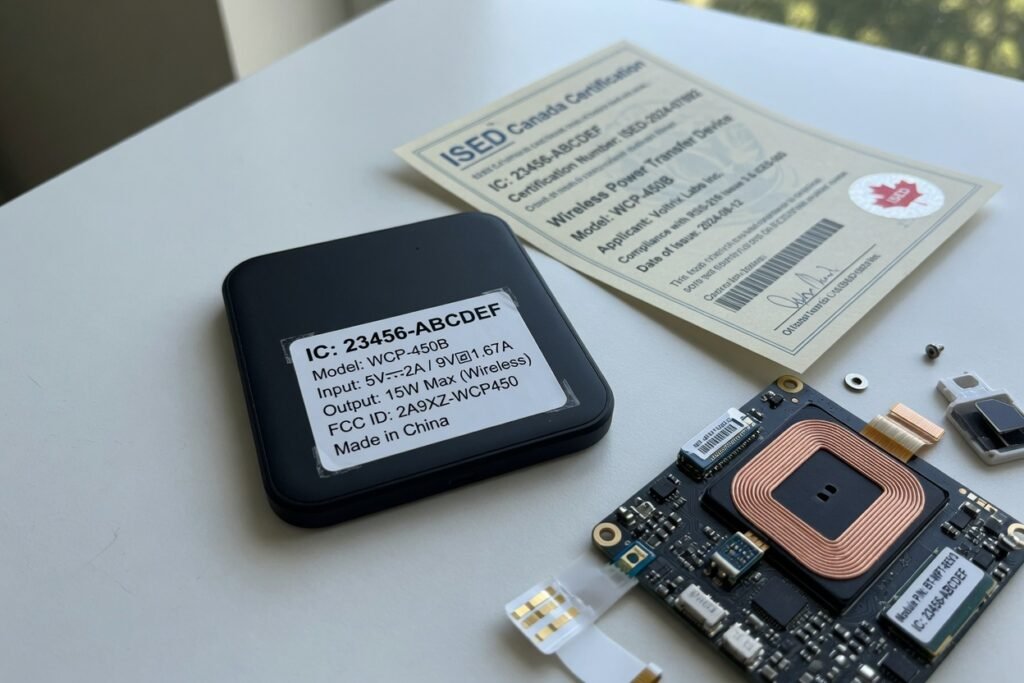
There is another point that many people stumble on: the judgment rules for modules and whole devices. If you import wireless modules separately (for example, purchase Bluetooth modules separately and ship them to Canada), the module itself needs to have ISED module-level certification. But if you install a certified wireless module into a whole device (for example, install a certified Bluetooth module into a fast charger), the clearance is based on the final sold whole device as the judgment unit, and you cannot directly use the module certification as the whole device certification.
There is only one case where module certification can cover the whole device: that is, the antenna, housing material, and module installation position in your whole device are exactly the same as the test conditions during module certification, without any changes. But this condition is very difficult to meet — for example, the same Bluetooth module, when installed in a fast charger with a plastic housing and a power strip with a metal housing, has completely different wireless signal transmission conditions, so in the vast majority of cases, whole devices integrated with wireless modules need separate whole-device ISED certification.
Basic Knowledge: Who Regulates, Who Is Liable for Issues
After confirming that the product is within the control scope, first clarify the two core institutions and the responsibilities of all parties, so as not to know who to turn to when something goes wrong.
There are two main departments responsible for wireless product regulation in Canada:
One is Innovation, Science and Economic Development Canada (ISED for short), which is equivalent to the “rule maker and certifier”: responsible for formulating wireless certification rules, maintaining the public certification database, and issuing a unique IC certification number for compliant products.
The other is Canada Border Services Agency (CBSA for short, which is the Canada Customs), which is equivalent to the “border gatekeeper”: responsible for verifying the compliance of products during the clearance process, and has the right to detain, return or even destroy non-compliant goods.
Why is Canada so strict with wireless products? The core reason is to prevent wireless charging, Bluetooth/Wi-Fi charging devices from transmitting signals indiscriminately and interfering with public communications, aviation, and medical equipment — for example, hospital monitors and airport communication systems may be interfered by non-compliant wireless devices, so certification must be passed to ensure the safety of radio frequency use.
If non-compliant, the consequences are more than just cargo detention:
During the clearance process, goods may be detained, returned or even destroyed, and demurrage fees and fines will also be incurred. The amount of the fine is determined based on the value and quantity of the goods;
Even if you pass clearance by luck, there may be troubles later: the importer will be included in the high-risk list, and every import will be subject to key spot checks in the future; moreover, if non-compliance is found in platform spot checks or market supervision spot checks, liability will still be pursued, it is not all good after clearance.
Many people will ask: who is responsible when something goes wrong? The liability boundary here is very clear:
• The Canadian local importer is the primary responsible party: they are responsible for entry declaration, and are also the official responsible party for ISED compliance. When problems arise, the first person the customs looks for is the importer;
• The brand owner or factory is responsible for the certification and labeling of the product, and ensures that the submitted documents are true and valid;
• Freight forwarders and customs brokers only assist in declaration and do not bear compliance responsibility — don’t think that hiring a reliable customs broker means you don’t have to worry about compliance, the core responsibility still lies with the importer and the brand owner.
Core Credential: How to Judge Whether an ISED (IC) Certification Is Valid
For wireless products entering Canada, the most core credential is ISED certification, which is also often called IC certification (because it was previously responsible by Industry Canada, and the institution has been renamed now, but people still used to call it IC number). For wireless products within the mandatory certification scope, it is equivalent to the “Canada access ID card”. After compliance, a unique IC number will be obtained, in the format of “IC:XXXX-YYYYYY”, the first half is the applicant enterprise number, and the second half is the corresponding product number. Products that meet ISED exemption clauses do not need to apply for an IC number, but need to confirm by themselves that the parameters fully meet the exemption requirements.
This IC number is not made up randomly, anyone can query its authenticity, as well as the corresponding product model, parameters and other information in ISED’s public database.
For charging and USB-C products, the vast majority of consumer-grade products with wireless functions fall within the mandatory certification scope, and need to be marked with the IC number as required by ISED; only a very small number of extremely low-power short-range devices that meet ISED’s explicit exemption clauses can have simplified requirements — but the exemption conditions are very detailed, it is not that you can be exempt if you think the power is low. For example, many people think that 5W wireless chargers do not need certification, but that is wrong. You must check whether specific parameters such as frequency, power, and bandwidth meet the exemption requirements. If you are not sure, it is best to find a professional to confirm, don’t make random judgments by yourself.
After getting an IC certification, how to judge whether it is really useful? There are three core criteria:
The first is model matching: the registered brand and model must be exactly the same as the product you import — even if there is just one missing hyphen or one extra letter in the model, it does not count as a match, let alone using someone else’s model.
The second is parameter matching: the product’s wireless frequency, power, as well as charging protocol, USB-C interface parameters, etc., must be consistent with the registered information. For example, if you registered a 15W wireless charger but the actual product is 25W, then this certification is invalid.
The third is valid status: the certification has not expired, has not been revoked, and covers the hardware version you are currently importing — if the wireless module model in the product is changed, or the circuit board design is modified, the original certification will be invalid and needs to be re-evaluated.
Mandatory Clearance Checks: Labeling and Commercial Documents Must Meet These Requirements
Certification alone is not enough. During customs clearance, the customs will also check product labeling and commercial documents, which is also a high-incidence area for detention.
First, the labeling requirements for the product body, three core points:
First, the mandatory information must not be missing: products within the mandatory certification scope must have the IC number, product model, and manufacturer information;
Second, the labeling must be qualified: it must not be easy to rub off, visible to the naked eye, and findable without disassembling the product — many people print the IC number on the circuit board, or stick it with easy-to-peel stickers, which are not allowed;
Third, if it is a very small product, such as a mini USB-C wireless charging receiver, whose body is too small to print a complete physical label, electronic labels or alternative display methods can be adopted in accordance with the label rules of the corresponding ISED product category: electronic labels must be normally accessible to users through officially recognized electronic methods such as the device’s built-in display interface, and cannot be replaced by ordinary external QR codes or third-party scanning pages; some labeling information can also be carried on packaging, manuals or accompanying documents. The specific requirements need to be checked against the corresponding rules, and cannot be simplified without authorization.
Then are the requirements for packaging and manuals:
• The packaging must be marked with the name and address of the Canadian local importer, and cannot only print the information of the domestic factory;
• The manual must have a bilingual (English and French) ISED compliance statement — Canada is a bilingual country, and missing either language is not allowed;
• Charging products also have exclusive requirements: the rated power of the wireless charger and the parameters of the USB-C interface must be consistent with the registered information, and cannot be falsely marked. For example, if the registered power is 15W but the packaging prints 25W, the product will be detained if found.
Finally, the clearance documents and the commonly mentioned “three consistency” principle:
The mandatory commercial document is the commercial invoice, which must clearly mark the product model, IC number (for mandatory certification products), purpose, importer information, and true value, without ambiguity. In addition, reference documents should be prepared: ISED certification certificate or official database query screenshot, and high-power wireless chargers may also need to prepare an RF test summary.
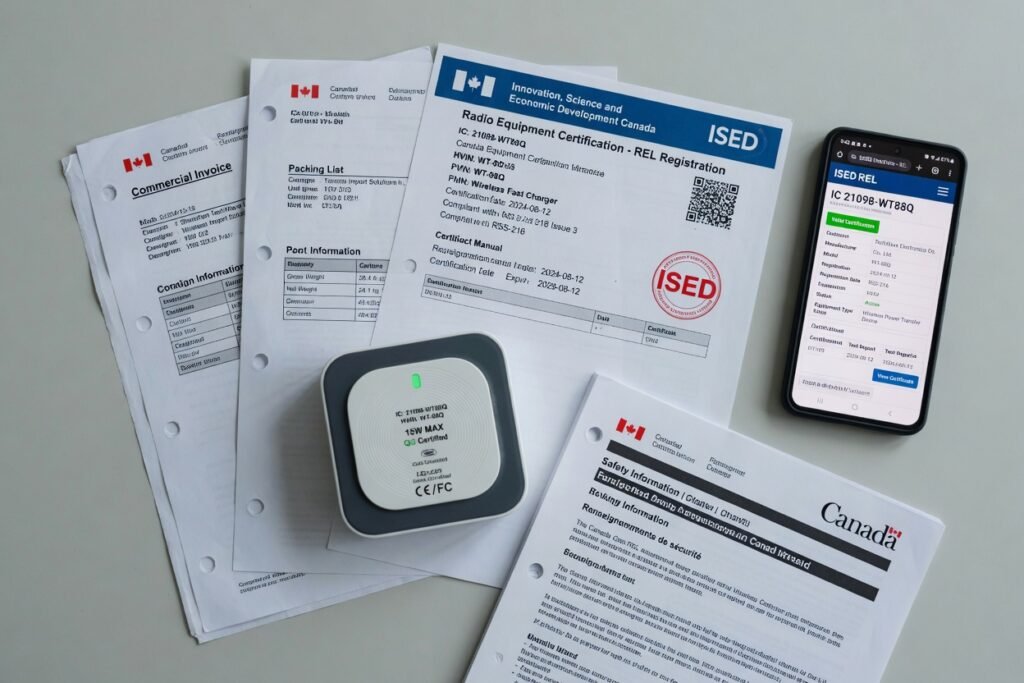
Special attention should be paid to HS code classification: adapters and charging products with wireless functions must be classified according to their actual functions, and cannot be classified under the HS code of ordinary chargers to save tax or for convenience, otherwise they will be deemed as false declarations.
The so-called “three consistency” is the core standard for customs verification: model on the invoice = model on the product label = model registered with ISED (for mandatory certification products), and the brand, importer, and function description must not have contradictions. Many sellers have their goods detained because the model on the invoice differs by one letter from the product, or the function is written as “charger” without mentioning the wireless function.
Requirements by Scenario: Rules Vary for Different Import Situations
Not all wireless products have the same clearance requirements. Depending on the product type, import purpose, and import channel, the requirements and spot check risks are different, you can directly match your situation.
First, look at the differences by product type:
• Low-power wireless chargers (rated power ≤15W): mostly belong to the short-range device category, and the strictness of clearance checks is relatively moderate, but note: 15W is only a common reference for product classification, and does not mean that rated power ≤15W automatically meets simplified or exemption requirements. It is still necessary to check whether the product’s wireless transmission frequency, bandwidth, actual transmission power and other parameters fall into the corresponding clauses of ISED’s explicit short-range devices, and cannot draw conclusions only based on the charging rated power;
• High-power wireless chargers, smart charging products with Bluetooth/Wi-Fi: stricter certification requirements, and customs may request test reports during spot checks to verify whether the actual parameters are consistent with the registration.
Then look at the differences by import purpose, which is what many people care about:
• Commercial bulk import: such as e-commerce stock, wholesale, Amazon FBA (Fulfillment by Amazon) shipments. In this case, formal ISED certification must be available (for products within the mandatory certification scope), and all materials must be complete, with no room for negotiation;
• Small quantity for personal use: in current Canadian laws and regulations, there is no clause that “wireless products for personal use can be exempted from ISED compliance requirements”, that is, “personal use” is not a legal reason for exemption. The final release is at the discretion of border officers based on product type, quantity, and actual purpose. From the common situation in practical operation, 1-2 pieces of low-power products that are obviously for personal use and have no contradictory declaration information usually have a higher release probability than commercial bulk goods, but this is only a common situation in actual scenarios, and by no means a legal exemption basis — even for a small quantity for personal use, as long as the product does not meet ISED requirements, there is theoretically a risk of detention. Don’t equate “high release probability” with “no need for compliance”;
• For samples, testing, R&D use: such products need to provide a purpose explanation letter, apply for a temporary import permit, and must be re-exported in accordance with regulations after expiration, and cannot be sold;
• Special temporary entry: such as exhibition samples, repaired/returned products, and replacement modules. These are subject to special temporary clearance rules, and also cannot be sold directly in Canada.
Finally, look at the difference in spot check risks by import channel:
• Full container load (FCL) and less than container load (LCL) by sea: the spot check rate is relatively high, because the cargo volume is large, so all materials must be prepared in advance;
• Air express (such as DHL, UPS): spot checks for commercial shipments are very strict, and personal use items are relatively lenient;
• Amazon FBA, overseas warehouse first-leg shipments: must have a Canadian local importer, the IC number of mandatory certification products must be queryable on the ISED official website, and Amazon platform itself will conduct additional checks. It is not all good after clearance, and non-compliant products may be directly removed from the platform.
Full Operational Process: What to Do From Before Shipment to After Release
After understanding the rules, how to operate specifically? We sort out the key nodes in chronological order, among which the pre-shipment check is the most important, which can stop most common clearance problems.
First is pre-shipment pre-check:
First, check the certification: if the product is within the mandatory certification scope, first confirm in ISED’s public database that the IC number is valid, and the product model and parameters are exactly the same as the registration. Don’t assume a certificate is real when you get it, cases of borrowed or fake certificates are very common; if the product claims to meet the exemption conditions, check all parameters in advance to meet ISED clauses, and keep supporting materials;
Second, check the labeling: check whether the labeling on the product body, packaging, and manual meets the requirements, whether the charging parameters are falsely marked, and whether the IC number is clear and not easy to rub off;
Third, check qualifications: confirm that there is a compliant Canadian local importer, and the customs broker you hire preferably has clearance experience with wireless charging products. Don’t hire a customs broker that only deals with clothing or general goods to handle electronic products, which is prone to mistakes;
Fourth, check documents: verify whether the information on the commercial invoice and packing list is complete, whether the HS code classification is correct, and whether the wireless function is clearly stated.
Then are the key points for customs clearance declaration:
First, declare truthfully: don’t conceal the wireless function, don’t undervalue the goods, don’t vaguely write adapters with wireless charging as “electronic accessories” or “ordinary chargers” — the consequences of concealment are more serious than non-compliance, and you may be blacklisted;
Second, submit proactively: send the certification documents (or exemption supporting materials) to the customs broker in advance, and proactively declare ISED compliance. Don’t wait until the customs checks to take them out. Preparing all materials in advance can reduce the risk of supplementary documents, unclear explanations, or delays caused by missing materials;
Third, unified information: the model, brand, and importer information on all documents must be completely consistent. Don’t have one brand on the invoice and another on the packaging.
If you really encounter customs inspection, don’t panic, follow these three steps:
First, confirm the reason for the inspection through the customs broker — whether it is a problem with document information, a random physical spot check, or a database mismatch. Figure out the reason first and then handle it targeted;
Then, supplement materials as required by the customs, such as the official query screenshot of the IC number, photos of product labels, manuals, certification certificates, or supporting materials for exemption parameters, etc., supplement whatever is missing;
Finally, the response should be unified: it is best for the importer or the brand owner to give a unified reply. Don’t have the factory say one thing, the freight forwarder say another, and the customs broker say yet another. Conflicting information will make the customs more suspicious.
Even after the clearance is released, there are two follow-up compliance points to note:
First, you cannot privately change the wireless parameters of the product. For example, if it was originally a 15W wireless charger and you secretly upgrade the firmware to 25W, the original certification will be invalid, and it will still be违规 if found in later market spot checks; if the product hardware is revised, it is also necessary to re-evaluate whether the certification is still valid;
Second, all import documents and certification materials (or exemption supporting materials) must be kept well, because ISED conducts irregular market spot checks, and you need to be able to produce them when required.
Pitfall Avoidance Guide: Common Detention Reasons and Remediation Ideas
Finally, we have sorted out the most common detention reasons, cognitive misconceptions, and remediation methods after detention, to help you avoid fewer pitfalls.
First, look at the four most common types of detention reasons:
The first category is certification issues: products within the mandatory certification scope do not have ISED certification, use US FCC or EU CE certification to impersonate, borrow others’ certification numbers, or use module certification as whole device certification — this is the pitfall that most people stumble on;
The second category is labeling issues: the body of mandatory certification products does not have the IC number printed, the label is blurry and easy to rub off, or only the packaging has the IC number but the product does not — remember, the requirement is that the product body must have it (except those that meet the electronic label rules), and having it on the packaging does not count;
The third category is document issues: the wireless function is not mentioned during declaration, the HS code classification is wrong, and the model on the invoice is inconsistent with the physical product;
The fourth category is qualification issues: there is no information of the Canadian local importer, or the importer is inconsistent with the responsible party on the certification.
Then correct the three most frequent cognitive misconceptions, which many people get wrong:
Misconception 1: “Low-power wireless chargers/USB-C products don’t need certification” — wrong. As long as the product is intentionally designed with wireless transmission/reception functions, no matter how low the power is, it needs to meet ISED requirements. Only products that meet the official explicit exemption clauses can simplify the process, and low power does not automatically mean exemption.
Misconception 2: “With FCC/CE/module certification/factory-made IC number, you can clear customs directly” — wrong. Each country’s wireless regulation is independent, and US FCC and EU CE certifications are not recognized in Canada; module certification is not equal to whole device certification, and factory-made IC numbers are even more useless. It must be an official certification number issued by ISED (except exempt products).
Misconception 3: “Personal use and sample imports 100% don’t need compliance” — wrong. Small quantity for personal use only has a relatively higher release probability, and is by no means a legal exemption; samples for testing, R&D, and exhibitions need to go through the temporary import process, be re-exported on schedule, and must not be sold. Non-compliance will also lead to detention.
If you are really detained, follow these four steps to remedy:
Step 1, first confirm the specific detention reason through the customs broker — whether it is missing materials, invalid certification, or labeling problems. Don’t guess, figure out where the problem is first;
Step 2, if it is a problem that can be corrected, such as missing materials or incorrect declaration information, submit supplementary materials as soon as possible, such as supplementing certification documents and correcting declaration information;
Step 3, if it is a labeling problem, for example, the IC number is not printed on the product, you can ask the customs if it is allowed to make compliance labels (such as tamper-proof stickers) in the supervised warehouse, which is allowed in some cases;
Step 4, if it is really impossible to correct (for example, there is no certification at all and the exemption conditions are not met), evaluate the cost of return and destruction, and choose the more cost-effective option.
Of course, in some situations, it is recommended to directly seek assistance from a professional agency, for example, the product functions are very complex, and you are not sure whether the module certification can cover the whole device; or the clearance detention needs urgent handling; also, if you plan to enter the Canadian market in large quantities for a long time, it is best to find a professional agency to sort out the certification and compliance in advance, so as to avoid big problems later.
Quick Clearance Self-Check List
• Product side: mandatory certification products have a clear IC number on the body (or an electronic label that meets the rules), and the parameters are consistent with the registration; the manual has a bilingual (English-French) compliance statement; the packaging has the information of the Canadian local importer; exempt products have been checked to confirm that their parameters meet the official requirements;
• Document side: the IC number of mandatory certification products can be queried in the ISED official database; the commercial invoice and packing list information are consistent; the HS code matches the actual function of the product;
• Scenario side: all clearance requirements corresponding to the import purpose have been met; preparations for the spot check risks of the import channel have been made in advance.
Competency Level Summary
• Beginner level (master 70% to handle routine situations): can accurately judge whether your product is within the ISED control scope; clear about the core labeling and document requirements for clearance; can independently complete basic pre-shipment checks;
• Semi-proficient level (master the remaining 30% to handle complex situations): can independently judge the validity of ISED certification; can evaluate clearance risks based on product type, import purpose, and import channel; know how to handle common problems, or can judge when to seek professional assistance.
Overall, although Canada’s wireless product clearance rules are detailed, the core logic is clear: first accurately determine whether the product is within the ISED control scope, then solidify the three core links of certification validity, product labeling, and declaration documents, complete pre-checks in advance, and declare truthfully. The vast majority of detention cases stem from finding it troublesome and taking chances in the early stage, either not doing certification as required, or making mistakes in labeling and document details. As long as the judgment criteria and operation key points mentioned in this article are implemented in place, most clearance risks can be avoided in advance.