
One of the core misconceptions that newcomers to EU electrical and electronic product compliance most easily fall into is believing that RoHS requirements are met as long as the average concentration of hazardous substances in the entire product or entire component meets the limit. In fact, the minimum unit for RoHS compliance judgment is “homogeneous material”, not the whole product or component. If this basic logic is misunderstood, deviations may occur in subsequent report verification, compliance self-inspection, and test sample submission. This article will systematically explain the definition of homogeneous materials, judgment methods, rules for special scenarios, and common pitfalls to avoid. The content is intended for beginner learners and can be used for preliminary disassembly, report verification, and sample submission communication; complex structures or borderline cases need to be further confirmed by compliance personnel and testing institutions in combination with technical documents.
Why RoHS Is Judged by Homogeneous Materials
RoHS limits are set for the smallest material unit, not the whole product, nor a single component.
Many people wonder why the average concentration of the entire product or component cannot be used for calculation. Take a simple example: a 100-gram plastic shell has a 0.1-gram electroplated layer on its surface. If the mass fraction of lead in the plating layer is 1% (10 times the conventional RoHS limit), but calculated based on the average mass of the entire shell, the lead concentration is only 0.001%, far below the conventional limit of 0.1%, which seems to fully meet the requirements. However, RoHS limits are set for the mass fraction of a single homogeneous material; calculating by the overall average will completely mask the high-concentration risk in small-volume materials. The requirement to judge by homogeneous materials is to avoid high-risk small components (such as plating, solder, and microelectronic components) being diluted by large-volume materials, and to ensure that the hazardous substance level of each material unit meets the requirements.
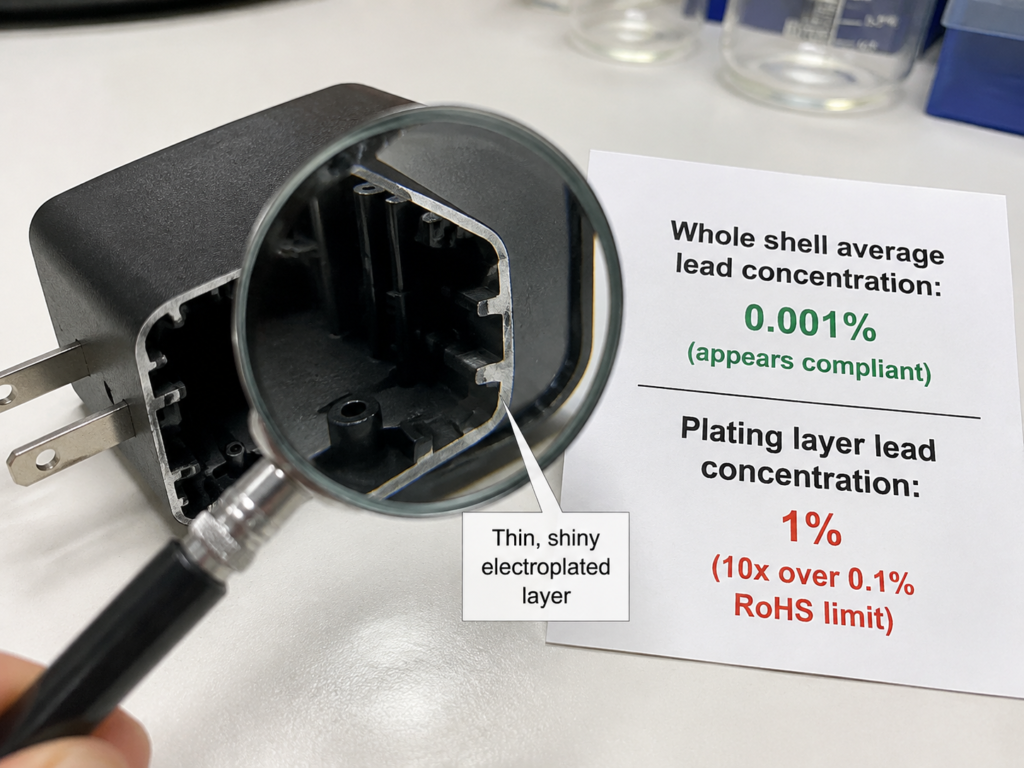
Note: This example is only used to explain the judgment logic and does not represent actual test or compliance conclusions. The mass, concentration, and limit values in the example are only used to demonstrate the calculation relationship and do not represent the actual data of any specific plating or product; a real compliance conclusion must be based on reliable test or material data of the corresponding homogeneous material, combined with applicable exemptions for judgment.
If this basic logic is misunderstood, it will not only invalidate one’s own compliance judgment, but also third-party test reports cannot be used alone as sufficient compliance basis if they are not tested by homogeneous material units; after the product enters the EU, if it is found to be non-compliant in random inspections by market supervision authorities, it may face risks such as removal from shelves, recall, and fines.
Whether you are verifying whether the RoHS report provided by the supplier is useful, disassembling test units during your own product compliance self-inspection, or coordinating with a third-party testing institution to confirm sample submission requirements, you must first understand the rules of homogeneous materials.
It should be clarified that the prerequisite for the application of homogeneous material judgment rules is that the product is electrical and electronic equipment (EEE) within the scope defined by the RoHS Directive. To judge whether a product is within the regulatory scope, it is necessary to check item by item the product categories and exclusions listed in Article 2 of the Directive and related annexes, and cannot be judged solely by product name or industry practice. For example, although some military equipment and specific medical equipment fall into the category of electrical and electronic products, they may not be subject to RoHS due to meeting exclusion clauses; the specific situation shall be subject to the currently valid directive text.
For products within the regulatory scope, not all components directly apply the homogeneous material rules: packaging attached to the product, independently sold batteries, food contact materials, etc. are usually specifically governed by other EU regulations; however, if a battery is a built-in component of electrical and electronic equipment, its compliance judgment must combine the requirements of battery regulations and RoHS, and it cannot be simply assumed that RoHS is completely inapplicable.
If a certain type of homogeneous material meets the specific substance/application exemption clauses specified in the RoHS annexes, relaxed limits or exemption requirements may be applied in accordance with the exemption requirements, but this only applies to specific substances of the homogeneous material, and does not mean that the entire component or product is not subject to RoHS regulation.
What Exactly Is a Homogeneous Material?
“Homogeneous Material” sounds professional, but its core meaning is very simple: it is the smallest unit that cannot be further disassembled into different materials using ordinary physical methods (such as twisting, cutting, scraping, breaking, grinding, and other mechanical means). There are two clear prerequisites for “mechanical disassembly” here: first, no chemical dissolution or special laboratory equipment is required; second, it is based on the actual structure of the product when it is launched and delivered to consumers, and unconventional means cannot be used for the sake of disassembly.
To judge whether a unit is a homogeneous material, there are two core conditions (both must be met):
- Cannot be separated into different materials by conventional mechanical action: If you try to disassemble with ordinary tools such as screwdrivers, blades, and pliers, and further disassembly will destroy the properties and form of the material itself (such as grinding plastic into powder, or scraping the plating so that it mixes with substrate debris), you have reached the end of disassembly. Completely peelable silk screen, laminated plates with layers, and independent parts that can be unscrewed all belong to situations where further disassembly is possible.
- The overall composition of the material is uniform: “Uniform” here does not mean a pure substance in the chemical sense, nor does it require only one component. Even if it is a mixture of multiple materials, as long as the mixture is uniformly dispersed and different components cannot be separated by mechanical methods, it meets the homogeneity requirement. For example, color masterbatches and antioxidants in plastics, various metals in alloys, and glass fibers and resins in glass fiber reinforced plastics, as long as they are uniformly mixed and cannot be mechanically disassembled, all belong to homogeneous materials; normal trace impurities do not affect the homogeneity judgment.
RoHS limits are set for each independent homogeneous material unit; the hazardous substance concentrations of different units cannot offset each other, nor can they be calculated by the overall average. Among the 10 substances currently controlled by RoHS, the conventional limit for cadmium is 0.01% (mass fraction), and the conventional limit for the other 9 (lead, mercury, hexavalent chromium, polybrominated biphenyls, polybrominated diphenyl ethers, and 4 phthalates) is 0.1% (mass fraction); the specific limits need to be confirmed in combination with applicable exemption clauses, regulation versions, and product categories.
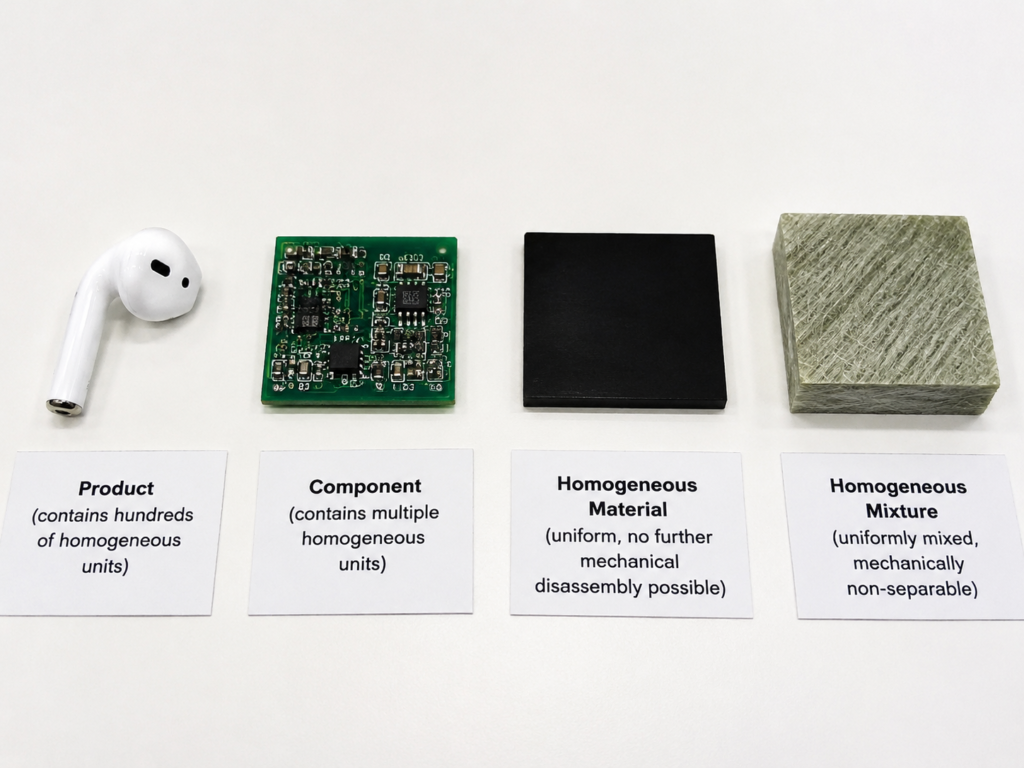
Many beginners confuse homogeneous materials with several similar concepts, which can be quickly distinguished by examples of common products:
- Difference from a product: A product is a finished product sold directly to consumers, such as Bluetooth headsets and chargers. A product often contains hundreds or thousands of homogeneous material units.
- Difference from a component: A component is a part with independent functions, such as resistors, screws, and printed circuit boards (PCB, the circuit board that carries electronic components). A component may contain multiple homogeneous units. For example, a screw with a peelable plating layer has two homogeneous units: the plating layer and the screw body.
- Difference from a chemically pure substance: It is not only 100% pure materials that are considered homogeneous. Alloys (several metals uniformly fused) and plastics with color masterbatch are homogeneous materials as long as they cannot be disassembled by ordinary mechanical methods.
- Difference from a mixture: Not all mixtures are non-homogeneous materials. For example, glass fiber reinforced plastic, where glass fiber and plastic are uniformly mixed and cannot be mechanically disassembled, is a homogeneous material; but if it is a layered structure of two different plastics pressed together that can be peeled apart, it is not a single homogeneous material and needs further disassembly.
Step-by-Step Guide to Judging Homogeneous Materials: Get Started in 4 Steps
After understanding the definition, the actual operation is not complicated. Following the four-step process, beginners can also complete preliminary judgment:
Step 1: First Disassemble the Finished Product into Independent Functional Components
You don’t have to disassemble down to screws and solder at the very beginning. First, use ordinary tools such as screwdrivers and pliers to disassemble the finished product into parts with independent shapes or functions. For example, disassemble a charger into upper and lower shells, a printed circuit board (PCB), pins, and a USB interface. Disassemble large components first, then gradually refine, so that it is not easy to get confused.
Step 2: Judge the Mechanical Disassemblability of a Single Component
After getting a component, use ordinary physical methods such as scraping, peeling, twisting, and grinding to try to disassemble different materials: if two or more different materials can be separated, and each material still retains its original properties after disassembly, further disassembly is required; if it is a very thin plating or coating that cannot be completely peeled off by conventional methods (scraping will bring down substrate debris), there is no need for further disassembly, and it is combined with the substrate as one unit.
Step 3: Verify the Homogeneity of the Disassembled Units
After disassembly to the point where different materials can no longer be separated by mechanical methods, check whether the unit meets the requirements of “uniform overall composition and no further mechanical separation”. For example, for a plastic shell with peelable silk screen scraped off, the remaining plastic body has uniform composition and cannot be further disassembled, so it is a homogeneous unit; if it is a plate laminated with two layers of different materials that can be peeled into two independent layers, further disassembly is required.
Common counterexample: For a plastic shell with scrapable silk screen, the silk screen ink and the plastic body are two mechanically separable materials, which must be split into two homogeneous units and cannot be calculated together.
Step 4: Classification and Merging of Homogeneous Units of the Same Type
It should be noted that this step belongs to the test sampling and compliance evidence management link, and does not change the definition of homogeneous materials itself. Each independent unit disassembled is essentially a separate homogeneous material, but in order to reduce compliance costs, under the premise of meeting consistency requirements, multiple units of the same type can be merged into one category for sampling and testing.
Merging has strict prerequisites: only when the material’s composition formula, specifications, production process, supplier, production batch, and change control are all proven consistent with sufficient evidence, and confirmed by risk assessment or testing institutions, can homogeneous units of the same type be merged into one category for sampling and testing. For example, uncoated metal screws of the same batch, same specification, and same material can be merged into one category for testing if complete production consistency certificates can be provided.
It should be noted that materials of different batches must be confirmed separately and cannot be merged at will; for plastics with the same substrate but different colors, the color change itself may mean adjustment of formula or additives, and cannot be automatically merged solely based on the supplier’s verbal statement that “only the color masterbatch is different”; written formula consistency certificates and risk assessment support are required.
If you are in a hurry, just ask yourself four questions to make a quick preliminary judgment:
- Can different materials be disassembled with ordinary tools?
- Is the overall composition of the disassembled unit uniform, and can different components no longer be separated by mechanical methods?
- Will further disassembly destroy the properties and form of the material itself?
- Are there sufficient consistency certification materials for the homogeneous units to be merged?
Examples of Judgment for Common Components: Understand at a Glance
Just talking about the process may still be a bit abstract. Let’s take the most common electronic components in daily life as examples, which can be used for quick reference:
Simple Components (1-2 Homogeneous Units)
- Solid color uncoated plastic shell: 1 unit, that is, the plastic body.
- Uncoated metal screw: 1 unit, that is, the metal or alloy itself.
- Ordinary insulated wire: 2 units, the inner copper core and the outer insulating sheath.
- Plastic shell with scrapable silk screen: 2 units, the plastic body and the silk screen ink.
Complex Components (Multiple Homogeneous Units)
- Printed circuit board (PCB): Common homogeneous units include glass fiber reinforced epoxy resin substrate (FR-4, the base plate of PCB), copper foil, solder, surface plating (such as immersion gold, tin spraying), and silk screen ink.
- Ordinary SMD resistor: Common units include ceramic substrate, metal electrodes at both ends, surface protective film, and electrode plating.
- Charging cable connector: Common units include metal plug, plastic shell, internal solder, copper wire, and insulating layer.
Beginner Judgment Rules for Components with Special Structures
When encountering components with particularly small sizes or special structures, beginners do not need to get stuck on details. They can handle them according to the following rules, and at the same time pay attention to retaining relevant basis:
- Ultra-small SMD components (such as 0402 type resistors, with a size of about 1mm × 0.5mm): If they cannot be disassembled into different materials by conventional mechanical methods, they can be temporarily managed as a whole unit in technical documents, but this is not an exception to the definition of homogeneous materials. Small size does not mean exemption from disassembly requirements; product structure descriptions, supplier material disassembly statements, and compliance basis must be retained simultaneously; if different internal materials can be separated by conventional mechanical methods, they should still be disassembled for judgment.
- Two-color injection molding/co-extrusion components: If areas of different colors/materials cannot be disassembled into independent materials by conventional mechanical methods, they can be treated as one homogeneous material; if different materials can be separated, they should be judged separately.
- Sealant/adhesive: If it can be completely peeled off without damaging the properties of the substrate and the adhesive itself after peeling, it is counted as a separate unit; if it has strong adhesion and brings down substrate debris when peeled, it is combined with the substrate as one unit.
Advanced Rules: Special Situations and Borderline Judgment
If you have mastered the basic disassembly method, when encountering uncertain special materials or borderline situations, you can handle them according to the following rules, which can help you solve the vast majority of difficult problems.
Judgment Rules for Special Materials
- Alloy materials: If multiple metals are uniformly fused and cannot be disassembled into different materials by mechanical means, it counts as 1 homogeneous unit; if it is a clearly layered composite metal (such as a plate laminated with two layers of different metals) that can be peeled apart, disassembly is required.
- Composite materials: For example, glass fiber reinforced plastic and FR-4 substrate of PCB, if the fiber and substrate are uniformly mixed and cannot be mechanically disassembled, it counts as 1 homogeneous unit; if it is a layered composite plate (such as two layers of different materials pressed together) that can be peeled apart, disassembly is required.
- Surface plating/coating: If it can be completely peeled off by ordinary mechanical methods, it is counted as a separate unit; if it cannot be peeled off conventionally, it is combined with the substrate as one unit, and the combination must be clearly marked in the report during testing.
- Adhesive/sealant: Those that can be completely peeled off are counted as separate units; those that cannot be peeled off from the substrate are combined with the substrate as one unit.
Impact of Version Differences and Exemption Rules
Many beginners ask whether the judgment rules of different versions of RoHS are different: the RoHS Directive initially restricted 6 hazardous substances (lead, mercury, hexavalent chromium, polybrominated biphenyls, polybrominated diphenyl ethers, cadmium). In 2015, the EU adopted the revised directive (EU) 2015/863, adding 4 phthalates – bis(2-ethylhexyl) phthalate (DEHP), butyl benzyl phthalate (BBP), dibutyl phthalate (DBP), and diisobutyl phthalate (DIBP), forming the current 10 controlled substances.
The judgment logic of homogeneous materials remains consistent across different revised versions, but the specific controlled substances, applicable product categories, effective dates, and exemption clauses shall be subject to the currently valid directive text. For example, the newly added restrictions on 4 phthalates usually apply to most electrical and electronic equipment from July 22, 2019, while the effective dates for special categories such as medical devices and monitoring and control instruments are different, and the specific content needs to be checked against the latest regulatory revisions.
Here, two easily confused concepts need to be particularly clarified to avoid errors in scope judgment:
- Product scope exclusion: It means that certain product categories are not within the regulatory scope of the RoHS Directive at all, and such products do not need to apply the homogeneous material judgment rules. However, the exclusion scope must be based on the clear clauses in Article 2 of the Directive and related annexes, and cannot be judged solely by product name or industry experience. For example, both are medical devices, some in vitro diagnostic devices may be excluded, while ordinary household medical devices may be within the regulatory scope, which needs to be checked item by item.
- Specific substance/application exemption: It means that for products within the RoHS regulatory scope, their specific homogeneous materials under specified application scenarios may not be subject to the conventional limit of a certain substance. Exemptions only apply to specific substances of the homogeneous material, and will never automatically exempt the entire component or product. All exemptions have validity periods, and the latest RoHS annexes (Annex III/IV) list needs to be checked regularly to confirm the applicable scope, duration, and renewal status.
Take a common example: the often-heard “lead exemption for copper alloys” needs to correspond to the specific clauses in the RoHS annexes (subject to the latest valid version), and only applies to lead in copper alloy homogeneous materials, with a maximum allowable content of usually 4%; however, this exemption does not apply to lead in other materials, nor does it mean that the entire copper component or product is exempt from RoHS requirements, and other homogeneous materials still need to meet the corresponding limits.
Handling Principles for Borderline Situations
When encountering composite structures that are really uncertain, handle them according to three core principles:
First, be based on the state of the product when it is launched and delivered: You cannot force disassembly just because the laboratory can disassemble it with special means, nor can you arbitrarily merge obviously separable different materials just because disassembly is difficult.
Second, mechanical disassembly shall be based on ordinary tools and conventional operations: No special means such as high-temperature melting or extreme grinding are required, and only disassembly that can be achieved by ordinary people with common tools counts.
Third, retain complete basis when in doubt: For structures that are difficult to judge, retain product structure descriptions and judgment reasons, and if necessary, require suppliers to provide official material declarations, and do not make arbitrary judgments on your own.
Pitfall Avoidance Guide: Common Mistakes and Verification Methods
Finally, we have sorted out several types of pitfalls that beginners are most likely to fall into. Whether you are verifying supplier reports, self-checking compliance, or coordinating with testing institutions, you should pay attention to avoiding them:
6 Common Core Misconceptions
- Thinking that the whole product/component meeting the limit is enough: Wrong. On the premise that the restricted substance applies to the homogeneous material and there is no valid applicable exemption, as long as one homogeneous unit exceeds the limit, the entire product does not meet RoHS requirements, even if the overall average concentration meets the limit.
- Thinking that materials of the same color are the same homogeneous material: Wrong. The same black plastic may be ABS or PC, with different formulas and different hazardous substance contents; you cannot just look at the color, you need to confirm that the substrate, formula, and process are all consistent.
- Thinking that thin plating and small solder joints can be ignored: Wrong. Materials with very small mass such as plating and solder cannot be directly skipped in judgment just because of their small size or mass; their actual risk depends on the material type, production process, and specific restricted substances. They must first be identified as independent homogeneous units based on mechanical separability, and then compliance is confirmed according to applicable substances. Otherwise, it is easy for the excess of small units to be masked by large-volume materials.
- Thinking that ‘lead-free’ means compliance with RoHS: Wrong. Lead-free only means that the lead content meets the requirements. RoHS controls a total of 10 substances, including mercury, hexavalent chromium, phthalates, etc., all of which need to meet the requirements.
- Thinking that the results of Substances of Very High Concern (SVHC) under the REACH Regulation can replace RoHS: Wrong. These are two completely different EU regulations, with different regulatory objects, thresholds, and rules, and cannot replace each other; REACH compliance does not mean RoHS compliance, and vice versa.
- Thinking that all mixtures are not homogeneous materials: Wrong. Any mixture that is uniformly mixed and cannot be disassembled into different materials by ordinary mechanical methods (such as alloys, glass fiber plastics) is a homogeneous material.
Key Points for Verifying Supplier RoHS Reports
After receiving the RoHS report provided by the supplier, do not archive it directly. Focus on verifying the following content to determine whether it can be used as the compliance basis for your own products:
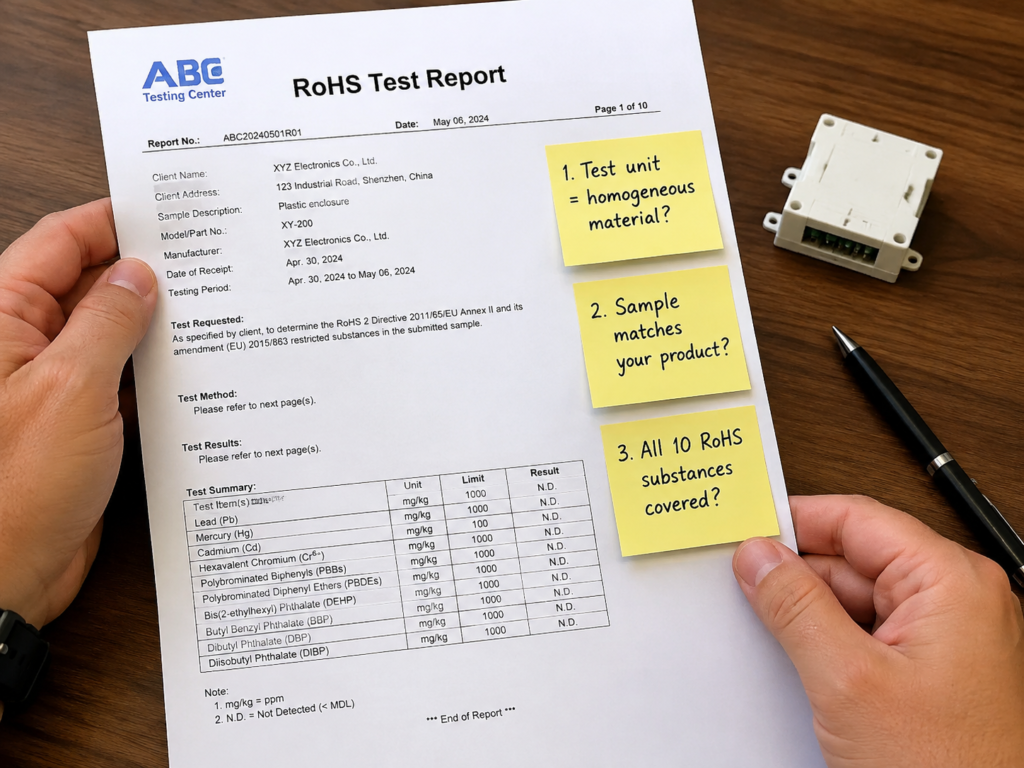
First, check the test unit and disassembly logic: Whether the test object of the report is a homogeneous material; if the report only marks “whole product test” or “whole component test”, it cannot be used alone as a sufficient compliance basis. The overall screening result can be used as supplementary evidence for risk assessment, but cannot prove that each homogeneous material meets the limit requirements separately, and needs to be used in combination with material disassembly instructions, supplier declarations, or targeted test data.
Second, check the matching between the sample and your own product: Whether the material disassembly, material type, production process, supplier, and batch in the report are consistent with the product components you purchase; for example, if the shell in the supplier’s report is ABS plastic, but your product shell is PC plastic, then this report cannot be directly used for your product compliance.
Third, check the test method and coverage: Whether the test method and detection limit meet the requirements, whether all 10 controlled substances are covered, and whether the applicable exemption clauses are clearly marked. Special attention should be paid: reports only marked with X-ray fluorescence screening (XRF) results can only screen some elements initially, cannot cover organic substances such as phthalates, and cannot accurately judge the valence state of hexavalent chromium (RoHS controls hexavalent chromium, not total chromium), so they cannot be used as the final compliance basis.
In addition, you can also pay attention to the issuance time of the report, laboratory qualifications, and traceability to ensure that the report is within the validity period and from a reliable source.
Practical Tips for Submitting Samples to Third-Party Testing
When submitting samples to a testing institution, pay attention to the following points, which can not only avoid mistakes but also reasonably reduce testing costs:
First, confirm the disassembly plan with the institution in advance. You can first provide the product disassembly list or structural photos to confirm that the disassembly logic is consistent, so as to avoid wasting costs due to testing the wrong unit.
Second, homogeneous units of the same type that meet the consistency requirements (consistent material, formula, process, supplier, batch, with sufficient certification materials) can be merged for testing to reduce the number of tests; however, merging is only a sampling arrangement, and if material differences are found later, separate evaluation is still required.
Third, if the test result is close to the limit (for example, the test result of lead is in the range of 0.08%-0.12%, close to the conventional limit of 0.1%), the impact of test uncertainty needs to be considered, and the actual value may exceed the limit; in this case, it is recommended to supplement more accurate quantitative tests according to material risks, and do not take chances.
Precautions for Self-Compliance Declaration
RoHS compliance cannot be achieved solely by a test report, but requires a complete set of technical documents to support, including homogeneous material disassembly list, supplier material declaration or test report, risk assessment record, applicable exemption basis, EU declaration of conformity, etc. All types of documents must correspond to each other. When making a self-compliance declaration, pay special attention to three risk points:
First, you cannot arbitrarily judge compliance based on the “whole component”. You must confirm that all homogeneous units in the component meet the requirements under the applicable substance scope and exemption clauses before judging the component to be compliant.
Second, for micro-components that are too small to be disassembled by conventional mechanical methods, you cannot default to compliance on your own. You need to retain the supplier’s material compliance declaration, structure description, and other basis to ensure traceability.
Third, if materials such as plating and coatings are tested together with the substrate because they cannot be peeled off, the combination must be clearly marked in the declaration and technical documents, and must not be concealed.
Final Summary
The core logic of RoHS homogeneous material judgment is essentially to avoid high-risk small materials being diluted by large-volume substrates by disassembling to the smallest mechanically separable unit, and to ensure that the hazardous substance level of each material unit meets the requirements.
Mastering the basic four-step disassembly method can cope with the preliminary homogeneity judgment of most common electronic components; combined with special material rules, exemption boundaries, and pitfall avoidance skills, you can complete daily report verification, test sample submission communication, and basic compliance self-inspection. It should be noted that the judgment of complex structures, borderline cases, or high-risk materials still needs to be combined with complete technical documents, supplier evidence, or professional institution opinions, and all judgment basis should be retained to effectively reduce the regulatory risk in the EU market.