
If you plan to sell products to Europe, or are engaged in EU cross-border e-commerce, you have most likely heard of the term “CE certification”. But many people’s understanding of it is either too vague — “anyway, just stick it on for export to the EU” — or too extreme — “just find an agency to buy a certificate”. It is only when goods are detained by customs, removed from platforms, or a fine notice is received that they realize they don’t even understand “who is responsible” and “which products need it”.
In this article, we will thoroughly explain the applicable entities and product scope of CE certification, from the most basic concepts to practical judgment methods, and then to common pitfalls. Even if you are exposed to it for the first time, you can make a preliminary judgment by yourself after reading, and you won’t be fooled by messy information.
1. First, Understand What the CE Mark Really Is
Many people’s misunderstanding of CE is fundamentally wrong, so we first nail down the core essence: CE is not a quality medal issued by a third party, nor a mark of origin, but a compliance “pass” for products to enter the European Economic Area. Its core is that the manufacturer self-declares that the product meets the EU’s minimum requirements for safety, health, and environmental protection. Simply put, you promise yourself that “my product meets the standards”, then stick a CE mark to enter the EU market, but you bear full responsibility if something goes wrong.
Which Countries Are Covered by Its Validity Scope
The core effective area of CE is the European Economic Area (EEA), which includes the 27 EU countries plus Norway, Iceland, and Liechtenstein, totaling 30 countries. Products with the CE mark can circulate freely in these countries.
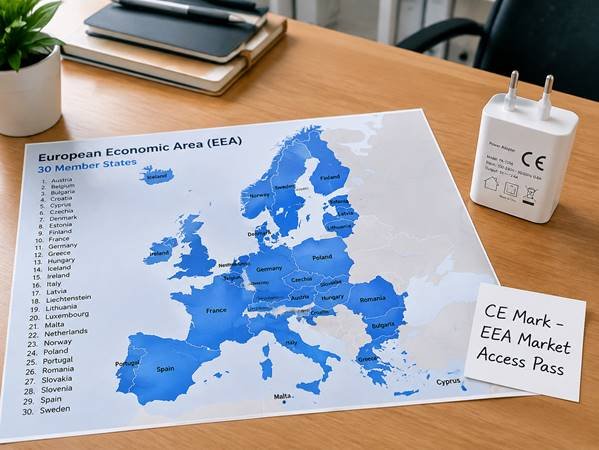
There are several special regions to note:
• Northern Ireland: The CE mark can be used directly; if the product is assessed by a UK notified body, it needs to be used with the UKNI mark, but the UKNI mark cannot be used alone in the EU market.
• Turkey: It has a customs union with the EU, and most industrial products accept the CE mark, but the regulatory process is slightly different from that of the EU. It is best to confirm before export.
• Mainland UK (GB): After Brexit, most categories still recognize CE, but special categories such as medical devices, construction products, and marine equipment need to be confirmed in accordance with local competent rules, and some categories may require the UKCA mark.
• Switzerland: It is not an EEA country, and only some categories have mutual recognition of CE. The specific situation needs to be verified separately according to product categories.
Several Core Terms You Must Understand
People who are exposed to it for the first time are easily confused by various abbreviations. We first explain them in plain language, then supplement the official names:
• Declaration of Conformity (DoC): A “compliance commitment letter” signed by the manufacturer itself. It is the core legal document of the entire CE compliance, and is more effective than any “certificate”.
• Notified Body (NB): A third-party assessment body officially authorized by the EU. Only high-risk products need to be audited by them, and ordinary low-risk products do not.
• EU Harmonized Legislation: Product compliance requirements uniformly formulated by the EU, divided into two types: one is “regulations”, which take effect directly across the EU; the other is “directives”, which need to be converted into national laws by each country before implementation.
• Harmonized Standards: Recognized technical specifications listed in the Official Journal of the European Union, equivalent to the official “compliance operation manual”. Adopting such standards usually gives a presumption of conformity for the essential requirements they cover; however, manufacturers still need to confirm the standard version, scope of coverage, and risks not covered by the standards, and retain test reports, risk assessments, and a full set of technical documents.
Relationship Between Common Compliance Documents
Many people can’t tell the difference between “test report”, “CE certificate” and “DoC”. We can think of CE compliance as an exam:
• DoC: It is the core legal commitment letter of “I have passed” signed by yourself. It must be prepared, kept, provided with the product as required by applicable regulations, or submitted when required by supervision.
• Technical Documents: They are your usual homework, review notes, and mock exam papers, that is, a full set of materials for product design, testing, and risk assessment. They need to be kept for 10 years for regulatory verification.
• Test Report: It is just the score of one mock exam paper, and is a supporting material for technical documents. It can be done internally or by a third party, but a single test report does not equal complete CE compliance.
• Notified Body Certificate: Only required for high-risk products, equivalent to the “invigilator’s signature” for difficult subjects. It only covers the assessment of specific links. Having it does not mean that all subjects are passed, let alone complete CE compliance.
• Label/Manual/Traceability Information: They are equivalent to your “admission ticket” and are a necessary part of compliance. The CE mark must be affixed to the product, and information about the manufacturer, importer or EU economic operator, model/batch/serial number, and necessary safety warnings must be marked in accordance with applicable regulations, while a manual in the language of the target market must be provided. Different regulations have different requirements for marking positions and accompanying documents, which need to be confirmed according to specific regulations. Without these, you can’t even reach the threshold of market access.
Differences from Other Common Certifications
Many people confuse CE with other certifications. Here is a quick clarification:
• vs ISO 9001: The latter is an enterprise quality management system certification, which manages the management process of your factory. It has nothing to do with whether a single product can enter the EU, and cannot replace CE.
• vs FCC/UL: FCC is the US electromagnetic compatibility requirement, and UL is a US voluntary safety certification. Both are rules for the US market, and are not valid in the EU, so they cannot replace CE.
• vs CB Scheme: It is an internationally mutually recognized test report for electrical products, equivalent to an “internationally universal transcript”. It can be used as a reference for CE assessment, but it is not an automatic pass, and the complete CE compliance process still needs to be followed.
Why It Is Necessary to Clarify the Scope and Entities First
If you get the applicable scope and responsible entities of CE wrong, the consequences are more serious than you think: in mild cases, customs will detain goods and platforms will remove products; in severe cases, you will face huge fines, product recalls, and even be blacklisted by market supervision. Judging clearly in advance can not only save unnecessary compliance costs, but also shorten the market entry cycle and avoid regulatory risks from the root.
2. Who Is Responsible for CE Compliance
Many people think that CE compliance is the factory’s business, or that they don’t need to worry about it if they find a third-party agency. In fact, both are wrong. The core responsible entities of CE are very clear. We will explain them layer by layer from the core to the periphery.
First Responsible Party: Manufacturer
The “manufacturer” here does not refer to the foundry that produces products for you, but the entity that designs, produces, and places products on the EU market under its own brand/name, regardless of whether you are inside or outside the EU.
For example, if you ask a domestic factory to make a batch of chargers, sell them on Amazon Europe under your own brand, then you are the manufacturer and bear the main responsibility. The foundry only processes for you and does not bear the core responsibility. This is the general rule for OEM/ODM scenarios: whoever sells under their own brand is the manufacturer.
The core obligations of the manufacturer include: conducting product risk assessment, establishing a full set of technical documents, signing the DoC, affixing the CE mark, and ensuring that mass-produced products are completely consistent with compliant samples.
There Must Be an Accountable Operator Within the EU
EU supervision cannot go overseas to hold manufacturers accountable, so for products covered by the Market Surveillance Regulation 2019/1020, an EU economic operator is usually required when entering the EU market; this role can be an EU manufacturer, importer, authorized representative, and may also be a fulfillment service provider under specific conditions. Some high-risk or special regulations such as medical devices may also have additional requirements for responsible persons, which should be confirmed according to specific regulations.
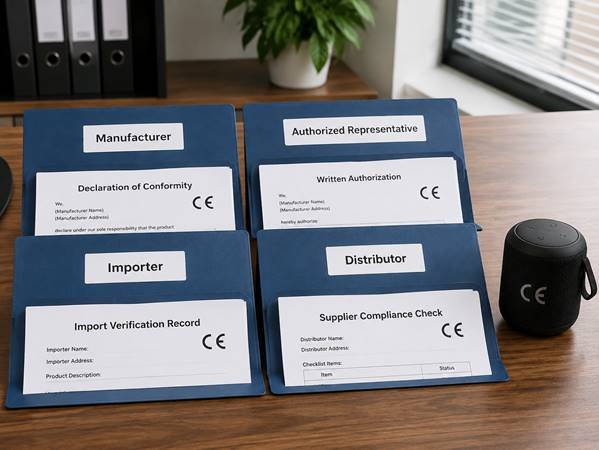
The responsibility boundaries of different roles are also different:
• Importer: The entity that first brings non-EU products into the EU market. It needs to verify the CE marking and compliance documents of the products and bear joint and several risks.
• Authorized Representative (AR/EU Representative): A contact person within the EU designated in writing by an overseas manufacturer. The specific obligations are subject to written authorization and applicable regulations. At a minimum, it should be able to provide DoC/technical documents to regulatory authorities, cooperate with corrective measures, and communicate recalls; however, core compliance responsibilities such as product design, risk assessment, and batch consistency still rest with the manufacturer. It is the most commonly used economic operator choice for overseas sellers.
• Fulfillment Service Provider: An entity within the EU that provides warehousing and distribution services for non-EU sellers. It can also act as an economic operator in specific scenarios.
• Distributors (including platform sellers, wholesalers, retailers): They need to verify the CE marking and traceability information of products. Those who sell products knowing that they are non-compliant shall bear joint and several liability.
Entity Identification in Special Scenarios
There are several scenarios that are easy to confuse, which we will explain separately:
• Cross-border e-commerce and online platforms: Even commercial orders shipped directly from China or via small parcels are considered “placed on the EU market” and still require the designation of an EU economic operator; platforms must take measures such as removal and banning of known non-compliant products.
• Product modifier: If you modify the configuration, change the brand, or change the purpose of an existing product and then sell it, you will be regarded as a new manufacturer, and need to redo CE compliance and bear full responsibility.
• Second-hand and personal-use items: Second-hand products placed on the EU market for the first time require CE; second-hand resale that has been compliantly circulated in the EU and has not been modified does not require CE; a small amount of personal purchase for personal use does not require it, but if it is second-hand sales for commercial purposes, compliance is required.
Document Retention Requirements for Different Entities
Different roles need to retain different compliance evidence. Don’t be unable to produce them when supervision inspects:
• Manufacturer: Retain a full set of technical documents, DoC, risk assessment report, product change records, and notified body certificate (if any).
• Importer: Verify DoC, CE marking, economic operator information, and retain import records.
• Distributor: Verify product CE marking and traceability information, and retain supplier qualification documents.
• Authorized Representative: Retain a copy of the manufacturer’s full set of compliance documents, and be ready to liaise with regulatory authorities at any time.
3. Which Products Need CE Certification
There are two core prerequisites for judging whether a product needs CE certification, both of which are indispensable:
1. To be placed on the market of the European Economic Area, or put into use for the first time within the EU: Here, “placing on the market” includes not only sales, but also gifting, leasing, commercial samples, cross-border direct mail, and customer trials; “putting into use” refers to the first installation/commissioning within the EU, for example, special equipment purchased internally by an enterprise is used in a European factory for the first time.
2. Belong to the product categories covered by EU CE harmonized legislation.
If the following conditions are met, exemption is possible: a small amount of non-commercial items purely for personal use, prototypes only for testing and marked “not for sale”, exhibits for exhibition and clearly marked “not for sale/use”, and unmodified second-hand products that have been compliantly circulated in the EU.
The 6 Most Common Categories of Products That Need CE
We have compiled the most common product categories that require CE, with typical examples and control directions, for your quick comparison:
| Product Category | Typical Examples | Core Control Direction |
| Electronic, electrical and wireless equipment | Mobile phones, chargers, home appliances, LED lights, Bluetooth headsets | Electrical safety, electromagnetic interference, wireless spectrum compliance |
| Mechanical products | Machine tools, food processing equipment, fitness equipment, power tools | Safety risks of moving parts |
| Toy products (for children under 14) | Toy cars, building toys, craft kits | Children’s use safety |
| Personal protective equipment | Protective masks, safety helmets, goggles, reflective clothing | Human body protection safety |
| Medical and construction products | Thermometers, medical gloves, doors and windows, thermal insulation materials | Medical safety / construction performance |
| High-risk special equipment | Pressure equipment, elevators, gas appliances, explosion-proof equipment | Stricter mandatory assessment requirements |
A special boundary reminder here: child care products such as strollers and baby carriages do not belong to the toy category, and should be controlled according to special requirements such as general product safety, mechanical/chemical requirements, etc. Don’t classify them incorrectly.
Common Products That Clearly Do Not Need CE
Not all products need CE. The following categories do not:
• Those governed by special regulations: food, cosmetics, human/veterinary drugs, complete motor vehicles. These have separate EU regulations and do not apply to the CE framework.
• Non-commercial circulation: non-commercial items purely for personal use, test/exhibition samples marked “not for sale”.
• Special categories: purely hand-made custom artworks, unprocessed raw agricultural products, products for military/national defense use.
Judgment Logic for Multiple Overlapping Regulations
Many products do not only need to comply with one CE regulation. When judging, you can’t just look at the product name, but look at all core functions, and the regulations corresponding to each core function must be covered.
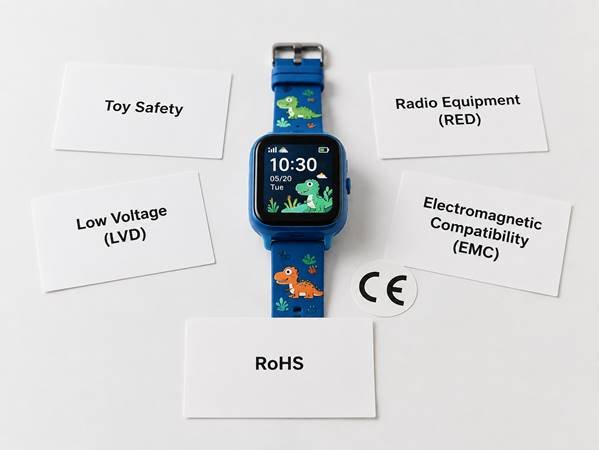
For example, a children’s smart watch is not only a toy for children under 14, but also has wireless communication functions, and must also meet the requirements of electrical safety and hazardous substance restriction. Therefore, it must comply with multiple regulations such as toys, wireless equipment, low voltage, electromagnetic compatibility, and RoHS. Many people think it is just an ordinary electronic product, ignoring the requirements of the toy category, and finally fall into the pit.
Boundary Between CE Regulations and Other EU Sales Regulations
It should also be noted that not all regulations affecting EU sales fall within the CE category. We divide the common ones into two categories:
• Core regulations that fall within the CE compliance category and require the CE mark: Low Voltage (LVD), Electromagnetic Compatibility (EMC), Radio Equipment (RED), Machinery Directive (MD), Toy Safety, Personal Protective Equipment (PPE), Medical Devices (MDR/IVDR), Construction Products (CPR), Pressure Equipment (PED), Explosion-Proof (ATEX), Gas Appliances (GAR), Lifts, Restriction of Hazardous Substances (RoHS).
• Regulations that are not mandatory CE requirements but will affect EU market sales: General Product Safety Regulation (GPSR), Chemicals Management (REACH), Waste Electrical and Electronic Equipment (WEEE), Battery Regulation, Packaging Regulation, Food Contact Materials Regulation, Ecodesign/Energy Labeling requirements. Although these do not require the CE mark, you will still be fined if you do not comply. Don’t think that passing CE means everything is fine.
4. Four-Step Practical Method for Judging Product Scope
After talking so much, some people may still feel a bit confused. It doesn’t matter. Follow these four steps, and you can basically judge it pretty accurately by yourself.
Step 1: Confirm the Placement Scenario and Purpose
First verify two core dimensions to quickly judge whether the compliance prerequisite is triggered:
• Trigger type: Does it fall into the category of “placing on the market” or “putting into use”? Any commercial inflow (sales, gifting, leasing, import, listing on platforms, commercial samples, customer trials, first installation/commissioning within the territory, etc.) counts.
• Use attribute: Is it for ordinary consumers or professionals? Is it claimed to have special uses such as medical, protective, or children’s use? Different uses may lead to completely different applicable regulations.
Key reminder: Cross-border e-commerce commercial direct mail orders are considered placing on the market; only test/exhibition prototypes clearly marked “not for sale/use” meet the exemption conditions.
Step 2: Match the Corresponding CE Regulation Category
Match the corresponding regulations according to the core functions of the product. For example, for products with electricity, first check low voltage and electromagnetic compatibility; for those with wireless functions, add wireless regulations; for those for children, add toy regulations; for those with protective functions, add personal protective equipment regulations.
Don’t just look at the product name, look at the actual function, manual, and even promotional content — for example, if you sell a wristband that is advertised to monitor heart disease, then it is a medical device, not an ordinary electronic product. Multi-functional products must cover the regulations corresponding to all core functions, and no omission is allowed.
Step 3: Check Whether There Are Exemptions or Special Rules
After matching the regulations, check if there are any special circumstances:
• Replacement by special regulations: Products with special EU regulations such as automobiles, drugs, and food do not apply to the CE framework.
• Judgment of parts/components: Those sold independently, with independent use functions, and targeted at end users (such as separately sold power adapters) need to be CE certified separately; internal components that are only for integration into finished products and have no independent functions are the responsibility of the final product manufacturer and do not need separate certification; spare parts that replace original compliant products do not need certification as long as their performance is not changed.
• Custom product rules: Customized non-standard products still need to meet the requirements of corresponding CE regulations. Only a very few categories such as medical devices have a special compliance path for “custom devices”, which is not an exemption.
• Semi-finished products/complete sets of equipment: For semi-finished machines that require supplementary safety components to be used, the final integrator is responsible for complete compliance; when multiple compliant single products form a complete set of equipment, if the combination method does not change the intended use and does not introduce new mechanical/electrical/control interface risks, it is usually not necessary to repeat the assessment for each single product, but the integrator should still assess the overall risk, interface compatibility, final labeling, and unified manual. If new risks arise after combination, a supplementary overall CE compliance assessment should be conducted.
Step 4: Formal Verification Channels When Uncertain
If you are not sure, don’t guess randomly, and don’t listen to one-sided statements on the Internet. Follow this order to find formal channels for verification:
• First check the official EU CE theme page and the official guidelines of corresponding regulations to confirm whether the product is within the CE coverage and which regulations apply;
• Then use the EU Nando database to check the qualification of the notified body to confirm whether it is authorized to handle the corresponding regulations and product categories — note that Nando can only check institutional qualifications, and cannot directly prove that a certain product necessarily needs CE;
• For high-risk or boundary-blurred products, then find a notified body with the corresponding authorization scope or a professional compliance lawyer to conduct a pre-assessment. Although it may cost some money, it is much more cost-effective than having goods detained and fined.
5. 4 Variables That Will Change the Judgment Result
The applicable scope of CE is not static. The following 4 variables will directly affect the judgment conclusion, and should be adjusted according to your actual situation.
Sales Region Variable
The core effective area of CE is the European Economic Area (EEA), but the rules in the following regions will directly change the applicable requirements of CE, which need to be confirmed separately:
• Mainland UK (GB): Most categories recognize CE. Medical devices, construction products, marine equipment, etc. need to be confirmed in accordance with local competent rules, and some categories require the UKCA mark.
• Northern Ireland: CE can be used directly; if the assessment report is issued by a UK notified body, it needs to be used with the UKNI mark, and the UKNI mark cannot be used in the EU market.
• Switzerland/Turkey: Switzerland only has mutual recognition of CE for some categories; Turkey accepts CE for most industrial products, but the regulatory process is different from that of the EU.
Product Use Variable
For the same product, different uses may lead to vastly different applicable regulations:
• For the same ornament, if it is claimed to be a toy for children under 14, it belongs to the toy category; if it is claimed to be an adult collection, it belongs to general products.
• Ordinary decorative masks and masks claimed to protect against viruses belong to general products and personal protective equipment (PPE) categories respectively, and the latter requires CE.
• Health equipment claimed for medical use will be classified into the medical device category, with much stricter requirements than ordinary electronic products.
Product Form Variable
• Brand new products: Require complete CE compliance.
• Second-hand products: Require CE when entering the EU for the first time; resale of products that have been compliantly circulated in the EU and have not been modified does not require CE.
• Modified products: Products that have undergone substantial modification (configuration change, purpose change, brand change) are regarded as new products and need to be re-evaluated.
• Parts: Those sold independently and with independent functions require separate CE; internal components integrated into finished products are covered by the final product.
Risk Level Variable
The risk level directly determines whether the compliance process requires the participation of a notified body:
• Most low-risk products that fully use EU harmonized standards to cover all risks: Can adopt the internal production control mode, that is, manufacturer’s self-declaration, without the participation of a notified body.
• High-risk products (such as Class III medical devices, pressure equipment, explosion-proof products): Regulations mandate the participation of notified bodies in audits, with stricter scope boundaries.
• Special circumstances: If low-risk products do not adopt harmonized standards, or if harmonized standards cannot cover all risks, a notified body may also be required to participate.
6. Avoiding Common Misconceptions
We have compiled the most common pitfalls people fall into, each with correct judgment, exceptions, and judgment basis to help you avoid detours.
Misconceptions About the Nature of CE
1. Misconception: CE is a quality certification that can be bought with money
Correct judgment: CE is a compliance self-declaration, and the core responsibility lies with the manufacturer. Buying a certificate is illegal, and you will face severe penalties if investigated.
Exception: None.
Judgment basis: The DoC must be signed by the manufacturer, and the technical documents need to be traceable to the entire process of product design and production. Fake certificates simply cannot withstand verification.
2. Misconception: Having a CE certificate means you can definitely sell
Correct judgment: Complete CE compliance requires DoC + technical documents + product consistency. Many so-called “CE certificates” on the market are actually just test reports, which cannot represent complete compliance.
Exception: High-risk products require a notified body certificate, but still need to be matched with other documents to be fully compliant.
Judgment basis: During regulatory verification, the DoC, technical documents, and product consistency will be checked at the same time. Having only one “certificate” is useless.
3. Misconception: A test report is CE certification
Correct judgment: A test report is only a supporting material for conformity assessment, and is not equivalent to complete CE compliance.
Exception: None.
Judgment basis: Complete compliance requires the simultaneous possession of DoC, risk assessment, and a full set of technical documents, and the test report is only part of them.
Misconceptions About Entity Responsibility
1. Misconception: Only EU-based enterprises need to do CE
Correct judgment: Overseas brand owners/manufacturers are the core responsible entities for CE compliance, and only need to designate an EU economic operator as the contact person.
Exception: None.
Judgment basis: The manufacturer’s information must be listed on the DoC, and overseas enterprises cannot evade responsibility just because they are not in the EU.
2. Misconception: You don’t have to be responsible if you find a notified body
Correct judgment: The notified body only conducts assessments within the specified scope, and the responsibility always rests with the manufacturer.
Exception: None.
Judgment basis: The notified body certificate only covers specific links of the corresponding regulations, and the manufacturer is responsible for the compliance of the entire product.
3. Misconception: Small sellers/cross-border self-shipping don’t need to worry about CE
Correct judgment: As long as products are placed on the EU market, there is compliance responsibility, regardless of enterprise size and shipping method.
Exception: A small amount of items purely for personal use.
Judgment basis: Platform orders and logistics records can be used to determine whether it is commercial placement. Even if there is only one commercial order, it is considered placing on the market.
4. Misconception: Distributors/platforms don’t have to be responsible
Correct judgment: Those who sell products knowing they are non-compliant need to bear joint and several liability; platforms need to take disposal measures against known non-compliant products.
Exception: Second-hand products that have been compliantly circulated in the EU and have not been modified usually do not trigger a new CE assessment, but distributors still have to perform basic verification, traceability, and product safety obligations, and cannot sell products knowing they are non-compliant or unsafe.
Judgment basis: Distributors need to retain the compliance documents of suppliers, and platforms need to review the qualifications of merchants. Those who sell products knowing they are violating regulations will be held accountable.
Misconceptions About Applicable Scope
1. Misconception: All products exported to the EU need CE
Correct judgment: Only products covered by CE regulations need CE. Affixing the CE mark randomly is illegal.
Exception: Products replaced by special regulations, items purely for personal use.
Judgment basis: Judge one by one against the CE regulation list, product use and function. Not all products are within the scope.
2. Misconception: Small batches/samples don’t need CE
Correct judgment: As long as they are placed on the market for commercial purposes, compliance is required regardless of batch size.
Exception: Samples only for testing/exhibition and marked “not for sale/use”.
Judgment basis: Commercial contracts, sample labels, and exhibition certificates can all be used to determine whether it is for commercial purposes.
3. Misconception: Parts definitely don’t need CE
Correct judgment: Parts sold independently and with independent functions need separate CE certification.
Exception: Internal components that are only for integration into finished products and have no independent functions.
Judgment basis: Check whether the product is independently packaged, independently sold, and has independent instructions for use.
4. Misconception: All custom products are exempt from CE
Correct judgment: Custom products still need to meet the requirements of corresponding regulations. Only a few categories have special compliance paths, which is not an exemption.
Exception: Custom devices in the medical device category have special rules, but still need to meet the corresponding compliance requirements.
Judgment basis: Custom contracts and product design documents can determine product attributes. Customization does not equal exemption.
7. Quick Judgment Checklist and Action Recommendations
If you are a cross-border e-commerce seller or a small business and don’t want to go through the long content above, you can first ask yourself these questions to make a quick preliminary judgment.
3 Quick Questions About Entity Responsibility
1. Am I the brand owner/manufacturer of the product, and will the product be placed on the market of the European Economic Area?
2. If I am an overseas manufacturer, have I designated an EU economic operator?
3. If I am an importer/distributor, have I verified the CE mark and compliance documents of the product?
4 Quick Questions About Product Scope
1. Will the product be placed on the market of the European Economic Area or put into use for the first time within the EU (sales, gifting, leasing all count)?
2. Does the product belong to the common categories covered by CE (electronics, machinery, toys, protective equipment, etc.)?
3. Does the product have an independent use function and is targeted at end users?
4. Does it belong to the clearly exempt categories (military industry, drugs, raw agricultural products, etc.)?
Action Recommendations After Preliminary Judgment
• Confirmed as needed: Prepare technical documents and declaration of conformity in accordance with the requirements of corresponding regulations, confirm the EU economic operator, and affix the CE mark as required.
• Doubtful: Conduct a pre-assessment through official channels or a qualified notified body. Do not affix CE blindly. The consequences of random affixing are more serious than not affixing.
• Confirmed as not needed: Keep the judgment basis, such as product use instructions and regulation comparison records, for regulatory verification.
Reference of Typical Scenario Cases
We have compiled 5 most common scenarios to help you better understand:
1. Bluetooth LED light: The responsible entity is the overseas brand owner (needs to designate an EU economic operator), and it needs to comply with LVD/EMC/RED/RoHS regulations at the same time. A common misconception is that only low-voltage testing is needed, ignoring the requirements of wireless regulations.
2. Children’s smart watch: The responsible entity is the brand owner, and it needs to comply with toy/RED/LVD/EMC/RoHS regulations at the same time. A common misconception is that it is only an electronic product and does not need to meet toy safety requirements.
3. Comparison of three types of masks:
| Mask Type | Use Positioning | Whether CE is Required | Applicable Regulation |
| Ordinary decorative mask | Decoration, warmth, no protective claim | No (needs to comply with general product safety) | GPSR |
| FFP2 protective mask | Personal protection such as dust and virus prevention | Yes | PPE (Personal Protective Equipment Regulation) |
| Medical surgical mask | Used in medical scenarios, protects against germs | Yes | MDR (Medical Device Regulation) |
A common misconception is that either all masks need CE or none do. The core judgment standard is the use claim.
4. ODM private label power adapter: The responsible entity is the brand owner (the foundry does not bear the main responsibility). It falls within the scope of LVD/EMC/RoHS and requires separate CE certification. A common misconception is that if the factory has a CE report, the brand owner does not need to comply.
5. Second-hand industrial machine tool: Requires CE when entering the EU for the first time; resale of unmodified products that have been compliantly circulated in the EU does not require CE. A common misconception is that all second-hand products are exempt from CE.
8. Core Summary
After reading this article, you should be able to independently judge three things:
First, what kind of CE compliance responsible entity you belong to and what core obligations you need to bear;
Second, whether your product is roughly within the applicable scope of CE certification;
Third, when the scope or entity is in doubt, through which steps and formal channels to verify.
Finally, we emphasize three core principles:
First, CE is centered on the manufacturer’s self-declaration. Notified bodies only participate in the audit of designated links for high-risk products, and the responsibility always rests with the manufacturer;
Second, the core logic of the applicable scope of CE is twofold: whether it triggers EU market placement/putting into use, and whether it belongs to the category covered by CE regulations;
Third, don’t believe false statements such as “all products need CE”, “small batches don’t need CE”, and “buying a certificate will pass”. Doing the basic work solidly in accordance with the rules is the real low-cost compliance.