
If you are in the EU electrical and electronic equipment business, you have most likely heard of cases where goods are detained due to RoHS non-compliance; if you are an ordinary consumer, you may have seen the CE mark when buying electronic products sold in the EU, but do not know its relationship with RoHS. The core of RoHS is a list of restricted hazardous substances. Understanding this list can help you avoid most pitfalls, whether you are handling compliance or selecting products.
First, Understand the Basics: What the RoHS List Is and Why It Matters
Plain-Language Explanation of the RoHS List
You can think of the RoHS list as a “toxic substance concentration limit table” set by the EU for electrical and electronic products: it clearly lists the types of restricted hazardous substances and the maximum concentration limits that must not be exceeded in homogeneous materials; for specific technical uses that meet specific exemption clauses, use exceeding the limits may be allowed. It is the core regulatory content of the EU’s Directive on the Restriction of the Use of Certain Hazardous Substances in Electrical and Electronic Equipment (abbreviated as RoHS), not an independent new regulation. The purpose of its formulation is simple: to reduce toxic components in e-waste and lower the long-term harm to the environment and human health.
Why This List Deserves Attention
For sellers, exporters, and e-commerce practitioners operating in the EU market, RoHS is a mandatory access threshold. If products are non-compliant, they may face measures such as sales restrictions, removal from shelves, recalls, and administrative penalties imposed by market supervision authorities of EU member states. The specific consequences depend on the enforcement rules of member states and the severity of the violation, and the losses can be very large. For ordinary consumers, this list is a basic reference for judging the environmental safety of electrical and electronic products, helping you avoid high-risk products that may release toxic substances.
It should be particularly emphasized that RoHS is a mandatory regulation, not a voluntary environmental certification for enterprises. As long as a product falls within the regulatory scope, it must meet the requirements.
Don’t Be Confused by Version Numbers: The Correct Caliber of the Currently Valid List
Many people are confused by the “RoHS 1.0/2.0/3.0” statements online. Here we clearly state the official valid version caliber:
The basic regulation of the current RoHS is the Directive on the Restriction of the Use of Certain Hazardous Substances in Electrical and Electronic Equipment issued in 2011 (official number 2011/65/EU, commonly known as RoHS 2.0). In 2015, the European Commission issued Commission Delegated Directive (EU) 2015/863, adding 4 phthalate plasticizers to the original restricted list. Up to now, Annex II of 2011/65/EU, as amended by this delegated directive, lists a total of 10 restricted substances; the update status of the list and exemptions are independent of each other, and the validity of exemption clauses shall be subject to the latest official text of the EU. The commonly mentioned “RoHS 3.0” is only an industry common name for this revision, not an independent new directive issued officially.
It should be noted that the restriction requirements for the 4 phthalates did not take effect immediately after the release of the 2015 revision, but phased transition periods by category were set: the vast majority of consumer electrical and electronic equipment must meet the requirements from July 22, 2019, while special categories such as medical devices and industrial monitoring and control instruments have longer transition periods, which need to be confirmed against official clauses. The earliest RoHS 1.0 (2002/95/EC), which only regulated 6 substances, has long been replaced by 2011/65/EU and is no longer applicable.
What Is the Relationship Between RoHS and the CE Mark
Many people think the CE mark is a “certificate of conformity” issued by a third-party organization, but it is not. First of all, CE is not an exclusive mark for RoHS. RoHS compliance is only one of the requirements that electrical and electronic equipment must meet to affix the CE mark. Whether a product needs to bear the CE mark also depends on whether it simultaneously meets other applicable EU regulations such as low voltage and electromagnetic compatibility.
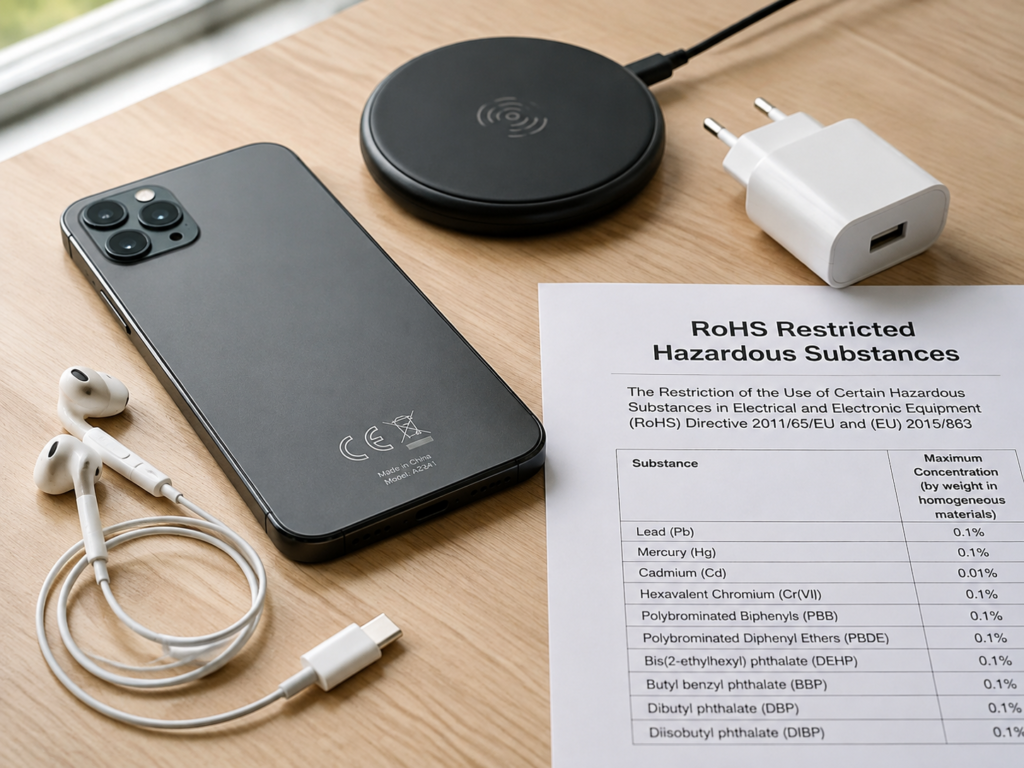
For electrical and electronic equipment subject to both RoHS and CE requirements, RoHS compliance is a prerequisite for affixing the CE mark and signing the EU Declaration of Conformity. But CE is essentially a manufacturer’s self-declaration — the manufacturer itself promises that the product meets all applicable EU regulations, and no mandatory third-party certification is required.
RoHS compliance cannot be directly judged solely by the presence or absence of the CE mark. A more reliable method is to confirm that the product falls within the RoHS regulatory scope and verify whether the merchant can provide the RoHS Declaration of Conformity and supporting technical documents.
Core Details: Full Explanation of the 10 Current RoHS Restricted Substances
First Understand the Limit Rules: Otherwise Reading the List Is Useless
Before looking at specific substances, you must first understand the RoHS limit judgment rules, otherwise it is easy to misunderstand:
First is the calculation basis: the limits apply to “homogeneous materials”, that is, the smallest unit that is uniformly composed and cannot be separated into different materials by mechanical disassembly. “Mechanical disassembly” here refers to separation methods using ordinary screwdrivers, pliers, scissors and other tools, but the core of judgment is whether the material composition is uniform, not whether it can be disassembled — for example, the plating on metal surfaces, solder on circuit boards, and plastic sheaths of wires, even if very thin, are separate homogeneous materials as long as they are independent material layers with uniform composition. For example, a charging cable can be disassembled into multiple homogeneous units such as plastic sheath, copper core, and metal shielding layer. You cannot cut the entire cable into pieces and mix them together to calculate the average content.
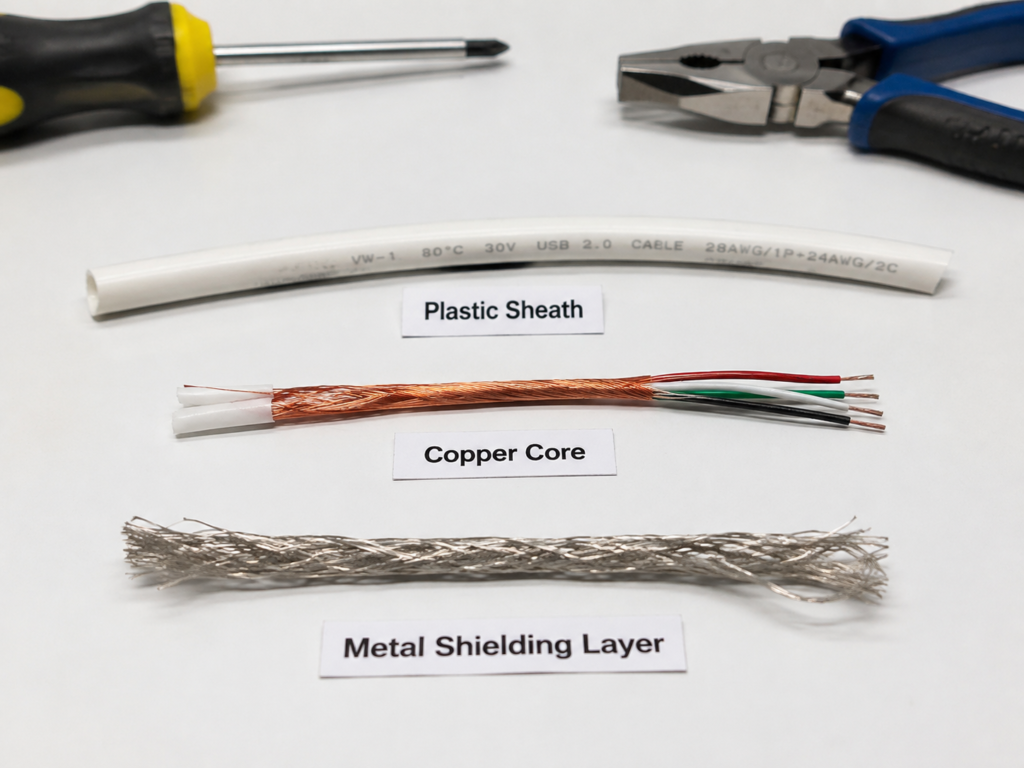
Second is the core principle: each smallest homogeneous material must meet the standard independently. Even if a small plastic part weighing only 1 gram exceeds the limit, the entire product is considered non-compliant, and the low content of other components cannot be used to “offset” it.
Third is unit conversion: the commonly used units in test reports are %, ppm, and mg/kg. The conversion is very simple: 0.1% = 1000 ppm = 1000 mg/kg, 0.01% = 100 ppm = 100 mg/kg. Remember this correspondence, and you will not be confused when reading reports.
Last is the form rule: RoHS restricts specific substances or specific valence states/forms in the list, not the total content of a certain type of element. For example, chromium has multiple valence states, and Annex II of RoHS only restricts hexavalent chromium (Cr(VI)). If the total chromium content is detected to be high, it cannot be directly equated with hexavalent chromium exceeding the limit. The content of hexavalent chromium must be specifically tested to judge compliance, and the hazards and test conclusions of chromium in different valence states cannot be mixed.
Category 1: 4 Heavy Metals (Cadmium Has the Strictest Limit)
Heavy metals are the first category of substances regulated by RoHS. Except for cadmium, which has a limit of 0.01% (100 ppm), the limits for the other three are all 0.1% (1000 ppm).
- Lead (Pb): The most familiar toxic heavy metal. It was widely used in welding and batteries in the past, and is now commonly found in solder, circuit board plating, and glazes of glass and ceramics. It should be noted that trace lead impurities in brass and bronze alloys may meet specific exemption conditions, and cannot be directly judged as exceeding the limit.
- Cadmium (Cd): More toxic than lead, it easily accumulates in the human body and has a clear carcinogenic risk. It has the strictest limit among all RoHS substances. It is commonly found in switch contacts, nickel-cadmium batteries, and colored plating. Recycled metals are a high-risk source — because cadmium-containing parts are easily mixed into old metal materials and are difficult to completely separate.
- Mercury (Hg, also known as quicksilver): A toxic heavy metal that can volatilize at room temperature, and inhalation can damage the nervous system. It was commonly used in fluorescent lamps and old switch relays in the past, and is now rare in ordinary consumer electronics. It is mainly used in some special lamps and professional equipment, and it is necessary to verify whether it meets exemption conditions.
- Hexavalent Chromium (Cr(VI)): The toxic valence state of chromium, which is carcinogenic and often used for rust prevention treatment of metals. It mainly exists in metal rust-proof plating and passivation layers. It is emphasized again: RoHS only restricts hexavalent chromium, and total chromium test results cannot be directly used as a basis for compliance judgment.
Category 2: 2 Brominated Flame Retardants
Brominated flame retardants are substances added to plastics and rubber for fire prevention. The two polybrominated flame retardants regulated by RoHS both have a limit of 0.1% (1000 ppm).
- Polybrominated Biphenyls (PBBs): A commonly used brominated flame retardant in the early days, which is now rarely actively added. The main risk comes from residues in recycled plastics and old inventory parts, and it is commonly found in plastic housings, circuit boards, and flame-retardant layers of wires and cables.
- Polybrominated Diphenyl Ethers (PBDEs): A brominated flame retardant that was once more widely used and whose health risks have received more attention. It is commonly found in electronic plastic parts, foamed plastics, and insulating materials. Here we clarify a common misunderstanding: products marked “halogen-free” are not equivalent to RoHS compliant — halogen-free only regulates the total amount of halogens such as chlorine and bromine, and does not necessarily cover these two specific flame retardants, let alone heavy metals and plasticizers.
Category 3: 4 Phthalate Plasticizers (Added in 2015)
Phthalates are what people often call “plasticizers”, which are additives used to make plastics softer and more elastic. Long-term exposure may affect reproductive development. They were officially added to the RoHS restricted list in 2015, and all four have a limit of 0.1% (1000 ppm).
High-risk materials for this type of substance are soft PVC, rubber, coatings, adhesives, and inks. The four common phthalates each have their main application scenarios:
- DEHP: The most commonly used phthalate, mostly found in PVC wire sheaths and rubber seals;
- BBP: Commonly found in artificial leather and plastic decorative parts;
- DBP: Mostly used in inks, adhesives, and plastic films;
- DIBP: Commonly found in PVC products, rubber, and coatings.
It should be noted that RoHS only regulates these 4 phthalates, not all plasticizers are restricted; and phthalates are not only present in PVC materials, they may also be found in rubber, coatings, and inks. Don’t think that if it’s not PVC, you don’t need to check.
Quick Reference Table for 10 Substances
For your quick comparison, here is a table of the 10 restricted substances:
| Category | Chinese Name | English Abbreviation | Limit in Homogeneous Materials | High-Risk Materials |
|---|---|---|---|---|
| Heavy Metals | Lead | Pb | 0.1% (1000 ppm) | Solder, PCB plating, glass/ceramic glazes, brass/bronze alloys |
| Heavy Metals | Cadmium | Cd | 0.01% (100 ppm) | Switch contacts, nickel-cadmium batteries, colored plating, recycled metals |
| Heavy Metals | Mercury (quicksilver) | Hg | 0.1% (1000 ppm) | Fluorescent lamps, old switches/relays, special lamps |
| Heavy Metals | Hexavalent Chromium | Cr(VI) | 0.1% (1000 ppm) | Metal rust-proof plating, passivation layers |
| Brominated Flame Retardants | Polybrominated Biphenyls | PBBs | 0.1% (1000 ppm) | Plastic housings, circuit boards, flame-retardant layers of wires and cables, recycled plastics |
| Brominated Flame Retardants | Polybrominated Diphenyl Ethers | PBDEs | 0.1% (1000 ppm) | Electronic plastic parts, foamed plastics, insulating materials |
| Phthalate Plasticizers | Bis(2-ethylhexyl) phthalate | DEHP | 0.1% (1000 ppm) | PVC wire sheaths, rubber seals |
| Phthalate Plasticizers | Butyl benzyl phthalate | BBP | 0.1% (1000 ppm) | Artificial leather, plastic decorative parts |
| Phthalate Plasticizers | Dibutyl phthalate | DBP | 0.1% (1000 ppm) | Inks, adhesives, plastic films |
| Phthalate Plasticizers | Diisobutyl phthalate | DIBP | 0.1% (1000 ppm) | PVC products, rubber, coatings |
Applicable Boundaries: Which Products Need to Meet RoHS Requirements
Products and Components That Must Comply
The core regulatory object of RoHS is Electrical and Electronic Equipment (EEE). To judge whether a product belongs to EEE, it is necessary to comprehensively determine based on the product’s designed use, rated operating parameters, current/electromagnetic field operating mode, and the exclusion categories in Article 2 of the RoHS Directive. Only products that operate on electric current or electromagnetic fields and do not fall into the exclusion categories need to meet RoHS requirements.
Common typical regulated products include mobile phones, computers, home appliances, lamps, electric tools, luminous toys with electronic functions, etc. Not only brand-new products must meet the requirements, but independently sold electronic accessories (such as chargers, wired earphones, connectors) themselves are electrical and electronic equipment, and must also independently meet RoHS requirements when sold separately.
Many people easily overlook small components: such as power cords, connectors, surface coatings, and solder. Although these are inconspicuous, as part of the product, they also fall within the regulatory scope and must meet the standards.
Two types of easily confused product boundaries need special explanation:
First, not all replacement parts for maintenance, reuse, or function/capacity upgrades are unconditionally subject to the latest limits. It is necessary to judge against the corresponding clauses of the RoHS Directive in combination with the time when the original equipment was placed on the market and the specific use of the replacement parts;
Second, independently sold batteries and accumulators are mainly subject to the EU’s special battery regulatory system, and do not belong to RoHS-regulated electrical and electronic equipment just because they are sold separately; the battery body is usually verified in accordance with EU battery regulations, and other homogeneous materials of battery-containing electrical and electronic equipment still need to be judged in accordance with RoHS. Non-battery body parts such as battery interfaces, connecting wires, and housings should also be verified separately according to their regulatory attributes.
Common Exclusion Categories and Applicable Conditions
The RoHS Directive clearly lists some products and scenarios that are excluded from application, but all have strict definition conditions. They cannot be directly judged solely by labels such as “industrial”, “medical”, or “military”. Common exclusion categories include:
- Military and National Security Equipment: Equipment specifically used for military purposes and meeting national security needs;
- Space Equipment: Equipment specifically used for space exploration and deployed on spacecraft;
- Large Fixed Industrial Tools/Installations: Large fixed industrial equipment and installations that meet the clear definition of the directive, usually referring to industrial-grade equipment that is fixed in a specific place for a long time and installed and maintained by professionals;
- Specific Medical and Monitoring Equipment: Some implantable medical devices, in vitro diagnostic medical devices, monitoring and control instruments specifically used for scientific research, etc., which need to match the exclusion categories clearly listed in the directive;
- R&D Prototype Samples: Prototype samples specifically used for technology research and development, only provided to enterprises and not placed on the consumer market;
- Temporary Exhibition Items: Temporary exhibits only used for exhibition and display, not sold in the EU market, which need to be taken out or destroyed after the exhibition;
- Second-hand Equipment Placed on the Market Historically: Second-hand electrical and electronic equipment that was placed on the EU market before the first implementation of RoHS in the EU on July 1, 2006, is not subject to the current RoHS requirements; this exclusion only applies to the secondary circulation of original equipment, and does not apply to products produced, remanufactured or refurbished and then re-placed on the market. The entity claiming the application shall retain relevant evidence of the first placement time of the equipment.
All the above categories must be confirmed strictly against the definition clauses of the RoHS Directive. Those that do not meet the definition still need to meet RoHS requirements.
Quick Judgment Method for Confusing Boundaries
Many products are in the gray area. Here are some simple judgment references:
- Small commodities with electronic functions: products with only simple electronic components such as luminous keychains and electronic greeting cards usually need to undergo RoHS scope assessment as EEE; but in the end, it is still necessary to check the exclusion categories in Article 2 of RoHS and specific product definitions, and conclusions cannot be drawn solely based on “having one electronic component”;
- Product packaging: ordinary paper and plastic packaging are not within the regulatory scope, but if it is a gift box with luminous and sound-emitting electronic functions, it needs to meet RoHS requirements;
- Detachable accessories: electronic accessories such as independently sold chargers and wired earphones need to meet RoHS requirements independently, and cannot rely on the compliance of the main product;
- Large industrial equipment: the rules for consumer electronics cannot be directly applied. It is necessary to judge based on the specific use of the equipment and whether it belongs to electrical and electronic equipment. If you are unsure, it is recommended to check the official product classification guide.
Advanced Understanding: How to Use RoHS Exemption Clauses
Exemption Is Not a “Get-Out-of-Jail-Free Card”: First Understand the Core Rules
Many people have heard of “RoHS exemption”, but it is easy to misunderstand it as “some products can use hazardous substances at will”, which is completely wrong. The essence of RoHS exemption is: for some specific technical application scenarios, suitable non-toxic alternative materials cannot be found temporarily, so the EU allows the use of restricted substances exceeding the limit within a certain period of time, which is equivalent to a “temporary pass”.
There are several core rules that must be remembered: First, exemptions are for specific technical uses, not giving the green light to the entire product, entire brand or entire industry — for example, lead in a certain type of high-temperature solder can be exempted, which does not mean that lead in all materials in the entire server can exceed the limit; second, all exemptions have validity periods and renewal mechanisms, and enterprises need to check whether the corresponding entries are still valid before placing products on the market; if they are not renewed or no longer applicable, they cannot continue to be used as the basis for exceeding the limit, and compliant materials must be used instead or the design must be adjusted; third, the official exemption lists are listed in Annex III and Annex IV of the RoHS Directive, and shall be subject to the latest version issued by the EU official.
Common Typical Exemption Scenarios
All RoHS exemption clauses are listed in Annex III (general exemptions for all electrical and electronic equipment) and Annex IV (special exemptions for medical devices and monitoring and control instruments) of the directive. Each article clearly limits the substance, use, applicable equipment category and validity period, and there is no general exemption for the entire industry or all categories. The following are several common examples of exemption scenarios (for reference only, specific details shall be subject to the clauses of the latest official version):
- Heavy metals:
- High-lead solder for high-temperature welding in specific categories such as servers, storage arrays, and network switching equipment: corresponding to Article 7(a) of Annex III, it only applies to the high-temperature welding scenarios and equipment scope specified in the clause. The lead content threshold and validity period need to be checked against the latest revised version;
- Cadmium in cadmium telluride thin-film solar cells: corresponding to Article 29 of Annex III, it only applies to cadmium telluride-based thin-film photovoltaic modules, and the validity period shall be subject to the latest official status;
- Hexavalent chromium rust-proof treatment layer for aerospace-related equipment or components: it is necessary to first confirm whether the product falls within the scope of RoHS application, and then check the specific exemption requirements in Annex III/IV or other applicable regulations one by one. Ordinary industrial or consumer electronics cannot directly apply the rules of aerospace scenarios.
- Mercury: mercury contacts in some special-purpose professional lamps and specific industrial equipment: corresponding to specific entries in Annex III or Annex IV, only covering the lamp types and equipment uses clearly listed in the clause, and there is no general mercury exemption.
- Phthalates: may only apply to specific medical device parts and specific industrial-grade electronic components clearly covered by Annex IV, and there is no phthalate exemption for all categories of medical or industrial products.
The application of all exemptions must fully match the literal description of the clauses, and the scope cannot be expanded without authorization.
4 Steps to Judge Whether a Product Can Apply for Exemption
If a certain type of substance in your product exceeds the limit and you want to confirm whether it can apply for exemption, you can judge according to these four steps:
Step 1: First confirm the specific use of the restricted substance and the materials used, which must fully match the literal description of the official exemption clause. Even a slight difference is not allowed. For example, if the exemption says “high-temperature solder for servers”, then solder for consumer electronics cannot use it;
Step 2: Check the validity period, renewal status and transition arrangements of the exemption, subject to the latest official text of the EU; expired exemptions that have not been renewed shall not be used;
Step 3: Confirm that the product category, use, etc. fully match the applicable requirements of the exemption clause; only when the clause clearly stipulates the time limit for placing on the market, it is necessary to check the corresponding time conditions;
Step 4: Be sure to keep supporting materials such as technical documents and alternative solution evaluation reports, so that you can provide evidence in case of inspection by EU market supervision authorities.
Finally, it should be reminded that exemption does not mean no control. Even if the exemption conditions are met, it is necessary to clearly list the applicable exemption clause number, corresponding substance and specific use in the Declaration of Conformity and supporting technical documents as the basis for compliance, and the situation of exceeding the limit cannot be concealed.
Practical Guide: Quickly Judge Whether a Product Meets RoHS
Simple Judgment Method for Ordinary Consumers/Small Buyers
If you are just an ordinary consumer or buy goods in small batches, you don’t need to do professional testing. You can make a preliminary judgment with these methods:
First, look at the marking: regular EU-sold ordinary consumer electrical and electronic products usually bear the CE mark, which can be used as a reference for initial screening, but cannot be used as the sole basis for judgment;
Second, check documents: you can ask the merchant for the RoHS Declaration of Conformity (DoC) and supporting test reports. Note that the DoC is the manufacturer’s self-declaration of conformity, which needs to be comprehensively judged in combination with technical documents;
Third, look for pitfall warning signals: unbranded, significantly low-priced PVC cables, and electronic products with pungent plastic odors are high-risk categories for RoHS non-compliance, and further verification is recommended.
Basic Self-Inspection Steps for Sellers/Suppliers
If you are a seller operating in the EU market, or need to do RoHS compliance for your products, you can do basic self-inspection in these four steps:
Step 1: Disassemble the product to the smallest homogeneous material unit, sort out the composition and source of each material, and list them into a bill of materials;
Step 2: Require upstream suppliers to provide RoHS material declarations or test reports for each material, and don’t just use the whole product report to make up the number;
Step 3: Check whether the content of the 10 restricted substances in each material meets the limit. If there is any excess, confirm whether the exemption clause can be applied;
Step 4: Sort out all technical documents and issue a RoHS Declaration of Conformity. When changing materials or suppliers, re-verify compliance, and cannot directly use old reports.
How to Check a Test Report? 6 Tips to Quickly Identify Validity
Many people don’t know how to check the authenticity and usefulness of test reports when they get them. Remember these 6 tips, and you can avoid most invalid reports:
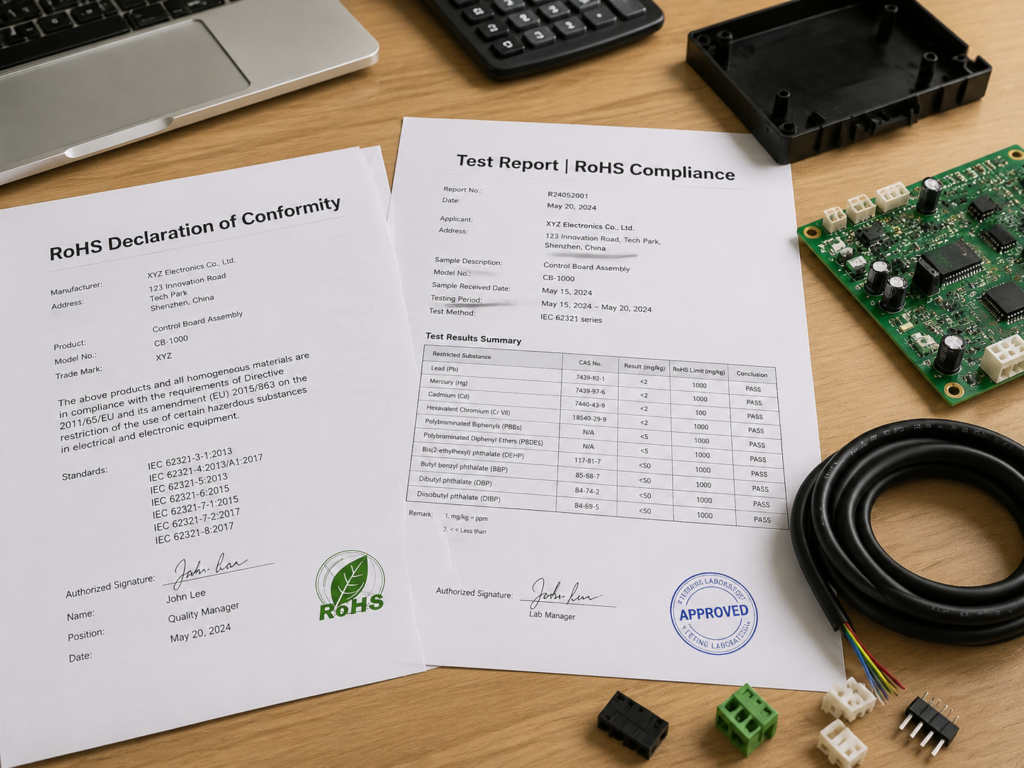
First, look at the test basis: whether it is tested separately by homogeneous material. If the report is tested by smashing the entire product and mixing it together, it cannot prove that each homogeneous material meets the limit requirements independently. It can only be used for preliminary risk screening, and cannot be used as complete RoHS compliance evidence. The final compliance judgment must still return to the homogeneous material level for verification one by one;
Second, look at the coverage scope: whether it covers the high-risk substances of the corresponding material. Metal materials usually focus on testing 4 heavy metals, and organic materials (plastics, rubber, coatings, etc.) usually need to cover all 10 types. The specific test combination can be determined according to material and process risks. Reports that miss clearly high-risk substances have limited reference value;
Third, look at the result unit: confirm whether the unit of the result is %, ppm or mg/kg, and don’t make a mistake in conversion. For example, taking 1000 ppm as 0.01% will make the joke of taking qualified as exceeding the limit;
Fourth, look at the limit of detection: the lowest value that the test method can detect (that is, the limit of detection) must be lower than the RoHS limit, otherwise it is useless even if the report says “not detected” — for example, if the detection limit of cadmium is 200 ppm, it cannot detect whether there is 150 ppm at all, and such a report is unreliable;
Fifth, look at the correspondence and validity period: the sample model and material of the report must be consistent with the mass-produced product, and reports of other models or materials cannot be used as substitutes. The RoHS regulation does not stipulate a fixed validity period for test reports, and the core of effectiveness depends on the consistency between the sample and the mass-produced product; when materials, suppliers, production processes or regulatory requirements change, compliance must be re-evaluated. The common 1-2 year reference cycle in the industry is only a common practice for enterprise risk control, not a mandatory requirement;
Sixth, look at the result accuracy: if the test result is just near the limit, for example, lead is measured at 980 ppm, which is very close to the 1000 ppm limit, you have to consider the fluctuation of production batches, and cannot directly judge it as qualified. It is best to test more batches to confirm.
Priority Screening Recommendations for High-Risk Materials
The following are priority screening directions based on material composition and common risks. In practice, they need to be split into homogeneous materials and judged one by one. The testing requirement for a certain type of substance cannot be directly excluded based on the type of main material:
- Metal substrates: common high-risk substances are 4 heavy metals: lead, cadmium, mercury, and hexavalent chromium. However, if metal parts have organic coatings, sealants, plastic accessories or composite structures, it is still necessary to separately check other restricted substances such as flame retardants and plasticizers for these homogeneous units;
- Organic materials (plastics, rubber, coatings, inks, etc.): it is usually recommended to cover all 10 restricted substances;
- Soft PVC and flexible plastics: are high-risk categories for phthalate exceeding the limit, and 4 phthalate plasticizers need to be checked emphatically;
- Metal plating and surface treatment layers: focus on checking cadmium, hexavalent chromium, and lead;
- Recycled plastics and old inventory parts: focus on checking PBB and PBDE, as early brominated flame retardants are likely to remain in old materials;
- Special lamps and old switches: focus on checking mercury content and whether they meet relevant exemption conditions.
Pitfall Clarification: Common Misconceptions and Confusing Concepts
4 Most Common Cognitive Misconceptions
Regarding the RoHS list, there are several widespread wrong perceptions, which are clarified here at once:
- Misconception: RoHS regulates all hazardous substances
Correct rule: RoHS only regulates the 10 substances in the Annex II list. Other hazardous substances are regulated by other regulations such as REACH. Meeting RoHS does not mean the product is completely non-toxic.
Judgment point: It is necessary to first check whether the specific substance is in the RoHS restricted list. - Misconception: RoHS limits are calculated based on the total weight of the entire product
Correct rule: The limits apply to the smallest homogeneous material unit. Even if a small part weighing only 1 gram exceeds the limit, the entire product is considered non-compliant, and the low content of other parts cannot be used to offset it.
Judgment point: Compliance judgment must be split to the homogeneous material level, and the average content of the whole machine is meaningless. - Misconception: The RoHS list is fixed and unchanged
Correct rule: The EU will regularly evaluate the hazards of existing substances and alternative technologies, and add or adjust restricted substances in due course. In 2015, 4 phthalate plasticizers were added.
Judgment point: It shall be subject to the latest version of Annex II text issued by the EU official. - Misconception: With exemption, you can use hazardous substances at will
Correct rule: Exemptions only apply to specific technical uses clearly listed in the clauses, and have clear validity periods. Use beyond the scope is still a violation.
Judgment point: Exemptions can only be applied when the use, substance, equipment category, and validity period all match. Industrial/medical products cannot directly apply exemptions, and exemptions for individual components do not cover other materials of the entire product.
Distinction Between Confusing Regulations/Concepts
Many people easily confuse RoHS with other similar regulations and labels. Here is a simple distinction:
RoHS vs REACH SVHC List: RoHS only targets 10 restricted substances in electrical and electronic equipment, with clear mandatory limits, and products exceeding the limits are not allowed to be placed on the EU market; the SVHC (Substances of Very High Concern) candidate list of REACH (Registration, Evaluation, Authorization and Restriction of Chemicals) applies to substances, mixtures and articles within the scope of REACH regulation. For article products, if the SVHC content exceeds 0.1% (by weight), it is usually necessary to transmit relevant information to downstream users or consumers, and when corresponding conditions are met, it may also involve SCIP notification, which is not a direct sales ban. Specific obligations depend on the type of article, supply chain role and member state enforcement requirements. Meeting RoHS does not mean meeting REACH, and the two are independent regulatory systems.
RoHS vs Lead-Free/Halogen-Free Labels: Lead-free only indicates the control of lead content in the product, and does not cover the other 9 restricted substances; halogen-free mainly controls the total amount of halogens such as chlorine and bromine, and does not necessarily cover the specific brominated flame retardants in RoHS, let alone heavy metals and plasticizers. Therefore, neither of these two labels can be directly equated with RoHS compliance.
RoHS vs WEEE Directive: RoHS restricts the content of hazardous substances in electrical and electronic products from the production source to reduce the environmental and health risks of e-waste; WEEE (Waste Electrical and Electronic Equipment Directive) mainly regulates the recycling and treatment system of waste electrical and electronic equipment, involving obligations such as producer registration, product recycling labeling, and assumption of recycling and treatment responsibilities. The specific requirements are determined by the implementation rules formulated by each member state in accordance with the directive. The two sets of regulations are implemented in parallel and cannot replace each other. Electrical and electronic products usually need to meet the requirements of both at the same time.
Content Summary
Mastering the core content of the RoHS restricted substance list can help you complete three levels of basic judgment:
- Basic identification ability: Can accurately state the three major categories of the 10 substances currently regulated by RoHS (4 heavy metals, 2 brominated flame retardants, 4 phthalate plasticizers), remember that the limit for cadmium is 0.01% (100 ppm), and the other 9 are 0.1% (1000 ppm), and the limits apply to homogeneous materials rather than the average of the whole machine.
- Scope judgment ability: Can combine the electronic function, designed use and exclusion categories of the product to initially judge whether the product belongs to the category of electrical and electronic equipment regulated by RoHS, and sort out common boundary situations.
- Compliance verification ability: Can understand the core elements of RoHS test reports and identify common problems of invalid reports; know the applicable rules of exemptions and will not arbitrarily expand the scope of exemptions; can distinguish the different requirements of RoHS from REACH, lead-free/halogen-free labels, and the WEEE Directive.
It should be noted that the above content is only general knowledge popularization and does not constitute legal advice or final compliance conclusions. The CE mark, supplier declaration or test report can only be used as supporting evidence for compliance, and the final RoHS compliance responsibility of the product is still borne by the manufacturer or importer based on complete technical documents.