
For practitioners of electrical products targeting the EU market, the LVD (Low Voltage Directive) is one of the most frequently encountered core rules in the CE compliance system. Many practitioners easily confuse its scope of application, its relationship with the CE mark, and compliance requirements when they first come into contact with it, and even incur unnecessary costs or compliance risks due to misjudgment. From introductory concepts to practical judgment, this article systematically sorts out the scope of application of LVD, core safety requirements, harmonized standard rules and the full compliance process, covering boundary product determination, supply chain responsibilities, common misconceptions and practical cases, to help cross-border sellers, product managers and small manufacturers establish a clear compliance cognitive framework.
1. What is LVD: The Safety Access Threshold for Electrical Products Applicable in the EU
1. Plain Language Definition and Regulatory Scope
You can think of LVD as the “electrical safety access threshold” set by the EU for specific electrical products — it only manages safety issues during the product’s use of electricity, such as whether it will cause electric shock, fire, or foreseeable personal injury. It does not care at all about product performance, how long it lasts, or how much power it consumes. It is one of the core directives under the CE mark system, and all products falling within its jurisdiction must meet its requirements before entering the EU market.
2. Legal Status and Current Version
The current version of LVD is 2014/35/EU, which has been mandatory across the EU since 2016, and is the basic threshold for electrical safety of electrical equipment within the scope of application. Its original legislative purpose is simple: in the early years, electrical safety rules varied across EU countries, and the same product might require two tests to be sold in Germany and France. LVD equalizes electrical safety requirements across the EU and eliminates trade barriers for electrical products. On the premise that the product complies with LVD and other applicable regulations, has complete technical documentation and markings, and has no uncontrolled safety risks, member states shall not in principle obstruct its circulation with additional national electrical safety rules; if the product has actual safety hazards, missing documentation, or uncovered risks, the market supervision authorities of member states may still take restrictive measures in accordance with the law.
3. Relationship with the CE Mark
Many people regard “CE” as an official certificate, thinking that “complying with LVD will get you a CE certificate”, which is the most common misconception. In fact, CE is not a single certification, but a unified declaration made by the manufacturer: “My product complies with all applicable EU regulations”.
LVD is only one of these regulations. If your product falls within the jurisdiction of LVD, it must meet its requirements, but meeting LVD alone is far from enough — you also need to meet other applicable regulations such as Electromagnetic Compatibility (EMC) and Restriction of Hazardous Substances (RoHS) before you can legally affix the CE mark.
2. Does Your Product Apply to LVD? 5-Step Legal Framework Judgment
To determine whether a product is subject to LVD, you cannot rely on the intuition of “whether it is powered by electricity”, but must check step by step in accordance with the EU’s legal framework. A wrong judgment will either cost unnecessary money or lead to inspection for non-compliance. If a step does not meet the LVD application conditions, you can stop the LVD applicability judgment, but you still need to continue to identify other applicable EU regulations.
1. First Understand the True Meaning of “Low Voltage”
Many people hear “Low Voltage Directive” and think it regulates safe low-voltage products like 5V and 12V, but the opposite is true — the “low voltage” here is the applicable range defined by EU law, and is not the same as what we usually call “safety extra-low voltage”:
• Applicable voltage range: Alternating Current (AC) 50V~1000V, Direct Current (DC) 75V~1500V
• Core judgment logic: The designed operating voltage and power supply structure of the product are the core basis, with comprehensive judgment combined with rated input/output, final sales configuration, and specific product standards; the existence of dangerous voltage inside cannot directly replace the product’s designed operating voltage. Only when the product structure or usage method causes the internal high voltage to constitute a foreseeable electricity use risk, it needs to be included in the judgment combined with risk assessment. For example, if the external interface of the product is 5V, but the internal inverter generates 220V output or the high-voltage battery pack is part of the normal function, and may bring electric shock/fire risks during maintenance, failure, or foreseeable contact, it cannot be simply excluded based on the external 5V, and should be re-judged in combination with the whole machine structure and applicable standards.
• Supplementary rules: Products supporting multiple voltages are judged according to the highest rated design voltage; the judgment only depends on the voltage range and has nothing to do with power — whether it is a 10W desk lamp or a 1000W electric heater, as long as the rated design voltage is 220V, it is within the applicable voltage range.
2. 5-Step Legal Judgment Framework
You can check one by one according to the following 5 steps:
1. Step 1: Confirm whether it is an electrical device driven by electric energy: If the product does not work on electric energy (such as an ordinary plastic water cup), naturally LVD does not apply.
2. Step 2: Check whether the designed operating voltage is within the applicable range: Those below AC 50V/DC 75V or above AC 1000V/DC 1500V are not subject to LVD.
3. Step 3: Check whether it belongs to the categories explicitly excluded by LVD: Products explicitly excluded are listed in Annex II of the Directive, and those that meet the criteria do not need to be assessed under LVD.
4. Step 4: Determine whether there are other specialized regulations covering electrical safety: If more detailed EU specialized regulations already govern the electrical safety of the product, follow the corresponding regulations, and the covered risks will not be repeatedly assessed under LVD.
5. Step 5: Confirm whether there is a situation of multiple regulations in parallel: For example, if a product falls within the scope of both LVD and EMC, it must meet both, not just one.
3. Common Applicable and Excluded Categories
The following table only lists common examples, which is not a complete list. The specific exclusion scope shall be subject to the original text of Annex II of the LVD Directive:
| Category | Typical Product Description |
| Products usually subject to LVD (must simultaneously meet the voltage range, not excluded by Annex II, and have no other specialized regulations covering electrical safety) | Household power strips, desk lamps, mobile phone chargers, computers, TVs, office audio-visual equipment, independently connectable industrial power modules |
| Examples of products explicitly excluded by LVD Annex II (specific scope subject to the original text of Annex II of the Directive) | Household plugs and sockets, electric fence controllers, electrical equipment specially used for ships/aircraft/railway vehicles |
| Products whose electrical safety is covered by other specialized regulations and usually do not undergo separate LVD conformity assessment | Medical devices (MDR, Medical Device Regulation), explosion-proof electrical equipment (ATEX, Equipment for Explosive Atmospheres Directive), elevators, machinery (MD, Machinery Directive), radio equipment (RED, Radio Equipment Directive) |
▌Common misjudgment reminder: High-voltage power transmission and distribution equipment (such as high-voltage transformers, high-voltage switchgear, transmission line equipment, etc.) is often mistakenly thought to be under the jurisdiction of LVD. In fact, such equipment either has a rated voltage exceeding the applicable range of AC 1000V/DC 1500V, or is subject to EU specialized high-voltage power equipment rules, and is usually not assessed under LVD. It should be noted that such situations do not fall into the explicit exclusion category of LVD Annex II, and the final judgment still needs to be made comprehensively in combination with the voltage range, product use and applicable regulations.
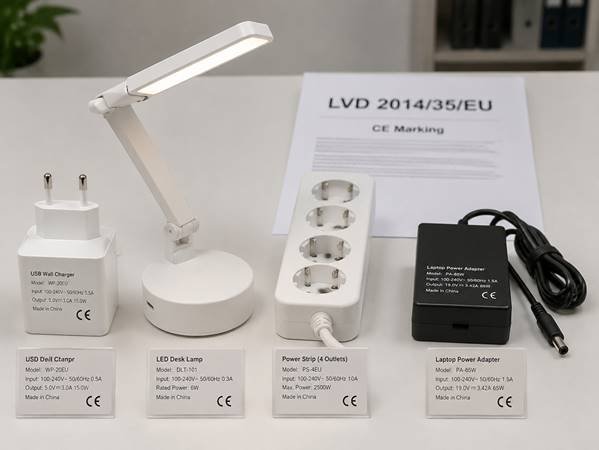
Note: Extra-low voltage equipment below AC 50V/DC 75V does not fall into the exclusion category of LVD Annex II, but is not subject to LVD because it does not fall within the applicable voltage range of LVD, but may still be subject to other EU regulations.
4. How to Judge Boundary Products? 4 Common Ambiguous Scenarios
In reality, many products are ambiguous, such as those with adapters or batteries. Such boundary products can be judged according to the following rules:
• Products with external power adapters: The adapter itself must be judged separately under LVD, but the compliance of the adapter does not mean the compliance of the whole machine — the overall safety when the product and adapter are used in combination (such as current matching, overheating risk) still needs to be evaluated separately, and the compliance conclusion of the adapter alone cannot be directly applied.
• Battery products: Pure low-voltage battery products (such as the main body of a DC 5V power bank, with both input and output at 5V) are not subject to LVD; products with mains charging input are judged according to the input voltage; products with internal high-voltage batteries or inverter circuits (such as outdoor power supplies that can output 220V) need to be comprehensively judged in combination with the risk exposure of internal high voltage, designed usage methods and corresponding product standards.
• Mechatronic products: The electrical safety risks of mechanical equipment are usually covered by the Machinery Directive (MD). Risks already covered by machinery regulations will not be repeatedly assessed under LVD. Applicable requirements not covered still need to be identified separately, and the overall conformity assessment shall be carried out in accordance with the requirements of the Machinery Directive.
• Semi-finished products/spare parts: Only spare parts that form a complete functional unit and can be independently connected to a power supply (such as an independent 220V power module) need to comply with LVD separately; ordinary parts that cannot work independently, such as resistors and capacitors, do not need to undergo LVD separately.
5. Division of Responsibilities with Other CE Regulations
LVD only manages electrical safety, and has a parallel or partially mutually exclusive relationship with other common CE regulations. Do not confuse them:
• EMC (Electromagnetic Compatibility) Directive: Governs electromagnetic interference and immunity (for example, whether the product will interfere with radios, or whether it will malfunction due to electromagnetic interference). It applies in parallel with LVD and does not include each other — as long as the product falls within the scope of both directives, it must meet both requirements.
• RED (Radio Equipment) Directive: Covers electrical safety, spectrum and electromagnetic compatibility requirements for wireless products. Products with wireless functions such as WiFi and Bluetooth, as long as they meet the scope of application of RED, usually no longer undergo separate LVD conformity assessment, and electrical safety requirements can be implemented under the RED framework; but manufacturers still need to identify other potentially applicable requirements.
• MD (Machinery) Directive: Covers the overall safety of mechanical products (including electrical safety). The electrical safety of powered mechanical equipment is handled under the framework of the Machinery Directive, and LVD conformity assessment procedures are not repeated.
• GPSR (General Product Safety Regulation): It is the EU’s fallback regulation for product safety, playing a supplementary role within the scope of product safety risks not covered by specialized regulations. Even if the product is subject to LVD, it is necessary to confirm whether there are safety risks not covered by specialized regulations that need to be regulated by GPSR, and there is no problem of duplicate application.
3. Core Safety Requirements of LVD: Matched by Risk, Not One-Size-Fits-All
Many people think that LVD has a unified checklist that all products must check against item by item, but that is not the case — the core of LVD is “requirements matched by risk”. The higher the risk and the harsher the use environment, the stricter the requirements. Ordinary low-risk products do not need to meet all clauses.
1. General Principle: Protection First, Covering Foreseeable Risks
For all products subject to LVD, safety requirements must cover three types of scenarios, and the specific determination shall be implemented in combination with risk assessment and corresponding harmonized standards:
1. Normal use: Conventional operation scenarios in accordance with the product manual and marking instructions.
2. Reasonably foreseeable misuse: Operations that the user does not intentionally violate the rules, but may occur due to negligence (such as accidentally spilling water on the product, plugging in the wrong voltage), which is not the same as arbitrary malicious abuse.
3. Single fault: A situation where a protective measure or component fails, and at this time, unacceptable hazards must still not occur (for example, damage to the insulation layer must not cause electric shock to the user).
No matter what type of product, it must follow the same protection priority:
Intrinsic safety design > Protective measures > Warning markings
That is to say, the best safety is to eliminate hazards from the root of the design (for example, completely enclose live parts in an insulating shell so that people cannot touch them at all); the second is to add protective structures (such as grounding, adding insulating sleeves); the last is to affix warning labels — you must never use “I have affixed a warning” to replace design protection. For example, if a product is obviously prone to electric shock, only affixing a “Do not touch” label is not compliant.
2. General Core Safety Risk Categories
• Electric shock prevention and insulation protection: The core is to prevent users from coming into contact with dangerous live parts. There are three common protection logics — basic insulation (wrapping a layer of basic insulation around live parts), grounding protection (in case insulation fails, electricity flows along the ground wire and will not shock people), double/reinforced insulation (two layers of independent insulation or one layer of thickened insulation, safe without grounding). The distance between insulations (that is, creepage distance and clearance in professional terms) is not fixed, but is determined by the working voltage, pollution degree, and use environment. For example, electrical appliances in the bathroom require larger insulation distances than those in the living room. The pollution degree here can be simply understood as the degree of influence of dust, moisture, and conductive pollutants in the equipment’s use environment on insulation performance; the more serious the pollution, the easier it is to form a conductive path on the insulation surface, so the required insulation distance and protection requirements are usually higher.
• Overheating and fire protection: The core is to avoid fire and scalding risks caused by overheating or short circuit of the product. Common requirements include: overload and short circuit protection (such as fuses, which automatically cut off power when the current is too large); the temperature of accessible parts must not be too high to scald people; internal combustible materials must be flame retardant, so that if a fire breaks out, it cannot spread quickly.
• Electrical-related mechanical structure safety: Only manages mechanical structure requirements directly related to electrical safety, for example, the shell must have sufficient strength and must not break to expose live parts after falling or impact; wiring terminals must be firm and must not loosen and cause ignition due to vibration or thermal expansion and contraction. Note: Pure mechanical performance (such as how much weight the product can bear) is not within the regulatory scope of LVD.
3. Scenario-Based Requirements: Only Required for Corresponding Products
The following requirements do not need to be met by all products, only when the product has corresponding risks or usage scenarios:
• Abnormal and single fault protection: When faults such as short circuit and overload occur, the product must still remain safe and must not cause electric shock or fire; there are also residual hazards after power failure, such as capacitor discharge — products with large capacitors will still be live for a period of time after power failure, and discharge treatment must be done to prevent users from getting an electric shock when touching the inside after unplugging. The specific requirements depend on the product risk assessment.
• Environmental tolerance requirements: For example, outdoor products must meet the corresponding dustproof and waterproof (IP) rating, bathroom products must be moisture-resistant, cold storage products must be low-temperature resistant, and ordinary indoor electrical appliances do not need to meet these requirements.
• Specific hazard protection: For example, products with lasers must protect against laser radiation, and products with high-voltage large capacitors must protect against dangerous energy. These are only required when the product contains corresponding risks, and ordinary products such as power strips and desk lamps do not need to be considered.
4. Markings and Instructions: Easily Overlooked Mandatory Requirements
Markings and instructions are mandatory requirements of LVD. Many products fail random inspections because of this, but the specific marking content needs to be determined according to the product type and applicable regulations, and is not exactly the same for all products:
• Product markings: Usually, basic information such as rated voltage, rated power, brand model, manufacturer name/address needs to be marked. Products with corresponding risks also need to be affixed with necessary warning symbols (such as “For indoor use only”). Note: The CE mark is a unified mark that can only be affixed after completing the conformity assessment of all applicable EU regulations, and is not a requirement unique to LVD. You cannot affix the CE mark only after completing the LVD assessment.
• Instruction requirements: The safe use methods, taboos, and installation requirements must be clearly written, and must be in the official language of the member state of sale — for example, products sold in France must have French instructions, and products sold in Poland must have Polish instructions. Only providing English is non-compliant.
4. Full Compliance Implementation Process: Steps from Assessment to CE Affixation
LVD is a self-declaration type directive, which does not require mandatory certification by EU official institutions, but this does not mean “you can just say it casually” — you need to complete all compliance actions in accordance with the process, keep complete documents, and bear corresponding legal responsibilities.
1. Conformity Assessment: Mainly Self-Declaration, No Mandatory Certification Required
The default conformity assessment procedure of LVD is “internal production control” in Annex IV, which in plain terms means that the manufacturer is responsible for the product’s compliance: you can do the testing yourself, compile the documents yourself, and declare compliance with the requirements yourself, without needing to find an EU Notified Body (NB, i.e. a third-party conformity assessment body officially recognized by the EU) for mandatory certification.
Of course, you can also voluntarily entrust a third-party institution to conduct testing or review, but even if you find a third party, the final compliance responsibility is still borne by the manufacturer — the third-party report can only prove the test situation of the submitted sample, and cannot be directly equated with a compliance certificate. The core of compliance is not only that the sample is qualified, but also that the mass-produced products are consistent with the compliant design.
2. Presumption of Conformity Rules for Harmonized Standards
You may often hear the terms “EN standards” and “harmonized standards”. Harmonized standards are European standards developed by European standardization bodies, confirmed by the European Commission and published in the Official Journal of the European Union (OJEU). Products that comply with harmonized standards can enjoy the legal effect of “presumed to comply with LVD requirements” for the basic safety requirements covered by the standards.
Three-Step Verification Method for Harmonized Standards
When selecting harmonized standards, you must check the following points in order, and you cannot just find a standard with the same name and use it:
1. Step 1: Check the inclusion status in OJEU: Confirm whether the EN standard is in the current valid published list of the Official Journal of the European Union (OJEU). Only officially included harmonized standards have the effect of presumption of conformity.
2. Step 2: Check the version and transition period: Verify whether the standard version is valid, whether it has been replaced by a new version, and whether the OJEU lists the withdrawal date; the period before the withdrawal date is usually the transition period. Old versions of standards may still be used to presume compliance with LVD requirements within their coverage. Continuing to cite the old version after the transition period will weaken or lose the presumption of conformity effect, and you need to switch to the new version or prove compliance through other methods such as risk assessment. The specific effect shall be subject to the official information published in the OJEU.
3. Step 3: Verify the scope of application and coverage boundaries: Confirm that the applicable product types and usage scenarios of the standard match your own product, and at the same time clarify which basic requirements of LVD are covered by the standard. Uncovered risks still need to be assessed separately.
Alternative Path Without Using Harmonized Standards
Manufacturers can also choose not to use harmonized standards, and form a complete technical evidence chain through risk assessment, design calculation, type testing, expert demonstration and other methods to prove that the product meets the basic requirements of LVD. However, this method does not have the effect of presumption of conformity, has higher requirements for the burden of proof and technical documentation, and requires more sufficient demonstration materials to be provided during regulatory random inspections.
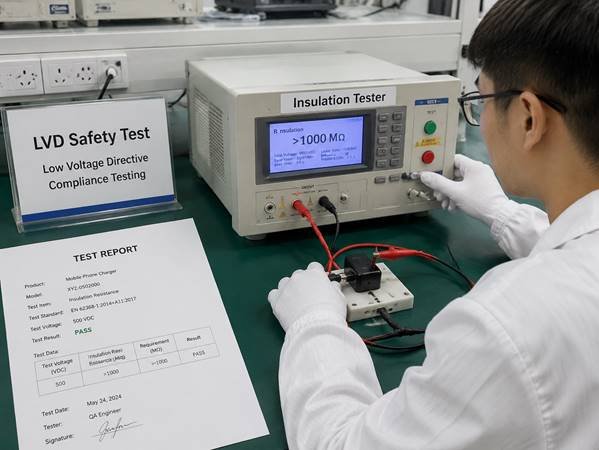
3. Complete the Full Compliance Process in 5 Steps
The compliance process of LVD is not complicated, just follow the order. Note that it must cover all applicable EU regulations at the same time, not just LVD:
1. Confirm the scope of applicable regulations: According to the 5-step judgment method above, confirm whether the product is subject to LVD, and at the same time sort out all applicable EU regulations and form a list.
2. Identify risks and select harmonized standards: Sort out all safety risks of the product, find matching harmonized standards, and confirm the validity and coverage of the standards.
3. Sample testing and production consistency control: Complete sample testing in accordance with standard requirements, and at the same time formulate a production consistency control plan — it is not enough that only the submitted sample is qualified, mass-produced products must also be consistent with the sample.
4. Prepare technical documentation and declaration of conformity: Organize all compliance materials to form complete technical documentation, and at the same time sign the EU Declaration of Conformity (DoC), which is the legal document in which you formally declare that the product complies with all applicable regulations.
5. Affix the CE mark and post-market maintenance: Affix the CE mark as required. After the product is launched on the market, it is necessary to continuously monitor safety, recall in time if there are problems, and re-evaluate compliance when designs or components are changed.
4. Required Documents and Affixation Rules
Compliance documents are the core of responding to regulatory random inspections and must be fully prepared:
• Core components of technical documentation: Product description and model difference description, electrical schematic/structural diagram and list of key components, risk assessment report, list of applicable standards and conformity, test report (must include test conditions and sample configuration), production consistency control procedure, label and instruction draft, change record.
• Core elements of the EU Declaration of Conformity (DoC): As a legal document independent of technical documentation, the DoC usually needs to include the following: manufacturer’s name and contact address, unique identification information such as product model/series, list of all EU regulations that the declaration complies with, harmonized standards adopted or other technical specifications proving compliance, name, position and signature of the signatory, place and date of signing. During regulatory random inspections, the DoC must be provided together with the technical documentation.
• Retention rules: From the date when the last product is placed on the EU market, it shall be kept for at least 10 years, and the manufacturer or EU authorized representative shall be responsible for keeping it.
• Language requirements: Technical documentation needs to be in a language understandable to the competent authority of the target member state, and a translation version meeting the requirements must be provided when required by the competent authority; instructions and safety warnings must be in the official language of the member state of sale.
• CE mark affixation rules: The mark shall be at least 5mm in height, clearly legible and not easily erased, and shall be affixed to the product body first; if it cannot be reasonably affixed due to the nature or size of the product, it can be affixed to the packaging, accompanying documents or data labels in accordance with regulatory requirements.
5. Supply Chain Responsibilities: Who Pays for Compliance
The compliance responsibility of LVD does not only fall on the manufacturer. Each role in the supply chain has corresponding legal obligations, and if problems arise, they will be held accountable according to their responsibilities.
1. Responsibilities of the Three Core Parties
• Manufacturer (first responsible party): Must ensure that product design and production meet requirements, complete risk assessment and testing, prepare technical documentation and DoC, affix the CE mark, be responsible for post-market monitoring and recall, and bear the core responsibility for product compliance.
• EU-based responsible entity and authorized representative: When a non-EU manufacturer places LVD products on the EU market, it must ensure that there is a responsible entity in the EU that can be directly contacted by the market supervision authority. The specific role may be an EU importer, an EU authorized representative, or other economic operators that comply with EU market supervision rules.
If the manufacturer formally appoints an EU authorized representative, its responsibilities are limited to the authorization letter and regulatory requirements. The core obligations include: keeping product technical documentation and EU Declaration of Conformity (DoC), providing compliance materials in a timely manner as required by the supervision authority, cooperating with regulatory verification and reporting safety risks as required, assisting in correcting non-compliant matters, etc.
The authorized representative will not automatically bear all the compliance responsibilities of the manufacturer (for example, the safety responsibility of the product design itself is still borne by the manufacturer), but if it fails to perform the statutory or agreed entrusted obligations, it shall bear corresponding legal responsibilities.
• EU importer: A merchant that imports products into the EU. Before entering the market, it must verify that: the manufacturer has completed the conformity assessment, the technical documentation and DoC are readily available, and the CE mark and the identification information of the manufacturer/importer are complete and compliant. The importer may only affix its own name, contact address and other identification information within the scope permitted by regulations, and shall not replace the manufacturer’s information or arbitrarily modify product markings; if it finds that the product has safety risks, it must immediately take measures such as stopping sales and reporting, and cooperate with supervision and recall.
2. Responsibilities of Dealers/Distributors
Dealers do not bear the main design and production responsibilities, but they must also fulfill basic obligations: they cannot sell obviously non-compliant products without the CE mark and with incomplete information; they must keep product markings and packaging intact and cannot arbitrarily modify products; if they find safety problems, they must immediately stop sales and cooperate with the manufacturer or regulatory department for traceability.
3. Division of Responsibilities in Special Situations
The responsibilities in some ambiguous scenarios are easy to confuse, and can be judged according to the following rules:
• Private label OEM sales: If you find a factory to do OEM and sell under your own brand, then you are regarded as the manufacturer and must bear all compliance responsibilities, and cannot shift the responsibility to the OEM factory.
• Modification of product electrical structure/rated parameters: If you modify the electrical design, rated voltage or power of the product, the modifying party must re-evaluate compliance and bear corresponding responsibilities.
• Only repackaging/relabeling: If you only change the packaging and affix labels without changing the product itself or the original compliance information, the main responsibility is still the original manufacturer, but the packaging party must ensure that the information is complete and accurate. However, if the repackaging party sells under its own brand, changes the product structure or compliance information (such as modifying parameters, replacing instructions) and affects compliance, or places the product on the market under its own name/trademark, it will be regarded as the manufacturer and bear all compliance responsibilities.
6. Common Misconceptions and Regulatory Response
1. 6 Most Common Cognitive Misconceptions
• Misconception 1: All powered products need LVD → Wrong. It must be checked according to the 5-step judgment method. It only applies if it meets the voltage requirements, is not in the exclusion scope, and has no other specialized regulations covering electrical safety.
• Misconception 2: CE is an official certification issued by the EU → Wrong. CE is the manufacturer’s self-declaration, and LVD has no mandatory official certification requirement. See Section 3 of Chapter 1 for details.
• Misconception 3: Having a third-party test report means compliance → Wrong. The report only proves the situation of the submitted sample. Batch consistency and complete technical documentation are the core. See Section 1 of Chapter 4 for details.
• Misconception 4: Passing LVD means you can sell across the EU → Wrong. LVD is only one of the CE applicable regulations. You need to meet all applicable regulations to legally affix the CE mark (see Section 3 of Chapter 1 for details).
• Misconception 5: Products below the lower voltage limit are completely unregulated → Wrong. Extra-low voltage products may still need to meet other EU regulatory requirements, and are not completely unregulated.
• Misconception 6: Complying with harmonized standards means 100% compliance → Wrong. Harmonized standards only have presumption effect on the content they cover, and uncovered risks still need to be assessed and handled by yourself.
2. 5 Common Pitfalls in Practice
• Pitfall 1: Adapter compliance = whole machine compliance: For specific judgment rules, see the boundary product description in Chapter 2. In practice, it is necessary to focus on checking whether the output voltage/current matching, temperature rise, polarity, connector compatibility and instruction guidance between the adapter and the whole machine are consistent, and the separate compliance conclusion of the adapter cannot be directly applied.
• Pitfall 2: Randomly selecting harmonized standards: You must check the current valid list of OJEU, pay attention to the version, transition period, and scope of application of the standard. Using an expired standard is equivalent to not using it.
• Pitfall 3: Technical documentation only in English is enough: The instructions must be in the official language of the country of sale, and the technical documentation must also be understandable to the local regulatory authority. A corresponding translation must be provided when required by the regulator.
• Pitfall 4: Not updating documents when key designs/components are changed: For example, replacing key capacitors or modifying the circuit structure may affect safety. Compliance must be re-evaluated and technical documentation updated, otherwise the original compliance conclusion will be invalid.
• Pitfall 5: It’s okay to stick the CE mark on the packaging: It should be affixed to the product body first. Only when the product cannot be reasonably affixed due to its nature or size can it be affixed to the packaging and instructions in accordance with regulatory requirements.
3. EU Regulatory Random Inspections: What is Checked and How to Respond
EU market supervision authorities carry out regular random inspections on products on sale, and products sold on e-commerce platforms are also one of the key targets of random inspections. The key points of random inspections are generally: whether the CE mark is standardized, whether the technical documentation is complete, whether electric shock prevention and markings are compliant, and whether the instructions are in the local language.
If non-compliance is found, the market supervision authorities of member states may take measures such as rectification, suspension of sales, recall, withdrawal from the market, restriction or prohibition of placing on the market according to the nature and severity of the violation, and may impose corresponding penalties in accordance with the domestic laws of the member state.
The core of response is actually very simple: prepare complete compliance documents in advance, ensure that mass-produced products are consistent with test samples, all design and component changes must be recorded, and evidence can be produced in a timely manner during random inspections.
7. Practical Tools and Typical Cases
1. LVD Applicability Quick Decision Chain
You can use this simplified judgment chain to quickly screen whether a product is subject to LVD. Note that regardless of the result, you must complete the identification of other regulations:
“Electrical equipment? → Yes → Voltage between AC 50-1000V/DC 75-1500V? → Yes → Not in the LVD Annex II exclusion list? → Yes → No other specialized regulations covering electrical safety? → Yes → Subject to LVD”
If the answer to any of the above links is “No”, LVD does not apply, but it is still necessary to further identify other applicable EU regulations to form a complete compliance list, and other compliance requirements cannot be ignored just because LVD does not apply.
2. Compliance Cases of 2 Typical Products
Case 1: Mobile phone charger with 220V AC input and 5V DC output
• Scope judgment: The input voltage of 220V is within the applicable range of LVD, it is a general power supply, there are no exclusion situations, and no other specialized regulations cover electrical safety → subject to LVD
• Applicable regulations (example): LVD + EMC Directive + RoHS Directive (need to confirm whether there are other applicable regulations according to the specific attributes of the product)
• Applicable harmonized standards (example): EN 62368-1 (IT/audio-visual equipment safety standard) can be referred to. The specific selection shall be based on the function, structure, rated parameters and sales configuration of the charger, and the current publication status, version validity and scope of application on the OJEU shall be verified
• Core test points (example): Electric shock prevention, insulation withstand voltage, overheating, short circuit protection, markings
• Division of responsibilities: The manufacturer bears the main responsibility, and the EU importer verifies compliance documents and markings before entering the market.
Case 2: 5V USB-powered desk lamp (with 220V external power adapter)
• Scope judgment: The working voltage of the desk lamp body is DC 5V, which is lower than the lower limit of LVD → not subject to LVD; the adapter input is 220V → subject to LVD; the whole machine combination needs to be evaluated for other applicable regulations such as electromagnetic compatibility
• Applicable regulations (example): The adapter needs to be assessed for LVD, EMC, RoHS, etc.; the desk lamp body still needs to identify applicable requirements such as EMC, RoHS, and photobiological safety according to its electronic functions, materials and sales configuration
• Applicable standards (example): EN 62368-1 can be referred to for the adapter (need to verify OJEU validity), and the desk lamp shall select corresponding standards such as photobiological safety according to risks
• Points to note: When sold as a set, the matching between the adapter and the desk lamp must be verified, including output current margin, connector mis-insertion prevention design, and temperature rise risk during combined use. At the same time, ensure that the compliance documents and markings of all components in the set are unified and complete
• Division of responsibilities: If sold as a set, the seller must ensure that all components are compliant and bear overall responsibility.
3. Entry-Level Compliance Self-Check List
You can use this list for basic LVD compliance self-check:
□ Have confirmed whether the product is subject to LVD according to the decision chain
□ Have identified all applicable EU regulations
□ The selected harmonized standards are in the current valid list of OJEU and match the product
□ The product nameplate contains necessary information such as rated parameters, brand and model, and the CE mark complies with specifications
□ Instructions and safety warnings are in the official language of the member state of sale
□ Technical documentation and DoC are complete and kept as required
□ Mass production is consistent with test samples, and changes are recorded
Summary
When judging the applicability of LVD, you should start with the voltage range and exclusion conditions, then identify other applicable regulations, and finally prove that product risks have been effectively controlled through complete technical documentation. The core logic of LVD is to match safety requirements based on risk, and the manufacturer bears the primary compliance responsibility — as long as safety design is put in front, complete compliance documents are kept, and mass-produced products are consistent with the compliant design, you can effectively respond to market supervision random inspections and reduce compliance risks.