
If you have ever bought wall-plug chargers or laptop power adapters in Canada, you have most likely seen the CSA or cUL mark on the bottom of the product or its packaging. Many people think this is just a mark of “excellent quality”, and some even mistake the U.S. UL mark for a universally accepted mark in Canada. As a result, they either buy non-compliant products that pose safety hazards, or small business owners have their goods detained by customs when restocking. This article will thoroughly explain the rules for CSA/cUL marks, focusing on chargers, charging cables, and related charging electronic products in the Canadian market. It is directly applicable for both ordinary consumers making purchases and small merchants conducting self-inspection when restocking.
Getting Started: What Exactly Are CSA/cUL?
First, a plain-language definition: both CSA and cUL are “charging product safety compliance certificates” issued by third-party organizations officially recognized by Canada. They are not “self-praising marks” printed by manufacturers themselves, nor are they certificates issued directly by the government. Instead, they are authorized marks that can only be used after a product has passed a series of electrical safety tests covering insulation, temperature rise, short circuits, and more, conducted by a third-party organization. Before such charging products with AC plugs can be publicly sold in Canada, they usually must obtain safety certification recognized by the province/territory; CSA and cUL are currently among the most common and widely recognized compliance marks.
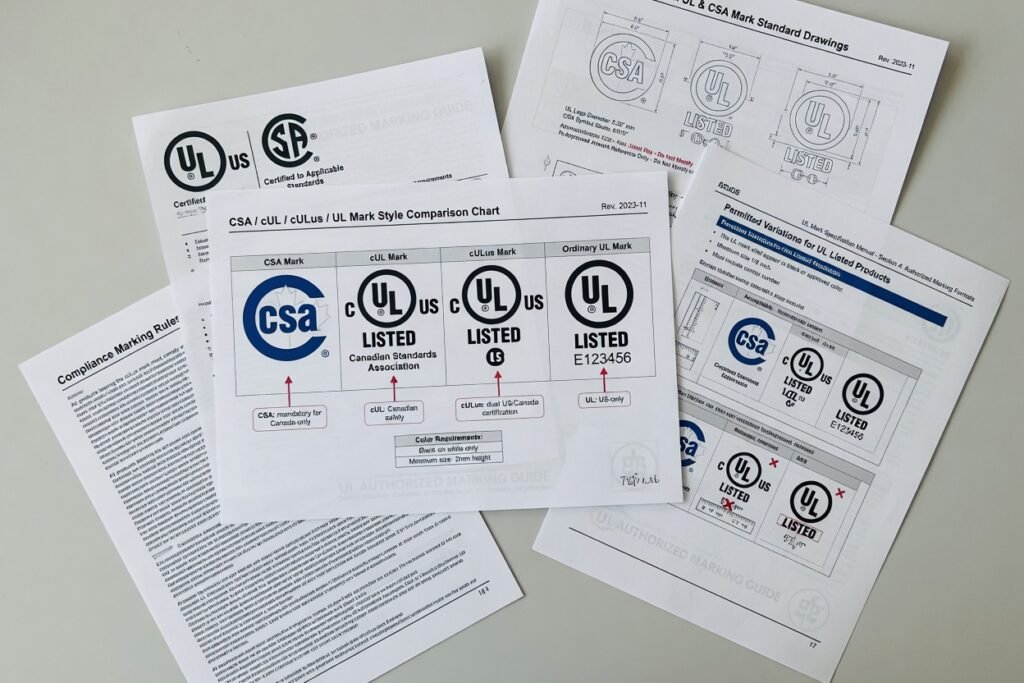
Many people cannot tell CSA and cUL apart when they first encounter them, and some even think one is Canadian and the other is American. In fact, the two have exactly the same legal effect in Canada, but differ in their certification systems. We can quickly clarify them with a simple comparison table:
| Comparison Item | CSA Mark | cUL Mark |
| Certification System | CSA Group (CSA certification system) | cUL Listed mark issued by UL Solutions in accordance with Canadian standards |
| Core Appearance Features | CSA letters + exclusive “C” mark, mostly black-and-white circular or square shapes | Lowercase “c” prefix + UL mark, easily confused with U.S. UL marks |
| Official Verification Channel | Certified product list on CSA Group official website | UL Product iQ database |
| Legal Effect in Canada | Fully valid (recognized by the Standards Council of Canada, SCC) | Fully valid (recognized by the Standards Council of Canada, SCC) |
A key point to emphasize: the Standards Council of Canada (SCC) is the official body responsible for assessing the technical competence of certification bodies. Both the Canadian certification systems of CSA Group and UL Solutions are recognized by the SCC, so their compliance validity is equivalent. There is no such claim that “CSA is more authoritative than cUL”.
In addition to the Canada-only CSA C and cUL marks, there is also a dual-country North American mark, such as CSA C-US and cULus, which are marked with both “US” (representing the United States) and “C”/”c” (representing Canada). These marks are valid in both the U.S. and Canada, and are very common on cross-border sold charging products.
The most common misconception is: the ordinary UL mark without the lowercase “c” prefix only applies to the United States and is completely unrecognized in Canada. Even if a merchant claims it “supports Canadian 120V voltage”, it is useless—voltage compatibility is only a basic requirement and does not mean the product has passed Canadian safety tests.
Limits of the Mark’s Function
Many people overestimate the role of the CSA/cUL mark, so here is a clear boundary:
It only proves one thing: this product has passed the corresponding electrical safety tests in accordance with applicable standards, and safety items such as insulation, temperature rise, and short-circuit/fault protection meet the requirements under normal and abnormal test conditions specified in the standards, upholding the basic bottom line of electrical safety.
It does not prove faster charging speed, longer service life, or higher quality grade—these performance and quality dimensions are separate from safety certification.
It also cannot replace you in doing these things: checking whether the charger’s power matches your device, checking whether the plug fits into Canadian wall sockets, and using the product normally according to the manual (for example, do not immerse the charger in water).
Connection to Canadian Safety Regulations
Electrical safety in Canada is regulated by each province. All provinces refer to the Canadian Electrical Code (CEC)—the national baseline rule for electrical safety—which requires electrical products to pass certification before being placed on the market. Simply put: regulations put forward the requirement of “being safe”, standards provide the evaluation basis for “what counts as safe”, and the CSA/cUL mark is a visual proof of “I have met the standards”. The mandatory requirements for charging products are enforced by the electrical safety departments of each province. As for whether a specific certification mark is recognized, it shall be subject to the list of certification bodies and applicable product standards published by the electrical safety regulatory authority of the province/territory where the product is sold.
Which Charging Products Require a CSA/cUL Mark?
Not all charging-related products need this mark. We will explain them in three categories according to the degree of mandatory requirement:
Charging Products That Mandatorily Require the Mark
Such charging products with AC input and built-in power conversion functions usually must obtain electrical safety certification recognized by the selling province/territory before public sale in Canada, and CSA/cUL are among the common and widely recognized marks; the specific recognized marks are still subject to the list published by local regulatory authorities. Since these products convert household 120V high-voltage alternating current into low-voltage direct current that devices can use, problems can easily cause electric shock or fire, so regulatory requirements are relatively strict. Specific products include: ordinary wall-plug chargers, laptop power adapters, multi-port USB fast chargers; wall sockets with charging function (such as wall sockets with built-in USB ports), wireless charging bases with AC input; integrated charging products with built-in power conversion modules, such as portable charging stations with plugs.
Charging Products That Are Non-Mandatory or Situation-Dependent
Pure charging cables and data cables: as long as they do not have power conversion functions such as voltage transformation and rectification (i.e., ordinary power transmission cables with no active circuits inside), they generally do not require a CSA/cUL mark on the whole product;
Car chargers: since they use 12V low-voltage input (drawing power from a car’s cigarette lighter) and are not high-voltage AC products, whether they are mandatory depends on the specific regulations of the province where they are sold;
Key internal components such as charging interfaces and power chips: they are usually reviewed as part of the whole-product certification, and some components can apply for component recognition separately; however, component recognition cannot replace the whole-product Listed certification of finished products, so there is no need to affix a whole-product level CSA/cUL mark on the outer casing of finished products.
Compliance Differences Across Sales Scenarios
If sold publicly in Canadian physical stores or on mainstream e-commerce platforms, the above-mentioned mandatory products must bear the mark, otherwise they cannot be listed for sale;
For enterprises importing and distributing in bulk, Canada Customs and regulatory authorities will check whether the product mark matches the certification information. If they do not match, it may affect customs clearance;
For personal overseas shopping for self-use, generally small quantities of products will not be specifically inspected for certification, but if a safety problem occurs, the responsibility shall be borne by the individual, and insurance companies may also refuse compensation on the grounds of non-compliant products.
What Does a Compliant Mark Look Like? Where Is It Printed?
Many people see a similar mark when shopping and think it is compliant, but that is not the case. Compliant CSA/cUL marks have clear traceability requirements, and there are also specifications for where they are printed.
Core Criteria for Judging Compliant Marks
The core of judging whether a mark is compliant is “traceability”: a compliant mark shall include the official certification mark, and can clearly correspond to the product model and unique certification number, file number, or control number on the product body nameplate or the smallest packaging/attached materials permitted by the rules; if a clear corresponding relationship cannot be established between the three, it shall not be used as a compliant mark. If there is only a large logo, no clues of model or number can be found, the pattern is deformed, or the printing is blurry, it can basically be judged as non-compliant. Usually, the mark is placed in the same conspicuous position as the product’s input and output parameters and manufacturer information, so that users can check it conveniently.
Appearance Features of the Two Main Types of Marks
The core of the CSA mark is the three letters CSA plus the Canadian-exclusive “C” mark, mostly in black-and-white circular or square shapes;
The core of the cUL mark is the lowercase “c” prefix plus the UL mark. Be sure to check if there is a small c to the left of UL; if not, it is the U.S. version and is not recognized in Canada;
Dual-country marks will be marked with both “US” and “C”/”c”, and it is easy to tell at a glance that they are North America-wide.
Common Mark Locations for Different Charging Products
When looking for the mark, you can prioritize checking these places:
Chargers and power adapters: usually on the nameplate at the bottom, or on the permanent label on the side, and some are laser-engraved on the contact surface of the plug;
Ordinary passive charging cables/data cables generally do not require a whole-product CSA/cUL mark; for cable products with active circuits and power conversion functions, or for which manufacturers have voluntarily obtained cable safety certification, the mark is commonly laser-engraved on the plastic part of the connector, and for thicker cables, it may also be printed on the cable body area that is not easy to wear;
Wall sockets with charging function: usually on the side of the prongs or the nameplate on the front, and sometimes printed together with the plug’s safety mark.
Location Exception for Small-Sized Products
For particularly small charging products, such as mini fast chargers or connectors of thin-diameter charging cables, where the body is too small to print the mark, it is allowed to print the mark on the smallest sales packaging, but the product body must have a traceable model, such as a laser-engraved model abbreviation. It should be noted that the mark cannot only be attached to places that can be torn off easily, such as temporary protective films or outer plastic wraps—such marks are not valid.
You Can’t Just Stick It On: Four Core Prerequisites for Mark Usage
Many merchants violate the rules because they do not understand that the CSA/cUL mark cannot be printed and pasted casually. It must meet several hard conditions, otherwise even if it is pasted, it is non-compliant.
The first prerequisite: the mark must correspond to a specific certified model. That is to say, only the model that has actually passed the test can use this mark. Different models of the same series, even if they look exactly the same, cannot share the same mark as long as their power, interfaces, or plugs are different. For example, if a 20W fast charger has passed certification, but a 65W model with the same appearance has not been tested, the 20W mark cannot be pasted on the 65W product. Even if the appearance is the same, but the internal circuit and key safety components (such as fuses and transformers) are different, the mark cannot be borrowed.
Many people ask whether private labeling or changing factories will affect the validity of certification—in fact, changing the brand owner (private labeling) or changing the production factory itself will not directly invalidate the certification. The core judgment criterion is whether the product’s structural design, key safety components, model, and rated parameters are completely consistent with the sample during certification: if only the production factory or brand logo is changed, and the core configuration and model remain unchanged, the certification and corresponding mark can continue to be used; but if the internal circuit, component selection, or parameters are adjusted while changing the factory, even if the appearance and model remain unchanged, the original certification mark can no longer be used, and a new test application must be submitted.
The second prerequisite: all parameters of the product must be within the scope of certification coverage. Not only must the model be correct, but parameters such as input voltage, output power, current, and charging gears must not exceed the scope during certification. Especially for multi-port USB-C fast chargers, it is necessary to check not only the maximum output of a single port, but also the combined output when multiple ports are used at the same time. As long as one item exceeds the scope, even if the mark is pasted, it is non-compliant.
The third prerequisite: if the product structure changes, the certification must be reconfirmed. If the外壳, heat dissipation structure, plug, or interface (for example, changing USB-A to USB-C) is modified, or key safety components are replaced, certification must be re-conducted before the mark can continue to be used. Only minor appearance adjustments that do not affect safety, such as changing the color or modifying the silk-screen pattern, can continue to use the original certification. After the product is upgraded and revised, the old version of the certification mark cannot continue to be used.
The fourth prerequisite: it must be whole-product Listed certification. Here we need to distinguish between two easily confused certification levels: Listed (whole-product listing) is a certification level where the finished product has passed complete safety tests and can be sold directly to ordinary consumers. The marks of compliant products we usually refer to are of this type; Recognized (component recognition) only targets internal parts of the product, such as power chips and fuses, proving that the parts themselves meet safety requirements, but does not mean that the whole product assembled from these parts can pass safety tests. Many merchants use “internal components with cUL certification” to mislead people. In fact, component certification does not mean the whole product is compliant. Finished products must have whole-product Listed certification before the corresponding mark can be affixed.
Mark Usage Requirements for Different Scenarios
There are not only requirements for pasting the mark on the product, but also rules for using it on packaging, manuals, and e-commerce pages, and it cannot be used indiscriminately.
The requirements for the product body are the strictest: the mark must be made by processes that are not easy to wear, such as permanent printing, laser engraving, or molding. Its size must ensure clear recognition under normal viewing angle; there is no unified millimeter-level size requirement, but it cannot be so small that it is invisible. Temporary stickers, removable or easily peelable labels cannot be used; if a label form is used, it shall also be a permanent label that meets durability requirements, and labels that can be torn off easily are not valid.
The prerequisite for use on packaging and manuals is that the product body has already obtained certification: only after the product has passed certification can the corresponding mark be printed on the outer packaging and manuals. The mark information on the packaging must be completely consistent with the product’s certification information, and the coverage scope cannot be exaggerated—for example, if there is only Canada-only certification, the dual-country mark cannot be printed. In addition, the mark cannot be more conspicuous than the brand mark, to avoid consumers mistaking it for the brand’s logo.
There are also clear requirements for use on online e-commerce pages: if a picture of the mark is displayed on the detail page, the corresponding certification number must be marked at the same time, and the number must completely match the model being sold. If multiple models are sold in the same link (for example, the same link has 20W, 45W, and 65W fast chargers), the certification status of each model must be marked separately, and one certification picture cannot be used for the entire page. It is even more forbidden to forge marks through photo editing, or use phrases such as “supports Canadian voltage” to imply that the product has passed certification—voltage compatibility and safety certification are completely different things.
Beginner-Friendly: 4 Steps to Verify Mark Authenticity and Compliance
Whether you are an ordinary consumer buying a charger or a small merchant restocking, you can use these 4 steps to quickly judge whether the mark is compliant, without needing professional knowledge.
Step 1: First check the appearance and process to filter out 80% of fake marks. First check completeness: is the mark’s pattern clear, is the proportion correct, can clues of the corresponding product model and certification number/file number be found, to ensure traceability to the specific certification; be careful of any mark missing key clues. Then check firmness: gently scrape it with your fingernail to see if it comes off easily, whether it is printed/engraved or a temporary sticker, and whether it is printed on the plastic wrap—marks on plastic wrap are not valid. Finally, check the location: prioritize finding the mark on the product body. If it is only on the packaging, you should be vigilant, unless it is a particularly small mini product (and the body must have a traceable model).
Step 2: Check the consistency of the model and parameters. The model on the product body, packaging, and e-commerce detail page must be completely consistent. Even if there is only one suffix letter difference, it may not be the same certified model. Then check whether the charger’s input and output parameters, number of interfaces, and power gears match the information supporting the mark—for example, if it is marked as a 65W fast charger, but the maximum in the certification information is only 45W, there must be a problem. If the parameters are vague or lack key values (for example, only “fast charge” is written without specific power), the credibility of this mark is extremely low.
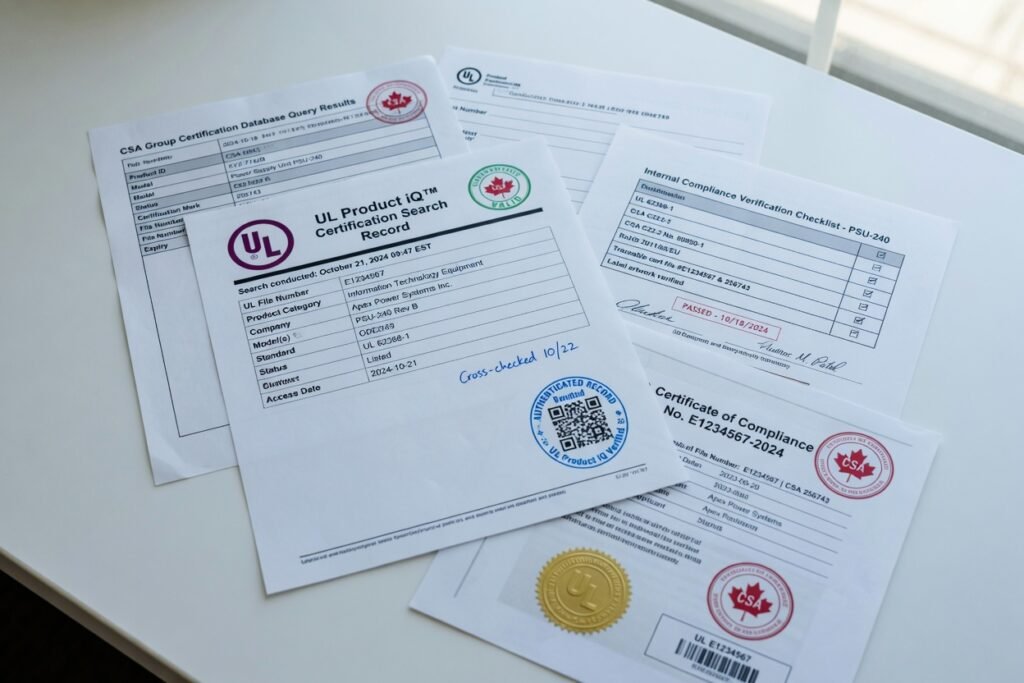
Step 3: Verify in the official database, and the authenticity will be known once checked. This is the most accurate method, and it is very simple to operate: if it is a CSA mark, go to the certified product list on the CSA Group official website and enter the model or certification number to search; if it is a cUL mark, go to the UL Product iQ database and enter the model or file number to search. When checking, three points need to be verified: whether the certification status is valid, and whether the model, manufacturer, and parameters completely match the product you bought. It should be noted that most consumer-grade charging products in recent years can be found; some very old products may not be fully entered into the online database, so not being found does not necessarily mean it is fake, but extra vigilance is required.
Step 4: Identify edge-case rhetoric and don’t be misled. Many merchants do not directly make fake marks, but use ambiguous words to mislead consumers. Common ones include the following: “meets CSA standards” ≠ “passed CSA certification”—the former is the manufacturer’s own claim of compliance with standards without third-party testing, while the latter has truly passed third-party certification; “globally universal” and “supports Canadian voltage” ≠ having Canadian compliance certification—voltage is only the basics, and only passing safety tests counts; “component-level certification” and “cUL-grade materials” ≠ whole product passed certification—good parts do not mean the assembled whole product is safe.
Advanced Pitfall Avoidance: Common Violations and Special Scenario Rules
If you are a small business merchant, or want to understand more deeply, this part of the content can help you avoid many pitfalls.
Common Violation Scenarios and Consequences
There are 5 most common mark violations in charging products: the first type is fake marks, which are printed privately by merchants with no corresponding certification at all, and the number cannot be found in the official database; the second type is out-of-scope use, where the certification mark of model A is used on model B, or the product’s parameters exceed the certification coverage scope; the third type is mark confusion, using marks from other regions such as U.S. UL (without the c prefix), CE, and FCC to pass them off as Canadian compliance marks. Note that CE is EU certification, and FCC is U.S. electromagnetic compatibility certification, neither of which can replace safety certification in Canada; the fourth type is level misuse, using Recognized (component recognition) marks to pass them off as Listed (whole-product listing) marks; the fifth type is missing marks, where mandatory products have no mark on the body and do not meet the exception conditions for small-sized products.
The risks of violating mark usage rules are very real in the Canadian market: if detected by Canada Customs at the entry stage, the goods may be detained, and you may be required to supplement certification materials or make rectifications. Losses from failure to clear customs smoothly are usually borne by the importer; if sampled and inspected by the electrical safety departments of each province in the market stage, you may be required to remove the products from shelves, recall them, or even pay fines, subject to local law enforcement rules; if an electrical safety accident occurs with the product, such as fire or injury, non-compliant products may have an adverse impact on liability determination, and insurance companies may also refuse compensation on the grounds that the product does not meet local safety requirements.
Ordinary users can directly verify according to the 4 steps above when purchasing, and small merchants can also save screenshots or records according to these 4 steps when reviewing restocked goods: confirm that the official database number is valid, the model is consistent across all channels, the parameters are within the certification coverage scope, and the body has a permanent mark.
Mark Rules for Special Scenarios
There are also several mark rules for special scenarios that many people cannot figure out:
The first is the requirement for charging kits (charger + charging cable): the charger in the kit is subject to mandatory certification. If the matching cable is a mandatory product with power conversion function, it must also be certified separately, and each shall bear the corresponding mark. The outer packaging of the kit can print both marks at the same time, but you cannot only print the charger’s mark and claim the whole kit is compliant. There is a common misconception here: many people think that if the charger is certified, the matching pure charging cable does not need to be checked for safety. In fact, although pure cables do not require a mandatory whole-product CSA/cUL mark, you should still check the cable’s rated current, interface specifications, supplier test reports, or corresponding cable certification materials. You cannot default that all accessories in the kit are safe just because the charger has CSA/cUL.
The second is the mark requirement after certification changes: here we need to distinguish and judge two situations: if it is only the renewal of the certification certificate upon expiration, and the product’s structure, parameters, and model are completely unchanged, and the certification body has not issued a mark style update notice, the original mark can continue to be used; if the certification body adjusts the official mark style, it also needs to be gradually replaced according to the officially announced transition period, and there is no need to replace all immediately on the day of renewal. However, if the product’s model, power, interface, internal structure, or key safety components change, regardless of whether the certification has expired, a new certification application must be submitted, and the corresponding mark can only be used after passing, and the old version of the certification mark cannot continue to be used. The specific transition period for the old mark is always subject to the official notice of the certification body, and replacement cannot be delayed indefinitely.
The third is the requirement for customized and small-batch charging products: as long as they are publicly sold in the Canadian market, regardless of the batch size, even if only dozens of units are made, they must bear the compliant mark. Customized brand logos cannot obscure or cover the CSA/cUL mark. Samples that are only used for internal testing and not for external sale do not need to bear the formal sales mark.
Summary
Understanding the usage rules of CSA/cUL marks can help avoid many common safety hazards and compliance risks, whether for ordinary consumers buying charging products in Canada or small merchants conducting compliance self-inspection for import and sales. As long as you grasp the core principles of “corresponding to a specific model, parameters within the certification scope, whole-product Listed certification, and verifiable in the official database”, most fake and non-compliant marks can be easily identified.
CSA/cUL only proves electrical safety compliance, and does not equal a guarantee of performance, lifespan, or quality. You still need to check power, plug type, and usage conditions. Understanding the mark is the first step to ensuring safety. Combined with purchasing from legitimate channels and using the product normally according to the manual, risks can truly be minimized.