
If you are in the charging equipment business for the South Korean market, or have bought a USB-C fast charger in South Korea, you have most likely seen the small label with a dark green to red gradient strip on the bottom of the product — this is the South Korean energy efficiency label. Many people confuse it with KC safety certification, and often are not sure whether their products need to comply or how to do so. This article focuses on power adapters, fast chargers, and charging devices that people encounter most in daily life, and fully breaks down the core rules and practical key points of this system from basic knowledge to compliance and pitfall avoidance.
Basic Knowledge: 3 Core Questions Beginners Must Understand
What exactly is it, and what is its purpose?
First of all, it should be clarified that the South Korean energy efficiency label is not a safety certification, but a mandatory energy consumption disclosure + market access system for designated energy-using products. Its legal basis is South Korea’s Energy Use Rationalization Act, which has mandatory binding force — simply put, as long as a product is in the mandatory catalog, without energy efficiency filing and labeling, it cannot clear customs, be put on shelves, or be sold legally.
It has three core functions: helping consumers quickly choose energy-saving products, forcing manufacturers to upgrade technology to reduce energy consumption, and ultimately reducing carbon emissions.
Who is in charge, and who do you contact for processing?
The top-level rules of this system are formulated by South Korea’s Ministry of Trade, Industry and Energy (MOTIE), including core catalogs and rules such as which products are included, how grades are divided, and how thresholds are adjusted; specific testing and review, filing and disclosure, and market spot checks are all the responsibility of the Korea Energy Corporation (KEMCO/KEA); actual energy efficiency testing must be reported by a third-party laboratory recognized by South Korea.
There is a common pitfall here: do not contact the Korea Environment Corporation (KECO), which is an agency in charge of environment-related certifications and does not handle energy efficiency. Contacting the wrong agency will waste time.
Is it the same as KC safety certification?
This is the most common misunderstanding. Many people think that having the KC mark means energy efficiency compliance, but in fact the two are completely independent requirements, and products in the mandatory catalog must meet both. We use a table to quickly clarify the differences:
| Comparison Dimension | KC Safety Certification | South Korea Energy Efficiency Label |
|---|---|---|
| Core problem addressed | Safety risks such as electric shock and fire | High power consumption and energy waste issues |
| Assessment content | Electrical safety and electromagnetic compatibility | Conversion efficiency and standby power consumption |
| Mandatory scope | Mandatory for products in the catalog | Mandatory for products in the catalog |
Always remember: KC regulates “whether safety incidents will occur”, while energy efficiency regulates “whether power is wasted”. The two are not inclusive of each other, and having KC certification does not mean automatic energy efficiency compliance at all.
4 Core Mechanisms: Complete Rules from Labeling to Invisible Access
South Korea’s energy efficiency system is not as simple as “sticking a grade label”. It consists of 4 progressive mechanisms, from the disclosure that consumers can directly see to the access threshold that manufacturers cannot see, which together form a complete regulatory system.
Energy Efficiency Grade Labeling System: The Mandatory Label Most Familiar to Consumers
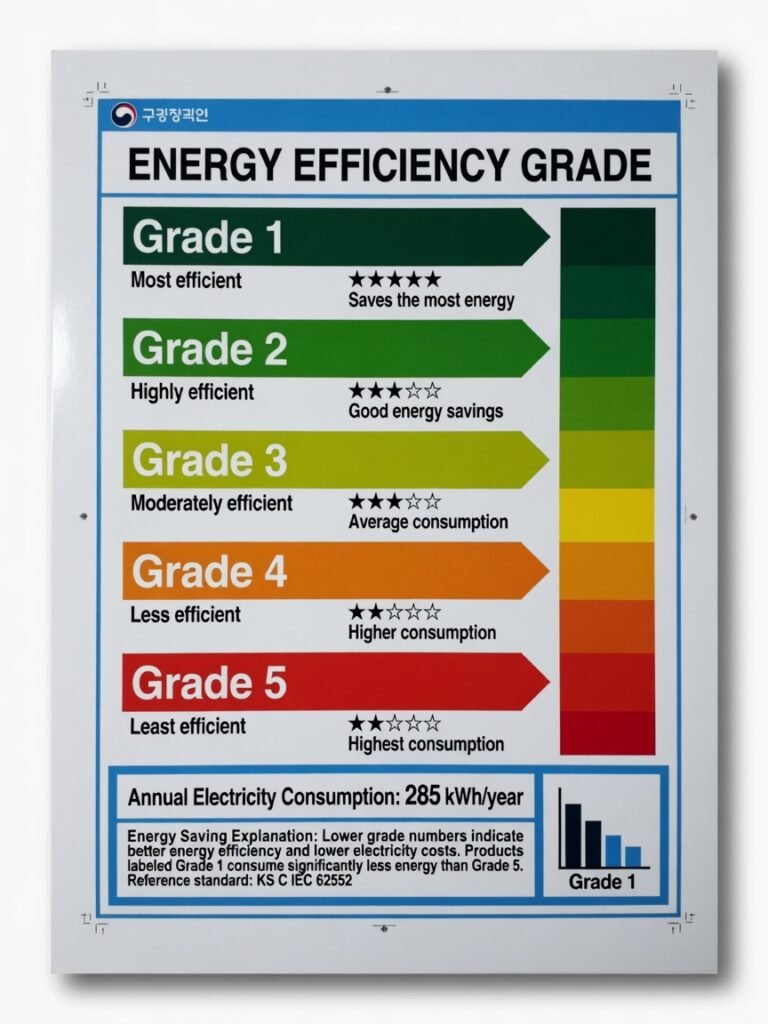
This is the mechanism that people most often come into contact with, and it is a mandatory requirement. It divides products into grades 1 to 5 according to energy efficiency level: grade 1 in dark green is the most energy-efficient, and grade 5 in red is the minimum qualification line. For all products in the official mandatory catalog, manufacturers must proactively file for registration, and affix the grade label in a prominent position on the product and packaging.
The ≤250W external power adapters we often contact — including mobile phone fast chargers and laptop power adapters — are all within the scope of mandatory labeling.
Minimum Energy Performance Standards (MEPS): The Invisible Access Threshold
Many people have not heard of MEPS (Minimum Energy Performance Standards), but it is more basic than the grade label: it is the “pass line” for energy efficiency. Products that do not meet the minimum efficiency requirements do not even have the qualification to be launched on the market, and cannot be rated grade 5 at all.
All products in the mandatory catalog must meet MEPS requirements, regardless of whether they have a grade label. The specific minimum efficiency threshold is divided according to the product’s output power range, and the pass line varies with different power levels.
Standby Power Consumption Management System: Regulating “Power Wasted While Plugged In But Not In Use”
This mechanism specifically assesses the no-load/standby power consumption of products when they are plugged in but not working — that is, the situation we often call “power is consumed even when not in use while plugged in”. If the standby power consumption exceeds the standard, the product needs to be affixed with a special warning label.
At present, mainstream grade 1 low-power chargers usually have a standby power consumption of ≤0.1W. Of course, the specific requirements shall be subject to the latest official standards.
High-Efficiency Equipment Certification: The Voluntary “Top Energy-Saving Performer” Label
This is a voluntary high-energy-efficiency certification that only top products with energy efficiency performance far exceeding the industry average can apply for, which is equivalent to adding an officially recognized energy-saving endorsement to high-end products. Ordinary sellers who only need basic compliance do not need to prioritize this certification, and can use it as a differentiated bonus item for high-end product lines. However, special attention should be paid: this certification cannot replace the mandatory energy efficiency grade label, MEPS minimum energy efficiency standards, or filing requirements at all. Even if you obtain the high-efficiency equipment certification, all mandatory filing and labeling that should be done are still required, and it is not a necessary condition for market access.
Applicable Scope and Boundary Judgment: Does Your Product Need Energy Efficiency Compliance?
The question that many sellers are most concerned about is: does the product I have need to be included in energy efficiency management? For example, do power strips with USB ports need to comply? Do charging cables need to comply? Do industrial power supplies need to comply? We will clarify the boundaries from the mandatory scope, non-included scope, exemption scenarios, and a 3-step judgment method.
Clearly Defined Mandatory Products
The mandatory products related to the charging field mainly include several categories:
The first category is ≤250W external power adapters. USB/USB-C chargers that meet this definition and are sold for the South Korean market usually need to be confirmed and processed according to the official catalog, common ones including mobile phone fast chargers and laptop power adapters;
The second category is devices with power conversion functions, such as desktop charging stations and charging docks with adapters;
If the adapter is sold as part of a host set, such as the power supply included with a monitor, compliance needs to be confirmed together with the whole machine;
There are also household power strips with USB charging functions. Such products shall be subject to the latest official catalog, as the catalog is dynamically updated.
Accessories That Do Not Need Separate Inclusion
Ordinary passive charging cables, USB adapters and other accessories that only perform physical connection and have no power conversion function do not need separate energy efficiency compliance. But there is an exception: active cables with power conversion, such as boost cables that can raise 5V to 12V, need to be judged separately for inclusion.
If it is a charger with a non-detachable cable, such as a fast charger with an integrated cable, it is directly managed as a whole machine, and the cable does not need to be assessed for energy efficiency separately.
Scenarios Eligible for Exemption
There are several scenarios that can be exempted from energy efficiency requirements and do not need filing:
For example, small quantities of chargers purchased via overseas online shopping for personal use (not for sales purposes); customized power supplies dedicated to industrial use, chargers for experimental or sample use; as well as export and transit goods, and military products. However, these must meet the official clear exemption clauses, and exemption cannot be self-determined.
3-Step Boundary Judgment Method
If you are still unsure, using this 3-step judgment method can basically cover the vast majority of situations:
Step 1 Look at the function: Does the product have AC-DC power conversion — for example, a charger converts 220V AC to 5V DC, and products with conversion are likely to be included;
Step 2 Look at the parameters: Is the output power ≤250W? If it exceeds 250W, you need to check the latest official catalog for confirmation;
Step 3 Look at the scenario: Is it sold to ordinary consumers — if it is for industrial dedicated customization, experimental/sample and other scenarios, you need to simultaneously check the official clear exemption clauses, purpose certificates and sales restrictions, and cannot directly determine exemption based solely on B2B sales targets.
Do Not Overlook the Risk of Catalog Updates
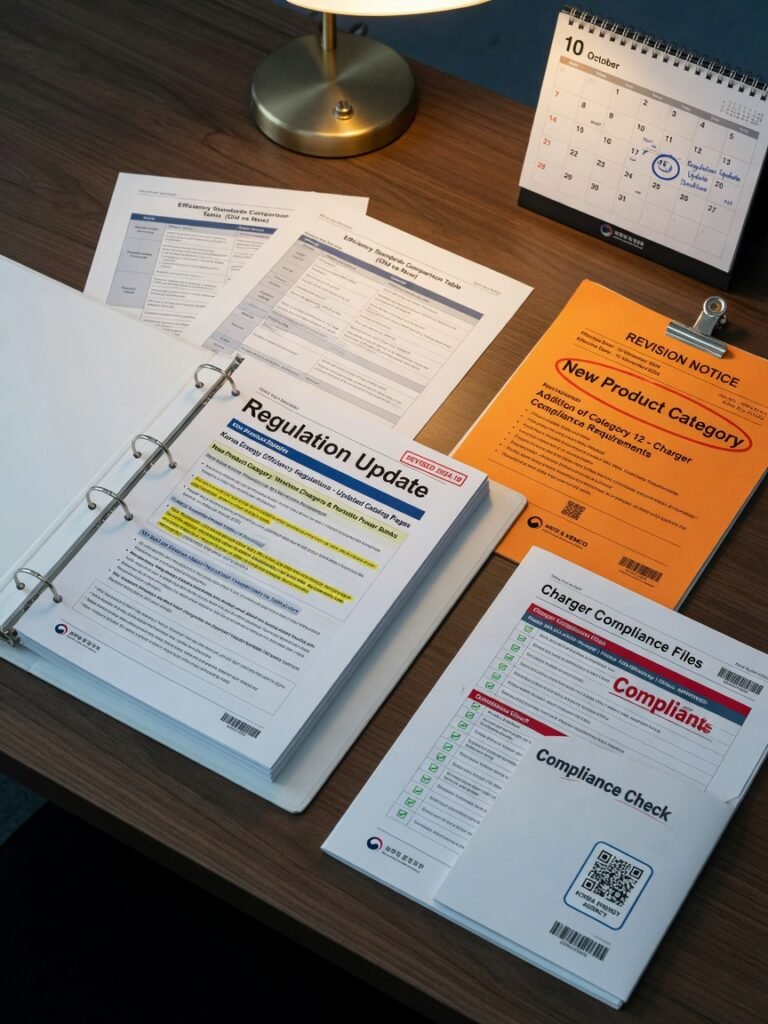
South Korea’s official energy efficiency catalog is updated every 1 to 3 years, and new forms of products such as multi-port fast charging stations and gallium nitride chargers may be included in the catalog at any time. Never judge based on old experience from two or three years ago. Be sure to check the latest official catalog before shipping or putting products on shelves, otherwise you are likely to run into pitfalls.
Label Composition and Quick Reading Guide: Understand Energy Efficiency Labels Fast
After figuring out which products need compliance, let’s look at what a standard South Korean energy efficiency label looks like and how to read it quickly — this is useful whether for consumers choosing products or for sellers doing compliance.
Core Components of the Label
A complete South Korean energy efficiency label has several core elements: the most prominent is the energy efficiency grade bar, from dark green grade 1 to red grade 5, you can see the energy-saving level at a glance; then there is the estimated annual power consumption/electricity cost, which is calculated based on the 220V/60Hz electricity environment of South Korean households. This value comes from official standardized testing and usage conditions, and is suitable for horizontal comparison of similar products. The user’s actual electricity cost will be affected by usage frequency, load, standby habits and current electricity price, and has strong reference value; below is basic product information, including brand, model, rated power, manufacturer or importer; there is also a very important energy efficiency filing number, which can be verified for authenticity on the official website of the Korea Energy Corporation (KEMCO/KEA).
In addition to the content visible on the surface, the filing query page of some products will also disclose more detailed conversion efficiency ranges and standby power consumption values. It should be noted here that energy efficiency grades can only be compared between products of the same power range and same interface type. For example, a 20W USB-C fast charger can only be compared in grade with other 20W USB-C fast chargers. Comparing the grade of a 20W charger with a 65W charger is meaningless.
Label Placement Requirements
There are clear regulations on the placement position of the label, and it cannot be stuck casually: on the product body, chargers are usually labeled next to the USB port or on the bottom, and adapters are usually labeled near the input and output ends. The specific placement position shall be subject to the official label format specifications announced by the Korea Energy Corporation (KEMCO/KEA), the actual structure of the product and visibility requirements; if the product body has too little space to affix the label, you need to confirm in advance whether it is allowed to adjust to the minimum packaging or other designated display positions.
The label must be affixed in a prominent position on the minimum sales packaging, and cannot be hidden on the inside or in the instruction manual; if sold online, the product detail page must clearly display the energy efficiency grade and filing number, and cannot omit them entirely.
3-Step Quick Reading Method
The energy efficiency label can be read quickly in 3 steps:
Step 1 Look at the grade: Grades 1-2 are high energy efficiency, grade 3 is medium level, and grade 5 just reaches the pass line;
Step 2 Look at annual power consumption: For products of the same power, the smaller the number, the more power-saving it is when used year-round;
Step 3 Check the number: If you have questions about the energy efficiency of the product, you can enter the filing number on the official website of the Energy Corporation to verify the authenticity, to avoid buying falsely labeled products.
Energy Efficiency Grade Assessment Logic: How Are Grades Determined?
Many people are curious: how are these grades 1 to 5 determined? Will manufacturers label them arbitrarily? After understanding the assessment logic, you can judge which statements are true and which are misleading.
Core Assessment Indicators
The assessment of energy efficiency grades mainly depends on two indicators:
The first is conversion efficiency, which is the ratio of alternating current converted to direct current — for example, if the efficiency is 90%, 100W of AC input produces 90W of DC output, and the remaining 10W is wasted as heat. The higher the efficiency, the less waste;
The second is standby/no-load power consumption, which is the power consumed when plugged in but not working, and the lower the better.
For high-power power supplies, power factor may also be assessed, but the low-power mobile phone chargers and laptop power supplies we commonly use generally do not involve this indicator.
Grade Classification Rules
The grade classification is based on the same power range and same product type — simply put, products of the same power and same type are compared together. Grade 1 represents a higher energy efficiency level within this category and power range, and grade 5 is usually close to the minimum access requirement; the specific grade boundaries shall be subject to the product category threshold table announced by MOTIE/KEA. The thresholds are tightened irregularly with the revision of regulations, forcing manufacturers to upgrade their technology. Enterprises should check the latest announcements before shipping and model changes. For example, a grade 1 charger from ten years ago may not even reach grade 5 now.
Key Test Conditions
The grade assessment test is conducted under strict standard conditions: the test environment is 220V/60Hz voltage and 25℃ room temperature; the load test must cover four load segments: 25%, 50%, 75%, and 100%, and the average efficiency is finally taken, not only testing full load; if it is a USB-C PD fast charger, it must also cover common voltage levels (such as 5V, 9V, 12V, 20V); for multi-port chargers, the weighted efficiency of single-port output and simultaneous multi-port output must also be tested to ensure the results conform to actual usage scenarios.
4 Common Assessment Misconceptions
Here we need to correct several common misunderstandings:
First, “the higher the power of the charger, the lower the energy efficiency grade” — wrong. Grades are compared within the same power range. A 65W grade 1 charger is top-tier in the 65W segment, and there is no difference in level between it and a 20W grade 1 charger;
Second, “fast chargers must consume more power” — wrong. Most regular fast chargers have grade 1-2 energy efficiency, and have higher conversion efficiency than old 5V1A slow chargers, so they are actually more power-saving in use;
Third, “charging cables affect the energy efficiency grade” — wrong. The energy efficiency grade only assesses the charger itself, excluding passive charging cables. Even if a poor-quality cable causes slow charging, it is not considered an energy efficiency problem of the charger;
Fourth, “the higher the energy efficiency grade, the faster the charging speed” — completely wrong. Energy efficiency only represents the degree of power saving, and has nothing to do with charging speed. Charging speed depends on power, fast charging protocols and the support of the device itself.
Full Compliance Process: How Can Sellers Get It Right Step by Step?
If you are a seller in the South Korean market, what you are most concerned about is definitely how to comply, what process to follow, and what the consequences of non-compliance are. We simplify the entire compliance process into steps that everyone can understand, along with precautions.
Who Bears the Compliance Responsibility?
First of all, the responsible entity must be clarified: if it is a South Korean local manufacturer, it is responsible for filing and labeling on its own; if it is an overseas seller or factory, a South Korean importer or authorized representative must act as the responsible entity, and individuals cannot directly apply for filing; sales platforms and offline merchants also have the obligation to verify the energy efficiency compliance of products on sale, and it is not only manufacturers that bear responsibility.
Simplified 5-Step Compliance Process
The entire compliance process can be simplified into five steps, and following them step by step will avoid mistakes:
Step 1: First use the 3-step judgment method mentioned earlier to confirm whether the product is in the mandatory catalog, to avoid unnecessary work;
Step 2: Send samples to a third-party laboratory recognized by South Korea for Korean standard energy efficiency testing, and obtain the test report;
Step 3: Submit the test report and product materials to the Korea Energy Corporation (KEMCO/KEA) to apply for energy efficiency filing;
Step 4: After passing the review, obtain the filing number, print the label in accordance with the officially specified format, and affix it to the product and packaging;
Step 5: After the product is launched on the market, accept random spot checks by the regulatory authorities, and just cooperate with the inspection.
Core Preparation Documents
There are three core documents to prepare for filing: the first is the product specification, which should clearly state information such as input and output parameters, power levels, interface types, and supported fast charging protocols; the second is the Korean standard energy efficiency test report issued by a laboratory recognized by South Korea; the third is the Korean label and packaging draft, which must have the energy efficiency grade, filing number, and basic product information, meeting the official format requirements.
Consequences of Non-Compliance
If non-compliant, penalties will be handled in tiers according to the circumstances of the violation and the applicable regulatory clauses: minor violations such as non-compliant label placement positions and substandard packaging label clarity will generally be ordered to rectify within a time limit; serious violations such as false labeling of energy efficiency grades and failure to meet MEPS minimum energy efficiency standards may result in an order to stop sales, forced removal from shelves and recall, and a fine stipulated by the corresponding regulatory clauses. The specific penalties shall be subject to the Energy Use Rationalization Act and the latest announcement of the Korea Energy Corporation (KEMCO/KEA); for repeated violations or particularly serious circumstances, the entity may also be included in the regulatory dishonesty list, and subsequent filing applications will be subject to stricter restrictions.
Precautions for Long-Term Compliance
Compliance is not a once-and-for-all matter, and there are several long-term management requirements to note:
First, product model changes require re-filing — for example, if the circuit is changed, the main control chip is replaced, the power is adjusted, or the fast charging protocol is changed, as long as it affects energy efficiency, re-testing and filing are required;
Second, if a transition period is set for regulatory updates, the specific duration and old inventory handling rules shall be subject to the announcement of the Energy Corporation, and timely follow-up and confirmation are required to avoid inability to sell normally after the transition period ends;
Third, it is recommended to leave a 5%-10% energy efficiency margin during mass production, because component aging and ambient temperature changes will reduce efficiency, and leaving a margin can avoid unqualified results during market spot checks;
Fourth, the filing has a validity period, the specific duration shall be subject to the announcement of the Energy Corporation, and remember to renew before expiration.
Practical Tools and Pitfall Avoidance Guide
Finally, we have sorted out practical purchasing and self-check methods for consumers and cross-border sellers, as well as the most common pitfalls, to help everyone avoid detours.
Consumer Purchasing Tips
If you are a consumer living in South Korea, remember three points when choosing a charger:
First, prioritize products with grade 1-2 energy efficiency — here is a reference estimate: assuming specific standby duration, daily charging load and a certain residential electricity price, for a 20W fast charger that is plugged in year-round, grade 1 energy efficiency may save 3,000-5,000 won per year compared to grade 5. It should be noted that this is only an estimated value under specific assumptions, and does not represent the general savings amount for all 20W products; South Korean residential electricity prices have tiered rates, surcharges and time-of-use differences, and the actual savings will vary with usage time, electricity price, charging load and other factors. It is recommended to calculate by yourself combined with the annual power consumption on the product label and the current electricity price. Overall, for long-term plugged-in use, the cost-effectiveness of high-energy-efficiency products will be more obvious;
Second, check whether the energy efficiency labels on the product body and packaging are complete and whether there is a filing number;
Third, if you have questions about the product, you can go to the official filing system of the Korea Energy Corporation (KEMCO/KEA) and enter the filing number to verify the authenticity, to avoid buying falsely labeled products.
Cross-Border Seller Self-Check List
If you are a cross-border seller doing business in the South Korean market, you can self-check according to these four points:
First, category check — ≤250W external power supplies for the general consumer market are all within the mandatory scope, do not miss them;
Second, document check — the model information on the test report, filing number, and label must be completely consistent with the actual product, and cannot be mismatched;
Third, publicity check — the energy efficiency publicity on online product detail pages must be consistent with the filed grade, and you cannot casually label “grade 1 energy efficiency” without filing;
Fourth, model change check — if the product parameters or internal solution change, be sure to re-confirm compliance, and do not think that no change is needed just because the appearance has not changed.
Core Differences from Energy Efficiency Labels in Major Regions
Many cross-border sellers will ask: I have energy efficiency-related reports from the EU or China, can I use them directly in South Korea? The answer is no, because there is no official mutual recognition of energy efficiency systems in different regions.
For products such as external power supplies and chargers, the EU mainly imposes mandatory requirements such as minimum conversion efficiency and no-load power consumption through the ErP (Ecodesign) regulations; the A-G grade energy efficiency label that people often hear about is mainly applicable to other labeled categories designated by the EU, and not all chargers need to be affixed with the A-G grade label. The testing logic and threshold settings of the two are different. Compared with China’s energy efficiency, although both are divided into grades 1-5, the calculation standards for annual power consumption and grade thresholds are different, and there is no mutual recognition either. Energy efficiency reports from other countries can only be used as a preliminary technical reference, and separate Korean standard testing and filing are required to enter the South Korean market.
4 Common Compliance Pitfalls
First, having KC certification means no need for energy efficiency labels: the two are independent mandatory requirements, and products in the mandatory catalog must meet both;
Second, energy efficiency reports from other countries can directly apply for South Korean filing: there is no general mutual recognition, and Korean standard test reports issued by South Korean recognized laboratories must be used;
Third, products with the same appearance but different power can share one filing number: power changes will directly affect the energy efficiency grade and MEPS compliance, and re-testing and filing are required, even if the appearance is exactly the same;
Fourth, second-hand or parallel imported products do not need energy efficiency labels: as long as they are products in the mandatory catalog sold in the South Korean market, even if they are second-hand or parallel imported, they need to meet energy efficiency requirements, otherwise they will still be punished.
The above is the core content of South Korea’s energy efficiency labeling system. Whether you are an ordinary consumer purchasing charging products or a cross-border seller handling compliance, it is recommended to refer to the latest official catalog and rules released by the Korea Energy Corporation (KEMCO/KEA), as the energy efficiency system is dynamically updated with technological development.