
CSA and cUL are the two most common third-party safety certification marks for Canadian electrical safety compliance. They are issued by organizations accredited by the Standards Council of Canada (SCC), such as CSA and UL Solutions, in accordance with corresponding safety standards, and are not directly issued by the Canadian government. The two only differ in the issuing body, have completely equivalent validity in the Canadian market, and their core function is to prove that products such as chargers, power adapters, and charging cables with AC plugs meet the minimum safety requirements for market access, retail channels, and platform audits.
Here are a few common cognitive misunderstandings that beginners are most likely to fall into, to avoid going astray at the very beginning:
First, existing certifications from other countries or regions such as UL, CE, FCC, and 3C cannot automatically replace SCC-accredited safety certifications such as Canadian CSA/cUL. Even the US UL mark is not equivalent to cUL certification applicable to Canada; it is necessary to check whether the certificate covers Canadian standards and bears the authorized mark applicable to Canada;
Second, charging cables with AC plugs fall within the scope of mandatory certification, while ordinary low-voltage charging cables are subject to the specific requirements of the sales channel;
Third, certification only corresponds to specific models, parameters, and structures. Even other models produced by the same factory cannot directly apply the existing certification;
Fourth, certificates are not once-and-for-all. Annual supervision audits are required to maintain their validity, and safety-related changes to products must be reported to the organization in advance.
Step 1: First Determine Whether Your Product Needs Certification
Don’t jump straight to thinking about getting certified. First figure out what category your product falls into, whether it needs certification, and which type to get.
Quick Judgment Method (For Beginners to Use Directly)
You can make a quick judgment based on two criteria:
1. Can the product be directly plugged into a Canadian 120V wall outlet? If yes, it most likely falls within the scope of mandatory certification;
2. Does your sales channel (such as Amazon, offline retailers) have clear requirements? If the channel requires it, even if it is not within the mandatory scope, you still need to get certified.
Specific Scope Classification
Common charging products can be divided into three categories:
Category 1: Statutory mandatory certification scope (usually requires safety certification from an SCC-accredited body to meet the requirements for Canadian sales, retail channels, platform audits, most import procedures, and market spot checks)
Including wall-plug chargers, power adapters, charging cables with AC plugs, adapters, as well as car inverters with AC output and portable charging power supplies – these products either connect directly to the mains or can output mains voltage, have high safety risks, and are the focus of Canadian regulation and channel verification.
Category 2: Non-mandatory but often required by channels (depends on the sales channel)
For example, ordinary USB-C charging cables, car chargers plugged into car cigarette lighters, as well as low-voltage input wireless charging bases themselves, and wireless charging base sets with matching adapters – among these, ordinary USB-C low-voltage cables themselves do not directly connect to 120V mains power and have no power conversion or voltage step-up/step-down functions, so they usually do not trigger mandatory mains safety certification due to the cable itself; however, if the cable has an AC input plug, a built-in power conversion module, is sold together with a set that includes an AC adapter and the channel requires certification for the entire set, the compliance requirements need to be re-evaluated based on the actual product structure. The wireless charging base itself does not directly connect to 120V mains power, so it does not fall within the scope of statutory mandatory certification; but if the set comes with an AC wall-plug adapter, the adapter itself must meet the applicable Canadian safety certification requirements. As for whether the entire device needs additional certification, it depends on the product structure and the specific regulations of the sales channel. Mainstream channels such as Amazon and Best Buy usually require that all relevant components of the entire product set have corresponding certifications before they can be listed.
Category 3: Scenarios where separate CSA/cUL whole-device safety certification is usually not required
Pure low-voltage data cables without any power conversion function (such as ordinary USB-C data transmission cables), non-sale samples for R&D use, equipment for personal use, and products that are only powered by batteries and do not connect to mains power at all, usually do not require separate CSA/cUL whole-device safety certification. However, note that if such products are sold as a set with an AC adapter, the sales channel has other requirements, or they involve other compliance requirements such as transportation and radio, they still need to be verified according to the actual product combination and rules, and cannot be generalized.
Choose CSA or cUL? Pick According to Your Situation
After confirming that you need to apply, which certification is more cost-effective? You can choose based on these logics:
• If the sales channel clearly specifies the CSA or cUL mark, just choose according to the requirement;
• If you are targeting both the US and Canadian markets, choosing cULus dual certification is much more cost-effective than applying for two certifications separately;
• If you already have US UL certification, you can apply to UL to extend the cUL mark applicable to Canada. Most of the existing product documentation and test results can usually be reused, so you don’t need to do all tests from scratch. However, you still need to evaluate the differences between Canadian and US standards, 120V/60Hz rating adaptation, Canadian plug specifications, bilingual English-French labels/manuals, and the Canadian certification status of key components. If necessary, supplementary tests or supplementary factory audits may be required, but overall it still saves a lot of time and cost compared to applying separately;
• If you only target the Canadian market and the volume is small to medium, both are fine. Just compare quotes and services, as their validity is exactly the same.
Step 2: Preparations Before Application
After confirming that you need to apply for certification, don’t rush to submit the application. Sufficient preliminary preparation can save you a lot of detours. Pre-application preparations mainly include four things: organizing application materials, preparing test samples, selecting the right certification body or agent, and confirming whether series models can be applied for together.
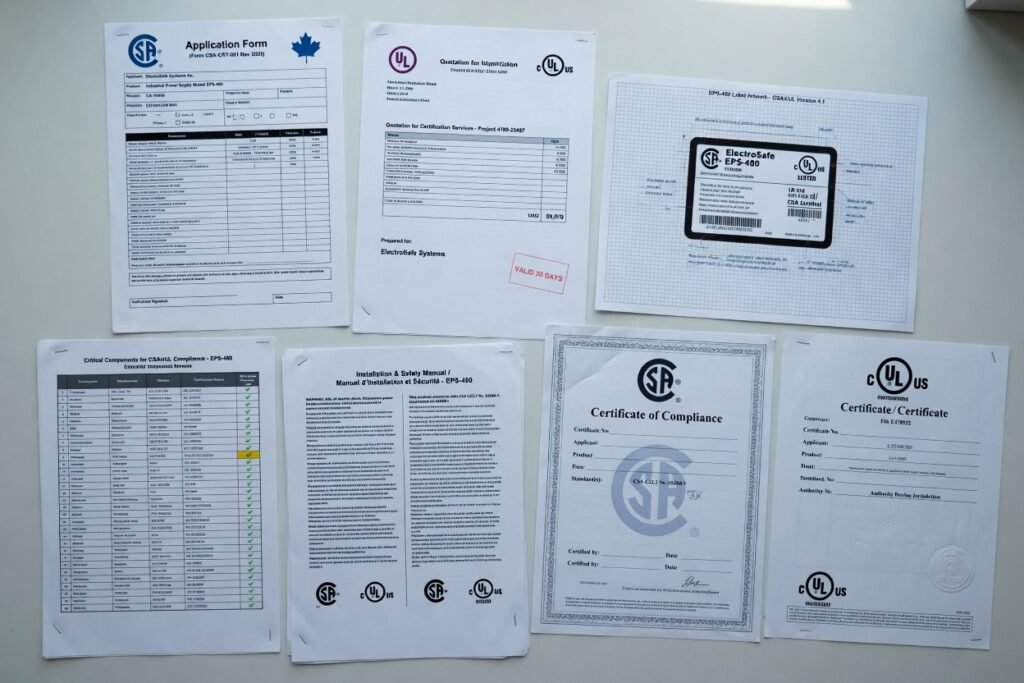
1. Organize Application Materials Exclusive to Charging Products
There are clear exclusive requirements for application materials for charging products. Preparing them in advance according to the list can avoid delays caused by repeated supplementary submissions:
• Basic product information: A list of all applied models, input and output parameters, interface types, local Canadian plug specifications, and main usage scenarios of the product must be listed clearly;
• List of key safety components: List core components that affect safety, such as transformers, fuses, housing plastics, wire cores, and interfaces. If the components themselves already have CSA/cUL certification, attach the corresponding certificate number or file number, which can reduce subsequent test items and lower the failure rate;
• Document materials: Product appearance drawings (which must clearly show the overall structure and marking positions), bilingual English-French manuals (safety warnings must be in both English and French), and label design drafts with reserved positions for certification marks (to facilitate the organization’s review of whether the placement of the mark is compliant).
2. Prepare Test Samples According to Requirements
Samples are the core of testing. Sending wrong samples or unqualified samples will directly slow down the entire process. Pay attention to the following points when preparing:
• Quantity reference: Usually prepare 5-10 units for wall-plug chargers and power adapters, and 10-20 pieces for charging cables. The specific quantity is subject to the official requirements of the laboratory;
• Status requirements: Samples must be mass-produced versions, with structure, materials, and firmware completely consistent with subsequent bulk goods. Hand-made engineering samples are not accepted – if you deliberately make “perfect samples” that are inconsistent with subsequent bulk goods, problems will directly arise during annual audits or spot checks;
• Sample submission rules: If multiple models of the same series are applied for together, priority is given to sending the model with the highest power and highest risk for testing. At the same time, Canadian-spec plugs and corresponding test loads must be fully equipped to avoid delays in testing due to lack of accessories in the laboratory.
3. Choose a Reliable Certification Body or Agent
If beginners are not familiar with certification rules, finding the right body or agent can save a lot of trouble. When choosing, you can verify from these dimensions:
• Check qualifications: The issuing body should be a certification body accredited by the Standards Council of Canada (SCC). The qualifications of mainstream issuing bodies such as CSA and UL can be verified in the SCC or the body’s official database; an agent itself is not equivalent to the issuing body. You should verify whether it is an authorized or cooperative channel of CSA/UL, whether it can provide an official project number and a standardized quotation contract, and whether the final certificate can be queried in the official database of the issuing body. Certificates provided by agents without formal channel qualifications may not be recognized by the Canadian market;
• Look at experience: Prioritize bodies that have certification cases for charging products such as PD chargers, USB-C charging cables, and multi-port fast chargers. Such bodies are familiar with charging standards and test requirements, and can help you avoid many common problems in advance;
• Verify the quotation: A formal quotation will clearly list all fees, including testing fees, certificate fees, initial factory audit fees, and the number of free retests included (usually 1-2 times). You should also ask clearly about the charging standard for subsequent annual audits in advance, and be wary of situations where only a low price is quoted and there are various hidden fees later;
• Pitfall avoidance reminder: Don’t believe promises of “guaranteed pass” or “ultra-low price and quick certification”. Formal certification has fixed testing and audit processes, and certification can only be obtained if it meets safety standards. For those who compress the cycle without bottom line or promise 100% pass, you should carefully verify their qualifications and the source of the certificate.
4. Confirm Whether Series Models Can Be Applied for Together
If you have multiple product models, those that meet the conditions can be applied for together, which can save a lot of testing fees. But not all models can be combined, and the judgment rules are very clear:
• Cases that can be combined: Series models with exactly the same circuit design, consistent key safety components, and the same housing structure, with only differences in color, sales model, or small power, can be applied for together and share the same certificate;
• Cases that cannot be directly combined: If the interface type is changed, the rated power is increased, key safety components are replaced, or the power distribution logic of multi-port output is adjusted, they usually cannot be directly added to the existing certificate, and need to be re-evaluated or supplementary tests are required;
• Important reminder: For models not included in the certificate coverage and not evaluated, you must never print the CSA/cUL mark without permission. Otherwise, it is considered certificate fraud. Once found, the certificate will be directly revoked, and you may also face market penalties.
Step 3: Full Process of Formal Application
After all preliminary preparations are done, you can enter the formal application process. The entire process proceeds in sequence around application, testing, factory inspection, and certification, with clear precautions for each link.
1. Submit Application and Material Review
There are two ways to apply: large merchants with a dedicated compliance team can directly submit applications through the official website of the certification body; small and medium-sized sellers are recommended to find a reliable agent to submit, which can save a lot of rule learning and communication costs.
There are three main focuses of the review: whether the product input voltage covers Canada’s 120V/60Hz, whether key safety components have valid certification, and whether the safety warnings in the manual are bilingual in English and French.
If the review is passed, the body will issue a project number and formal sample submission requirements; if not passed, you need to supplement materials or replace compliant components and resubmit: documentary corrections are usually processed according to the project process, with no additional charge; if it involves replacing key components, re-evaluation, supplementary testing, or reopening the case, whether fees are charged is subject to the contract agreement of the body or agent.
[Checkpoint] Prepare all materials in advance according to the list to avoid delays caused by repeated supplementary submissions.
2. Sample Testing (Core Link)
After sending the samples to the designated laboratory as required, the testing phase begins – this is the most core and time-consuming step in the entire process.
If the sample passes the test in one go, the reference conventional cycle is: 2-3 weeks for 20W single-port PD chargers, 3-4 weeks for high-power or multi-port chargers, 1-2 weeks for ordinary low-voltage charging cables. The specific time depends on the laboratory’s schedule.
The test progress can be directly queried with the body or agent by the project number.
[Checkpoint] Confirm that the sample is completely consistent with the mass-produced version before sending. Do not modify the design arbitrarily during the testing process, to avoid invalidating previous tests and increasing additional time and cost.
3. Main Test Items for Charging Products
Many beginners only know that they need to send samples for testing, but they don’t know exactly what is tested or how these tests relate to product safety. In fact, the test items for charging products are all designed around safety risks in actual use, and the test focuses vary greatly among different categories:
Core Test Items for Wall-Plug Chargers/Adapters
This type of product is directly connected to 120V mains power, with the highest safety risk. The core tests are centered around “electric shock prevention, fire prevention, and fault prevention”:
• Electric shock isolation verification: Usually combined with multiple test items such as withstand voltage, insulation resistance, creepage distance/clearance, to jointly confirm that the high-voltage side inside the charger connected to 120V mains power meets the complete electrical isolation requirements from the USB low-voltage side connected to mobile phones and computers – even if there is voltage fluctuation, high voltage will not leak to the low-voltage side, preventing users from getting an electric shock when touching the USB interface while plugged in.
• Full-load temperature rise test: Let all interfaces of the charger run at full rated power at the same time, and after working continuously for a sufficient time, measure the temperature of the housing, internal components, and plug pins to ensure that the temperature of all parts is within the safety threshold. This test is particularly important for multi-port fast chargers. Excessive temperature can cause burns to users in mild cases, and ignite surrounding items in severe cases.
• Overload/short circuit protection test: Simulate fault scenarios in user use – such as dust entering the interface causing a short circuit, or connecting a device with excessive power, to verify whether the charger can automatically cut off output or limit current, and will not cause fire risk due to continuous overload heating.
• Housing fire resistance + plug compliance test: The housing fire resistance test verifies that the plastic housing has a sufficient flame retardant grade. In case of an internal circuit fire, the housing will not be ignited and will not allow the fire to spread outside the product; plug compliance confirms that the AC plug meets local Canadian size and electrical performance standards, has good contact when plugged into a wall outlet, and will not generate heat due to excessive contact resistance.
Core Test Items for Charging Cables
The testing of charging cables mainly focuses on wear and overload risks in daily use:
• Tensile strength test: Simulate scenarios of pulling or hanging the charging cable in daily use. Through tensile and bending tests with specified force, confirm that the wire core will not break and the insulation layer will not be damaged, to avoid the risk of charging failure or even electric leakage.
• Insulation performance test: Verify that the outer sheath of the charging cable and the insulation layer between the core wires can withstand the specified voltage without breakdown and electric leakage – even if the cable sheath is slightly worn, it can ensure that users will not get an electric shock when touching it.
• Overcurrent capability test: Let the charging cable continuously pass the rated maximum current, measure the temperature of the cable and interface parts, to ensure that the temperature does not exceed the safety value, and there will be no overheating melting or even fire.
• Interface plug-in life test: Simulate the daily use scenario of repeated plugging and unplugging. After plugging and unplugging for the standard number of times, check whether the interface is loose and whether the contact resistance exceeds the standard, to avoid heating or even failure due to poor contact after long-term use.
Common Test Failure Reasons and Rectification Rules
There are relatively concentrated high-frequency points for test failures of charging products. Understanding them in advance can help you avoid them:
• Common failure points for chargers/adapters: Excessive full-load temperature rise, unqualified insulation distance/withstand voltage between high-voltage side and low-voltage side, insufficient flame retardant grade of the housing;
• Common failure points for charging cables: Unqualified insulation layer thickness/withstand voltage, insufficient tensile strength, excessive temperature rise under rated current.
According to the severity of the problem, the cost and cycle of rectification vary greatly:
• Minor rectification: If it is a problem that does not involve the safety structure, such as incorrect label marking or non-compliant parameter marking, usually only material correction or local recheck is needed, no full retest is required, and the cost and time consumption are very small;
• Major rectification: If changes that affect core safety performance are required, such as modifying circuit design, replacing housing materials, replacing key safety components, or adjusting multi-port power distribution logic, usually re-evaluation or even full retest is required, and the cost and cycle will increase significantly.
The fee rules for retests are usually agreed in the contract in advance. It is common in the industry to include 1-2 free retest opportunities (only for local tests of non-major rectifications). If the number of times is exceeded or it is a full retest, additional fees are required.
4. Initial Factory Audit
After the test is passed, the body will arrange an initial factory audit – many small factories are afraid of this, but actually there is no need to be nervous. The purpose of the audit is to confirm that the factory has the ability to continuously produce products that meet safety standards, and the core focus is the effectiveness of production control.
The audit will be scheduled 3-7 days in advance, no surprise visits, so the factory has enough time to prepare. There are three main focuses of the audit: production control (such as whether finished products undergo power-on tests, whether the welding process is inspected), material consistency (whether key components are consistent with the samples sent), and finished product spot checks.
If it is a minor problem, such as incomplete production records, it only needs to be rectified within a time limit, no re-audit is required; if it is a serious problem, such as unauthorized replacement of key components or large differences between the product and the sent sample, re-audit or even re-test may be required after rectification.
[Checkpoint] Small factories can pass as long as production control is in place. There is no need to specially decorate offices or production lines. The audit focuses on actual control, not superficial efforts.
5. Obtaining Certification and Mark Authorization
After the factory audit is passed, the official certificate can be issued within 1-3 working days.
After receiving the certificate, you must first check the core information: the certificate file number, covered models, power range, interface type, and production factory address must all be consistent with the application content. When checking the covered models, you must compare all models, power levels, interface combinations, and production factory addresses that are being sold or planned to be sold one by one. Models not included in the certificate coverage must not be printed with the CSA/cUL mark.
The certification mark can only be printed on products, packaging, or manuals after obtaining formal authorization from the body. The size and proportion must comply with the body’s specifications, and out-of-scope use is strictly prohibited – for example, if the certificate only covers 20W models, the mark must not be printed on 65W products.
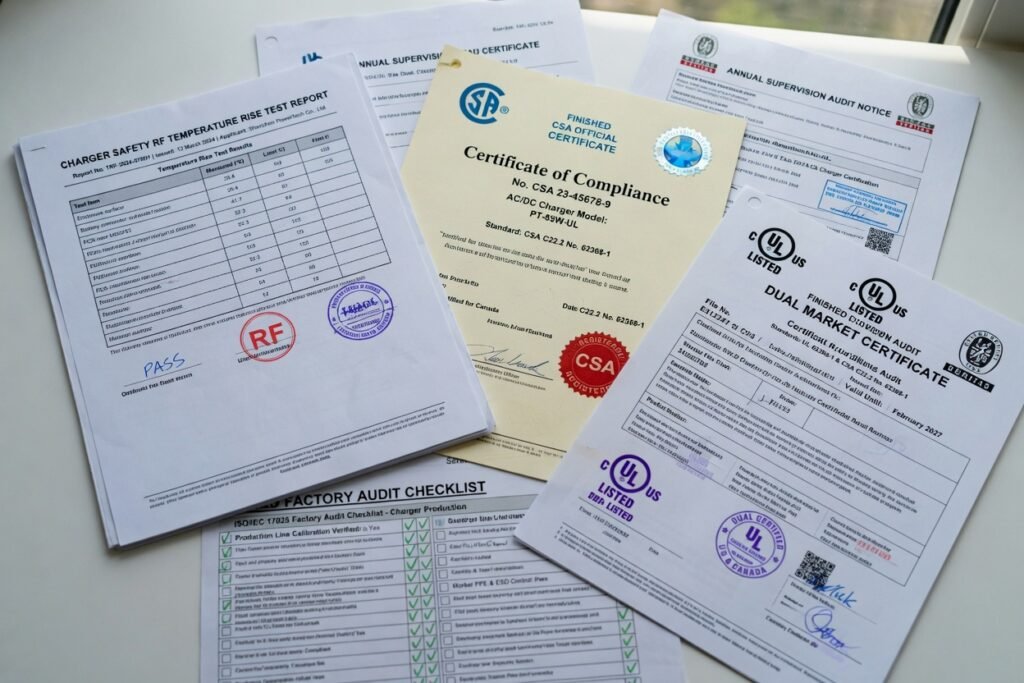
After receiving the certificate, you should first verify the authenticity and coverage of the certificate through the official CSA or UL database, and confirm that the information is completely matched before using it, to avoid receiving forged certificates or certificates with out-of-scope authorization.
Getting Certified Is Just the Beginning: Precautions for Subsequent Maintenance
Many people think that getting certified means everything is fine, but that’s not the case. Certificates need to be maintained to remain valid, otherwise they may be revoked.
Annual Supervision Audit
The CSA/cUL certificate itself is long-term valid, but it needs to pass regular supervision audits by the issuing body to maintain its validity. For conventional small charging products, an annual supervision audit (i.e., annual audit) is usually arranged once a year. The specific supervision frequency, spot check method, and fees are subject to the CSA/UL project contract, factory category, and product category.
The content of the annual audit is similar to the initial factory audit, focusing on product consistency – that is, whether the products you are now producing and selling are the same as the samples you used to get certified.
The annual audit fee for small charging product factories can be roughly estimated at 50% of the initial factory audit fee, and the overall cost is not high.
If the annual audit fails, the certificate may be suspended or even revoked. You must immediately stop selling related products, otherwise there will be compliance risks.
Product Changes Must Be Reported in Time
If there are changes to the product, do you need to report them? There are two situations:
• Must be reported, and supplementary testing may be required: Changing the circuit design, replacing key safety components, increasing power, changing the interface type, or changing the production factory – these all affect product safety. You must report to the body in advance, evaluate whether supplementary testing is needed, and make changes only after passing.
• Changes that do not need to be reported: Limited to adjustments that do not affect the safety structure, rated parameters, safety warnings, style and position of certification marks, certificate listing information, and production factory information, such as only changing the outer packaging design, modifying non-safety usage instructions in the manual, or changing internal sales models that do not involve certificate listing; if the label layout adjustment involves certification marks, rated input and output parameters, product models, or bilingual English-French safety warnings, you should first confirm with the issuing body whether reporting is required.
Money-saving tip: If it is a minor change, you can go through the “difference test” process, only testing the changed part, no need for full retest, which can save a lot of money.
Precautions for Market Sales Compliance
You should also pay attention to compliance when selling, otherwise problems will arise if checked:
• The product parameters on the e-commerce page must be consistent with those on the certificate. You cannot falsely mark power or promote beyond the scope. For example, if the certificate says 20W, you cannot write 65W.
• You cannot use only the US UL Listed mark to impersonate Canadian compliance certification. The cUL or cULus mark must display the Canadian applicable mark in accordance with UL’s authorized format.
• The information of the importer and brand party must match the certificate chain. During market spot checks, the query path of the certificate must be provided, otherwise it may be judged as non-compliant.
Overall, as long as entry-level practitioners can accurately judge product certification requirements, be familiar with the basic application process, independently complete material and sample preparation, and understand core safety testing and annual maintenance requirements, they can meet conventional compliance needs; for long-term stable operation and control of compliance costs, further mastering the skills of certification selection, series combination, change reporting, and certificate verification can avoid the vast majority of compliance risks and unnecessary cost consumption.