
If you are engaged in cross-border trade of charging products, plan to enter the Korean market, or pay attention to the environmental compliance requirements of electronic accessories, you have most likely seen the expression “K-RoHS”. Many people confuse it with KC certification and EU RoHS, and are not clear whether common products such as chargers and charging cables need to meet relevant requirements. This article will systematically sort out the core rules of K-RoHS from basic concepts, scope of application, control requirements to practical judgment.
What exactly is K-RoHS?
The full name of K-RoHS is the Restriction of Hazardous Substances in Electrical and Electronic Products of Korea, which is a mandatory environmental threshold formulated by Korea for electronic and electrical products — it requires the use of toxic and hazardous materials to be restricted at the production stage, and is not an optional recommended standard. Its regulatory basis is the Act on Resource Circulation of Electrical and Electronic Products and Automobiles of Korea and supporting subordinate regulations, and all regulated electronic and electrical products entering the Korean market must comply with it.
It has three core functions: first, to restrict the use of toxic materials from the source; second, to reduce the harm to the environment and human health after products are scrapped; third, it is a necessary environmental access condition for charging products to enter Korea.
In terms of supervision, the competent authority is the Ministry of Environment (MOE) of Korea, and the customs and market supervision departments will cooperate in carrying out random inspections. Technical support is provided by the EcoAS system operated by the Korea Environment Corporation — this system is mainly used for compliance declaration and information inquiry. Enterprises can upload compliance documents, and regulatory authorities can also verify through the system. The original intention of the legislation is also very straightforward: to reduce electronic waste pollution and at the same time protect the health of consumers in daily contact — after all, people touch chargers and charging cables every day, and if the materials are toxic, the risk of long-term contact is not small.
Many people confuse K-RoHS with other certifications and regulations. Here, three core differences are first clarified, and the specific differences will be expanded later:
- ≠ KC Safety Certification: KC covers performance dimensions such as safety and electromagnetic compatibility, while K-RoHS only manages chemical hazardous substances in materials. The two are completely independent requirement systems.
- ≠ EU RoHS: Although both have RoHS in their names, this is a local regulation independently formulated by Korea. The specific requirements are not completely consistent with those of the EU, and EU compliance documents cannot be directly used in Korea.
- ≠ Waste Electronic Recycling System: The recycling system manages the recycling and treatment of products after they are scrapped, which is a back-end requirement; K-RoHS manages material restrictions at the production end, which is a front-end requirement, and the two are in an upstream and downstream relationship.
It is also necessary to specifically explain its connection with charging products: K-RoHS controls the material composition of products, which has nothing to do with charging performance and safety performance. The reason why chargers and adapters are high-risk categories is that such products have many plastic, solder, and plated parts, plus a large amount of scrapping, difficult recycling, and frequent daily contact. Once the materials exceed the standard, the health and environmental risks are more prominent.
Which charging products need to comply with K-RoHS?
General Principle of Judgment
To judge whether a product needs to comply with K-RoHS, there are two steps: first, check whether the product is an electrical and electronic category listed in the regulations, and then verify the component materials; there is only one core judgment standard — whether the product is publicly sold in Korea, regardless of the country where the brand belongs. Even if it is a Chinese brand or an American brand, as long as it is publicly sold in the Korean market, it must meet the requirements.
Specific Rules for Charging-Related Categories
Different charging products have different control rules, you can directly match them:
- Clearly included in control: All chargers and adapter categories, including mobile phone chargers, laptop power supplies, PD fast chargers, car chargers, wireless chargers, etc., as long as they are power adapter products that can supply power and charge devices, are all within the control scope.
- Conditionally included: Accessories such as charging cables, adapters, plugs, and charging port components do not need to be separately compliant in all cases: if they are sold as a set with the main product (such as mobile phones, laptops), they only need to be compliant together with the main product, and no separate compliance for accessories is required; if they are imported separately as accessories and sold separately in Korea, the Korean importer must first confirm whether they belong to the category of regulated accessories in accordance with current regulations, and only those confirmed to be included in the control need to independently meet K-RoHS requirements. The specific boundary shall be finally confirmed by the Korean importer in accordance with the regulations, and shall not be judged by oneself.
It should also be noted that as long as it is a regulated product, whether it is the main product or an accessory, all constituent parts must meet the requirements, not just the shell or main parts.
Exemptions and Boundaries (Need Case-by-Case Confirmation)
There are several types of situations that do not require mandatory compliance, but do not apply them by yourself, and need case-by-case confirmation:
- Scenario exemption: A small amount of personal use entry, samples for R&D and testing and not for sale, usually do not need to complete the full access document process according to the requirements of publicly sold products, but need to retain certificates of use, quantity, and non-sale. Whether the exemption is applicable shall be confirmed by the Korean importer or customs declaration party according to the actual scenario.
- Category boundary: Products not included in the regulatory control catalog, or special equipment controlled by special regulations (such as military and aerospace electronic products), need to be judged on a case-by-case basis, and cannot directly apply the rules of consumer electronics.
- Material exemption: If some materials are indeed irreplaceable due to technical reasons, you can apply for official exemption from the Ministry of Environment of Korea. The specific exemption list shall be subject to the latest announcement of the Ministry of Environment of Korea, and self-declared “irreplaceable” is not valid.
What substances does K-RoHS control? What are the limit values?
List of Controlled Substances
The current K-RoHS controls a total of 10 hazardous substances, divided into two categories:
- 6 basic substances (earliest included in control): lead, mercury, cadmium, hexavalent chromium, as well as polybrominated biphenyls (PBB) and polybrominated diphenyl ethers (PBDE) — the latter two are common brominated flame retardants, which are added to plastics to prevent fire, but are toxic.
- 4 phthalates (abbreviated as phthalates, added later): DEHP, BBP, DBP, DIBP. These substances are commonly used plasticizers, which can make soft plastics more flexible, but long-term contact will affect health.
In the early days, K-RoHS only had 6 controlled substances, and now it has increased to 10. The specific list may be adjusted with the update of regulations, and shall be subject to the latest announcement of the Ministry of Environment of Korea. For charging products, soft PVC cable sheaths, plug sheaths, and rubber-coated parts are the highest-risk materials, because phthalate plasticizers are often added to soft plastics.
Limit Values and Calculation Rules
This part is a disaster area where many people make mistakes, so be sure to figure it out:
- Limit requirements: Among the 10 substances, cadmium has the strictest limit of 0.01% (i.e., 100 ppm, cadmium content per kilogram of material does not exceed 100 mg); the limit values of the other 9 substances are all 0.1% (i.e., 1000 ppm).
- Calculation caliber: The limit is not calculated based on the average content of the entire product, but calculated separately for homogeneous materials. The so-called homogeneous material is the smallest unit of the same material that cannot be disassembled by mechanical methods (screwing, breaking, etc., without chemical dissolution). For example, the plastic shell of a charger is a homogeneous unit, the metal plating of the pin is another, and the solder on the PCB board is another.
- Compliance logic: As long as the content of hazardous substances in any homogeneous material exceeds the standard, the entire product is non-compliant.
For example: a charger has a total weight of 100 grams, of which 1 gram of solder has a lead content of 5% (50,000 ppm), and the remaining 99 grams of materials do not contain lead. If calculated by the average of the whole machine, the lead content is 500 ppm, which seems to be lower than the limit of 1000 ppm, but because the solder is an independent homogeneous material, it has seriously exceeded the standard, so this charger still does not meet the K-RoHS requirements.
High-Risk Parts of Charging Products
Whether it is testing or checking reports, focusing on these high-risk parts can cover most problems:
- Charger/Adapter: PCB solder (prone to lead), plastic shell/transformer bobbin (prone to PBB/PBDE brominated flame retardants), power pin plating (prone to hexavalent chromium).
- Charging cable/interface accessories: PVC/TPE cable sheath/plug sheath (prone to cadmium, phthalate plasticizers), USB terminal solder/metal interface plating (prone to lead, hexavalent chromium).
How to achieve K-RoHS compliance? Who is responsible?
Responsible Subject and Supervision Process
The first responsible person for K-RoHS is the domestic manufacturer or importer in Korea. If it is a cross-border e-commerce scenario, the Korean importer or e-commerce platform generally assumes the first responsibility, and overseas sellers need to cooperate in providing compliance documents.
Korea’s supervision logic is “declare first, then random inspection”: enterprises first confirm product compliance by themselves and retain relevant documents; random inspections may be carried out during customs clearance, market supervision and circulation, e-commerce platform entry or daily inspection. If non-compliance is found in random inspections, the regulatory authorities will take corresponding disposal measures in combination with the circumstances of the violation and the product risk level, which may include requiring rectification within a time limit, restricting sales and removing from shelves, product recall, and even imposing fines. The specific law enforcement scale shall be subject to the current rules of the Ministry of Environment of Korea and relevant regulatory authorities.
Compliance Certification Documents
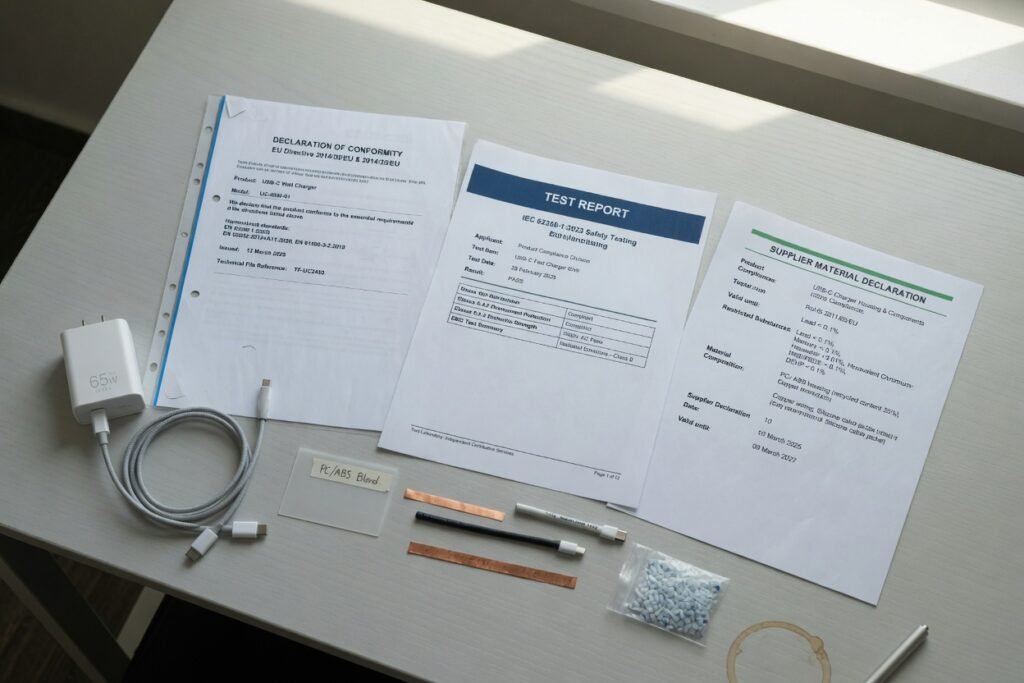
There are three main types of compliance documents that need to be prepared. Let’s make it clear first: K-RoHS does not require a special label on the product, as long as the documents are kept for inspection, no extra cost is needed for labeling.
- Declaration of Conformity (DoC): A Korean version of the compliance declaration issued by the responsible party, which must be based on real test data, and the issuing party shall bear legal responsibility.
- Test report: Priority is given to reports issued by laboratories with KOLAS (Korea National Accreditation Service) or ISO 17025 international laboratory accreditation qualifications. Reports from overseas laboratories need to be confirmed by the Korean importer to meet the requirements before they can be used for compliance declaration.
- Supplier Material Declaration: A statement of substance content issued by the upstream component supplier, which serves as supporting material for compliance.
Compliance Steps for Charging Products
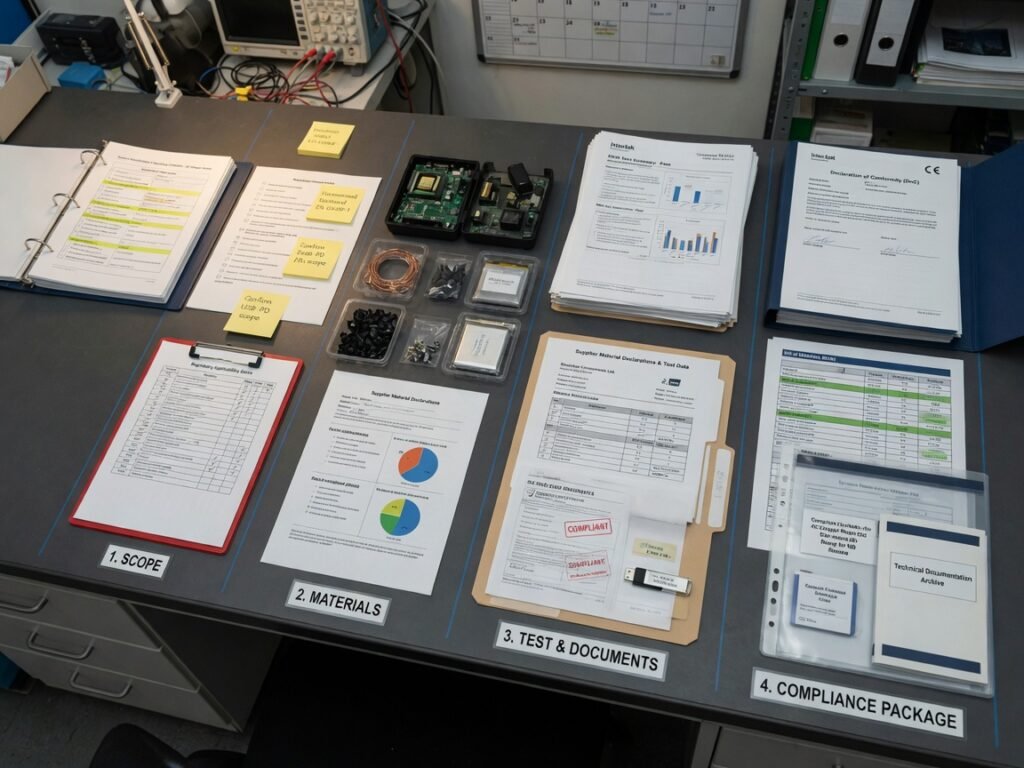
To achieve K-RoHS compliance for charging products, follow these four steps and you won’t go wrong:
- Confirm the scope of control: Check against the regulatory category list, combined with the import/sales method (sold separately or as a set accessory), to confirm whether the product is within the scope of control.
- Split homogeneous materials: Disassemble the product to the smallest mechanical disassembly unit, and sort out the material and use of each unit.
- Collect compliance materials: All homogeneous materials need to be covered by compliance documents; in practice, supplier-issued material declarations can be used for low-risk parts, and third-party testing should be prioritized for high-risk parts such as cable sheaths, solder, plating, and flame-retardant plastics. Testing of all parts has stronger compliance support.
- Organize the document package and keep it: Organize a complete compliance document package, issue a Declaration of Conformity (DoC) and keep it. The complete document package includes: BOM (Bill of Materials, listing all parts, materials, suppliers), homogeneous material split table, supplier material declaration, test report, DoC, product change records. Documents shall be kept for the number of years required by regulations after the product is discontinued, and can also be uploaded through the EcoAS system for inspection.
Change Management Rules
Many people easily ignore this point: as long as the product’s materials, suppliers, production processes, and models change, the compliance needs to be re-evaluated, and you can’t use one report all the time. Even for products of the same series, you cannot default to sharing the same report, you must confirm that the materials and structure are completely consistent before reuse. For example, if the same charger only changes the shell color and the plastic supplier remains the same, it is fine, but if the solder supplier is changed, it must be re-evaluated.
What is the difference between K-RoHS, EU RoHS and KC certification?
Many people confuse these three concepts. Let’s first list the core differences in a table, and then supplement the details:
| Comparison Dimension | K-RoHS (Korea) | EU RoHS | KC Certification (Korea · Charging Products) |
|---|---|---|---|
| Control Direction | Hazardous substances in materials | Hazardous substances in materials | Safety, electromagnetic compatibility, radio frequency (covering different sub-items according to product functions) |
| Core Logic | Limit judgment of homogeneous materials | Limit judgment of homogeneous materials | Product safety and performance compliance testing |
| Compliance Process | Enterprise self-declaration, keep documents for inspection, no special label required | It is a requirement for hazardous substances in electronic and electrical products under the EU CE access framework. Enterprises need to self-declare and establish complete technical documents. Regulated products need to affix the CE mark in combination with the overall CE compliance requirements, and RoHS has no separate exclusive mark | Covers multi-dimensional requirements such as electrical product safety, EMC, and radio frequency. The specific process is determined according to product category, function and applicable regulations. Compliant products need to affix the KC mark or complete the declaration according to the corresponding requirements |
| Scope of Application | Regulated electronic and electrical products in the Korean market | Regulated electronic and electrical products in the EU market | Regulated electronic and electrical products in the Korean market |
| Report Requirements | Third-party reports need to be recognized by Korean importers, and documents issued by laboratories with KOLAS/ISO 17025 qualifications are preferred | Manufacturers need to self-declare and establish complete technical documents. Third-party test reports are often used as compliance support, and laboratory qualifications need to meet EU regulatory or importer requirements | Report requirements vary for different compliance paths. Some categories require testing and certification by Korean designated institutions, and some can be self-declared by enterprises and retain test reports that meet the requirements. The specific shall be subject to applicable regulations |
Similarities and Differences with EU RoHS
The two have many similarities: the basic limit values, the judgment logic of homogeneous materials, and the core control ideas are consistent, after all, they are all regulations for hazardous substances in electronic and electrical products. But the core differences are also obvious: the scope of controlled categories is different, the exemption list is different, the labeling requirements are different, and the report recognition is different.
Never think that “complying with EU RoHS will definitely comply with K-RoHS” — if you use materials that are exempted by the EU but not by Korea, or the laboratory issuing the report does not meet Korean requirements, EU compliance documents are completely invalid in Korea.
Differences with KC Certification
These two are completely independent systems, and there is no overlap in the control dimensions: KC is Korea’s access system for electrical and electronic products, which may involve three types of requirements: safety, electromagnetic compatibility (EMC) and radio frequency according to product categories; ordinary wired chargers usually focus on safety and EMC, and wireless chargers or products with wireless transmission functions will involve radio frequency items. K-RoHS is an environmental requirement that only controls hazardous substances in materials.
KC-related requirements cover multiple dimensions such as electrical product safety, electromagnetic compatibility (EMC), and radio frequency. The specific compliance process needs to be confirmed in combination with product category, function and corresponding control catalog: AC adapters/power supplies included in Korea’s electrical product safety management catalog and meeting the rated range usually need to be processed according to the corresponding KC safety procedures; car chargers, charging cables, and products with wireless charging functions need to confirm the applicable compliance path in combination with specific functions and control requirements. Labeling and declaration requirements also vary according to the specific applicable procedures.
For charging products, entering the Korean market generally needs to meet both KC-related requirements and K-RoHS requirements, neither is dispensable.
Judgment Logic for Report Reuse
- EU RoHS test report: can only be used as internal reference, and cannot be directly used for K-RoHS declaration.
- Third-party test report: it can be used for K-RoHS compliance only after meeting three conditions: the laboratory qualification meets the requirements of the Korean side, the test method is compliant, and the homogeneous splitting rules are consistent, and after being confirmed by the Korean importer.
How to judge whether a compliance document is really valid?
Many suppliers will casually take a report to fool people, and learning these tricks can quickly judge whether the document is useful.
Key Points for Checking the Validity of Test Reports
There are five core check points:
- Check qualification: The laboratory issuing the report must have KOLAS or ISO 17025 qualification and be recognized by the Korean importer, otherwise no matter how good the report looks, it is useless.
- Check product: The product model and component list in the report must be completely consistent with the actually purchased/sold product, covering all components, and cannot be misappropriated.
- Check standard: The report must be judged by homogeneous materials and cover all current 10 controlled substances, not just lead and mercury.
- Check test method: XRF (X-ray Fluorescence Spectrometer) scanning can only do rapid preliminary screening of elemental substances such as lead, mercury, cadmium, total chromium, and total bromine. It cannot distinguish hexavalent chromium from other valence states of chromium, nor can it detect organic hazardous substances such as phthalates, PBB, and PBDE at all. Therefore, it can only be used for internal pre-screening or preliminary risk investigation in the supply chain, and cannot be used as a formal compliance judgment basis. Formal compliance testing needs to be based on the IEC 62321 series of standards, and confirm all controlled substances using corresponding chemical analysis methods, especially for items that XRF cannot accurately quantify or identify, such as hexavalent chromium, phthalates, and brominated flame retardants, special chemical testing must be done.
- Check validity period and applicable prerequisites: K-RoHS does not have an officially stipulated fixed validity period for test reports. Whether the report can continue to be effective depends entirely on two core prerequisites: first, the product’s materials, suppliers, production processes, and models have not changed in any way; second, the regulatory requirements such as K-RoHS’s controlled substance list, limit values, exemption rules, and test methods have not been updated. As long as any one of them changes, the original report may become invalid, and compliance needs to be re-evaluated. Some Korean importers may require regular rechecks, but this is an internal risk management requirement of enterprises, not a unified validity period stipulated by regulations.
Key Points for Checking the Validity of DoC
- Look at the declaring subject: The responsible Declaration of Conformity for K-RoHS shall be issued by the Korean domestic importer or manufacturer (i.e., the first responsible person stipulated by the regulations) and bear legal responsibility; self-declarations, material declarations or test reports issued by overseas brands and manufacturers can be used as supporting materials for the Korean responsible party to issue the DoC, and cannot directly replace the Korean responsible party’s declaration.
- Look at content completeness: The DoC must include the product model, the applicable regulatory standards, and the responsible person information, and cannot just write “compliant with K-RoHS”.
- Look at supporting documents: The DoC must have corresponding test reports and supplier material declarations as the basis, and a statement without evidence is meaningless.
Simple Risk Warning (For Procurement Reference Only, Not a Substitute for Testing)
You can initially screen high-risk products without testing. Note that the following are only for procurement reference and cannot be used as a basis for compliance judgment:
- Appearance and odor: If the plastic shell and cable sheath have obvious pungent odor, it can be used as a procurement risk signal, indicating that the material may have poor management of plasticizers, flame retardants or other volatile substances, but this judgment cannot replace RoHS testing, nor can it directly prove that the controlled substances exceed the standard.
- Metal parts: If the plating of plugs and USB interfaces has paint peeling or rust, it indicates that there is a risk in the plating process or anti-corrosion quality, and the material declaration and hexavalent chromium test report of the plating should be further verified; it is impossible to directly judge whether illegal hexavalent chromium plating is used only by appearance.
- Supplier qualification: Suppliers who cannot even provide basic K-RoHS compliance certificates have extremely high overall compliance risks, and cooperation is not recommended.
Pitfall Avoidance Guide for Common Scenarios
Typical Compliance Cases
Several of the most common scenarios, you can directly refer to:
- Individually sold USB-C PD fast charger: Clearly within the scope of control, needs separate compliance, focus on checking three high-risk parts: solder, plastic shell, and pin plating.
- Individually sold PVC USB-C charging cable: The Korean importer must first confirm whether it belongs to the category of regulated accessories in accordance with current regulations; if it is confirmed to be included in the control and sold separately, it needs independent compliance, focusing on checking the phthalate and cadmium content of the cable sheath.
- Mobile phone set with charger + cable: It only needs to be compliant together with the main product (mobile phone), and there is no need to issue a separate DoC for the cable, but the cable material must meet the standard, otherwise the entire set is non-compliant.
- Replacing the solder supplier: It is a key material change, the original test report is directly invalid, the compliance needs to be re-evaluated, and the entire compliance document package needs to be updated.
High-Frequency Cognitive Misconceptions
These 6 pitfalls are the most easy to step on, be sure to avoid them:
- Misconception: Having KC certification = complying with K-RoHS
Consequence: Missing environmental compliance, leading to customs detention or platform removal.
Correct approach: The two are independent control systems, and compliance documents need to be prepared and kept separately. - Misconception: Average compliance of the whole machine = compliance
Consequence: Exceeding the standard of a single homogeneous material is judged as unqualified, and the previous compliance work is wasted.
Correct approach: Check one by one according to the smallest detachable homogeneous unit, and if any unit exceeds the standard, the whole is non-compliant. - Misconception: K-RoHS requires a special label
Consequence: Wasting unnecessary labeling costs, and may be questioned due to inconsistent labels.
Correct approach: Only need to keep documents for inspection, no need to affix any special labels on the product or packaging. - Misconception: Only plastic parts need to be controlled
Consequence: Exceeding the standard of metal parts such as metal plating and solder is missed, leading to non-compliance.
Correct approach: In addition to plastic parts, focus on high-risk metal parts such as solder and metal plating. - Misconception: EU RoHS reports can be directly reused
Consequence: Compliance documents are not recognized by Korean regulators, and products cannot be cleared or sold.
Correct approach: Confirm the report qualification and scope of application in advance, and retest in time if they do not meet the requirements. - Misconception: The charging cable in the set does not need to be managed
Consequence: The material of the accessories in the set exceeds the standard, resulting in the entire set failing the compliance inspection.
Correct approach: All accessory materials in the set must meet the standard, and be compliant together with the main product, and no accessories can be missed.
Practical Suggestions for Pitfall Avoidance
Three simple and practical suggestions can help you avoid most problems:
- Before procurement, require suppliers to provide K-RoHS DoC and test reports that meet the requirements, don’t wait until shipment to ask, to avoid passivity.
- When checking the report, first confirm that the BOM and homogeneous material split table have covered all parts of the product, then prioritize in-depth inspection of high-risk parts such as cable sheaths, solder, and plug plating; you cannot only check high-risk parts and miss the material declaration or compliance coverage relationship of low-risk parts.
- As long as you change the supplier, material or production process, you must require the supplier to re-provide the compliance certificate and update the document package, don’t find it troublesome.
For beginners who have just been exposed to cross-border compliance, through this article, you can clarify the mandatory environmental attribute of K-RoHS, quickly judge the control scope of common charging products, identify high-risk parts and more than 3 common cognitive misconceptions, and meet the basic needs of daily supplier docking; if you need to handle advanced work such as actual compliance declaration and document review, you can also refer to the regulatory difference comparison, test report and DoC check methods, and simple risk prediction skills in the article to deal with basic compliance verification.
In general, the core logic of K-RoHS is to restrict toxic and hazardous materials in electronic and electrical products from the source of production, which not only reduces the long-term environmental impact of electronic waste, but also reduces the health risk of consumers’ daily contact. As long as you grasp the core principles of “first confirm the scope of control, separate judgment of homogeneous materials, the responsible subject is the Korean domestic importer/manufacturer, and independent of safety certification”, you can avoid most common compliance problems.