
If you do e-commerce in the North American market, or supply goods to U.S. customers, you have most likely heard of “UL testing”. When many people first encounter it, they regard it as a “product quality rating”, or think that passing the test means you can directly print the UL mark — these are common misconceptions. The core of UL testing is only one: to evaluate whether a product will cause safety accidents; as for function quality or durability, they are not within the scope of the test. Starting from basic definitions, this article sorts out the core requirements, implementation rules and common pitfalls of UL testing.
1. First, Get the Basics Straight: UL Tests Safety Risks, Not Quality
1. What Exactly is UL Testing
UL stands for Underwriters Laboratories. The “underwriters” in its name exactly points out its origin: it was initially a safety testing organization led by insurance companies to reduce claim losses from electrical fires and electric shocks. Today, it is one of the widely recognized safety testing, certification and standard-setting institutions in the North American market.
Its core logic is simple: to evaluate whether a product will cause safety risks such as electric shock, fire, overheating, and mechanical injury under normal use, as well as foreseeable abnormal or misuse scenarios defined by standards (such as output short circuit, blocked ventilation openings, pulled cables, etc.; specific abnormal scenarios are specified by the corresponding product standards).
It should be clarified first that a standalone UL test only issues results for the submitted samples, and is not equivalent to UL certification — this is the concept that beginners most easily confuse.
2. UL Testing and UL Certification Are Not the Same Thing at All
Many people confuse “UL test report” with “UL certification”. In fact, there are several links between the two. To use a simple analogy: UL testing is equivalent to a “single-subject quiz”, while UL certification is equivalent to “comprehensive evaluation of the entire semester + random daily attendance checks”.
The core differences are as follows:
- Testing is only the core pre-step of certification. A complete UL certification also includes document review, factory production process inspection, follow-up tracking services and factory inspections (the frequency and method are determined according to product category, certification scheme and factory status) to ensure that mass-produced products are consistent with the submitted samples.
- A standalone UL test report absolutely cannot be used with the UL mark directly. If found by Amazon platform or U.S. regulatory authorities, the lightest consequence is product removal, and the heaviest is facing compliance penalties.
- Testing only verifies that the submitted samples meet the standards, while certification is the recognition of the mass production consistency of the entire product.
- After product modification, certification requires supplementary testing + review, while a standalone test report only corresponds to the submitted samples and has no follow-up supervision effect.
In short: if someone tells you “we have a UL report”, first ask clearly whether it is a “test report” or a “certification certificate”. The validity, cycle and cost of the two are usually very different, and they cannot be used interchangeably.
3. Which Products Need UL Testing
Not all products need UL testing. Its scope of application is very clear: consumer or industrial products that are sold in the U.S./North American market, are electrified/generate heat/have mechanical risks.
Common examples such as mobile phone chargers, small home appliances, lamps, lithium batteries, power cords, plugs and sockets are all within the scope; fire-resistant materials or fire-resistant building materials may involve UL’s specific performance evaluation or Classified category, depending on the use and customer requirements.
There are two sources of requirements: one is statutory mandatory, for example, some categories are included in mandatory requirements by OSHA (Occupational Safety and Health Administration, which manages workplace safety) and CPSC (Consumer Product Safety Commission, which manages civilian product safety) in the U.S.; the other is channel mandatory, for example, platforms such as Amazon and Walmart will not allow products to be listed without uploading a UL report, even if there is no clear legal requirement.
Of course, there are exemptions: daily necessities that are completely non-electrified and have no safety risks (such as ordinary plastic water cups, pure cotton towels), as well as products for personal use and not for sale, do not need UL testing.
4. 4 Boundaries Beginners Must Know
Beginners who are new to UL need to pay attention to the following 4 core boundaries to avoid common cognitive deviations:
- Passing UL testing ≠ usable globally: It only corresponds to the safety requirements of North America. Certifications from other regions such as CE in the EU and PSE in Japan have their own standards and are not mutually applicable.
- UL Recognized component certification ≠ automatic pass for the whole machine: For example, the power module you bought has UL component recognition, but installing it in your own desk lamp does not mean the desk lamp does not need to be tested — after the component is installed in the whole machine, heat dissipation, wiring, and safety distances may change, and must be re-evaluated in combination with the whole machine scenario.
- Laboratory pre-test pass ≠ official UL test pass: Many manufacturers do pre-tests first to eliminate risks, which is a good thing, but pre-tests have no official UL validity, cannot be shown to platforms or customers, and even less can be advertised as “passing UL testing”.
- Similar products passing UL ≠ current model will definitely pass: Even if the appearance is exactly the same, as long as the internal structure, materials, or rated parameters change, the test results may be different. Do not directly copy the conclusions of competing products.
2. Choosing the Right Standard Prevents Wasted Effort: The Core Basis of UL Testing
Many people think UL has a “universal standard”, but that’s not the case at all — each category has its own exclusive safety pass line. If you choose the wrong standard, after spending money and time, the report will be just a piece of waste paper.
1. What Exactly are UL Standards
UL standards are jointly formulated by UL together with industry representatives, regulatory authorities, and consumer representatives. One category corresponds to one set of standards, and there is no universal “UL standard”. Standards are updated regularly; for example, when new product forms or new accident types appear, requirements will be adjusted. Testing must use the currently effective version, and reports of old versions will become invalid after the transition period.
Here are some standard references for common categories (the specific shall be subject to the judgment of official or authorized laboratories): ordinary lamps commonly use UL 1598; UL 62368-1 is common in audio-visual, information technology, communication technology equipment and related power supply scenarios, and does not cover all power supply products; battery products may involve different standards such as UL 62133, UL 1642, UL 2054 depending on the cell, battery pack, and energy storage/power use.
2. 3-Step Method for Entry-Level Standard Selection
Beginners don’t need to memorize standards by rote. Following these three steps will basically not go wrong:
Step 1, Match core functions and categories: If it is a multi-functional product, it must cover all functions with safety risks. For example, a desk lamp with USB charging must cover both the safety requirements of lamps and the safety requirements related to power supplies; in practice, it may be the whole machine lamp standard superimposed with the requirements of built-in power supplies/adapters, charging modules or key components, which is judged by the laboratory according to the structure and power supply method, not simply applying two complete standards.
Step 2, Match sales region: When selling to the U.S., Canada, or covering both the U.S. and Canada, the authorization scope of the report and mark should be confirmed. For example, different mark combinations such as UL, cUL, cULus correspond to different applicable regions; whether a product can be used in Canada depends on the specific certification scope, and you cannot default to general applicability just because there is the UL word on the report. Don’t test a standard corresponding to a single region and end up unable to use it in other regions.
Step 3, Confirm with the official if you are unsure: Directly check the UL official database, or consult a UL-authorized laboratory. Don’t directly copy competing products — if the competing product chose the wrong one, you will follow suit and fall into the pit.
3. Mandatory Attribute of Standards: Channels May Be Stricter Than Laws
Many people think UL is all statutorily mandatory, but that’s not the case: only some standards are included in mandatory requirements by OSHA and CPSC, and the rest are industry voluntary standards. However, channel merchants and large customers often take it as an access condition, which may be more common than legal requirements in actual implementation.
Whether mandatory or voluntary, a report with the wrong standard or version is completely invalid — there is no room for negotiation on this point.
3. What Exactly Does UL Testing Test? 6 General Safety Inspection Dimensions
UL testing items may seem numerous, but their core is all around “preventing safety risks”. Summarized, they are 6 dimensions, each with clear inspection logic:
1. Electrical Safety: Preventing User Electric Shock
In plain language: check whether places that people can touch are live, whether insulating materials are strong enough, and whether there will be electric leakage.
Core inspection points include: the “safety distance” between live parts and touchable areas (the distance along the insulating surface is called creepage distance, and the straight-line distance in air is called clearance; you don’t need to memorize the terms, just know that enough safety margin is reserved); the voltage withstand capability of insulating materials (apply high voltage to see if it will break down and leak electricity); whether the leakage current of touchable parts will hurt people; for products with grounding function, whether the grounding is firm.
The most common reasons for failure: insulating material is too thin, live parts are too close to the shell, grounding terminals are loose.
2. Fire and Flame Retardant Safety: Preventing Fire and Fire Spread
In plain language: check whether the product itself is easy to burn, and whether it will drip fire when burning and ignite surrounding things.
Core inspection points include: the flame retardant grade of the shell, internal plastic, circuit boards, and wires; simulate two fire scenarios — internal short circuit fire, external fire source contact, to see if the product can control the fire; whether burning will produce flaming drips that ignite surrounding items. It should be noted here that the flame retardant grade does not only depend on the material model, but also is judged in combination with material thickness, use position, and operating temperature. For the same plastic, a thin version may not meet the standard.
The most common reasons for failure: insufficient flame retardant grade of shell plastic, insufficient flame retardancy of wire sheaths.
3. Temperature Rise and Abnormal Operation Safety: Preventing Overheating and Explosion
In plain language: check whether the product will get too hot and catch fire, or even explode, during normal use or even when there is a minor fault.
Core inspection points include: during normal full-load operation, the temperature of the shell, internal components, and insulating materials must not exceed the safety limit — note that you cannot judge by “whether it feels hot to the touch”; it must be measured with instruments at the positions specified by the standard. Some positions feel hot but meet the standard, while some that are warm may instead exceed the limit. Various abnormal scenarios must also be simulated: motor locked rotor, output short circuit, blocked ventilation openings, single component failure, to see if they will cause safety problems. Battery products also need additional testing for thermal runaway risk, that is, whether the battery will explode or catch fire when it fails.
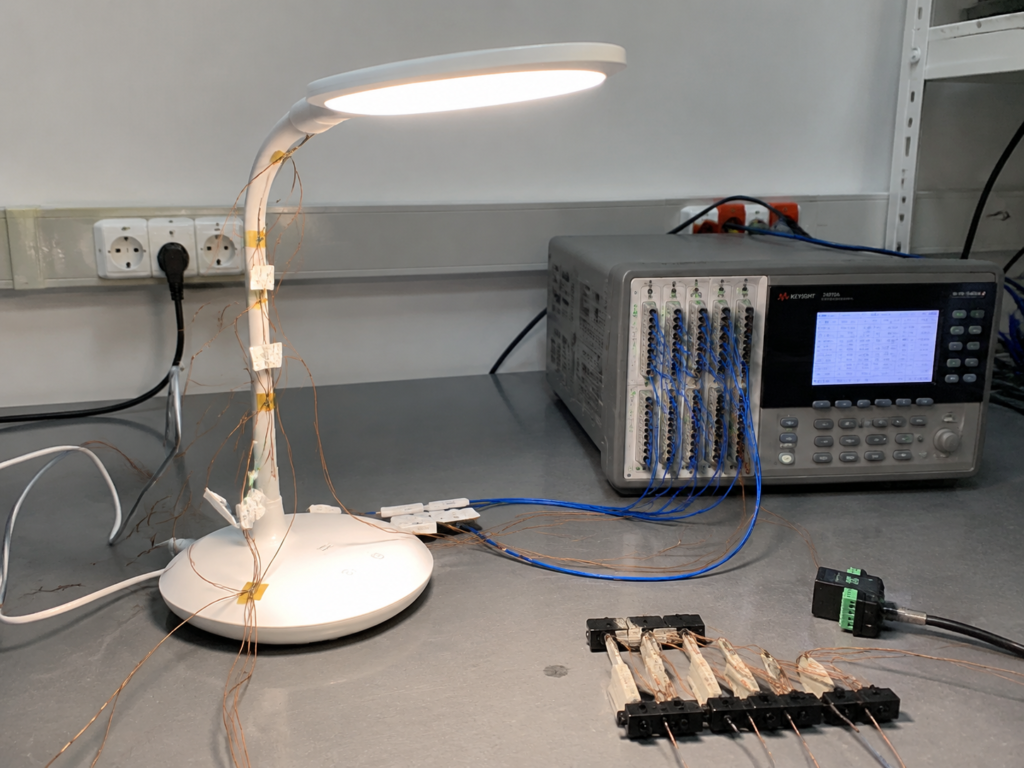
The most common reasons for failure: poor heat dissipation design, failure of battery protection circuit, false power rating.
4. Mechanical Safety: Preventing Physical Injury
In plain language: check whether it will cut or pinch people, and whether live parts will be exposed after falling or impact.
Core inspection points include: protection of sharp edges and moving parts (for example, fan grilles must not allow fingers to reach in and touch the blades); drop, impact, and pull tests (for example, whether the power cord will fall off and expose copper after being pulled a few times); if it is a product accessible to children, additional checks are needed to see if small parts are easy to fall off to avoid accidental ingestion.
The most common reasons for failure: insufficient power cord pull resistance, too large shell openings that make it easy to touch internal components, edges that are too sharp.
5. Environmental Tolerance Safety: Safety and Stability in Different Environments
In plain language: check whether the safety performance of the product will fail in environments such as humidity, cold and heat.
Core inspection points include: insulation performance in humid environments (for example, bathroom lamps must not leak electricity due to heavy steam); whether structure and fire performance will change in high and low temperature environments; outdoor products also need additional testing for waterproof, sun protection, and weather resistance to ensure that they will not crack or let water in after long-term outdoor use.
The most common reasons for failure: insufficient moisture-proof grade of bathroom lamps, poor shell sealing of outdoor products.
6. Labeling and Instruction Safety: Avoiding User Misuse
Many people think this item is not important, but in fact UL attaches great importance to it — if the labeling is unclear or the instructions are wrong, user misuse can also cause safety accidents.
Core inspection points include: whether labels such as rated voltage, current, and power are clear, wear-resistant, and placed in obvious positions; whether necessary safety warnings are accurate and easy to understand; whether the instruction manual covers safety tips for installation, use, and maintenance; the parameters on the label must be consistent with the actual operating parameters, and must not be falsely marked.
The most common reasons for failure: label parameters do not match the actual situation, lack of safety warnings, labels come off as soon as wiped.
Actual testing will split the above dimensions into specific items according to category standards. Not every product undergoes exactly the same tests, and the specific shall be subject to the requirements of the corresponding standard.
4. Basic Rules to Know Before Submitting Samples for Testing
If you want to do UL testing, figuring out these rules in advance can save you a lot of detours, time and money.
1. Basic Requirements for Submitted Samples
First, the samples must be regular products in mass production state. You cannot specially use good materials or modify a few “test-only samples”. Once discovered, the test will be directly invalidated.
The number of samples depends on the category and standard, usually ranging from a few to dozens. The higher the risk of the product, the more samples are needed. For example, lithium batteries may require dozens, while ordinary plugs may only need a few.
If it is a series of products with multiple models, the differences between different models must be clearly listed, and the laboratory will judge whether the test can cover them — for example, if only the appearance color is different and the interior is completely the same, the test may be shared; if the power or structure changes, it will not work.
2. Qualification Requirements for Testing Institutions
Formal reports used in the UL certification process or claiming compliance with UL standards shall be issued by UL official laboratories or third-party laboratories with the corresponding UL standard authorization scope; internal self-testing of enterprises and results from laboratories without corresponding authorization can only be used as R&D reference and have no UL recognition validity.
Here we mention the NRTL (Nationally Recognized Testing Laboratory) system: this is a third-party testing institution system officially recognized by OSHA in the U.S., and UL itself is one of the NRTLs recognized by OSHA. It should be noted that NRTL recognition is mainly used for workplace product safety scenarios under OSHA’s jurisdiction; whether a specific report is accepted by platforms, customers, or the UL certification process also depends on whether the laboratory has the authorization qualification for the corresponding UL standards and items.
Verifying qualifications is simple: directly go to the UL official website to check the laboratory’s authorization qualifications. If you can find it, it is formal.
3. Core Materials to Prepare Before Submitting for Testing
Don’t wait until you send the samples to find that the materials are incomplete, which delays time. Generally, the following types of materials should be prepared before submitting for testing:
- Basic product information: specifications, instruction manual, label drawings, rated parameter description;
- Structure and circuit information: circuit diagram, product structure drawing, bill of materials (BOM);
- Component information: certification documents for key components (such as power modules, fuses), as well as UL yellow cards for materials (if available — the yellow card is a certification of flame retardant and temperature resistance performance issued by UL for materials. Having it can reduce some material tests; it’s okay if you don’t have it, you just need to test a few more items);
- Factory information: mass production address, quality control description (may not be needed if only doing testing, but need to be prepared if you want to do UL certification later).
4. 4-Step Self-Inspection Before Submitting for Testing: Eliminate Risks in Advance to Save Costs
Many test failures are actually low-level mistakes. Checking by yourself before submitting for testing can avoid a lot of unnecessary retest costs:
Step 1, Check labels: The rated parameters on the label are consistent with the actual design, safety warnings are complete, and the label is firmly pasted and cannot be wiped off.
Step 2, Check structure: Touchable metal parts have no live risk, shell openings do not allow fingers to touch internal components, and the power cord is firmly fixed.
Step 3, Check materials: The temperature resistance and flame retardant grade of materials near heating components meet the requirements, and will not melt as soon as heated.
Step 4, Check protection: The models and specifications of key protection devices (fuses, thermostats) are clear and not used incorrectly.
5. Test Result Judgment and Validity Period Rules
The judgment logic of UL testing is very strict: passing is only achieved when all items meet the standard; one failure means overall failure — but it is not a one-time final decision. You can retest after rectification. If it is a very slight difference, you can also apply for UL evaluation, and it can be deemed as meeting the requirements after approval.
Regarding the validity period, many people ask “how many years is the UL report valid for”. In fact, there is no unified universal validity period: the report only corresponds to the model, version, test standard and specific conditions of the submitted samples; after product modification, changes in key materials/structures/parameters, or the end of the transition period for standard version updates, the laboratory or corresponding channel needs to evaluate whether the original report is still applicable, and supplementary testing or retesting is required if necessary. Different channels have different time limit requirements for reports. For example, some platforms commonly require reports within 1-3 years, depending on the corresponding rules.
5. Key Conditions Affecting Test Conclusions (Semi-Proficient Judgment)
Many people think that “passing UL testing means it’s done once and for all”, but that’s not the case. When many conditions change, the test conclusion no longer applies. Understanding these, you can judge many problems by yourself, without asking the laboratory for everything.
1. Product Category and Applicable Standard: Wrong Choice Means Direct Invalidity
Different categories (lamps/power supplies/home appliances/batteries) correspond to completely different UL standard systems, and even a single word difference is not allowed. Multi-functional products shall determine the main standard according to the main function and highest risk, and may need to cover multiple standards.
In addition, after the standard version is updated, the old version of the report will have a transition period, and will become invalid after the transition period ends. At that time, it needs to be retested according to the new version.
2. Use Environment and Installation Method: Requirements Change with Risk Scenarios
The same product, used in different scenarios, has completely different test requirements:
- Indoor/outdoor, dry/humid, household/commercial/industrial scenarios, requirements increase in order;
- Safety distance and flame retardant requirements are also different for user-accessible areas and closed installation areas that people cannot touch (such as power supplies in ceilings);
- The wider the claimed use scenario of the product, the more test items need to be covered, and the higher the cost.
3. Rated Parameter Level: The Higher the Power, the Stricter the Safety Boundary
The higher the voltage, current, and power, the greater the risk of electric shock and heating, and the stricter the test limits. For example, a 10W mobile phone charger and a 100W fast charger have completely different levels of requirements for insulation, heat dissipation, and wires.
Some people may think “then if I mark the rated power lower, is it easier to pass” — theoretically yes, but you absolutely must not falsely mark it: if the actual power is higher than the label, it will be unqualified if found, and users may also have safety problems when using it according to the low power, which is not worth the loss.
4. Structure and Material Changes: Small Changes May Cause Result Invalidity
Many people think “I just changed the plastic supplier, and the color changed from black to white, it should be fine”, but that’s not necessarily the case. The following changes all require re-evaluation of whether the test conclusion is valid:
- Changes in key components such as shell materials, PCB layout, power modules, wires, fuses;
- Changes in material thickness, color, processing method (may affect flame retardant and temperature resistance performance);
- Supplier change (even if the material model is the same, product performance from different manufacturers may vary).
In practice, it can be judged according to the following principle: as long as the change involves live parts, fire-resistant materials, or heat dissipation structures, don’t make a decision by yourself, directly consult the laboratory to avoid problems later.
5. UL Recognition Status of Components: Affects the Whole Machine Test Scope
Components with UL recognition can indeed help save some test costs for the whole machine, but it’s not “everything is fine once you have it”. First understand three common types of UL recognition:
- UL Listed: Certification for complete finished products, which can be sold directly to end users. For example, the power strip you buy in a supermarket with this mark means the whole machine has passed certification.
- UL Recognized: Certification for components, which can only be used installed in the whole machine, cannot be sold separately to end users, and does not mean that it will meet the requirements when installed in the whole machine; it needs to be evaluated in combination with the whole machine scenario.
- UL Classified: Certification for specific performance/limited use. For example, a material has only passed fire performance certification, with a limited scope of application, and cannot be regarded as full-item certification.
In short: a component with a UL mark does not mean that its installation method, rated value, and use environment meet the requirements of your whole machine, but using recognized components can indeed reduce the items and costs of whole machine testing.
6. How to Read a UL Test Report: It’s Not Just About Pass/Fail
Many people turn to the first page of the report to see if there is a Pass. In fact, there are a lot of details in the report. Only by understanding it can you avoid the pitfalls of fake reports and certificate fraud.
1. Core Identifiers of a Valid UL Test Report
A formal and valid UL test report must have at least these core identifiers:
- It has the mark of a UL-authorized laboratory, and clearly marks the standard number used for testing, sample model parameters, and test date;
- It has the laboratory’s qualification number and the tester’s authorized signature;
- It is attached with complete test items, test conditions, measured data and judgment results, and cannot only have a “pass” conclusion;
- The sample photos, structure description, key component list, and standard version/date in the report should correspond to the current sales model.
2. 4 Checkpoints to Quickly Judge Whether a Report is Usable
Whether a supplier gives you a report, or you need to submit the report to the platform, checking according to these four steps will basically avoid pitfalls:
Step 1, Check match: Whether the product model, test standard, and sales region are consistent with the actual situation — for example, if you want to sell to Canada, and the report is a U.S. standard, it is useless.
Step 2, Check results: Turn to the test details page to see if all items have passed, and whether there are unclosed unqualified items. Don’t just look at the Pass on the cover.
Step 3, Check qualification: Whether the institution issuing the report is on the list of UL official authorized laboratories. You can find out by checking the official website.
Step 4, Check restrictions: Whether there are restrictive conditions in the report such as “only for specific installation methods” or “only for use with specified components”. If there are, and your actual use does not meet them, the report is invalid.
3. Correctly Understand the Boundaries of the Pass Result
Don’t take it for granted after getting a Pass report. Its validity has boundaries:
- Pass only means that the submitted samples meet the safety requirements under the specified standards and specified conditions, and does not mean that products of other models, other materials, or produced by other factories also meet the requirements;
- It does not mean that the product has excellent performance and long service life — UL does not evaluate function, durability and user experience;
- It does not mean that it covers other regulatory requirements such as FCC, energy efficiency, and environmental protection; those are managed by other departments.
4. Classification of Common Reasons for Fail Results
Don’t panic if the test fails. First see what kind of problem it is, and solve it targeted:
- Design problems: Insufficient safety distance, poor heat dissipation, insufficient structural strength. Need to adjust the design and then retest;
- Material problems: Mismatched flame retardant grade, temperature resistance grade, insulation grade. Need to replace or reconfirm materials that meet the conditions of thickness, temperature resistance, flame retardancy and supplier, and evaluate whether it affects other test items;
- Document problems: Drawings, BOM, labels, instruction manuals are inconsistent with the samples. Need to adjust the documents to make them completely consistent with the samples and mass production state, and supplement sample verification if necessary;
- Sample problems: Assembly deviation, use of substitute materials, samples are inconsistent with mass production. Need to replace with correct samples that meet the mass production state and retest.
5. Common Report Pitfalls
UL reports on the market are mixed. These pitfalls must be avoided:
- Fake reports: Forged by Photoshop, or issued by unqualified laboratories. Can be identified by checking the laboratory’s qualification;
- Certificate fraud reports: Using reports from other models or other manufacturers, changing the model to pretend to be yours. Can be found by checking the product photos, structure, and parameters in the report;
- Partial test reports: Only tested a few items, for example, only tested electrical safety, not fire protection, which does not cover all safety requirements at all and is useless;
- Expired reports: The standard has been updated, or the product has been modified, and the report is no longer applicable. Even if it was real before, it is useless now.
7. Boundary Clarification and Common Pitfall Avoidance
1. Core Boundary of UL Testing: Only Tests Safety, Nothing Else
UL testing only verifies safety risks, does not cover other compliance requirements such as electromagnetic compatibility (under FCC jurisdiction), energy efficiency, and environmental chemical restrictions (such as RoHS), and cannot replace other types of compliance certifications.
2. Differences Between UL and Other Common U.S. Compliance Requirements
Many people confuse UL with other U.S. certifications. Here is a simple comparison:
- vs FCC certification: UL manages safety (electric shock, fire, etc.), FCC manages electromagnetic interference (for example, whether the product will interfere with radios, WiFi). Electrified products usually need both.
- vs FDA certification: UL manages the safety of ordinary products, FDA manages the safety related to food, medical care, and cosmetics. The jurisdiction scope is completely different.
- vs CSA certification: UL is a U.S. institution, CSA is a Canadian institution. Some UL certifications can cover Canada at the same time (with cUL or cULus mark), so they can be used in both the U.S. and Canada.
3. The 5 Most Common Misconceptions
- Materials with UL yellow cards must be qualified? Wrong. The yellow card only proves the performance of the material under specific conditions, and must be judged in combination with thickness, use position, and whole machine standards. For example, if the 2mm thickness on the yellow card meets the flame retardant standard, using 1mm thickness will not work.
- Can you advertise UL certification if the pre-test passes? Wrong. Pre-test is only used for risk elimination. Only after passing the official test + complete certification can the UL mark be used. Violations will result in platform removal and regulatory penalties.
- If one model passes, the whole series automatically passes? Wrong. Series coverage depends on whether the difference affects safety. Changes in power, materials, and structure all require re-evaluation.
- UL testing only tests the electrical part? Wrong. Shell, plastic, labels, instruction manuals, mechanical structure are all within the test scope. It’s not that if the circuit is fine, it will definitely pass.
- Getting the UL mark means it’s done once and for all? Wrong. UL certification has follow-up tracking inspections. The factory must keep materials and processes consistent with those at the time of submission. If changes are not declared, the certification will become invalid, and even penalties will be imposed.
8. Core Judgment Abilities You Can Master After Learning
After reading this article, readers with different needs can master different levels of abilities:
Entry Level (Covers 70% of Core Content)
- Can quickly judge whether a product needs UL testing;
- Can state the 6 core safety inspection directions of UL testing;
- Can prepare basic materials and samples for UL testing according to the list;
- Can identify the basic authenticity of UL test reports.
Semi-Proficient Level (Covers 30% of Advanced Content)
- Can judge the applicability and restrictive conditions of UL test reports;
- Can judge whether product changes require re-doing UL testing;
- Can avoid common pitfalls of UL testing and certification, and not be misled by false publicity;
- Can initially distinguish the differences between UL and other U.S. compliance requirements.
In general, UL testing may seem to have many items and detailed rules, but its core logic is actually very simple: around the possible safety risks of the product, verify item by item according to the standards of the corresponding category. The scope of application of UL test reports is limited by multiple conditions such as product model, materials, and test standards. When products are changed or standards are updated, re-evaluation is required, and there is no universal conclusion of “one test for all time”.