
Merchants, purchasers, and even ordinary consumers who engage with the North American market are mostly familiar with UL certification — it is almost the “passport” for product safety in the North American market. But many people do not know that the validity of UL certification is not a once-and-for-all matter after obtaining the certificate; it is inseparable from an often overlooked link: the Follow-Up Service (FUS). Some people compare it to a “long-term on-duty check” for UL certification — the expression is rough but the point is valid: it is a necessary prerequisite for maintaining the validity of UL certification, not an optional add-on service. It should be noted that FUS is not a separate certificate, but an integral part of the entire UL certification system — without effective FUS, UL certification is not considered valid.
First, get it straight: What exactly is FUS?
Many people confuse FUS with initial certification, but in fact, the two have completely different positioning:
| Comparison Dimension | UL Initial Certification | UL Follow-Up Service (FUS) |
|---|---|---|
| Stage | Access stage before obtaining certification | Mass production and certificate-holding stage after obtaining certification |
| Core Purpose | Verify whether submitted samples meet safety standards | Verify whether mass-produced products remain consistent with certified samples |
| Inspection Content | Full-item safety testing | Focus on consistency verification, with spot testing only for core safety items |
| Nature | One-time access assessment | Long-term continuous supervision |
Why does UL set up such a “long-term on-duty check”? In the early years, UL also encountered situations where “submitted samples are perfect, but mass production cuts corners” — for example, using flame-retardant enclosures for submission, but replacing them with ordinary plastic in mass production; using thick copper wires for submission, but replacing them with thin ones in mass production. When such products flow into the market, they can easily cause safety accidents, and over time, the credibility of UL certification will be damaged. In addition, retailers, insurance companies, and customs in the North American market all regard UL certification as a core reference basis. If certified products are actually unsafe, the trust of the entire commercial chain will be compromised. Therefore, the core role of FUS is to reduce the risk of mass-produced products deviating from certified samples and certification files, reduce the problem of “passing submission but failing mass production”, and maintain the credibility of UL certification through continuous supervision, on-site verification, and necessary spot testing.
A common misunderstanding should be particularly clarified here: FUS is not a mandatory regulation of the U.S. federal government. The entity providing UL certification services is an independent third-party safety certification agency, not a U.S. federal government department. The requirements for FUS come from the certification service agreement signed between the manufacturer and UL and the rules of the UL certification system, which are contents agreed upon in commercial contracts. But this by no means means that FUS is “optional” — under the premise that retailer procurement terms, insurance requirements, project specifications, or specific import scenarios explicitly require valid UL certification, certification invalidation caused by FUS failure may lead to actual commercial impacts such as customs clearance obstruction, channel delisting, contract breach, and unfavorable insurance assessment, and its binding force is no weaker than that of some mandatory requirements.
Which products require FUS? What situations are exempt?
As long as a product has obtained official UL certification, is still being produced and sold, and uses the UL mark, it must accept FUS. The UL certification here includes three most common types:
The first type is UL Listing, which is the most familiar finished product certification. For finished products such as home appliances, mobile phone chargers, and lamps, after passing Listing certification, they can be affixed with the complete UL Listing mark, indicating that the product meets all safety standards.
The second type is UL Recognized Component, which targets components in finished products, such as power cords, PCB boards, and insulating materials. The mark of this type of certification is incomplete and can only be used on components, and cannot be directly affixed to finished products for external sale.
The third type is UL Classification. This type of certification only targets a specific safety performance of the product, for example, only certifying fire resistance performance, not covering all safety items, so its application scenarios are relatively limited.
Common categories that require FUS cover a wide range, including home appliances, consumer electronics, lamps, industrial safety components, and almost all products with UL certification are within the scope. As long as the product is still produced, sold, and uses the UL mark, it must continue to accept FUS.
There are three types of situations that are not included in the scope of regular FUS coverage:
The first type is products whose certification has been suspended, revoked, or voluntarily cancelled. Such products are no longer in a valid certification state where they can be normally labeled and sold, so they are not included in the regular FUS scope as certified mass-produced products; if you want to resume or re-use the UL mark, you need to complete rectification, resume certification, or re-apply in accordance with UL’s written requirements. It should be noted that when the certification is in the above state, the product shall not continue to use the UL mark without authorization; whether the produced inventory products can continue to circulate and how to handle the labeled products shall be strictly implemented in accordance with UL’s written requirements and the rules of the corresponding sales channels.
The second type is products that have only undergone UL consultation and testing but have not obtained official UL certification, for example, only asking UL to issue a test report without going through the complete certification process.
The third type is customized single-piece products that are only used for internal use or specific project delivery, have not obtained official UL certification, and do not bear the UL certification mark. Such products do not enter the open market for circulation and are usually not within the scope of FUS coverage; however, if the single-piece or small-batch customized product has been included in the UL certification scope and uses the UL mark, it still needs to accept follow-up inspection in accordance with the requirements of the certification agreement.
FUS inspections are divided into two trigger scenarios: one is regular periodic inspection, that is, UL conducts inspections according to a pre-scheduled plan, which is the most common type; the other is special trigger inspection, which is a temporary surprise inspection. For example, if UL receives consumer safety complaints, fails market spot checks, the factory makes major changes without reporting, or a product safety accident occurs, UL will temporarily launch an inspection.
The inspection objects of FUS are not only the certified brand owners, but also the contract manufacturers that actually produce the products are within the inspection scope. If one UL certification corresponds to multiple production factories, all authorized production addresses will be spot-checked, not only the headquarters or the brand owner’s office. Another point that is easily overlooked: changes in key component suppliers will eventually translate into FUS compliance risks for the manufacturer — even if the replaced part itself has UL certification, as long as it is not updated in the certification file, it will still be found unqualified on the manufacturer’s side. For example, if you are a power supply manufacturer, you privately replace the Brand A power cord in the certification file with Brand B, which also has UL certification, without telling UL, it will still be considered a violation during FUS inspection.
How is FUS conducted? What are the processes and rules?
FUS on-site inspections are usually carried out by on-site inspectors who are directly under UL’s official authority or formally authorized by UL and have professional qualifications for the corresponding product categories, in accordance with the corresponding inspection procedures. Official FUS conclusions are only issued by the UL system. Ordinary third-party intermediaries, testing companies, and consulting agencies have no right to replace UL in conducting inspections or issuing qualified results; enterprises should not readily believe service claims such as “we handle FUS inspections for you” or “guaranteed FUS pass”. Such institutions can at most provide compliance guidance and cannot replace UL’s official inspection.
There is no unified answer as to whether the inspection will be notified in advance, which depends on the product risk level and the factory’s past compliance records. Most high-risk products (such as power strips, water heaters, power tools, which are prone to safety accidents) are subject to surprise inspections without prior notice, and inspectors may arrive directly at the factory gate; for low-risk products, or factories with particularly good past compliance records, UL may inform the approximate time range in advance.
There is also no fixed unified standard for the frequency of inspections. UL will determine it based on three factors: first, the risk level of the product itself, the higher the risk, the more frequent the inspection; second, the factory’s past compliance records, those that have had problems before will be subject to stricter inspections; third, the production scale and number of factories, the larger the output and the more factories, the higher the inspection frequency may be. Common frequencies are quarterly, semi-annual, and annual. For high-risk or poor compliance cases, it may be more frequent. The specific notification method and inspection frequency shall be subject to the follow-up inspection procedures of UL’s corresponding product category number (CCN), product risk level, and factory’s historical compliance records. The quarterly, semi-annual, and annual frequencies mentioned in this article are only common industry ranges, not unified fixed rules of UL.
The FUS inspection process is actually very clear, generally divided into five steps:
The first step is scheduling initiation: UL will schedule the inspection plan in advance according to the inspection procedures corresponding to each product category number (that is, the rule number assigned to each product category within UL, referred to as CCN for short).
The second step is on-site verification: after arriving at the factory, the inspector will first verify the factory’s identity and address, confirm that it is the production address covered by the certification, and then review the factory’s production and quality-related records.
The third step is sampling verification: the inspector will randomly draw samples from the end of the production line or the finished product warehouse, and check the product details item by item against the certification files archived by UL to confirm that they are consistent with the originally submitted samples.
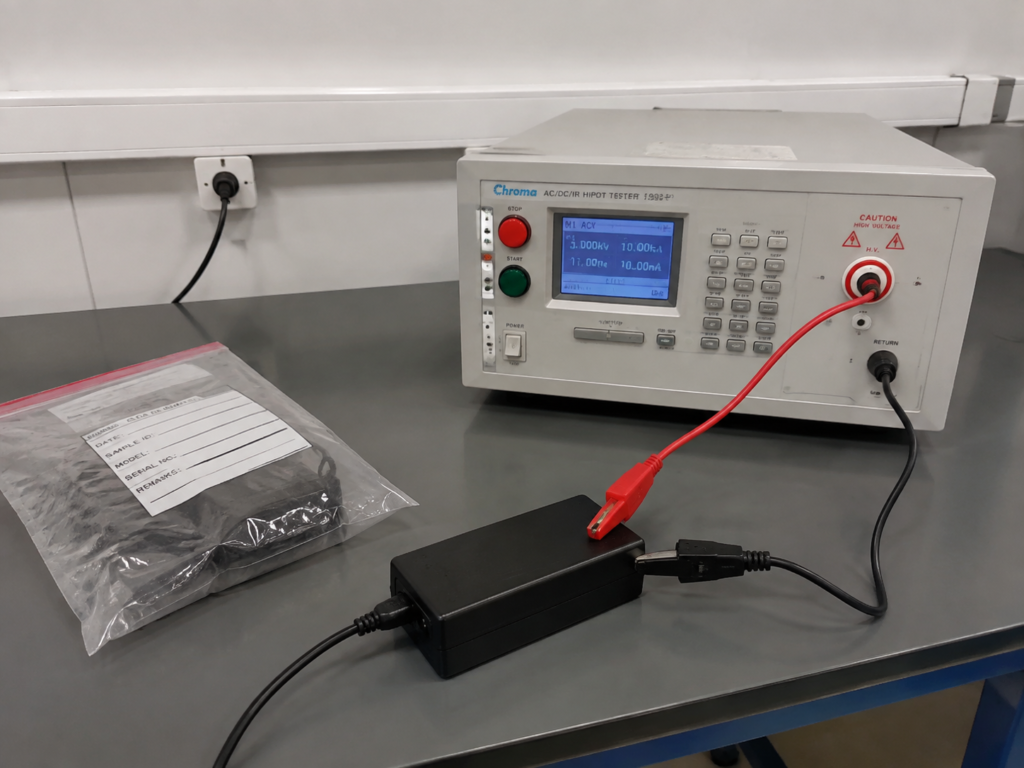
The fourth step is sealed sample spot testing (optional): if doubts are found during on-site verification, or the product is already in UL’s regular spot testing plan, the inspector will seal the samples and send them to UL’s official laboratory for testing. Spot testing will not cover all items, only core safety indicators.
The fifth step is result feedback: after the inspection, the inspector will give a preliminary opinion on site, but the official result shall be subject to UL’s written notice. If there are unqualified items, a Notice of Discrepancy (referred to as NOD for short) will be issued at the same time.
In terms of fees, the regular FUS inspection fees are generally borne by the certified factory or the certification applicant. UL does not have a public unified price list. The specific fee will be determined according to the product category and the complexity of the inspection. The usual composition includes: basic inspection service fee, plus spot testing fee if there is spot testing, plus re-inspection fee if re-inspection is required due to non-conformity, and the inspector’s travel costs (if involved).
What does FUS mainly check? Focus on these areas
Although FUS inspection content seems to be a lot, the core is all around “whether mass-produced products are consistent with certification requirements”, which is mainly divided into four major parts:
The first part, and also the most important, is product consistency verification. This is the core focus of FUS, and many manufacturers stumble here. It should be clarified here: the main judgment basis for FUS is UL certification files, the follow-up inspection procedures of the corresponding CCN, and applicable standard requirements; enterprise internal standards, or the consistency of product appearance and function with submitted samples, cannot replace these official bases. Consistency verification is divided into three aspects:
First, structural consistency: for example, the key dimensions of the product, assembly method, number of insulation layers, and whether the distance between electrical components is sufficient, all of these must be consistent with the requirements in the file.
Second, consistency of key components: for key parts directly related to safety such as thermostats, power cords, PCB boards, and insulating materials, their models, suppliers, and their own UL certification status must be consistent with those registered in the file.
Third, material consistency: key parameters such as the flame retardant grade and heat resistance grade of the housing plastic, and the electrical performance of insulating materials must be consistent with the requirements in the file.
For example: if you replace the flame-retardant plastic of the product housing from V0 grade to V2 grade, even if the appearance and function are completely unchanged, it is still a serious non-conformity, because the reduction of flame retardant grade will directly increase the risk of fire.
The second part is the compliance verification of UL mark use. UL has very strict requirements for marks, which is also a key inspection point:
First, the style must be compliant. The officially approved UL pattern and size must be used, and you cannot design or modify the appearance at will.
Second, it cannot be used beyond the scope: for example, if you only have component recognition certification, you cannot affix the UL Listing mark to finished products; if a certain model is not within the certification scope, you cannot affix the mark to this model.
Third, marks cannot be mixed: the marks of UL Listing, Recognized Component, and Classification each have their own uses, and cannot be randomly affixed or mixed.
Fourth, the content on the mark: for example, product model, rated voltage and current, warning statements, etc., must be completely consistent with those in the certification file.
Finally, the position of the mark: it should be affixed in a place easily visible to users, meeting the affixing requirements of the corresponding product standards, and cannot be affixed in a position that can only be seen after disassembly.
The third part is the verification of production records and traceability. Simply put, it is to check whether the production process is under control and whether the source can be traced if there is a problem. The records to be checked include: incoming inspection records (batches of key components, suppliers, corresponding inspection reports), production process records (process parameters, assembly steps, internal test records), non-conforming product handling records (traceability and handling of problematic batches), change records (whether there are UL approval traces for all changes involving products, processes, and production addresses). These records are not for show. Inspectors will randomly select batches for verification. If the records do not match, it will also be judged as unqualified.
The fourth part is spot testing. Spot testing is not conducted every time, but once the sampled product fails, the consequences will be relatively serious. Common situations that trigger spot testing include: doubts found during on-site verification, product safety complaints, UL’s regular spot testing plan, and the first inspection after obtaining the certificate. Spot testing will not conduct full-item tests like initial certification, but only test the most core safety indicators, such as withstand voltage, temperature rise, flame retardancy, etc. Special attention should be paid: the samples for spot testing must be randomly drawn from mass-produced finished products or inventory, and must not be “samples” specially prepared by the factory. If it is found that specially made samples are used to cope with spot testing, it will be directly regarded as a serious non-conformity.
What happens if you fail? Result judgment and actual impacts
Many manufacturers get nervous as soon as they hear about FUS, but actually there is no need. There are several types of results, and certification is not revoked as soon as there is a problem.
The core results of FUS are divided into three categories:
The first category is qualified: all verifications and spot tests meet the requirements, the certification remains valid, and the products can be normally labeled and sold.
The second category is observation items: referring to extremely minor problems that do not affect safety performance at all, such as inconsistent record formats but complete key traceability information. Such situations will not be officially listed as non-conformities, only recorded on site, and can be rechecked during the next inspection.
The third category is unqualified: that is, there are indeed problems that do not meet the requirements, which will be handled in grades according to the severity.
The final result classification shall be subject to the written inspection notice or Notice of Discrepancy (NOD) issued by UL.
Non-conformities are divided into three grades, corresponding to different consequences:
Minor non-conformity: for example, missing pages in incoming inspection records of some batches, deviation of label position from file requirements but no misuse of the mark. Such problems will be officially included in the Notice of Discrepancy. Usually, correction is completed within the rectification period allowed by UL, and certification may not be suspended immediately; whether products can continue to be labeled and sold shall be subject to the written notice issued by UL.
General non-conformity: for example, key parts have been changed but not reported, but there is no direct safety risk. This requires rectification and re-inspection, and the UL mark cannot be used temporarily during the rectification period.
Serious non-conformity: for example, intentional tampering with product structure, failure of safety items in spot testing, abuse of UL mark, forgery of records or samples. This will directly suspend or even revoke the certification.
The difference between suspension and revocation should be particularly clarified here, as many people confuse them:
Suspension means temporarily stopping the right to use the UL mark. As long as the rectification is qualified within the specified time, the certification can be resumed, and the original certification file will be retained, so there is no need to redo the certification from scratch.
Revocation means directly canceling the certification qualification, and the original file becomes invalid. If you still want to obtain UL certification, you have to apply for initial certification from scratch, which has high cost and time cost. Generally, revocation only applies to cases of serious violations or persistent non-compliance despite repeated warnings.
If you do receive a non-conformity notice, it is not that there is no remedy. The general rectification process is: first receive UL’s Notice of Discrepancy (NOD), confirm the grade of non-conformity and the rectification deadline, then analyze the root cause of the problem, submit a rectification plan, supplement corresponding evidence or test reports. After UL’s review is passed, or after a re-inspection is arranged and passed, the certification status will be restored. If you have objections to the inspection result, you can also submit technical certification materials to apply for review within the time limit specified by UL, and if necessary, you can apply for re-sampling inspection.
The actual impact of FUS failure is not limited to the certification itself: first, inventory products can no longer be sold with the UL mark at will, and if the problem is serious, they must be recalled; second, in channels or scenarios that require UL certification, there may be situations such as customs detention, retailers requiring delisting, or even cancellation of cooperation; in the longer term, brand reputation will be damaged, product liability insurance premiums may rise, and even insurance companies may refuse to underwrite.
The most common FUS cognitive misconceptions, don’t fall for them
There are many manufacturers that do UL certification, but few really understand the FUS rules. The following 6 high-frequency cognitive misconceptions are almost common pitfalls:
- Misconception: Getting a UL certificate is a once-and-for-all matter
Correction: FUS is a necessary condition for maintaining the validity of UL certification. Failure to cooperate with inspection or failing the inspection will lead to invalidation of the certification, and you cannot continue to sell products with the UL mark. - Misconception: FUS is equivalent to redoing a full-item certification
Correction: The core of FUS is to verify the consistency between mass-produced products and certification files. Only a few core safety items are spot-tested when necessary, and the time cost and fee are much lower than those of initial certification. - Misconception: There is no need to report to UL when replacing parts, modifying structures, or moving the factory site
Correction: Any change that may affect product safety performance or be inconsistent with the certification file (including replacement of key safety parts, adjustment of structure/insulation, change of production address, modification of production process, etc.) must be reported to UL in advance and can only be implemented after approval. - Misconception: Parts with UL certification themselves can be directly replaced
Correction: Even if the replaced part itself has UL certification, as long as its model, parameters, supplier, or certification status are inconsistent with the registered information in the certification file, direct replacement without UL confirmation is still a violation. - Misconception: FUS will definitely be notified in advance
Correction: Most high-risk products adopt the surprise inspection mode, and the inspection time will not be notified in advance. Factories need to maintain daily compliance and cannot have the fluke mentality of “temporarily preparing to cope with the inspection”. - Misconception: Passing internal quality inspection equals UL compliance
Correction: The main judgment basis for FUS is UL certification files, corresponding follow-up inspection procedures, and applicable standards. No matter how high or low the enterprise’s internal quality standards are, they cannot replace official requirements.
In addition to avoiding these cognitive misconceptions, different roles have different practical key points to avoid pitfalls.
For certified factories, doing these 6 things well can basically avoid most FUS risks:
First, assign special personnel to manage UL certification files, follow up on the updates of UL standards and rules at any time, and avoid the disconnection between file information and actual requirements;
Second, establish a pre-change review mechanism. Whether it is replacing key parts, modifying designs, moving factory sites, or adjusting processes, first confirm the change requirements with UL, and then implement after approval, do not make judgments on your own;
Third, conduct a monthly self-inspection of the use of UL marks, and promptly correct problems such as out-of-scope use, wrong affixing, and irregular affixing;
Fourth, properly keep all records of production, inspection, and changes, and keep them for at least one complete inspection cycle to avoid having no basis for verification;
Fifth, when producing in multiple factories or contract manufacturers, ensure that all production addresses are within the certification scope, and all production sites control consistency in accordance with unified certification requirements, to prevent violations by contract manufacturers from implicating the brand’s certification;
Sixth, fully cooperate when encountering surprise inspections, do not conceal the situation, do not forge records or samples. The penalty for fraud is far heavier than ordinary non-conformity, and may even directly lead to certification revocation.
For overseas buyers or ordinary consumers, they should also pay attention to avoiding pitfalls when choosing UL-certified products: don’t just look at whether there is a UL mark on the product, it is best to check the official certification status, because the mark may be fake, or the certification may have expired; when purchasing, confirm that the product model, production factory, and certification information match. Don’t just listen to the supplier saying there is certification, only to find that the model you bought is not within the certification scope at all; if the price of a certain UL-certified product is much lower than similar products, you should be careful, it is likely to be a product that cuts corners and cannot pass FUS; if you really find that the product has safety problems, you can directly complain to UL, and UL will trigger a special FUS inspection to verify at the factory.
Practical tool: How to check the real status of UL certification?
Many people don’t know that UL certification status is publicly searchable and free of charge. The official query channel is the UL Product iQ database, which can be used as long as you register a free account.
In this database, you can check information such as whether the certification is valid, whether there are suspension or revocation records, the production factory address corresponding to the certification, and the covered product models. When querying, you can search by product model, CCN (product category number), or factory name. Focus on verifying two pieces of information: first, whether the production address is consistent with the production address of the product you bought; second, whether the product model is within the certification scope — many times the certification is real, but the model or factory is wrong, then the product is not considered compliant.
In addition to checking the certification status, there are two practical judgment methods:
For manufacturers, when you are not sure whether a change needs to be reported to UL, use a core standard to judge: whether this change will affect the safety performance of the product, or whether it will cause the product to be inconsistent with the certification file. For example, replacing key safety parts, modifying structure or insulation, changing production addresses, adding or deleting models, and UL standard updates — these definitely need to be reported. If you are really unsure, contact UL customer service for consultation in advance, don’t guess on your own, the cost of guessing wrong is too high.
For buyers, to judge whether a supplier’s UL compliance risk is high or low, you can look at several signals: if the supplier frequently replaces key parts, has multiple production factories but incomplete addresses in the certification, has messy product label versions, and the certification information does not match that on the manual — these are all high-risk signals. Conversely, if the supplier can provide the latest FUS inspection records, has a standardized change process, and all production records are complete and traceable, then the compliance risk is relatively low.
Final Summary
Finally, the core of the full text can be sorted out with three practical capabilities:
First, be able to accurately distinguish the positioning of UL initial certification and FUS: the former is a one-time access assessment before obtaining the certificate, and the latter is continuous supervision after mass production, which is a necessary prerequisite for maintaining the validity of the certification;
Second, be able to judge the applicable scenarios and core requirements of FUS: know which products need to be inspected, what the core inspection items are, and be able to distinguish the corresponding impacts of different non-conformity grades;
Third, be able to complete basic compliance judgments: know how to use the UL Product iQ database to query the real status of certification, and be able to initially judge whether product changes need to be reported to UL and whether suppliers have compliance risks.
The real value of UL certification has never lain in that paper certificate, but in the continuous compliance of the mass production stage — this is exactly the core significance of FUS as a “long-term on-duty check” mechanism.