
If you have ever been stopped with a power bank when boarding a plane, or had a package detained due to lithium batteries when sending international express, you most likely ran afoul of transport rules. This article will help you sort out the globally applicable logic of lithium battery transport, covering common scenarios from personal carry-on to commercial freight. However, two points must be clarified first: first, what we cover is the international general framework and verification methods for major markets, and we will not list trivial rules country by country; second, all content cannot replace the current valid rules of carriers, competent authorities, and departure/transit/destination locations. Before actual shipment, you must always follow the latest official requirements.
Don’t Use the Wrong Rules: First Clarify Scenarios and Scope
Many people find lithium battery transport rules messy when they first encounter them. In fact, the core reason is that they do not distinguish applicable scenarios — the rule logic for different scenarios is completely different. Using the wrong rules will result in refusal of carriage at best, and fines at worst.
Rule Differences Between Three Common Scenarios
There are three most common scenarios: The first is passenger carry-on, that is, self-use charging devices you bring when you take a plane. The core of the rules is to ensure cabin safety, and restrictions mainly focus on capacity and carrying methods. The second is personal parcel shipping, such as self-use items sent to relatives and friends via international express or post, with more complex requirements than carry-on. The third is commercial freight, such as e-commerce orders, samples, and bulk import and export goods. This part has the strictest rules, which must be strictly implemented in accordance with dangerous goods classification, packaging, and declaration requirements. The core difference between the three scenarios is: passenger rules focus on immediate cabin safety, while freight rules focus more on full-chain dangerous goods classification, packaging and declaration management.
Covered Product Scope
The scope of lithium battery-related products we refer to is wider than many people think: it includes not only power banks and standalone lithium-ion/lithium metal spare batteries, but also charging products with built-in lithium batteries (such as wireless chargers, portable charging devices), spare batteries placed in the same box as equipment but not installed, and ordinary consumer electronics with lithium batteries such as mobile phones and laptops — all are within the scope of transport control.
Special Items Prohibited from Regular Channels
There are several types of special lithium battery products that must never be sent via regular express or carry-on channels, and you must confirm a special transport plan with the carrier in advance: for example, faulty batteries that are bulging, leaking, damaged, water-damaged or unable to charge normally; batteries or devices that are recalled or have safety defects; waste, pending recycling or dismantling batteries; newly designed batteries still in prototype testing stage that have not passed transport safety tests; as well as large energy storage batteries and electric mobility scooter batteries (rarely accessed by ordinary users). These products either have excessively high risks or do not meet general safety standards, and using regular channels can easily cause safety accidents.
Beginner’s Must-Know: Why Lithium Battery Transport Is Regulated
Many people wonder why daily-use lithium batteries are so strictly regulated during transport. In fact, the core is the risk characteristics of lithium batteries themselves, coupled with the amplification effect of the transport environment.
Lithium batteries are prone to thermal runaway when encountering short circuits, extrusion or high temperatures — that is, instantaneous severe heating or even fire and explosion. The environment during transport is far harsher than daily use: low-pressure environment at high altitude, jostling and stacking during transport, and temperature fluctuations in different regions will further amplify this risk. What’s more troublesome is that lithium battery fires are difficult to extinguish with conventional methods, and fire extinguishing equipment in ordinary cargo holds or containers is simply insufficient to deal with them. Once an accident occurs, it will be a serious safety incident.
Global regulation of lithium battery transport is essentially not a ban on transport, but through unified classification, packaging and declaration standards, to avoid chaos caused by each country setting its own rules, so that carriers and security inspectors can clarify risks and take precautions in advance, and ultimately reduce transport risks to an acceptable level.
5 Common Beginner Misconceptions
People who are new to this are easy to fall into several cognitive pitfalls, here we clarify them first:
The first misconception is “brand new unopened batteries can be shipped via regular freight”. In fact, as long as the product contains lithium batteries, regardless of whether it is opened or not, in most cases it needs to be declared truthfully and cannot be transported as ordinary goods.
The second misconception is “power banks are accessories, not batteries”. This is completely wrong. Power banks are usually treated as UN3480 lithium-ion batteries in freight classification; however, they are often managed separately in passenger baggage rules, and capacity and quantity limits should be verified in accordance with airline and applicable passenger rules.
The third misconception is “having sales certifications such as CE and UL means they can be transported”. Neither the CE mark nor UL certification (if applicable) can replace UN38.3 and transport packaging and declaration requirements. CE is a conformity mark issued by the manufacturer after conformity assessment when the product complies with EU regulations, and is not a unified EU product certification; UL is usually a third-party certification, and its legal or commercial necessity depends on the specific product and market.
The fourth misconception is “low-capacity batteries are completely not subject to rules”. In fact, low capacity only means more simplified requirements apply, not that compliance is completely unnecessary.
The fifth misconception is “concealing the declaration and sending via regular express will most likely get through”. Express companies, postal services, airport security and carriers may identify undeclared lithium batteries through document review, appearance inspection, security screening and other methods; you must not conceal the declaration because you think it will not be found. Concealing the declaration may lead to rejection, detention, return, administrative penalties or other legal consequences.
Core Basic Concepts: General Premise of All Rules
To understand lithium battery transport rules, you must first understand several core concepts. These are the foundation of all rules, applicable to any transport mode and any country.
Two Battery Types
The most common lithium batteries are divided into two categories, with completely different rules. Do not confuse them:
One type is lithium-ion batteries, an electrochemical system in which lithium participates in the form of ions, usually rechargeable batteries. Most batteries in mobile phones, power banks and laptops fall into this category, and capacity is measured in watt-hours (Wh) during transport.
The other type is lithium metal or lithium alloy batteries, which use lithium metal or lithium alloy as the negative electrode, and are usually primary batteries. Common examples include button batteries and batteries in small trackers. During transport, risk is measured by lithium metal content, and Wh standards cannot be applied.
However, the fundamental basis for transport classification is the electrochemical system of the battery. Actual declaration shall be based on the manufacturer’s information, UN38.3 test summary and the battery chemical system in applicable rules, and cannot be judged solely by “whether it is rechargeable”.
Transport Status and UN Number
In addition to battery type, transport status is also a core factor determining the rules. Many people get the classification wrong because they do not distinguish transport status. There are three common transport statuses:
The first is installed in equipment, that is, the battery has been installed in the equipment powered by it for operation. For example, the built-in battery in a mobile phone is a typical state of being installed in equipment.
The second is packed with equipment, that is, the battery is not installed in the equipment, but is placed in the same package as the equipment powered by it. For example, a spare battery given when buying a camera, placed in the same packaging box as the camera but not installed, falls into this state.
The third is shipped alone, that is, there is no supporting equipment, only batteries or battery packs. Power banks fall into this category — because they are themselves an independent battery pack with no corresponding “main device”.
It is important to remember specifically: being in the same box does not equal being installed in equipment. Judgment should be made comprehensively based on the definition of “equipment” in applicable transport rules, actual installation status, and the quantity and packaging conditions of the corresponding packing instructions. Equipment must be an appliance powered by the battery for its operation; batteries already installed in equipment are usually treated as “installed in equipment”, batteries not installed but packed in the same package as the equipment they power are usually treated as “packed with equipment”, and must meet corresponding quantity, packaging and short-circuit prevention requirements.
To facilitate global unified identification, the United Nations has assigned unified dangerous goods numbers, namely UN numbers, to lithium batteries of different types and statuses, totaling four:
• Lithium-ion batteries shipped alone (including power banks): UN3480
• Lithium-ion batteries packed with equipment but not installed, or installed inside equipment: UN3481
• Lithium metal batteries shipped alone: UN3090
• Lithium metal batteries packed with equipment but not installed, or installed inside equipment: UN3091
If the same box contains multiple devices and spare batteries, it cannot be directly classified as built-in. It is necessary to verify the quantity ratio of devices and spare batteries in accordance with the corresponding packing instructions, and only when the requirements are met can it be shipped under the corresponding classification.
Watt-Hour (Wh) Calculation (Lithium-Ion Only)
Many people are used to looking at milliampere-hours (mAh) when buying power banks, but when transporting lithium-ion batteries, the general capacity unit is watt-hour (Wh), which represents the total energy stored in the battery and is the core basis for judging transport restrictions. mAh cannot be directly used for declaration.
The conversion method is very simple:
Wh = nominal voltage (V) × nominal capacity (Ah)
where ampere-hour (Ah) = milliampere-hour (mAh) ÷ 1000
Take a common example: the nominal voltage of the cell of an ordinary power bank is 3.7V. If it is 10000mAh, converted to Ah it is 10Ah, so the total energy is 3.7V × 10Ah = 37Wh; for 20000mAh it is 74Wh.
There are two error-prone points here: First, priority is given to the rated Wh marked on the casing of the battery or battery pack; if Wh is not marked, calculate according to the nominal voltage (V) × rated capacity (Ah) of the cell or battery pack. You cannot mechanically multiply the nominal mAh on the packaging by 3.7V uniformly, nor can you calculate using the 5V USB output of the power bank. Second, if it is a multi-cell battery pack, it must be calculated based on the total rated energy after series and parallel connection, not just the capacity of a single cell.
Capacity and Lithium Content Thresholds
Lithium batteries of different capacities have different levels of strictness in transport restrictions. There are several commonly used thresholds to remember, but note that the threshold standards for the two types of batteries are completely different:
• Lithium-ion batteries are calculated in Wh. 100Wh and 160Wh are common thresholds for passenger carry-on and some air transport scenarios. The higher the capacity, the more restrictions.
• Lithium metal batteries are calculated by lithium metal content. Single cell ≤1g and single battery ≤2g are common simplified thresholds. The Wh classification of lithium-ion batteries must never be applied.
The general rule is: the higher the capacity or lithium content of the battery, the more transport restrictions there are. Specific requirements need to be confirmed in combination with the transport mode and transport status.
UN38.3 Test Summary
When it comes to lithium battery transport, the UN38.3 test is unavoidable. Many people think it is a product quality certification, but it is not. It is a special transport safety access test.
UN38.3 refers to the test standard specified in Section 38.3 of the United Nations Manual of Tests and Criteria. Simply put, it simulates various harsh environments that may be encountered during transport, such as high altitude low pressure, temperature changes, vibration, shock and short circuit. It tests whether the cell or battery meets the corresponding pass criteria under specified test conditions; passing the test does not mean that thermal runaway will not occur under any transport or use conditions.
In the transport link, generally only the UN38.3 test summary needs to be provided, and a complete test report is not required. The summary contains core test information and product parameters.
There are two common misunderstandings to clarify here:
First, passing the UN38.3 test does not mean that the battery will not experience thermal runaway under any transport conditions; it is only the minimum access requirement for transport safety.
Second, UN38.3 is a transport-specific test and cannot replace applicable product safety requirements such as CE mark, UL certification or IEC62133. The functions of the two are completely different.
Only prototype or small-batch test batteries can be exempted from the UN38.3 test after approval by the competent authority, but ordinary users almost never encounter this situation.
Global General Compliance Bottom Line
No matter what transport mode you use or which country you ship to, there are several general compliance bottom lines that must be met. These are the foundation of all rules.
Access Requirements for Batteries Themselves
For ordinary mass-produced consumer batteries, three basic conditions must first be met:
First, they need to pass the UN38.3 test. Products from legitimate brands generally have already undergone this test, and you can ask the merchant for the test summary;
Second, the battery appearance must not have defects such as bulging, leakage, damage, etc. Defective batteries are prohibited from using regular channels;
Third, rated parameter proof can be provided. The most convenient is the marking on the battery casing. If there is no marking, factory documents and purchase vouchers can also be used as proof.
General Basic Packaging Requirements
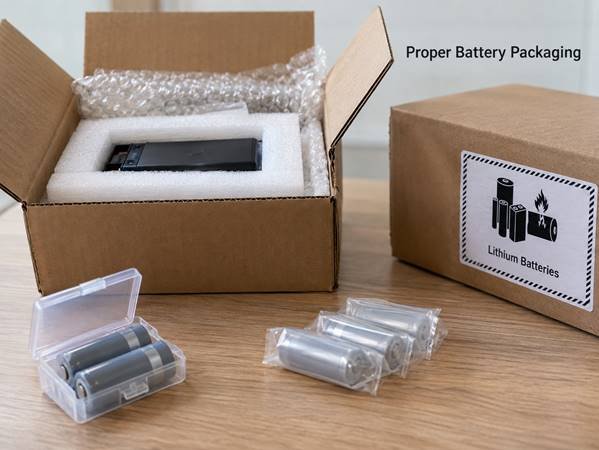
No matter which transport mode is used, packaging must meet three core requirements:
First, short-circuit prevention. For bare cells, spare batteries and accessible terminals, effective short-circuit prevention measures such as separate inner packaging, terminal insulation or protective boxes shall be taken to avoid direct contact with metal objects. For batteries installed in equipment, short circuits and damage shall be prevented through equipment fixation, accidental activation prevention and outer packaging protection in accordance with applicable packing instructions.
Second, extrusion prevention. The outer box must be filled with cushioning materials, such as bubble wrap and EPE foam, to avoid being crushed and deformed during transport;
Third, movement prevention. The products in the box must be fixed properly to avoid shaking and collision during transport.
General Declaration Principles
It is necessary to truthfully declare that the goods contain lithium batteries. Concealment or false reporting of category, capacity or quantity is prohibited. When declaring, the battery type, capacity/lithium content and transport status must be clearly stated.
Compliance Evidence Chain (5 Core Documents)
Many people don’t know what materials to prepare for transporting lithium batteries. In fact, there are 5 core items, which can be prepared as needed according to different scenarios:
1. UN38.3 test summary: Manufacturers and subsequent distributors shall provide or make it available; whether it needs to be submitted to the carrier during commercial shipment shall be confirmed in accordance with applicable regulations and carrier requirements;
2. Product parameter proof: such as casing marking, factory specification sheet, purchase voucher;
3. Packaging and marking: meet the insulation, cushioning, marking/labeling requirements of the corresponding transport mode;
4. Transport documents: whether dangerous goods transport documents, express declaration information, etc. are required shall be determined according to the specific transport mode, UN number, packing instructions or special provisions, exemption conditions and carrier requirements, and cannot be distinguished solely by personal or commercial identity;
5. Carrier confirmation: confirm in advance that the transport channel can accept lithium batteries of the corresponding type and capacity.
Hierarchical Differences Between Transport Marks, Labels and Documents
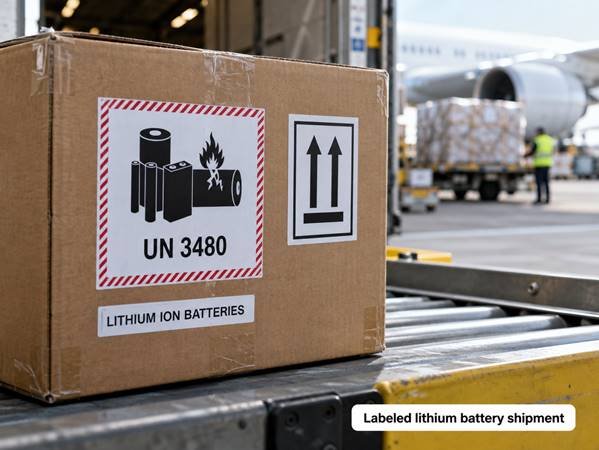
Many people cannot distinguish between various transport labels and documents. In fact, different marks and labels correspond to different risk levels and have different applicable scenarios. Common marks and labels include the following categories:
| Mark/Label Type | Main Applicable Scenarios | Core Function |
| Lithium Battery Mark | Transport of low-capacity lithium batteries that meet simplified conditions | Indicates that lithium batteries are contained inside, a simplified marking |
| Class 9 Dangerous Goods Label | High-capacity lithium batteries or lithium batteries that do not meet simplified conditions | Formal dangerous goods classification marking |
| Cargo Aircraft Only Label | Scenarios prohibited from passenger aircraft, such as standalone lithium batteries by air | Indicates that transport can only be done by cargo aircraft |
| UN Number Mark | Lithium battery packages marked as required by specific rules | Quickly identify dangerous goods type and risk |
| Overpack Mark | When multiple compliant small packages are combined into a large overpack | Indicates that the overpack contains compliant small packages |
Dangerous goods transport documents, UN number marks and lithium battery marks shall be determined according to the specific transport mode, packing instructions/special provisions and exemption conditions, and shall not be absolutely distinguished by commercial or personal identity. For personal mailing, specific declarations or documents may also be required when required by applicable rules or service terms.
Remember a general principle: all requirements for marks, labels and documents are jointly determined by applicable rules, packing instructions and carriers, and are not static. The specific requirements shall prevail at the time of actual shipment.
Rule Differences Between Different Transport Modes
Global lithium battery transport rules are not a unified law, but international general standards formulated by transport mode. Countries and carriers can tighten requirements on this basis. Among them, the international normative basis for international air transport of dangerous goods is ICAO Annex 18 to the Convention on International Civil Aviation (Chicago Convention) and the Technical Instructions for the Safe Transport of Dangerous Goods by Air (Doc 9284), which are implemented by the regulations of the country of departure, stopover countries and the country of destination; IATA DGR is an aviation industry operating rule based on ICAO Technical Instructions and incorporating operator variations. Sea transport refers to the IMDG Code (International Maritime Dangerous Goods Code), which is updated every two years. No matter which mode is used, the latest rules of the carrier, departure/transit/destination locations shall prevail before shipment.
Air Transport (Most Concerned, Divided into Two Scenarios)
Air transport is the transport mode with the strictest rules and the most inquiries. It is mainly divided into two scenarios: passenger carry-on and commercial freight, with completely different rules. Do not mix them.
Passenger Carry-On (Power Bank Flight Regulations)
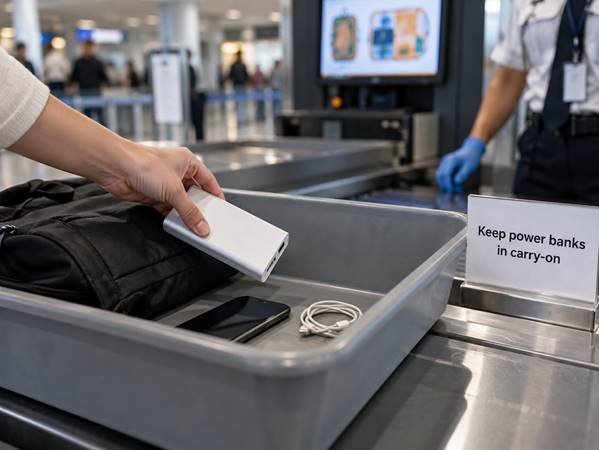
The rules for international air passengers carrying lithium batteries shall be verified on the basis of ICAO Annex 18, Doc 9284 and relevant national regulations; IATA DGR can be used as an operational reference based on ICAO Technical Instructions and incorporating operator variations. Passengers must also comply with additional requirements of airlines, airports and relevant countries. This part only applies to self-use lithium battery products carried by individuals when flying.
Passenger rules must distinguish between batteries in equipment, spare batteries and power banks:
• Spare batteries and power banks must not be checked in;
• For batteries in equipment ≤100Wh, when meeting conditions such as accidental activation prevention, they can be checked in or carried on according to airline rules;
• Batteries in equipment and spare batteries between 100Wh and 160Wh usually require airline approval, among which spare batteries are usually limited to no more than 2 per person;
• Effective March 27, 2026, each passenger may carry no more than 2 power banks, and this upper limit is independent of the quantity and capacity limits of other spare batteries;
• Power banks must not be charged during flight. Charging portable electronic devices with power banks is not recommended, and airlines or countries may impose stricter requirements;
• Power banks exceeding 100Wh up to 160Wh also require operator approval;
• Batteries exceeding 160Wh are usually not allowed to be carried as passenger baggage, and shall be verified according to cargo rules or applicable exceptions such as medical equipment and wheelchairs.
Special attention should be paid: power banks are standalone batteries and cannot be checked in. If you have a connecting flight, you must also meet the requirements of the transit airport and all involved airlines, not just look at the rules of the departure place.
Commercial Air Freight/International Express
The international normative basis for international air freight is also ICAO Annex 18 and Doc 9284, implemented by relevant national regulations; IATA DGR is a commonly used operating rule in the aviation industry. Packing instructions will specify specific requirements according to different UN numbers and transport statuses, applicable to commercial scenarios such as e-commerce orders, samples and bulk goods.
Key restrictions include:
• UN3480 standalone lithium-ion batteries, according to PI965, usually must be shipped at a State of Charge (SoC for short, which is the proportion of remaining battery power) not exceeding 30% of the rated capacity;
• Effective January 1, 2026, SoC restrictions have also been added to PI966 and PI967 for UN3481. The specific scope of application depends on the packing instruction section, the Wh value of the cell or battery, and whether national approval is required; for example, lithium-ion cells or batteries exceeding 2.7Wh in Section II usually must not exceed 30% SoC, and when higher than 30%, they must follow the corresponding full section and obtain the required national approval;
• For built-in batteries ≤100Wh (UN3481), even if they meet basic packaging requirements, whether they can be transported in the belly hold of passenger aircraft must also be verified by the applicable packing instruction section, SoC, quantity limit and operator variations, and cannot be judged solely by capacity.
In specific implementation, it is also necessary to confirm the carrier’s acceptance policy, quantity limit per package, and labeling requirements. Regulations may vary between operators.
Quick Reference Logic for Air Packing Instructions
Air transport packing instructions (PI for short) are classified by battery type and transport status. The quick reference logic is as follows:
• Standalone batteries: lithium-ion corresponds to PI965, lithium metal corresponds to PI968;
• Packed with equipment but not installed: lithium-ion corresponds to PI966, lithium metal corresponds to PI969;
• Built into equipment: lithium-ion corresponds to PI967, lithium metal corresponds to PI970.
It should be noted that specific limits, passenger/cargo aircraft restrictions, and SoC requirements shall be subject to the current year’s ICAO Technical Instructions, IATA DGR and operator policies, and there is no need to memorize them by rote.
Sea Transport (Suitable for Large-Volume Non-Urgent Goods)
Sea transport rules are slightly looser than air transport, suitable for large-volume, non-urgent goods. The regulatory source is the IMDG Code, which has a special provision SP188, a simplified clause for low-capacity lithium batteries.
The applicable objects are mainly bulk import and export goods of merchants.
Key restrictions:
• When low-capacity consumer batteries meet SP188, corresponding simplified requirements can be applied after meeting all its conditions; in addition to capacity or lithium content thresholds, requirements such as UN38.3, short-circuit prevention, packaging strength, drop test and lithium battery marking shall also be verified. Whether transport documents are required and their content shall be confirmed according to the current IMDG Code, specific cargo status and shipping company requirements;
• For large-capacity batteries or those that do not meet simplified conditions, operations shall be carried out in accordance with complete dangerous goods clauses.
Additional restrictions on state of charge or stowage shall be subject to the current version of IMDG, measures of the competent authority and shipping company policies.
For sea transport, special attention should also be paid to the rules of transit ports. The transit requirements of some routes are more complex than air transport, so be sure to confirm clearly before shipment.
Land Transport (Road/Rail, Commonly Used for Regional Cross-Border)
There is no unified global rule for land transport. It is mainly subject to the laws and regulations of the countries/regions passed through, bilateral or regional arrangements, and the requirements of carriers. It is suitable for small parcels or large goods in neighboring countries.
Many people think land transport rules are very loose, but they are not: consumer batteries that meet low-capacity simplified conditions can go through simplified procedures if their packaging is qualified, but this does not mean there are no requirements. Restrictions on some cross-border sections may be stricter than air transport.
Before shipment, it is necessary to confirm regulatory differences in cross-border sections, carrier qualifications and declaration requirements.
Post and International Express (Not Naturally Mailable)
Many people think that post and international express can send anything, but that’s not true. The rules for postal channels are that under the framework of the Universal Postal Union (UPU), all parties formulate stricter acceptance standards.
Common restrictions include: bare batteries, power banks, used batteries, and routes to remote areas are often restricted from acceptance.
Even if transport is permitted by regulations, there may be no available services for individuals or small merchants, so be sure to confirm with the express company or post office before sending.
Quick Comparison of Three Transport Modes
To facilitate quick selection, here is a comparison of the three main transport modes:
| Transport Mode | General Strictness | Cost and Speed | Triggers for Tighter Restrictions |
| Air Transport | Highest | Fastest speed, highest cost | The higher the battery capacity and the closer the transport status is to “standalone”, the more restrictions; some carriers/routes have stricter requirements |
| Sea Transport | Medium | Slowest speed, lowest cost | Same as above |
| Land Transport | Relatively low | Medium speed, medium cost | Same as above, some cross-border sections may be stricter |
It should be noted that this strictness is only a general threshold, and specific scenarios may be reversed. For example, some cross-border land transport sections have stricter requirements than air transport, so it cannot be generalized.
Major Market Verification Framework
Many people ask whether the rules of different countries vary a lot. International transport rules have a common framework, but national laws, national variations, regional rules and additional carrier requirements of each country may still be different. You cannot presuppose that the rules are exactly the same. Below we sort out the verification points for several major markets:
United States
The regulatory basis for the US is the 49 CFR rules formulated by the Pipeline and Hazardous Materials Safety Administration (PHMSA) of the Department of Transportation, plus carrier service terms.
There is a common misconception to clarify: not all lithium battery packages in the US require the same lithium battery mark uniformly, but packages that meet the small lithium battery exception conditions of 49 CFR 173.185 have statutory lithium battery marking requirements. Other marking, labeling and document requirements shall be determined according to battery specifications, transport mode and whether exceptions apply. Purchase vouchers are usually not a unified dangerous goods document requirement under 49 CFR, but carriers may require them additionally.
European Union
The EU’s transport rules are the regional implementation versions of ADR for land transport, IATA DGR for air transport, and IMDG for sea transport.
Core note: The CE mark is a conformity mark when products comply with EU regulations, not a precondition for transport. Do not think that having the CE mark means smooth transport.
For personal parcels, the EU does not have a unified “simplified declaration for self-use low-capacity” regulation, and the specific terms are subject to the service terms of express or postal services.
Japan, South Korea and Other Asia-Pacific Markets
For air, sea and land transport requirements in Japan, South Korea and other Asia-Pacific markets, the rules of the national competent authority, ICAO national variations, departure/transit/destination requirements and carrier policies shall be verified separately. It shall not be presupposed that there are no additional mandatory requirements.
IATA DGR can be used as an industry operational reference, but it does not replace the laws, regulations and national variations of applicable countries.
Emerging Markets Such as Southeast Asia and Latin America
There is a common point of confusion in these markets: transport rules, import customs clearance, and market access are three independent links. Certificate of origin, taxation, local certification, etc. all belong to trade or customs clearance requirements, not part of transport rules. Do not confuse them.
Also note that some small countries may not have formal lithium battery transport channels, so be sure to confirm with a freight forwarder in advance before sending.
Methods to Quickly Query the Latest Rules
Rules may be updated every year, so there is no need to memorize them by rote. Just query according to the following methods:
• Individual users: directly consulting the customer service of the cooperating express company, freight forwarder or airline is the most convenient way;
• Business users: can consult IATA official guides, the official website of the destination transport department, or entrust a qualified freight forwarder to confirm.
Special reminder: the rules of the transit country/region must also be met at the same time, not just the requirements of the departure and destination locations.
Practical Steps and Judgment Cases
After talking about so many rules, some people may feel confused. In fact, as long as you judge according to fixed steps, you can sort out most situations.
General Four-Step Decision Tree (Applicable to All Scenarios)
Step 1: Determine the chemical system of the battery: priority should be given to confirming whether it is a lithium-ion battery or a lithium metal/lithium alloy battery based on the manufacturer’s information, UN38.3 test summary and applicable rules; usually lithium-ion batteries are rechargeable batteries, and lithium metal/lithium alloy batteries are usually primary batteries, but judgment cannot be made solely by whether they are rechargeable;
Step 2: Determine the transport status: is it shipped alone, packed with equipment, or built into equipment;
Step 3: Match the corresponding UN number and the packing instructions of the corresponding transport mode;
Step 4: Verify capacity, quantity, marking and labeling, document requirements, and additional restrictions of the carrier.
Practical Steps for Individual Users (Carry-On/Parcel)
1. Confirm the battery type, transport status and capacity level according to the general decision tree;
2. Prepare relevant vouchers, such as purchase vouchers, to prove the battery capacity and self-use attribute;
3. Proper packaging: spare batteries or accessible terminals must be protected against short circuits, and the outer box must be reinforced against extrusion;
4. Declare truthfully: clearly mark “lithium-ion battery” and capacity, do not conceal the declaration.
Practical Steps for Small Merchants (Commercial Freight)
1. Confirm product attributes according to the general decision tree, including battery type, transport status, total Wh or lithium content;
2. Check core documents: the UN38.3 test summary must match the actual model, and dangerous goods declaration forms shall be prepared as needed;
3. Compliant packaging: do a good job of insulation and fixation according to transport mode requirements, and paste corresponding marks;
4. Choose compliant channels: find a freight forwarder with lithium battery transport operation capability, and confirm the acceptance scope clearly;
5. Declare truthfully: product name, capacity, quantity and value must be consistent with the actual situation.
10-Item Pre-Shipment Checklist
Before shipment, you can check one by one against the following 10 items to avoid omissions:
1. The battery type (lithium-ion/lithium metal) and transport status (standalone/packed with equipment/built-in) have been clearly confirmed
2. The rated Wh or lithium content has been calculated, and the corresponding capacity threshold is clear
3. The battery appearance has no defects such as bulging, damage, leakage, etc.
4. For commercial freight, it has been confirmed that the UN38.3 test summary matches the actual product and meets the requirements
5. Effective short-circuit prevention measures have been taken for bare cells, spare batteries or accessible terminals; the products in the box have been fixed and will not shake
6. The marks and labels on the outer box match the transport mode and UN number
7. The declared information is completely consistent with the actual goods, with no concealment or false reporting
8. It has been confirmed that the transport channel can accept lithium batteries of this type and capacity
9. The special requirements of the departure place, transit place and destination have been met
10. Product parameters and test vouchers have been kept for inspection
Real Scenario Judgment Cases
We use two common scenarios to demonstrate how to judge, to help everyone understand better:
Case 1: 3.7V 10000mAh (37Wh) power bank carried on flight
First, product identification: this is a lithium-ion battery, the power bank is in standalone transport status, with a capacity of 37Wh ≤100Wh.
The corresponding UN classification is UN3480.
Preliminary judgment: usually can be carried on, checked in is prohibited. Effective March 27, 2026, each passenger may carry no more than 2 power banks, and power banks must not be charged during flight; charging portable electronic devices with power banks is not recommended, and airlines, countries or airports may impose stricter requirements.
Points that need additional confirmation: airline carry-on restrictions, and the rules of the transfer airport.
Common mistakes: putting the power bank in the checked luggage, or calculating the capacity using the USB output voltage of 5V. Although the result does not exceed the threshold at this capacity, the calculation method is wrong, and misjudgment will occur when encountering products close to the threshold.
Case 2: Commercial air transport of wireless charging equipment with 1 built-in + 2 uninstalled spare batteries
Product identification: lithium-ion battery, 1 built-in + 2 matching uninstalled, single unit capacity 37Wh.
Preliminary classification: may belong to UN3481 (packed with equipment), but cannot be directly calculated as built-in battery, need to be verified according to transport status standards.
Verification steps: first confirm the Wh of a single battery, then confirm the number of devices and spare batteries in each package, match the corresponding packing instruction section, verify the applicable SoC restrictions, and finally check the operator’s passenger aircraft acceptance policy.
Conclusion principle: there is no unified conclusion that “it can be transported in the belly hold of passenger aircraft”. The final conclusion shall be subject to packing instructions, SoC requirements and carrier confirmation.
Common mistakes: declaring directly as built-in batteries, ignoring the existence of spare batteries, or spare batteries not being properly protected against short circuits.
Advanced Pit Avoidance and Judgment
After mastering the basic rules, you also need to understand some common pitfalls and judgment methods to avoid stepping on mines. This part is suitable for merchants or practitioners who ship frequently.
Consequences and Correction of 5 Types of Violations
1. Capacity misjudgment caused by using mAh instead of Wh for declaration: the consequence is cargo detention or return. The correction method is to give priority to the rated Wh on the nameplate; if Wh is not marked, calculate the total Wh according to the nominal voltage and rated capacity of the actual cell or battery pack before declaring;
2. Putting standalone lithium batteries in checked luggage or shipping via passenger aircraft freight: the consequence is refusal of carriage or fine. It is necessary to switch to carry-on or cargo aircraft channels as required;
3. No short-circuit prevention measures taken for bare cells, spare batteries or accessible terminals: the consequence is refusal of carriage due to short-circuit risk. The correction method is to adopt effective measures such as separate inner packaging, terminal insulation or protective boxes; for batteries installed in equipment, equipment fixation, accidental activation prevention and outer packaging protection shall be done in accordance with applicable requirements;
4. Concealing the battery category and shipping via regular channels: the consequence is cargo detention, fine or even destruction. Serious cases may also involve violations of the law. It is necessary to declare truthfully and use compliant channels;
5. Defective batteries shipped via regular transport: the consequence is refusal of carriage and there is a major safety risk. It is necessary to confirm a special transport plan with the carrier.
How to Judge Whether a Transport Channel Can Accept Lithium Batteries
There are many freight forwarders and express companies on the market. How to judge whether they can accept lithium batteries in compliance? It mainly depends on two points:
First, look at operational capability: whether there is dangerous goods transport-related training, carrier authorization and local transport permit — note here that IATA is only responsible for formulating rules and conducting training. Having an IATA training certificate does not mean having transport qualification. It also depends on local permits and carrier authorization.
Second, ask clearly about the boundaries: the types of batteries that can be accepted, the upper limit of capacity, the upper limit of quantity, and what documents need to be provided.
Pit avoidance tip: if the quotation of a certain channel is far lower than the market price, it is most likely that they use regular channels by concealing the declaration, with extremely high risks of cargo detention and fines. Do not be greedy for cheapness.
Reasons and Responses for Cargo Detention/Refusal of Carriage
If you are unfortunately subject to cargo detention or refusal of carriage, don’t panic first. The common reasons are nothing more than incomplete documents, unqualified packaging, concealed declaration, and excessive capacity/lithium content.
The response idea is: contact the express company or freight forwarder immediately to understand the specific reason. If it is incomplete documents or minor packaging problems, supplement what can be supplemented, and if it does not meet the requirements, you can apply for return.
The best response is actually prevention: confirm all requirements in advance before sending, keep parameters and test vouchers, and do not take chances.
UN38.3 Test Summary Validity Judgment
Many merchants don’t know how to judge whether the UN38.3 test summary they have is valid. In fact, it can be viewed from two levels: regulatory and commercial.
There are three core standards at the regulatory level:
First, the information elements are complete. The summary must include mandatory information such as battery/cell model, parameters, test items, manufacturer, etc.;
Second, it is traceable. The information of the manufacturer and test laboratory is true and verifiable;
Third, confirm that the actual cell or battery belongs to the model or type covered by the test summary. If there is a major material change as specified by regulations compared with the tested type, or a change that may substantially affect the test results, it shall be regarded as a new type and retested as required; whether non-substantive changes affect the coverage scope shall be judged by the manufacturer based on applicable rules and test data.
Reference standards at the commercial level:
Laboratories with accreditation qualifications such as CNAS and ILAC can be used as a capability reference, but are not mandatory legal requirements; some freight forwarders require test summaries to be issued within 1-2 years, which is the commercial policy of the freight forwarder, not a mandatory validity period by regulations. There is no unified validity period requirement in regulations. As long as the test summary still covers the actual product, its validity shall be judged according to applicable rules.
Analysis of Easily Confused Concepts
There are several groups of concepts that are easily confused, here we specifically analyze them:
1. MSDS/SDS vs UN38.3: MSDS (now called SDS, Safety Data Sheet) is a form that records product safety parameters and emergency treatment methods. It cannot replace the UN38.3 transport safety test voucher. Many people think that having an MSDS means it can be shipped, which is wrong.
2. Passenger Rules vs Freight Rules: The requirements for carry-on are completely different from those for international express and commercial freight, and cannot be mixed. For example, it is okay to carry a power bank under 100Wh with you, but sending it via international express must follow freight rules, and you cannot directly apply the carry-on logic.
3. Output Power (W) vs Battery Capacity (Wh): W is a unit of charging speed. For example, 65W fast charging refers to the charging power; Wh is the total energy stored in the battery, which is a capacity unit for transport. The two are completely different things and cannot be confused.
4. Power Bank vs Built-in Battery Device: Power banks sent alone usually belong to UN3480 lithium-ion batteries in freight classification, and cannot be declared as UN3481; however, passenger baggage rules often manage power banks separately, and capacity and quantity limits shall be subject to airline and applicable passenger rules.
Common Risks for E-Commerce Bulk Shipping
Merchants who do e-commerce bulk shipping should also pay attention to several special risk points:
First, for the situation of multiple batteries and multiple devices in the same box, you cannot only look at the Wh of a single battery, but also verify the total quantity and total energy limit per box according to the packing instructions. Exceeding the limit means it does not meet the requirements.
Second, for the situation of overpack, that is, putting multiple compliant small packages into a large box, it shall be verified according to applicable transport rules whether “OVERPACK” needs to be marked, and whether UN numbers, labels, lithium battery marks and orientation arrows need to be repeated. If the dangerous goods marks and labels required for inner packaging are not visible from the outside, corresponding marks usually must be added outside the overpack. The specific requirements shall be subject to the rules of the applicable transport mode.
Third, for the quantity limit per shipment and per package, the limits vary with different transport modes and different packing instructions, and shall be subject to the current rules and carrier requirements.
Lithium battery transport rules may seem complicated, but in fact the core logic is all around risk management — the higher the battery capacity and the closer it is to the “standalone transport” state, the higher the risk, and the stricter the rules. As long as you judge step by step and confirm requirements in advance, you can avoid most transport pitfalls and have lithium batteries delivered to their destination safely and compliantly.