
If you are an ordinary consumer living in Europe, or a seller selling power banks via cross-border e-commerce, you must have heard the term “EU’s new battery regulation” a lot recently. Some say all power banks need new certification, some say additional recycling fees have to be paid, and others say products without the new mark will be detained in 2025 — there are all kinds of claims, but which ones are true?
This guide only covers rules directly related to power banks. From the most basic “does it apply to you”, to specific tasks for different roles, and common pitfalls, everything is explained in plain language, so you don’t have to wade through hundreds of pages of the original EU regulation text.
Basic Introduction: First Understand the Regulatory Scope and Core Concepts
Core Logic of the New Battery Regulation
Many people don’t know that the EU’s previous battery rules were the old Directive 2006/66/EC, and each member state could adjust the implementation details on its own, which was somewhat “each doing its own thing”. This new battery regulation (Regulation No. EU 2023/1542) is a unified rule directly applicable to all EU member states, without the need for each country to transpose it into national law. It covers the entire life cycle from production, sales to recycling, with two core goals: safer and more environmentally friendly.
It will replace the old directive in phases starting from February 18, 2024, and most of the content of the old directive will be officially repealed on August 18, 2025. However, for specific individual clauses and the supporting measures of each member state, you still need to check the latest local requirements in actual operation.
Let’s sound a warning here: ordinary power banks are essentially portable rechargeable battery packs, and they are one of the core regulatory targets of this new regulation. Don’t think that you can avoid it just because what you sell is a “power bank” not a “battery”.
Product Classification Determination: Three Steps to Confirm Which Category Your Product Belongs To
The EU has provided a legal determination process, so you don’t have to guess by yourself, just follow three steps:
Step 1: First confirm whether the product is a battery or a battery pack. A power bank is an energy storage battery pack composed of cells, a protection board and a casing, so it definitely meets this step.
Step 2: Check whether it is a portable battery. Three conditions must be met at the same time: sealed, weighing no more than 5 kg, and not for industrial use, electric vehicle use, light means of transport use, or starting, lighting and ignition (SLI) use. Ordinary consumer-grade power banks on the market, whether 5000mAh or 20000mAh, basically meet these conditions.
Step 3: If it meets the above requirements, it will be regulated according to the rules for consumer-grade portable batteries; if not, for example, it is a large-capacity battery pack for industrial equipment, it will be evaluated according to the rules for industrial batteries.
Are there any exemptions? Only batteries for military, aerospace, and nuclear use can be fully exempted. Ordinary consumer-grade power banks are not eligible at all, so don’t try to take advantage of this loophole.
Plain Language Explanation of Core Terms
Several key terms will be mentioned repeatedly later. If you understand them first, you won’t get confused:
The first is portable battery, which refers to an independent battery or battery pack that can be carried around easily. Power banks fall into this category.
The second is the CE mark. Many people think it is a “certification certificate”, but in fact it is a market access mark for the EU market. It can only be affixed if the product meets the corresponding EU regulatory requirements, and it is a “compliance commitment” for consumers and regulators.
The third is DoC (Declaration of Conformity). This is a legal document that should be drawn up and signed by the manufacturer, equivalent to a written promise of “I guarantee that my product meets all requirements, and I will be responsible if there is a problem”, not a randomly printed piece of paper. If an authorized representative is authorized in writing by the manufacturer to handle relevant matters on its behalf, the scope of authorization and whether it meets relevant requirements must also be verified.
The fourth is EPR (Extended Producer Responsibility). To put it simply, it means “whoever sells the product is responsible for collecting the waste” — the entity that places the product on the EU market must bear the cost of recycling and disposing of old products, and cannot just walk away after selling.
Phased Effective Timeline: Only Look at Nodes Related to Power Banks
Now that the regulatory scope is clear, what everyone is most concerned about must be “what to do and when”. Let’s first clarify: the following are the unified effective start dates at the EU level, but for specific label requirements and test methods, you also need to refer to the delegated acts issued by the EU and the latest harmonized standards; in addition, the EPR registration process, requirements for recycling organizations, and the rules of e-commerce platforms of each member state shall be subject to the regulations of the country where you actually sell, and cannot be generalized across the entire EU.
Let’s sort them out in chronological order:
Already Effective (from August 18, 2024)
From August 18, 2024, the hazardous substance limit requirements for portable batteries have been officially implemented, and all ordinary power banks must comply with them. This is already being inspected now, so don’t think it’s still in the transition period.
Effective on August 18, 2025
This is an upcoming important node, with three matters:
First, the separate collection mark (the crossed-out trash bin mark) must be mandatorily affixed. The specific size requirements will be explained later.
Second, the obligations of economic operators within the EU are officially implemented, divided according to different business models: if it is an import model, the EU importer shall bear the statutory importer obligations; if it is a non-EU manufacturer, it must designate an EU authorized representative — note that this authorized representative is not the same as an importer and cannot replace the importer’s responsibilities; if it is a direct sales model where non-EU sellers sell directly to EU consumers, it is necessary to both confirm the regulatory subject and meet the requirements for an EPR authorized representative.
Third, EPR-related requirements (Chapter VIII of the Regulation) officially come into effect. Whichever member state you first place the product in, you must complete EPR registration in that country first, and only after registration can you sell legally.
Effective Rules for Labeling and Capacity Marking
The effective time of capacity labels and general labels, which many people ask about, is a bit special and not fixed: the effective date is the later of the two dates “August 18, 2026” and “18 months after the entry into force of the label implementing act”. For example, if the label implementing act only takes effect in October 2025, then 18 months later will be April 2027, which is later than August 2026, so it will be calculated as April 2027.
Here is a verification tip: in September 2026, you can go to the EU’s EUR-Lex official website to check whether the implementing act for Article 13(10) has taken effect, and then you can determine the final date. There’s no need to guess blindly now.
Effective on February 18, 2027
There are two requirements in this batch: the first is the QR code mark, which all power banks must have. From February 18, 2027, the battery QR code shall provide access to the label information specified in Article 13(1) to (5). Ordinary power banks are not subject to the battery passport QR code system under Article 77; if enterprises additionally provide a DoC link, it can be regarded as voluntary information, but should not be regarded as a legally required content of this QR code.
The second is the rule that “batteries in appliances with built-in portable batteries shall be removable and replaceable”. This usually does not apply to independent power banks, and only applies to batteries that are fixedly integrated into other products, which will be explained in detail later.
2028 and Later (Pending Delegated Acts)
Requirements currently still under planning include: minimum performance and cycle life requirements for general portable batteries such as AA and AAA, as well as stricter hazardous substance limits and long-term goals for recycled material utilization. These do not apply to ordinary power banks for the time being, and we will wait for the follow-up detailed rules to be released.
Clearly Non-Mandatory Requirements for Now
We specifically mention these to prevent you from being fooled by bad service providers: for example, carbon footprint declarations and battery passports only apply to automotive batteries, large industrial batteries, and light means of transport (LMT) batteries, and there is no legally mandatory timetable for ordinary power banks; there are also rules required by some large customers or e-commerce platforms themselves, which are commercial thresholds, not legally prescribed obligations, so don’t confuse them.
Core Compliance Requirements: These Are the Bottom Lines That Must Be Met
Now that we know when to do what, let’s talk about the specific requirements to meet. We will cover four parts: safety and hazardous substance red lines, labeling requirements, recycling and EPR obligations, and the 2027 removable rule.
Safety and Hazardous Substance Red Lines (Statutorily Mandatory)
This is the bottom line of compliance, and crossing it will cause problems.
First, let’s talk about the hazardous substance limits, all calculated by weight ratio: mercury content shall not exceed 0.0005%, cadmium shall not exceed 0.002%, and lead content of portable batteries shall not exceed 0.01% — of course, zinc-air button cells have transitional exceptions, but power banks basically do not use this type of battery, so just be aware of it.
Then there are basic safety requirements: the product must not have unreasonable risks such as fire and explosion, and must comply with the corresponding EU harmonized standards, such as the common EN 62133.
Many people think that compliance is just a test report, but that’s not the case. The manufacturer shall establish technical documentation in accordance with Article 18 and Annex VIII, and demonstrate compliance in accordance with the applicable conformity assessment procedure in Annex V. The technical documentation shall include product description, design and manufacturing information, risk or conformity assessment, standards or technical specifications adopted and relevant test or calculation evidence required for applicable requirements; specific safety test items shall be determined according to product design and applicable standards.
So how is the conformity assessment done? To put it simply, the manufacturer first prepares the technical documentation and signs the EU DoC (Declaration of Conformity). Not all products require the participation of a notified body (commonly known as an NB body). Whether it is required shall be judged according to the statutory procedure, so don’t spend a lot of money asking a notified body to issue a certificate right away.
If a test report has been prepared under the old directive before, can it continue to be used? The answer is: if the old report complies with the current harmonized standards, the conclusions of the safety part can be used, but other documents required by the new regulation must be supplemented, and the old report cannot be directly used as proof of compliance with the new regulation.
There are two important boundaries that must be clarified: first, UN 38.3 is only used for transportation, for example, batteries must pass this test for air transport. It governs transportation safety and cannot replace market access compliance requirements at all. Don’t think that with UN 38.3 you can sell in the EU; second, a test report is not equal to a certification certificate. A test report only proves the results of the tested sample, and compliance is a matter of the entire system.
From the actual situation, there are two most common non-conformity risks for power banks: one is the lack of overcharge, overdischarge, and short circuit protection, and the other is excessive hazardous substances. These two are the key points to focus on.
Labeling Requirements Matrix
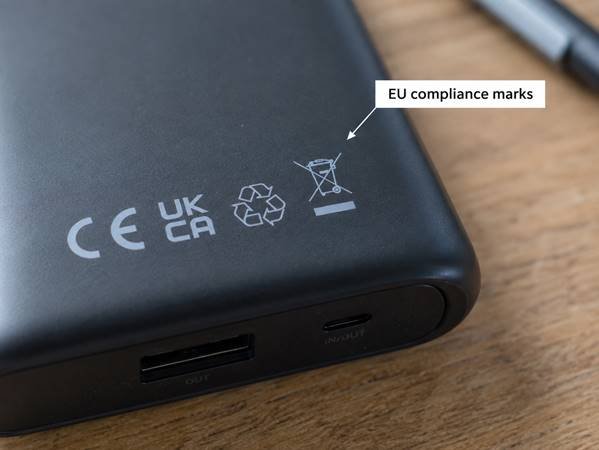
Different labels have different effective times, affixing positions, and size requirements. For your convenience, we have organized them into a table:
| Label Type | Effective Date | Affixing Requirements | Common Mistakes |
| Separate collection mark (crossed-out trash bin) | August 18, 2025 | Regular size: at least 3% of the largest side area of the battery, maximum no more than 5×5cm;<br>Small size exception: if the body cannot be marked with a ≥0.47×0.47cm mark, the body can be exempted from marking, but a ≥1×1cm mark must be printed on the packaging | Only printed on the e-commerce product detail page, not on the body/packaging; size does not meet requirements |
| CE mark | Already effective | In principle, affixed to the product body; if limited by volume/nature, it can be affixed to the packaging + accompanying documents; must meet size and visibility requirements | The mark is blurry and easy to peel off; the size is too small to be recognized |
| Heavy metal chemical symbols (Cd/Pb) | August 18, 2025 | Trigger conditions: must be marked when cadmium > 0.002% and lead > 0.004%;<br>Affixing position: below the crossed-out trash bin mark, with an area of at least 1/4 of the collection mark;<br>The affixing carrier follows the same rules as the CE mark | Not marked when exceeding the limit; the marking size is too small |
| General label + capacity label | The later of August 18, 2026 and 18 months after the entry into force of the label implementing act | Must include information such as rated capacity and battery chemistry type; the affixing carrier shall be subject to the implementing rules | Randomly marking capacity in advance, which does not comply with subsequent specifications |
| QR code | February 18, 2027 | Shall provide access to the label information specified in Article 13(1) to (5); ordinary power banks are not subject to the battery passport QR code system | The QR code cannot be scanned; incomplete information |
| EU economic operator information | August 18, 2025 | Manufacturers, importers and authorized representatives shall provide identity and contact information in accordance with their respective applicable requirements; in principle, they shall be marked on the battery, and only when it is impossible or inappropriate due to the size or nature of the battery, can they be marked on the packaging or accompanying documents; the subject information to be marked shall be determined according to the actual supply chain role | Only marking the information of overseas manufacturers, without a responsible entity within the EU |
In addition to the content in the table, let’s mention a few common labeling non-conformity issues: for example, the mark peels off as soon as it is touched, or marks that should be on the body are only printed on the packaging or even the e-commerce product detail page, and there are missing mandatory marks. These are the key points of regulatory inspection.
Recycling and EPR Obligations (Extended Producer Responsibility)
This part is the most confusing for many sellers. Let’s first talk about the core logic: the essence of EPR is “whoever places it is responsible”. The entity that places products on the EU market must bear the cost of recycling and disposing of old batteries. Moreover, this battery EPR is completely independent of EPR for other categories (such as WEEE e-waste recycling), they cannot offset each other, and EPR for other categories cannot be used to impersonate battery EPR.
So who is the statutory “producer” (that is, the responsible subject)? This does not depend on whether you are a factory, but is judged according to the scenario of “first placing on the market”:
• If you are an own-brand manufacturer within the EU that produces and places products on the market under your own brand, then you are the producer;
• If you are an entity within the EU that produces, commissions design or manufacturing under its own name or trademark, and first supplies batteries in a professional manner in a member state, you are usually the producer of that member state; whether the original manufacturer is named cannot be used as the sole or necessary judgment condition;
• If you are an importer within the EU, and overseas products are first sold to a member state through you, then you are the producer of that country;
• If you are a non-EU distance selling seller that sells directly to EU consumers, then you, as an overseas seller, are the producer, and you must designate a dedicated EPR authorized representative in each country where you sell.
Special attention should be paid here: battery EPR is registered separately for each member state where sales are made. There is no EU-wide battery EPR number. You cannot just register EPR in Germany and sell across the entire EU, that is non-compliant. The registration path may vary from country to country, and shall be subject to the regulations of the local competent authority.
After registration, the producer shall complete registration and declaration in accordance with the system of the selling country, and bear the financial or organizational responsibility for recycling and disposal. You can fulfill your responsibilities collectively through a PRO (Producer Responsibility Organization), or individually if permitted by the member state; the registration number, fees and declaration path shall all be subject to the system of the competent authority of that member state. In addition, you must also provide free recycling channels within the EU so that consumers can discard old batteries for free.
Finally, let’s emphasize the role distinction again: an ordinary market access authorized representative is not the same as an EPR authorized representative, nor is it the same as a PRO service provider. These three are completely different roles with different responsibilities. Don’t think that everything is settled just because you find one institution. You must confirm them separately.
There are three common EPR non-conformity risks: first, using EPR of other categories to impersonate battery EPR, for example, using a WEEE number as battery EPR; second, only registering in one country and selling across the entire EU; third, not informing consumers of recycling channels.
2027 Removable/Replaceable Rule (Clear Applicability Boundary)
This rule has been widely circulated recently. Many people say “power banks must allow cells to be removed with bare hands”, but that’s not the case at all. Let’s first clarify the applicability boundary:
The applicable object of this rule is appliances with built-in portable batteries, that is, situations where the battery is installed in another product and not sold independently. Independent power banks are usually not applicable. Only power banks that are fixedly integrated into other products, such as a power bank installed in a backpack that cannot be taken out, require case-by-case judgment.
For appliances with built-in portable batteries subject to Article 11, the battery shall be removable and replaceable by the end user with commercially available tools during the lifetime of the appliance, without impairing the safety, performance or function of the appliance or battery. Tools provided by the manufacturer with the appliance are also considered commercially available tools. The manufacturer shall also provide replacement batteries within a reasonable period after the last model is placed on the market.
Are there any exemptions? An appliance may be exempted from the end-user removable and replaceable requirements only in the limited circumstances listed in Article 11(2) and meeting its specific conditions; when involving waterproof or dustproof, it must meet the conditions specified in the regulation such as continuous power supply and inability to be realized by independent professionals, and technical justification shall be retained.
Multi-Regulation Overlay Determination: It’s Not Enough to Only Comply with the Battery Regulation
Many people think that compliance with the battery regulation is all that’s needed, but that’s not the case. Power banks also have electronic circuits, and some have wireless functions, so they may need to comply with other regulations. Let’s first talk about the core logic: the battery regulation is a mandatory compliance requirement for all battery-containing products. The GPSR (General Product Safety Regulation) can play a supplementary role in product safety risks not covered by EU harmonized legislation; if the applicable harmonized legislation has covered all relevant safety risks, the GPSR will not apply separately to such risks. Other regulations shall be evaluated one by one according to the product’s function, electrical properties, and placement method, and cannot be applied in a one-size-fits-all manner.
We have organized several common power bank scenarios into a table for your comparison:
| Product Type | Mandatory Compliance Items | Usually Need to Evaluate | Usually No Need to Do |
| Pure wired independent power bank | Battery Regulation, Battery EPR | RoHS (when containing electronic circuits), EMC (when containing electronic circuits), WEEE (when constituting EEE) | RED (no radio communication or radio determination function); ordinary USB power banks are usually not within the scope of LVD because their rated operating voltage is lower than the LVD lower limit of 50V AC/75V DC |
| Power bank with Bluetooth/App/cellular communication | Battery Regulation, Battery EPR, RED (triggered by radio function) | RoHS, EMC, WEEE | Ordinary USB power banks are usually not within the scope of LVD because their rated operating voltage is lower than the LVD lower limit of 50V AC/75V DC; common charging interface regulation |
| Power bank only with Qi wireless charging | Battery Regulation, Battery EPR | EMC, RoHS, WEEE; if the product intentionally emits or receives radio waves for radio communication or radio determination, RED needs to be evaluated | Ordinary USB power banks are usually not within the scope of LVD because their rated operating voltage is lower than the LVD lower limit of 50V AC/75V DC; common charging interface regulation |
| Power bank sold bundled with wall charger | Battery Regulation, Battery EPR (only for the power bank part) | Power bank side: same as RoHS/EMC/WEEE etc. for products with corresponding functions;<br>Charger side: determine LVD (when AC input ≥50V), EMC, RoHS, WEEE according to input voltage/function | It shall not be assumed that one party is subject to/not subject to the regulation just because of bundling; ordinary power banks do not trigger the common charging interface regulation just because they have a USB-C port |
| Power bank built into appliances such as backpacks/table lamps | Battery Regulation, Battery EPR (only for the battery part) | Corresponding product regulations for the whole machine, WEEE (if the whole machine is EEE), removable/replaceable rule from 2027 | (RED needs to be evaluated if the whole machine intentionally emits or receives radio waves for radio communication or radio determination) |
After reading the table, let’s clarify a few most confusing regulatory boundaries:
1. Common charging interface boundary: This regulation is for listed radio equipment (such as mobile phones, tablets). Ordinary power banks usually do not trigger it, and chargers shall be evaluated according to their own attributes.
2. RED and wireless charging boundary: Power banks that only provide wireless power supply such as Qi and are not used for radio communication or radio determination are usually not subject to RED just because of this power supply function itself; but if the product intentionally emits or receives radio waves for radio communication or radio determination, the applicability of RED shall be evaluated.
3. RoHS and battery regulation boundary: The battery part is subject to the battery regulation first, and the electronic and electrical part is evaluated according to the scope of RoHS. The two regulate different contents and cannot replace each other.
4. WEEE and battery EPR boundary: The two are completely independent. WEEE is for the recycling of whole electronic and electrical equipment, and battery EPR is for the recycling of batteries. Their obligations cannot offset each other.
5. UN 38.3 boundary: Let’s emphasize again that this is only used for transportation control and cannot replace market access compliance requirements at all.
6. Authorized representative and EPR representative boundary: Ordinary market access authorized representatives and EPR authorized representatives are two different roles with completely different responsibilities, which need to be confirmed separately.
Quick Compliance Judgment Method: From Preliminary Screening to Accurate Verification
After talking about so many requirements, is there a simple way to quickly judge whether a product is compliant? Yes, we will talk about it in three scenarios.
1-Minute Appearance Inspection Method (Preliminary Screening for Ordinary People/Purchasers)
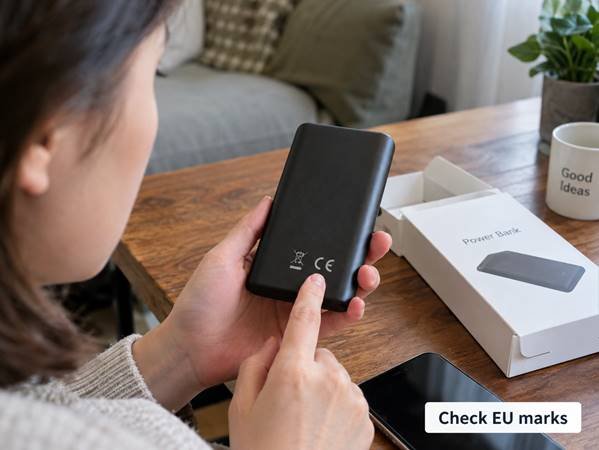
This method is suitable for ordinary consumers or purchasers to do preliminary screening, without professional knowledge. The mandatory inspection items are based on the current effective time. For example, after August 2025, two items will be checked first: the separate collection mark and the CE mark. Prioritize checking the product body, and for particularly small products, you can check the packaging.
The judgment logic is very simple: if there is no core mark at all, it is probably non-compliant; but having a mark does not mean 100% compliance, because marks can be printed randomly, and documents need to be verified to confirm.
It should be noted here that the mark must be clear and not easy to peel off. Being only printed on the e-commerce product detail page does not count; it must be on the product or packaging.
Document Verification Method (Accurate Judgment)
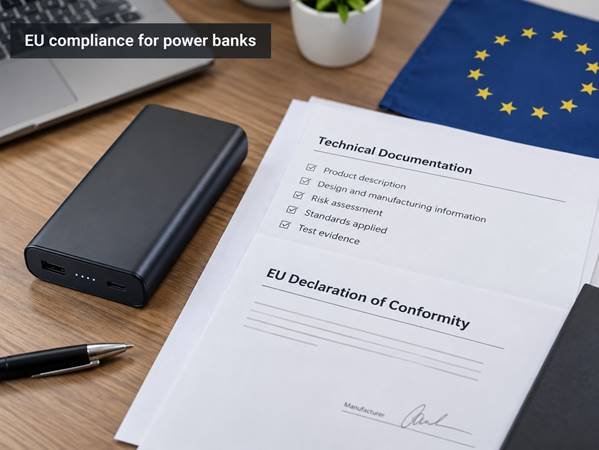
This is for accurate judgment, suitable for sellers or purchasers to verify.
First, the manufacturer must have two core documents: first, the product technical documentation, which shall be established in accordance with Article 18 and Annex VIII, and include product description, design and manufacturing information, risk or conformity assessment, standards or technical specifications adopted and relevant test or calculation evidence required for applicable requirements; second, the EU DoC (Declaration of Conformity), which shall be drawn up and signed by the manufacturer. If an authorized representative is authorized in writing by the manufacturer to handle relevant matters on its behalf, the scope of authorization and whether it meets relevant requirements shall also be verified.
In addition, according to different business models, corresponding materials must also be verified: for example, the battery EPR registration certificate of the selling country, and for non-EU distance sales, there must be an EPR authorized representative appointment letter; information of EU economic operators (importer/authorized representative); RED, EMC, RoHS, WEEE related documents for products with corresponding functions; and the UN 38.3 transport report, which is only used for logistics and is not a market access compliance document.
How to verify the authenticity of these documents? For EPR qualifications, priority is given to checking the official website or official register of the competent authority of the selling country, don’t just look at the paper certificate given by the service provider; test reports and DoC can be verified by contacting the issuing institution, and the DoC shall be drawn up and signed by the manufacturer, not signed randomly.
There are three common fake document pitfalls: first, cross-category EPR impersonation, such as using a WEEE number as battery EPR; second, reports under the old directive impersonating reports under the new regulation; third, completely forged test reports. Everyone should be careful.
Ordinary User Capacity Preliminary Judgment Method (Only for Consumer Experience Reference)
Many people only look at the mAh number when buying a power bank. In fact, mAh is just a unit of capacity, and you also need to look at the nominal voltage to know the actual energy. The basic conversion formula is: Energy (Wh) = Nominal Voltage (V) × Capacity (Ah), and 1Ah equals 1000mAh. For example, a common 10000mAh power bank with a nominal voltage of 3.7V has an energy of 37Wh.
So how to estimate the number of charges? For example, a 10000mAh (3.7V) power bank can charge a 3000mAh mobile phone 2-3 times, which is a normal range, because there is circuit loss. There are many factors that affect the number of charges: nominal voltage, circuit conversion efficiency, the health of the mobile phone battery, and the matching degree of the charging protocol, all of which affect actual use. So don’t just look at the merchant’s propaganda such as “charge 5 times”.
Let’s make it clear here: this method is only used to preliminarily judge the consumer experience, and cannot replace the statutory capacity marking, laboratory testing or conformity assessment at all. Don’t use this to claim that a product is non-compliant.
Product Change Control Rules
Sellers must pay attention: different models can share part of the compliance materials only when the technical documentation, risk assessment and test or calculation evidence can clearly prove their coverage relationship and representativeness. If changes in capacity, cells, protection boards, structure or functions may affect applicable requirements or conformity conclusions, the manufacturer shall re-evaluate and update the corresponding technical documentation, test evidence and EU Declaration of Conformity.
Action Guide for Different Roles: What You Specifically Need to Do
After finishing the judgment methods, let’s talk about what different people specifically need to do. We will divide them into three types of roles.
Ordinary Consumers (Buying/Using Power Banks)
You have three rights to enjoy: first, buying safer products, because the new regulation has stricter safety requirements; second, there are free channels for recycling old power banks, so you don’t have to pay for disposal yourself; third, after 2027, appliances with built-in batteries that are subject to relevant rules and do not fall under statutory exceptions shall support end users to remove and replace batteries with commercially available tools, so you don’t have to throw away the entire product just because the battery is broken, which is more cost-effective and environmentally friendly.
Your obligations are also very simple: old power banks should be sent to designated recycling points, don’t throw them into household garbage, otherwise they will pollute soil and water.
How to protect your rights if you buy non-compliant products? You can complain to the e-commerce platform, or contact the local consumer protection agency, both are acceptable.
Implementation SOP for Cross-Border Sellers/Independent Station Sellers
This is what everyone is most concerned about. We have listed the core mandatory steps in order of priority:
Step 1: First confirm the product classification and the list of applicable regulations, don’t just do random certifications and waste money;
Step 2: Complete the conformity assessment of the battery regulation, and organize the technical documentation and DoC;
Step 3: Implement the requirements for economic operators within the EU according to your business model. For example, if you use the import model, find a good importer; if you use the direct sales model, find a good authorized representative;
Step 4: Register battery EPR in all member states where you sell, either designate a local EPR authorized representative or directly connect with the local PRO;
Step 5: Complete product labeling according to the currently effective requirements.
We also have a few compliance suggestions for the transition period: prioritize completing the already effective requirements, such as hazardous substance limits, and then slowly prepare for the subsequent clauses; it is best to prepare tests and documents 6-12 months in advance, don’t rush to work until the deadline, which is easy to fall into pitfalls; choose formal certification and recycling institutions, don’t be greedy for cheap and buy low-priced fake certificates, which will end up costing more than you gain; also regularly pay attention to the EU’s implementing rules to avoid being unaware of rule updates.
What are the consequences of non-compliance? Common ones include customs detention of goods, platform delisting/suspension of sales, product correction/withdrawal/recall, and statutory penalties from member states. The specific amount of fines varies from country to country, depending on local regulations. Some countries impose very heavy fines, so don’t take chances.
Division of Responsibilities for EU Importers/Distributors
The general principle is: the manufacturer bears the primary responsibility for design, manufacturing and conformity assessment, and importers and distributors bear the verification and cooperation responsibilities for their respective links.
Importers have two core obligations: first, before placing products on the market, they must verify compliance, such as whether the labels are correct, whether the documents are complete, and whether safety requirements are met; second, they must keep compliance documents for at least 10 years for regulatory inspection.
Distributors also have two core obligations: first, they must exercise reasonable care before selling, such as checking whether there are labels and necessary documents; second, if they find that the product is non-compliant, they must immediately stop selling, and also cooperate with subsequent correction, recall and other work.
The consequences of non-compliance are similar to those for sellers: customs detention of goods, product delisting/suspension of sales, correction/withdrawal/recall, and statutory penalties from member states. The specific standards are also set by each country itself.
High-Frequency Misconceptions and Corrections
Finally, we have sorted out 10 most frequently asked misconceptions, and we will correct them all at once, so don’t be fooled again:
1. Misconception: Power banks are not batteries and are not regulated by the battery regulation.
Correction: Power banks are essentially rechargeable battery packs, falling within the regulatory scope of portable batteries, and are definitely under regulation.
2. Misconception: Only large-capacity power banks above 100Wh need to be compliant.
Correction: As long as they meet the definition of portable batteries, regardless of capacity, they must be compliant, even 5000mAh ones are no exception.
3. Misconception: Having a CE report equals full compliance.
Correction: CE only covers the safety requirements of the corresponding regulation, and obligations such as EPR and labeling must also be met. It’s not that having a CE report is everything.
4. Misconception: If you have done RoHS, you don’t need to do the battery regulation.
Correction: The two have different regulatory scopes. RoHS regulates hazardous substances in electronics and electrical equipment, while the battery regulation regulates battery safety, recycling, etc. They cannot replace each other.
5. Misconception: Power banks with wireless charging must do RED.
Correction: Power banks that only provide wireless power supply such as Qi and are not used for radio communication or radio determination are usually not subject to RED just because of this power supply function itself; if the product intentionally emits or receives radio waves for radio communication or radio determination, the applicability of RED shall be evaluated.
6. Misconception: Power banks built into backpacks are accessories and don’t need to be managed.
Correction: The battery part still must comply with the battery regulation, and the whole machine must also comply with the corresponding product regulations. It cannot be exempted just because it is built-in.
7. Misconception: It’s enough to print the label only on the packaging.
Correction: In principle, both the collection mark and the CE mark must be affixed to the product body, and only in statutory exceptional cases can they be affixed to the packaging.
8. Misconception: All power banks must be marked with capacity in 2025.
Correction: The effective time of the capacity label has not been finally determined. The earliest is August 2026, and there is no mandatory requirement in 2025.
9. Misconception: The EU authorized representative is the EPR responsible person.
Correction: Ordinary market access authorized representatives and EPR authorized representatives are two different roles with different responsibilities, and cannot be confused.
10. Misconception: Power banks must have a battery passport.
Correction: Battery passports only apply to automotive, large industrial, and LMT batteries, and there is no statutory mandatory requirement for ordinary power banks.
Summary
At this point, the core content of the EU’s new battery regulation for power banks is almost covered. Let’s finally sort it out for everyone:
For ordinary consumers, it is enough if you can learn to quickly check basic compliance marks in 1 minute, know how to dispose of old batteries, what rights protection channels there are, and be able to identify false information such as “carbon footprint is mandatory” and “all power banks must allow cells to be removed with bare hands”.
For sellers and importers, you need to be clear about your compliance obligations and core implementation steps, be able to distinguish between the old and new battery regulations and the applicability boundaries of different regulations, avoid unnecessary expenses, and also be able to avoid common compliance pitfalls such as fake certificates and cross-category EPR.
In the final analysis, the core of the EU’s new battery regulation (EU 2023/1542) is to cover the entire life cycle of batteries, improve product safety, and reduce e-waste. Compliance is not a one-time job; you need to follow up on rule updates according to the effective phases, and it cannot be done once and for all.
Finally, a note: this guide is compiled based on EU-level regulations that can be publicly verified as of September 17, 2026. The EPR rules, labeling language requirements, penalty standards of member states, and platform rules shall all be subject to the official requirements in effect on the same day in the selling country. It is recommended that you check the latest local regulations before actual operation.