
Many practitioners engaged in cross-border e-commerce or exporting chargers and power adapters to the United States have a lot of questions when they first come into contact with FCC certification: What exactly does the FCC regulate? Does my product need it? Is an FCC ID mandatory? What are the differences from UL and CE? This article starts with the most basic concepts, covers all links including applicability assessment, testing logic, handling process, and authenticity query. Whether you are a new seller or a procurement staff, you can easily understand it.
I. First, Understand What FCC Certification Is
Basic Definition
FCC is the abbreviation of the Federal Communications Commission of the United States. FCC certification is the mandatory compliance requirement for electromagnetic emissions formulated by this agency. Its core is to control the electromagnetic interference of electronic equipment, to prevent electromagnetic waves leaked during product operation from affecting the normal operation of surrounding electrical appliances and communication networks. For example, poor-quality chargers causing WiFi dropouts or static on radios are typical electromagnetic interference phenomena.
The switching circuits inside power adapters operate at high frequencies and are prone to generating high-frequency noise. Therefore, it is necessary to judge whether they fall within the FCC regulatory scope based on the actual circuit and function. It is not possible to uniformly conclude that Part 15 applies or that SDoC must be handled just because a switching power supply topology is adopted; for power supplies that do not contain digital circuits and only convert alternating current to direct current, including some chargers, they may be eligible for the exemption stipulated in 47 CFR §15.103(d).
Practical Value of Compliance
For merchants, FCC compliance is a prerequisite for regulated devices to be legally circulated in the U.S. market. Without a compliance certificate, they may not even pass customs; for users, compliant products can greatly reduce the probability of electromagnetic interference; for e-commerce platforms and purchasers, FCC compliance is a core reference indicator for judging the basic qualification of products.
Several Core Terms You Must Understand
First explain in plain language, then supplement with terminology, to avoid confusion when reading the following content:
• Unintentional radiator: The product itself does not have the function of actively transmitting wireless signals, but accidentally leaks electromagnetic energy during operation. Ordinary wired power adapters and chargers usually fall into this category. Their main job is voltage transformation and power supply, not signal transmission.
• Intentional radiator: Products that actively transmit wireless communication/control signals, such as smart chargers with Bluetooth and WiFi that can connect to mobile phones to adjust power and view charging data, belong to intentional radiators.
• ISM equipment: Equipment that uses electromagnetic energy for energy transmission or heating and is not used for communication. For example, pure wireless charging pads that rely on electromagnetic induction to power mobile phones and do not send communication signals may belong to ISM equipment.
• SDoC (Supplier’s Declaration of Conformity): The enterprise tests by itself or entrusts a third-party laboratory to test. After confirming that the product meets the requirements, it issues a compliance declaration by itself and retains the full set of test materials. There is no official certification issuance and no FCC ID.
• Certification (official certification): It is necessary to submit test materials to a third-party organization authorized by the FCC for review. After passing, a unique FCC ID is issued, which can be publicly queried in the official FCC database.
• TCB: A third-party organization officially authorized by the FCC to review and issue Certification approvals, equivalent to a “third-party certification issuing window” recognized by the FCC.
Regulatory Boundaries: What the FCC Regulates and What It Does Not
This is the most easily misunderstood point, which must be clarified first:
• Scope of regulation: The electromagnetic interference intensity of the product, and whether the operating frequency band and transmission power of wireless devices are compliant.
• Scope of non-regulation: Product safety performance (electric shock prevention, fire prevention, which are the scope of safety certifications such as UL), product performance (fast charging speed, conversion efficiency, etc.).
• Attribute positioning: FCC is only a mandatory entry requirement for electromagnetic compliance, which does not mean that the overall product quality is good, nor does it mean safety.
• Applicable regions: It is only valid in the United States and a few regions that recognize FCC rules. Other markets such as the European Union and Southeast Asia have their own compliance requirements and are not universal.
Finally, a preliminary note: This article is a general reference, and specific requirements shall be subject to the current effective rules of the FCC; the applicability of products needs to be comprehensively determined based on technical attributes, usage scenarios, and marketing purposes. If you are unsure, it is recommended to consult a professional laboratory or compliance consultant for confirmation.
II. Does Your Product Need FCC Certification? How to Assess Applicability
When to Conduct Applicability Assessment
As long as any of the following conditions is met, further compliance assessment is recommended:
• Planned to be sold in the U.S. market, listed on e-commerce platforms (such as Amazon, eBay), or commercially imported;
• The product contains switching power supply, digital control, display screen, wireless charging/communication functions;
• Channel merchants and purchasers explicitly require FCC compliance certificates.
The final applicability needs to be confirmed by the laboratory, TCB, or compliance consultant based on the actual form of the product, and should not be judged solely based on experience.
What Situations Qualify for Exemption
Not all power adapters need FCC certification, but FCC exemptions must correspond to specific regulatory provisions item by item, and cannot be used as a general exemption reason solely based on “industrial controlled scenarios” or “customized products”:
• Technically: Power supplies that do not contain digital circuits and only convert alternating current to direct current, including some chargers, may meet the exemption stipulated in 47 CFR §15.103(d); it cannot be judged solely by whether a linear power frequency power supply or switching power supply is used;
• In terms of use: Power supplies built into other complete machines and not sold separately shall usually be evaluated together with the complete machine, but this does not mean that their impact on the compliance of the complete machine need not be considered;
• Industrial or commercial use may affect Class A/B classification, or involve other item-by-item listed exemption conditions, but it does not mean automatic exemption as long as it is used in special controlled scenarios;
• Personal use import may be eligible for limited import exemption, but it is usually subject to conditions such as quantity and non-commercial use, and it cannot be presumed that the product does not need to meet applicable FCC requirements when marketed or commercially circulated in the United States.
Rules and Path Selection for Products with Different Functions
This is the core decision-making logic of the full text. You can directly match your own product:
1. Pure wired power adapters (no digital control/display): For example, ordinary 20W fast chargers for mobile phones, it cannot be concluded that FCC Part 15 Subpart B applies or that SDoC must be adopted just because they are switching power supplies. For products that do not contain digital circuits and only convert alternating current to direct current, the exemption under 47 CFR §15.103(d) may apply; if they do not meet the exemption and have regulated digital, radio frequency, or other functions, the authorization path shall be determined according to the actual functions and applicable provisions.
2. Wired adapters with digital control/display (no wireless function): For example, 65W gallium nitride chargers with digital voltage and current display may be subject to FCC Part 15 Subpart B (digital device rules), usually adopting the SDoC path and requiring no FCC ID.
3. Wireless charging adapters (no communication function): For example, ordinary magnetic wireless charging pads that can only charge but cannot connect to APPs need to be judged on a case-by-case basis for their applicable rules. If they are Part 18 consumer ISM equipment, they usually need to follow the Certification path and obtain an FCC ID; it cannot be directly concluded that no Certification or FCC ID is required just because they are not Part 15 intentional radiators. Whether a small number of products apply to Part 15 or other provisions shall be confirmed according to working principle, frequency, power, and specific rules.
4. Smart adapters with Bluetooth/WiFi/cellular connectivity: For example, smart chargers that can connect to mobile phone APPs to set charging modes and view data need to comply with corresponding rules according to actual wireless functions. Bluetooth, WiFi, etc. usually involve Part 15 wireless rules; products with cellular communication functions may also be subject to corresponding cellular service rules. When Certification is required, an FCC ID shall be obtained.
5. Adapters using pre-certified wireless modules: Pre-certified Bluetooth/WiFi modules do not automatically cover all compliance obligations of the host device. The integrator must verify the module’s authorization conditions, antenna and installation restrictions, and host device labeling requirements, and evaluate applicable requirements such as Part 15 Subpart B for the host device; if the module authorization conditions are not met, the radio frequency characteristics are changed, or applicable rules require separate certification of the host device, additional certification or other authorization procedures may be required.
How to Choose Between Class A and Class B
Products that are also subject to Part 15 rules are divided into two categories, with different strictness of limits:
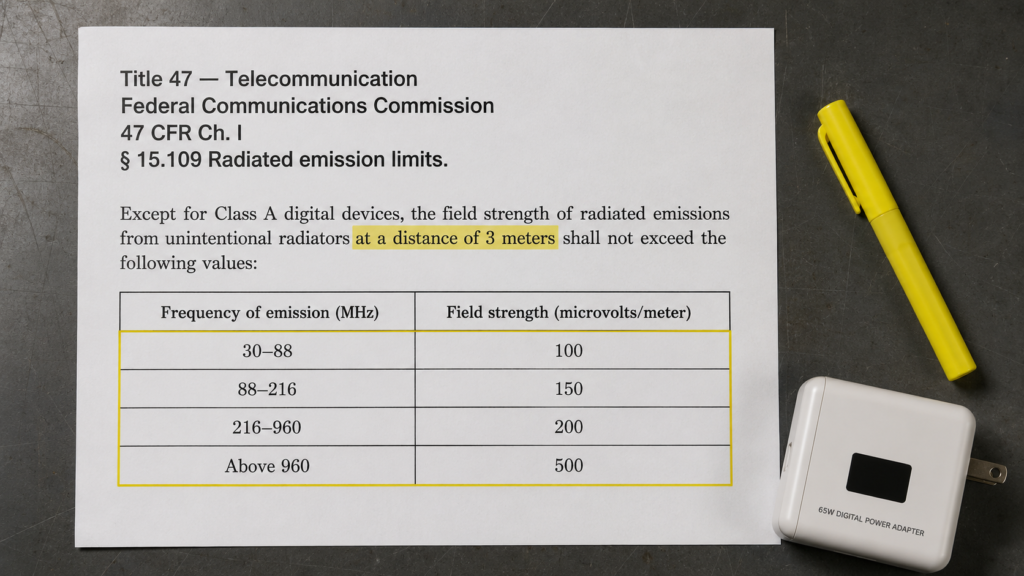
• Class B: For home/residential scenarios, with stricter limits. Consumer-grade chargers and power adapters basically choose this category, because there are many electrical and communication equipment in the home environment, which are more sensitive to interference.
• Class A: For commercial/industrial scenarios, with looser limits, but Class A compliance reports must never be used to replace the requirements for household Class B.
The judgment basis is very simple: look at the sales target, label description, and target usage scenario of the product. As long as it is sold to ordinary consumers and used at home, choose Class B.
Commercial Risks of Non-Compliance
If you commercially import or sell non-compliant products, you may face the following consequences:
• Detention or refusal of release by U.S. Customs during import, making it impossible for the goods to clear customs;
• Forced removal from e-commerce platforms, sales restrictions, and in severe cases, account freezing;
• Fines and recall requirements for failing market spot checks;
• If electromagnetic interference complaints are triggered, there is no basis for defense without a compliance certificate.
Note: The regulatory requirements for personal use entry are different from commercial import. Personal use import may be eligible for limited exemption, but it is usually subject to conditions such as quantity and no sales; carrying a large quantity may be deemed as commercial import.
III. What Exactly Does FCC Testing Measure? What Is the Core Logic?
Many people find FCC testing mysterious, but its core logic is actually very simple: simulate the operating state of the product with the maximum interference, and detect whether the electromagnetic leakage exceeds the limit.
Relationship Between Rules, Test Methods, and Test Plans
The three have a layer-by-layer implementation relationship. There is no unified “test list”, and what to test specifically depends entirely on the rules applicable to the product:
• Regulations (Part 15/18, etc.): The “rules” set by the FCC, which define which products need to be compliant, what the limits are, and what the scope of application is;
• ANSI test standards: The “operation manual” set by the American National Standards Institute, which stipulates the test layout, operation methods, and equipment requirements to ensure consistent test results from different laboratories;
• Laboratory test plan: The “test scheme” for specific products, which determines specific configurations such as the number of samples, cable specifications, and load conditions.
Common Test Items (by Product Type)
Test items vary greatly for different types of products. Here we only list the core items related to power adapters:
1. Wired switching power supplies/digital control adapters: Two core tests—
• Conducted emission: detects the intensity of interference transmitted back to the power grid through the power cord. For example, if a router on the same power strip is interfered with, it is most likely due to excessive conducted emission;
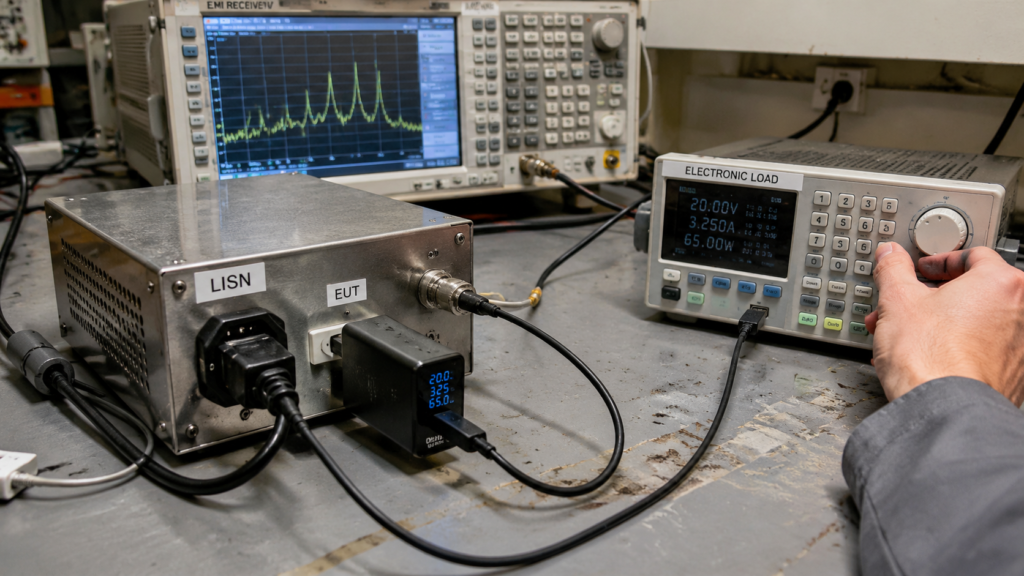
• Radiated emission: detects the intensity of electromagnetic waves emitted by the product into the air. For example, if WiFi lags when a charger is close to the router, it may be due to excessive radiated emission.
The specific test frequency bands and limits are determined according to applicable rules and product categories (Class A/B).
2. Wireless charging adapters (Part 18): In addition to basic conducted and radiated emissions, the following also need to be tested—
• Whether the operating frequency band meets the ISM frequency band requirements, and shall not illegally occupy communication frequency bands;
• RF exposure assessment: evaluates the impact of the product’s RF energy on the human body, which needs to be determined in combination with rules, frequency, power, usage distance and other factors.
3. Adapters with wireless communication functions: In addition to basic conducted and radiated emissions, wireless parameters also need to be tested—
• RF power, frequency band compliance, adjacent channel leakage (whether the signal leaks to adjacent frequency bands and interferes with other communications), etc.;
• The product must prove compliance with applicable RF exposure requirements, but it can first be judged whether it meets the RF exposure assessment exemption conditions; if not exempted, then conduct SAR, MPE or other applicable assessments according to frequency, power, usage distance and equipment use category. Products with cellular communication functions also need to comply with corresponding cellular service rules, and cannot be simply categorized under Part 15.
How to Select Test Conditions
The core principle of testing is: Test under the most unfavorable operating mode with the maximum electromagnetic interference. Only when the most stringent conditions meet the standards can daily use be guaranteed to be problem-free.
Manufacturers need to provide all combinations of operating modes, cables, and loads for the laboratory to screen. The laboratory determines the worst-case conditions through pre-scanning, formulates a formal test plan, and records it. Common consideration factors include: load status (no-load/light-load/full-load, usually full-load has the greatest interference), port load (multi-port chargers with all ports fully loaded), fast charging gear (fast charging mode has high switching frequency, and interference may be greater), output cable length (the longer the cable, the stronger the antenna effect, and the greater the radiation; generally, the longest standard cable is used for testing).
Factors Affecting Test Pass Rate
• Internal filter circuit design and component quality: for example, using poor-quality capacitors and inductors results in poor filtering effect and is prone to exceeding limits;
• Housing shielding material and structure: the shielding effect of metal housings is usually better than that of plastic housings;
• Product power: generally, the higher the power, the higher the interference risk;
• Switching frequency of fast charging mode: the higher the frequency, the more likely it is to generate high-frequency interference.
What to Do If Testing Fails? Rectification Closed Loop
Don’t panic if the test exceeds the limit. The formal process includes a rectification link:
Step 1: Locate the excessive frequency band and coupling path through pre-scanning (whether it is conducted or radiated, and where the interference comes from);
Step 2: Targeted rectification. For example, if conducted emission is excessive, add input filters, common-mode inductors, and Y capacitors; if radiated emission is excessive, optimize shielding, adjust PCB layout, add ferrite magnetic rings on cables, etc.;
Step 3: Retest under the most unfavorable operating mode after rectification, and only proceed to the next step after meeting the standards.
Note: Rectification must not change the core functions of the product. The design after rectification must be completely consistent with the final mass production design. It is not allowed to “modify for testing and revert for mass production”.
IV. Full Process of FCC Compliance Handling and Pitfall Avoidance
Preparations Before Handling
Preparing these materials in advance can save a lot of detours:
• Samples: provide samples that can represent the intended marketing and final mass production configuration, the quantity shall meet the needs of testing, backup, disassembly, photography, etc., subject to the requirements of the laboratory;
• Technical documentation: BOM (Bill of Materials), schematic diagrams/PCB layouts, key component list, user manual, label draft, circuit block diagram, operating mode description;
• Additional documentation for wireless products: antenna specifications, RF parameter table, pre-certified module certificate (if any);
• Complete applicability prediction in advance, confirm applicable rules and authorization paths, to avoid wasting money on testing under the wrong rules.
Core Steps of the Two Paths
For easy comparison, here is a table summarizing the differences between SDoC and Certification:
| Comparison Item | SDoC (Supplier’s Declaration of Conformity) | Certification (Official Certification) |
| Applicable products | Wired adapters, digital devices, etc. eligible for the SDoC procedure | Devices with wireless communication functions such as Bluetooth/WiFi/cellular, as well as consumer Part 18 ISM devices that may require Certification, etc. |
| FCC ID | None | Yes, globally unique and queryable |
| Reviewing entity | The enterprise is responsible on its own, no official review required | Reviewed and issued by FCC-authorized TCB |
| Public query | No public database record | Queryable in the official FCC database |
| Cycle | Relatively short, depending on testing and rectification time | Relatively long, with additional TCB review time |
| Cost | Relatively low | Relatively high |
SDoC Path Steps
1. Select a third-party laboratory with testing capabilities for the corresponding FCC rules;
2. Send samples for testing; if unqualified, rectify and retest until passing;
3. Obtain the official test report, and the enterprise issues a compliance declaration;
4. Retain the full set of compliance documentation, and the product can be launched on the market after providing compliance information as required.
Certification Path Steps
1. The first two steps are the same as SDoC: select a qualified laboratory, send samples for testing, and rectify until passing;
2. For first-time applications, an FCC Grantee Code (the enterprise’s unique identity code at the FCC) is required;
3. Submit test documentation and product information to the FCC-recognized TCB for review;
4. Obtain the unique FCC ID and authorization document after passing the review;
5. The product shall be marked with the FCC ID as required, and launched on the market after retaining the full set of documentation.
Factors Affecting Cycle and Cost
There is no fixed cycle and cost for FCC certification, which is mainly affected by these factors:
• Number of testing and rectification rounds: the more rectification rounds, the longer the cycle and the higher the cost;
• Laboratory scheduling and TCB review speed: scheduling may be longer in peak seasons;
• Whether it involves RF exposure assessment, confidentiality application (e.g., not disclosing schematic diagrams), such additional needs will increase cost and time;
• Product complexity: the higher the power and the more functions, the more test items, and the higher the cost;
• Authorization path: the overall cycle and cost of Certification are generally higher than those of SDoC.
Key Points for Pitfall Avoidance
• Test samples shall be able to represent the final configuration intended for marketing and mass production. Engineering samples or prototypes can be used for testing, but the manufacturer must ensure that the mass-produced product is consistent with the tested and authorized configuration; for changes that may affect RF or electromagnetic emissions, difference assessment and necessary supplementary testing or authorization changes shall be completed before mass production and marketing;
• Do not believe “guaranteed pass” promises. Formal institutions only assist with rectification and do not commit fraud. The consequences of fraud being discovered are very serious;
• SDoC cannot omit testing. It is not enough to just print a declaration by yourself. The test report must be true and valid, and must be kept for a long time for inspection;
• You cannot arbitrarily apply reports of other models in the same series. Even if they look similar in appearance, they must be confirmed through difference assessment.
Basic Compliance Requirements After Obtaining Certification
Obtaining a compliance certificate is only the first step. The following requirements must be met subsequently:
• Products shall provide or mark compliance information in accordance with the rules: SDoC products shall provide compliance information with the product in accordance with 47 CFR §2.1077, including product identification and contact information of the U.S. responsible party, which can be provided in accompanying documents or electronically; the FCC ID of Certification equipment shall usually be marked on the device body in accordance with 47 CFR §2.925, and devices that meet the electronic labeling rules can use electronic labels;
• The full set of test reports and compliance documents shall be kept for a long time and provided within the specified time when the FCC conducts spot checks;
• The responsible party for SDoC must be located in the United States; overseas applicants for Certification must designate a U.S. agent to handle matters such as service of legal documents;
• Compliance authorization must be completed before launching and selling, and it is not allowed to sell first and make up later.
Division of Obligations of Responsible Parties
FCC compliance is not a matter of one party, and the responsibilities of all parties vary under different authorization paths:
• Manufacturer: responsible for product design compliance, providing true samples and documentation, and ensuring that mass-produced products are consistent with test samples;
• SDoC responsible party: must be located in the United States, responsible for preserving and providing compliance documentation;
• Certification grantee: can be located outside the United States; overseas applicants must designate a U.S. agent to handle matters such as service of legal documents;
• Importer/distributor: shall verify compliance in accordance with the product authorization path and its role in the supply chain, and shall not sell non-compliant products, otherwise they may also bear responsibility.
Product Change and Series Sharing Management
Many sellers ask: if I change a part or add a model, can I use the original report? Here we clarify the rules uniformly:
Basic Principles of Change Assessment
Before any design, component, or function change, the responsible party or grantee shall conduct a compliance difference assessment based on applicable rules. For Certification equipment, it shall be determined in accordance with 47 CFR §2.1043 whether it is a permitted change, Class II permissive change, or requires new authorization, and shall be handled through appropriate TCB procedures as required; it is not allowed to presume that reports can be shared solely based on “same main controller, same circuit”.
Common Change Scenarios Requiring Assessment
• Replacement of core electromagnetic-related components such as main control chips, transformers, and filters;
• Modification of circuit structure, shielding design, and housing material;
• Adding wireless functions, increasing rated power, and increasing the number of ports;
• Replacing the type or length of input/output cables (may affect test results).
Prerequisites for Sharing Reports Among Same-Series Models
Whether different models in the same series can use the same report or representative model requires technical basis, and the following conditions shall usually be considered:
• Whether the basic circuits, core components, and electromagnetic interference characteristics are consistent, or whether engineering analysis can prove that the differences will not affect compliance;
• Whether the tested model is the configuration with the highest interference risk in the series, such as the model with the highest power and the most ports;
• Whether difference analysis, supplementary testing, or representative model testing is required to prove that other models are also compliant;
• Evaluated and confirmed feasible by the laboratory, TCB, or responsible party in accordance with applicable rules.
It cannot be based solely on similar model names, nor should it be mechanically limited to only differences in color or silk screen printing.
V. How to Verify the Authenticity of FCC Compliance? What Are the Query Boundaries?
Many people use wrong methods to check FCC compliance. Here we explain the correct verification methods and what content cannot be queried.
Labeling Requirements for Different Types of Products
First, check the labeling, but do not only rely on labeling:
• SDoC products shall provide compliance information with the product in accordance with 47 CFR §2.1077, including product identification and contact information of the U.S. responsible party; this information can be provided in accompanying documents or electronically, and is not necessarily required to be printed on the product body;
• The FCC ID of Certification products must usually be marked on the device body and be consistent with official authorization records; only devices that meet the electronic labeling rules can use electronic labels, and packaging or user manuals usually cannot replace the FCC ID body label;
• The official FCC Logo is not mandatory. The core is that compliance information is complete and traceable; having a printed Logo does not mean it is truly compliant.
FCC ID Verification Method (Certification Category)
Products that have obtained Certification authorization can be queried for free through the official FCC public database:
• Query method: enter the complete FCC ID, or enter the enterprise’s Grantee Code to query the list of all authorized products of the enterprise;
• Key points for verification: product model, brand, hardware version, wireless function, and certification photos are consistent with the actual product;
• Note: The FCC ID of the built-in wireless module of the product does not automatically mean that the entire host device is compliant. The module’s authorization conditions, antenna and installation restrictions, labeling requirements, and applicable electromagnetic compliance requirements for the host device shall be verified; only when applicable rules require the host device to be certified separately should the host device’s own FCC ID be queried.
SDoC/Part 18 Category Verification Method
Ordinary wired adapters or other products that follow the SDoC path usually do not have public FCC ID records generated by SDoC, and cannot be verified by checking the ID. The correct approach is:
• Require the seller to provide the test report and compliance declaration for the corresponding model;
• Verify that the model, specifications, and manufacturer information on the report are consistent with the actual product;
• Confirm that the report is issued by a laboratory with corresponding testing capabilities.
It should be noted that some Part 18 consumer ISM devices need to go through Certification and obtain an FCC ID. Therefore, wireless charging adapters cannot be verified as SDoC products simply because they have no communication function; their actual authorization path should be confirmed first.
Risk Signals of Non-Compliance
If you encounter the following situations, you should be alert that the product may be non-compliant:
• Unable to provide compliance documents or responsible party information for the corresponding model;
• The report model and parameters are inconsistent with the actual product;
• No record is found in the official database for products that should have obtained an FCC ID;
• Certification photos and frequency band information do not match the actual functions of the product. For example, the product claims to have Bluetooth, but there is no corresponding frequency band in the certification.
Query Boundaries of the FCC Database
This is the most easily misunderstood point: the official FCC database can query devices that have obtained Certification authorization, which is not limited to Part 15 intentional radiators with wireless communication functions; some Part 18 consumer ISM devices may also have an FCC ID.
SDoC products such as Part 15 SDoC usually do not have public FCC ID records generated by SDoC. In other words, the absence of an FCC ID does not mean that an ordinary wired adapter must be non-compliant; but for products that should actually follow the Certification path, the absence of an FCC ID requires further verification. Whether an FCC ID should be found must first be judged based on the actual authorization path of the product.
Basic Troubleshooting for Suspected Electromagnetic Interference
If you suspect that a power adapter is causing electromagnetic interference, you can first conduct a simple self-check:
• Unplug the suspicious adapter and observe whether the interfered device returns to normal;
• Replace the socket, output cable, or charging device to rule out external factors;
• Move the adapter to a position farther away from the interfered device and observe whether it improves;
• If it is confirmed that the obvious interference is caused by the adapter, it is recommended to further verify its compliance.
VI. Clarification of Common Cognitive Misconceptions
Here we clarify the most common pitfalls at once:
1. CE/UL/DOE certification can replace FCC: Wrong. The regulatory dimensions of each certification are completely different—CE is a European Union compliance requirement, UL is a U.S. safety certification, and DOE is a U.S. energy efficiency certification; none can replace the FCC’s electromagnetic compliance requirements.
2. Having an FCC label means true compliance: Wrong. Labels can be printed by yourself, and must be verified in combination with the official database (for products applicable to Certification), test reports, and compliance declarations (for SDoC products).
3. All adapters require an FCC ID: Wrong. Whether an FCC ID is required depends on the actual authorization path. Products with wireless communication functions such as Bluetooth/WiFi usually require Certification and an FCC ID; some consumer Part 18 ISM devices may also require Certification. Ordinary wired adapters do not necessarily need an FCC ID if they are eligible for SDoC or meet specific exemption conditions.
4. FCC certification has a fixed validity period: Wrong. FCC device authorization usually does not have a fixed annual review or uniform expiration date. When a product undergoes changes that may affect compliance, it shall be evaluated in accordance with applicable rules; after FCC rules are updated, it shall be judged whether supplementary evaluation, re-testing, or updated authorization is required based on the effective date of the rules, transition arrangements, and whether they apply to existing products.
5. Products with pre-certified wireless modules do not require whole-device certification: Wrong. Module certification does not automatically cover all compliance obligations of the host device. After integration, it is still necessary to verify the module’s authorization conditions, antenna and installation restrictions, and labeling requirements, and complete the applicable electromagnetic compliance assessment for the host device; only when the module conditions or rule requirements are not met does the host device need to obtain separate Certification or FCC ID.
6. Wireless charging adapters must have FCC ID certification: This cannot be generalized. Pure wireless charging devices need to be judged based on working principle, frequency, power, and specific rules; if they are Part 18 consumer ISM devices, they usually require Certification and an FCC ID. It cannot be directly assumed that no FCC ID is required just because there are no communication functions such as Bluetooth or WiFi.
VII. Quick Judgment Tools
If you don’t want to read a long article, you can use these methods to quickly draw preliminary conclusions, but the final result still needs to be subject to the evaluation of a professional institution.
10-Second Judgment on Whether Applicability Assessment Is Needed
The core depends on two points: whether it is commercially sold/imported for the U.S. market, and whether it contains switching power supply/digital/wireless functions. If both points are met, further assessment is required.
60-Second Judgment of Compliance Path
Three steps to get it done:
Step 1: Confirm whether the product has active wireless communication functions such as Bluetooth/WiFi/cellular;
Step 2: If not, confirm whether it has a wireless charging function, and whether the wireless charging function may apply to Part 18, Part 15, or other provisions;
Step 3: When there is active wireless communication function, it is usually necessary to judge the Certification and FCC ID requirements in accordance with applicable wireless rules; for pure wired power adapters, first judge whether they contain digital circuits and whether they meet specific exemptions such as 47 CFR §15.103(d), and cannot be assumed to require SDoC just because they are switching power supplies; wireless charging products without communication functions need to be judged on a case-by-case basis, and those belonging to Part 18 consumer ISM devices usually require Certification and FCC ID.
Supplement: The final path needs to be confirmed in combination with applicable rules and channel requirements, and some platforms may have additional third-party testing requirements for SDoC products.
3 Steps to Identify Basic Authenticity of Compliance
Step 1: For products that should obtain Certification, first check the official FCC ID database;
Step 2: For SDoC products, request test reports and compliance declarations;
Step 3: Verify whether the information in the documents or database is consistent with the actual product model, parameters, and functions.
In general, FCC certification is an important mandatory compliance requirement for power adapters to enter the U.S. market. It is complicated if you think it is—products with different functions have very different applicable rules and paths; it is simple if you think it is—as long as you first clarify the product functions, find the corresponding rules, and test and rectify according to the process, you can achieve compliance smoothly. Remember several core principles: FCC only regulates electromagnetic compatibility and not safety performance; not all products require an FCC ID; the absence of an ID does not mean it must be non-compliant; for wireless charging devices and products using pre-certified modules, especially, you cannot draw conclusions based solely on common sayings. When in doubt, it is safer to confirm with an experienced laboratory or compliance consultant than to judge based on experience.