
Friends who engage in cross-border e-commerce or source charging products from China to sell to the European Union and the United States have most likely encountered suppliers patting their chests and claiming “we have CE/FCC certification”. However, the documents you receive are either a blurry screenshot or a report full of English, leaving you worried: is this certificate real? Will my listing be rejected by the platform, or my goods detained by customs during clearance?
In fact, verifying the authenticity of CE and FCC certifications is not that mysterious, and you do not need to master too many professional terms. Step-by-step verification can filter out some materials with obvious document, model, or path issues, but it cannot guarantee the identification of all forged or misappropriated documents. In this article, we take common products such as charging cables, chargers, and adapters as examples to explain the complete verification method clearly, from entry-level basics to advanced pit avoidance.
First Step of Verification: Quick Initial Screening, Filter Out Low-Quality Fake Certificates in 10 Minutes
After understanding the basic rules, don’t rush to check the official database first. Do a round of quick initial screening to filter out obvious low-quality fake certificates, which can save a lot of time.
First Request the Complete Document Package
Many suppliers only provide a screenshot or a half-page report, which is impossible to verify at all. You should explicitly require the other party to provide complete PDF files, and prioritize requesting the following:
• CE-related materials: EU Declaration of Conformity (DoC) + product model/nameplate information + technical supporting materials that can prove conformity + real photos of product nameplates/packaging
• FCC-related materials: documents related to SDoC or FCC ID + test or evaluation records + real photos of product nameplates/packaging
• Supplementary materials: parameter sheet of the purchased product, authorization certificate (if applicable), quotation/proforma invoice (used to check the model)
Test reports and laboratory accreditation information can be used as important verification materials, but not all CE products must have third-party test reports or accredited laboratory certificates. If the other party only provides screenshots, cropped images, or makes excuses not to provide complete PDFs, you should require them to supplement; if the manufacturer cannot provide the EU DoC, or cannot explain its technical documents and conformity assessment basis, it should be regarded as a major risk, and procurement should be suspended or a professional institution should be entrusted for verification.
General Initial Screening: Check These 4 Points First When You Get the Documents
Scan through the documents as soon as you open them. If there are these problems, you can basically reject them directly:
1. **Basic information does not match**: The product model and name on the document are completely different from the product you want to purchase, and there is no signing entity or issuance date.
2. **Signing does not meet requirements**: DoC/SDoC must have the name, address, signatory’s name, date and signature of the manufacturer or authorized representative; test reports usually should have a report number, issuance information, and signature of the authorized signatory. Note: **A seal is only an auxiliary clue, not a legal requirement**. Many formal foreign documents only have signatures and no red seal, and they are still valid. Don’t judge authenticity only by whether there is a seal.
3. **Series models are covered randomly**: Many suppliers will say “our entire series has certificates”, but only one model is listed in the document. Formal series coverage must clearly state which models are within the scope, and core differences (such as power, circuit) must have technical basis. You can’t be fooled by a casual sentence like “the entire series is universal”.
4. **Obvious abnormal appearance**: Discontinuous page numbers, varying font sizes, skewed logos, obvious PS stitching traces – these are most likely altered fake certificates.
Exclusive Initial Screening Points for Charging Products
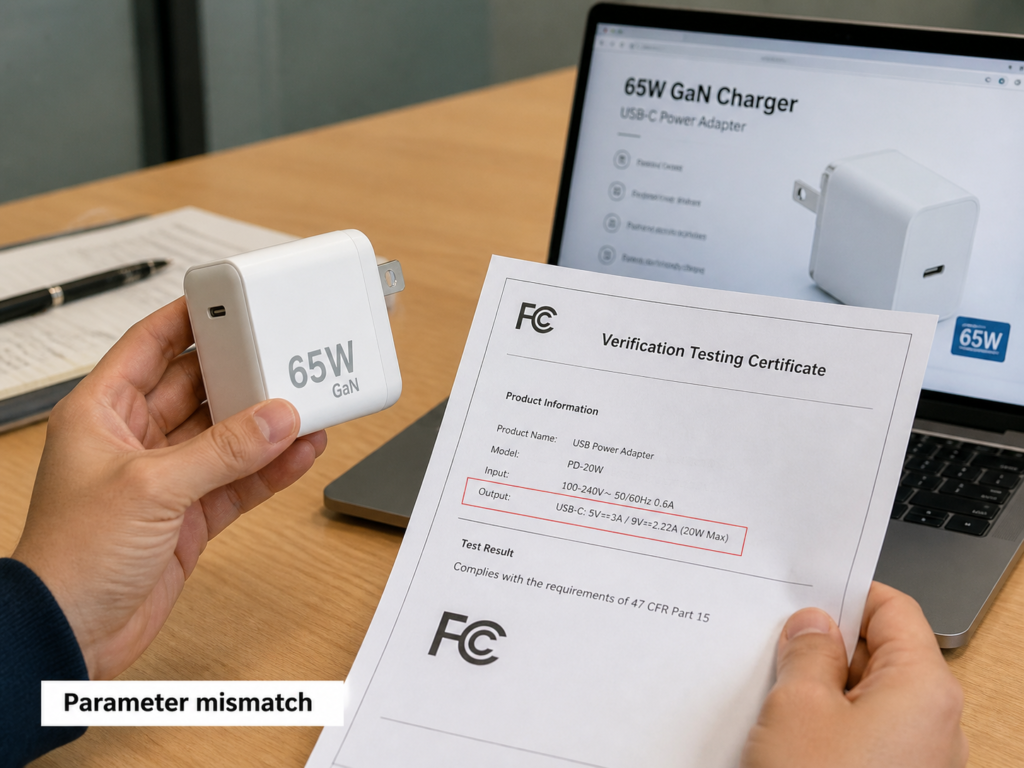
For products such as chargers and cables, there are several exclusive quick judgment points:
1. For common chargers and power adapters that are connected to the mains and have a rated voltage within the scope of the LVD, the conformity of safety (Low Voltage Directive, LVD) and electromagnetic compatibility (EMC) should usually be checked; however, this should first be confirmed according to the product’s rated voltage, power supply method, electronic functions, and applicable regulations, and it cannot be asserted that LVD applies to all charging products without exception.
2. For ordinary wired charging products, if the supplier voluntarily provides you with an FCC ID, be wary of misappropriated certificates – whether such products need an FCC ID depends on the specific device category. If they give you a certificate that does not match the product functions for no reason, it is most likely using a certificate from another product to make up the numbers.
3. The parameters on the certificate (power, voltage, number/type of interfaces) are different from those advertised for the product. For example, if it is advertised as a 65W GaN charger but the certificate says 20W, there must be a problem.
4. Products of the same series with different powers and different interfaces cannot be assumed to share certificates. For example, 20W and 65W chargers, even if they look exactly the same, have completely different internal circuits. You must confirm that the report actually covers the power you need.
Step-by-Step Verification of FCC Document Authenticity (Exclusive for Charging Products)
The verification logic of FCC is similar to that of CE. The core is also to first judge whether the path is correct, and then check the documents and official information.
First Confirm: Which FCC Path Should Your Product Follow?
Many people’s biggest misunderstanding of FCC is that “all FCC certifications can be found on the official website”, but this is not the case. The query methods for different paths are completely different:
• Whether wired charging products need Part 15 SDoC depends on whether they are regulated digital devices, unintentional radiators, and whether exemptions apply; passive cables cannot be simply classified as SDoC.
• Products with wireless transmission functions such as Bluetooth and Wi-Fi usually need to follow the FCC Certification path, have an FCC ID, and can be queried in the official database.
• Wireless charging and wireless power transmission products should confirm device authorization according to Part 18 and specific device classification; consumer-oriented ISM devices usually must undergo Certification and obtain an FCC ID. You cannot directly conclude that no FCC ID is needed just because there is no Bluetooth or Wi-Fi.
• Common fake trick: Disguise SDoC as FCC ID, make up an ID number casually, or use the ID of another product to impersonate.
Verification Method for SDoC Documents
SDoC is a common FCC compliance path for some wired electronic products. Since there is no public database, the focus is on checking these points:
1. **Basic information verification**: The manufacturer’s name, address, information of the responsible party who assumes compliance responsibility, and signatory information are complete. According to FCC rules, the responsible party must be located in the United States, and should not be generally referred to as a US Agent.
2. **Applicable rules verification**: The document should clearly mark the corresponding FCC rules. For example, ordinary wired digital devices may apply to Part 15B, and it cannot just write “meets FCC requirements”.
3. **Product model verification**: Clearly cover the model you purchase, and differences in the same series must have a reasonable explanation.
4. **Test support verification**: There should be test or evaluation records that can prove conformity as support, not just a declaration paper that cannot explain the basis.
5. **Laboratory qualification**: Laboratories with ISO 17025 accreditation are more reliable, but this is not the only standard for the validity of SDoC – because SDoC is the responsibility of the supplier itself, whether an accredited laboratory must be used should be judged according to specific rules and conformity assessment paths.
6. **Note**: FCC does not have a public SDoC database, so don’t say that SDoC is fake just because you can’t find it. The focus is on whether the responsible entity and test support are complete.
Official Query Steps for FCC ID
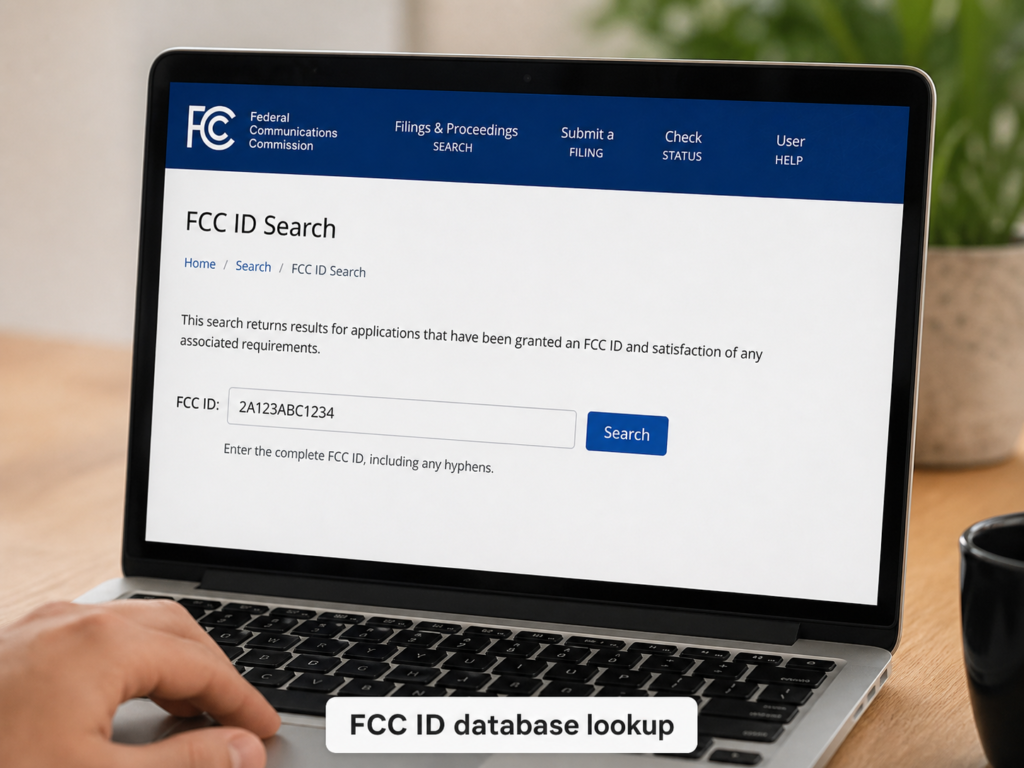
If your product is a wireless transmission device that requires FCC Certification, you can verify it in these three steps:
1. **Step 1: Find the FCC ID**: The FCC ID can usually be found on the product label, back marking, instruction manual, or electronic label that complies with the rules. It consists of a grantee code and a product code; the grantee code is usually 3 or 5 alphanumeric characters, and the product code is set by the applicant and subject to the length limit of the rules. The complete FCC ID in the FCC database shall prevail.
2. **Step 2: Query in the official database**: Go to the FCC ID query page officially authorized by the FCC, enter the complete ID number to search.
3. **Step 3: Check core information**:
• Whether there is a corresponding authorization record
• Whether the registered model and product appearance are consistent with the one you purchase
• Whether the applicant (grantee) is related to the supplier; if there is no relationship, it may be a misappropriated certificate
• Whether the registered functions match the actual functions of the product
If it cannot be retrieved, you should first recheck whether the complete ID and label reading are correct, and whether the device is indeed an end product that should be certified; if it still cannot be matched, it should be regarded as a major risk, require the manufacturer or grantee to explain, and suspend procurement.
• **Common pit**: Use the FCC ID of a wireless module to impersonate the end product ID. For example, a charger uses a Bluetooth-enabled module, and the module has an ID, but the end product has not obtained FCC ID certification. This is non-compliant. You must confirm that the registered device type is “end product”, not “module”.
These Situations Should Be Regarded as Major Risks for FCC Documents
If you encounter any of the following situations, you should suspend procurement and further verify:
• Only has the FCC mark, and cannot provide a written SDoC or test and evaluation records that can prove conformity
• Has no corresponding radio frequency function, but is marked with an FCC ID and cannot give a reasonable explanation (for example, an ordinary wired charger is printed with an FCC ID)
• The FCC ID cannot be retrieved, or the registered information is completely mismatched with the product, and the manufacturer or grantee cannot give a reasonable explanation
• The SDoC has no test support and cannot provide any compliance records
Implementation of the Whole Procurement Process: What to Check from Inquiry to Receipt
Verification is not only done when you get the documents, but should run through the entire procurement process. From inquiry to receipt, you must check every step to avoid pits to the greatest extent.
Inquiry Stage: Efficiently Request Documents
• Don’t rely on screenshots of the product detail page. Be sure to request complete PDF files before placing an order.
• Don’t just say “give me the CE certificate”. You should explicitly require the provision of “declaration documents + technical supporting materials + laboratory qualification number (if any)” to avoid suppliers perfunctorily giving you a screenshot.
• Make it clear in advance whether your target market is the EU or the US, to avoid suppliers giving the wrong documents. For example, if you want to sell to the US, they give you CE documents, which are useless at all.
• For bulk procurement, be sure to get samples first, check that the parameters and appearance of the samples are consistent with those on the certificate, and then place an order.
Before Placing an Order: Predict Platform Review in Advance
The compliance review requirements of cross-border platforms (such as Amazon, AliExpress) vary depending on the platform, site, product category, and risk level, and shall be subject to the current compliance policy and specific notices of the target platform. For FCC products, you should first confirm whether SDoC, Certification, or other rule paths apply, and you cannot only prepare FCC ID uniformly.
The key points of self-inspection in advance are still clear: whether the documents are complete, whether the models are correct, and whether the responsible entity is clear. If problems such as misappropriated certificates, mismatched product models, standards or technical basis that cannot support the current product, or institutional qualifications that do not match the claimed services are found, you should verify them before listing.
Receipt Stage: Physical Cross-Check
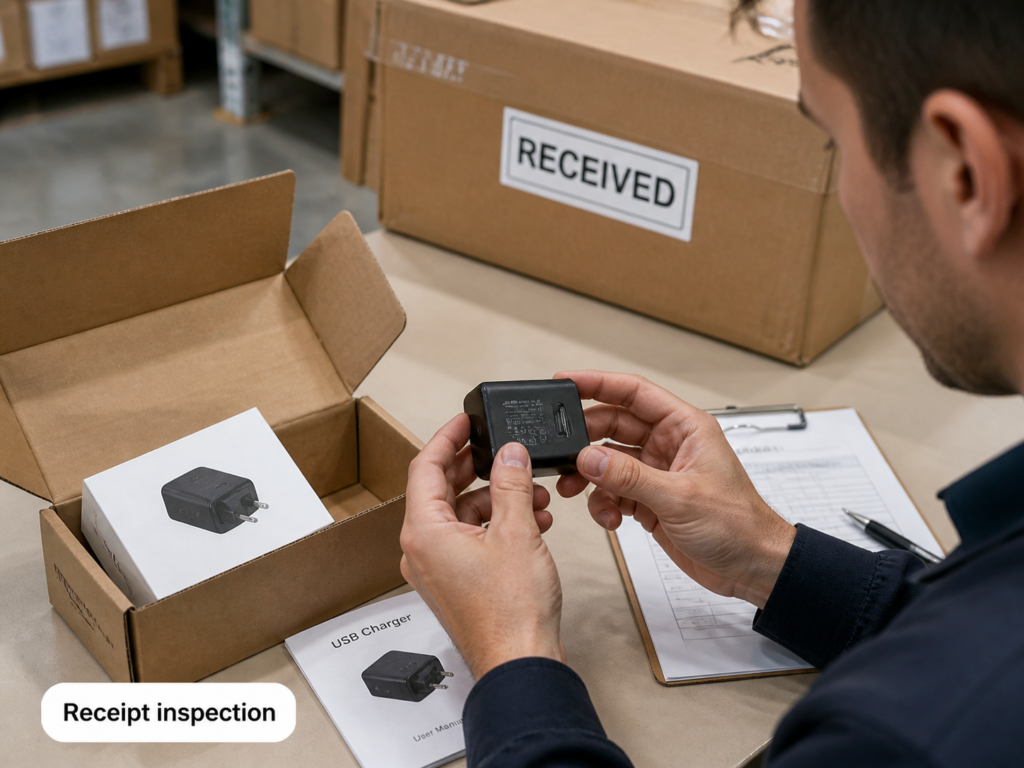
Genuine documents do not mean that the bulk goods are genuine. Be sure to do a physical check when receiving the goods:
• Appearance check: Whether the models and parameters on the nameplate, packaging, and instruction manual are consistent with those on the certificate.
• Marking check: CE/FCC marks comply with the specifications; for products that require FCC Certification, it should be confirmed that the FCC ID can be provided to users through a permanent label or an electronic label that complies with the rules.
• Sampling verification: Take a few products, check whether the model, parameters, plug, wireless module (if any), and label are consistent with the previous samples.
• All compliance documents, contracts, and sample photos should be kept properly. In case of customs detention or platform appeal, they can be used directly.
Pit Avoidance Principles for Supplier Screening
• Don’t believe in “certificate issuance in 1 day, ultra-low price certificate processing”. Formal testing requires time and cost, and this kind of situation is most likely fake certificates or misappropriated certificates.
• If the certification price is far lower than the market price, it is basically fake, or only part of the test has been done, not full compliance.
• Prioritize suppliers who can actively provide complete documents and support official verification. Such suppliers are generally more reliable.
Doubt Handling: What to Do If You Are Not Sure? Where Is Your Verification Boundary
You often encounter ambiguous situations during verification. Don’t panic at this time. First, classify and handle them according to the risk level. At the same time, you must know your own ability boundary, and find a professional institution when you should.
Clarification of High-Frequency Questions
First, let’s clarify a few questions that everyone asks most often:
1. **Is a certificate that cannot be found necessarily fake?** Not necessarily. DoC and SDoC do not have public databases by nature. For FCC IDs, failure to retrieve is usually a major abnormality, but you should first check the complete ID, device category, and label information, and then require the supplier to supplement supporting materials for judgment.
2. **Is a certificate that can be found necessarily valid?** Not necessarily. It may be a misappropriated certificate, mismatched product model, or expired institutional qualification. You must cross-check the information, and don’t feel relieved just because it “can be found”.
3. **Can CE and FCC replace each other?** Absolutely not. One is the compliance requirement of the EU, and the other is that of the US. The applicable regions, test standards, and compliance logic are completely different.
4. **How long is the validity period of the test report?** There is no unified legal validity period. Whether the report is still applicable should be continuously evaluated in combination with factors such as whether the product design and mass production are consistent, whether regulations or standards have changed, and whether new risk information has emerged; when there are changes that affect compliance, re-evaluation is required.
Doubt Risk Level and Handling
If you encounter uncertain situations, you can handle them according to the corresponding levels below:
| Risk Level | Typical Performance | Handling Method |
| Low Risk | Inconsistent document format but consistent core information, older report but no product changes, supplier can give a reasonable explanation | Continue cooperation after supplementary verification |
| Medium-High Risk | No manufacturer/signatory information, mismatched model/power/function, FCC ID cannot be found | Suspend procurement, require the supplier to supplement materials, and make a decision after verification |
| Severe Risk | Forged signature seal/number, misappropriation of other’s documents, complete mismatch between physical goods and materials, supplier refuses to supplement materials | Directly give up cooperation, do not take risks |
Ability Boundary of Personal Verification
You don’t need to know everything. You should know what you can check and what you can’t:
• **What can be independently verified**: Notified Body (NB) qualification, FCC ID registration information, laboratory accreditation qualification, product information matching degree – these are all public information, and you can check them by yourself.
• **What cannot be independently verified**: The authenticity of DoC/SDoC signatures, finely PS-ed test reports, consistency between bulk products and samples – these are difficult to judge with the naked eye by individuals.
• **Situations that require a professional institution**: Large-value orders, high-power high-risk products, platform appeals/customs detention, new regulatory categories – in these cases, finding a professional compliance institution for help is much more reliable than handling it by yourself.
Quick Checklist and Capability Summary
Finally, we condense the core content into a checklist that you can compare at any time. After reading this article, you can also master the basic authenticity identification ability.
3-Step Entry-Level Quick Verification Checklist
Beginners don’t need to remember too much. Follow these three steps to filter out most obviously problematic materials:
1. **Check model parameters**: Confirm that the documents cover the model you purchase, and the core parameters (power, interface, function) are completely matched.
2. **Check document completeness**: Verify whether DoC/SDoC and technical supporting materials can identify the product, applicable rules or standards, test or evaluation methods, results, date, and responsible entity. Sample photos, client information, continuous page numbers, and accreditation certificates are valuable cross-verification clues, but should not be mechanically regarded as legally required items for all reports.
3. **Check official queryable information**: For documents that do involve NB, check the institution qualification on the EU NANDO; for products that require FCC Certification, check the FCC ID registration information on the official query page; check the status of laboratory qualification on the official website of the accreditation body.
Exclusive Verification Points for Different Charging Products
• Chargers/adapters: For common products connected to the mains and with rated voltage within the LVD scope, LVD and EMC conformity should usually be checked; whether FCC SDoC applies needs to be judged according to device attributes and applicable exemptions.
• Ordinary charging cables: Confirm whether independent compliance materials are required according to whether they are sold independently and whether they contain electronic functions; passive cables cannot be simply classified as FCC SDoC.
• USB-C cables with E-Marker: E-Marker does not automatically trigger certification, and judgment is based on the overall function of the product.
• Wireless chargers/smart charging devices: Those with wireless transmission functions need to check FCC device authorization; wireless charging and wireless power transmission products should also be confirmed according to Part 18 and specific device classification, and compliance or non-compliance cannot be judged based on “only wireless power supply” or no ID.
Core Abilities You Can Master
After reading this article, you should be able to do the following:
1. Distinguish the applicable scenarios of CE DoC, NB certificates, FCC SDoC, and FCC ID, and no longer confuse them.
2. Be able to lock in the correct compliance path according to product functions and target markets, and will not be easily fooled by suppliers.
3. Know how to use three official channels (NANDO database, FCC ID query page, laboratory accreditation official website) for basic verification.
4. Be able to identify common types of fake certificates: misappropriated certificates, mismatched models, unqualified institutions, and doubtful standard applicability.
5. Know how to grade doubts, and know when you can verify by yourself and when you should find a professional institution.
In fact, the essence of verifying the authenticity of CE/FCC is not to see “whether the certificate looks real”, but to see “whether the path is correct, whether the documents are complete, whether the information matches, and whether it can be found officially”. Especially for charging products, there are great differences in functions and parameters. As long as you check step by step, you can avoid most pits without knowing too much professional knowledge.