
When we buy chargers via overseas shopping or sell power supplies cross-border, we always see a bunch of marks like UL, CE, CCC, PSE printed on the packaging or the product itself, which is dazzling. Some people think a mark means safety, some think one certification allows selling worldwide, and others mistake the PD fast charging mark for a safety certification — these are all common misconceptions. Today we will thoroughly explain global certifications for power adapters, from basic concepts to authenticity verification, and then to compliance requirements for different scenarios. After reading this, you will be able to make a pretty accurate judgment on your own.
1. First, Understand the Basics: What Exactly Is Certification?
Coverage and Core Boundaries
First of all, it must be clear that the power adapter certification we are talking about covers daily consumer-grade products: wall-plug USB/USB-C chargers, laptop power adapters, desktop multi-port charging stations, and ordinary DC adapters are all included. Industrial, medical, and in-vehicle products usually apply different or additional regulations, standards, and test conditions, and compliance cannot be directly judged based on the requirements for consumer-grade external power adapters described in this article.
There is a most easily overlooked pitfall here: Certification is tied to specific models, structures, and key components; it is not universal across an entire brand product line. For example, if a brand’s 20W USB-C charger has passed CCC certification, it does not mean its 65W multi-port charging station has also passed — even if the two products bear the same logo, as long as the model and internal structure are different, the certification cannot be shared.
The Essence of Certification: A Compliance Credential for Market Access
Many people think certification is a “quality medal”, but its core is a legal entry ticket to a certain market: official or third-party institutions evaluate according to unified standards to confirm that the product will not hurt people or interfere with other equipment, and meets the minimum access requirements.
There are generally three types of compliance paths:
• Mandatory certification: Issued by a third-party institution, products without certification are prohibited from sale, such as China’s CCC certification;
• Voluntary certification: When it is not a mandatory requirement in the applicable market, it can be used as a market bonus; but whether energy efficiency is voluntary must be confirmed according to the product and target market; external power supplies may be subject to mandatory energy efficiency regulations in markets such as the US and the EU;
• Self-declaration: No official or third-party certification is required. Enterprises complete testing, retain documents, and sign a commitment to meet the requirements. The responsibility is entirely borne by the enterprise, such as most categories under the EU CE mark.
Three Types of Risks of Non-Compliance
If a product is launched without compliance, it will face three clear types of risks:
The first is commercial risk, such as customs detention and fines, e-commerce platforms rejecting listing or directly removing products. Many cross-border sellers have stumbled over this, and fines may be higher than the value of the goods;
The second is safety risk. Products that have not passed safety tests may overheat, catch fire, or leak electricity, which may burn mobile phones and computers in mild cases, and cause fires in severe cases;
The third is liability risk. Once a problem occurs, without compliance documents, it is impossible to prove that the product meets the requirements. Not only must compensation be borne, but also responsibility tracing is very difficult to advance.
4 Most Common Mistakes for Beginners
People who are new to certification can easily go astray. Let’s explain the most common misconceptions in advance:
1. Having a certification mark = having certification? Wrong. Marks can be printed by any printing factory. Only certifications with records in official systems or supported by a full set of test documents are real. Many UL and CE marks on no-name chargers are printed privately.
2. One certification works globally? Wrong. Each country and region has different regulations and different required certifications. China’s CCC is not valid in the EU, and the US FCC is useless in Japan. You have to get the certification of the market you want to sell in.
3. USB-C/PD/fast charging protocol mark = safety certification? Wrong. PD, QC and others are charging protocols, which govern whether the device can be fast charged. They are completely different from whether the product is safe or can be sold legally. Protocol certification cannot replace safety compliance.
4. Works normally = meets certification? Wrong. The threshold between “usable” and “safe and compliant” is far apart. A no-name charger that costs a few dollars can also charge a mobile phone, but it may short-circuit when dropped, which completely fails to meet compliance requirements.
2. What Do Certifications Test? 5 Core Assessment Dimensions
After figuring out what certification is, you may be curious: what exactly do these certifications test? Is it enough as long as it doesn’t explode? In fact, there are several assessment dimensions for certification, each with clear requirements, and none can be missing.
Electrical Safety Testing (Most Core: Preventing Personal Injury)
This is the most basic and important part of all certifications, and its core goal is to prevent products from harming users. Its requirement is: whether in normal use or in case of minor faults (such as sudden voltage rise, output short circuit), the product must not present electric shock or fire risks.
The testing mainly focuses on three directions: whether overvoltage/overcurrent/overheat protection is effective, whether insulation performance is sufficient to prevent electric leakage, and whether the外壳 and internal materials are flame-retardant. Multi-port products shall be evaluated for the most unfavorable single-port, combined output and abnormal load conditions according to applicable safety standards and rated output definitions; single-port test results cannot replace all applicable working conditions.
Many people think that higher-power chargers are less safe, but this is a misconception. The goal of safety certification is “not to hurt people”. It’s just that the test requirements for higher-power products will be adjusted with power and structure, for example, temperature rise thresholds and overload test conditions will be stricter, but as long as they pass the certification, the safety level is up to standard.
Electromagnetic Compatibility (EMC) Testing (Preventing Mutual Interference Between Devices)
Simply put, it governs “no mutual interference between devices”, and there are two core requirements: first, the product itself must not emit too much interference signal, for example, when charging a mobile phone, it will not make the nearby radio full of noise; second, the product must not be damaged by external interference, for example, when a microwave oven is turned on nearby, the charger will not stop working directly or even fail.
Special attention should be paid: safety and EMC are usually independent compliance dimensions; whether both emission and immunity tests are required shall be confirmed according to the target market, product category and applicable regulations. US FCC Part 15 mainly controls electromagnetic emissions for most unintentional radiators.
Energy Efficiency Testing (Reducing Wasted Power)
To put it bluntly, it depends on whether the product wastes electricity, mainly measuring two indicators: no-load power consumption (power consumption when plugged into the socket and not in use) and conversion efficiency (utilization rate of grid electricity converted into charging DC power, the less waste, the higher the efficiency).
The energy efficiency judgment threshold is not unified, and is jointly determined by target market regulations, product power, number of ports, and regulation version. There is a pitfall here for multi-port products: you cannot directly add the peak power of each port as the total power. The statutory energy efficiency test is tested according to the specified combined output. For example, when two ports output at the same time, the total power may not be twice that of a single port.
There is also a common misconception: the higher the energy efficiency level, the more cost-effective? Not necessarily. If the charger is plugged in all year round, high energy efficiency can indeed save electricity bills; but if it is only used a few times a year, the extra money spent on high energy efficiency may be more than the electricity bill saved, which must be judged in combination with the frequency of use.
Environmental Protection and Recycling Requirements (Compliance Add-ons)
Such requirements have nothing to do with safety, and are rules at the environmental protection level, such as the commonly heard RoHS (restricting the content of toxic substances such as lead and mercury in products), WEEE (requiring enterprises to bear the responsibility for e-waste recycling and affix recycling marks), California Prop 65 (centered on exposure to listed chemicals; unless the enterprise can prove that exposure is below the applicable safe harbor level or meets other statutory exemptions, a warning is usually required, and it cannot be judged only by whether the product contains the substance or whether it reaches a unified content threshold).
A special misconception should be corrected here: RoHS and WEEE marks do not mean the product is safer. They are only environmental protection requirements, and have nothing to do with electric shock or fire.
Logic of the Compliance Document Chain
Many people think that compliance is just getting a certificate, but it’s not. Compliance is a complete chain from top-level regulations to implementation. From mandatory regulatory requirements, to test reports, declarations of conformity, product labeling, and post-marketing records, every link must be traceable. A single document cannot replace complete compliance. For example, if you only have a CE certificate but cannot produce test reports and a declaration of conformity, you will still be judged as non-compliant.
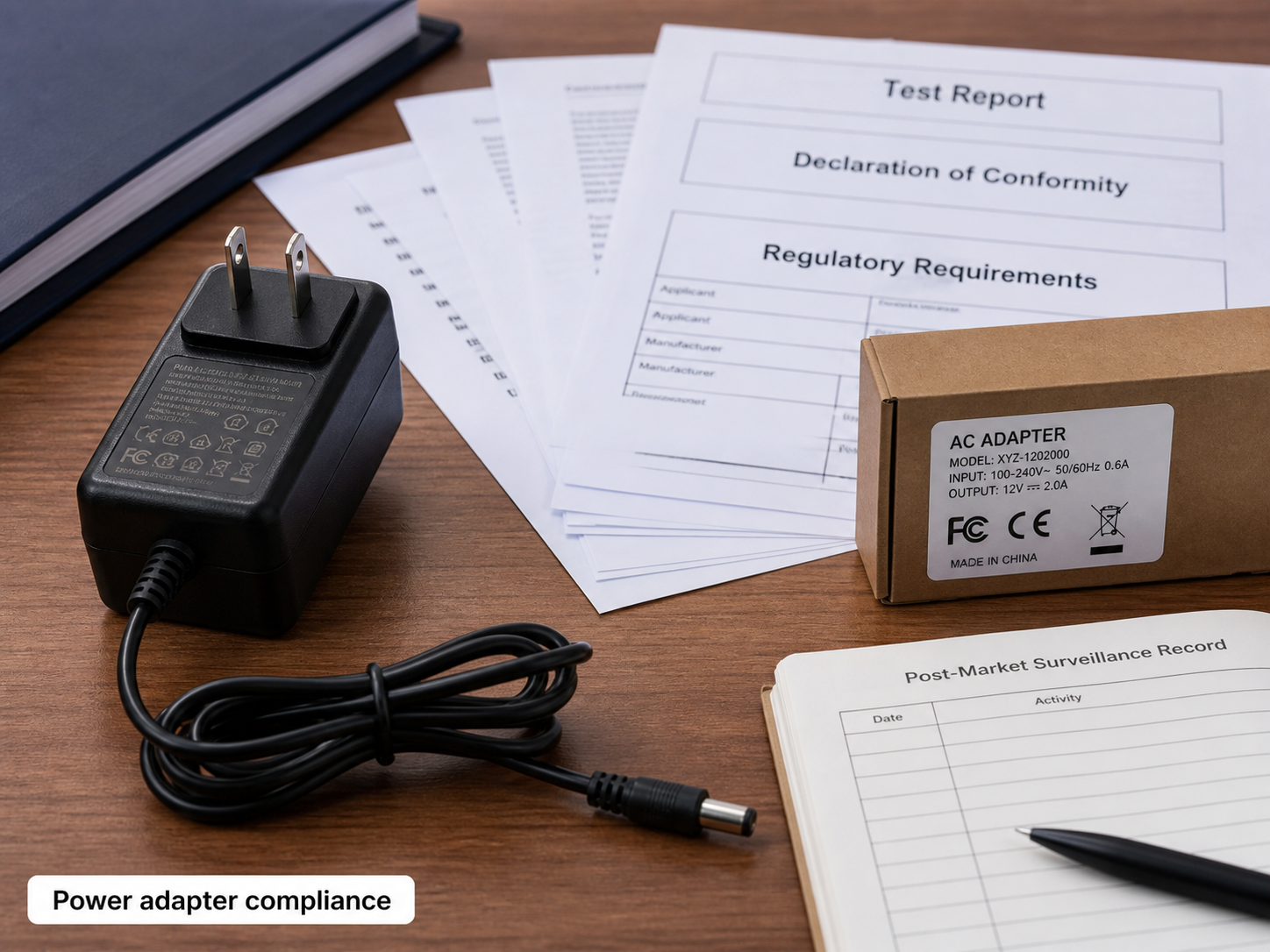
And compliance is not a one-and-done thing: regulatory authorities may conduct spot checks at any time after listing. Before changes to key components, factories, rated values or structures, re-evaluation shall be carried out in accordance with applicable regulations and the change control procedures of the issuing body. If the change exceeds the coverage of the original certificate or report, or affects conformity, supplementary testing, certificate change or re-certification shall be completed before continuing sales.
3. Overview of Market Access Requirements for Major Global Markets
After understanding what certifications test, let’s talk about the specific requirements of major global markets, which is also the part that everyone is most concerned about. But before talking about specific regions, we must first talk about a major premise: different product attributes have completely different applicable certification requirements, which are mainly affected by five factors:
• Product type: External AC/DC adapters, USB chargers, and traditional DC barrel adapters have different applicable standards;
• Sales method: Separately sold chargers require full certification, and those sold with laptops and mobile phones can follow unified certification with the terminal in some regions;
• Additional functions: Products with additional functions such as wireless charging, digital display, and Bluetooth need to supplement compliance tests for corresponding functions;
• Structural differences: For travel models with detachable power cords and replaceable plugs, different plug versions need to separately meet local plug safety requirements;
• Import mode: The degree of supervision is very different between carrying one or two items for personal use and commercially importing hundreds of items for sale.
For quick comparison, a quick reference table of core mandatory requirements for mainstream markets is compiled first:
| Region | Core Safety Access Requirements | EMC Requirements | Energy Efficiency Requirements | Environmental/Other Requirements |
| US/Canada | The US has no unified federal mandatory safety certification; e-commerce platforms/retailers usually require NRTL listing; Canada is implemented by provincial/territorial regulations, usually requiring certification or recognition by an SCC-accredited body | US FCC Part 15 (SDoC) | US DOE, Canada NRCan | California Prop 65 (judged based on exposure and exemption conditions) |
| EU | CE-LVD (self-declaration, requires full set of technical documents) | CE-EMCD | Ecodesign regulations | RoHS, REACH, WEEE (registration required) |
| UK/Northern Ireland | CE/UKCA/UKNI applies by product category; Northern Ireland follows EU rules as the main standard | Corresponding requirements same as safety mark | Same as EU/UK local rules | Same as EU/UK local rules |
| China | CCC mandatory certification (within catalog) | CCC includes EMC | Energy efficiency label (within catalog) | RoHS (within catalog) |
| Japan | Diamond PSE (specified electrical appliances, third-party certification)/Circular PSE (non-specified, fulfill obligations such as conformity inspection) | DENAN/PSE mainly governs electrical safety; EMC and wireless requirements shall be confirmed separately according to product functions against the Radio Law, VCCI or other applicable rules | Local energy efficiency regulations | No mandatory universal environmental label |
| South Korea | KC-related safety conformity assessment (confirmed per catalog) | Safety, EMC, wireless, etc. confirmed separately per catalog | Separate energy efficiency requirements | No mandatory universal environmental label |
| Australia and New Zealand | Australia is managed per EESS risk levels of participating jurisdictions; New Zealand is confirmed per its own electrical safety regulations | RCM/EMC requirements confirmed separately per sales location | Local energy efficiency regulations | No mandatory universal environmental label |
Let’s talk about the details by region below:
North America (US, Canada)
In terms of EMC, the US uniformly implements FCC Part 15 requirements. Most ordinary power adapters follow the Supplier’s Declaration of Conformity (SDoC) path. Enterprises can test and retain documents by themselves, without third-party certification, but they are responsible for compliance.
Safety access is the most confusing part in North America: there is no unified mandatory safety certification at the US federal level, and safety responsibility is entirely borne by manufacturers and sellers. But this does not mean that any product can be sold casually — e-commerce platforms, large retailers, and local competent authorities (such as fire departments, referred to as AHJ) usually require products to have NRTL listing. NRTL is a third-party testing laboratory officially recognized by the US, and common ones include UL, ETL, CSA and other institutions.
Canada cannot simply apply the US NRTL system. The specific requirements of Canada are implemented by the electrical safety competent rules of each province and territory, and usually require product certification or recognition by a certification body accredited by the Standards Council of Canada (SCC). Some institutions are also US NRTLs, but Canadian access should not be judged only by whether it is an NRTL.
In terms of energy efficiency, the US is under the jurisdiction of the DOE (Department of Energy), and Canada is under the jurisdiction of NRCan (Natural Resources Canada). Not all power adapters are in the control catalog. You need to first confirm whether the product is in the catalog before corresponding testing.
There is also a special requirement, California Prop 65: it is centered on exposure to listed chemicals. Unless the enterprise can prove that exposure is below the applicable safe harbor level, or meets other statutory exemptions, a warning is usually required; it cannot be judged only by whether the product contains listed chemicals, or whether it reaches a certain unified content threshold.
Europe (EU + UK + Northern Ireland)
The EU’s CE certification is the most commonly heard and most easily misunderstood. EU harmonized legislation related to the CE mark that may be relevant to power adapters usually includes: LVD (Low Voltage Directive, governing electrical safety), EMCD (Electromagnetic Compatibility Directive) and RoHS (Restriction of Hazardous Substances). REACH is an independent chemical compliance obligation and does not belong to CE mark legislation; ecodesign energy efficiency requirements shall be confirmed according to specific implementation regulations such as external power supplies.
Many people think that CE is a certificate issued by the EU official, but it is not at all: CE is a compliance mark for manufacturer self-declaration, and does not require EU official certification. The compliance process is: complete testing as required, organize technical documents, conduct risk assessment, sign the EU DoC (EU Declaration of Conformity, a document where the enterprise signs and promises that the product meets all relevant regulations), and finally affix the CE mark. The entire process is the responsibility of the enterprise. As long as you can produce a full set of documents to prove that you meet the requirements, you can affix the CE mark.
WEEE (Waste Electrical and Electronic Equipment Directive) should also be mentioned here: it requires producers to bear recycling responsibilities, need to register locally and affix recycling marks, but WEEE is not within the scope of CE, don’t confuse them.
The rules of the UK and Northern Ireland have been adjusted several times after Brexit. The current principle is: according to product category and applicable regulations, confirm whether to use CE, UKCA or UKNI marks. Due to its special status, Northern Ireland usually applies EU rules, and in specific scenarios, both CE and UKNI marks need to be affixed. Specific requirements are subject to the latest official UK guidance, don’t judge based on old experience.
The EU’s common charger rule is also explained here: this rule only covers specific portable electronic device categories included in the Radio Equipment Directive, not all chargers. Listed categories of radio equipment that can be charged by wired means must be equipped with a USB-C power receiving port from December 28, 2024, and laptop computers will be implemented from April 28, 2026; applicable devices must also support USB Power Delivery under wired charging conditions higher than 5V, 3A or 15W. Whether it applies still needs to be confirmed according to product category and function.
There is also a voluntary bonus item in Europe: the German GS certification. GS is a German voluntary third-party safety mark, usually accompanied by requirements such as independent certification and continuous supervision; its technical testing and LVD may use the same or additional standard requirements, and cannot be generally said to be stricter than LVD.
Core Asia-Pacific Markets
The core of the Chinese market is “catalog priority”: first confirm whether the product is in the CCC certification catalog and the energy efficiency label catalog, the two are completely independent and do not include each other. CCC covers safety + EMC, is a mandatory certification, and requires the CCC mark to be affixed; products in the energy efficiency catalog need to be affixed with the China Energy Efficiency Label. In terms of voluntary certification, CQC certification has high recognition.
The Japanese market divides products into two categories according to the Electrical Appliance and Material Safety Law (DENAN): specified electrical appliances require third-party institutions to conduct conformity inspections and affix the diamond PSE mark; non-specified electrical appliances do not require this third-party conformity inspection, but manufacturing or importing enterprises still must complete conformity inspections, keep records and fulfill DENAN declaration obligations, and affix the circular PSE mark. The specific classification shall be confirmed according to product parameters and categories against the DENAN catalog, and cannot be judged by oneself.
The South Korean market also follows “catalog priority”, and applicable regulations for safety, EMC, and energy efficiency need to be confirmed separately according to category and parameters. Don’t infer that all obligations have been completed just by a KC mark: KC can be used for electrical safety and some radio communication/EMC conformity assessment systems; the specific applicable procedures and labeling requirements for safety, EMC, wireless and energy efficiency still need to be confirmed separately according to the product catalog.
Australia shall be confirmed according to the EESS risk level, responsible supplier registration and equipment registration requirements of participating jurisdictions; New Zealand shall be confirmed according to its electrical safety regulations. The EMC/RCM requirements of the two places shall also be checked separately according to the sales location.
Quick Compliance Check for Niche Markets
In addition to mainstream markets, many people will also come into contact with niche markets such as the Middle East, Southeast Asia, South Asia, and South America. It is too troublesome to check regulations one by one, and you can check according to four unified dimensions: first check whether the product is in the local control catalog (applicable premise), then check what typical compliance documents are required, then confirm whether a local responsible entity (importer/local representative) is needed, and finally clarify the official verification channel.
The core requirements of several common niche markets are as follows:
• Middle East: Saudi SASO controls according to HS code/category, requires a certificate of conformity + test report, requires a Saudi registered importer, and can be verified on the SASO platform; the UAE shall confirm applicability, certificate path and local responsible entity requirements through MoIAT’s current ECAS controlled products and services requirements, and use the MoIAT official system for verification.
• Southeast Asia: Singapore shall first confirm whether it is a controlled consumer appliance under CPSO; when applicable, a registered supplier applies for the Safety Mark, and verifies it through the official Safety Mark query system. The required test and certification documents are confirmed according to product category and designated certification body requirements; Malaysia SIRIM is confirmed according to the mandatory catalog, requires SIRIM certificate + test report, requires a Malaysian local importer, and can be queried on the SIRIM platform; Thailand TISI is confirmed according to the mandatory list, requires TISI certificate + factory audit report, requires a Thai local agent, and can be queried on the TISI official website.
• South Asia/South America: India BIS is confirmed according to the mandatory registration list, requires BIS registration certificate + test report, requires an Indian local representative/importer, and can be queried in the BIS database; Brazil INMETRO is confirmed according to the mandatory catalog, requires INMETRO certificate + factory audit report, requires a Brazilian local importer, and can be queried on the INMETRO platform.
• Eurasian Economic Union: EAC certification is confirmed according to the Customs Union technical regulation catalog, requires EAC certificate/declaration + test report, requires an authorized representative within the union, and can be queried in the official database of the Eurasian Economic Union.
Special reminder: regulations in niche markets are updated frequently. Before shipment, be sure to review according to HS code, specific category, and the latest requirements of the target country, don’t rely on old experience.
Cross-Market Cost-Reduction Tool: CB Certification System
If you plan to do certifications for multiple markets, there is a very useful cost-reduction tool — the CB certification system. It is a global mutual recognition system initiated by the International Electrotechnical Commission (IEC). Its core function is: after obtaining the CB certificate and report, when applying for local certifications in other countries, the CB report can be used as the base document, without all retesting, which can save a lot of money and time.
But note: CB itself is not a sales permit, you cannot sell directly in various countries with the CB mark. When applying for local certification, you still need to supplement local national difference tests and documents to obtain the final access permit.
4. Preliminary Screening by Nameplate: How to Read Adapter Labels
Don’t underestimate the nameplate (label) with parameters printed on the charger. The information on it is all the core basis for compliance. Learn to read the nameplate, and you can initially screen out a large number of unreliable products.
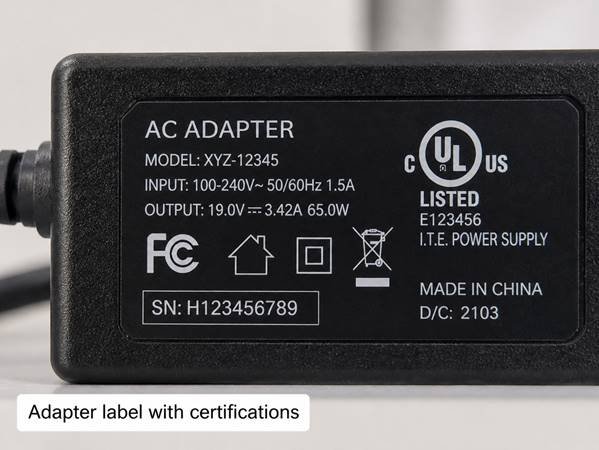
Input Parameters: Judge Whether It Can Be Connected to the Local Power Grid
Input parameters are the first step to judge whether the product can be used locally. The most common wide voltage format is , and this product can be used in the power grids of most countries in the world. If it is a single-voltage product, for example, only marked 120V, it cannot be directly used in a 220V country, it will burn out as soon as it is plugged in.
There is a super common misconception here: many people think that buying a conversion plug can solve all cross-border use problems — wrong. The conversion plug can only change the shape of the plug so that it can be inserted into the local socket, and it cannot convert the voltage at all. So don’t use it just because the plug can be inserted, be sure to first check whether the input voltage range meets the local power grid.
Output Parameters: Judge Whether It Is Compatible with Charging Devices
Output parameters are the basis for judging whether the product can charge your device. If it is a USB-C PD/PPS fast charging product, don’t just look at the maximum wattage, you must carefully check all charging gears, as well as single-port power and shared total power — for example, a dual-port charger marked 65W, when used with a single port, it is 65W, when used with two ports at the same time, it may be 45W + 20W, and the total power is not 130W which is the sum of two 65W.
For traditional constant voltage DC barrel adapters, check the output voltage, polarity and plug size; the rated supply current of the adapter shall not be lower than the current required by the device. A higher current rating usually does not mean that it will force more current to be output, but voltage, polarity or plug mismatch may cause failure or damage.
It should be noted that matching output parameters is only a prerequisite for normal charging, and has nothing to do with safety certification. Correct parameters do not mean that the product is safe and compliant.
Model and Manufacturer Information: Core Basis for Certification Query
When checking certification, you should first obtain the full model (including all suffixes) on the adapter body, and at the same time check the packaging or set model. You cannot only use the product title or brand name for judgment, nor can you mechanically only look at the body model — it shall be based on the model and coverage clearly listed in the certificate, listing record or DoC, to confirm that it does cover the actually sold adapter and set configuration.
If a product doesn’t even have complete model and manufacturer information, traceability and verification are extremely difficult, and it can basically be judged as unreliable, don’t buy it.
Key Points for Preliminary Observation of Certification Marks
Formal certification marks have several characteristics: clear printing and normal proportion. Some certification marks or product labels will carry control numbers, file numbers, factory codes or other traceable information, but the specific form varies with the certification system and institution. Verification shall combine the full model, mark type, file number or control number and the records of the issuing body, and shall not be judged only by whether there is a printed number.
If you see that the mark is blurry, misspelled (for example, UL is written as VL), out of proportion, or there is only text without a specific mark pattern, you must be vigilant.
Common marks are actually easy to recognize: CCC is three nested C-shapes, PSE is divided into diamond and circular types, and the KC mark has KC letters directly in it. But it must be emphasized again: marks can be counterfeited, and authenticity must be based on official records or compliance documents. It’s useless just to see that the mark looks right.
Another misconception: the more marks, the more compliant? Wrong. The key is to have the marks required by the target market. For example, when sold only in China, you should first confirm whether it belongs to the CCC catalog; for products in the catalog, CCC is one of the corresponding mandatory requirements, but other applicable obligations such as energy efficiency, RoHS, wireless functions and labels should also be checked at the same time.
5. How to Check the Authenticity of Certification? Full Practical Steps
Since marks can be faked, how to confirm that the certification is real? Let’s talk about it step by step.
Three Common Counterfeiting Methods
First understand the common counterfeiting methods to have a bottom line in mind:
1. Fake marks: No testing at all, privately printed certification labels, pure fraud;
2. Certificate misappropriation: Use certification numbers of other manufacturers or other models to impersonate their own, for example, take the certification number of a peer’s 20W charger and paste it on their own 65W product;
3. Out-of-scope certification: Certification is indeed done, but the certification only covers low power or specific models, and the actually sold product exceeds the certification coverage. For example, the certified one is 20W, but the actually sold one is 65W, which is also considered fraud.
Preparations Before Query
Before checking certification, you must first prepare the following information: full product model (including suffix), rated power, output specifications; certification marks on the label, certificate number/file number; sales region, plug version, physical photos of the product. Be sure to pay attention to distinguishing between the charger body model and the packaging set model, don’t check the wrong object.
Formal Query Channels and Key Verification Points
Prioritize querying on the official website of the issuing body and the official platforms of regulatory authorities of various countries. E-commerce screenshots, seller verbal statements, and even photos of a single certificate cannot be used as credible basis — because certificates can also be photoshopped.
Different certification systems have different query accessibility, let’s talk about them one by one:
• NRTL listing (UL/ETL/CSA, etc.): Certification bodies usually provide product or certification mark query channels, but public fields and search capabilities vary by institution and product category. If public records are insufficient, verify the coverage and status with the issuing body based on the full model, label control information and certification documents;
• CE: There is no unified official database for query by product model. The well-known NANDO database can only check the qualifications of notified bodies, and cannot check whether a product has CE certification. Verification requires the supplier to provide the EU DoC and supporting technical documents and test reports;
• FCC: SDoC products have no public database, and suppliers need to retain data; products with wireless functions can be queried in the official database through FCC ID;
• CCC: The official website of the China National Certification and Accreditation Administration has a public database, where you can check the certificate status, covered models, and holder information;
• PSE: Diamond PSE products must obtain conformity inspection from a registered conformity inspection body, and can be verified with relevant institutions, but the public query scope varies by institution; circular PSE products do not require this third-party conformity inspection, but manufacturers or importers still must complete conformity inspection, keep records and fulfill DENAN declaration obligations, not just by self-declaration;
• RCM: The Australia-New Zealand EESS database can check the responsible supplier information of registered products.
After finding the information, focus on checking four core items: whether the certificate holder is the brand or manufacturer, whether the model and power completely match the product, whether the certificate status is valid (whether it has been revoked or suspended), and whether the certification coverage includes the corresponding product type.
There is a common misconception here: being able to find the certification number means it is a real certification? Wrong. The number can be copied from others, and only when all core information matches can it be considered real.
According to the verification results, it can generally be divided into four types of conclusions:
• Full match: Model, power, holder, and status are all consistent, and the corresponding item is compliant;
• Partial match: For example, the holder is an affiliated company, and the model suffix has reasonable differences. You can ask the supplier to provide supplementary supporting documents and confirm before counting as compliant;
• No public database: For example, CE, FCC SDoC, circular PSE, directly ask the supplier to provide DoC and a full set of technical documents for verification;
• Conflict/Invalid: The information does not match, the certificate has been revoked or suspended, and the corresponding item is non-compliant.
Correct Judgment When No Certification Record Is Found
If you can’t find the certification record, don’t rush to conclude that it is fake. First check several common input errors: whether the model suffix is entered wrong, whether spaces or hyphens are missing, whether the wrong regional version is selected — some products have different model suffixes in different regions, for example, the US version and the European version differ by one letter.
Also, self-declaration certifications have no public database by nature, so it is normal that they cannot be found, and cannot be directly judged as fraud. The principle of risk judgment is: if it is a third-party mandatory certified category (such as CCC, diamond PSE), if no record is found and the information conflicts, the probability of fraud is extremely high; if no valid record is found for NRTL listing, it is a major compliance risk, and you must be cautious.
6. How to Choose for Different Scenarios? Scenario-Based Compliance Decisions
After talking about so much basic knowledge, let’s finally apply it to actual scenarios. Different situations have completely different requirements and focus points for certification. Let’s talk about four categories.
Personal Cross-Border Carrying and Personal Use
This is the most common scenario for ordinary consumers:
• Small amount for personal use via overseas shopping: Different countries have different requirements, subject to local law enforcement. Prioritize products with formal certifications, which are safer and less likely to have problems;
• Moving cross-border with multiple items: Confirm the rules of the entry country in advance, don’t bring too many, otherwise it may be judged as commercial import, and the goods will be directly detained and fined;
• Cross-border travel: Prioritize wide-voltage products, and match plug converters as needed — reminder again, the converter only changes the shape of the plug, not the voltage. Be sure to confirm that the input voltage range of the product meets the local power grid;
• Common question: Wide voltage only means that the product has power supply compatibility within the rated voltage and frequency range on the nameplate, and does not mean that it meets local plug safety, product safety or import requirements. Whether there is exemption for personal carrying and personal use and how law enforcement is carried out shall be confirmed according to the destination rules.
Cross-Border Sales/E-Commerce Listing
This is the scenario that cross-border sellers are most concerned about:
The basic requirements of mainstream e-commerce platforms are roughly as follows (specifics are subject to the latest platform rules): US sites generally require FCC compliance + NRTL listing/test report; European sites require CE compliance + RoHS + energy efficiency + WEEE registration; Japanese sites require corresponding PSE certification; Australian sites require RCM-related compliance documents.
A core principle to remember here: platform requirements are not equal to the statutory minimum requirements, both must be met. Some platform requirements may be stricter than statutory ones, and you cannot only meet one of them.
The suggested order for preparing the compliance document package is:
1. First classify the product, confirm the statutory requirements of the target market, and avoid blind certification;
2. Prepare core compliance documents, such as test reports, certificates, DoC, etc.;
3. Settle local requirements such as local responsible person, importer, and energy efficiency registration;
4. Submit to the platform for review;
5. Retain the full set of documents for future reference to respond to regulatory spot checks or platform re-inspection.
If you plan to do certifications for multiple markets, prioritize making a CB report first, and then convert to local national certifications, which can reduce repeated testing and lower costs. The cycle and cost of certification are affected by many factors: the higher the product power and the more complex the structure, the higher the cost and the longer the cycle; the stricter the applicable standards, the higher the cost; if the first test fails and rectification is required, the more rectification times, the higher the cost and the longer the cycle; the number of samples and whether factory inspection is required will also affect the final price and time.
Don’t take it lightly after the product is launched. Before changes to key components, factories, rated values or structures, re-evaluation shall be carried out in accordance with applicable regulations and the change control procedures of the issuing body. If the change exceeds the coverage of the original certificate or report, or affects conformity, supplementary testing, certificate change or re-certification shall be completed before continuing sales. Daily compliance obligations should also be done well: retain complaint records, spot check reports, recall plans, and file in time when the responsible person’s information changes.
Enterprise/Bulk Procurement
If the company purchases in bulk for employees, or distributors purchase in bulk, focus on three points:
• Inspection focus: Spot check the model, nameplate parameters, and plug version of the physical product to see if they are consistent with the certification documents provided by the supplier, to avoid the supplier using the certification of model A to ship goods of model B;
• Risk avoidance: Require the supplier to provide certification proof for the corresponding product, confirm the relationship between the certificate holder and the supplier (for example, whether it is OEM certification, whether there is authorization), to avoid getting certificate-misappropriated products;
• Filing requirements: Retain purchase batches, certification document versions, and query records, which can be directly traced when problems occur.
Additional Certification Requirements for Special Products
Several types of special products have additional compliance requirements, which are explained separately:
• USB-C PD fast charging: It is necessary to confirm whether the common charger rule of the target market covers the product. For example, the EU common charger rule only targets specific categories, and not all PD chargers need to comply;
• Multi-port/desktop charging stations: Testing shall be completed in accordance with the applicable safety and energy efficiency regulations of the target market, based on the total rated output, port configuration and specified load combinations; single-port peak or single working condition cannot replace the applicable combined working conditions;
• High-power laptop adapters: Match the corresponding standards according to rated values, structure, and usage scenarios, focusing on temperature rise and overload protection testing;
• Travel models with replaceable plugs: Different plug versions need to meet the plug safety requirements of the corresponding regions respectively, not just being able to plug in;
• Low-power products: Whether to be exempted from energy efficiency requirements cannot be judged only by 5W, but shall be confirmed according to the product definition, output type, power range and explicit exemption clauses in the target market regulations; 5W shall not be used as a universal exemption threshold.
7. Quick Checklist and Competency Summary
At this point, you may feel that there is a lot of information. It doesn’t matter. We have compiled a five-step quick checklist. Whether you are buying or selling, following this steps will basically not cause big mistakes:
1. Confirm the target country/region, check the local control catalog according to the specific product classification, and clarify the mandatory requirements;
2. Check whether the marks and documents required by local mandatory requirements are complete and clear, and whether there are obvious signs of fraud;
3. Query through official channels using the full product model, and confirm that the model, power, holder, and certificate status match;
4. Confirm whether special products (fast charging, multi-port, high-power, replaceable plugs) meet additional requirements;
5. For personal use, additionally confirm that the input voltage range and output parameters are compatible with your own devices.
After learning these contents, you should have mastered the following abilities: can state the core access requirements of mainstream markets such as China, the US, the EU, Japan, South Korea, Australia and New Zealand; can read the input and output parameters and certification marks on the charger nameplate; can verify the authenticity of certification through official channels and identify three common counterfeiting methods; can match corresponding certification requirements according to different scenarios of personal use, sales, and procurement; can avoid common misconceptions in the whole process and not be misled by fake certifications.
Frequently Asked Questions
Is UL certification mandatory for export to the US?
There is no unified federal mandatory safety certification at the US federal level, and safety responsibility is borne by manufacturers and sellers. NRTL listings such as UL and ETL are usually required by e-commerce platforms, retailers or local competent authorities. Whether to do it specifically shall be confirmed according to the actual sales scenario.
Is CE certification an official-issued certificate?
CE is not officially issued. It is a compliance mark for manufacturers to self-declare conformity with EU harmonized regulations. Complete CE compliance requires a full set of materials such as EU DoC (EU Declaration of Conformity), test reports, and technical documents. It is not just having a CE mark that counts.
What is the difference between circular and diamond PSE?
Diamond PSE corresponds to specified electrical appliances, requiring third-party conformity inspection; circular PSE corresponds to non-specified electrical appliances, no such third-party conformity inspection is required, but manufacturers or importers still need to complete conformity inspection, keep records and fulfill DENAN declaration obligations. Which category a specific product belongs to shall be confirmed according to parameters and category against Japan’s DENAN Law catalog.
How to check the authenticity of a charger with CE mark?
CE has no unified official database for query by product model, and cannot be checked directly by scanning a code or entering a number. The correct way is to require the supplier to provide the EU DoC, check the responsible entity, applicable regulations, product model, and signing information, and then supporting check of technical documents such as test reports. The NANDO database can only query the qualifications of notified bodies, and cannot prove the CE compliance of the product.
Do USB-C PD chargers need additional certification?
USB-IF’s PD certification is a voluntary protocol certification, which only proves the protocol compatibility of the product, and cannot replace mandatory requirements such as statutory safety, EMC, energy efficiency, and environmental protection. Export to corresponding markets still needs to meet all local mandatory compliance requirements. Some regions (such as the EU) have mandatory requirements for specific categories of USB-C/PD products under the common charger rule, and specifics shall be confirmed according to product category.
Overall, global certifications for power adapters may seem complicated, but the core logic is actually very simple: ensure the product is “legal, safe, and traceable”. Whether choosing a charger for personal use, doing cross-border sales, or bulk procurement, as long as you follow the steps: first clarify the target market requirements, then check product information, and finally verify the authenticity of certification, you can avoid the vast majority of pitfalls. After all, safety is no trivial matter; spending a little more time figuring out certifications is always better than regretting after a problem occurs.