
Sellers of charging products targeting the Australian market have most likely heard of the term “RCM”. Many people think it is an “Australian certification certificate” that can be bought for tens of thousands of yuan to list products, only to end up either having goods detained by customs and fined for missing a requirement, or being tricked by intermediaries into getting a “full set of certifications” and wasting several times more money.
In fact, RCM is not a single certification at all—it is the Regulatory Compliance Mark used in Australia and New Zealand, which can only be printed on products after the responsible supplier has completed all applicable compliance requirements. For the vast majority of civilian charging products, the two most commonly encountered requirements are EESS electrical safety and ACMA communications compliance. Many people often confuse these two systems and fall into many pitfalls. Today, we will clarify these two systems thoroughly, from basic concepts to practical judgment, then to pitfall avoidance tips, to help you quickly understand what compliance your product needs, save money, and avoid violations.
First, Understand the Basics: Three Core Concepts
To compare the two systems, we must first sort out the most basic concepts to avoid misunderstanding from the very beginning.
RCM Is Not a Certification, But the Final Compliance Mark
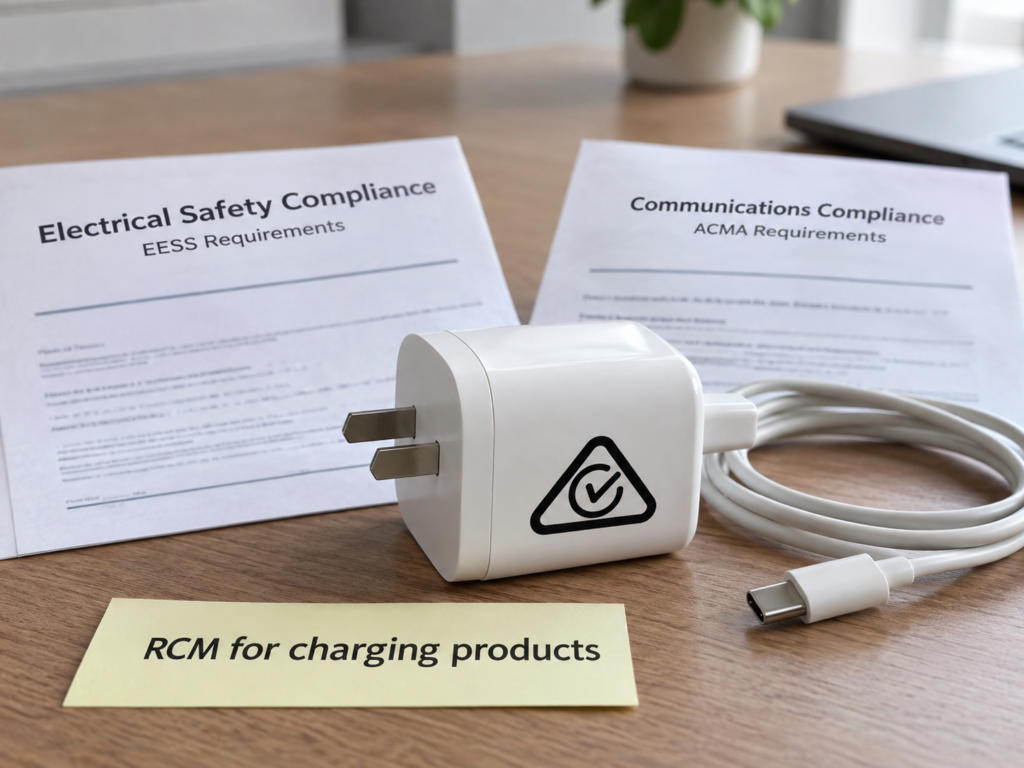
The biggest misunderstanding many people have about RCM is that they regard it as a “certificate”. In fact, it is a unified compliance mark used in Australia and New Zealand, not a certification issued by a single institution—you must first complete all regulatory requirements applicable to your product before you are eligible to print this mark on the product. For charging products, it is usually necessary to meet both applicable EESS electrical safety and ACMA communications compliance requirements before the RCM mark can be used legally.
EESS: Electrical Equipment Safety Framework for Participating Jurisdictions
EESS is a cross-jurisdictional framework aimed at unifying the regulatory requirements for household low-voltage electrical equipment, with a very straightforward core goal: preventing safety accidents such as electric shock, overheating, and fire. It is not a unified law implemented in exactly the same way by all states and territories; when selling in Australia, it is also necessary to confirm local electrical safety regulations, registration, and marking requirements according to the actual state or territory of sale.
The in-scope equipment referred to by EESS usually refers to low-voltage electrical equipment with a rated voltage greater than 50V RMS AC or 120V ripple-free DC, and less than 1000V RMS AC or 1500V ripple-free DC, and designed or marketed for household, personal, or similar use. Whether it is subject to specific EESS requirements must also be judged in combination with the actual sales jurisdiction and equipment category, and cannot be determined solely by whether a certain voltage threshold is exceeded.
ACMA: Federal Regulator in Charge of Communications Order
ACMA is the Australian federal communications and media regulator. It does not care whether your product can electrocute people; it is in charge of two things: first, whether the product will generate electromagnetic interference that affects surrounding public communications such as mobile phones, WiFi, and radio; second, whether it uses radio frequency bands in violation of regulations, disrupting communications order.
However, it cannot be simply understood as “as long as there is an active electronic circuit or wireless transmission function, ACMA compliance is definitely required”. ACMA requirements must be judged item by item based on whether the product falls under applicable EMC, radiocommunications, EME, or telecommunications marking rules and their exemptions. Switching power supplies, transistor switching circuits, microprocessors, etc., usually cause non-battery-powered equipment to fall into the EMC medium-risk category, but applicable standards, power supply methods, and exceptions must still be checked.
Why Must the Two Systems Be Clearly Distinguished?
Confusing EESS and ACMA can range from wasting unnecessary money to being directly fined for violations. First, many people think the two systems are the same thing, miss one of them, and face penalties when spot-checked after listing; second, there are many types of charging products, some only need to meet one system, some need both, and clarifying the differences can save unnecessary compliance costs; finally, many compliance intermediaries now ask for a “full set of RCM certifications” as soon as they open their mouths, and if you can distinguish the boundaries of the two systems, you will not be fooled by such rhetoric.
Clarify Before Comparison: Scope of Application and Boundaries
To make the comparison results more accurate, let’s first clarify the premises and boundaries of the comparison to avoid applying the wrong rules.
Unified Comparison Object: Civilian Consumer Charging Products
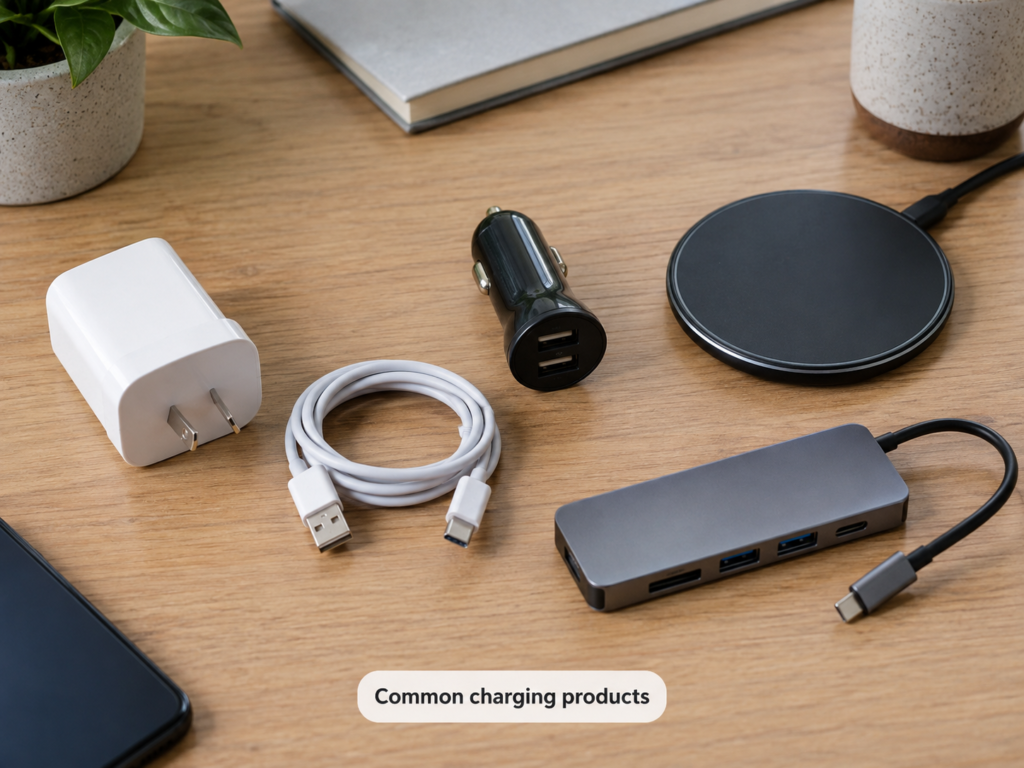
All comparison conclusions today are for ordinary civilian consumer charging products, covering the most commonly sold categories: wall-plug chargers/power adapters, USB charging cables, car chargers, wireless chargers, USB-C hubs, etc. Charging products for industrial use, medical use, automotive original equipment, and special industries are not within this scope, as they have separate compliance requirements.
A judgment principle must be specially emphasized here: which category a product falls under for regulation depends on its actual function and input voltage, not its appearance or promotional name. For example, if you call a pure copper cable a “smart fast charging cable”, it is still a passive cable, and will not have additional compliance requirements just because the name includes “smart”.
We Compare from 6 Core Dimensions
The following comparison will be carried out around 6 dimensions most relevant to charging products: regulatory body and responsibility requirements, scope of regulated charging products, compliance levels and processing requirements, registration rules and database queries, marking use and validity period, and violation consequences and supervision methods.
These Situations Do Not Apply to This Article
The rules in this article only apply to civilian products sold locally in Australia or imported into Australia. Among them, whether EESS applies and how it is implemented should also be confirmed with local electrical safety regulations according to the actual state or territory of sale; EESS registration rules cannot be unconditionally equated with unified requirements across Australia.
This article only covers currently valid rules; obsolete historical marks such as C-Tick and A-Tick are not within the scope of discussion. In addition, if your product’s input voltage or circuit function changes (for example, originally connected to 5V low voltage, changed to 240V mains, or originally had no wireless function, added Bluetooth), the compliance requirements will also change accordingly, and re-judgment is required.
Item-by-Item Comparison of 6 Core Dimensions: See the Differences at a Glance
Below we will break down the differences between the two systems dimension by dimension. For each dimension, we will first explain the respective requirements, then point out the core differences and precautions, so that you can directly compare them.
Regulatory Body and Responsibility Requirements
EESS is implemented by the relevant energy regulatory authorities of participating jurisdictions in Australia, and has very strict requirements for the responsible entity: it must be a legal entity within Australia and New Zealand, hold an Australian ABN (Australian Business Number) or New Zealand IRD (Inland Revenue Department) tax number, and be the local first importer or manufacturer. Simply put, without a local entity in Australia or New Zealand, you cannot directly apply for EESS at all; you must first find a local responsible party.
ACMA is a federal-level agency with unified law enforcement across the country, and its requirements for the responsible entity are relatively flexible: overseas manufacturers can find an agent within Australia to assume compliance responsibility on their behalf, without having to register a local company specifically.
Core difference: EESS has stricter territorial requirements for the responsible entity, which must be the local first importer or manufacturer; ACMA allows local agents to assume responsibility on behalf of overseas manufacturers. If you do not have a local entity in Australia or New Zealand, the first step is to find a local responsible party for EESS, otherwise you cannot even complete registration.
Scope of Regulated Products (Exclusive to Charging Products)
For charging products, the regulatory boundaries of the two systems cannot be concluded based on only one condition, but must be judged according to the complete definition:
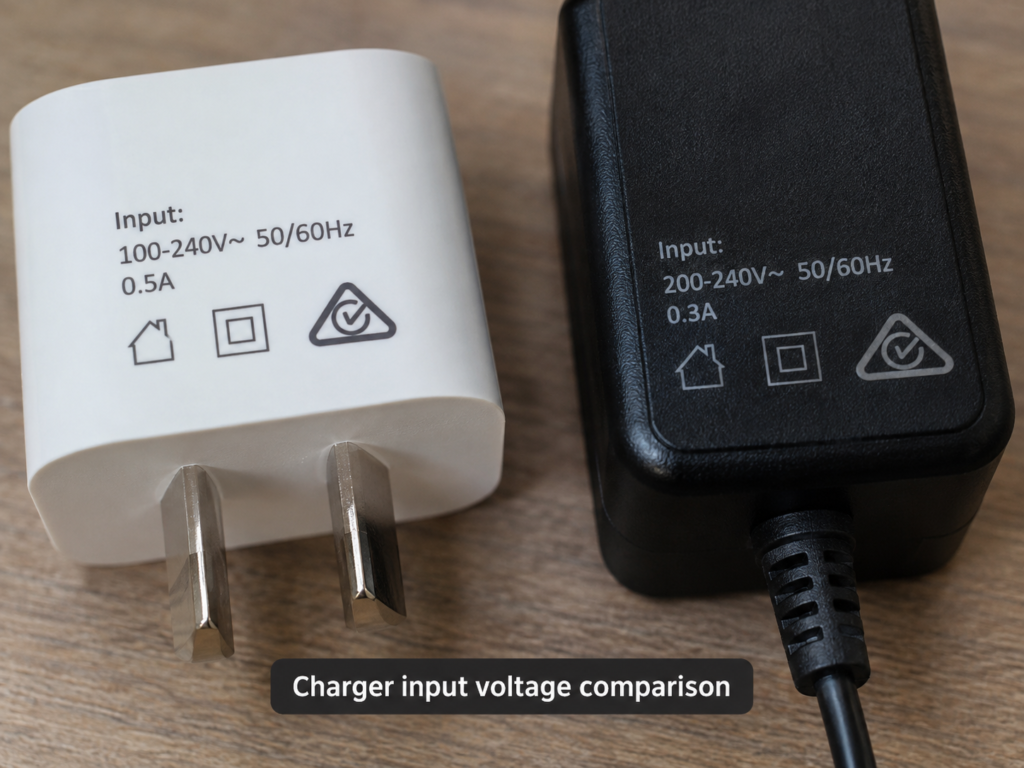
- Key EESS judgment points: First, check whether the product is a low-voltage electrical equipment for household, personal, or similar use, and whether the rated voltage is between 50V RMS and 1000V RMS AC, or between 120V and 1500V ripple-free DC; then confirm in combination with the actual state or territory of sale and the product’s category in the risk level catalog. Wall-plug chargers/adapters connected to 240V mains, and charging cable assemblies with AC plugs, usually require further evaluation according to EESS rules. Pure low-voltage products and pure passive connectors (such as ordinary copper cables) are usually not EESS in-scope equipment.
- Key ACMA judgment points: It is necessary to confirm respectively whether EMC, radiocommunications, EME, or telecommunications marking rules apply, and whether there are exemptions. Charging products with switching power supplies and charging devices with wireless transmission functions usually require evaluation; cables with electronic components cannot be directly concluded based solely on “whether there is wireless function”. Pure passive products without any electronic circuits usually do not have requirements due to EMC rules, but should still be confirmed in combination with actual product attributes.
There is a common boundary question here: do high-power USB-C cables with E-Marker chips need ACMA compliance? It cannot be simply said “definitely yes” or “definitely no”. E-Marker is an electronic marking chip embedded in the cable, not a passive component. Whether it falls under ACMA requirements must be confirmed item by item in combination with the power supply method of the chip and cable, actual functions, applicable EMC or telecommunications marking rules and exemptions. Cables with functions such as active signal amplification and video conversion also require evaluation of ACMA requirements. In addition, if the product adds active circuits or wireless functions, the applicable ACMA rules may increase, and re-judgment is required.
Compliance Levels and Processing Requirements
Both systems may have different risk levels, but the grading logic and evidence paths are different, and they must never be applied interchangeably:
- EESS’s 3 levels (classified by electrical safety risk): For Level 1 low-risk products, you only need to keep compliance evidence by yourself, and mandatory registration is not required; for Level 2 medium-risk products, product registration is required, and a compliance folder must be prepared for inspection; for Level 3 high-risk products, you must first obtain a certificate of conformity from a third-party institution before product registration.
- ACMA requirements need to be judged separately according to specific rules: EMC, radiocommunications, EME, and telecommunications equipment are not under the same unified “Level 1/2/3” procedure. Taking EMC as an example, low-risk equipment has no additional testing requirements; medium-risk equipment needs to obtain a test laboratory report or technical construction file; high-risk equipment needs to obtain a report or technical construction file from an accredited testing laboratory. When it comes to radiocommunications, EME, or telecommunications equipment, it must be confirmed separately according to corresponding rules and applicable standards, and cannot be replaced by a unified ACMA three-level table.
Core difference: The levels and evidence requirements of the two systems are independent. You cannot say that if EESS is Level 3, ACMA must be high-risk. For example, for ordinary wall-plug fast chargers, EESS usually falls under Level 3; its ACMA requirements must be confirmed separately according to applicable EMC or other rules. If the product’s risk level changes, the processing procedure and cost will vary greatly. Do not take it for granted to infer the level of one system from the other.
Registration Rules and Database Queries
Registration requirements are a place where the two systems differ greatly, and also a disaster area where many people waste unnecessary money:
- EESS implements a “supplier + product” dual registration system: first, the responsible supplier must be registered to obtain a supplier number, and then separate product registration must be done for Level 2 and Level 3 products. EESS has a public database where you can query the registration information of suppliers and Level 2/Level 3 products.
- When ACMA is responsible for supplier registration, it uses the National Database, that is, the EESS Platform. Products that only apply to ACMA usually do not need separate product registration, and the public can query supplier registration information; but the DoC (Declaration of Conformity), test reports, and other compliance records of specific products should be obtained from the responsible supplier or verified by the regulatory authority.
Core difference: EESS requires registration of Level 2 and Level 3 products; ACMA usually only requires suppliers to register in the National Database. If your product only needs to meet ACMA requirements, you do not need to apply for EESS product registration at all. Don’t be tricked by intermediaries into getting “full registration”.
Marking Use and Validity Period
Although both systems may ultimately use the RCM mark, the specific marking requirements and validity period rules are different:
- Under EESS, qualified in-scope equipment shall be marked with RCM in accordance with AS/NZS 4417.1 and AS/NZS 4417.2. Do not mistake the EESS platform registered supplier number or old approval number as a universal mandatory marking on the product body; other statutory nameplate information shall still be confirmed according to applicable safety standards and local regulations. Level 3 certificates of conformity are usually valid for 5 years; if restricted by factors such as changes in safety standards, the validity period of the certificate may be shorter. The registration period of Level 3 products shall not exceed the validity period of their current certificate of conformity.
- ACMA also uses the unified RCM mark, no additional marks are required, and in specific scenarios, a QR code can be used instead of printing on the product. ACMA has no fixed validity period. As long as the product has not changed, compliance remains valid, and changes are entirely controlled by the supplier.
It should be noted here that no matter which system it is, as long as the key components, circuits, or functions of the product change, compliance must be re-evaluated. Registration once is not a once-and-for-all solution.
Violation Consequences and Supervision Methods
The supervision priorities and penalty logic of the two systems are also different:
- EESS is the responsibility of the relevant energy regulatory authorities of participating jurisdictions, mainly relying on market spot checks, as well as traceability and accountability after safety accidents occur. If a product causes safety accidents such as electric shock or fire, the penalty will be much stricter than ordinary spot checks.
- ACMA is a federal agency with unified law enforcement across the country, and its supervision method is national spot checks + user complaint verification. The maximum fine can be hundreds of thousands of Australian dollars, and if the product interferes with public communication networks, the penalty will be heavier.
Core difference: EESS focuses on accountability for safety accidents, while ACMA focuses on complaints and spot checks for electromagnetic interference. Many people think “it’s fine if you don’t get picked”, but if your charger catches fire, or your wireless charger interferes with someone else’s WiFi and is complained about, the regulatory authority will definitely come to you.
For your quick comparison, I have organized the core differences of the 6 dimensions into a simple table:
| Comparison Dimension | EESS Electrical Safety | ACMA Communications and EMC |
|---|---|---|
| Regulatory Core | Prevent safety accidents such as electric shock, overheating, and fire | Prevent electromagnetic interference and illegal frequency use, and ensure communications order |
| Regulatory Trigger | Meets in-scope definitions such as low voltage, household/personal or similar use, and is judged in combination with sales jurisdiction and equipment category | Judged according to applicable EMC, radiocommunications, EME or telecommunications rules, standards and exemptions |
| Responsible Entity | Must be a local legal entity in Australia or New Zealand (holding ABN/IRD) | An Australian domestic agent may assume responsibility on behalf of overseas manufacturers |
| Registration Requirements | Dual registration of supplier + Level 2/3 products | Register suppliers in the National Database; most products do not require separate registration |
| Validity Period | Level 3 certificates are usually valid for 5 years, may be shorter due to standard changes, etc. | No fixed validity period, re-evaluated with product changes |
| Supervision Focus | Safety accident traceability + market spot checks in participating jurisdictions | Electromagnetic interference complaints + unified national spot checks |
Ready to Use: Quick Compliance Judgment for Common Charging Products
After talking about the theory, let’s go directly to practice. The following judgment sequence can help you initially screen the vast majority of charging products, but the final confirmation must still be based on the actual place of sale, product category, and applicable rules.
General Two-Step Judgment Method (for Initial Screening)
Step 1: Check whether the product meets the complete in-scope definition of EESS—including rated voltage range, household/personal or similar use, actual sales jurisdiction, and equipment category. Meeting the definition does not mean that EESS requirements are automatically completed; it is necessary to further confirm its risk level and local rules.
Step 2: Check which ACMA rules may apply to the product—confirm EMC, radiocommunications, EME, or telecommunications marking rules respectively, and check applicable standards, power supply methods, and exemptions. Products with switching power supplies, microprocessors, or wireless functions usually require key evaluation, but cannot be directly concluded solely based on “having active electronic circuits”.
When making a judgment, be sure to confirm in combination with the product’s actual input parameters and internal structure. Don’t just look at the promotional name or appearance.
Below we use this method to judge the 6 most common types of charging products:
1. Ordinary Passive USB/USB-C Charging Cables
Conclusion: Usually neither EESS nor mandatory ACMA compliance is required.
Basis: It is a pure low-voltage product, and it is passive, without any electronic circuits. It is usually not an EESS in-scope device, and usually does not have requirements due to EMC rules.
Exception: If the cable has active signal processing or power conversion functions (such as a charging cable with a boost chip), separate evaluation is required.
2. Wall-Plug Ordinary Fast Charger/Power Adapter
Conclusion: It is usually necessary to meet applicable EESS and ACMA requirements respectively, and the RCM mark can be affixed only after completion.
EESS requirements: Ordinary household wall-plug chargers/power adapters are usually classified as Level 3 according to the definition of “power supply or charger” in AS/NZS 4417.2, requiring third-party certification + product registration. Whether there is an exception must be judged based on the actual use of the product and the exclusion clauses of the standard or other equipment definitions. Low power or simple structure cannot be used as a basis for downgrading to Level 2.
ACMA requirements: It is usually necessary to confirm the risk category, test report or technical construction file, DoC, and supplier registration requirements in accordance with applicable EMC rules.
Exception: If a specific product does not meet the definition of “power supply or charger”, it shall be judged separately according to the actual category.
3. Charging Devices with Wireless Charging/Bluetooth
Conclusion: If connected to mains input, it usually needs to be judged according to EESS requirements; if it has wireless communication functions, it also needs to evaluate ACMA’s EMC, radiocommunications, EME and related requirements.
Note: Wireless charging devices should at least be evaluated in accordance with applicable EMC rules; whether radiocommunications, EME, or category licensing requirements also apply must be confirmed based on their actual operating frequency band, transmission characteristics, power, and applicable standards. Other ACMA radio-related requirements cannot be excluded solely on the grounds of “no Bluetooth or WiFi”.
4. 12V/24V Car Chargers
Conclusion: Usually not EESS in-scope equipment, but applicable ACMA EMC requirements still need to be evaluated.
Basis: The input DC is 12V/24V, which is lower than the 120V ripple-free DC lower limit in the EESS in-scope definition; but car chargers have switching power supply circuits, and it is usually necessary to further confirm whether ACMA EMC rules apply.
Exception: If it has wireless charging or Bluetooth functions, further evaluation of radiocommunications, EME, or other ACMA requirements is required.
5. High-Power USB-C Cables with E-Marker Chips
Conclusion: It cannot be asserted whether EESS or ACMA compliance is required solely based on “having E-Marker”.
Basis: E-Marker is an electronic marking chip, usually used for cable identity and power supply capability identification. Whether it falls under ACMA requirements should be confirmed item by item in combination with the power supply method of the chip and cable, actual functions, applicable EMC/telecommunications marking rules and exemptions. Pure passive low-voltage USB cables without electronic components are usually not EESS in-scope equipment, but other requirements should still be confirmed according to the actual attributes of the product.
Exception: Cables with active signal amplification and video conversion functions (such as USB-C to HDMI cables) require evaluation of ACMA requirements.
6. USB-C Hubs/Ethernet Adapters
Conclusion: The external mains adapter and the hub body must be judged separately, and cannot be counted as a “set of products”.
Body requirements: Usually need to evaluate ACMA EMC requirements; those with wireless functions need further evaluation of radiocommunications and EME requirements; if connected to a public communication network (such as converting to Ethernet), telecommunications rules must also be evaluated.
Adapter requirements: If it is a power adapter connected to the mains, it usually needs to meet EESS and applicable ACMA EMC requirements respectively.
From Project Initiation to Launch: 5 Steps for Dual-Track Compliance Practice
If you are preparing to launch charging products in the Australian market, you can plan compliance according to the following 5 steps, which will neither miss items nor waste unnecessary money.
Step 1: Product Boundary Sorting (Project Initiation Stage)
First, disassemble all accessories of the product you want to sell, and list them one by one: main unit, charger, cable, adapter, wireless module. Then record the input voltage, internal structure, and function of each component (whether there is an active circuit, whether there is a wireless function).
Checkpoint: Compliance of a set product does not mean that individual accessories are also compliant when sold separately. For example, the charger in the set you sell is compliant, but if you sell the cable in the set separately, you have to judge the compliance requirements of the cable separately. Don’t take it for granted that “if the set passes, everything can be used”.
Step 2: Applicability Judgment (Evaluation Stage)
First, confirm whether each component needs EESS evaluation according to the complete EESS in-scope definition, sales state or territory, and equipment category; then confirm whether each component needs EMC, radiocommunications, EME, or telecommunications requirements according to specific ACMA marking rules, applicable standards, power supply methods, and exemptions. Then clarify the EESS risk level and the evidence path required under specific ACMA rules.
Checkpoint: If you are unsure about the level or applicability, you can directly consult the Australian regulatory authority or a formal compliance agency. Don’t guess blindly, so as to avoid rework later.
Step 3: Compliance Evidence Preparation (Testing Stage)
Prepare compliance materials according to the corresponding risk levels and rules: on the EESS side, prepare test reports, compliance folders, or third-party certificates of conformity according to the level; on the ACMA side, prepare test reports, technical construction files, supplier declarations of conformity (DoC) and other records according to applicable EMC, radiocommunications, EME, or telecommunications rules.
Checkpoint: Overseas test reports (such as CE and UL reports) cannot be directly used as Australian compliance. Although some test items overlap, Australia has local standard versions and responsible entity requirements. You must confirm in advance whether the report is recognized by Australia to avoid wasting costs on repeated testing.
Step 4: Registration and Enrollment (Pre-Launch)
All necessary registrations must be completed before launch: on the EESS side, first register the responsible supplier, then complete the database registration of Level 2/3 products; on the ACMA side, complete the supplier registration in the National Database. Products that only apply to ACMA usually do not need separate product registration; only Level 2/3 products that are also subject to EESS safety rules need to complete EESS product registration item by item.
Checkpoint: The registered product model, version, and responsible entity information must be completely consistent with the actually sold product. Even if the model just has an extra suffix, it may be deemed non-compliant.
Step 5: Marking Affixation and Continuous Maintenance (Post-Launch)
Affix the RCM mark on the product body as required, and confirm that other nameplate information complies with applicable safety standards and local regulations. Do not mistake the EESS supplier number or old approval number as a universal mandatory marking on the product body. All compliance documents must be kept properly for regulatory spot checks.
Checkpoint: If key components, circuits, wireless modules are replaced later, or the responsible entity changes, be sure to re-evaluate compliance. Don’t think that registration once is the end of the story.
Pitfall Avoidance Guide: 6 Most Common RCM Compliance Misconceptions
Finally, let’s talk about a few high-frequency misconceptions that many people have fallen into when they first entered the Australian market. Avoiding them in advance can save you a lot of money and trouble.
Misconception 1: RCM is a single certification, and getting one certificate means compliance
Correction: RCM is a compliance mark, not a certification. If both apply, the responsible supplier must meet the substantive compliance requirements of EESS and ACMA respectively. EESS requires responsible supplier registration, and Level 2/3 products must be registered; ACMA usually requires suppliers to register in the National Database and keep DoC and corresponding compliance records, rather than separate registration for most products.
Pitfall avoidance: When asking a supplier or compliance agency for compliance certificates, don’t just look at a single “RCM certificate”. For EESS Level 2/3 products, you can check the supplier and product registration information; for ACMA, you should also request the DoC, test report, or other applicable compliance records of the corresponding product, instead of asking for a non-existent “ACMA product registration certificate”.
Misconception 2: The Level 1/2/3 of the two systems correspond to each other
Correction: EESS levels are classified according to electrical safety risks; ACMA is judged according to different rules such as EMC, radiocommunications, EME, or telecommunications, and is not a unified electromagnetic/radio frequency Level 1/2/3 system, so they cannot be applied interchangeably.
Pitfall avoidance: Check the EESS risk level catalog and the specific applicable rules of ACMA respectively. Don’t infer the level of one system from the other, otherwise it is easy to get the processing requirements wrong.
Misconception 3: Having CE/UL certification can be directly used as RCM
Correction: Although some test items and standards overlap, Australia has local registration requirements, responsible entity requirements, and standard version requirements. CE/UL reports cannot directly replace Australian compliance.
Pitfall avoidance: Before testing, ask clearly whether the report can be recognized by the Australian regulatory authority. Try to find a laboratory with Australian qualifications for testing to avoid repeated spending.
Misconception 4: Printing the RCM mark on the product means compliance
Correction: You must first complete the applicable compliance requirements of the corresponding system, supplier registration, and necessary EESS product registration before you are eligible to use the RCM mark. Printing the RCM mark without completing compliance is a violation and will be fined if found.
Pitfall avoidance: Before importing or purchasing products, don’t just look at whether the RCM is printed on the product. For EESS Level 2/3 products, you can query supplier and product registration information; what is publicly available for ACMA is supplier registration, and finding supplier registration cannot be equated with a specific product having met all technical requirements. The DoC, test reports, and other compliance records of specific products should be obtained from the responsible supplier.
Misconception 5: All charging products need full RCM compliance
Correction: Not all charging products need both EESS and ACMA. For example, pure low-voltage passive cables usually need neither, and ordinary car chargers are usually not EESS in-scope equipment, but still need to evaluate ACMA requirements. Blindly doing the full set will only cost more money.
Pitfall avoidance: First conduct initial screening according to the complete EESS definition and sales jurisdiction, then confirm the items according to specific ACMA rules. Don’t just do the full set as soon as you hear “RCM”.
Misconception 6: If the output is low-voltage USB, EESS is not required
Correction: EESS judgment cannot only look at the output voltage. If the product is connected to 240V mains input, even if the output is 5V USB, it usually needs further confirmation according to the complete EESS in-scope definition, product category, and sales jurisdiction.
Pitfall avoidance: When making a judgment, first look at the input rated voltage, then look at the product use, complete voltage range, equipment category, and local sales rules. Don’t just look at the output parameters, otherwise it is easy to miss EESS.
Final Summary
After reading this article, you will at least master three practical abilities: First, you can use the complete judgment logic to initially screen whether any civilian charging product needs EESS evaluation, and whether it may be subject to ACMA’s EMC, radiocommunications, EME, or telecommunications requirements. You no longer have to panic when you hear others say “full set of certifications”; second, you can clearly distinguish the core differences between the two systems, know who is in charge of what, who is responsible, and how to check registration information, and will not be fooled by a so-called “RCM certificate”; third, you can avoid 6 high-frequency compliance pitfalls, check risks by yourself before purchasing, importing, and listing, and do compliance planning step by step, which can not only save unnecessary money, but also avoid violations and fines.
Australian compliance rules seem complicated, but as long as you grasp the core logic of “electrical safety depends on EESS scope of application and sales jurisdiction, communications and electromagnetic requirements depend on specific ACMA rules”, and then judge in combination with the actual parameters of the product, it is actually not difficult at all.