
If you often buy digital accessories in North America, or sell power banks through cross-border e-commerce, you must be familiar with “UL certification”. Some say it is the entry ticket to the US and Canadian markets, while others say it is just a randomly printed sticker — what exactly is UL? What does it regulate? How to verify its authenticity? In this article, we will explain UL certification for power banks from basics to practical operation from the perspectives of ordinary consumers and sellers, no need to memorize jargon, and you can use it right after reading.
1. First, Understand: What Exactly is UL Certification?
Plain Language Explanation (Power Bank Context)
Simply put, UL is a third-party non-governmental organization engaged in safety science in the United States, and its certification business is operated by UL Solutions. In the context of power banks, if you need to obtain UL Listing or certification from UL Solutions, you shall apply directly to UL Solutions, or confirm that the test data, witnessed testing, or other projects participated by third-party laboratories are acceptable to UL Solutions for this product and standard. You cannot judge that a laboratory can issue UL Listing just based on its self-proclaimed “UL recognized” or “UL authorized” status.
UL Solutions inspects the safety risks of products under normal use and some reasonably foreseeable misuse from dimensions such as charge-discharge logic, battery, interface, and casing, such as whether there is a risk of fire, explosion, or electric shock.
Here is a key background: UL is one of the Nationally Recognized Testing Laboratories (NRTL for short) recognized by the US Occupational Safety and Health Administration (OSHA). In the United States, if a certification body has OSHA NRTL recognition scope for relevant standards, its certification can usually be used to meet the corresponding workplace product recognition requirements; however, the specific acceptance requirements of the certification body, applicable standards, certification marks, place of sale, platforms, and competent authorities shall be confirmed item by item. For Canada, it shall also be confirmed whether the certification has a scope applicable to Canada, for example, whether it carries the corresponding Canadian mark.
3 Core Functions
Many people think UL is a “bonus item”, but in fact, for power banks in the North American market, UL certification or evidence of compliance with specific safety standards may be an access requirement for some platforms, retailers, purchasers, or insurance contracts. There are three core functions:
The first is to meet the access requirements of some online and offline channels. The rules of different platforms and retailers are not exactly the same, and shall be subject to the current requirements of the sales channel. Taking the public requirements of Amazon US site as an example, UL 2056 is one of the acceptable paths, and there is an alternative combination of “equipment standard + battery standard”, and materials such as UN38.3 are usually required; offline retail channels such as Walmart and Target may also require suppliers to provide corresponding safety compliance documents during procurement.
The second is to help reduce compliance and liability risks in safety incidents. In the event of a power bank fire or personal injury, whether the product has qualified certification, whether it is produced in accordance with certification requirements, and whether the seller has fulfilled its review obligations may affect the judgment of platforms, insurance companies, importers, or other relevant parties. However, the results of liability, claim settlement, and penalties shall still be judged in combination with specific laws, contracts, declaration status, and accident facts, and cannot be simply understood as “having UL means no liability” or “no UL means claim will definitely be rejected”.
The third is to enhance consumer trust. After all, everyone has seen news about lithium battery safety. With the safety endorsement of a third-party organization, users will feel more at ease when purchasing.
3 Sets of Basic Concepts That Must Be Distinguished
This is where merchants are most likely to exploit loopholes, so you must understand it clearly:
1. UL Listing ≠ UL Recognition
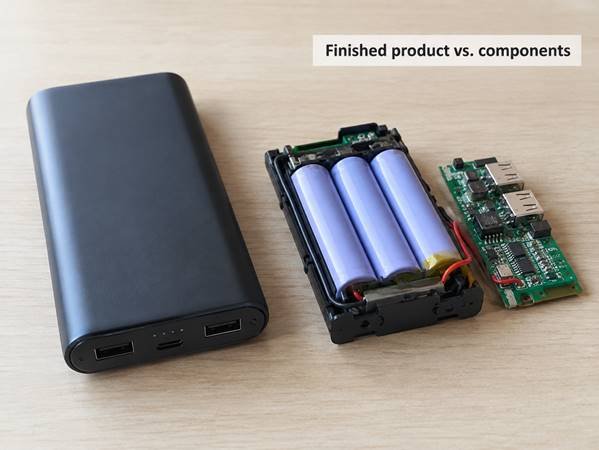
Many merchants promote “components have UL certification” as “the whole product has UL certification”, but in fact they are completely different things. UL Listing is for finished whole products, that is, the entire power bank that you can buy directly and use directly. After passing, you can affix the UL Listing mark, which is a certification for end consumers; while UL Recognition is usually for components and parts, such as battery cells and protection boards in power banks. The recognition of these parts only means that they meet specific requirements, and does not mean that the assembled whole product will definitely meet the requirements.
2. UL Certification ≠ UL Test Report
Some merchants will use a “UL test report” to impersonate certification, but in fact the two are not the same. UL Listing or certification usually follows the model of “product evaluation + continuous production supervision”: not only samples are evaluated, but also follow-up supervision is conducted to confirm that mass-produced products remain consistent with certification requirements.
A test report usually proves the test results of the tested sample or tested model under the conditions specified in the report, and is not automatically equivalent to UL Listing or certification that includes continuous production supervision. Whether the report can be used for platform, procurement, or regulatory compliance shall be judged based on the report scope, laboratory qualifications, product consistency, and specific channel requirements.
3. UL Safety Certification ≠ Quality/Performance Certification
This is the most misunderstood point: UL mainly focuses on safety, which is not equivalent to a comprehensive evaluation of whether the product is “easy to use”. For example, whether a power bank poses risks such as fire or electric shock due to design or abnormal conditions is the focus of safety evaluation; however, performance and quality issues such as sufficient capacity, fast charging speed, service life, and drop resistance are not all covered by UL certification. Don’t think that a power bank with UL certification is a “high-quality power bank”; it first means that the product meets the corresponding safety requirements.
2 Core Premises
Before talking about specific standards, first clarify two most easily overlooked premises, which can help you avoid 90% of cognitive misunderstandings:
First, UL is not a unified mandatory certification of the US federal government. That is to say, whether UL certification or other safety compliance evidence must be provided depends on the product type, sales channel, procurement contract, local competent authorities, and other specific requirements. It is often a market-driven access requirement, but not all power banks are uniformly required by federal law to obtain the UL mark in all sales situations in the United States.
Second, UL can only reduce safety risks in the design and manufacturing process, it is not a “get-out-of-jail-free card”. If you throw the power bank into a fire, smash it with a hammer, leave it in a car exposed to the sun for an afternoon, or it ages after five or six years of use, problems may still occur — it evaluates safety risks under specific standards and conditions, not that it “will never break no matter how you use it”.
2. Applicable Scope: Which UL Standard Corresponds to Your Product?
Many people think that all power banks use the same UL standard, but that’s not the case. Different types of products may correspond to different standards or certification schemes, and using the wrong one is equivalent to doing it in vain. We first organize the 4 core standards into a table for easy understanding at a glance:
| UL Standard Number | Applicable Product Type | Plain Language Explanation |
| UL 2056 | Ordinary consumer-grade power banks | Applicable to power banks with a maximum rated input and output of 60Vdc and a rated energy of no more than 100Wh. Commonly found in products for charging mobile phones, tablets, etc., and may also include products with built-in photovoltaic cells that meet the scope. |
| UL 2743 | Portable/movable power packs | Applicable to portable and movable power packs that supply power to different equipment or appliances on site, which may have one or more inputs or outputs. The boost emergency start function is one of the functions that can be included, but AC output and emergency start are not necessary conditions for applicability. Whether it is applicable shall be judged based on the complete functions, rated parameters, and standard scope. |
| UL 1642 | Lithium battery safety requirements | Covers primary and secondary lithium batteries, and products may consist of a single cell or multiple cells in series and parallel. Whether it can ultimately be used in finished products still depends on the end use and whole-product evaluation requirements. |
| UL 2054 | Household and commercial battery safety requirements | Applicable to household and commercial batteries within the corresponding scope. Its compliance is not automatically equivalent to the compliance of the whole power bank. |
Non-applicable Product Scope
There are three types of products that are not directly covered by the UL standards for ordinary power banks, don’t confuse them:
1. Individually sold lithium battery cells or battery packs usually need to be evaluated according to battery-related standards and end uses, and are not equivalent to power banks;
2. Medical and industrial-specific power banks may have industry-specific safety standards or additional requirements, and consumer-grade product solutions cannot be directly applied;
3. Household fixed energy storage systems, such as wall-mounted solar energy storage batteries, usually comply with energy storage system-related requirements, and are not the same as portable power banks.
Judgment Rules for Special Products
Now many power banks have various additional functions. How to judge which standard to use? It cannot be judged only by name or main use, but must be combined with complete functions, power supply methods, rated parameters, and regulations of the place of sale:
• For products with additional functions such as lighting, Bluetooth speakers, magnetic attraction, and hand warmers, the power bank standard may not automatically become inapplicable; however, additional functions may also trigger other standards, regulations, or additional evaluations, and other requirements cannot be excluded just because “the core is mobile charging”;
• Capacity may affect the applicable standard, not just the test items. UL 2056 is only applicable to power banks with a maximum input and output of 60Vdc and a rated energy of no more than 100Wh; when the energy exceeds 100Wh or the function exceeds this scope, the applicable standard shall be re-determined;
• For set products, such as power banks, chargers, and charging cables sold together, the compliance scopes of the three cannot be automatically substituted for each other. Whether they need independent certification or can be evaluated as a system, as well as which standard applies to external chargers, shall be confirmed according to product structure, use, sales method, place of sale, and platform requirements;
• Power banks with solar panels cannot be generalized either. Products with built-in photovoltaic cells as power sources can be included in UL 2056 when they meet the full scope of UL 2056; when they exceed the scope or have other special functions, they shall still be re-determined.
Distinction from Other Compliance Requirements
In addition to UL, power bank exports may also involve many other regulations or requirements, don’t confuse them with UL:
• FCC: Mainly involves interference of radio frequency equipment, equipment authorization, and applicable RF exposure requirements. Whether the product is applicable depends on whether it has functions such as wireless communication and wireless charging, and cannot be simply understood as “having nothing to do with safety at all”;
• UN38.3: Lithium battery transportation safety test requirements, which are related to transportation conditions such as air and sea transportation, and are not equivalent to UL safety evaluation during product use;
• CE/PSE/KC: CE is a conformity mark under applicable EU regulations, usually based on manufacturer’s conformity assessment and EU declaration of conformity, and is not generally equivalent to third-party safety certification; PSE and KC shall be confirmed according to the respective regulations and product categories of Japan and South Korea;
• DOE/CEC: DOE is the US federal energy efficiency authority, and CEC is a California agency. Whether energy efficiency requirements apply to external power supplies, chargers, or specific products shall be judged based on whether the product belongs to the corresponding regulated category, and not every power bank will automatically be applicable.
Common Consequences of Standard Mismatch
If the standard is wrong, for example, an ordinary power bank that should fall within the scope of UL 2056 is treated according to UL 2743, or a product that exceeds the scope of UL 2056 is still operated according to the ordinary power bank scheme, additional evaluations may be required later, increasing time and cost.
If it does not meet the applicable requirements of a certain platform, retailer, or purchaser, it may also lead to sales restrictions, requests for supplementary materials, or removal from shelves. As for customs detention, insurance claim settlement, and liability issues, they shall be judged based on specific regulations, contracts, declarations, and accident facts, and the result cannot be directly presumed only based on “no UL certification”.
3. What Exactly Does UL Certification Inspect?
Many people are curious that UL certification tests so many things, what exactly is being tested? In fact, the core is all around the safety risks of lithium batteries.
Sources of Safety Risks
The safety risks of power banks mainly come from four core components: lithium batteries, battery packs, protection boards, output interfaces, and casings. There are three corresponding main risks: battery failure, such as bulging, leakage, or thermal runaway; protection circuit failure, such as abnormal charging and discharging; structural design defects, such as electric leakage, overheating, or flame spread. UL’s relevant evaluations are all aimed at reducing these risks to a reasonable range.
Core Safety Assessment
UL safety evaluation will conduct applicable construction and abnormal condition tests for related risks such as charging, discharging, short circuit, abnormal temperature rise, structure and materials. The actual requirements for ordinary power banks and portable power supplies will vary with product design and applicable standards, and should not be understood as all products must adopt exactly the same functions.
Consumers can focus on understanding the following six common types of risks:
1. Abnormal charging risk: The product needs to control risks under abnormal charging conditions. Different designs may adopt charging cut-off, current limiting, protection circuits, or other control methods, not necessarily the single practice of “automatically completely powering off after fully charged”.
2. Abnormal discharging risk: When the power is too low or the discharging conditions are abnormal, the product needs to prevent the battery from being in a potentially damaged or dangerous state. Common designs may include output limiting, output cutting, or other protection strategies.
3. Short circuit risk: If a short circuit occurs at the output end or internal wiring, large current may cause rapid heating or even fire, so it will be evaluated whether the relevant circuits and structures can control the risk.
4. Abnormal temperature rise risk: High load, high ambient temperature, component failure, etc. may all cause the temperature to rise. Products may adopt temperature monitoring, current limiting, cutting, or other methods, but the specific strategy depends on the design and applicable standards.
5. Casing and material risk: Casing materials and structures shall reduce the risk of flame spread. However, flame-retardant materials do not mean that when the battery undergoes thermal runaway, the fire can definitely be completely confined inside the casing.
6. Interface safety risk: Interfaces need to avoid loosening, overheating, short circuit, or other electrical risks as much as possible during plugging and unplugging, long-term use, and abnormal load.
Additional Assessment for Additional Functions
If the power bank has additional functions, corresponding electrical, temperature rise, abnormal operation, overload, or material evaluations may be added due to its structure and rated conditions:
• Products with wireless charging may need to be evaluated for issues such as coil temperature rise and abnormal operation according to product structure and applicable standards. Whether specific functions such as foreign object detection are required shall be subject to the applicable standards, product specifications, and the project judgment of the certification body;
• Products with USB-C PD fast charging may need to pay attention to temperature rise, overload, and electrical control risks during high-power operation. However, safety certification shall not be expressed as a guarantee of full protocol compatibility or that all powered devices will not be damaged;
• Products with multi-port output may need to evaluate the total load, power distribution, and safety performance under abnormal conditions when multiple ports work simultaneously.
Scope of Content Not Assessed
Let’s clarify again that UL is not equivalent to a comprehensive performance evaluation, don’t have too high expectations for it:
• Performance indicators: such as actual output capacity, charging speed, cycle life, etc., should not be deemed fully verified only based on UL certification;
• Appearance durability: such as drop resistance and wear resistance, unless these issues affect safety, they may not be the focus of certification;
• Fast charging protocol compatibility: such as whether it supports a brand’s proprietary fast charging protocol, unless related issues involve safety risks, it is not equivalent to being fully covered by UL certification.
Judgment Logic of Test Coverage
If you are a seller or doing product selection, to judge whether the UL test of a product is complete, you can remember three logics:
First, different power, capacity, input/output methods, and additional functions may bring different evaluation requirements. For example, high-power portable power supplies usually involve more usage scenarios and abnormal conditions than ordinary small power banks;
Second, don’t presume that all interfaces and functions are covered just because “one interface has been tested”. The port configuration, rated values, models, and functions actually covered by the certification file shall be checked;
Third, any change that may affect the certified construction, such as battery cells, protection boards, casing materials, or key structures, shall be reported to the certification body before implementation. The certification body shall decide whether document evaluation, supplementary testing, change of certification scope, or re-certification is required.
4. Full Process of Applying for UL Certification and Pitfall Avoidance
If you are a seller and want to apply for UL certification for your power bank, you will probably go through links such as product evaluation and subsequent production supervision, and there are many pitfalls to pay attention to in the process.
Core Process
1. Match the standard: First confirm the product specifications, rated energy, input/output voltage, and functions, and correspond to the correct standard or certification scheme. Whether an ordinary power bank is applicable to UL 2056 depends on whether it meets the scopes such as 60Vdc and 100Wh; for portable or movable power packs, whether UL 2743 is applicable shall be judged according to the complete product functions and parameters.
2. Submit samples and materials: If you need to obtain UL Listing or certification from UL Solutions, you shall apply directly to UL Solutions, or confirm that the test data, witnessed testing, or other projects participated by third-party laboratories are acceptable to UL Solutions for this product and standard. The submitted samples shall be as consistent as possible with the mass-produced version, and product materials and key component information shall be prepared.
3. Safety test and evaluation: The laboratory or certification body completes the corresponding safety evaluation according to applicable standards. Unqualified items need to be rectified, and materials or tests shall be supplemented as required.
4. Production supervision arrangement: UL certification projects usually include product evaluation and continuous Follow-Up Services or production supervision. The specific arrangement of the first production inspection shall be subject to the project documents issued by UL Solutions for the product, factory, and certification scheme.
5. Obtain certification and continuously meet requirements: After certification, it shall be continuously ensured that mass-produced products meet the certified construction and requirements. The review frequency, project cycle, fees, and transition and supplementary evaluation requirements after standard revision shall all be subject to specific project documents.
Key Points for Pitfall Avoidance in Each Link
There are several common pitfalls in the application process, knowing them in advance can save a lot of money and time:
• Sample submission requirements: The submitted samples shall be consistent with the final mass-produced version. Even if you only change the battery cell brand or the protection board model, you shall first report to the certification body, which will judge whether supplementary evaluation or testing is required. Don’t continue to use the original certification after making changes on your own;
• Material preparation: If there are available certification materials for key batteries, cells, or other components, submit them to the laboratory or certification body in advance, which will help them judge whether relevant materials can be cited and may speed up the progress;
• Cycle reference: There is no unified fixed answer for the project cycle, which depends on product complexity, sample and material completeness, number of rectifications, number of models, laboratory arrangement, and certification scheme. Don’t take “4-8 weeks” as a general commitment for all power bank projects;
• Cost composition: Certification fees are usually not just one-time test fees, but may also include product evaluation, factory or production supervision, annual service, mark and document maintenance fees, etc. The budget shall be subject to the specific quotation;
• Cost influencing factors: Capacity, number of interfaces, additional functions, product series differences, and key component material conditions may all affect the cost and cycle;
• Standard update and product change: When standard update or product change occurs, you shall take the initiative to confirm with UL whether action is required. Standard revision does not necessarily mean that existing certifications will immediately become invalid or all products must be retested, but it cannot be ignored on your own;
• Choose a partner: When choosing a formal laboratory or service institution, confirm whether the tests, witnessed testing, or reports they participate in are acceptable to UL Solutions for this product and standard, don’t just listen to propaganda such as “UL authorized”;
• Beware of false propaganda: Be vigilant against services such as “guaranteed pass” and “ultra-low price and fast certification”. Some documents may just be test reports, or even cannot be verified, and may ultimately fail to meet the requirements of platforms or purchasers.
Precautions After Obtaining Certification
Getting the certificate is not a once-and-for-all thing, and two situations require special attention:
The first is change of certified construction. Replacement of core parts, changes in factory production conditions, and adjustments to materials or structures may all affect the certification scope. Before changes occur, you shall report to the certification body, and don’t continue to use the original mark and propaganda after changing materials without authorization.
The second is UL mark usage rules. It can only be used on the products, models, or within the certification scope corresponding to the certification. The mark style shall comply with UL regulations, and cannot be used across models or categories, nor can it be misleading in propaganda — for example, you cannot generally say “all series of products have UL certification”, but shall explain according to the actual certification scope.
Cost Reduction and Efficiency Improvement Tips
If you want to save money and time, you can try these methods:
• Prioritize the use of key components such as battery cells and protection boards that have applicable certification materials, to facilitate evaluation by the certification body;
• Try to unify the bill of materials (BOM) for products of the same series, reduce differences between different models, which may help reduce repeated evaluations;
• Conduct compliance review of product labels and manuals in advance, don’t wait until the test is completed to find that the labels do not meet the requirements, which will waste time due to repeated modifications;
• Choose a formal laboratory or service institution, and confirm whether its test data or witnessed testing is acceptable to UL Solutions;
• Be vigilant against propaganda such as “guaranteed pass” and “ultra-low price and fast certification”, and guard against the risk of fake certificates or inapplicable documents.
5. 3 Steps to Verify the Authenticity of UL Certification
Whether it is ordinary consumers buying power banks or sellers selecting products, the most feared thing is encountering fake UL certification — in fact, it is not difficult to check the authenticity, but you should pay attention not to mistake the control number on the mark as the “unique certification number”.
Step 1: Check the Product Body Label
First find the label on the product casing. The UL Listing mark may contain information such as product identification, manufacturer name, file number, issue number, serial number, or alphanumeric control number. The specific layout varies with product and mark types, and may not all be directly below the mark.
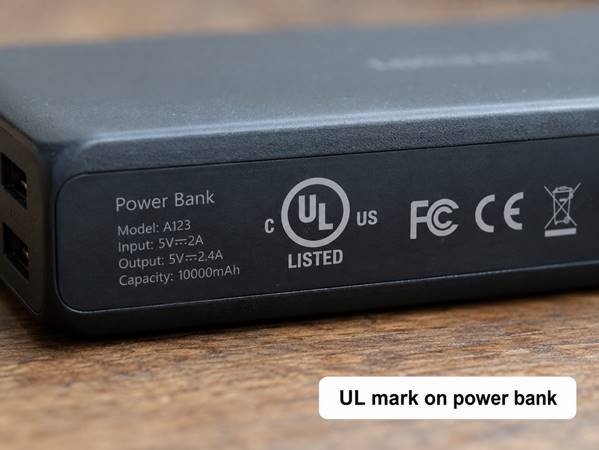
At the same time, the following shall also be checked:
• Product model;
• Rated parameters, such as voltage, energy, and Wh value;
• Manufacturer or brand information;
• Whether the mark matches the product category.
Note: Those only printed with “UL compliant” or “UL tested” are not equivalent to UL Listing. Even if you see the UL mark, you cannot judge the authenticity only by the sticker, you need to continue to verify.
Step 2: Query in the UL Product iQ Database
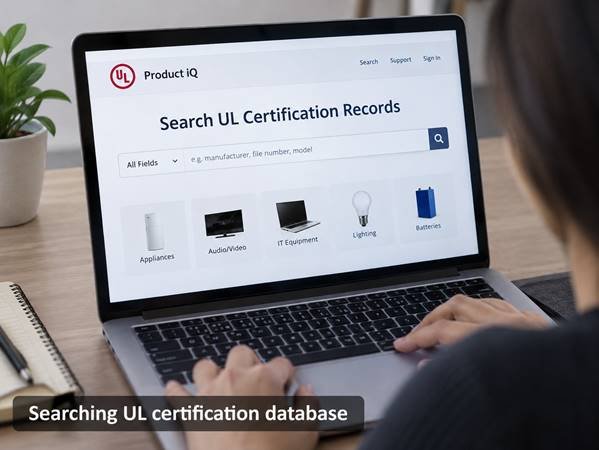
UL has a product certification query database called Product iQ, which requires a registered account to use. You can search by information such as manufacturer, file number, CCN, brand, or model. If there is a file number or other identifiable information on the product, it can usually be prioritized to narrow the query scope.
If no results are found, you can ask the brand or seller for verifiable certification materials, and check whether the manufacturer, model, and product category in the materials correspond. If you need to confirm whether a certification is still valid currently, you shall contact its Customer Experience Center according to UL’s instructions, instead of judging by yourself only based on the database page.
Step 3: Check the Coverage Scope
After finding the results, don’t feel relieved just because there is a record, you also need to check several key points:
1. Whether the manufacturer is consistent: The manufacturer or certification holder in the query results shall be consistent with the information in the product label and the materials provided by the seller;
2. Whether the model is covered: The certification file may cover multiple models. The key point is to confirm whether the specific model you see or sell is within the model naming and coverage scope of the file, rather than requiring each model to have a separate certificate;
3. Whether the product category corresponds: Ordinary power banks cannot use the UL 1642 of battery cells or battery-related materials as the whole power bank certification for propaganda;
4. Whether the ports, rated values, and functions match: The capacity, interface configuration, input and output rated values, and main functions of the product shall match the certification scope. For example, if you buy a 20000mAh model with USB-C, but the query results only cover 10000mAh models with different interface configurations, you should be vigilant.
Do not regard the control number as the unique file number of a single product, nor judge by the so-called fixed “certification validity period” or “near expiration”. Whether the certification file is still valid shall be further confirmed through UL official channels.
Handling Methods for Suspected Certification
If you suspect that the UL certification of the product you bought is fake, don’t panic, follow these steps:
• First, do not use it for unattended charging, nor use it under high load, such as charging laptops or high-power equipment, to avoid danger;
• Save the product label, packaging, and order screenshots as evidence;
• Contact the brand, sales platform, or UL official for verification;
• If the product has bulging, peculiar smell, abnormal high temperature, smoking, etc., stop using it immediately, don’t make do with it.
6. Common UL Publicity Misconceptions, Don’t Be Tricked
Now many merchants have UL-related pitfalls in their propaganda. We have sorted out three of the most common types, and you can avoid them after reading.
Authenticity-related Misconceptions
• Having a UL mark means it is a real certification: Wrong. Private printing of UL marks and misappropriation of other product materials may occur. You must check in combination with UL official database, manufacturer, model, and certification coverage scope, don’t just look at the sticker.
• UL certification is permanently valid once obtained: Wrong. UL Listed products are usually subject to continuous production supervision. When the product structure, key materials, or components change, it is necessary to report to the certification body; whether the certification is still valid shall be confirmed through UL official channels.
• Different models of the same series share one certification: Not necessarily. A certification file can cover multiple models, but models with different capacities, different interfaces, and different functions may also not be in the same certification scope. The key point is not “each model must have a separate certification”, but to confirm whether the specific model is covered.
Standard Coverage-related Misconceptions
• UL certification covers all quality issues: Wrong. UL mainly assesses safety-related risks. Performance and quality issues such as false capacity labeling, slow charging, and breakdown after half a year of use should not be deemed resolved only based on UL certification. Don’t regard UL certification as a comprehensive endorsement of high quality.
• If the battery cell has UL certification, the whole product does not need to be certified: Wrong. UL 1642 covers primary and secondary lithium batteries, which may involve single cells or multi-cell combinations, but its compliance is not automatically equivalent to the compliance of the whole power bank. The whole product shall still be evaluated according to the end use and applicable scheme.
• UL 2743 is a universal standard for all power banks: Wrong. UL 2743 is applicable to portable and movable power packs that supply power to different equipment or appliances on site, which may have one or more inputs and outputs, and may also include a boost emergency start function. It does not require the product to have AC output or emergency start function, but ordinary power banks within the scope of UL 2056 are also not applicable to UL 2743.
• If the included charger/cable has certification, the power bank is safe: Wrong. The compliance scopes of chargers, cables, and power banks cannot be automatically substituted for each other. Whether they need independent evaluation or can be evaluated as a system depends on the product structure, use, sales method, and channel requirements.
Effectiveness Scope-related Misconceptions
• UL certification is globally valid: Wrong. The UL mark does not automatically prove that the product meets all legal requirements of the European Union, Japan, South Korea, or other markets. When entering each market, the applicable regulations, tests, technical documents, markings, and conformity assessment procedures shall be confirmed respectively. EU products usually need to complete CE conformity assessment and EU declaration of conformity under applicable regulations, and whether a notified body is required depends on the specific regulations and product category.
• Only certifications issued by UL are valid: Not necessarily. In the United States, if a certification body has OSHA NRTL recognition scope for relevant standards, its certification can usually be used to meet the corresponding workplace product recognition requirements; however, the acceptance conditions of the specific institution, standard, mark, place of sale, platform, and competent authorities shall still be confirmed. For Canada, its Canadian certification scope shall also be confirmed, not just whether it is a US NRTL.
7. Practical Decision-Making: How to Choose a Safe and Compliant Power Bank
After talking so much, let’s finally get to the practical use: whether you are an ordinary user buying a power bank or a seller selecting products, you can follow the methods below.
Ordinary Users: 4-Step Judgment Method for Purchase
1. Clarify your needs first: First figure out how much capacity you need, what interface you want, whether you need fast charging, and whether it is for daily commuting or outdoor use — for daily use, an ordinary power bank of 10000-20000mAh is enough, and for outdoor use, consider a large-capacity portable power supply. Don’t blindly buy a large one.
2. Prioritize verifiable safety compliance materials: When buying, you can check whether the product has a UL Listing mark or other safety compliance evidence that meets the requirements of the sales channel. Whether an ordinary power bank is applicable to UL 2056 depends on whether the product meets its scope; for portable power supplies, it shall be judged according to actual functions and parameters. Don’t just look at the standard number written by the merchant, nor just look at the words “UL tested”.
3. Understand core parameters: Pay attention to two points here:
• Wh is more accurate than mAh: Wh is a unit of energy, calculated as「nominal voltage × capacity (Ah)」. For example, a 10000mAh power bank with 3.7V is 3.7×10=37Wh. Wh is not only a more accurate indicator for judging capacity, but also the core basis for air carriage.
• Battery cell capacity ≠ available output capacity: Due to reasons such as voltage boost and cable loss, the actual output capacity will be smaller than the battery cell capacity. For example, for a 10000mAh battery cell, the actual output may only be 6000-7000mAh. This is a normal phenomenon, not necessarily false labeling, and UL certification is not equivalent to guaranteeing this performance.
4. Verify materials before placing an order: After choosing the style, you can go to UL Product iQ to check the manufacturer, product category, and model coverage scope; if you need to confirm whether the certification is still valid currently, you can contact its Customer Experience Center according to UL’s instructions. After confirming there is no problem, compare the price and after-sales service, and place an order with more peace of mind.
Ordinary Users: Daily Safe Use and Abnormality Judgment
Even with UL certification, it must be used correctly to ensure safety:
• Correct use: Use matching chargers and cables, don’t use inferior “three-no” chargers (without manufacturer, production date, and quality certificate); don’t charge in high-temperature or sun-exposed places, nor charge under pillows or quilts, which will affect heat dissipation.
• Regular inspection: Check every once in a while whether the casing is bulging or cracked, and whether the interface is loose or dusty. If there is a problem, don’t use it.
• Stop-use criteria: If there is bulging, peculiar smell, abnormal hotness during charging, smoking, or frequent power failure, stop using it immediately, don’t be reluctant to throw it away.
• Air carriage: Taking US FAA rules as an example, power banks are spare lithium batteries and can only be carried with you; 0-100Wh is usually allowed, 101-160Wh requires carrier approval and a maximum of two per person, and more than 160Wh is usually prohibited from carriage. International routes and airlines may set stricter restrictions, and you should check the current regulations of the actual carrier before traveling.
Seller/Product Selection Decision Logic
If you are engaged in cross-border e-commerce or product selection, in addition to the basic content above, you should also pay attention to the following points:
1. Before product selection, first determine the product category, rated energy, input/output voltage, and functions, and match the correct UL standard or other acceptable certification schemes. Ordinary power banks can only be evaluated according to UL 2056 when they meet the scope of UL 2056; whether UL 2743 is applicable to portable or movable power packs shall be confirmed according to complete functions and parameters. Don’t wait until the product is listed to find that the standard is wrong.
2. Prioritize supply chains where key batteries or cells have applicable materials and the whole product has corresponding safety evaluation, which may not only save subsequent certification time, but also make risks easier to manage.
3. Be sure to confirm the manufacturer, product category, model naming, and configuration scope covered by the certification file. Don’t use the so-called “validity period”, “near expiration”, or “expired certification” as a simple basis for judgment; if you need to confirm whether the certification is still valid currently, you shall verify it through UL official channels.
4. For products with multiple interfaces and multiple functions, confirm that the certification file actually covers all port configurations, rated values, models, and functions. Don’t presume that the entire product is covered just by the propaganda of one interface or one sample.
5. Check product labels and promotional copy before listing to avoid misleading certification statements — for example, don’t generally say “full series UL certification”, but explain according to the actual certification coverage scope, so as not to be punished by the platform.
Final Remarks
In general, UL certification is not something mysterious. It is essentially a way for third-party organizations to evaluate the safety requirements related to power banks — for ordinary users, it is a reference tool for selecting safe products; for sellers, it may be an important compliance condition for entering specific North American channels.
As long as you can distinguish the standards that different products may correspond to, understand the difference between listing and component recognition or test reports, know how to check the certification coverage scope, and avoid common publicity pitfalls, you can avoid a lot of detours whether you buy or sell power banks. After all, when it comes to lithium battery safety, you can never be too careful.