
Many sellers of charging products targeting the US market, or users who enjoy cross-border shopping for charging accessories, often come across the two concepts CPSC and FCC. Many people think these are two alternative US certifications, and even believe that a charger with an FCC mark will absolutely never catch fire—actually, the regulatory scopes of these two agencies are completely independent, they regulate entirely different matters, and some charging products may need to meet the applicable requirements of both respectively. Today, we will use the most familiar products like chargers, USB cables, and wireless chargers as examples to clearly explain the differences between CPSC and FCC, specific requirements, and pitfalls to avoid, covering everything from beginner understanding to self-conducted compliance checks.
First Understand What the Two Agencies Regulate (Beginner Cognition)
First, let’s give the most straightforward positioning of the two agencies, so you can distinguish their general directions after reading:
The full name of CPSC is the U.S. Consumer Product Safety Commission. You can think of it as the “department that manages whether products will hurt people”—as long as it is a product for ordinary consumers, if there is an unreasonable risk of personal injury, such as electric shock, fire, or falling parts that stab people, it may be under its jurisdiction. It is particularly important to note that CPSC does not have a unified official certification mark. Any product on the market that claims to have a “CPSC certification mark” is basically a marketing gimmick, don’t believe it easily.
The full name of FCC is the U.S. Federal Communications Commission. It regulates the “electromagnetic environment and wireless order”—for example, if your charger causes your home router to disconnect when plugged in, the radio frequency energy of a wireless charger exceeds the limit, or a Bluetooth charger uses an unlicensed frequency band, these are all within its regulatory scope. There is a most common misconception that needs to be clarified firmly here: the FCC mark or FCC ID only means that the product meets electromagnetic/wireless related requirements, **it is completely not equivalent to passing electrical safety tests**, and cannot be used to prove that the product will not catch fire or leak electricity.
Many people who are new to this think “since they are both US certifications, just doing one is enough”, which is a typical beginner misconception. The regulatory dimensions of the two agencies are completely independent: one manages personal safety, and the other manages electromagnetic order; for specific products, it is necessary to separately judge whether the applicable requirements of both are triggered. The source of this misconception is that many people confuse “compliance marks” with “all regulatory requirements”, thinking that seeing one mark means full compliance.
Prerequisite Notes Before Comparison
Before officially launching the comparison, we must first clarify the scope and rules of the discussion, to avoid everyone applying the conclusions to unrelated products and causing misjudgment:
This article focuses on charging products generally sold to consumers, including common chargers, power adapters, USB/USB-C cables, wireless chargers, magnetic chargers, and smart chargers. Industrial, medical, military, and government procurement products may be subject to different or additional regulatory frameworks, and whether they are subject to specific CPSC or FCC requirements should be judged item by item according to product use, equipment category, and applicable regulations.
The comparison is based on the current US federal regulations as of 2024, and all conclusions only apply to charging products. Do not directly apply them to other categories such as toys and home appliances. If regulations are revised in the future, all shall be subject to the latest official announcements of CPSC and FCC.
We will compare from 6 core dimensions: regulatory logic, applicable boundaries, compliance process, test focus, labeling requirements, and law enforcement consequences. Each dimension will be explained in combination with actual scenarios of charging products, without vague provisions.
Item-by-Item Comparison of Core Dimensions (Charging Product Scenarios)
Dimension 1: Core Regulatory Risks—One Regulates Injury, the Other Regulates Interference
The most essential difference between the two agencies is that the risks they regulate are completely different.
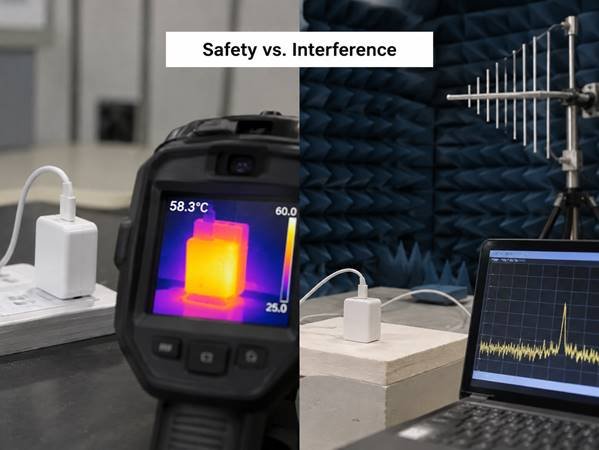
CPSC’s rules and law enforcement are centered around “reducing the risk of personal injury and property loss”. Applied to charging products, common regulatory scenarios include: electric shock to users caused by insulation failure of power adapters, fire risk of cables, user injury caused by loose and falling charger prongs, etc. Simply put, as long as the problem of the product itself injures people or burns things, it may be under CPSC’s jurisdiction.
FCC’s rules are all centered around “ensuring the stability of the electromagnetic environment and compliance of wireless communications”. Applied to charging products, common regulatory scenarios include: conducted interference of wired chargers causing abnormal operation of devices such as routers and TVs, radio frequency energy of wireless chargers exceeding safety limits, smart chargers with Bluetooth using unlicensed frequency bands, etc. Simply put, whether the product will “make other electronic devices not work properly” and whether the wireless function is compliant are under FCC’s jurisdiction.
There is a very practical exception here: if it is a purely mechanical product without any circuits, such as the most ordinary passive adapter, it usually does not fall into the category of products requiring FCC equipment authorization; but if it is sold to consumers, it may still be subject to CPSC’s general product safety law enforcement and defect risk requirements. For example, if the prong of the adapter breaks off in the socket and injures the user, it may still fall within the regulatory scope of CPSC.
Dimension 2: Applicable Boundaries—Which Charging Products Are Under Their Jurisdiction
After figuring out what risks they regulate, let’s take a look at which specific charging products need to meet their requirements.
CPSC has a wide scope of application: consumer-oriented charging products may usually be subject to CPSC’s general product safety law enforcement and defect reporting obligations. Even passive data cables without circuits and purely mechanical adapters cannot have unreasonable safety risks. However, whether there are specific mandatory standards, certification, labeling or testing requirements depends on whether the product is subject to a certain CPSC rule, ban or standard. Industrial use or government use cannot be automatically regarded as general exemption.
FCC’s scope of application cannot be simply determined by “whether there is an electronic circuit”. Charging products containing electronic components may be classified as unintentional radiators, intentional radiators or ISM equipment under FCC rules; whether equipment authorization is required, whether SDoC or Certification applies, and whether there is an exemption must be judged according to specific equipment categories and rule provisions. It cannot be directly concluded that SDoC is mandatory just because there is an E-Marker chip or “with circuit”. Purely passive USB cables without any chips, and purely mechanical adapters, usually do not involve FCC equipment authorization.
There are two special situations to note: first, if the product has wireless functions, it may need to apply the FCC Certification path, but it should still be judged according to the equipment category; second, if the product is a children’s product designed or intended for use mainly by children aged 12 and under, and the corresponding children’s product safety rules apply, it may trigger stricter CPSC testing and certification requirements. It cannot be automatically concluded that third-party testing is mandatory just because the charger is for children’s use.
Dimension 3: Compliance Process—What to Do to Meet the Requirements
Many people are most concerned about “what certification do I need to get to sell”. In fact, the compliance logic of the two is completely different, and even CPSC does not have a unified “mandatory certification” concept applicable to all charging products.
Let’s talk about CPSC first: it does not require general charging products to obtain a unified official certification. If a product is subject to a certain CPSC consumer product safety rule, ban, standard or regulation, the manufacturer or importer must conduct certification in accordance with the applicable rules and issue a **General Certificate of Conformity (GCC)**, which shall be supported by a reasonable test plan. For general chargers that are not subject to applicable CPSC rules, it cannot be asserted that they must have a GCC or CPSC test report just because they are chargers. Commercial procurement, insurers, state or local regulations may still require safety assessments such as UL.
If the product is a children’s product designed or intended for use mainly by children aged 12 and under, and the corresponding children’s product safety rules apply, it must be tested for applicability by a third-party conformity assessment body accepted by CPSC, and a Children’s Product Certificate (CPC) shall be issued; it cannot be automatically concluded that third-party testing is mandatory just because the charger is for children’s use.
CPSC does not set a unified pre-market approval process for general charging products. For products subject to specific rules, testing, certification, labeling and other work shall be completed in accordance with the applicable rules; if defects or risks are found after listing, it may also trigger reporting, correction or recall.
Now let’s talk about FCC: its compliance path depends on the equipment category. Products applicable to SDoC are usually tested in accordance with relevant rules and a declaration of conformity is provided by the responsible party; products applicable to Certification need to complete applicable tests, and be reviewed and issued equipment certification by an FCC-recognized Telecommunication Certification Body (TCB). Certified devices use an FCC ID, and relevant information can be queried in the FCC equipment authorization database.
Products with wireless transmission functions often need to go through the Certification path, but absolute judgment cannot be made just based on the words “wireless charger” or “Bluetooth”, it still depends on specific technical characteristics and applicable provisions. Testing laboratories and TCBs shall also comply with applicable FCC qualification rules.
The exception here is still children’s products: whether children’s products require third-party testing depends on whether they are children’s products designed or intended for use mainly by children aged 12 and under, and whether the corresponding children’s product safety rules apply; the FCC path is still judged according to equipment category and wireless functions, and will not automatically change just because the product is for children.
Dimension 4: Test Focus—What Specific Items Are Tested
After knowing the process, let’s take a look at what the two sides specifically focus on, so that when you get the test report, you know what to look at.
Insulation, withstand voltage, temperature rise, material flame retardancy and mechanical strength are common items in safety assessments such as UL and IEC for power supply products. For example, power adapters may be evaluated for insulation withstand voltage, leakage current and surface temperature rise, and USB-C cables may be evaluated for materials, connectors and mechanical durability. However, these are not a unified test list specified by CPSC for all charging products. The specific applicable items and limits shall be determined according to product category, applicable standards, state or local regulations, and sales channel requirements.
Therefore, 65W power adapters may focus on insulation and temperature rise, and USB-C cables may also focus on plug-in durability and material performance; but these common safety assessment items cannot be directly understood as unified CPSC tests that all charging products must complete. There is also no general threshold that “for chargers above 100W, CPSC will tighten temperature rise and insulation tests”.
For FCC, for unintentional radiators subject to Part 15, the focus is usually on conducted emission and radiated emission limits, that is, to see whether the product will emit excessive electromagnetic interference through power lines or air. FCC generally does not specify unified immunity testing for such devices under Part 15; instead, the rules require devices to accept received interference.
For wireless products such as wireless chargers, Bluetooth or Wi-Fi, radio frequency exposure compliance assessment is also required according to their technical parameters and use conditions. Specifically, SAR, MPE assessment may be required, or corresponding exemption conditions may be met, which cannot be generally referred to as “wireless chargers must test SAR”. For ordinary wired chargers, if relevant rules apply, common concerns are conducted and radiated emissions; wireless products may have additional frequency, power and RF exposure requirements.
Dimension 5: Labeling and Document Requirements—What Should Be on the Product and What Documents Should Be Kept
Many users’ first reaction to judge compliance is to look at the mark, so let’s take a look at the requirements of both sides for labeling and documents.
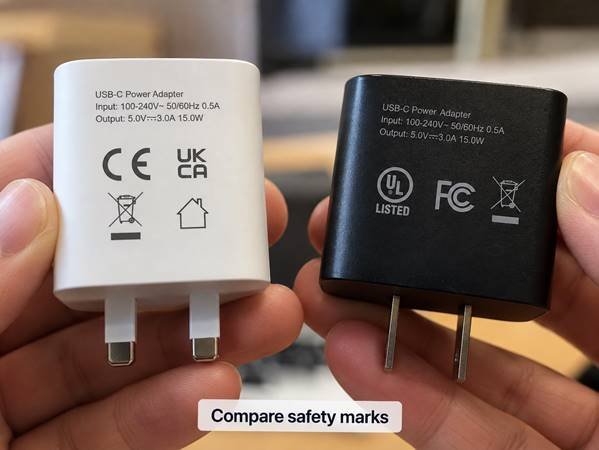
On the CPSC side, there is no unified certification mark applicable to all charging products, nor is there a set of traceability label rules that all general chargers must use. Whether labels, traceability information and warning statements must be provided shall be judged according to specific applicable CPSC rules, product standards and other legal requirements.
If children’s products are subject to the tracking label rule, they shall meet the prescribed traceability information such as manufacturer or private labeler, production location and date, batch number, etc.; general chargers cannot apply this rule generally. Prompts such as “Do not cover the charger” may be safety warnings adopted by product standards, manufacturers or sales channels, but they are not general mandatory warnings for high-risk chargers issued by CPSC.
If the product is subject to a certain CPSC rule, supporting documents may include GCC, CPC or corresponding test materials. Enterprises shall keep them in accordance with applicable rules and be able to provide them when required by regulatory authorities; but GCC and CPSC test reports cannot be regarded as documents that every charger must naturally have.
On the FCC side, labeling requirements also need to be distinguished by authorization path. Equipment applicable to SDoC shall be identified by model in accordance with the rules and provide prescribed compliance information; the FCC Logo can be used voluntarily and is not a mandatory mark. The name and contact information of the responsible party shall be provided with the product in accordance with the rules, but it is not always necessary to be printed on the product body.
For products that go through FCC Certification, the FCC ID shall be marked in accordance with applicable rules. This number can be queried by anyone in the equipment authorization database on the FCC official website for corresponding product information. The label is usually provided on the device body, electronic label or accompanying materials, and the specific method depends on the device type and label rules.
The labeling arrangement for mini products cannot be simply understood as “FCC labels can all be moved to the packaging”. Whether electronic labels, packaging labels or manual labels can be used shall be judged according to the FCC rules applicable to the equipment; CPSC’s traceability information and warning statements also depend on specific product rules, not just on product volume.
Dimension 6: Law Enforcement Consequences—What Penalties Will There Be for Non-Compliance
The last dimension, which is also the most concerned by everyone: if it is not compliant, what will be the consequences?
CPSC’s law enforcement consequences can be very serious because they involve personal safety. Common measures include: requiring cessation of sales, correction or recall of sold products, as well as civil fines; if the risk is intentionally concealed and the product is sold knowing that there is a problem, the relevant responsible persons may also be involved in criminal liability. Common safety problems of charging products include: charger fire, data cable overheating and melting, prong breakage and falling off, etc.
Once relevant enterprises obtain information that may trigger CPSC Section 15 reporting obligations, they shall report immediately; CPSC usually regards 24 hours as the benchmark for timely reporting, but in limited cases, a short-term investigation can be conducted first. Whether to report shall be judged according to the statutory threshold, for example, product defects may cause substantial product hazards, there is an unreasonable risk of serious injury or death, or violate applicable rules, etc.; it cannot be generally understood as “must complete reporting within 24 hours after discovering any major safety risk”.
FCC’s violation consequences are more concentrated on equipment market access and electromagnetic compliance. Devices imported or sold without applicable equipment authorization may be subject to FCC law enforcement, and may be refused entry, detained or subject to other measures by U.S. Customs and Border Protection (CBP) at the import stage. The amount of forfeiture is determined according to the inflation-adjusted upper limit in current regulations and specific illegal facts, and cannot be generalized as a fixed “tens of thousands of dollars per day”.
Common FCC-related problems of charging products include: failure to complete authorization when equipment authorization is applicable, excessive electromagnetic emissions, wireless products requiring Certification without obtaining corresponding certification, etc. But it cannot be simply assumed that “without an FCC ID, the goods will definitely be directly detained by customs”, because the premise is that the product does belong to equipment requiring Certification and FCC ID.
There is a special situation: if the non-compliant product causes personal injury, CPSC may pay more attention to risk disposal, reporting and recall responsibilities; FCC still mainly handles corresponding illegal acts in accordance with electromagnetic and wireless rules.
Charging Product Compliance Quick Reference Table
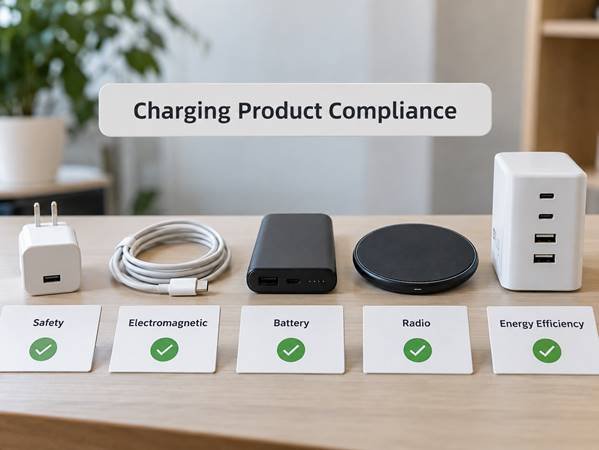
After talking about the 6 dimensions, many people may still not remember what requirements their products need to meet. We have compiled a quick reference table for compliance of common charging products, which you can directly compare:
| Product Type | CPSC Requirements | FCC Requirements |
| Purely passive USB/USB-C cables (no chip, no LED, pure physical connection) | Usually subject to general product safety and defect risk requirements; whether there are specific mandatory standards, labeling or testing requirements needs to be judged separately | Usually do not involve FCC equipment authorization |
| Data cables with electronic components (e.g. with E-Marker, HUB or expansion functions) | May be subject to general product safety and defect risk requirements; specific safety testing requirements depend on applicable rules and standards | May be subject to FCC rules, but whether equipment authorization is required, whether SDoC or other paths apply, shall be judged according to equipment category and exemption conditions |
| Wired chargers/power adapters | May be subject to general product safety and defect risk requirements; safety assessments such as UL/IEC may be affected by requirements of sales channels, state or local regulations, etc. | May be subject to FCC emission rules; whether SDoC is required or whether there is an exemption shall be judged according to specific equipment category |
| Wireless charging pads/magnetic chargers | May involve basic electrical safety, surface temperature and other applicable safety requirements | Usually need to be evaluated in accordance with rules for radio or wireless power transmission equipment, and Certification and RF exposure assessment may apply |
| Smart chargers with Bluetooth/Wi‑Fi | May be subject to general product safety and defect risk requirements | Usually need to be evaluated in accordance with rules for wireless transmission equipment, commonly Certification, but shall still be confirmed according to specific equipment category |
Beginner Practice: 3-Step Compliance Self-Check
Whether you are purchasing charging products for sale, or buying accessories via cross-border shopping for yourself, as long as you master these 3 steps, you can complete basic compliance self-check and avoid most pitfalls.
**Step 1: First determine the product type and clarify basic requirements**
First, compare with the quick reference table above to determine which category your product belongs to: is it a purely passive cable, a wired charger, or a wireless charger. If you are not sure whether the product has a chip or wireless function, you can check the function list in the manual, or directly consult the supplier.
For example, many people cannot tell whether a USB-C cable has an E-Marker, and cannot judge only by “above 65W”. You should check the cable specifications, USB-IF identification information or manufacturer’s technical materials; whether the cable needs an electronic marker depends on the current capacity, function of the cable and the USB Type-C and USB PD specifications it follows.
**Step 2: Check labels and supporting documents**
First look at CPSC-related: does the product have enough information for you to identify the brand, model and sales entity? If you are purchasing, can you request safety test materials consistent with the actual model? If the product is subject to a certain CPSC rule, you should also confirm whether the enterprise can provide the corresponding GCC, CPC or other compliance documents. Do not directly equate the absence of GCC for general chargers with non-compliance; the key is to first confirm whether it is subject to specific rules that require GCC.
Then look at FCC-related: do not judge only by “whether there is an FCC mark”. For products applicable to SDoC, the FCC Logo itself is optional; if the product is a wireless device requiring Certification, you should look for the FCC ID and confirm whether the product information corresponds. For wired chargers and data cables with electronic components, the supplier should also explain their FCC equipment classification, authorization path and whether exemption applies.
**Step 3: Verify authenticity and consistency**
Many products have marks, but they may be fake. This step is to verify the authenticity. Verification of FCC ID is very simple: directly enter the ID number in the database on the FCC official website, you can find the corresponding product model and manufacturer information, and check whether it is consistent with the actual product.
As for the test report, you need to check whether the product model and version on the report are the same as the product you actually sell or buy, don’t use reports of other models to make up the number. For products applicable to SDoC, focus on checking whether the compliance information provided by the responsible party is consistent with the product model.
If you encounter the following situations, you can basically judge them as high-risk products and try not to touch them:
• “Three-no” products with no brand, no model, and no manufacturer information;
• Merchants claim “US certification” but cannot tell whether it is CPSC or FCC;
• Products claiming to require wireless certification only have a vague FCC mark but cannot provide a verifiable FCC ID;
• The product model on the e-commerce page is inconsistent with the model on the physical label.
Advanced Pitfall Avoidance: Misconceptions, Priorities and Compliance Invalidation
If you are a seller doing the US market, or want to understand compliance more deeply, avoid marketing gimmicks and common decision-making mistakes, you must read this part.
Common Marketing Misconception Pitfall Avoidance
Now many merchants use compliance as a marketing gimmick, and you will be tricked if you are not careful. We have sorted out the 5 most common misconceptions:
1. **Misconception: Chargers with FCC certification will not catch fire**
Clarification: FCC only manages electromagnetic interference and wireless compliance, and does not manage electrical safety, fire, electric shock and other issues at all. Even if a product has an FCC mark, it may catch fire due to insufficient insulation or unqualified flame retardancy.
Pitfall avoidance: When buying chargers or selecting suppliers, you cannot only look at the FCC mark, you should confirm whether the product has undergone electrical safety assessment consistent with its category and sales channel requirements.
2. **Misconception: “CPSC certification” is a mandatory certification for charging products in the US**
Clarification: CPSC has never had an official “certification” statement applicable to all charging products. Only when a product is subject to corresponding safety rules, bans, standards or regulations, may there be certification document obligations; children’s products also need to meet the conditions of “designed or intended for use mainly by children aged 12 and under” and applicable children’s product safety rules, etc., before triggering third-party testing and CPC requirements. The so-called “CPSC certification” on the market is basically a marketing concept created by merchants.
Pitfall avoidance: Don’t believe the gimmick of “CPSC certification”, focus on whether the documents and test content correspond to the actual product, applicable rules and product use.
3. **Misconception: All USB cables do not need FCC compliance**
Clarification: Purely passive USB cables without any electronic components usually do not involve FCC equipment authorization; but whether cables with electronic components are subject to FCC rules and what authorization path is required depends on equipment definition, technical characteristics and exemption conditions. It cannot be directly concluded that SDoC is mandatory just because of an E-Marker chip, HUB or LED light.
Pitfall avoidance: When buying high-power USB-C cables or cables with expansion functions, you should ask the supplier to explain the cable specifications, electronic functions and applicable FCC compliance path, instead of only looking at whether there is an FCC mark.
4. **Misconception: If the wireless module has an FCC ID, the whole machine will definitely be compliant**
Clarification: A wireless module can have an FCC ID, but the complete device may also have its own FCC ID. After a certified module is installed in the host, whether the host can directly use the module certification depends on the module authorization conditions, antenna, installation method and other circuits and wireless functions of the host. Changes in the overall structure, antenna position, power supply method, and firmware version may affect electromagnetic and radio frequency performance.
Pitfall avoidance: When purchasing products with ready-made wireless modules, you must verify whether the whole machine has undergone applicable compliance assessment, not just look at the FCC ID of the module.
5. **Misconception: Compliant products will absolutely never be recalled**
Clarification: FCC implements pre-market access requirements for devices requiring equipment authorization, and also conducts post-market law enforcement; CPSC usually does not conduct pre-market approval for general charging products, but products subject to specific rules may have testing, certification and labeling obligations. If new safety risks are found after listing, or there are problems with previous tests or product consistency, it may still trigger reporting, correction or recall.
Pitfall avoidance: You can subscribe to relevant notifications from CPSC and FCC, regularly check the products you have purchased or sold, and deal with problems in a timely manner.
Compliance Priorities for Different Sales Scenarios
Many sellers will ask: I have a limited budget, can I do one compliance first, then the other? In fact, different product scenarios have different compliance priorities, and you can arrange them according to the level of risk:
1. **Scenario 1: Selling purely passive USB cables/mechanical adapters**
Priority: Prioritize product safety and defect risks, FCC usually does not involve equipment authorization.
Judgment criteria: If the product does not have any electronic components and is only a pure physical connection, it usually does not need FCC equipment authorization; but you should still evaluate the material, structure and use safety, and check whether there are other applicable product standards, state or channel requirements.
2. **Scenario 2: Selling ordinary wired chargers/power adapters**
Priority: Separately evaluate the applicability of FCC equipment authorization, as well as specific CPSC rules and product safety risks.
Judgment criteria: Such products may involve both electrical safety issues and electromagnetic emission requirements. If FCC authorization applies, the corresponding path must be met before marketing or import; in terms of product safety, you should also check applicable state, local, retail channel and product standard requirements, and cannot generalize CPSC documents and FCC documents as indispensable for all products.
3. **Scenario 3: Selling charging products with wireless functions (wireless chargers, smart chargers)**
Priority: First confirm whether FCC Certification and FCC ID are required, and at the same time evaluate product safety requirements.
Judgment criteria: Products with wireless functions are usually more likely to trigger FCC equipment authorization requirements; if they are devices requiring Certification, they should obtain corresponding authorization before import or sale. But it cannot be simply assumed that without an FCC ID, the goods will definitely be detained by customs, you still need to first confirm the specific equipment classification and applicable rules of the product. CPSC safety risks, state and local regulations, and sales channel standards also cannot be ignored.
4. **Scenario 4: Unsure of the regulatory classification of the product**
Query method: You can go to the CPSC official website to check relevant consumer product rules, or go to the FCC official website to check equipment authorization guidelines. If you are still not sure, it is recommended to consult a professional third-party compliance agency, don’t make random judgments by yourself, otherwise it is easy to step into pitfalls.
Situations Where Compliance Conclusions Become Invalid
Many sellers think that doing compliance once is enough once and for all, but that’s not the case. The following changes may affect the applicability of existing FCC authorizations, safety tests or certificates, and a change impact assessment should be conducted:
• **Key component changes**: For example, changing the power chip, wireless module, cable material, housing flame retardant material, these may affect safety and electromagnetic performance;
• **Product structure changes**: For example, changing the circuit board design, antenna position, prong structure, structural changes may directly affect the test results;
• **Firmware/software upgrades**: For example, adjusting the wireless transmission power, changing the charging power parameters, software changes may also affect electromagnetic and safety performance;
• **Sales configuration changes**: For example, replacing the matching cable, adding new accessories, modifying the rated parameters advertised for the product, these may cause the actually sold product to be inconsistent with the original test sample.
If the change affects regulated parameters, the consistency of certified samples or applicable safety requirements, supplementary testing, document updating, re-certification or re-authorization shall be carried out in accordance with applicable rules; it cannot be generally concluded that all changes will automatically invalidate the original conclusions.
Core Summary
Finally, we extract the most core judgment methods. As long as you remember these points, you can handle the CPSC and FCC compliance judgment of most charging products:
First, distinguish the regulatory scope in one sentence: **CPSC manages “whether the product will hurt people”, FCC manages “whether it will interfere with the electromagnetic environment”**. The two have different regulatory dimensions, and whether they apply needs to be judged separately.
Second, quickly judge the requirements of common charging products: purely passive USB cables usually do not involve FCC equipment authorization; wired chargers and data cables with electronic components should separately evaluate FCC equipment classification, authorization path and exemption conditions; products with wireless functions usually need to focus on checking whether FCC Certification and FCC ID apply.
Third, be able to independently complete basic compliance self-check: know how to check the model and sales entity information on the product, know how to request test materials consistent with the actual product, know how to check the authenticity of the ID on the FCC official website, and can quickly identify high-risk three-no products.
Fourth, know how to judge priorities according to sales scenarios: for purely passive products, first focus on product safety and defect risks; for wireless products, first confirm the applicability of FCC authorization; for wired chargers, also separately check FCC rules, product safety standards, state and local regulations, and sales channel requirements. If you are not sure, check the official website or find a professional agency.
Fifth, avoid common marketing misconceptions: don’t treat the FCC mark as a safety certification, don’t believe the gimmick of “CPSC certification”, don’t think that if the module is compliant, the whole machine is compliant.