
Have you ever encountered this situation: when you plug a 65W fast charger into a power strip next to a router, the WiFi suddenly slows down or even disconnects while your phone is charging; or when you charge your earphones with a long fast charging cable, there is a buzzing current noise when you get close to a Bluetooth speaker? These seemingly trivial small problems are essentially related to electromagnetic interference. The core global technical standard system used to regulate electromagnetic interference of such electronic devices is the CISPR series we are going to talk about today.
Before we officially start, a major premise must be clarified: there is no default conclusion for the applicability of CISPR standards. To confirm the specific applicable standard for any product, a comprehensive judgment must be made in combination with the product category, intended use, and regulations of the target market. All cases in this article take common scenarios of consumer-grade charging products (chargers, USB-C data cables, power adapters, etc.) as examples, and do not constitute formal compliance basis.
CISPR Basic Cognition
Many people think CISPR is a certification from a certain country when they hear it for the first time, but it is not. The full name of CISPR is the International Special Committee on Radio Interference, which is affiliated to the International Electrotechnical Commission (IEC). Its core work is to formulate globally unified electromagnetic disturbance emission test rules and limit references, and it is a recommended international technical standard. Simply put, it sets a “general examination paper” for electromagnetic interference testing of electronic devices worldwide. Countries may transform or reference CISPR-related standards into local regulations, harmonized standards or conformity assessment systems; only under the requirements of specific regulations and systems may relevant requirements become mandatory requirements for market access. Common misconception: CISPR is not a national standard of a certain country, but a general technical base for the global EMC field.
Speaking of this, we must first explain what EMC, which people often hear about, is. EMC is also called electromagnetic compatibility, which refers to the ability of electronic devices to work normally without interfering with each other in a common electromagnetic environment. It is mainly divided into two categories: one is electromagnetic disturbance (abbreviated as EMI), which is the electromagnetic interference emitted by the device to the outside; the other is electromagnetic immunity (abbreviated as EMS), which is the ability of the device to resist external electromagnetic interference.
The core work of CISPR is to regulate EMI, that is, to manage “devices should not emit interference randomly”. Only a few CISPR standards for specific categories cover immunity requirements. Most general immunity test methods refer to the IEC 61000-4 series of standards, which are independently formulated by the IEC and do not belong to the CISPR system. Common misconception: CISPR does not cover all EMC issues, and most immunity requirements should refer to IEC 61000 or specific product standards.
For charging products, CISPR is a standard system that needs to be understood for three reasons: First, in many markets, CISPR-related standards or their locally adopted versions are important technical basis for EMC compliance of specific products; if they do not meet the mandatory requirements of the target market, they may face sales restrictions, recalls or administrative penalties, and the specific consequences depend on local regulations and law enforcement systems. Second, the electromagnetic interference generated by unqualified fast chargers and data cables does affect the normal use of wireless devices such as WiFi and Bluetooth; third, as the power of fast charging is getting higher and higher, and data cables are getting longer and longer, the risk of electromagnetic interference has also become an issue that needs attention in design and compliance assessment.
Here we also need to correct a very common misunderstanding: there is no official “CISPR certification” uniformly issued by the IEC or CISPR. CISPR is just a set of technical standards, just like the examination outline and scoring standards; CE and UKCA are conformity marking systems for corresponding markets, FCC Part 15 is the US radio frequency equipment rule, and the specific equipment authorization method depends on the equipment category. CISPR is a test technical standard, which is not equivalent to the conformity procedures or marks of these markets.
If merchants promote the non-existent official “CISPR certification” as a global market access certificate, or fail to specify the specific standard, version, test scope and certification body, it should be regarded as having a misleading risk, and local regulations and the authenticity of the certificate should be further verified. Test reports based on pure CISPR standards cannot be directly used for market access in all markets, and must match the local regulations and conformity assessment procedures of the target market.
Core Framework of CISPR Standard System
The CISPR standard system is mainly divided into two categories: one is basic standards, and the other is product family standards.
Basic standards are equivalent to “general rules for test methods”, which only specify general test methods, instrument requirements, and site requirements, and do not set limits for specific products. The most core of these is the CISPR 16 series, which specifies the general rules for electromagnetic disturbance emission testing, including all general requirements such as measuring instruments, test sites, operation procedures, and result statistical methods. The specific reference of CISPR 16 shall be subject to the corresponding product standard and the version adopted by the target market. Its core test elements include LISN (Line Impedance Stabilization Network, whose function is to unify the impedance on the grid side to ensure the comparability of test results from different laboratories) for conducted testing, measuring antennas, receiving equipment, measurement distance, detector type, etc. Common misconception: Not all tests need to fully follow the requirements of CISPR 16, and the specific requirements shall be subject to the provisions of product standards.
In addition, it should be noted that the basic standards related to immunity are not formulated by CISPR. The core reference is the aforementioned IEC 61000-4 series, which specifies the general methods for immunity testing, and is usually designated for reference by product family standards or local regulations, and does not belong to the CISPR system.
Product family standards are formulated according to product types, and will set limit requirements for specific categories of products, and are also the core reference standards for charging products.
When selecting applicable standards, there is a fixed priority: the first priority is the official harmonized standards or regulatory requirements of the target market, which is the most authoritative; the second priority is the CISPR standard of the corresponding product family, which must match the intended use of the product; the third priority is the basic measurement standard, such as CISPR 16. Key reminder: There is no rule that “all chargers are subject to CISPR 32 by default”, and judgment must be made in combination with the actual classification and use of the product.
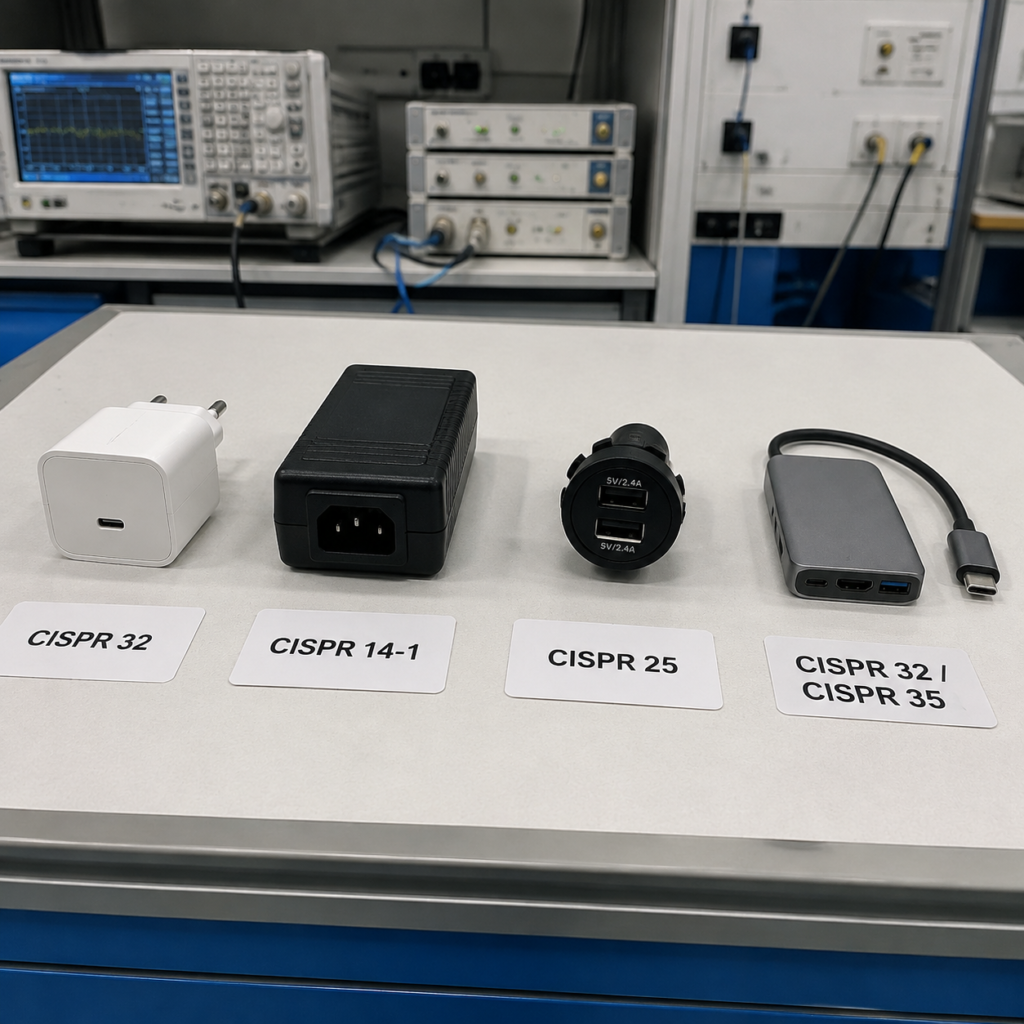
For consumer-grade charging products, the following are the commonly used product family standards, which we have organized into a table for easy comparison:
| Standard Number | Applicable Charging Product Types | Core Regulatory Content |
|---|---|---|
| CISPR 32 | Products that may be involved such as multimedia devices like mobile phones/laptops and their supporting external power supplies, cables, etc. | Electromagnetic disturbance emission of multimedia devices; whether it is applicable shall be confirmed based on the scope of product standards, independent sales methods, product functions, configurations and target market requirements |
| CISPR 35 | Products classified as multimedia and their related configurations | Electromagnetic immunity of multimedia devices |
| CISPR 14-1 | May involve the power supply part evaluated together with household appliances, electric tools or similar appliances | Electromagnetic disturbance emission of household appliances/electric tools |
| CISPR 14-2 | May involve the power supply part evaluated together with household appliances, electric tools or similar appliances | Electromagnetic immunity of household appliances/electric tools |
| CISPR 25 | In-vehicle USB chargers, in-vehicle charging modules | Electromagnetic disturbance emission of vehicles and in-vehicle electronics |
It should be noted that not all power adapters for household appliances can be directly equated with products applicable to CISPR 14-1 or CISPR 14-2. Many adapters are components of appliances or external power supplies, and the final applicable standard shall be determined according to the overall appliance, the independent sales method of the adapter and the requirements of the target market.
There are also two other product family standards that are basically not used by ordinary civilian charging products: one is CISPR 11, which targets electromagnetic disturbance of industrial, scientific and medical equipment, and only special industrial or medical charging equipment may be involved; the other is CISPR 15, which targets electromagnetic disturbance of lighting equipment, and only power supplies for lighting may be used.
Let’s also briefly talk about the version of the standard: CISPR 32 replaces CISPR 13 and CISPR 22 in the field of multimedia devices; other products should select the corresponding standard according to the product family, and the specific adopted version and transition arrangement shall be subject to the official documents of the target market. The colon after the standard number is followed by the year of publication. For example, CISPR 32:2015 is the version published in 2015. If there is an AMD mark, it means amendment. For example, AMD 1 is Amendment No. 1.
Quick Judgment Method for Applicable Standards of Charging Products
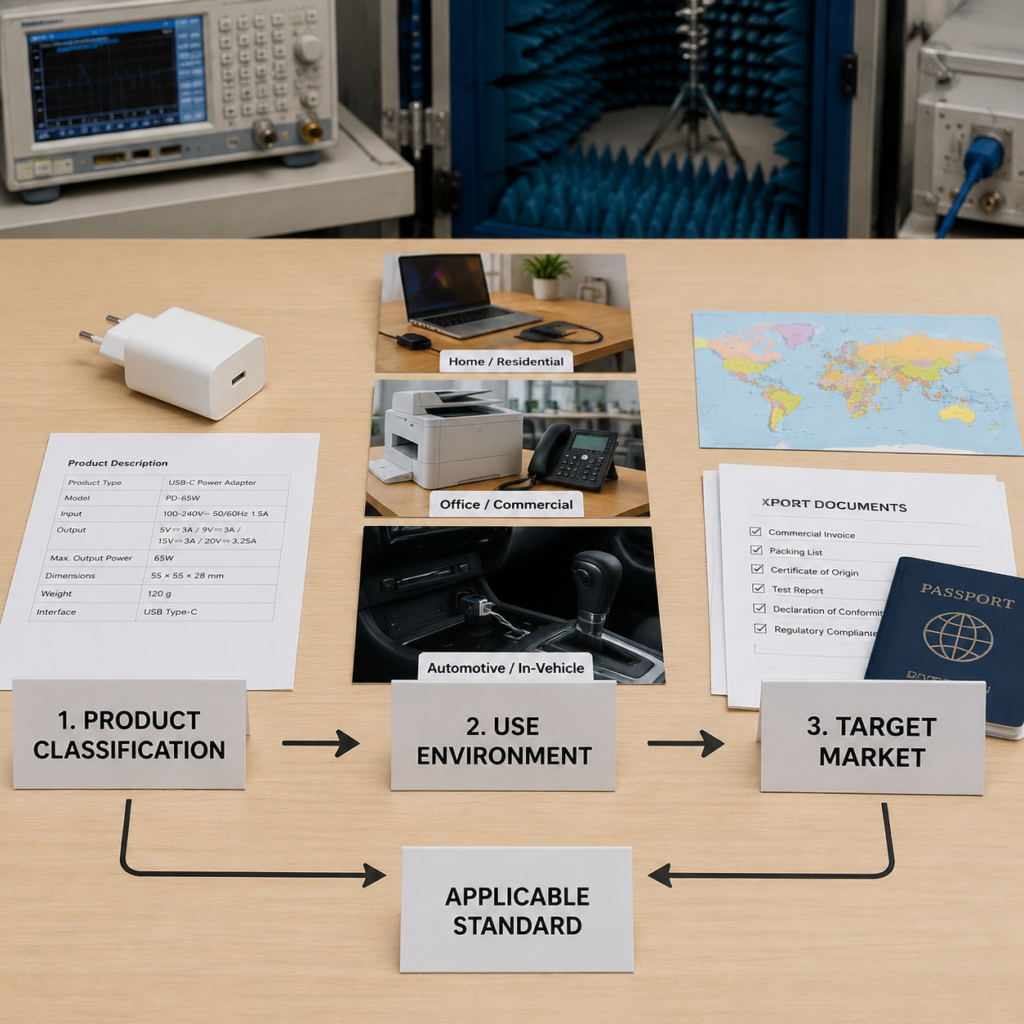
After understanding the core standards, how to quickly judge which CISPR standard a charging product is generally applicable to? You can follow a three-step method:
The first step is to judge based on the product’s function, intended use, ports and product classification. If it is a general-purpose USB power adapter for pure power supply, it should be judged in combination with the type of terminal it is mainly matched with; if it is the original matching power supply for mobile phones and laptops, it usually needs to be evaluated according to the applicable local product standards. Whether its supporting external power supply, charger and cable are included in the same assessment or assessed separately shall be confirmed based on the scope of product standards, supporting sales configurations and target market requirements, and CISPR 32 cannot be directly applied only based on the terminal category.
If it is a power adapter for household appliances, such as the power supply of refrigerators and air purifiers, it may be subject to CISPR 14-1 along with household appliances or similar appliances; but whether an independent external power supply is applicable to this series must be confirmed according to the specific product scope and local adopted standards. If it is an in-vehicle USB charging module, CISPR 25 may apply; if it is a charging product with data, video or expansion functions, such as a USB-C expansion charger with HDMI output, it may involve CISPR 32 and CISPR 35, but it still needs to be confirmed according to the specific product classification and target market requirements.
As for cables, ordinary passive USB/USB-C cables (cables without built-in chips) are usually evaluated as the connection configuration or accessories of the device under test, and do not automatically become independent CISPR 32 tested products just because they have data functions. USB Type-C cables with E-Marker are not equivalent to active signal cables. Whether they need to be evaluated separately or together with the power supply and terminal shall be judged according to applicable standards, interface configurations, sales combinations and target regulations.
The second step is to judge the limit level according to the use environment of the product. Some CISPR product standards use limit classifications such as Class A and Class B. If the product is intended for use in a residential environment, it usually needs to be evaluated according to the Class B requirements of the applicable product standard; products used in commercial, industrial or professional environments may be subject to Class A, and the final shall be subject to specific product standards and target market regulations. If it is a product for in-vehicle environment, the corresponding level of CISPR 25 shall apply, and the Class B level of civilian chargers cannot be applied.
The third step is to match the locally adopted version of the target market. CISPR is an international standard, and all countries will transform it into local standards, which may adjust the version and supplement some differential clauses. Therefore, the pure international version of CISPR standards cannot be directly used for market access, and the version locally adopted by the target market must be used.
We can give several typical examples for reference (note that they are only for reference, and the specific shall be subject to the actual situation): a civilian 20W USB-C mobile phone fast charger may involve local EMC standards related to multimedia devices or external power supplies; a power adapter for civilian refrigerators may be subject to CISPR 14-1 Class B along with the appliance; an in-vehicle USB fast charger may be subject to CISPR 25; a passive USB-C fast charging cable shall be evaluated with related power supplies and terminals according to the product scope, sales configuration and target market requirements.
Core Test Items for Charging Products (Plain Language Version)
Many people find CISPR test items very complicated. In fact, for charging products, the core test items can be divided into three categories, which we will explain in plain language:
The first category is conducted disturbance testing, which measures the electromagnetic interference transmitted by the product outward through wired ports. Simply put, it is to see whether the product will transmit interference to the power grid or other devices through wired lines such as power cords and data cables. Common test ports include AC power ports, DC power ports, and communication/data ports. The core equipment of this test may include LISN, which is the Line Impedance Stabilization Network we mentioned earlier. Its function is to provide a unified standard impedance for the specified power port, so that the results measured by different laboratories can be compared with each other.
Many conducted disturbance tests for AC power ports applicable to CISPR product standards cover 150 kHz to 30 MHz, but the specific frequency bands, ports and test methods must be confirmed according to product standards and the target market version. Whether cables are tested separately also needs to be determined according to the product scope and the configuration of the whole machine. Mains-powered chargers and power adapters usually need to focus on this type of test. If the conducted test fails, the product may interfere with devices such as routers and TVs on the same power strip.
The second category is radiated disturbance testing, which measures the electromagnetic interference emitted by the product into the air, including the radiation of the product itself and the radiation of connecting cables. Simply put, it is to see whether the product will emit electromagnetic waves into the air like a small radio station to interfere with surrounding wireless devices. The common frequency band for radiated testing is above 30 MHz, and the upper limit depends on the highest oscillation frequency of the product, applicable standards and target market requirements. The requirements for antennas, detectors and limits around 1 GHz may be different.
The type, length, shielding and arrangement of connecting cables may significantly affect the radiated disturbance results of the whole machine. Whether to test USB/USB-C cables separately shall be determined according to specific product standards, sales configurations and target market requirements, and conclusions cannot be drawn directly just because they are data cables, long cables or high-current cables. Cables may affect common-mode current and radiation results, and the combination of chargers and cables may also affect the test results of the entire set of products. If the radiated test fails, the product may interfere with wireless devices such as wireless earphones, Bluetooth speakers, and mobile phone WiFi.
The third category is immunity-related testing, which measures whether the product can work normally when subjected to external electromagnetic interference. Only some CISPR standards cover this type of test. Whether to do it specifically shall be subject to the classification of the product, product standards and the requirements of local regulations. Common reference standards include CISPR 35 (for multimedia products), CISPR 14-2 (for household appliances), and the general IEC 61000-4 series. There are many failure criteria for immunity testing, such as charging interruption, repeated renegotiation of charging protocols, device reset, data transmission errors, abnormal flashing of indicator lights, etc. Charging products classified as multimedia, such as USB-C chargers with expansion functions and smart chargers, may need to undergo this type of test, and the specific shall still be subject to applicable standards and regulations.
Interpretation of Test Results and Reports
When you get a CISPR test report, how to judge whether it is valid and reliable? First of all, it must be understood that the applicability of test results depends on test conditions. If conditions change, the coverage of the results may also change. There are three main core conditions that affect test results:
The first is test facilities and environment. Formal compliance measurements shall use the specified artificial networks, auxiliary equipment and sites in accordance with applicable standards, and meet the requirements of the target market for laboratories and reports. For specified power port conducted tests, corresponding LISN or other artificial networks may be required; radiated tests usually need to be carried out in a semi-anechoic chamber, full anechoic chamber or open area test site, which can simulate a standard electromagnetic environment.
In addition, if the measurement distance of the radiated test is different, the readings are not directly comparable. For example, the results measured at a distance of 3 meters and those measured at 10 meters cannot be directly compared. Ordinary indoor measurements can generally only be used for engineering pre-assessment, and cannot of course replace formal compliance evidence. Whether the report can be used for market access also depends on target regulations, test methods, laboratory qualifications and conformity assessment procedures.
The second is the working state of the product. The standard requires that the test must be carried out in the “most unfavorable working mode”, that is, the mode with the largest electromagnetic interference of the product, which is usually the maximum load, but not equivalent to the maximum power – some products have stronger interference when working at medium load or with specific protocols. For multi-port chargers, harsh working conditions such as simultaneous operation of multiple ports and combinations of different protocols should also be considered; if testing a data cable, it must be matched with the corresponding terminal and run in the mode of maximum current or highest rate. Common pitfall: Many merchants use test results under no-load or low-load conditions to pretend to be qualified. Such results cannot fully represent the performance of the product under normal sales configurations and typical use conditions.
The third is the test configuration. The hardware, firmware, and supporting accessories of the tested product must be consistent with the actually sold configuration or have a clear coverage relationship, especially cables – the length, shielding structure, and arrangement of cables will directly affect the results of radiated tests. After changes in product configuration, power, hardware or firmware, the scope of application of the original report must be confirmed, and difference analysis or supplementary tests shall be carried out if necessary; it cannot be simply assumed that the original report automatically covers all changed products.
In addition to test conditions, the limit level in the report must also be confirmed. It must be clearly marked whether it is Class A or Class B, and the level must match the actual use environment of the product. If the product is intended for use in a residential environment but uses an inapplicable Class A limit, the conformity conclusion may not be valid; whether it constitutes false advertising also needs to be determined in accordance with local laws.
So how should a basic CISPR test report be read? You can follow these steps: first check the basic information, including product model, software and hardware versions, test standard number plus version, and limit level; then check the test conditions to confirm that the test facilities, product working mode and test configuration meet the requirements of target regulations and applicable standards; next check the test items. For example, wall-mounted chargers usually need to focus on conducted and radiated tests. If it is a product with multimedia functions, it is also necessary to confirm whether the corresponding immunity test is required; then check the detection method. Different frequency bands and standards will require different detection methods. Common ones are quasi-peak (QP), average (AV), and peak (Peak). The specific combination shall be confirmed according to applicable product standards; finally, you can look at the margin, that is, the gap between the measured value and the limit, in dB. The larger the gap, the more conducive it is usually to cope with consistency changes during mass production. The common empirical value in the industry is 3~6dB, but this is not a mandatory requirement, but only a reference for internal quality control of enterprises. Key reminder: “Pass” in the report only means passing under the specified test conditions, configuration and scope of application. After changing conditions or product configuration, the coverage relationship needs to be reconfirmed.
There are several situations where test reports need to be treated with caution, and you can pay attention to them: the first is that the specific CISPR standard number and version are not marked, and only a general statement of compliance with CISPR is made; the second is that the limit level is not marked, or the level does not match the actual use environment of the product; the third is that the test load or working mode does not reach the most unfavorable working condition, or the tested product configuration is inconsistent with the actually sold one; the fourth is that products of the same series with different powers and different hardware versions directly share the same report, but there is no difference analysis, representativeness demonstration or supplementary test; the fifth is that the test facilities or laboratory conditions do not meet the requirements of the target market for formal compliance evidence. Whether a laboratory must have specific qualifications and whether the report can be used for market access shall be judged in accordance with the target market regulations and conformity assessment system.
If you want to do a formal CISPR test, you need to prepare several types of materials in advance: first, basic product information, including model, software and hardware versions, intended use, target market; then standard information, that is, the initially confirmed applicable product standard and version, limit level; there is also configuration information, such as port type, cable specifications, list of supporting accessories; materials related to test conditions are also indispensable, such as load matrix, description of the most unfavorable working mode; finally, record documents during the test, including layout drawings, detector type, measurement uncertainty, rectification records, mass production consistency verification records, etc.
Correspondence of Market Access in Global Regions
Many friends who do cross-border e-commerce or export products will ask: if you have a CISPR test report, can it be used globally? The answer is no. CISPR is only an international reference standard. All countries will transform it into local mandatory requirements, and may adjust the version and supplement differential clauses. Therefore, pure CISPR test reports cannot be used globally. The specific applicable version shall be subject to the official harmonized standard list and regulatory requirements of the target market.
We have sorted out the EMC standard adoption systems for charging products in several mainstream markets for your reference:
The EU transforms CISPR into the EN 550xx series of standards. For example, EN 55032 corresponds to CISPR 32. It may be used as one of the technical bases for EMC requirements in CE conformity assessment, but the complete EMC conformity of chargers still needs to confirm emission, immunity and other related requirements according to product classification and applicable regulations.
For the UK, the target product regulations and the designated standards published by the UK government should be checked. BS EN standards can support the corresponding conformity path only when they are applicable and designated or recognized by regulations. The UK currently continues to allow the use of the CE mark for some products, and UKCA is not the only access path for all related products in all periods.
The RCM requirements of Australia and New Zealand also need to be confirmed in combination with local applicable regulations, EMC standards, supplier declarations and registration procedures. It cannot be simply understood that RCM certification is completed as long as the AS/NZS CISPR series of standards are adopted. The US FCC Part 15 is its own rule. Although it partially references the content of CISPR, it has its own requirements. It is necessary to select the corresponding authorization method according to the equipment category and comply separately. China uses a local standard and regulation system including the GB/T series. GB/T 9254.1 can be used as the basis for the assessment of disturbance emission of some multimedia devices, but it cannot be used to summarize all the requirements of the Chinese market.
Let’s give several common reference examples for charging products going overseas: USB-C fast chargers and charging cables with data function exported to the EU may involve EN 55032, but this is only one of the standards that may be involved; it is also necessary to confirm the complete emission, immunity and other safety and energy efficiency requirements according to product classification and applicable regulations. Power adapters for household appliances exported to the EU may involve EN 55014-1 Class B, but whether this series is applicable still needs to be judged in combination with specific appliances and sales methods; in-vehicle chargers exported to major global markets need to comply with the in-vehicle electronic EMC standards of the corresponding regions.
Of course, cross-market reports are not completely unusable. Whether they can be accepted depends on the target market’s regulations, certification systems, laboratory qualifications, mutual recognition arrangements and test items. If the laboratory has the corresponding qualifications and the test items also meet the requirements of the target market, overseas test reports may also be accepted. But remember, pure CISPR reports cannot be used directly as certification, and must match local regulations and certification processes.
Entry-level Pitfall Avoidance and Phenomenon Observation
For entry-level learners, whether they are buying charging products or communicating with suppliers, they can use the following points to quickly check the publicity risks related to CISPR:
- Claims to have “CISPR certification” → If the non-existent official “CISPR certification” is promoted as a global market access certificate, you should be vigilant and verify the nature of the certificate, the certification body and local regulations
- No specific standard number + version + limit level → Unreliable, just saying compliance with CISPR is equivalent to saying nothing
- Incomplete test items → Unreliable. For example, wall-mounted chargers usually need to focus on conducted and radiated tests, and those with multimedia functions also need to confirm whether corresponding immunity is required
- No test conditions specified → Unreliable. It should be confirmed whether the test environment, working mode, configuration and sold products are consistent
- Mismatched level → If the product is intended for use in a residential environment but uses an inapplicable Class A limit, its conformity conclusion may not be valid; whether it constitutes false advertising needs to be determined in accordance with local laws
If you are an ordinary user, you can also initially observe the electromagnetic interference of the product through some simple phenomena, but note that these observations are only for reference and cannot prove that the product does not meet CISPR standards, because interference may be caused by other reasons. For example, you can try plugging the charger into a power strip next to the WiFi router, let the charger work at full load, and see if the WiFi has obvious speed drop or disconnection; or when charging the device with a fast charging cable, bring the cable close to wireless earphones or Bluetooth speakers and listen for noise. Here we also remind everyone not to disassemble the machine or modify the mains power for testing, and do not plug and unplug repeatedly under unsafe conditions to avoid danger.
Finally, let’s give you a few EMC pitfall avoidance reminders for charging cables: First, the shielding, length, structure and arrangement of cables may affect the EMC performance of the entire set of products, and the results cannot be judged only based on the label of “long cable” or “no-name cable”; second, after replacing non-original cables, the original charger test report may not automatically cover the new combination. The scope of application of the report should be confirmed, and difference analysis or supplementary tests should be carried out if necessary; third, USB Type-C cables with E-Marker are not equivalent to “active cables” with active signal conditioning or active transmission functions. The combined impact of it with power supplies, terminals and other cable configurations should be evaluated according to applicable standards, interface configurations, sales combinations and target regulations, and CISPR compliance cannot be claimed solely based on the E-Marker or the title of “active cable”.
Learning Summary
In general, CISPR is one of the core technical reference systems in the global electromagnetic compatibility field, especially for charging consumer electronic products. It is not only an important reference for product quality, but also a basic technical basis in some market access requirements.
For entry-level learners, as long as they can distinguish the positioning and jurisdiction of CISPR, not confuse it with EMC and conformity marks, can initially judge the applicable standards according to the logic of “product classification → use environment → target market”, understand basic test reports, and avoid common publicity and report risks, they can already meet the basic needs of most daily purchases and small-batch overseas sales. If you want to do formal product compliance, it is still recommended to consult a professional compliance agency in the target market to confirm in combination with specific products and regulatory requirements to avoid pitfalls.