
Have you ever encountered these situations: when you plug a fast charger into the socket next to your router, the originally smooth WiFi suddenly slows down; when you listen to music with Bluetooth headphones while charging, the sound cuts in and out; even when you turn on the radio, static appears as soon as you plug in the charger. Many people’s first reaction is that the network is bad or the headphones are broken, but in fact, the culprit may be the charger itself — the electromagnetic noise it leaks during operation interferes with surrounding wireless devices.
In the US market, there is a clear set of mandatory rules for the control of such electromagnetic interference, which is what we will cover today: FCC Part 15. FCC Part 15 is a rule of the US Federal Communications Commission regarding the use of radio frequency equipment, unintentional emissions, and intentional emissions, with a focus on limiting harmful radio frequency interference. It is not equivalent to the complete EMC immunity test system in the EU sense, and is closely related to products we use daily such as chargers, charging cables, and wireless chargers.
Basic Introduction: What is FCC Part 15, and What Does It Have to Do with Charging Products?
Let’s start with the most basic question: what exactly is FCC Part 15?
It is a mandatory rule formulated by the US Federal Communications Commission (FCC), whose core goal is to limit the electromagnetic waves leaked by electronic equipment during operation, and protect legitimate radio services such as broadcasting, WiFi, and Bluetooth from interference. It should be noted that it is a mandatory access requirement for the US market, not an optional certification. As long as relevant equipment is sold or used in the US, it must comply.
Some people may wonder: isn’t a charger just something that converts mains electricity to low-voltage electricity? How can it be related to electromagnetic interference?
This is because most chargers today use a switching power supply structure, which generates high-frequency electromagnetic noise during operation. This noise is transmitted along power cords and charging cables, and also leaks into the air through gaps in the casing and interfaces. Inferior chargers cut out filtering and shielding structures to save costs, and the leaked noise will be large enough to interfere with surrounding wireless devices.
Regarding FCC Part 15, there are three most common beginner misunderstandings that need to be corrected first:
The first misunderstanding is “Only chargers with wireless functions need to comply.” This is actually wrong. Even a pure wired switching power supply charger will leak electromagnetic noise during operation, and is also within the scope of control.
The second misunderstanding is “It is a safety certification.” Wrong. FCC Part 15 only regulates electromagnetic interference, and does not involve electrical safety at all — such as electric shock risk, fire risk, sufficient insulation, etc. These are not under its jurisdiction; that is the matter of safety certification.
The third misunderstanding is “It is globally applicable.” No, this set of rules is only mandatory in the US. The EU’s CE, the UK’s UKCA, and Canada’s ICES are all independent rules and cannot replace each other.
Applicable Boundaries: Which Charging Products Need to Comply, and Which Do Not
After clarifying the basic concepts, what everyone is most concerned about must be: among the charging products at hand, which need to comply with FCC Part 15? Which do not?
First, let’s talk about charging products that need to comply, which are mainly divided into three categories:
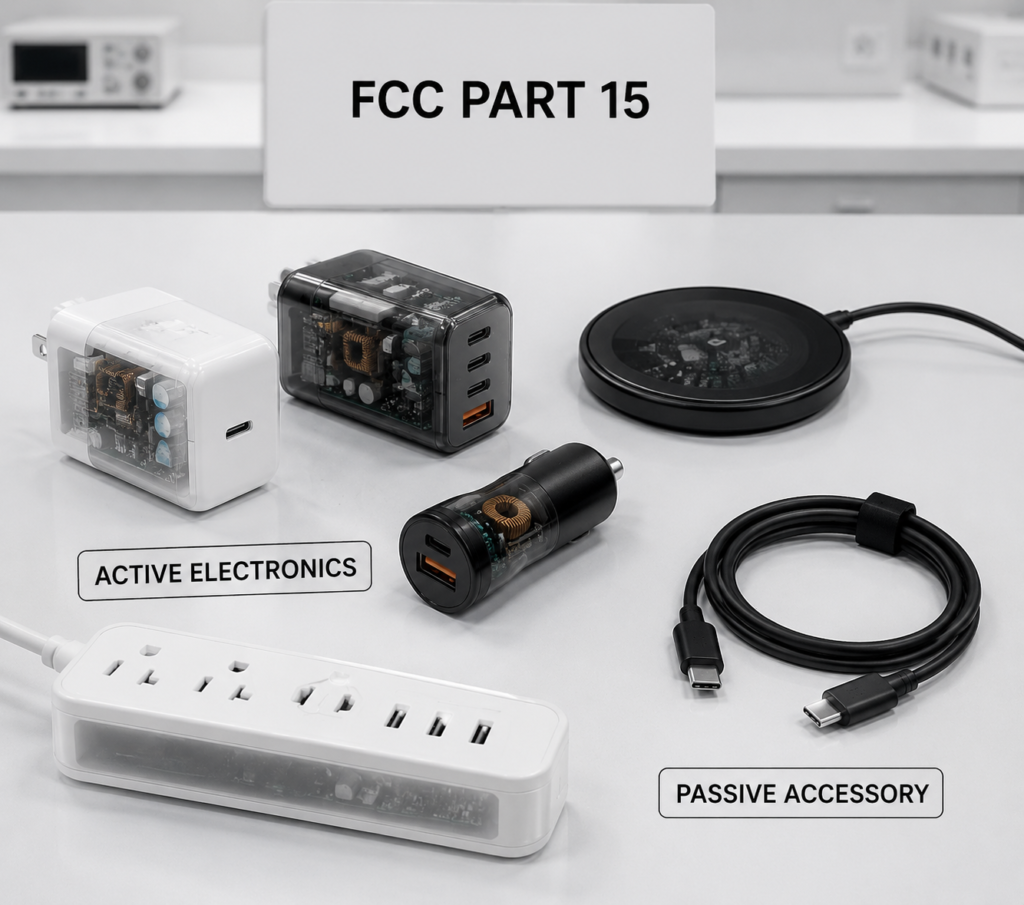
The first category is active charging equipment, that is, the most common mobile phone chargers, USB-C adapters, wireless chargers, car chargers, power strips with USB ports. These with built-in switching power supplies or active circuits all need to comply.
The second category is accessories with active circuits, such as USB-C fast charging cables with E-Marker chips, charging adapters with indicator lights or protocol chips. Such accessories should be evaluated according to their circuit functions and applicable Part 15 clauses, and it cannot be directly concluded that they must obtain FCC authorization solely because they “have a chip”. When used in combination with a charger, they may still affect the overall emission results.
The third category is related products with charging functions, such as charging docks, docking stations with charging functions, power banks with wireless charging. As long as they have a charging function, they are included in the control scope.
Are there any accessories that do not need to comply separately? Yes, mainly completely passive products: for example, ordinary charging cables without chips, LEDs, or any active electronic components, and adapters with pure mechanical structures (such as USB-C to Micro USB adapters without chips).
However, a special reminder here: not needing to comply separately does not mean it has nothing to do with it at all. These accessories do not need to be certified separately, but when tested together with the charger, they will directly affect the overall compliance result. For example, using an inferior unshielded charging cable may draw out the noise inside the charger, causing the combined test of the charger and cable to fail.
How to quickly judge whether a charging product needs to comply with FCC Part 15? Actually, two steps are enough:
Step 1: Check if it has an active circuit — as long as it has a switching power supply, chip, or wireless module, it needs to undergo compliance assessment combined with its functions and applicable clauses.
Step 2: Check if it is sold or used in the US market — if yes, it must comply.
Some people may ask, will very low-power products be exempted? There are indeed products exempted for very low power, but the number is very small. The modern charging products we usually contact, such as mobile phone chargers and fast chargers, basically do not meet the exemption conditions.
Product Classification: The Strictness of Requirements Varies for Different Products
It should be noted that FCC Part 15 does not divide all products into two dimensions uniformly according to “emission nature + usage scenario”. For applicable digital devices or unintentional radiators, it is necessary to select Class A or Class B limits according to the expected use environment; intentional transmitters also need to undergo certification and emission testing according to specific frequency bands and applicable Part 15 clauses.
First, check whether the product belongs to unintentional emission or intentional emission.
The first type is unintentional emission, which accounts for the vast majority of charging products. Simply put, the product itself does not actively transmit radio signals, but accidentally leaks some noise during operation, and the corresponding rule is Part 15 Subpart B. Ordinary wired chargers, fast chargers, and multi-port adapters without wireless functions that we usually use all belong to this category.
The second type is intentional emission, that is, the product has a built-in wireless transmission function and will actively send out radio signals. Such products usually need to meet the requirements of Part 15 Subpart C and other requirements according to specific wireless functions, operating frequency bands and corresponding rules, in addition to evaluating the unintentional emission requirements. For example, smart chargers with Bluetooth or WiFi, and power banks with wireless charging and Bluetooth functions, all need to evaluate their wireless transmission part and host circuit separately.
There is a point that is easy to get wrong: wireless charging products cannot be directly classified as intentional emission. The specific classification depends on its operating frequency and circuit design. It is not that as long as it has the word “wireless” it is considered intentional emission, so don’t confuse it. Some wireless power transmission products may also involve Part 18 or other specific rules.
For digital devices or unintentional radiators applicable to Class A or Class B limits, the use environment will affect the selection of limits.
Class B is household/consumer grade, with stricter limits, applicable to equipment that is designed or reasonably expected to be used in a residential environment.
Class A is commercial/industrial grade, with relatively loose limits, usually applicable to equipment designed for commercial, industrial or business environments and not suitable for residential environments. Class B equipment can also be used in commercial environments, so it cannot be judged only by the sales target.
How to judge quickly? If the equipment is designed or reasonably expected to be used in a residential environment, it should usually be evaluated according to Class B; only equipment intended for commercial, industrial or business environments and not suitable for residential use may be applicable to Class A. The final judgment should also be combined with product design, instructions and marketing purposes.
If you are given a charging product, you can make a preliminary judgment according to the following ideas:
Step 1: Check if there is an active wireless transmission function — such as Bluetooth, WiFi, built-in communication module. If yes, it should be evaluated according to the specific rules of intentional transmitters; if not, it usually belongs to unintentional emission equipment or digital equipment.
Step 2: If the product is applicable to Class A/Class B classification, then check the expected use environment — residential use usually corresponds to Class B, and only equipment for pure commercial, industrial or business use and not suitable for residential use may be applicable to Class A.
If it is a multi-functional product, it is necessary to evaluate the rules involved in each function separately, and cannot simply use “intentional emission Class B” to summarize all requirements.
Core Requirements: What Conditions Must Be Met to Be Qualified
After classification, let’s look at what specific requirements must be met to be qualified. The core is two types of emission limit requirements, plus a set of basic coexistence principles.
First, let’s talk about conducted emission requirements, that is, electromagnetic noise propagated through specified ports and cables.
The requirement is very straightforward: electromagnetic noise must not exceed the limits of the corresponding standard. For charging products, conducted noise mainly comes from two places: one is the high-frequency noise of the switching power supply itself, and the other is the noise generated during USB-C interface protocol communication.
For applicable equipment, FCC AC power supply conducted emission is usually in the range of 150kHz to 30MHz, tested using a specified Line Impedance Stabilization Network (LISN). You can think of LISN as a “unified ruler”, used to stabilize the impedance of the power cord during testing, so that the result will not be inaccurate due to changing the cord or socket.
USB output cables or other DC cables should not be generally equated with FCC AC power supply conducted testing. Whether they require additional testing should be judged according to the equipment category, port nature and applicable test methods.
Next, let’s talk about radiated emission requirements, that is, electromagnetic waves scattered into the air.
The requirement for radiated emission is the same: electromagnetic waves scattered into the air must not exceed the corresponding limits. There are three main sources of radiated noise from charging products: high-frequency harmonics of the switching power supply, the charging cable drawing out noise like an antenna, and leakage due to poor casing shielding.
Class B radiated emission usually covers 30MHz to 1GHz, using quasi-peak detection in applicable frequency bands; above 1GHz, corresponding detection methods such as peak and average should be used according to FCC regulations. The test distance and frequency band should be determined according to specific clauses and test methods, and not all frequency bands and all equipment absolutely use a 3-meter distance uniformly. The limits for different frequency bands are also different, and the specific ones shall be subject to the applicable FCC rules.
In addition to emission limits, there is also a set of most basic coexistence rules, that is, the basic principles of Part 15.5, a total of two:
First, the equipment must not cause harmful interference.
Second, the equipment must accept received interference, including interference that may cause unintended operation. Part 15.5 does not take “automatic recovery to normal after interference disappears” as a compliance judgment condition.
It should be noted here that FCC Part 15 usually does not have a set of generally mandatory immunity test requirements like the EU CE complete EMC system, which is different from the EU CE complete EMC requirements. The core mandatory requirements of FCC Part 15 are mainly concentrated on emission restrictions, and at the same time, the principled provisions on interference must be complied with.
For charging products, there are several special factors that directly affect the interference level, which should be paid special attention to whether buying products or doing testing:
The first is fast charging mode. During PD negotiation and voltage switching, the interference may be higher than during normal charging.
The second is multi-port output. When multiple ports are fully loaded at the same time, the interference may be stronger than when using a single port, but full load is not necessarily the worst working condition for all products.
The third is the charging cable. Inferior cables without a shielding layer may draw out the noise inside the charger and amplify radiated interference.
The fourth is the casing and interface. The shielding performance of plastic casings is usually worse than that of metal casings, and poor grounding of the USB-C interface may also increase noise leakage.
Compliance Paths and Labeling: How to Prove That a Product Meets the Requirements
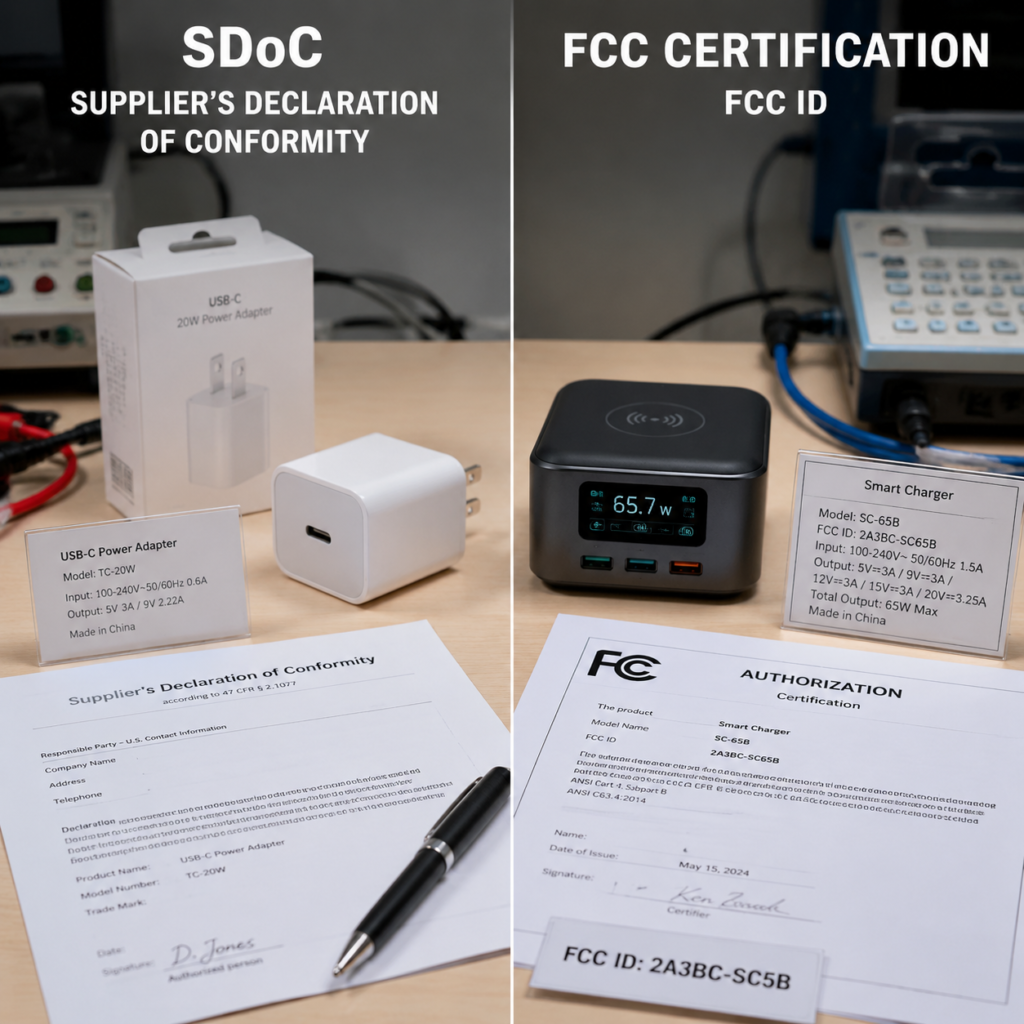
Then how does a product prove that it complies with FCC Part 15? Common equipment authorization paths include Supplier’s Declaration of Conformity (SDoC) and Certification, but the specific method should be confirmed according to the equipment category and applicable clauses. For easy comparison, I have sorted out the core differences between the two paths into a table:
| Comparison Item | Supplier’s Declaration of Conformity (SDoC) | FCC Certification (Certification / FCC ID) |
|---|---|---|
| Applicable Products | Applicable to equipment for which SDoC is allowed under the rules, such as many unintentional emission digital devices | Most intentional transmitters that require certification, such as some charging products with Bluetooth/WiFi |
| Approval Method | The manufacturer tests by itself or entrusts a laboratory, declares compliance on its own, and does not require prior FCC approval | The application materials are reviewed and approved by a FCC-recognized Telecommunication Certification Body (TCB) in accordance with applicable rules |
| Core Requirements | Complete test reports must be retained, and compliance declarations and US responsible party information must be provided as required | The product uses the corresponding FCC ID, and the authorization information can be queried in the FCC database |
| Labeling Features | Provide Part 15 compliance statement and relevant responsible party information according to the rules | Usually marked or provided with an alphanumeric FCC ID in a prescribed manner |
These labels and compliance information can generally be placed on the equipment, packaging, instructions or accompanying materials according to FCC rules. Most chargers have them on the bottom or packaging, charging cables mostly have them at the connectors, and wireless chargers generally have them on the bottom of the body, but the specific location and presentation method shall be subject to applicable rules.
Regarding compliance paths, there are three common mistakes to avoid:
First, SDoC replaces the old DoC procedure; Verification has not been fully replaced by SDoC, and may still apply to some equipment listed in FCC rules. Don’t simply say that Verification has been cancelled by SDoC.
Second, the FCC ID of a wireless module is not equal to the compliance of the whole machine. For example, for a charging head with Bluetooth, even if the Bluetooth module inside has passed FCC ID, the power supply part of the whole machine still needs to meet the unintentional emission requirements, and cannot rely solely on module certification.
Third, products with similar appearance in the same series cannot share compliance reports. As long as the internal circuit, power, or number of ports changes, compliance must be re-evaluated, and you cannot use the same report just because they look the same.
Testing Common Sense: What Kind of Test Results Are Valid
Some people may wonder: how are these tests done? What kind of results are valid? How to judge whether they are qualified?
First of all, there are three core premises for valid test results:
First, representative or evaluated cables, power supplies and port configurations with the worst emissions should be used, and the configurations should be recorded in the report. After replacing the cable, its impact on emissions should be re-evaluated, but the results obtained using third-party cables are not necessarily invalid.
Second, according to product functions and pre-scan results, representative modes that may produce the maximum emissions during normal use should be selected, and if necessary, cover different output powers, port combinations and fast charging protocol states. Full power output, simultaneous full load of multiple ports, and fast charging mode enabled may all be working conditions that need to be evaluated, but full load is not necessarily the worst working condition for all products.
Third, formal testing should be carried out in a test site that meets FCC site validation and measurement requirements, such as a qualified open area test site or semi-anechoic chamber, and control background noise, site effects and measurement uncertainty. Different test items can use different types of qualified facilities, and it cannot be simply understood that a certain type of semi-anechoic chamber must be used.
Then how to judge whether the test result is qualified? There are several key points:
First, all mandatory test items shall be judged in accordance with the corresponding FCC clauses under applicable frequency bands, bandwidths, detection methods, distances and port configurations. Only when all applicable items meet the corresponding limits and measurement requirements can the overall compliance be determined. Different emission types may not necessarily apply Class A or Class B limits.
Second, if the test value is close to the limit, for example, only 1-2dB short, you should pay attention — the test itself has errors, and there are also component tolerances during mass production, so it is easy to exceed the standard in mass production.
Third, passing with a single port and no load does not mean that it can pass with multiple ports fully loaded and loaded.
Fourth, the test report is only valid for the listed samples, configurations (such as what charging cable is used, how many ports there are) and working conditions. As long as they change, it is necessary to re-evaluate whether the result is still applicable.
There are three main categories of common reasons for exceeding standards in charging products:
Conducted exceeding standards are mostly because manufacturers omit the input filter circuit and common mode inductor, and the switching power supply design is too inferior.
Common reasons for radiated exceeding standards are poor grounding of the USB-C interface, no shielding structure on the casing, and no shielding layer on the charging cable.
There is another category related to working conditions, such as peak noise during fast charging voltage switching and superimposed noise when multiple ports are fully loaded, which are likely to cause exceeding standards.
There are also several test concepts that are easy to confuse, which need to be clarified:
First, FCC Part 15 testing is not equal to electrical safety testing — as we said before, it does not care about safety issues such as electric shock and fire, and the testing here does not involve indicators such as withstand voltage, insulation, and overheating at all.
Second, radiated emission testing is not equal to wireless signal strength testing — it measures the useless noise leaked out, not the useful wireless signal sent by the product itself.
Third, conducted emission testing is not equal to output ripple testing — it measures the noise transmitted from applicable ports or lines, not the fluctuation of output voltage.
Practical Guide: How to Check Compliance and What Pitfalls to Avoid
After talking about so much technical content, for ordinary users or purchasers, the most practical thing is how to judge whether a product is compliant and what pitfalls to avoid.
First, let’s talk about the actual impact of non-compliance:
For ordinary users, the mild impact is slower WiFi, disconnection of Bluetooth headphones, and static in the radio; moderate impact may interfere with nearby smart devices, and even cause frequent charging disconnections.
For merchants or purchasers, non-compliant products may face FCC enforcement measures, such as prohibition of sale, requirement to stop marketing, revocation of authorization, fines, or entry restrictions in cooperation with customs. E-commerce platform delisting and recall depend on the specific case and the decisions of the platform or regulatory agency.
Here is another reminder: damaging charged equipment, catching fire, etc. are safety issues, not within the scope of FCC Part 15 control, so don’t confuse them.
Then how to initially judge whether a product is compliant? The simplest way is to look at the product label:
For intentional transmitters that require Certification, their FCC authorization should be confirmed through product labels, electronic labels, instructions or module authorization information. It cannot be judged solely by whether the FCC ID is directly printed on the casing, and the authorization conditions of the whole machine or module still need to be checked.
Ordinary wired chargers, when within the scope of SDoC, must provide the prescribed compliance statement and responsible party information in accordance with FCC rules. The specific carrier can be the equipment, packaging, instructions or accompanying materials. Compliance cannot be judged solely by whether the text is printed on the product body, and printing only an FCC logo does not prove compliance.
If the product only has marks such as CE and RoHS printed on it, it also cannot prove compliance with FCC requirements, because those are certifications from other regions or other categories.
If it is a product with wireless functions, you can also go to the official to verify the authorization information:
The operation is very simple: log in to the FCC’s official OET certification database, enter the FCC ID number on the product, or query according to the module authorization information.
When checking, pay attention: the product model, photo, and function found must be consistent with the actual product; if the product uses a certified module, you also need to check the authorization conditions, labeling method and installation configuration of the whole machine using the module.
If it cannot be found, or the model and function do not match, you need to be alert to problems such as number fraud, improper authorization use, or fake certification.
There are four common fraud routines on the market, which you should pay attention to when buying:
The first is number fraud, that is, using the FCC ID of other products to impersonate, and when you check on the official website, the model does not match the actual product.
The second is downgraded configuration testing: using good shielded cables during testing, and selling with unshielded inferior accessories, so the interference exceeds the standard in actual use.
The third is grade confusion: selling Class A commercial products as Class B household products, and the limits simply cannot meet household requirements.
The fourth is module passing as whole machine: only claiming that the wireless module inside has passed certification, and the whole machine has not done compliance testing at all.
Boundaries and Advanced: Special Situations and Common Misunderstandings
There are also some special situations and advanced misunderstandings that many people easily confuse, so let’s clarify them uniformly here.
First, let’s talk about the judgment rules for multi-functional charging products:
As long as it has a charging function, the entire product needs to undergo compliance evaluation combined with all its functions, not just testing the charging part.
For example, a product with wireless charging and Bluetooth speaker needs to evaluate the intentional emission of Bluetooth, the unintentional emission of the host digital circuit, and the rules that may apply to the wireless power transmission part separately; it cannot be simply summarized as “according to intentional emission Class B”.
If it is a charging cable with data transmission, it is also necessary to evaluate the emission requirements according to its circuit functions and applicable rules to avoid interfering with data transmission.
Then let’s talk about the clear boundaries with other certifications, don’t confuse them:
It is not an electrical safety certification such as UL or ETL — as we mentioned before, it does not care about safety, and the specific safety performance depends on the corresponding safety certification separately.
It is not a USB-IF certification, and is not responsible for verifying PD protocol compatibility or fast charging performance. USB-IF certification is an independent industry compatibility and labeling program, and whether it is required depends on product use, brand authorization and market requirements.
It is not an energy efficiency certification, and does not care about standby power consumption or charging efficiency. The US Department of Energy (DOE) has separate energy efficiency requirements.
It is also not globally applicable — as we mentioned before, it is only mandatory in the US. The EU requires CE-EMC/RED, Canada requires ICES, and the rules of each region cannot replace each other.
Finally, there are several common advanced misunderstandings to avoid:
First, low-power chargers automatically meet the requirements? Wrong, no matter how small the power is, if the filter circuit is omitted, it may still exceed the standard.
Second, is it compliant if it has an FCC logo? Wrong, the FCC logo is not mandatory. The core is the test report and compliance path. Just pasting a logo proves nothing.
Third, is it okay if the charging cable has passed FCC separately? Wrong, the charging cable needs to be evaluated combined with its own functions and actual use configuration, and also needs to be evaluated with the charger for its impact on the overall emission results. Separate testing cannot automatically prove the compliance of the combined product.
Fourth, do you not need to worry about it after the product is launched? Wrong, if you change the chip, change the cable, or modify the casing, you have to re-evaluate the compliance, it cannot be done once and for all.
Summary
So far, the content of FCC Part 15 related to charging products has been almost covered. After learning these, you can at least handle these judgments:
Entry-level basic judgment, which is also the most core content: you can distinguish which charging products and accessories need to comply with FCC Part 15, and which need to be evaluated according to specific functions and clauses; you can distinguish between unintentional emission and intentional emission, and also understand that Class A and Class B mainly depend on the expected use environment of applicable equipment; you can also understand the FCC labels and authorization information of charging products, and know that wireless transmitters requiring Certification should be able to verify the corresponding authorization.
Advanced pit avoidance and decision-making: you can verify the authenticity of certification of intentional emission charging products through the FCC official website; you can identify four common compliance fraud routines and avoid inferior charging products; you can judge which functions of multi-functional charging products need to be evaluated separately; you can also distinguish the boundaries between FCC and other certifications such as safety, USB, and energy efficiency.
In the future, when buying charging products, or doing business in charging products for the US market, you will not be confused by various certification statements.