
Many sellers of charging products who are just entering the European market are most prone to making mistakes in compliance: some think that affixing a CE mark is enough to clear customs, only to have their goods detained by customs upon arrival at the port; some listen to service providers say that everything needs to be done, and spend tens of thousands of yuan in wasted money; others only find out after selling for half a year that they need to register for EPR, and their products are directly removed from the platform. In fact, although European compliance requirements seem scattered, as long as you sort out the framework and match them according to product attributes, you can ensure neither omission nor waste.
We will start with the most basic entry-level common sense to help you build an overall cognitive framework for European compliance.
First Grasp 5 Entry-level Common Knowledge Points to Avoid Half the Detours
Is your product within the basic coverage scope?
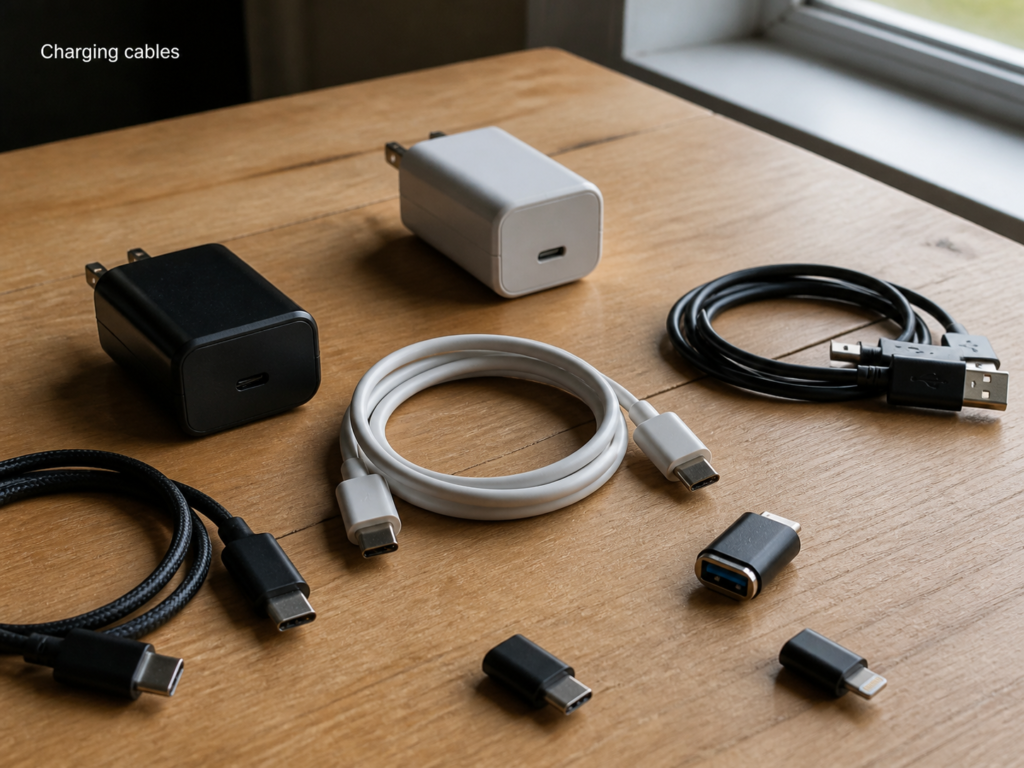
Charging cables, USB-C cables, data cables, chargers, power adapters, and interface connectors that we commonly deal with are the core coverage objects of this checklist. However, note that two types of products are not included in the basic checklist: power banks with built-in batteries, and charging products exclusively for children. These two categories need to additionally comply with special battery-related and children’s product-related compliance requirements, and cannot directly apply the checklist for ordinary charging products.
The European market is not a unified regulatory area
Many people think “Europe = the European Union”, but in fact, European regulation is layered:
• The 27 EU member states, plus Norway, Iceland, and Liechtenstein in the European Economic Area (EEA), usually adopt the CE compliance framework for products covered by EU harmonized regulations. However, CE does not replace the language, plug, EPR, packaging, and other national obligations of the country of sale; when entering the EEA, it is also necessary to verify whether the corresponding EU regulations have been incorporated into local rules.
• The United Kingdom has left the EU, and there are two sets of rules for Great Britain (GB, i.e., England, Scotland, Wales) and Northern Ireland (NI), so the UK cannot be directly treated as an EU market.
• Switzerland and other niche European countries have their own independent regulatory rules, which need to be verified separately, and CE cannot be assumed to apply by default.
In addition, there are some common differences among countries: for example, product manuals must be translated into the local official language, plugs must meet local standards (e.g., Type F in Germany, Type G in the UK), and recycling registration requirements also vary.
Compliance requirements are divided into four categories, stop calling them all “CE certification”
Many novices call all compliance “CE certification”, but in fact, European compliance requirements can be clearly divided into four categories with completely different boundaries:
1. **CE-type mandatory compliance**: This is the core access requirement for the EU market. After meeting the requirements, the CE mark can be affixed, and it is covered by EU harmonized regulations.
2. **Non-CE mandatory obligations**: These requirements are also mandatory to fulfill, but do not correspond to the CE mark, such as chemical control and general safety requirements.
3. **Country-by-country EPR registration**: EPR stands for Extended Producer Responsibility. Simply put, relevant producers bear the responsibility for recycling and treatment. For whichever country you want to sell in, you need to judge whether to register and who will register according to that country’s rules, which is a completely separate matter from product certification.
4. **Voluntary value-added certification**: Not a mandatory requirement, but may help with retailer access, brand trust, or compatibility proof. It cannot replace legal obligations, nor does it guarantee a reduction in the probability of official random inspections.
You can think of it as opening a physical store: CE-type compliance is the business license, which must be publicly displayed; non-CE mandatory obligations are fire protection and hygiene inspections, which do not need to be posted but must meet standards; EPR is the waste disposal fee collected separately by each city, which has nothing to do with the business license; voluntary certification is the “Integrity Merchant” sign, which can help you attract more customers.
Why are charging products a regulatory focus? What are the consequences of non-compliance?
Charging products are directly connected to the mains power supply. If their quality is substandard, they can easily cause safety accidents such as electric shock and fire. Coupled with the frequent counterfeiting of CE marks on the market, they have always been a key category of European regulation.
In case of non-compliance, in mild cases, goods will be detained by customs and products will be removed from platforms; in severe cases, fines will be imposed, and even consumer claims will be faced. Do not take any chances.
Who bears the compliance responsibility?
Many sellers are confused about whether they are the responsible entity. In fact, it needs to be judged in combination with product regulations and supply chain arrangements:
• If it is a manufacturer within the EU, it bears primary compliance responsibility.
• If it is a non-EU manufacturer that places products on the market through an EU importer, the importer shall bear the corresponding obligations of an importer.
• When selling to EU consumers, arrangements for manufacturers, importers, authorized representatives, or other eligible economic operators within the EU shall be verified in accordance with the GPSR and applicable EU product harmonization regulations; overseas warehouses or FBA do not automatically replace these entities.
• Note: Overseas warehouses and fulfillment warehouses only provide warehousing or fulfillment services, and do not automatically replace importers, authorized representatives, or other responsible entities; e-commerce platforms will also not bear the final compliance responsibility on behalf of sellers.
EU EPR Registration Requirements: Register for the Country You Sell In
The core of EPR is that “relevant producers bear the responsibility for recycling and treatment of the product throughout its life cycle”. It is completely independent of product certification, and usually requires obligations to be fulfilled separately according to the country of sale. It cannot be said that obtaining EPR in one country is valid across the whole of Europe.
First of all, it is necessary to clarify who is a “producer”: the identity of a producer must be judged separately according to the WEEE, packaging, and battery regulations implemented in the country of sale, with focus on verifying arrangements for manufacturing, import, first placing on the market, distance selling, and authorized representatives. Overseas warehouses or FBA are not the sole basis for automatically identifying a producer, and direct mail also depends on the specific rules of each country.
There are three main EPR categories involved in charging products: WEEE (Waste Electrical and Electronic Equipment recycling), Packaging Law, and Battery Law (only required for products containing batteries).
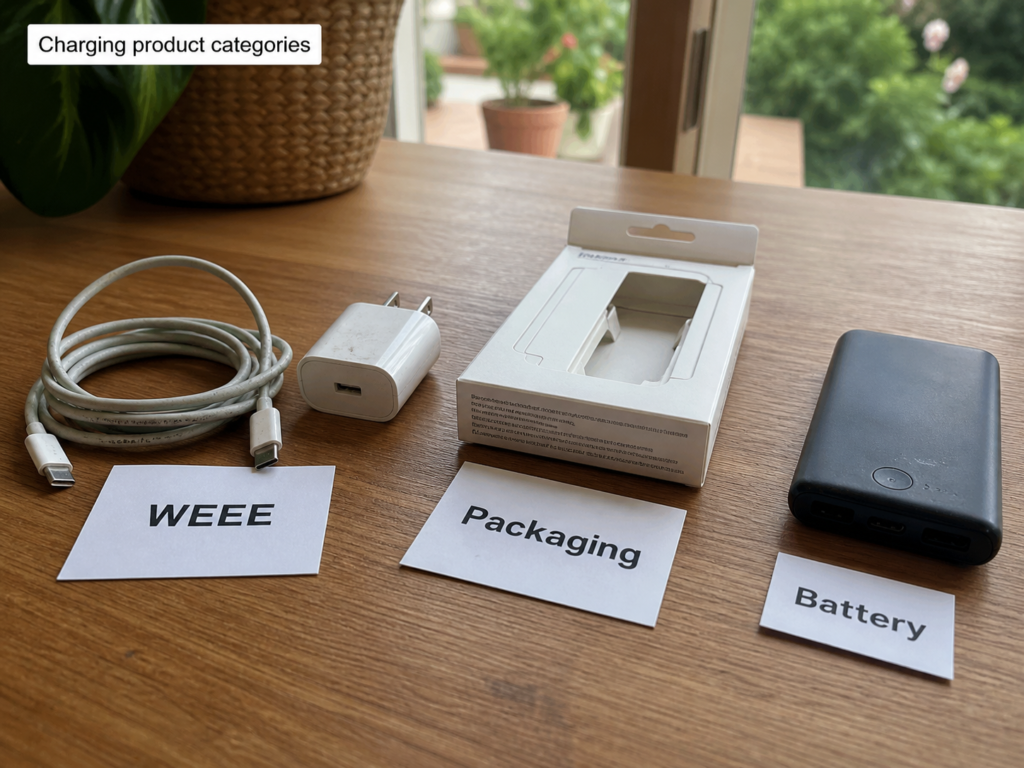
WEEE (Waste Electrical and Electronic Equipment Recycling) Requirements
WEEE targets the recycling of electrical and electronic equipment. The applicable judgment standard is: whether the product relies on electric current or electromagnetic fields to achieve its main function. Whether a cable is placed on the market as an independent EEE shall be judged according to the WEEE Directive, product functions, and the implementation laws of the country of sale; it cannot be uniformly excluded just because it is a USB cable or connector, nor can it be generally stated that the standards of all countries are completely different.
The main requirements of WEEE are as follows:
• **Registration rules**: For whichever country you sell in, you need to judge whether to register according to that country’s rules. The designated recycling organizations and specific procedures may vary from country to country.
• **Labeling requirements**: The “crossed-out trash bin” mark shall be affixed in accordance with the WEEE Directive and the implementation laws of the country of sale; if product size or function does not allow it, it can usually be marked on the packaging, manual, or warranty certificate as required.
• **Declaration requirements**: Regular declarations shall be made based on sales volume or weight. The declaration cycle varies from country to country, some are quarterly, some are annual.
• **Platform requirements**: E-commerce platforms in some countries will forcibly verify the WEEE registration number, but this is not unified across Europe.
Packaging Law Requirements
The Packaging Law targets sales packaging, transport packaging, etc. of products. As long as your product has packaging, you need to fulfill the obligations of the Packaging Law, and transport outer boxes cannot be assumed to be exempt by default.
Core requirements of the Packaging Law:
• **Registration rules**: Register separately in the country of sale, and declare based on the weight of packaging.
• **Labeling requirements**: Some countries require printing of recycling marks, which is not unified across Europe.
• **Declaration cycle**: Varies by country, mostly annual or quarterly.
Battery Law Requirements
The Battery Law only applies to charging products with built-in or included batteries. Products without batteries such as ordinary chargers and passive cables do not need it.
Products containing batteries must be marked with the crossed-out trash bin, capacity, and other applicable information in accordance with the Battery Regulation and the implementation requirements of the country of sale, and fulfill corresponding producer registration, recycling, and information disclosure obligations.
Requirements of the Battery Law include:
• **Registration rules**: Register separately in the country of sale or fulfill corresponding producer responsibilities in accordance with local systems.
• **Labeling requirements**: Mark the crossed-out trash bin, capacity, and other required information in accordance with applicable regulations.
• **Additional obligations**: Must also meet requirements such as battery labeling and recycling information disclosure.
Operational Differences in Major EU Markets
Germany and France are the two largest e-commerce markets in Europe, with the strictest platform verification. Let’s talk separately about the differences between these two countries:
• **Germany**: WEEE registration is usually handled through Stiftung EAR, and packaging registration is handled through LUCID; recycling system contracts, declaration cycles, and platform verification requirements shall be confirmed in accordance with current German regulations, product categories, and platform rules. The WEEE mark and packaging labels must also meet specific German requirements.
• **France**: WEEE and Packaging Law procedures are usually handled within the system of relevant designated recycling organizations or eco-organizations. Products or packaging falling within the scope of relevant French REP labeling shall use the Triman mark with sorting instructions as required; declaration, payment, and data cycles shall be confirmed according to specific REP categories and eco-organization requirements.
Finally, it should be reminded that the registration process, declaration cycle, labeling requirements, and platform verification rules vary from country to country. Be sure to follow the official regulations of the country of sale, and do not assume that all EU countries have the same rules.
Voluntary Certification Selection Guide: Which Ones Are Worth Doing?
After covering all mandatory requirements, let’s talk about voluntary certifications — these are not mandatory, but can help you improve competitiveness and reduce risks in specific scenarios.
Common Voluntary Certification Types and Applicable Scenarios
There are three common voluntary certifications related to charging products:
1. **GS Certification**: GS is a voluntary safety mark under German law, assessed by authorized GS bodies according to specific product safety requirements. It may include additional inspection and production supervision requirements, but cannot be generally stated as uniformly stricter than LVD. If you want to enter large offline retailers, or sell brand products with high customer unit prices, GS certification will be more helpful.
2. **USB-IF Certification**: The official USB compliance certification, used to verify the USB specification (including PD) compliance and interoperability of products. If your product focuses on PD fast charging, obtaining USB-IF certification can reduce compatibility complaints and enhance user trust.
3. **CB Scheme Certification**: This refers to test reports and certificates mutually recognized by IECEE member states, which can be used as the basis for multi-country certification and reduce the cost of repeated testing. If you need to obtain certifications for multiple countries, doing a CB report first can save part of the testing fees when converting to certifications of other countries.
The Difference Between Test Reports and NB Certificates
Many sellers are confused about the difference between ordinary test reports, NB (Notified Body) certificates, and GS certificates. Here is a brief explanation:
• **Ordinary test report**: Test reports shall be issued by laboratories with corresponding technical capabilities and accreditation scopes, or the manufacturer shall complete applicable internal assessments. The report can be part of the technical documentation, but its technical credibility, accreditation scope, and legal effect need to be judged in combination with the specific issuing body and assessment content.
• **NB (Notified Body) Certificate**: Only when the specific conformity assessment procedure requires the intervention of a notified body, does the conformity assessment need to be carried out by a notified body within the corresponding scope; it is not required for all charging products.
• Authoritative bodies such as TÜV and DEKRA can issue both ordinary test reports and notified body certificates, GS certificates. The validity of the three types of documents is different. Do not think that a report issued by TÜV is a notified body certificate.
Criteria for Deciding Whether to Do Voluntary Certification
More voluntary certifications are not always better; you should choose according to your actual situation:
• **Must-do scenarios**: Entering large offline retailers, brand products with high customer unit prices, products focusing on safety or compatibility selling points.
• **Optional scenarios**: Ordinary cross-border e-commerce mass distribution, small-batch trial sales, novice sellers with limited budgets can skip it first, and consider it after sales volume increases.
High-frequency Pitfall Avoidance Checklist for Novices
Common Pitfalls in Certification
The first common pitfall is **”having a test report equals having CE certification”**. Many novices think that having a test report means they have CE qualification. In fact, the core of CE is the manufacturer’s self-declaration, and the test report is only part of the technical documentation. Complete CE compliance requires a full set of TCF documents plus a Declaration of Conformity (DoC). If you only have a test report, it may still be judged as incomplete documentation during random inspections. The correct approach is to supplement all documents against the TCF checklist to ensure that the model on the report completely corresponds to the model actually sold.

The second pitfall is **”all USB-C products must support PD fast charging”**. This is a misunderstanding of the common charger regulation. For devices covered by the common charger regulation and supporting wired charging power exceeding 15W, they must have the USB Power Delivery charging communication protocol, and simultaneously meet the requirements of the regulation regarding USB-C ports, charging capability information, and other accessories. Separately sold USB-C cables and chargers do not automatically assume the obligations of this regulation for applicable portable devices. You should first verify whether the product is a device covered by the regulation, its placement date, and charging capability, then conduct PD tests as needed, instead of blindly adding extra tests.
The third pitfall is **”CB reports can be directly used as CE certification”**. The CB scheme is only a mutually recognized testing basis. Obtaining a CB report does not mean you have CE certification. To convert to CE, you still need to complete the CE conformity assessment, confirm the applicable version and difference requirements of EU harmonized standards, and prepare the DoC and full set of TCF documents. Do not think that you can sell directly in the EU with a CB report.
The fourth pitfall is **”wireless chargers must comply with ErP standby power consumption requirements”**. The applicability of ErP shall be judged according to product type, implementing measures, and placement time, and conclusions cannot be drawn only by looking at the product name. For example, some low-power wireless chargers may not be within the implementation scope of ErP. The correct approach is to check whether the product falls within the scope of the corresponding implementing measures according to ErP’s judgment logic.
Common Pitfalls in Registration and Market Entry
The first pitfall is **”CE certification can be directly used in the UK’s GB region”**. The scope and period of CE recognition in the GB region shall be verified according to specific product regulations and UK government policies. Not all products can always use CE to enter the GB market. If you do not meet the CE recognition conditions, or choose the UKCA route according to specific regulations, you need to prepare corresponding documents, and arrange information on UK manufacturers, importers, authorized representatives, or other economic operators in accordance with applicable regulations. It cannot be generally assumed that all routes require separate designation of a UK responsible person.
The second pitfall is **”obtaining EPR in one EU country allows selling across the whole of Europe”**. EPR is judged and fulfilled separately according to each country’s system. Each country has different rules, recycling organizations, and fee standards. There is no single EPR registration that can automatically cover the whole of Europe. For whichever countries you sell to, you must separately confirm your obligations according to those countries’ rules on WEEE, packaging, and battery producer responsibility. Especially for countries with strict platform verification such as Germany and France, you must complete the procedures in advance.
The third pitfall is **”transport outer boxes do not need to be included in packaging EPR declarations”**. Many sellers think that only sales packaging needs to be declared. In fact, packaging EPR in most countries may cover transport packaging and commercial packaging, which cannot be assumed to be exempt by default. It is recommended that you verify the declaration requirements for transport packaging with the recycling organization or compliance service provider in the target country in advance to avoid fines due to omitted declarations.
The fourth pitfall is **”all cross-border sellers must find an EU authorized representative”**. The judgment of the responsible entity shall be based on the sales model, applicable product regulations, and supply chain arrangements. Not all sellers designate an authorized representative in the same way, and fulfillment warehouses and overseas warehouses do not automatically replace the responsible entity. You can confirm the arrangements for manufacturers, importers, authorized representatives, or other economic operators according to the rules mentioned earlier, and designate a domestic responsible person as needed, instead of spending money blindly.
The fifth pitfall is **”printing the recycling mark equals completing WEEE registration”**. The recycling mark is only one of the requirements of WEEE. Registration requires applying to the local recycling organization, and it is only completed when you get the registration number. If you only print the mark without registration, it may still be rejected during platform random inspections. Be sure to complete the applicable registration first, then print the mark as required and declare regularly.
Overall, although there are many compliance requirements in the European market, the logic is very clear: first clarify the boundaries of the four categories: CE mandatory, non-CE mandatory, EPR, and voluntary certification, then match the corresponding requirements according to your product attributes and sales countries, and prepare step by step according to the process, so you can avoid most pitfalls.
Compliance is not a one-time task, but an obligation that runs through the entire product life cycle. Planning in advance can not only reduce the risks of cargo detention, product removal, and fines, but also help your products sell stably in the European market for a long time.