
If you are a cross-border practitioner dealing with charging cables, chargers, and power adapters who has just expanded into the EU or mainland China market, you have most likely encountered pitfalls in compliance: either you think “they are all safety certifications, one is enough for universal use”, or you cannot figure out “why CE usually relies on manufacturer self-declaration, while products in the CCC catalog usually need to complete certification or self-declaration according to rules”. In this article, we will clarify the differences between the two from essence to practical operation. All comparisons focus on consumer charging products that everyone most frequently contacts, and after reading, you will be able to make basic compliance judgments independently.
First, Understand the Essence: What Exactly Are CE and CCC?
The essence of many people’s misunderstandings about certification is that they do not understand the core logic of “which legislations apply to the product, who is responsible, and who conducts the audit”. Let us first clarify the basic attributes of the two marks and systems.
CE Mark: Regulatory Compliance Mark for the EU Market
In plain terms, the CE mark indicates that a product complies with the EU harmonized legislation applicable to it. It is not a unified certification system, nor does all products have to meet three categories of requirements: safety, electromagnetic compatibility, and environmental protection at the same time.
Take charging products as an example: chargers usually need to be assessed against requirements such as the Low Voltage Directive (LVD), Electromagnetic Compatibility Directive (EMC), and RoHS, based on product structure, rated input/output, functions, and sales form; which specific legislations apply needs to be judged item by item. No matter which legislation applies, the manufacturer must complete the corresponding conformity assessment, prepare technical documentation, and sign the EU Declaration of Conformity (DoC).
For many ordinary chargers, the conformity assessment can be carried out by the manufacturer through internal production control in accordance with applicable legislation, and there is no need for an EU authority to uniformly “issue a CE certificate”. However, whether a Notified Body (NB) is required to participate depends on the conformity assessment procedure specified in the applicable legislation, and an absolute judgment cannot be made solely based on “ordinary product” or “high-risk product”.
CE mainly applies to the EU market, and also covers Norway, Iceland, and Liechtenstein in the European Economic Area (EEA). For the Great Britain market, the use of CE or UKCA should be judged based on the current UK legislation and transitional arrangements; for products subject to EU legislation, CE may still be required or accepted in Northern Ireland, so it cannot be simply summarized that CE is not recognized throughout the UK.
Non-EU manufacturers must ensure that the EU economic operator and responsible contact information required by applicable legislation are in place. Whether it is mandatory to appoint an EU authorized representative depends on the specific product legislation, and it is not a universally mandatory requirement for all CE products to have an EU authorized representative.
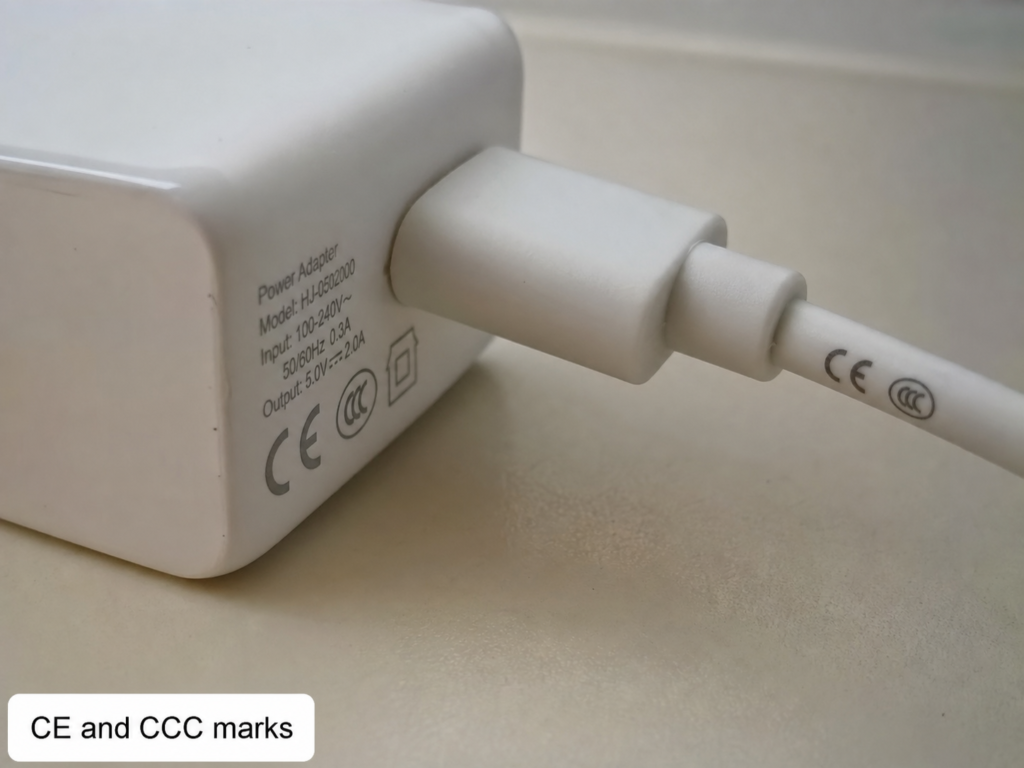
CCC: China’s Mandatory Product Certification System
The full name of CCC is China Compulsory Certification. In common terms, it is a conformity assessment system set up by mainland China for products within the mandatory certification catalog: products in the catalog must complete conformity assessment in accordance with the corresponding certification implementation rules and obtain a valid certificate, or adopt a self-declaration procedure where permitted by the rules.
CCC is not an administrative license in the usual sense. Certification bodies carry out certification work in accordance with the law and issue certificates based on the corresponding implementation rules; some products can apply for self-declaration in accordance with regulations. Which method to use specifically depends on the latest CCC catalog, certification implementation rules, and self-declaration implementation details.
The coverage area is mainly mainland China; Hong Kong, Macao, and Taiwan regions of China have their own certification and regulatory rules, and the mainland China CCC system does not directly apply to them.
Responsible entities may include manufacturers, importers, sellers, or other certification applicants. Who bears the certification entrustment and product compliance responsibilities according to the rules needs to be judged in combination with the product supply chain and specific implementation rules.
How Important Is It for Charging Product Practitioners?
Whether you are engaged in cross-border e-commerce or offline trade, without compliance documents that meet the requirements of the sales destination, you may encounter customs inspections, platform delisting, regulatory penalties, and in severe cases, recalls may be triggered. The core reminder is: CE and CCC are not mutually replaceable certifications. Under the premise of meeting their respective legislations and rules, some test data may be referenced or reused, but the requirements of each market must still be completed separately.
The scenarios where these two systems are used daily are also clear: cross-border e-commerce sales of charging products to the EU or mainland China, offline physical import of charging electronic products, and compliance verification by purchasers before bulk procurement.
Unify the Caliber Before Comparison: What Do We Compare?
To avoid invalid comparisons like “comparing industrial chargers with mobile phone chargers”, we first unify several premises, and all conclusions are based on this scope.
First, unified reference product scope: the core samples are consumer mobile phone chargers, USB/USB-C data cables, and ordinary power adapters with rated output ≤36V; charging products for special scenarios such as industrial, medical, automotive, and military are excluded, as these products have special legislations and are not within the scope of this discussion.
Second, unified comparison dimensions: we mainly compare four core aspects: mandatory attribute, test requirements, process cost, and marking supervision; and we only compare the minimum requirements for market access, not involving product quality grade assessment—compliance is only the basis for “being able to enter the market” and does not mean that the product has a higher quality grade.
Third, rule version: the standards and rule examples in this article refer to the 2024 rule background listed in the topic. CE should be judged based on the EU harmonized legislation applicable to specific products, which may involve LVD, EMC, RoHS, etc.; CCC should apply the current CCC catalog and certification implementation rules issued by the State Administration for Market Regulation and the Certification and Accreditation Administration of China. Specific requirements for different products may vary.
To help everyone quickly understand the core differences, we first present a brief table, and then break it down in detail in subsequent sections:
| Comparison Dimension | CE Conformity Assessment (EU) | CCC System (Mainland China) |
|---|---|---|
| Core Nature | Fulfill ongoing compliance obligations in accordance with applicable EU harmonized legislation, usually centered on manufacturer self-declaration | Products in the catalog complete mandatory conformity assessment according to rules; some products can adopt self-declaration |
| Document or Certificate | Manufacturer signs DoC and keeps technical documentation; whether a Notified Body is required depends on specific legislation | CCC certification bodies designated by law or accredited issue certificates according to rules, or self-declaration is handled according to rules |
| Coverage Area | EU and EEA; for Great Britain market, CE or UKCA is judged according to current UK arrangements | Mainly applies to mainland China |
| Core Requirements | Determined by the legislation applicable to the product, which may involve safety, EMC, RoHS, etc. | Determined by the CCC catalog and specific certification implementation rules |
| Processing Cycle | Depends on product scope, testing, document preparation, and institution scheduling | Depends on application, testing, factory inspection or self-declaration procedure, rectification, and institution scheduling |
| Cost | No unified official price; inquire based on testing, documentation, responsible entity, and service content | Varies by certification category, factory, supervision method, and institution fees |
| Validity Period and Maintenance | There is no unified validity period for CE certificates; ongoing compliance with legislation must be maintained and documents updated | Certificate validity period, supervision frequency, and renewal requirements are subject to specific implementation rules |
| Authenticity Query | Verify DoC, technical documentation, test data, responsible entity information, and mark usage | Check certificates and status through the official systems of the Certification and Accreditation Administration of China or relevant certification bodies |
Core Comparison 1: Mandatory Attribute and Applicable Scope
The most essential difference between the two systems is the difference in “applicable legislation and conformity assessment methods”. In the EU, manufacturers usually bear ongoing compliance responsibilities based on legislation; in China, corresponding mandatory conformity assessment requirements are set for products in the CCC catalog.
Essential Differences in Mandatory Nature
CE is a product compliance obligation within the scope of EU legislation. Manufacturers must identify applicable EU harmonized legislation, complete the corresponding conformity assessment, prepare technical documentation, and sign the DoC. Whether an EU Notified Body (NB) is required depends on the conformity assessment procedure specified in the specific legislation.
Many ordinary chargers can be subject to internal production control by the manufacturer, but it cannot be concluded that third-party assessment is completely unnecessary just because they are “ordinary”. Products such as devices with radio functions may be subject to different conformity assessment procedures; the final decision shall be based on specific legislation and product functions.
CCC is China’s mandatory product certification system. Products in the catalog usually must obtain CCC certification, but some product categories or low-risk products may be eligible for the self-declaration procedure. Whether self-declaration is allowed cannot be judged by experience; the latest CCC catalog, certification implementation rules, and relevant details must be checked.
Differences in Coverage of Charging Products
The scope of application of CE is not that “all charging-related products entering the EU are automatically affixed with the CE mark”. Charging adapters and cables with electronic circuits usually need to be assessed against applicable CE legislation; passive data cables, connectors, etc., should be judged separately whether they fall within the scope of RoHS, General Product Safety Regulation, or other legislations.
CCC is managed under a catalog system. Whether power adapters and chargers are in the CCC catalog should be checked item by item according to product category, use, rated parameters, and the latest certification implementation rules, and cannot be judged solely by the condition of “rated output ≤36V”. Most ordinary passive USB charging cables are not within the scope of mandatory CCC, but they still need to fulfill applicable product quality, material safety, and other legislative obligations.
Differences in Equivalent Recognition Scope
CE has clear legislative significance within the EU and EEA. Some countries or regions outside the EU may take CE as a reference basis for market access; whether it is directly accepted depends on local laws and product categories, and cannot be generalized.
CCC is mainly used for the management of mandatory product certification in mainland China. Other countries or regions usually will not directly exempt local certification or compliance requirements just because a product has obtained CCC.
Conditions for Changes in Mandatory Scope
If a product has the following conditions, compliance requirements may be adjusted accordingly:
- With wireless function: If the product includes wireless communication or falls within the definition of radio equipment, applicable requirements such as the Radio Equipment Directive (RED) need to be assessed. Whether pure near-field induction power supply equipment is subject to RED depends on the specific structure, frequency, and function. For the Chinese market, the requirements for wireless products should also be checked according to product categories and corresponding rules.
- Products outside the mandatory scope: Not being in the CCC catalog does not mean that China’s product quality and safety requirements can be ignored; enterprises can choose voluntary certifications such as CQC according to market demand. For the EU market, it is also necessary to judge whether the product falls within the scope of RoHS, General Product Safety Regulation, or other legislations, rather than simply treating it as “no need to worry at all if there is no CE”.
- High-power products: High-power chargers may receive more attention due to risk assessment, accident records, or special regulatory actions, but 65W or 100W cannot be used as a unified regulatory or random inspection threshold for the EU and China.
Core Comparison 2: Test Requirements and Core Indicators
Many people think that the test requirements of the two systems are very different. In fact, some technical standards do overlap, but the specific test items are determined by product function, rated parameters, applicable legislation, standard version, and certification implementation rules, and a fixed test list cannot be applied mechanically.
Overlaps and Differences in Major Test Categories
For chargers with power conversion or electronic circuits, electrical safety and electromagnetic compatibility (EMC) are usually important assessment items. Products such as passive cables may not be subject to all test items, nor can it be said that all charging products must undergo exactly the same safety and EMC tests.
EU products may need to meet the requirements of RoHS 2011/65/EU and its amendments, and affix the CE mark as required. It should be noted that RoHS itself is not a “CE certification test”, but a compliance obligation under the EU’s restriction of hazardous substances legislation.
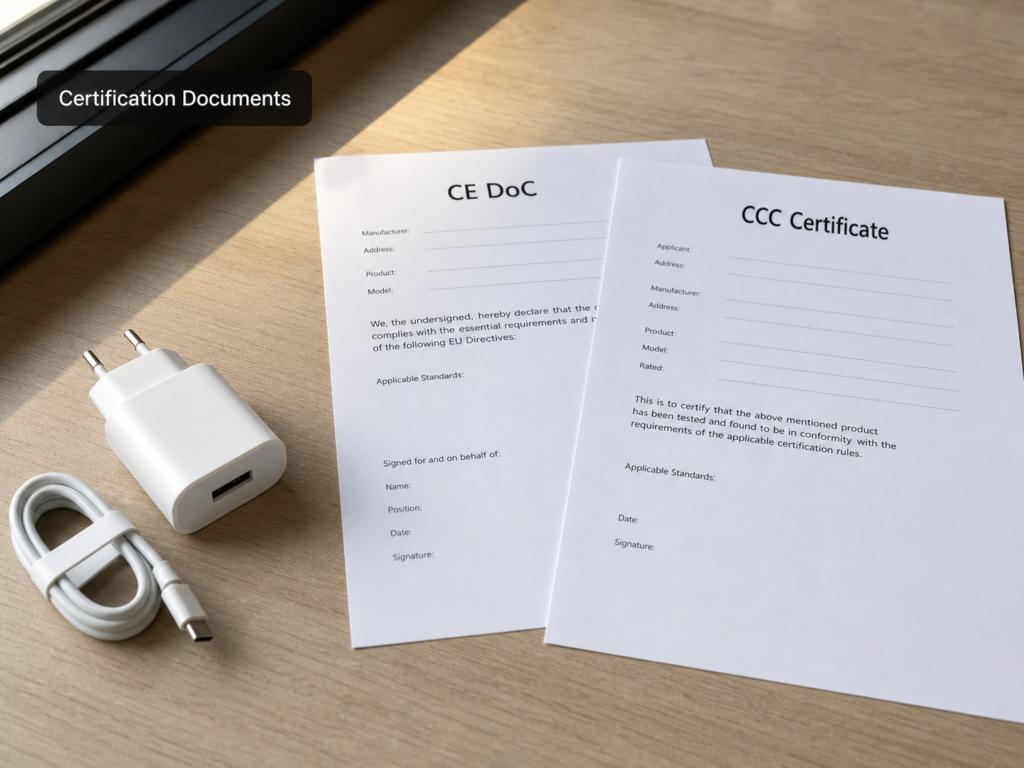
Whether China’s CCC certification itself includes environmental protection items depends on the certification implementation rules of specific products. Even if a CCC certification does not include environmental protection testing, the product may still be subject to other legislations and information disclosure requirements such as China RoHS.
Differences in Core Indicators of Charging Products
- Safety indicators: Some safety standards in both regions are based on IEC, and there are many overlaps in technical requirements, but the adopted standard versions, national deviations, scope of application, test conditions, and additional requirements may be different. Testing and judgment should be carried out based on specific EN, GB versions, and certification implementation rules respectively.
- EMC indicators: There may be differences in the limits and test frequency bands of conducted and radiated disturbances. Whether EMC testing is required also depends on whether the product contains circuits that generate or process electromagnetic energy.
- Data cable indicators: Cables may involve requirements such as mechanical strength, bending resistance, and material restrictions; cables with active electronic circuits may also require further assessment of EMC or other applicable legislations. All test items cannot be judged solely by the “USB-C” interface type.
Underlying Connection of Test Standards
CE products may adopt EU harmonized standards. For example, some information technology, audio-visual, and communication equipment refer to standards such as EN 62368-1.
CCC products must cite current GB or GB/T standards according to product categories and certification implementation rules, such as GB 4943.1-2022 and applicable standards such as GB/T 9254.1-2021 and GB/T 9254.2-2021. The old name GB 9254, which has been updated or split for application, cannot be used alone.
Some EN and GB standards are based on IEC, so there may be many similarities in technical requirements. However, not all standards can be simply regarded as equivalent transformations. Even if the standards are similar, shared test data must meet the requirements of corresponding legislation, standard version, laboratory qualification, sample configuration, and test methods. Whether it can be reused must be confirmed by the relevant certification body or compliance responsible entity according to specific rules.
Conditions for Changes in Test Requirements
If a product has the following characteristics, more targeted assessment is usually required:
- High-power chargers or chargers supporting functions such as PD: Items such as temperature rise, abnormality, overcurrent, overvoltage, and short circuit should be assessed according to rated input/output, structure, and applicable standards. 65W cannot be used as a unified additional test threshold for both regions.
- USB4 cables with high-speed data transmission function: Signal integrity verification can be carried out according to interface specifications, customer requirements, and product risks; it is a mandatory compliance test item only when explicitly required by applicable legislation or certification implementation rules.
- Products with fast charging protocols: Chargers or cables supporting protocols such as PD and QC can undergo protocol interoperability and safety risk verification. Such verification is not automatically equivalent to the unified additional certification items specified by CE or CCC, and the specific situation still depends on applicable legislation and implementation rules.
Core Comparison 3: Certification Process, Cost, and Cycle
This part is the most concerned content for practitioners, after all, it is directly related to time and money. The process differences between the two mainly come from different applicable legislations, product categories, and conformity assessment methods.
Differences in Process Steps
The core of the CE process for ordinary charging products is “identify legislation, prepare evidence, and bear ongoing responsibility”: first determine which EU harmonized legislations and standards apply to the product, then conduct testing and technical assessment as needed; then prepare technical documentation, complete risk assessment, sign the DoC, and confirm the EU economic operator, responsible contact information, and CE mark usage method as required. Whether a Notified Body is required to participate depends on the conformity assessment procedure of the specific legislation.
Products in the CCC catalog usually need to submit an application to a certification body designated by law or accredited, conduct testing, factory inspection, or other prescribed procedures in accordance with the corresponding implementation rules, and after completion, the certification body will issue a CCC certificate. For products eligible for the self-declaration procedure, prepare materials, complete evaluation, and handle self-declaration in accordance with relevant rules. Subsequent supervision and maintenance as required by the implementation rules must also be accepted.
Cost Reference for Conventional Products
Neither CE nor CCC has a unified price applicable to all 5V/2A chargers. CE costs may include sample testing, technical documentation preparation, translation, EU economic operator or authorized representative services, etc.; some enterprises complete part of the documentation work by themselves, while others entrust third-party institutions to assist. Whether a Notified Body is required will also significantly affect the cost.
CCC costs may involve items such as application, testing, factory inspection, certificate, supervision, and renewal, and are affected by certification category, number of factories, certification units, supervision methods, and certification body fees.
Therefore, “CE costs several thousand to 15,000 yuan” or “CCC costs 10,000 to 30,000 yuan” cannot be understood as official standard prices. For actual projects, inquiries should be made to relevant institutions according to specific products, functions, number of models, factory conditions, and certification rules.
Comparison of Conventional Certification Cycles
Neither CE nor CCC has a unified statutory processing cycle applicable to all 5V/2A chargers. The CE cycle depends on product scope, whether testing passes at one time, technical documentation preparation, and institution scheduling; CCC may also involve factory inspection, sampling, rectification, supervision, and certification body scheduling.
If the product documentation is complete and the sample passes at one time, the processing will be smoother; if the product structure is complex, there are many models, testing fails, or the factory is insufficiently prepared, the cycle will be extended. Therefore, the fixed “get the certificate in a few weeks” given by suppliers can only be regarded as a commercial arrangement, not a legislative guarantee.
Document Validity Period and Maintenance Requirements
- CE: There is no unified “validity period of CE certificate”. CE is an ongoing compliance obligation, and the manufacturer’s DoC and technical documentation must continuously reflect the current applicable legislation, standards, and product status. When product design, key components, legislation, standards, or responsible entities change, relevant documents should be re-assessed and updated.
- CCC: The certificate validity period, supervision and inspection frequency, certificate renewal, and replacement requirements are subject to the corresponding certification implementation rules. The certificate holder must continuously meet the requirements of the rules and accept the prescribed supervision. It cannot be generalized that all CCC certificates have a fixed 5-year validity period and one factory inspection per year.
Conditions for Changes in Process and Cost
The following situations will directly affect certification time and cost:
- Products with wireless function: If the product falls within the scope of application of RED or China’s wireless product rules, corresponding wireless function, frequency, and safety compliance assessments need to be added. How much cost and time will be increased depends on product functions and test scope, and a unified promise of a 30% to 50% increase or a fixed extension of several weeks cannot be made.
- Existing CCC factory inspection or certification results: Existing results may exempt or simplify part of the inspection only if permitted by the corresponding implementation rules and certification body assessment. It cannot be guaranteed that any new product can be exempted from initial factory inspection, nor can it be guaranteed to be shortened by 2 to 3 weeks.
- Multi-model series products: Series assessment can be carried out when model differences, configurations, and applicable legislations permit, and technical documentation can cover all models; however, evidence of applicability for each model should be retained. CCC must be divided according to corresponding certification units and implementation rules, and cannot be merged arbitrarily.
Core Comparison 4: Marking Usage and Market Supervision
Compliance is not done once you get the documents. How the marking is used and how the market inspects it also affects whether the product can be sold for a long time.
Marking Style and Affixing Requirements
- CE mark: It should be used in accordance with relevant EU rules. There are normative requirements for the mark’s proportion and minimum size, and it can usually be marked on the product, packaging, or manual as required. CE is not a certificate issued by a unified official platform. Whether a Notified Body number is required depends on the applicable legislation and conformity assessment procedure.
- CCC mark: It must be affixed in accordance with CCC mark management requirements and specific certification implementation rules, and ensure that it is consistent with the valid certificate, product model, and manufacturer information. Different products may be subject to standard specification marks, printed marks, or other prescribed methods. When querying the certificate, check the certificate number and registration information. It cannot be simply understood that each CCC mark corresponds to a unique certificate number one by one.
Market Supervision Methods and Intensity
- EU: Market supervision usually includes links such as market random inspection, risk investigation, platform collaboration, and non-compliance disposal. After problems are found, rectification, delisting, recall, fines, or sales restrictions may be required. Specific measures are determined by the regulatory rules of the relevant countries and regions.
- China: China implements certification access requirements for products in the CCC catalog, and carries out risk supervision and market random inspection through customs, market regulation, platforms, and other channels. The specific verification method depends on the product and regulatory scenario, and not all products will be verified one by one before entering the market.
Comparison of Authenticity Query Methods
- CE: There is no unified official certificate query platform for all CE products. Purchasers should require suppliers to provide DoC, applicable test and assessment materials, technical documentation summaries, and EU economic operator or authorized representative information (if required by legislation), and verify the model, configuration, and applicable standards.
- CCC: You can check the certificate number, manufacturer, production factory, product model, and certificate status through the official certificate query system of the Certification and Accreditation Administration of China or relevant certification bodies. The query results should also be compared with the physical product, batch, configuration, and supplier documents, and cannot alone prove that the physical product or mark usage is definitely compliant.
Conditions for Changes in Regulatory Requirements
The following scenarios may bring additional document requirements or stricter reviews:
- Cross-border e-commerce platforms: Platforms may require CE/CCC certificates, DoC, test reports, responsible person information, or other documents according to product category and sales region. The specific requirements are subject to the platform’s current rules and regulatory requirements. Not all platform requirements should be summarized as “must upload certification certificates”.
- High-power chargers: High-power products may receive key attention due to risk assessment, accident records, or special actions, but 100W cannot be used as a unified random inspection or regulatory threshold for the EU and China.
- Set products: The applicable legislation and certification scope of the set as a sales unit should be confirmed, and whether each component is subject to legislation or the CCC catalog respectively should be checked. It cannot be simply presumed that each component must obtain the same certification separately, nor can the compliance issues of the components themselves be ignored.
Exclusive Compliance Judgment Guide for Charging Products
The above are general differences. Below, we provide more reliable judgment methods for several types of charging products that everyone most frequently contacts.
Chargers/Power Adapters
- EU market: LVD, EMC, RoHS, and applicable ecodesign or energy efficiency requirements should be assessed based on rated input, output, functions, and product category. Whether external power supplies are subject to ErP-related requirements should be confirmed according to the scope of specific legislation; it cannot be summarized that all external power supplies uniformly “need additional ErP testing”. When there is wireless communication or radio functions falling within the scope of RED, RED should also be assessed.
- Mainland China market: Whether power adapters and chargers are in the CCC catalog should be checked item by item according to product category, use, rated parameters, product structure, and the latest certification implementation rules, and cannot be judged solely by output voltage ≤36V.
- Note: If the product is in the CCC catalog of mainland China, CCC certification or applicable self-declaration procedures should be completed according to rules when importing, producing, or selling. CE cannot replace the CCC requirements of mainland China.
Ordinary Charging Cables/Data Cables (Passive, No Chip)
- EU market: Passive USB/USB-C cables should be assessed against requirements such as RoHS based on materials and functions; only when they contain active electronic circuits or fall within the scope of other CE harmonized legislations, do they need further assessment of EMC, LVD, or other legislations and affix the CE mark. Just because a USB-C interface is used, it cannot be automatically assumed that CE must be obtained according to “safety + EMC + RoHS”.
- Mainland China market: It is necessary to check the latest CCC catalog and other product quality and material safety requirements. Most ordinary passive charging cables are not in the mandatory CCC catalog, but whether other compliance documents are required still needs to be judged in combination with product use and sales requirements.
- Common misconception: Data cables matched with CCC chargers do not automatically obtain CCC qualification. Chargers and cables should be judged separately whether they fall within the catalog or other legislative scopes.
Data Cables with Chip/Protocol Functions
Because this type of cable has built-in electronic components, its compliance complexity is usually higher than that of ordinary passive cables, and it needs to be judged in combination with the complete product functions, rated parameters, and uses:
- EU market: Cables with electronic circuits may require further assessment of EMC, safety, RoHS, or other applicable requirements, but it cannot be automatically assumed that CE must be obtained just because they “have a chip”.
- Mainland China market: Having a chip itself does not automatically trigger CCC. The CCC catalog and relevant implementation rules should be checked according to the complete product functions, rated parameters, and uses, and conclusions cannot be drawn solely based on the fact that it is an accessory of information technology equipment.
- Note: USB-IF certification is a voluntary industry certification of the USB industry association, which only indicates that the product meets the corresponding USB technical specifications and cannot replace CE or CCC requirements.
Set Products (Charger + Data Cable)
- When sold as a set, the applicable legislation and certification scope of the set as a sales unit should be confirmed, and whether each component is subject to legislation or the CCC catalog respectively should be checked.
- The information on the outer packaging or manual of the set cannot cover up the actual compliance problems of the components; however, it cannot be simply presumed that each component must obtain the same certification separately or be affixed with a mark separately.
- If the cables, plugs, or power modules in the set are replaced, the certification conclusion and technical documentation of the entire set should be re-assessed, and the original conclusion cannot be directly used.
- If the set is sold in the name of a “complete machine”, it is necessary to confirm that the model, configuration, and applicable legislative scope of the entire set are fixed and covered by documents, and components cannot be replaced arbitrarily.
Common Scenarios for Cross-border E-commerce and Overseas Warehouses
- Only shipped to EU overseas warehouses, only sold in the EU market: First judge whether the product falls within CE-related harmonized legislations, then prepare DoC, technical documentation, marks, and EU economic operator information according to applicable legislations; not all charging-related products necessarily require the CE mark.
- Only imported for sale in mainland China: First check whether the product is in the CCC catalog. Products in the catalog must obtain CCC certificates or adopt applicable self-declaration procedures according to rules; products outside the catalog must also meet other applicable product quality and safety requirements.
- Sold in both the EU and mainland China markets: The applicable compliance requirements of both regions should be completed separately. Not all products necessarily obtain both CE and CCC, nor can the mark or documents of one region be directly used as a substitute for the other.
Pitfall Avoidance and Quick Decision-Making: Don’t Step on These Common Pitfalls
Many friends who have just entered the industry are easily fooled by false information or unscrupulous intermediaries. Here we list the most common misconceptions and give you a set of quick judgment methods.
5 Most Common Cognitive Misconceptions
- Misconception 1: CE and CCC are mutually recognized — Wrong. The two are not mutually replaceable systems. Due to the connection of some underlying standards, some test data may be referenced or reused in technical assessment, but they still must meet the applicable legislations and rules of the EU and mainland China respectively.
- Misconception 2: Products with CE/CCC have better quality — Wrong. They mainly solve market access and legislative compliance issues, which is not equivalent to product quality grade assessment, nor does it mean that the product is necessarily a high-end product.
- Misconception 3: Ordinary USB charging cables do not need any certification — Wrong. Ordinary USB cables cannot be simply said to require no compliance at all, but whether the CE mark is required should be judged according to whether they fall within the scope of RoHS or other CE harmonized legislations; passive cables usually do not automatically apply to LVD and EMC. When sold in mainland China, even if CCC is not required, they still must meet applicable product quality and material safety requirements.
- Misconception 4: Having a test report equals completing certification — Wrong. CE compliance usually requires the manufacturer to sign the DoC, prepare technical documentation, and continuously fulfill applicable legislative requirements; whether it is mandatory to appoint an EU responsible economic operator or authorized representative depends on specific legislation. For CCC, it depends on whether the product is subject to the certification procedure or the self-declaration procedure. A test report alone cannot automatically prove that all requirements have been completed.
- Misconception 5: Certification marks can be affixed casually — Wrong. Forging, fraudulently using, or improperly using CE and CCC marks may lead to responsibilities such as ordered rectification, delisting, recall, and fines; when statutory conditions are met, it may also involve criminal liability.
3-Step Method for Quick Certification Judgment
When encountering products you are unsure about, follow these three steps:
Step 1: Look at the sales region. First determine the legislative system applicable to the sales destination: for the EU/EEA, mainly look at EU harmonized legislations; for mainland China, mainly look at the CCC catalog and other Chinese legislations. It cannot be directly concluded that all products must obtain the corresponding mark solely based on the region.
Step 2: Look at the product type. Check the product’s functions, input/output parameters, whether it has wireless communication, whether it contains electronic circuits, use, and sales form, then judge whether it falls within CE legislations or the CCC catalog.
Step 3: Look at the sales channel. Some platforms, importers, or purchasers may have additional document requirements. Even if the product is not within the mandatory scope, it may be necessary to provide DoC, test data, material declarations, or other compliance documents.
3 Pitfall Avoidance Tips for Charging Product Certification
- For CE, you cannot just buy a “CE certificate”. CE is not a universal certificate issued by a unified official authority. Real compliance usually requires applicable legislation analysis, testing or technical assessment, technical documentation, DoC, and confirmation of responsibility information such as EU economic operator or authorized representative according to specific legislation.
- For CCC, look for qualified certification bodies and laboratories. It is necessary to check whether the institution carries out corresponding CCC business in accordance with the law, and confirm the certification implementation rules applicable to the product. For products eligible for the self-declaration procedure, they must also be handled in accordance with official rules, and you cannot just listen to the verbal promises of intermediaries.
- Product modification must be re-assessed for compliance. For example, changing the USB interface supplier, modifying key circuits, replacing power modules, adding wireless or fast charging functions may change the original conclusion. It should be judged according to the content of the change whether re-testing, updating the DoC and technical documentation, or handling changes according to CCC rules is required.
Self-Inspection Methods for Ordinary Users and Purchasers
If you are a purchaser or buyer, to verify the materials provided by the supplier, you can do the following:
- CCC verification: Check the certificate number, product model, manufacturer, production factory, and certificate status through the official certificate query system of the Certification and Accreditation Administration of China or relevant certification bodies, then compare with the physical product and supplier documents.
- CE compliance verification: Require the supplier to provide DoC, summaries of applicable standards and test data, product model and configuration descriptions, and EU economic operator or authorized representative information required by applicable legislation. Do not just accept a document named “CE Certificate”.
- Key verification for charging products: Confirm that the input/output voltage, current, rated power, functions, and applicable regions marked on the product are consistent with the documents, and at the same time check whether the mark is used clearly and whether the position meets the rules.
Summary
From the perspective of access attribute, CE is an ongoing compliance obligation fulfilled in accordance with applicable EU harmonized legislations, with manufacturers bearing the main responsibility; CCC is a mandatory product certification system in mainland China, and products in the catalog must complete certification or applicable self-declaration according to specific rules.
From the perspective of applicable scenarios, the EU and mainland China have their own legislative systems. CE and CCC are not mutually replaceable certifications; some test data may be referenced or reused when conditions are met, but products must still complete the applicable requirements of each market separately.
From the perspective of core technical requirements, some safety and EMC standards are based on IEC, and there may be many overlaps in technical content, but standard versions, national deviations, scope of application, and certification procedures are not necessarily the same. Requirements such as RoHS, China RoHS, ecodesign, wireless functions, and product quality should also be judged separately according to specific products.
After mastering this set of ideas, you can more reliably judge what documents are required for a certain charger, data cable, or set product when entering the EU and mainland China, avoid mistaking the CE mark for a unified certificate, and also avoid simplifying the CCC catalog, test reports, or platform requirements.