
For cross-border sellers selling charging products, the first pitfall they are most likely to encounter when entering the Japanese market is failing to clarify the relationship between PSE and METI business notification: some people think that obtaining PSE means everything is fine, only to encounter problems in supervision or customs clearance; others regard business notification as product certification and ignore the product’s own conformity requirements. In fact, the regulatory logic for electrical products in Japan is not complicated, but it is necessary to first confirm whether the product is an “electrical appliance and material” in the statutory catalog, and then handle product conformity, operator notification, and labeling obligations separately.
This article focuses on common charging products such as chargers, power adapters, and USB/USB-C charging cables, and introduces PSE requirements for the Japanese market, METI business notification, and related responsibilities borne by import operators, from entry-level judgment to semi-proficient verification.
Entry-Level Basics: Core Rules for Charging Product Access
Japan’s regulation of electrical products is mainly based on the (abbreviated as DENAN). This law mainly targets “electrical appliances and materials” listed in the statutory catalog, with the purpose of reducing electrical safety risks such as electric shock, fire, and overheating.
Therefore, it cannot be simply understood that “all electrical products sold in Japan must undergo PSE”. Whether PSE applies to a product should be judged based on the product category, structure, rated parameters, and the statutory catalog published by the Ministry of Economy, Trade and Industry (METI) of Japan.
Which charging products are within the regulatory scope?
Whether common wall chargers, power adapters, USB/USB-C charging cables, and accessories with charging functions are regulated products depends on their specific structure and statutory items, and cannot be judged solely based on the name “charging product”.
For example, power products directly connected to alternating current usually require key verification against the DENAN catalog; products with power conversion functions should also be judged in combination with their input and output structures and rated parameters. Cables that are only used to transmit low-voltage signals and do not undertake power supply functions at all may not fall within the same regulatory scope, but whether PSE applies specifically should still be confirmed against METI’s official catalog, and cannot be presumed to be exempt on one’s own.
Plain-language explanation of the two core requirements
Many people are confused by the two terms “PSE” and “METI filing” when first exposed to Japanese regulations. In plain terms, they can be understood as follows:
• **PSE**: Product safety conformity requirements for electrical appliances and materials in the statutory catalog. After meeting the requirements, operators can use the corresponding PSE mark in accordance with regulations.
• **METI business notification**: Operators submit a declaration to the competent authority with jurisdiction regarding the business of importing or manufacturing products regulated by DENAN, stating information such as the operator, business office, business type, and related product categories.
Business notification is not a declaration for “this batch of goods”, nor is it a batch-by-batch import filing, let alone a product safety certification or market access certificate. It mainly addresses the regulatory registration issue of “who is operating the regulated business and what categories of products are operated”, and cannot replace PSE-related obligations.
The logical relationship between the two
PSE conformity and business notification are two different types of obligations, which cannot replace each other, nor can they be simply summarized as a fixed “PSE first, then filing” in all scenarios.
After an operator begins to import or manufacture electrical appliances and materials regulated by DENAN, it shall submit a business notification within the time limit prescribed by law; at the same time, the product must still complete the applicable PSE conformity assessment and be correctly labeled in accordance with regulations before sale. In actual projects, it is best to complete product classification, conformity confirmation, label preparation, and business notification arrangements before shipment and sale to avoid disconnection between various links.
A common misunderstanding is to interpret METI business notification as another type of product certification. In fact, it is only a statutory declaration submitted by the operator to the competent authority, and cannot prove that the product itself has met safety technical standards.
Consequences of non-compliance
Japanese law does not establish a unified penalty tiering system according to the “mild, moderate, severe” levels previously mentioned in this article, nor can it be inferred that all issues will be automatically rectified and released, uniformly added to a regulatory blacklist, or necessarily destroyed.
Depending on the facts of the violation, product risks, and the handling of relevant authorities, possible consequences include:
• Correction instructions or requests for supplementary explanations;
• Restriction on the sale, shipment, or continued operation of related products;
• Requirements to take measures such as recycling and improvement;
• Administrative orders, administrative penalties, or criminal liability;
• Return of goods, and other disposal measures taken under specific circumstances.
Whether to detain, return, destroy, or take other measures shall be judged based on the specific case, product risks, and the decision of the competent authority. If a product causes a safety accident, the manufacturer, import operator, seller, and other related entities may also bear civil, administrative, or criminal liability based on the specific facts.
Quick Judgment: Which Type of PSE Does Your Charging Product Need?
The PSE mark is usually divided into two types: diamond and round, corresponding to “specified electrical appliances and materials” and “non-specified electrical appliances and materials”. However, the shape of the mark cannot be judged solely by whether the product is wall-plugged, its power level, or whether it has a chip. The first step is always to confirm whether the product is in METI’s statutory catalog of electrical appliances and materials, and then determine the applicable PSE type based on the specific item and rated parameters.
Core differences between diamond and round PSE
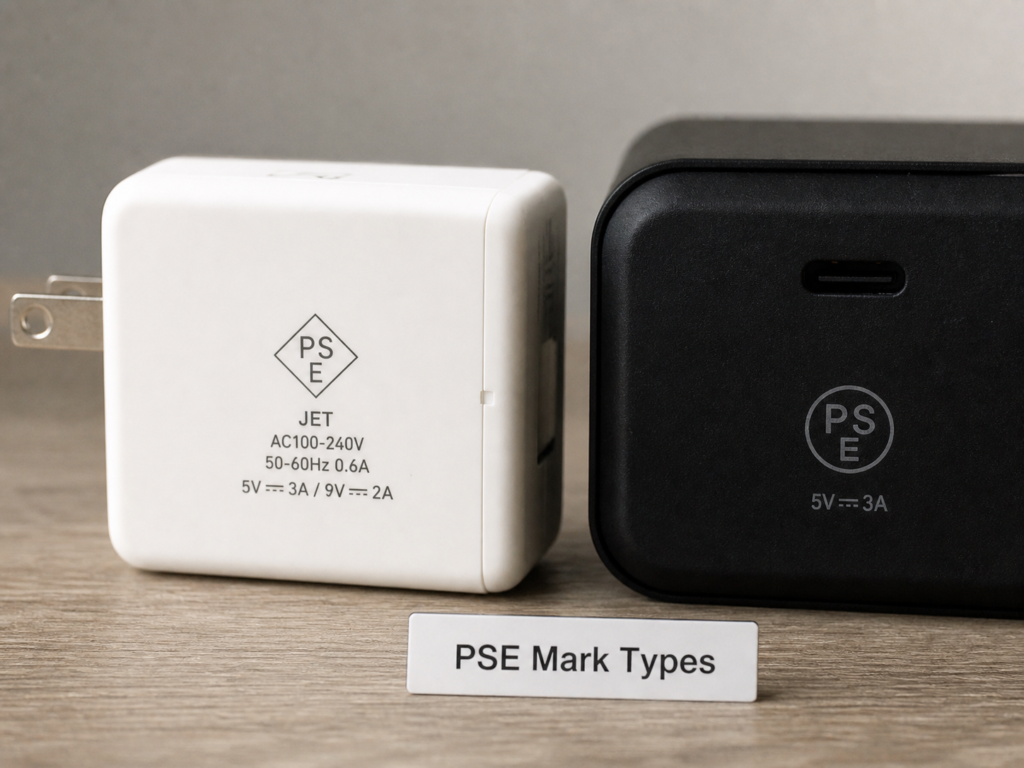
For quick distinction, the core differences between the two types of PSE can be summarized as follows:
| Comparison Item | Diamond PSE (Specified Electrical Appliances and Materials) | Round PSE (Non-Specified Electrical Appliances and Materials) |
| Corresponding Category | Specified electrical appliances and materials in the statutory catalog | Non-specified electrical appliances and materials in the statutory catalog |
| Conformity Requirements | Statutory conformity inspection shall be implemented by METI-registered conformity inspection bodies | The manufacturing or import operator shall conduct conformity inspection in accordance with the law and keep the required records |
| Mark Style | Use the diamond PSE mark in accordance with regulations, and label relevant operator or institution information | Use the round PSE mark in accordance with regulations, and label relevant operator information |
| Validity Judgment | The validity period of the conformity inspection certificate shall be specified according to the specific item | The PSE mark cannot be simply understood as having a unified fixed validity period, and operators must continuously perform conformity obligations |
In short, specified electrical appliances and materials corresponding to diamond PSE usually have stricter statutory conformity inspection requirements. Although non-specified electrical appliances and materials can be subject to conformity inspection by the manufacturing or import operator on their own, this does not mean that a “verbal self-declaration” is sufficient. Operators must still conduct inspections in accordance with the technical standards of applicable items and keep inspection records required by law.
For specified electrical appliances and materials, the conformity inspection certificates of some items have a statutory validity period, but not all diamond PSE certificates can be generally summarized as “3-7 years”. The specific period depends on the product item and applicable regulations.
PSE mainly evaluates electrical safety and compliance with technical standards, and is not equivalent to charging speed, protocol compatibility, or efficiency certification. The specific inspection items shall be subject to the Japanese technical standards of applicable items, and it cannot be absolutely stated that all performance or function-related items are not within the assessment scope.
Classification correspondence of common charging products
Combined with the characteristics of charging products, a preliminary screening can be carried out according to the following ideas:
• **Products requiring key verification**: Wall chargers, USB chargers, power adapters, etc. that are directly connected to AC mains. Ordinary AC adapters and USB chargers should usually be judged according to the specific statutory items and rated parameters in the DENAN catalog, and cannot be uniformly classified as diamond or round PSE.
• **Charging accessories requiring boundary verification**: Charging accessories with power conversion, control circuits, or other active functions should be judged in combination with their actual functions, input and output structures, rated voltage, and statutory items.
• **Cables requiring verification**: Ordinary USB/USB-C data cables or charging cables cannot be directly identified as round PSE products just because of high power, built-in chips, or a certain fast charging function. Whether they are electrical appliances and materials shall be confirmed item by item according to actual functions and the DENAN catalog.
• **Easily confused products**: Wireless chargers, desktop multi-port charging stations, power banks with AC input, travel adapters with USB ports, etc., may involve mains input, low-voltage output, or other circuit structures at the same time, and cannot be simply classified, so they must be carefully checked.
3-step quick preliminary judgment method
You don’t have to memorize all product names at the beginning. You can first make a preliminary judgment in these three steps:
1. **Check if it is connected to the mains**: Whether the product is directly connected to the Japanese AC power supply can be used as a preliminary screening clue, but it cannot be directly concluded that diamond PSE is definitely required.
2. **Check if it performs AC/DC conversion**: Whether it has the function of converting alternating current to direct current helps narrow the judgment range, but it also cannot be used alone to determine that the product is definitely subject to PSE or definitely belongs to a certain type of PSE.
3. **Check against METI’s official catalog**: Finally, verify the DENAN statutory items, applicable technical standards, input and output structures, and rated parameters to confirm whether PSE applies to the product and which mark should be used.
If the product structure is complex, or the boundaries of items in the catalog are unclear, further confirmation should be sought from the METI competent window, registered conformity inspection bodies, or professionals familiar with Japanese regulations.
Common misconceptions about classification
Many sellers fall into pitfalls in classification because they directly equate product features with regulatory classification:
1. **Misconception 1: All USB cables do not need PSE.**
This statement is too absolute. USB/USB-C cables should be judged based on whether they contain power conversion, rated voltage, structure, and DENAN statutory items. The conclusion that “round PSE is required” cannot be drawn solely based on power or whether they have a built-in chip.
2. **Misconception 2: Products with USB ports do not need PSE.**
Having a USB port does not mean the product is automatically exempt. USB chargers connected to the mains still need to be judged whether PSE applies and which type applies according to their specific statutory items.
3. **Misconception 3: Wide-voltage (100-240V) products automatically comply with PSE.**
Wide voltage only means that the product design may support a certain input range, and does not mean it automatically complies with Japanese safety technical standards. Plugs, insulation, structure, fire protection, and other applicable requirements still need to be confirmed separately.
4. **Misconception 4: Set products can be judged by individual components.**
Each component in a set must be evaluated separately. For example, for a “charger + charging cable” set, you cannot only check the charger; the charging cable must also be judged separately based on its actual function and regulatory scope.
5. **Misconception 5: All wall-plugged charging products require diamond PSE.**
Whether it is wall-plugged and whether it uses Japanese mains can only be used as preliminary clues, and cannot directly determine the PSE shape. Ordinary AC adapters, USB chargers, etc. should be confirmed according to specific statutory items and rated parameters.
PSE Compliance Handling: Rules, Processes, and Validity Judgment
After understanding product classification, the next step is the specific conformity assessment. The handling methods of diamond PSE and round PSE are different, and the same set of documents or processes cannot be used as a substitute.
Handling rules for diamond PSE (specified electrical appliances and materials)
Specified electrical appliances and materials must undergo statutory conformity inspection by **METI-registered conformity inspection bodies**. It usually involves product inspection and related inspections of manufacturing factories. The specific process, inspection content, and certificate form are determined by the registered body and applicable items.
The general process can be understood as:
1. Confirm that the product is a specified electrical appliance and material;
2. Submit samples, technical materials, and manufacturing information to the registered conformity inspection body;
3. Complete product inspection and related manufacturing factory inspections as required;
4. Obtain the corresponding certification documents after passing the inspection, and use the diamond PSE mark in accordance with regulations.
The inspection focus usually includes electric shock prevention, fire prevention, temperature resistance, insulation, and structural safety, but the specific items shall be subject to the Japanese technical standards of applicable items. PSE is mainly an assessment of safety and technical standard conformity, and is not equivalent to charging speed, protocol compatibility, or efficiency certification.
Handling rules for round PSE (non-specified electrical appliances and materials)
The conformity obligation for non-specified electrical appliances and materials is usually performed by the manufacturing or import operator in accordance with the law. Operators need to conduct conformity inspections in accordance with the Japanese technical standards of applicable items and keep statutory inspection records.
The inspection content may involve insulation, overheating prevention, fire prevention, temperature rise, structure, and safety performance under abnormal conditions, depending on the product item and applicable standards. Operators cannot just keep a test report with a similar product name and directly consider that all obligations have been fulfilled.
If the key components, structure, rated input and output, or other important parameters of the product change, it is necessary to reconfirm whether it still complies with applicable standards, and update relevant records and labels based on the inspection results.
PSE document validity judgment method (semi-proficient skill)
Many sellers think everything is fine when they get a report or certificate. In actual verification, you can judge whether the document matches the product from three dimensions:
1. **Check the institution**: For conformity inspection documents of specified electrical appliances and materials, confirm whether the issuing institution is a METI-registered conformity inspection body. For other test materials, also confirm the institution’s capabilities, testing basis, and report scope.
2. **Check the scope**: The models, rated input and output, structure, and key components covered by the document must be consistent with the actually sold products. For example, if the document only covers 45W models, it cannot be directly used to prove that 65W models meet the requirements.
3. **Check the status**: Confirm whether the certificate of the specific item is still within the applicable validity period, and confirm whether the product has undergone key changes that have not been re-evaluated, such as replacement of transformers, fuses, plugs, or main circuit structures.
Common pitfalls in PSE handling
When handling PSE, these pitfalls are the easiest to fall into:
1. **Using documents from institutions without corresponding qualifications**: For specified electrical appliances and materials, it is necessary to verify whether the institution is a METI-registered conformity inspection body, not just look at the document format or institution’s publicity.
2. **Multiple models share documents but exceed the coverage scope**: When there are multiple products in a series, even if they look similar, it is necessary to check whether the rated parameters, structure, and key components of each product are within the document coverage.
3. **Key component changes are not reconfirmed**: After replacing key components such as transformers, fuses, and plugs, the old documents cannot be directly used. Conformity should be reconfirmed and necessary records should be updated.
4. **Directly treating overseas reports as PSE**: CE and FCC cannot directly replace PSE statutory conformity assessment. CB reports can be used as technical materials for review by registered conformity inspection bodies, but whether they are accepted, the scope of acceptance, and whether supplementary Japanese difference items are required shall be determined by the body and applicable items.
METI Filing (Import Business Notification) Handling Rules
Product conformity is only part of the compliance work for entering the Japanese market. For operators who import or manufacture electrical appliances and materials regulated by DENAN, they must also handle business notification in accordance with legal provisions. The so-called “METI filing” referred to here is more accurately the business notification under DENAN, not a batch-by-batch import filing.
Statutory requirements for filing
Several key points of business notification need to be understood by both overseas sellers and Japanese partners:
• **Notifying entity**: Operators who import or manufacture regulated electrical appliances and materials shall submit a business notification to the competent authority such as the competent Economy and Industry Bureau. Whether an overseas entity can serve as the notifying operator shall be judged based on its business entity, business office, address, and specific legal status in Japan, and it cannot be generally stated that all overseas sellers cannot handle it.
• **Relationship with PSE**: Business notification is not a pre-approval that requires obtaining a PSE certificate or test report as a market access permit. The product must still complete the applicable PSE conformity assessment and be correctly labeled before sale.
• **Declaration timing**: According to DENAN regulations, the business notification should usually be submitted within 30 days from the date of starting the business of importing or manufacturing relevant electrical appliances and materials. The specific applicable situations, forms, and requirements of the competent authority shall be subject to the latest official guidelines.
• **Regulatory authority**: The competent authority with jurisdiction under the METI system is responsible for the management of relevant business notifications.
Filing materials and processing cycle
The focus of business notification is to declare statutory information such as the operator, business office, business type, and related product categories. It is not a technical review of each batch of goods, nor is it a procedure to obtain a market access permit after submitting materials.
Therefore, it cannot be used as a unified rule that “submit PSE certificates and test reports, and obtain a filing certificate within 1-2 weeks after the materials are complete”. PSE conformity materials shall still be kept by the operator according to product categories and legal requirements, and provided in cooperation when required by METI, customs, or other competent authorities. Whether supplementary materials are needed for business notification, what forms to use, and the processing time shall be subject to the specific requirements of the competent authority.
Change rules for filing
Business notification is not a product filing approved one by one by product model. Whether it is necessary to change or re-notify mainly depends on whether the statutory notification items have changed, such as:
• Changes in operator information;
• Changes in business office, address, or jurisdiction;
• Changes in the business type operated or statutory product categories;
• Changes in other notification items stipulated by law.
Changes in product models, rated parameters, or key components mainly require reconfirmation of PSE conformity, inspection records, and product labeling, and should not be generally referred to as re-filing. Whether different categories need to be declared separately shall also be judged based on the business notification form and statutory product categories, rather than simply handled according to the two product names of “charger” and “charging cable”.
Common misconceptions about METI filing
Regarding business notification, these misunderstandings are the most common:
1. **Misconception 1: With PSE, there is no need to do business notification.**
Wrong. Product conformity and operator business notification are different obligations. Whether business notification is required shall be judged based on whether the operator is engaged in import or manufacturing business regulated by DENAN and the specific statutory categories.
2. **Misconception 2: Business notification requires re-testing the product.**
Usually, business notification should not be understood as a repeated testing procedure. However, operators must still perform applicable PSE conformity assessment, record keeping, and labeling obligations.
3. **Misconception 3: Business notification is a product safety certificate.**
Wrong. Business notification is only a statutory declaration submitted by the operator to the competent authority, and cannot prove that the product itself has met safety technical standards.
4. **Misconception 4: Business notification can be lent to other brands or products.**
Wrong. The notification corresponds to a specific operator and its declared business, business office, and statutory product categories, and cannot be used to prove the compliance of other operators or other products.
Japanese Importers: Statutory Responsibilities and Compliance Selection Guide
Since Japanese import operators need to perform relevant obligations under DENAN, choosing a partner has become an important link for overseas sellers to enter the Japanese market. However, importers are not the only bearers of all responsibilities; manufacturers, sellers, and other related entities may also bear their respective responsibilities based on specific facts.
Statutory status and core responsibilities of importers
Japanese import operators usually need to perform obligations such as import, conformity confirmation, labeling, and record keeping stipulated by DENAN. The core work includes:
1. Verify whether the product is in the DENAN statutory catalog and which type of PSE requirements apply;
2. Confirm that the product has completed the applicable conformity assessment, and retain the required inspection records and certification documents;
3. Handle business notification or related change notifications in accordance with legal provisions;
4. Complete product labeling such as PSE mark, operator name, and rated parameters according to the requirements of applicable items;
5. Cooperate in providing materials, explaining product conditions, and assisting in handling problems when required by the competent authority.
The provision of compliance documents by overseas brand owners or factories does not automatically eliminate the statutory obligations of Japanese import operators. But this also does not mean that all responsibilities are borne solely by the importer. Manufacturers, sellers, and other related entities may bear administrative, civil, or criminal liability respectively in accordance with DENAN, the , and other applicable laws.
Joint risks of importers
If import operators fail to perform relevant obligations, they may face various risks:
• **Customs clearance and regulatory risks**: When the competent authority requires explanations or materials, importers need to cooperate with the investigation; whether the goods are detained, returned, or other measures are taken depends on the specific case.
• **Safety risks**: If the product causes a safety accident, the importer may bear product liability or other legal liabilities, but the final liability shall be judged separately in combination with the actions of the manufacturer, seller, and other entities.
• **Operational risks**: Violation records may lead to stricter regulatory review of subsequent products, increasing rectification, recall, and operating costs.
Judgment method for compliant importers (semi-proficient skill)
When looking for an importer, you can’t just look at the price. You can judge whether the other party is reliable from the following dimensions:
1. **Check the entity**: Confirm the other party’s Japanese business entity, business office address, and actual contact information, and understand whether it has import experience in similar charging products.
2. **Check responsibilities**: Require the signing of a formal cooperation agreement to clarify responsibilities for product classification, document provision, labeling, changes, recalls, and accident handling.
3. **Check capabilities**: Confirm that the other party can connect with customs clearance, METI, and other competent authorities, rather than just providing a “nominal filing” service.
4. **Check records**: Understand its past compliance records and product management capabilities. If the other party has long represented products with incomplete materials or frequent problems, the cooperation risk will increase accordingly.
Common pitfalls in importer cooperation
Every pitfall in importer cooperation may increase subsequent risks:
1. **Using addresses or entities that cannot be actually contacted**: When the competent authority or customs needs to contact, if the actual person in charge cannot be found, it may affect the investigation and goods handling.
2. **Agency for a large number of products with incomplete materials**: The importer’s overall management ability is insufficient, which may lead to mixed use of materials of different brands and models, increasing the risk of random inspection and rectification.
3. **Unauthorized misappropriation of product materials**: Applying the PSE materials, labels, or business notification information of one product to other brands, models, or products with different structures may cause serious compliance problems.
Full Process Practice: Steps for Charging Products from Project Initiation to Customs Clearance Access
After finishing the rules of individual links, let’s string together the process from product project initiation to entering the Japanese market. The following steps are suitable for use as a preliminary project management framework, but formal classification and declaration shall still be subject to the latest official catalog, technical standards, opinions of registered bodies, and requirements of the competent authority.
Project initiation stage: Confirm compliance requirements
Compliance should be considered in the product development stage. Don’t wait until the product is made to find that the classification or structure is inappropriate:
1. First clarify the product type, input and output structure, rated parameters, and sales model, whether it is sold separately or as a set;
2. Preliminarily judge whether it falls into the DENAN statutory catalog and the possible applicable PSE type according to the actual structure of the product;
3. Check against METI’s official catalog and applicable technical standards, confirm product classification, and estimate the cost and cycle of conformity assessment;
4. If the product has wireless, special battery, or other functions, it is also necessary to separately check other possibly applicable Japanese regulations.
Compliance stage: Complete PSE certification/testing
After confirming the product classification, start the corresponding conformity assessment:
1. If it is a specified electrical appliance and material, select a METI-registered conformity inspection body, and submit samples, technical materials, and manufacturing information;
2. If it is a non-specified electrical appliance and material, the manufacturing or import operator shall conduct conformity inspection in accordance with applicable technical standards and keep statutory records;
3. After obtaining the documents or completing the inspection, verify whether the covered models, rated parameters, structure, and key components are consistent with the actually sold products;
4. Any major design, component, or parameter change shall reconfirm PSE conformity and labeling requirements.
Filing stage: Complete METI business notification
After the product conformity preparation is completed, the operator shall handle the business notification in accordance with DENAN requirements:
1. Determine the operator, business office, and competent authority that actually undertake the import business;
2. Submit the business notification according to the time of starting the relevant business and the statutory time limit;
3. Check the operator information, business office, business type, and product category in the notification;
4. If the operator, business office, or other statutory items change, handle the change or re-notification in accordance with regulations.
Business notification is not a batch-by-batch import registration, nor is it a customs clearance voucher for each shipment. Product PSE conformity materials and business notification materials shall be managed separately, and one type of document cannot be used to replace the other obligation.
Before shipment: Label and document verification
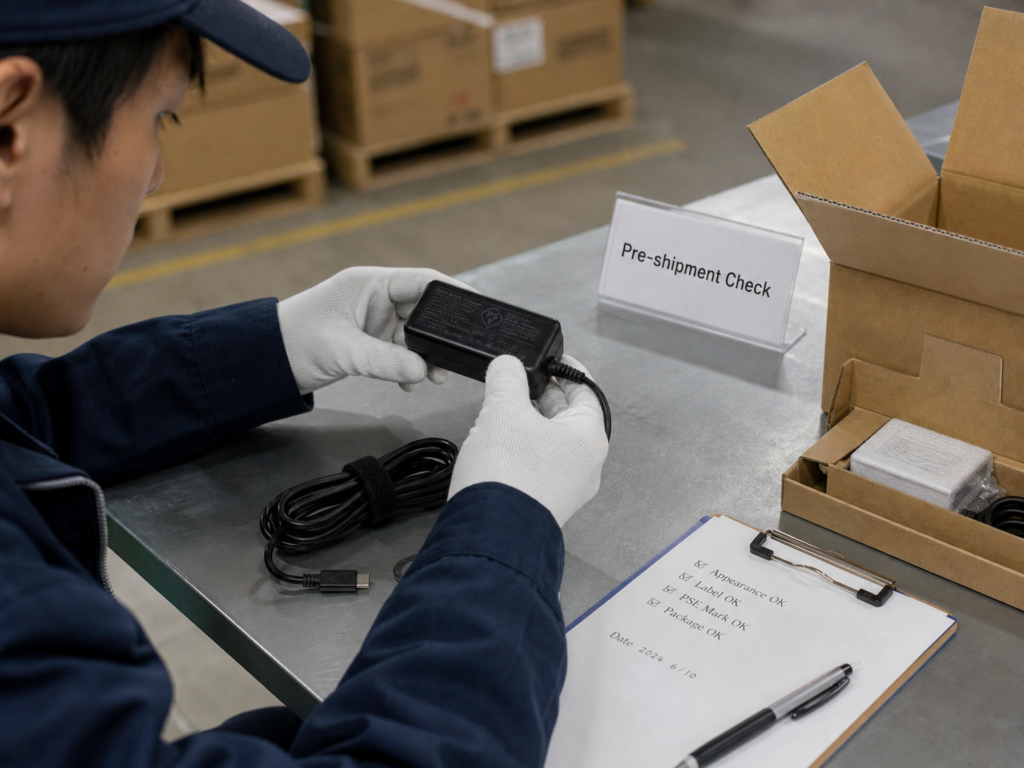
Be sure to conduct a comprehensive verification before shipment to stop problems as much as possible before shipment:
1. Check the product body: whether the PSE mark consistent with the applicable item is used;
2. Check operator information: whether the operator name and other required information are labeled in accordance with the provisions of specific items;
3. Check parameters: whether the rated input, rated output, model and other information are consistent with the actual product and conformity materials;
4. Check labeling position: In principle, it should be labeled on the product body at the specified position; if the regulations of specific items allow alternative methods such as packaging, containers, and manuals due to size or structure, they shall be implemented in strict accordance with the regulations;
5. Check sets: Each component in the set must be individually verified to see if it is a regulated product and whether it meets the corresponding requirements.
Customs clearance stage: Cooperate with customs verification
Importers shall keep PSE conformity materials, inspection records, and business notification materials, and provide them in cooperation when required by METI, customs, or other competent authorities.
These materials are not unified customs clearance documents that must be submitted for each shipment, and business notification is not a customs clearance voucher for each shipment. The specific customs clearance documents and inspection items will be determined according to the nature of the goods, declaration content, transportation method, and actual inspection situation.
If you encounter regulatory inquiries, ensure that operator information, product models, rated parameters, labels, and conformity materials can correspond to each other. Mismatches between certificates or inspection records and the actual goods, incomplete labeling information, expired operator materials, etc., may increase handling difficulties.
Key Pitfall Avoidance: Label Management, Self-Inspection, and Problem Handling
Even if the product classification and conformity assessment are done correctly, problems may still occur in the end due to irregular label or document management. The following details are particularly noteworthy.
PSE mark and product label rules
Labels are an important part of regulatory verification, but specific labeling requirements vary by product item:
• **Shape correspondence**: Products that are specified electrical appliances and materials cannot use the round PSE mark, and products that are non-specified electrical appliances and materials cannot use the diamond mark in reverse.
• **Labeling position**: In principle, it should be labeled on the product body at the specified position. For products with limited size or structure, alternative labeling methods such as packaging, containers, and manuals can only be used when permitted by the regulations of specific items.
• **Durability requirements**: The label shall be clear, friction-resistant, and not easy to fall off. Whether packaging or manuals can supplement or replace the body labeling shall be subject to the provisions of specific items, and cannot be handled uniformly.
• **Required information**: The PSE mark, operator name, rated parameters, and other required information shall be labeled in accordance with the statutory labeling requirements of specific items. Batch codes or serial numbers are not uniformly required items for all DENAN electrical appliances and materials, and should only be labeled when required by other applicable regulations, standards, or enterprise traceability requirements.
Compliance document retention requirements
Operators shall keep statutory conformity inspection records and related certification documents by product category, and the retention period shall be subject to the provisions of DENAN and applicable items. The common retention period for some conformity inspection records is 3 years, but not all documents can be summarized as a unified “statutory list of at least 3 years”.
Classification judgment records, label layouts, product change records, and batch materials can be kept as internal enterprise traceability and quality management materials. PSE certificates, test reports, and inspection records shall ensure that they can correspond to the actual sales models. Business notification materials shall also be properly kept for provision when required by the competent authority.
If the product or operator information changes, it shall be timely evaluated whether it is necessary to update conformity materials, inspection records, labels, or business notification, and old materials that are inconsistent with the current situation cannot continue to be used.
3-step quick self-inspection method (semi-proficient skill)
You can first complete the internal preliminary inspection in three steps:
1. **Check PSE documents**: Confirm whether the product is in the statutory catalog, whether the conformity assessment method is correct, whether the institution has the corresponding registration qualification, and whether the documents cover the actual models and parameters.
2. **Check business notification**: Confirm whether the actual operator, business office, business type, and product category are declared in accordance with regulations; do not look for so-called “batch-by-batch filing vouchers” or unified validity period certificates.
3. **Check product labels**: Confirm that the PSE mark, operator name, rated parameters, and other statutory information are labeled in accordance with the requirements of specific items and are consistent with the actual situation of the product.
This method is suitable for preliminary screening and cannot replace formal regulatory classification, conformity assessment, or confirmation by the competent authority.
High-risk violation risks and handling ideas
If you encounter compliance problems, do not simply apply fixed penalty results according to “mild, moderate, severe”. You should first stop the shipment or sale of the problematic batch, and then handle it according to the specific illegal facts, product risks, and requirements of the competent authority:
• **Document or classification problems**: For example, if the conformity materials cannot cover the actual model, the relevant products should be suspended, and the statutory items and assessment requirements should be reconfirmed.
• **Labeling problems**: For example, if the PSE shape, operator name, or rated parameters do not comply with regulations, handle them after confirming the allowed rectification methods, and do not assume that on-site sticker replacement and release are definitely possible.
• **Product safety problems**: If risks that may cause electric shock, fire, or overheating are found, sales should be suspended, and it should be evaluated whether recall, improvement, or reporting to the competent authority is required.
• **Business notification problems**: The actual operator shall check whether the declaration has been made in accordance with regulations, and make up, change, or resubmit according to the specific situation.
The general order of handling is: first suspend the shipment or sale of the problematic batch, then judge the type of problem, led by the relevant operator to connect with the competent authority and cooperative institutions for rectification, and keep records of communication, testing, rectification, and disposal.
Publicity information consistency requirements
The parameters and models on e-commerce pages, manuals, outer packaging, and product labels shall be true and consistent. Inconsistent information may cause DENAN labeling problems, and may also bring consumer protection or advertising regulatory risks; whether it constitutes a violation under laws such as the shall be judged separately based on the specific publicity content, consumer understanding, and actual products.
Marketing expressions such as “applicable in Japan” and “compliant with Japanese standards” cannot be used to replace actual product conformity assessment and statutory labeling. For multi-port chargers, the maximum output power of each port, combined output limit, and total power should be clearly stated as much as possible to avoid misleading consumers.
Ability Summary: What You Can Do After Learning
After reading this article, sellers at different stages can find corresponding action directions. However, it should be noted that the methods in the article can only be used for preliminary screening, and cannot confirm that a product must belong to a certain type of electrical appliance and material solely based on experience, nor can it guarantee that the product will definitely obtain Japanese market access.
Things that entry-level personnel can complete independently
• Preliminarily judge whether charging products may fall into the DENAN statutory catalog;
• Understand the difference between PSE conformity requirements and METI business notification;
• Plan preparation work according to the links of product classification, conformity assessment, business notification, labeling, and document retention;
• Find issues that need further confirmation from METI, registered conformity inspection bodies, or competent authorities.
Things that semi-proficient personnel can independently judge
• Preliminarily check the applicable items, models, parameters, and institution information of PSE documents;
• Judge whether the import operator has an actual business entity, business office, and liability bearing capacity;
• Complete the consistency check of labels, models, parameters, and documents before shipment;
• Identify re-assessment or notification obligations that may be brought about by product changes, operator changes, or business office changes.
Formal classification, conformity assessment, labeling, and business notification shall be verified based on the latest METI catalog, applicable technical standards, opinions of registered conformity inspection bodies, and requirements of the competent authority. If the product contains wireless communication functions, special batteries, or other regulated functions, it may also involve other rules such as radio regulations of the Ministry of Internal Affairs and Communications (MIC) of Japan, transportation requirements, consumer protection, and advertising regulation.
Core compliance principles
Finally, emphasize three core principles:
First, PSE is a product conformity requirement for applicable electrical appliances and materials, and METI business notification is a statutory declaration submitted by operators regarding related import or manufacturing businesses. The two are different in nature, cannot replace each other, and cannot be simply understood as batch-by-batch filing and product certification.
Second, Japanese import operators bear relevant obligations such as import, conformity confirmation, labeling, and record keeping stipulated by DENAN, but manufacturers, sellers, and other responsible entities may also bear their respective administrative, civil, or criminal liabilities based on specific facts.
Third, all compliance documents, product labels, publicity information, and physical products shall be consistent. The truly reliable approach is not to apply empirical rules such as “wall-plugged means diamond PSE” and “with chip means round PSE”, but to return to the latest METI catalog, technical standards, and specific product structure for confirmation.
Overall, the access of charging products to the Japanese market does not only depend on a PSE certificate or a so-called filing voucher. A more reliable way to enter the Japanese market is to first confirm whether the product is in the DENAN statutory catalog, then complete the applicable conformity assessment, correct labeling, and operator business notification, and finally conduct verification in combination with actual customs clearance and other regulatory requirements.