
Many sellers engaged in the export of charging accessories should have this impression: before Brexit, you only needed to complete one set of CE certification to sell in both the EU and the UK, which was worry-free and cost-effective. But after Brexit, the UK launched its own UKCA mark, leaving many people confused — what exactly is the difference between UKCA and CE? Is it stricter? Can old CE reports still be used? Do I need to redo the testing?
Today, we will thoroughly explain the differences between CE and UKCA from basics to practical operation, all centered around charging products that sellers commonly offer, such as 20W USB-C wall chargers and 100W fast charging cables with E-Marker (a small chip hidden in the cable connector used to identify charging power, which is usually included in high-power fast charging cables). The comparison covers the 27 EU member states and the EEA market (Norway, Iceland, Liechtenstein) which is usually subject to relevant EU rules, as well as the GB region of the UK (England, Scotland, Wales). Special categories such as medical and explosion-proof products are not within the scope of discussion, and the rules for Northern Ireland will be explained separately.
First, Understand the Basics: Core Positioning of the Two Marks
Let’s first clarify the basic concepts of the two marks: CE is mainly a market access mark used after products meet conformity requirements in accordance with relevant EU regulations. It applies to EU member states that adopt relevant EU product regulations, and usually applies to the EEA market which is subject to relevant EU rules. Simply put, it is an “entry ticket” for products to enter the relevant market, proving that the product meets applicable safety, environmental protection and other requirements, and does not represent some kind of high-end certification.
UKCA is the local compliance mark for the UK’s GB market. The UK government still recognizes CE for some product regulations at present, so the GB market does not exclusively require the use of UKCA. Whether CE, UKCA or other compliance measures are needed should be judged separately based on the applicable product regulations and sales time. For charging products, it is usually necessary to carefully evaluate relevant requirements such as safety, electromagnetic compatibility, environmental protection and energy efficiency; however, it cannot be concluded that all products must use the same mark just based on the term “charging category”. Non-compliant products will not necessarily be automatically rejected at every customs clearance, but they may face risks such as removal from shelves, recall, and penalties during market supervision, random inspections, platform audits, or accident investigations.
Some people may ask: in the past, one set of certification was enough, so why do we need a special comparison now? Because before Brexit, the UK was an EU member state and directly recognized the CE mark, so one compliance path could usually cover both the EU and the UK. But after Brexit, the UK has established its own independent compliance system. Although many UK regulations and standards are still highly aligned with EU rules, the regulations, standard lists and update times of the two sides are not exactly the same, and need to be checked item by item. In addition, charging products often involve electrical safety and electromagnetic compatibility, and compliance status will directly affect whether you can sell normally locally, so it is very necessary to understand the differences.
When first getting acquainted with UKCA, many people fall into several common cognitive pitfalls. Let’s clarify these misconceptions first to avoid detours later.
The first misconception is that UKCA is a high-end certification stricter than CE, which is actually not the case. UKCA and CE correspond to the compliance systems of the UK and the EU respectively. Many relevant UK product regulations and standards are still highly aligned with EU rules, but the two systems are not exactly the same.
The second misconception is that all charging accessories must have CE or UKCA, which is not necessarily true. For example, ordinary charging cables without chips and passive adapters need to be judged whether they are within the scope of relevant regulations based on actual functions, rated voltage, current and other parameters; not all products require the same conformity assessment.
The third misconception is that the CE mark is permanently valid in the UK, or that UKCA will be uniformly mandatory for all charging products from January 1, 2026. This is not the actual situation. Whether CE can continue to be used in GB must be confirmed based on the specific product regulations and conditions under which the UK government currently recognizes CE; at present, it cannot be generalized that all charging products must switch to UKCA as of a certain unified date. UKCA can be used as a local compliance path for the GB market, but not all relevant products must switch on the same date.
The fourth misconception is that having a test report equals completing compliance certification. In fact, compliance is a complete process. In addition to test materials, there must also be technical documentation, a Declaration of Conformity (DoC, a document issued by the manufacturer itself to prove that the product meets the requirements of relevant regulations), applicable responsible party information, and correct labels. The specific documents required depend on the applicable product regulations and conformity assessment modules, and cannot be judged solely based on one report.
Comparison of Applicable Rules: Where to Sell and When It Is Required
If you are not sure which compliance path your product needs to take, you can use three simple steps to quickly judge: first, clarify the core sales region — if you mainly target the EU and related EEA markets, you need to evaluate CE requirements in accordance with applicable EU regulations; if you mainly sell to the GB region of the UK, you need to check the current scope of regulations under which the UK recognizes CE, or you can choose to adopt UKCA in accordance with UK regulations. Second, look at the function, structure and rated parameters of the product itself to confirm whether it has electronic or active functions, and which specific regulations apply. Finally, confirm the time when the product is placed on the GB market, and check the latest UK government guidance on CE recognition and UKCA, instead of just remembering a unified deadline.
As for the applicable rules on both sides, CE mainly applies to EU member states that adopt relevant EU product regulations, and usually applies to the EEA market which is subject to relevant EU rules. The specific scope of application still needs to be checked according to product regulations and local implementation requirements, and CE cannot be understood as a certification issued by the EEA as a whole. Some non-EU countries such as Turkey adopt technical regulations aligned with the EU for some products and may accept the CE path, but this must be confirmed according to product categories and local regulations, and cannot be inferred to be automatically applicable to all products.
For charging products subject to relevant EU regulations, it is usually necessary to complete the corresponding conformity requirements and affix the CE mark as required before placing them on the market, but the specific situation still depends on whether the product falls within the scope of relevant regulations, whether there are special transitional arrangements, and the requirements of applicable regulations for assessment and labeling.
The scope of application of UKCA is mainly the GB region of the UK. Northern Ireland is usually handled in accordance with relevant EU rules, and UKCA is generally not applicable to Northern Ireland; we will discuss the rules for Northern Ireland separately later.
In the GB market, whether CE can be used must be confirmed based on the specific product regulations and conditions under which the UK government currently recognizes CE. The UK still recognizes CE within a certain scope for many common product regulations, so it cannot be simply stated that “all charging products must have UKCA after a certain unified date”. UKCA can be used as a local UK compliance path, but whether it is mandatory, whether it can be used in parallel with CE, and which responsible parties and label information are required must be checked according to specific regulations.
Let’s talk about the differences in the control scope of charging products. Cables with E-Marker contain electronic circuits, so it should be evaluated whether they fall within the scope of applicable regulations such as electrical equipment, electromagnetic compatibility, and RoHS, but it cannot be directly concluded that third-party certification is mandatory solely based on the E-Marker. Passive cables and passive adapters should also be judged based on specific functions, rated parameters and regulatory scope.
There may be differences in the control boundaries of subdivided products between the two sides, especially in terms of applicable regulations, standard versions, responsible parties and conformity assessment methods. The specific situation must be confirmed against the official rules of the EU and the UK.
Comparison of Core Requirements: Testing, Documentation and Responsible Parties
What many people are most concerned about is whether the testing requirements for CE and UKCA are the same? Can previous CE reports be reused? We will break this down from four dimensions: regulations, testing, documentation, and responsible parties.
First is the regulatory system. CE is based on applicable EU unified directives and regulations, such as low voltage safety, electromagnetic compatibility, restriction of hazardous substances, ecodesign, etc. UKCA is based on corresponding UK local regulations, many of whose core contents are still highly aligned with EU rules. However, the regulations, standard lists and update times of the two sides are not exactly the same. After EU regulations are updated, the UK may delay adoption or make adjustments, so they must be checked item by item, and a fixed ratio such as “more than 90% alignment” cannot be used to replace actual judgment.
Second are testing standards and items. CE can usually use EU harmonized standards to prove compliance with relevant requirements; UKCA usually uses UK designated standards. The standards of the two sides have the same or similar technical content in many cases, but it cannot be concluded that their legal effect, version and scope of application are exactly the same just based on names like EN or BS EN. In actual operation, the currently valid standard names, versions and applicable regulations of each side should be checked.
Common assessment items for charging products include electrical safety, electromagnetic compatibility, and restriction of hazardous substances; some products also require assessment of energy efficiency or ecodesign requirements. CE test materials that conform to the actual state of the product and adopt corresponding valid standards can usually be used as technical evidence for UK conformity assessment, but they need to be checked item by item against UK regulations and designated standards. If UK regulations require the participation of an approved body, it must also be confirmed that the corresponding body has UK-accredited qualifications, and it cannot be guaranteed that all CE reports can directly replace UKCA assessment. The test report itself is not a CE or UKCA certification certificate.
Next are the technical documentation requirements. The common requirements of both sides usually include test materials, instructions, product design or circuit materials, risk and conformity assessment records, and corresponding versions of the Declaration of Conformity. Manufacturers shall keep technical documents in accordance with applicable regulations and provide them when required by regulatory authorities. If the product has a key revision, it is also necessary to re-evaluate whether it affects the original conformity and update relevant documents.
Technical documents are usually kept by the manufacturer in accordance with applicable regulations and provided when required by supervision; if relevant regulations require or the manufacturer appoints an authorized representative, the authorized representative shall assist in keeping or providing relevant documents within the scope of entrustment. “Must be stored at the EU authorized representative” or “must be stored at the UK authorized representative” cannot be regarded as a unified rule for all products.
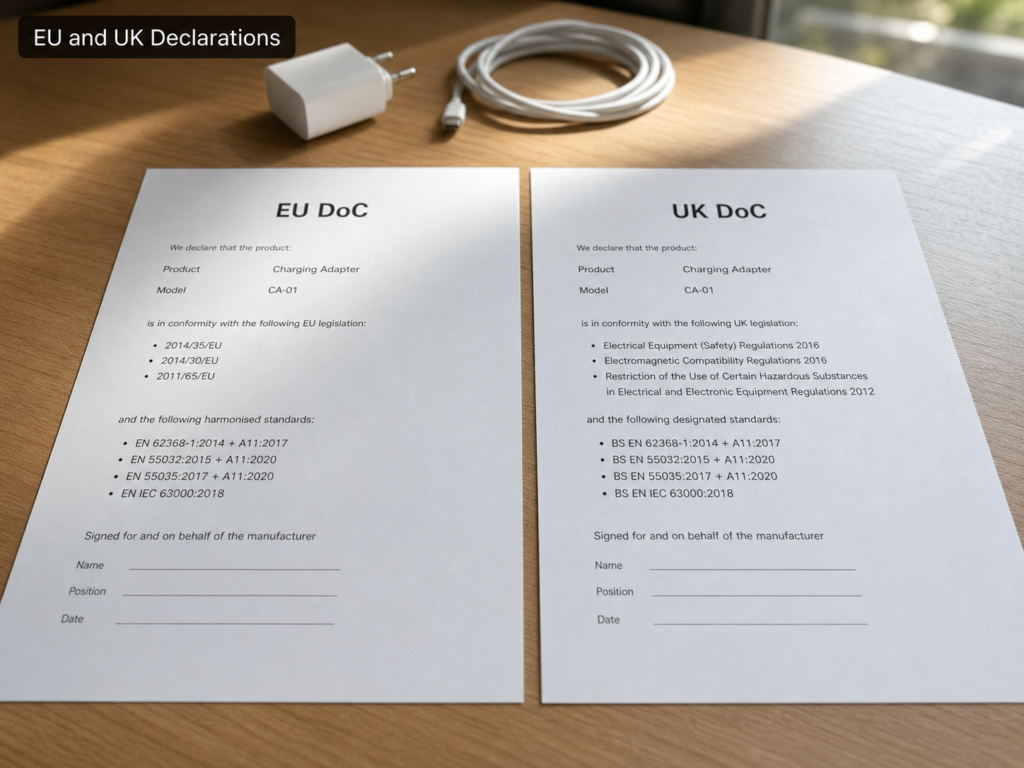
The Declaration of Conformity cannot simply cover all markets with one document. The EU market usually requires an EU version of the DoC, and the GB market usually requires a UK version of the DoC when adopting the UKCA path. The content of the document shall correspond to the actually applicable regulations, standards, product models and responsible party information.
Finally are the requirements for responsible parties. Provisions on whether an authorized representative is mandatory and how manufacturer or importer information shall be marked are not exactly the same across different EU regulations; UK regulations also do not require the appointment of a UK authorized representative for all products. In many cases, regulations focus on requiring that information on manufacturers, importers or other responsible parties can be identified by regulatory authorities and consumers.
Therefore, it shall be confirmed according to specific product regulations whether it is mandatory to appoint an EU authorized representative, UK authorized representative, importer or other responsible party, and their name and address shall be provided as required. E-commerce store addresses and overseas warehouse addresses cannot automatically replace the responsible party information required by regulations. Authorized representatives, importers and other parties performing responsibilities cannot be confused, as they may bear different legal duties.
Mark and Label Requirements: How to Affix Them Compliantly
Certification marks cannot be affixed casually. Both sides have requirements for the specifications, position and supporting information of the marks. Usually, the statutory proportion of the prescribed mark and a height of at least 5mm shall be maintained, but if applicable regulations provide exceptions for specific products, those regulations shall prevail. When it is not feasible to place the mark on the product itself, the mark shall be placed on the packaging or accompanying documents in positions permitted by regulations.
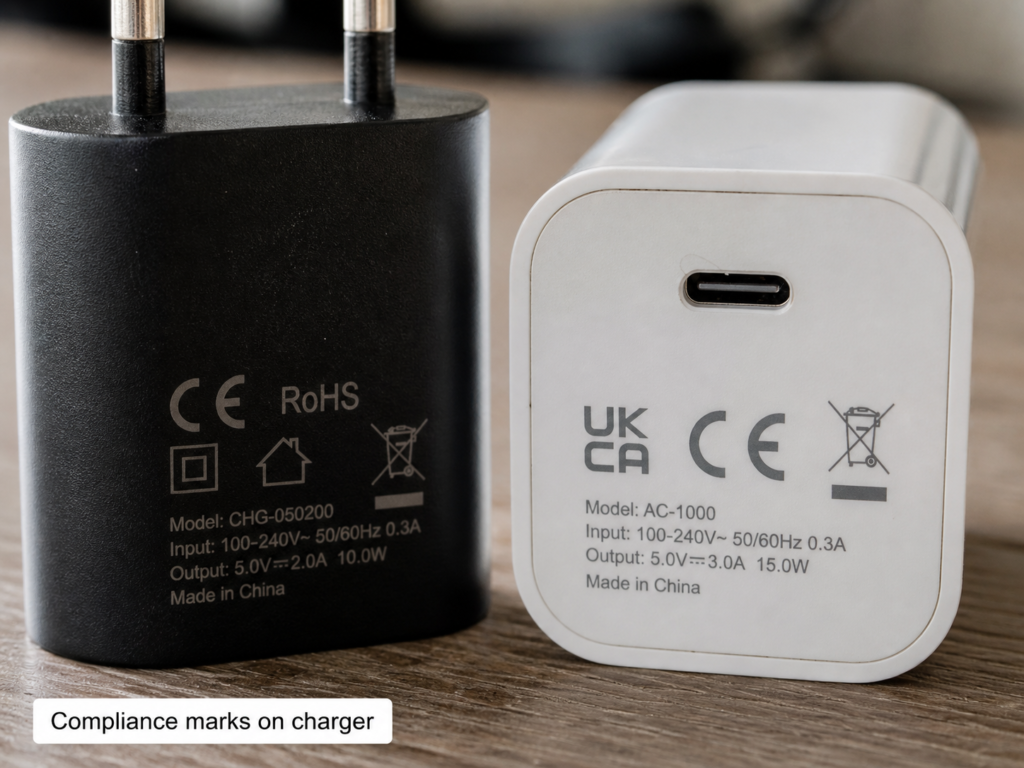
The mark must be clearly legible, indelible, and placed in a position visible to regulatory authorities and consumers. If both CE and UKCA marks are affixed, they must not obscure each other and each must be clearly visible. Whether they can be used simultaneously, where exactly to place them, and which responsible party information is required must also be confirmed according to currently applicable regulations and government guidance.
The supporting requirements for the CE mark usually include manufacturer information; if specific regulations require overseas manufacturers to provide EU authorized representative information, it shall also be marked as required. If the product falls into a category that requires the participation of a third-party conformity assessment body, the corresponding body number may also need to be marked.
The UKCA mark can be used in accordance with applicable UK regulations. Whether CE and UKCA can be used in parallel, label position and responsible party information shall be confirmed according to current specific regulations and government guidance, and January 1, 2026 cannot be used as the unified switch date for all charging products. If UK regulations require third-party conformity assessment, the body information shall also be marked in accordance with relevant requirements.
There are several common daily violations: arbitrarily scaling or distorting the proportion of the mark, using promotional slogans such as “meets EU standards” to replace the formal compliance mark, affixing the mark in easily worn or invisible positions, or simply omitting the mark and supporting parameter information because the product is small in size. These practices may lead to the product being removed from shelves, required to rectify, or even facing penalties.
Certification Process, Cost and Cycle: How to Choose the Most Cost-Effective Option
Many people think the certification process is very complicated. In fact, for charging products, the first thing to do is not to directly find an agency to “get a certificate”, but to determine the applicable regulations and conformity assessment modules for the product. Manufacturers can entrust laboratories with corresponding product and standard testing capabilities as needed; only when regulations require third-party participation is it necessary to use the corresponding EU notified body or UK approved body. Neither CE nor UKCA is a “certificate” uniformly issued by a single agency.
The conventional process for CE compliance is: first, identify the corresponding EU directives, regulations and testing standards, and confirm whether the product falls within the scope of relevant regulations; then arrange testing and assessment as needed, and organize technical documents that meet EU requirements; then the manufacturer signs the EU version of the Declaration of Conformity; finally, affix the CE mark in accordance with applicable requirements before placing the product on the relevant EU market.
The UKCA process has similarities with CE: the first step is to determine applicable UK regulations and designated standards; the second step is to prepare test materials and other conformity evidence as needed; if UK regulations require third-party participation, the qualification of the UK approved body must also be confirmed; the third step is to prepare UK version technical documents; the fourth step is to sign the UK version of the Declaration of Conformity; finally, use the UKCA mark in accordance with UK regulatory requirements before placing the product on the GB market.
Cost and cycle cannot be summarized with a fixed set of figures. If there are already CE test materials that conform to the actual state of the product, standard version and UK requirements, some technical evidence may be reused for the UK path, but it is still necessary to recheck UK regulations, designated standards, DoC, labels and responsible party requirements. If UK regulations require the participation of an approved body, it is also necessary to separately confirm the body’s qualification and assessment scope.
If complete technical materials are not yet available, the cost and cycle need to be estimated based on product complexity, testing items, standard version, whether the sample is qualified, number of rectifications, document preparation speed, and whether third-party conformity assessment is required. Mismatched standard versions, changes in product configuration, or different UK requirements may all require supplementary assessment. 1–2 weeks or 2–4 weeks can only be used as empirical estimates by individual service providers, not as fixed cycles stipulated by regulations, nor are they applicable to all charging products.
Exclusive Compliance Judgment Method for Charging Products
For charging products that sellers commonly offer, we can quickly judge the compliance boundaries by category, but ultimately we still have to return to specific regulations and product parameters, rather than drawing conclusions solely based on product names.
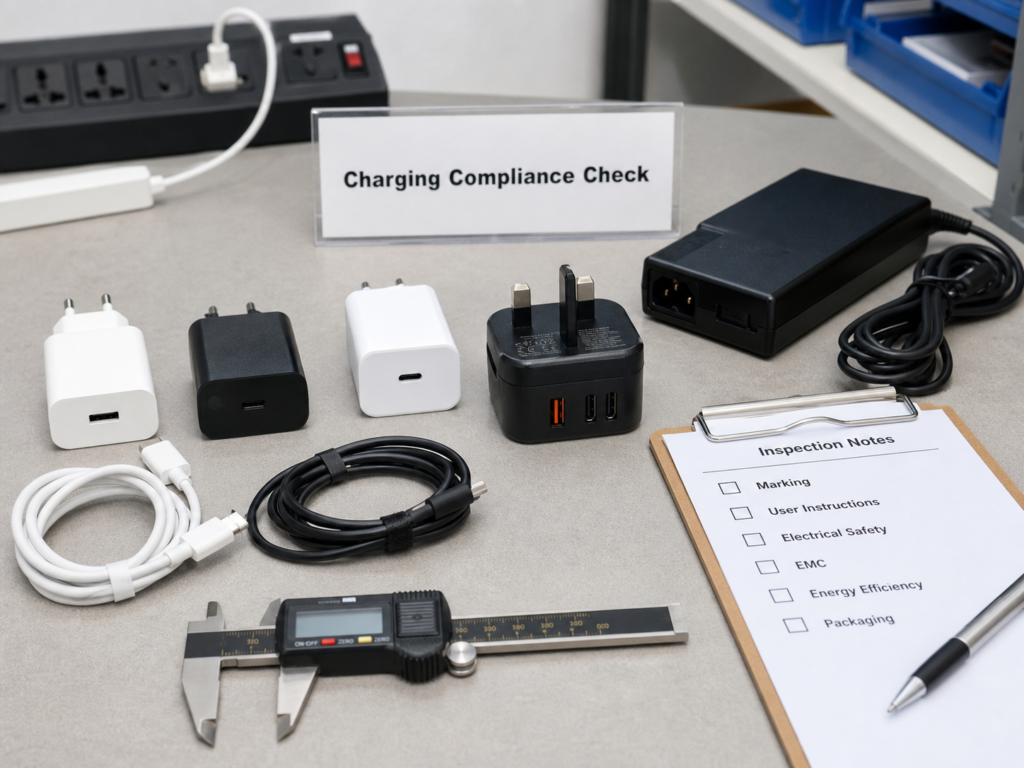
First are chargers and power adapters. Chargers directly connected to the mains usually require assessment of low voltage safety, electromagnetic compatibility, RoHS, and applicable energy efficiency or ecodesign requirements. Whether a certain regulation applies and whether third-party participation is required shall be judged based on the input and output rated range, product structure and specific regulations, and it cannot be concluded that third-party certification is mandatory just because it “plugs directly into the mains” or “has a low output voltage”.
If your charger has a wireless charging function, or integrates wireless modules such as Bluetooth and WiFi, you also need to additionally evaluate relevant regulations for wireless equipment, and cannot only perform basic safety tests.
Next are USB-C charging cables. Many people are confused about what kind of assessment is required for what kind of cable. The core depends on the actual function and structure of the cable: cables with E-Marker contain electronic circuits, so it should be evaluated whether they fall within the scope of applicable regulations such as electrical equipment, EMC, and RoHS, but the E-Marker itself does not automatically determine that the product must undergo CE or UKCA third-party certification. Ordinary passive charging cables and passive adapters also need to be judged based on rated voltage, current, function and specific regulatory scope.
Here we need to correct a common misconception: not all cables with USB-C connectors are automatically compliant; ultimately it depends on the actual function, rated parameters and internal structure of the product.
For sets or products with special functions, the judgment logic needs to be more detailed. For example, for a set of a charger plus a cable, you cannot only check whether the charger is compliant; the cable must also be confirmed separately. When the entire set is a product placed on the market, the conformity of the entire set must also be assessed. Smart chargers with a display screen that can show charging power also require additional assessment of electromagnetic compatibility and software-related compliance requirements. As for power banks with batteries, because they involve battery safety, additional battery-related compliance requirements are needed, and the assessment process for ordinary chargers cannot be directly applied; they must be checked separately.
There are also several easy-to-fall compliance boundary misconceptions to remind everyone of: for example, some people think passive adapters do not need certification at all, which is actually wrong; it still needs to be judged based on their rated voltage, current, function and regulatory scope; others say that cables only need data function and do not need compliance, but as long as they have a power supply function, they must be assessed as required; in addition, do not think that CE or UKCA can cover all compliance requirements. Things like waste electrical and electronic equipment (WEEE) recycling and packaging regulations are separate requirements and are not included in the scope of CE/UKCA.
Special Scenarios and Regulatory Risk Response
In addition to the conventional EU and GB markets, there are several special scenarios that are easy to confuse. These are advanced contents that need to be mastered, and can help you avoid many unnecessary risks.
The first is the Northern Ireland market. After Brexit, Northern Ireland maintains a special relationship with the EU Single Market, so the rules are not exactly the same as those for GB. Under normal circumstances, Northern Ireland recognizes the CE mark; if relevant products are assessed with the participation of a UK approved body or other compliant UK body, it may be necessary to use the combined CE and UKNI mark as required. UKCA is usually not applicable to Northern Ireland, and UKCA cannot be used to replace CE to enter the Northern Ireland market. The specific situation must still be confirmed according to product regulations and the type of body participating in the assessment.
The second is the judgment of CE and UKCA for the GB market. Do not memorize a unified deadline by rote. Whether CE can be used in GB shall be confirmed based on the specific product regulations and conditions under which the UK government currently recognizes CE; UKCA can also be adopted in accordance with applicable UK regulations. The correct verification method is: first confirm which regulatory category your product belongs to, then check the latest guidance on CE recognition, UKCA and designated standards on the official UK government website (GOV.UK), and finally confirm whether there are additional requirements.
It should also be noted that even if the CE path is still recognized in the GB market, it does not mean that nothing needs to be prepared. You still need to confirm whether the product meets the specific conditions recognized by the UK, and check the information of manufacturers, importers, authorized representatives or other responsible parties, as well as label and instruction requirements.
Let’s talk about the regulatory differences between the two sides. CE regulation is the responsibility of market supervision and relevant competent authorities of each EU member state. Daily random inspections may involve the safety and electromagnetic compatibility performance of charging products, as well as whether compliance documents are complete. GB market supervision is jointly undertaken by OPSS, relevant product category competent authorities, local law enforcement agencies, etc. The specific responsible authority depends on the product and regulatory category. The two regulatory systems are independent of each other, and compliance records in one market will not automatically replace the requirements of the other market.
When doing compliance for charging products, there are several high-frequency pitfalls that must be avoided.
The first is choosing the wrong testing agency. It should be confirmed that the laboratory has the testing capability for the corresponding product and standard, and the methods, standard versions and product models in the report shall also be consistent with the actual product. If regulations require third-party conformity assessment, it must be confirmed that the notified body or UK approved body has the corresponding legal qualifications. Ordinary self-assessed products are not automatically invalid just because the laboratory is not included in a certain official list.
The second is failing to prepare local responsible party information in accordance with regulations. Overseas manufacturers shall confirm according to specific regulations whether an EU authorized representative, UK authorized representative, importer or other responsible party is required, and provide the name and address as required. Neither e-commerce store addresses nor overseas warehouse addresses can automatically replace the responsible parties required by regulations.
The third is that the test report does not match the actual product, for example, the model is different, key components are changed, product configuration is changed, or the standard version used is not applicable. These situations will weaken the effectiveness of the report as evidence of conformity, and in severe cases, reassessment is required.
The fourth is mistakenly believing that self-conformity assessment allows for casual preparation of materials. Test reports, technical documents and Declarations of Conformity must all be true, complete, and able to support that the product complies with relevant regulations. Once fraud is discovered, you may face serious consequences such as removal from shelves, recall, and fines. Never take chances.
Practical Decision-Making Guide and Quick Check
After all this, how exactly should you choose the most suitable compliance solution for yourself? We have organized the basic paths according to different target markets:
- Only targeting the EU/EEA market: Complete CE-related requirements in accordance with applicable EU product regulations. If the product may flow into the UK’s GB region through channels such as distribution, you also need to additionally check the scope of UK recognition of CE, and cannot default that the EU path is automatically applicable in GB.
- Only targeting the GB market: First check the current specific regulatory scope and product conditions under which the UK recognizes CE, or you can adopt UKCA in accordance with UK regulations. For long-term operation, whether to establish a UKCA path shall be decided based on product categories, regulatory changes and supply chain arrangements.
- Targeting both the EU and GB markets: Check the regulations, standards, Declarations of Conformity, responsible parties and label requirements of the two regions separately. Eligible test and technical materials can be reused, but it cannot be defaulted that all materials, agency qualifications and DoCs are directly universal.
- Targeting the Northern Ireland market: Usually use CE in accordance with relevant EU rules; if a UK notified body or approved body participates in the assessment, use the combined CE and UKNI mark as required, and usually do not use UKCA. Specifically, other responsible party and document requirements shall be confirmed according to product regulations.
For everyone’s convenience in quick self-check, we have compiled a quick compliance checklist for charging products:
| Check Category | Core Check Content |
|---|---|
| Market Matching | The target sales region corresponds to the correct compliance path: EU/relevant EEA markets follow CE rules, GB follows the current scope of UK CE recognition or UKCA rules, Northern Ireland usually follows relevant EU rules |
| Product Scope | Whether the product’s function, structure and rated parameters meet the mandatory control requirements of the corresponding region |
| Compliance Documents | Hold the corresponding version of the Declaration of Conformity (DoC) and test materials, with model, configuration, and standard version consistent with the actual product |
| Responsible Party | The required information of manufacturers, importers, authorized representatives or other responsible parties has been confirmed and provided in accordance with specific regulations; e-commerce store and overseas warehouse addresses cannot be automatically replaced |
| Labeling and Marking | Usually maintain the statutory proportion of the prescribed mark and a height of at least 5mm; if applicable regulations provide exceptions, those regulations shall prevail, and ensure the mark is clear, indelible, and placed in a compliant position |
For small and medium-sized sellers, there are several practical tips to achieve compliance with low risk. First, when choosing suppliers, prioritize those that can provide complete compliance documents. Don’t just ask “do you have a CE certificate” and be done with it — many charging products may use manufacturer self-conformity assessment, and there is no unified so-called “certification certificate”. What you should ask for are the Declaration of Conformity, test materials and necessary technical documents for the corresponding model.
Second, all compliance documents and version change records must be properly kept so that they can be produced during regulatory random inspections. Also pay attention to whether the model, key components, and standard version in the test report are consistent with the actually sold product. Finally, before listing the product, be sure to check the local language requirements for labels and instructions. For example, products sold to Germany must have German instructions, and products sold to the UK must have English instructions. Don’t fail because of such small details.
Summary
Overall, CE and UKCA correspond to the compliance systems of the EU and the UK respectively. After Brexit, the two systems are independent, but many regulations and standards related to charging products are still highly aligned. The GB market also does not exclusively require the use of UKCA; the UK still recognizes CE within a certain scope at present. For sellers of charging products, the key is to understand the target market, product functions and rated parameters, applicable regulations, conformity assessment modules, and requirements for responsible parties such as manufacturers, importers or authorized representatives.
Eligible CE test materials may be used as technical evidence for the UK path, but it cannot be defaulted that all reports, standards and agency qualifications are directly universal. When encountering scenarios such as Northern Ireland, regulatory updates, wireless functions, power banks, or special assessment bodies, the latest rules of the EU and UK governments shall prevail, and item-by-item verification shall be carried out to avoid being misled by outdated unified deadlines or the claim that “all charging products must be certified”.