
Almost all sellers of charging products targeting the Indian market have heard of BIS certification, but many have only a superficial understanding of the testing standards behind it. Some think CE or FCC reports can be used directly; some only find out they chose the wrong standard after testing, wasting money; others confuse passing the test with obtaining the certificate, and end up stuck in the official review process. This article focuses on charging-related products such as chargers, charging cables, USB interfaces, and plugs, explaining BIS certification testing standards thoroughly from basic concepts to practical pitfalls to avoid. It is suitable for beginner sellers who are new to the Indian market, and can also help experienced sellers sort out common misconceptions.
Basic Understanding: First Master Four Core Concepts
Let’s first clarify a few most easily confused concepts, otherwise the subsequent logic will easily get messy.
First is BIS, full name Bureau of Indian Standards, the official agency in India responsible for formulating product standards and regulating market access, with functions equivalent to standardization management plus market access review.
Second is IS testing standards, full name Indian Standard, which are the minimum safety passing lines for various products formulated by BIS. For charging products to enter India, they must first pass tests corresponding to the relevant IS standards.
Third is the test report, which is the “report card” obtained after sending samples to a BIS-recognized laboratory and testing them in accordance with the corresponding IS standards, proving that the samples meet the standard requirements.
Fourth is BIS certification/registration, which is the market access “pass” obtained after submitting a qualified test report together with factory information, product materials, etc. to BIS for official review. Only with this can products be legally imported and sold.
The logical chain of these four is very clear: products first meet IS standards → laboratory issues a qualified test report → submit official application → finally obtain BIS certification/registration. They are progressive step by step, not the same thing. Here are three most common pitfalls for beginners:
First, passing the test does not equal obtaining the certificate. Testing only proves that the sample meets the standard; the official will also review materials, product consistency, etc. The certificate is not issued directly after testing.
Second, reports from international certifications such as CE, FCC, and USB-IF cannot replace BIS testing. India has no mutual recognition agreements with these institutions, so retesting must be carried out in accordance with India’s own IS standards. Do not apply with reports from other certifications, as they will definitely be rejected.
Third, BIS is a mandatory access threshold, not a quality award. Obtaining BIS certification only means that the product meets India’s minimum safety requirements, and does not represent how good the quality is. Do not treat it as a label for high-end products.
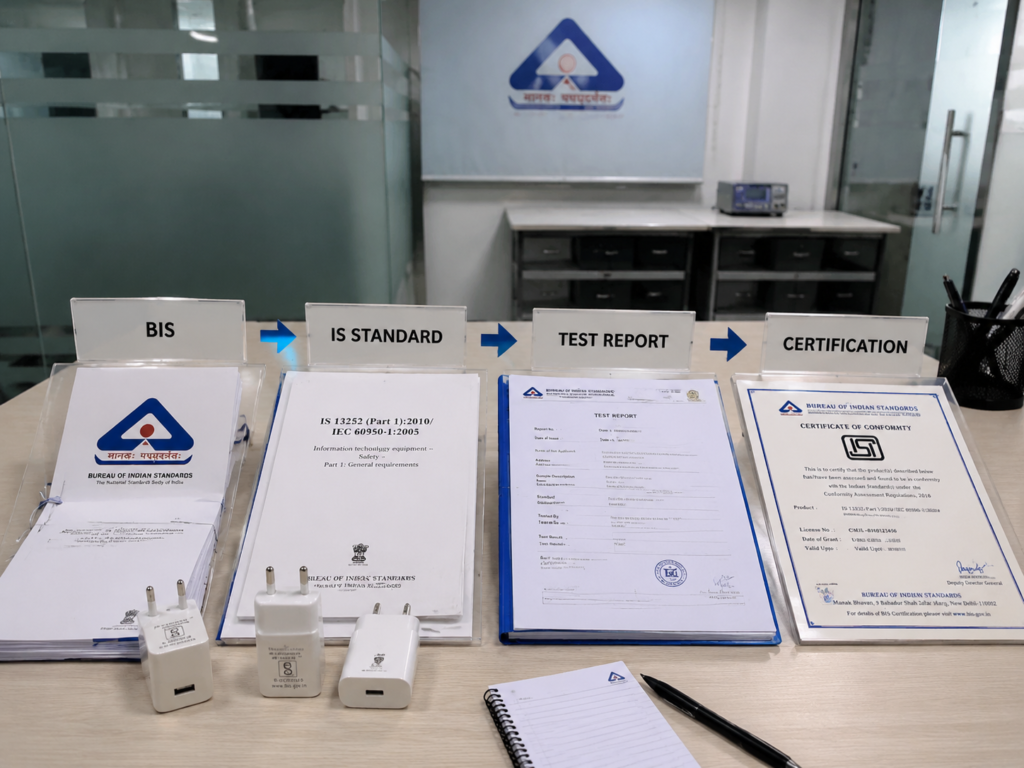
The reason why charging products must pay attention to BIS testing standards is, on the one hand, that most charging products are on the mandatory certification list. Without certification, customs will detain the goods, e-commerce platforms will delist them, and in serious cases, fines and product recalls will be imposed; on the other hand, charging products are directly connected to the mains power supply and often come into contact with human hands, with high risks of electric shock and fire. They are already a key category under BIS supervision, and inspections are much stricter than ordinary products.
Here we also clarify the product scope covered in this article: the charging products we refer to include wall-plug chargers, desktop/car adapters, USB-A/C charging cables, plugs, and device-side charging ports; they do not include unrelated categories such as toys, complete home appliances, and children’s products. The specific mandatory scope is subject to the latest list officially released by BIS, as the list is updated from time to time, so do not judge based on experience from a few years ago.
Certification Paths and Standard Matching
After understanding the basic concepts, the next core question is: which certification path should my product take, and what testing standards correspond to it?
BIS has two main certification paths for charging-related products, with basically the same testing requirements. The differences lie in the review process, sample source, and follow-up supervision methods. It is clearer to organize them into a comparison table:
| Comparison Item | CRS Mandatory Registration Scheme | ISI Mark Path |
|---|---|---|
| Applicable Products | Most finished chargers, adapters, charging cables, etc. (Specifically subject to the BIS mandatory registration list, quality control orders, and corresponding IS standards; even for the same cable or plug, different paths may apply due to differences in product definition, sales form, and use) | Basic components such as plugs and wires/cables |
| Sample Source | Enterprises submit samples on their own | Officials draw samples at the factory |
| Factory Audit | No initial factory audit, only follow-up random inspections | Initial factory audit required, with regular supervision |
| Follow-up Supervision | Mainly market random inspections | Factory inspections + market random inspections |
Simply put, ordinary finished charging heads and charging cables mostly take the CRS path, with a relatively simple process; while basic components such as plugs and wires usually take the ISI path, which has stricter requirements and requires factory audits.
Different charging products correspond to different core IS standards, which you can check against your own products:
The first category is chargers/adapters. Main applicable standards include the IS 13252 series (safety-related standards for information technology equipment, previously commonly applicable to products such as power adapters) and the IS 62368-1 series (general safety standards for information technology/audio-visual equipment). The latter is a newer cross-category safety standard that is gradually replacing some original special standards. The specific applicable category needs to be confirmed in combination with the product’s use and the official list. Power adapters with mains input and AC-DC conversion, such as wall-plug and desktop ones, are usually matched according to the corresponding safety standards for power adapters/electronic information equipment; car chargers mostly have DC input, which should be separately confirmed according to their power supply method, product classification, and the BIS list. For high-power fast charging products, they must additionally meet special tests for the corresponding power level. For example, the requirements for overheating and overload are much stricter than those for ordinary 18W chargers.
The second category is charging cables/USB interfaces. Basic requirements include wire flame retardancy, mechanical strength, and electrical conductivity, which all charging cables must meet. For USB-C related plugs, sockets, cables, or interfaces, they may also involve relevant standards such as IS 17017, IS 17037, or their sub-part standards, which need to be confirmed according to the product name, standard number, and version in the official list. It should be reminded here that charging cables/USB-C cables sold separately and included in the mandatory list usually need to be tested separately according to the corresponding standards; when sold as accessories, they can be evaluated together with the main product, but still need to be confirmed in combination with official classification and standard requirements.
The third category is plugs/device charging ports. Plugs sold in the Indian market must comply with the IS 1293 series of standards. The common three-round-pin plug is one of the mainstream categories covered by this standard. The standard has clear requirements for the length, spacing, shape, rated current, grounding structure, etc. of the pins, and even a slight deviation may result in failure. For device-side charging ports, such as the USB-C port on mobile phones and power banks, the main tests are interface lifespan, short circuit prevention, and contact resistance, to ensure that there are no safety hazards after multiple insertions and removals.
Many people don’t know how to match standards for their products. In fact, it can be done in just four steps:
First step: first check the official BIS mandatory list, and match according to the official classification, not just by what your product is called. For example, if you sell a “laptop fast charging head”, the official may classify it into the “information technology equipment power supply” category. If the classification is wrong, the selected standard will definitely be wrong.
Second step: confirm the sales form and use of the product. Is it sold separately or as an accessory to other products? Is it for mobile phones or laptops? These will affect the classification. For example, separately sold charging cables need to be tested separately, while those sold as accessories can be tested together with the main product.
Third step: check the core parameters. For example, what is the power, is the interface USB-A or USB-C, is it AC input or DC input, what is the input voltage range. Different parameters lead to different test items and requirements.
Fourth step: confirm the version and validity period of the standard. BIS standards are updated, and there will be a transition period after the new version is released. Do not test with obsolete old versions, as the testing will be in vain. Be sure to use the currently valid version officially announced.
It should also be noted that selecting the right standard is not a once-and-for-all matter. In the following situations, the standard matching result will change, and retesting may be required: for example, if the power increases from 18W to 65W, the test requirements for overheating and overload are upgraded; if the interface is changed from USB-A to USB-C, a special interface test needs to be added; if the use is changed from a mobile phone charger to a laptop adapter, it may correspond to different standards; if the sales form is changed from accessory sales to separate sales, separate testing may be required.
Core Test Items: Which Are Mandatory to Pass, Which Do Not Need Testing
Many people are curious about what BIS testing actually covers. In fact, the core is all about safety, and has little to do with performance. We can divide them into four categories. The first category is one-vote veto items: if even one fails, the product directly cannot pass.
The first category is safety-related one-vote veto items, all directly related to personal safety:
Electric shock protection test: during normal use or in case of failure, parts accessible to users (such as the housing, USB interface, pins) must not be live. It mainly examines the insulation performance of the housing and the length design of the pins, to prevent contact with live parts when plugging in.
Insulation withstand voltage test: the isolation layer between the mains input side (the end plugged into the wall) and the user-accessible output side (the USB port end) must be able to withstand high voltage without breakdown. Otherwise, people may get an electric shock if they touch the USB port while charging.
Flame retardant and fire resistance test: when the product has a short circuit or overheats, the housing and wires must not catch fire and spread, that is, they must be able to self-extinguish after catching fire. It mainly checks the flame retardant grade of plastics and wires.
Overheating/overload protection test: during long-term charging or short circuit, the product temperature must not exceed the standard, and the internal protection circuit must be triggered in time. For example, it will automatically cut off power when overcurrent occurs, to prevent burning or even explosion.
Mechanical strength test: after dropping, pulling, and multiple insertions and removals, there must be no safety hazards such as insulation damage or component falling off. For example, the copper core of the charging cable connector must not be exposed after a single pull, and the charger must not crack and expose the internal circuit board after being dropped.
The second category is charging-specific test items, unique to charging products, related to interfaces and power:
Interface size test: the size and shape of USB and USB-C interfaces must comply with the standard, and must not be loosely inserted or easily fall off. Otherwise, poor contact will cause overheating, or even short circuit.
Power carrying test: the product must be able to stably carry the corresponding current for a long time according to its rated power, and the heat generation must not exceed the standard. It cannot be marked as 65W but actually drop in power or get excessively hot after half an hour of operation.
Contact resistance test: the resistance at the interface contact must not be too high, otherwise a large amount of heat will be generated when current passes through, and in severe cases, the interface will be burned or even catch fire.
Multi-port output test: when a multi-port charger outputs at the same time, the total power must not exceed the standard, and there must be no safety problems. For example, the voltage of one port must not suddenly rise when two ports are used together, damaging the device or injuring people.
The third category is labeling compliance test items, which are the most likely to cause pitfalls. Many people have no problem with product safety, but are rejected due to unqualified labeling:
Parameter consistency test: parameters such as input and output voltage and power marked on the product must be consistent with the actual measured values, and must not be falsely marked. For example, if it is marked as 65W but actually only 45W, it is definitely unqualified.
Label durability test: parameters, warning statements, and BIS marks on the product must not come off with a hand wipe, or become blurred after wiping with alcohol, and must be able to be retained for a long time.
Mark standardization test: the product must have necessary safety warnings, and the size and position of the BIS mark must also meet the requirements. You cannot just draw a mark that is too small to be seen.
The fourth category is non-mandatory test scope. These do not need to be tested, so don’t waste money for nothing:
Performance category: for example, how fast the charging speed is, whether the fast charging protocol is compatible. As long as it does not involve safety, BIS does not care, and no testing is required.
Appearance category: for example, the color and shape of the product. As long as they do not affect the safety structure, it doesn’t matter, and there is no need to retest if you change the color.
Other categories: for example, electromagnetic compatibility (EMC). Only specific products need to be tested, not all charging products. It depends on the requirements of the corresponding standard. Don’t listen to the laboratory tricking you into testing everything.
Standard Application Differences and Pitfall Avoidance
BIS testing standards are not static, and requirements vary for different products and under different conditions. Here we sort out common differences and misconceptions.
First is the basic rule of standard updates: BIS standards are generally updated every 3 to 5 years. When new interfaces and new technologies emerge (such as the popularization of USB-C and the emergence of high-power fast charging), special standards will be added simultaneously. After the new version is released, there is usually a 6 to 12 month transition period. During the transition period, both the old and new versions are valid, and after the transition period, the new version must be used. The specific version and transition period can be queried in the official BIS announcement. Don’t believe everything third parties say.
Under different conditions, the differences in test requirements are obvious. You can check against your own products:
By product type: chargers need to be tested for circuit protection, but charging cables do not, because charging cables have no circuits; plugs need to be tested for pin size, but device-side charging ports do not, because the two have different usage scenarios.
By power level: the higher the power, the stricter the test requirements for overheating and overload. For example, the temperature rise limit for a 100W charger is much stricter than that for an 18W charger.
By interface type: USB-C products usually need to check interface compliance requirements more than USB-A products; if the product declares support for PD, high-power output, or the corresponding standard has clear requirements, attention should also be paid to PD/power carrying related tests — after all, USB-C supports higher power and more complex protocols, and the overall safety risk is relatively higher.
By certification path: products taking the ISI path also need to undergo additional consistency checks related to factory audits, to ensure that mass-produced products are consistent with the test samples.
Here are four common misconceptions about standard application, which many people have fallen into:
First misconception: you need to retest if you change the color or packaging. In fact, as long as the changes do not affect safety or change parameters, there is no need to retest. For example, changing the white housing to black, or changing the packaging design, is completely fine.
Second misconception: accessories (charging cables, plugs) do not need to be tested separately. Accessories sold only with the main product can be evaluated together with the main product, while mandatory accessories sold separately must be tested separately.
Third misconception: a global universal charger must meet BIS requirements. No, India has local plug requirements, labeling requirements, and voltage adaptation requirements. Even a global universal charger will definitely not pass BIS if the plug is a US standard two-flat-pin plug.
Fourth misconception: with USB-IF certification, there is no need to test BIS interface items. BIS standards are independent and have no mutual recognition with various international certifications, so interface items still need to be verified separately as required.
Many sellers ask whether multiple models can share one test report to save money. In fact, there are rules, and they cannot be shared arbitrarily. The situation where sharing is allowed is when they are on the same product platform, with the same key safety structures (such as transformers, housing materials, PCB layout), and only different in appearance color and model suffix. For example, the same 18W charger, the white version is called A18 and the black version is called A18B, can share one report. The situations where sharing is not allowed are when the output power changes, the number of interfaces changes, the pin type changes, or internal safety components (such as fuses, transformers) are replaced. These will affect safety performance and must be tested separately. Never share a report just because two products look similar. If they are randomly inspected by BIS, the consequences will be serious.
How to Read a Test Report: Focus on These Key Information
When you get a BIS test report, you don’t need to read every page. Focus on a few core pieces of information, and you can judge whether the report is useful and whether it can be used to apply for certification.
First, look at the core validity information. If these are wrong, the report is directly useless:
First is product information: the model, brand, manufacturer, and sample photos on the report must be completely consistent with the product you actually sell. You cannot have model A on the report but sell model B.
Second is test basis: the standard number and version number used must be the currently valid version of BIS. If an obsolete old standard is used, the testing is in vain.
Third is the final conclusion: it must be “qualified”, and there must be no restrictive remarks. For example, if the remark is “only applicable to 18W output”, then you cannot use this report for 65W products you sell.
For charging products, you should also focus on checking these types of test items to ensure there are no missing tests or failures:
Safety category: electric shock protection, flame retardancy, overheating protection, insulation withstand voltage, mechanical strength — all these one-vote veto items must be qualified. For products with wide voltage input (such as 100-240V), you also need to check the test results of the full input voltage range, and cannot just test 220V and call it a day.
Interface category: if it is a USB-C product, you need to check the test results of interface size and power carrying to ensure there are no missing tests.
Labeling category: the parameter labels in the report must be consistent with those marked on your product. You cannot have the report test 5V3A but mark 9V2A on your product.
Then how to judge whether this report can be used to apply for BIS certification? It mainly depends on two points:
First, laboratory qualification: the laboratory issuing the report must be officially recognized by BIS. Only NABL (National Accreditation Board of India) qualification is not enough; it must be on BIS’s list of recognized laboratories, otherwise the report is invalid.
Second, report validity period: the report must be within the validity period required by BIS, usually a report within 3 to 6 months before submitting the certification application. The specific requirement is subject to the latest official requirements. Don’t apply with a report from three years ago, as it will definitely be rejected.
It should be reminded here that the validity period of the test report is not equal to the validity period of BIS certification. The validity period of the certification is subject to the marking on the certificate, which is not the same as the validity period of the report.
Finally, pay attention to the model coverage scope of the report: if it is a report for series models, all covered models must be clearly listed, and it cannot just say “universal for the whole series”; the covered models must meet the aforementioned “same safety structure” requirement; if the report remarks “only applicable to a certain version”, then other versions cannot use this report. For example, if it is remarked that it is only applicable to the white version, the black version cannot use it.
Pre-Test Self-Inspection: Troubleshoot High-Frequency Problems in Advance
Many people directly send samples to the laboratory, only to find a bunch of problems after testing, and rectification costs money and time. In fact, doing a few simple self-inspections before testing can find most problems in advance and save a lot of detours.
First, let’s talk about the three types of items that are most likely to fail, which beginners are most prone to: the first type is false parameter marking. To make it easier to sell, 18W is marked as 65W, which is exposed as soon as it is tested. Small sellers are especially prone to this pitfall; the second type is substandard wires/materials. For example, the wire diameter of the charging cable is too thin to withstand the rated current, which will cause overheating, or the plastic of the housing has insufficient flame retardant grade and catches fire easily; the third type is non-compliant interfaces/plugs. For example, the size of the USB-C interface is deviated and cannot be plugged tightly, or the pin length and shape of the Indian plug do not meet the standard and cannot be inserted into Indian sockets.
The following methods are only used for preliminary risk screening before sending for testing, and cannot replace the official judgment made by BIS-recognized laboratories according to the working conditions, test points, and limits specified in the standards:
First is appearance self-inspection: first check whether the labels on the product are clear. Wipe with dry hands 10 times. If the words come off or become blurred, there is a high probability that it will not pass the label durability test; then check the plug. The plug form, size, rated current, and grounding structure should comply with the applicable Indian plug standards and product category requirements; a common mistake is to directly use US standard, European standard, or pins not designed according to Indian requirements, which have a high probability of failing the test.
Second is simple temperature rise test: let the product charge at rated power for 30 minutes. If the housing temperature is close to or exceeds about 60°C and is too hot to hold continuously, you should focus on rechecking the temperature rise design and troubleshoot overheating risks in advance.
Third is rough parameter measurement: use an ordinary USB power meter (which can be bought for a few dozen yuan) to measure the actual maximum output power of the product. If the difference between the measured maximum output and the rated value exceeds about 20%, you need to check the nameplate declaration and actual output capacity, and troubleshoot the risk of false marking in advance.
Before testing, you should also prepare these things to avoid repeated rectification: first, basic materials. Drafts of product model, use description, input and output parameters, nameplate, packaging, and manual should be prepared in advance. Don’t change the nameplate after testing, as you will have to retest the labeling items then; then structure confirmation. The specifications of key safety components (such as transformers, housing materials, fuses) must be consistent, and there must be no obvious design defects. For example, if the housing is too thin and cracks when dropped, it will definitely not pass the mechanical strength test; finally, difference confirmation. If there are multiple models, multiple interfaces, or multiple plug versions, sort out the differences in advance, judge whether separate testing is needed, and don’t just test one model and end up with other models unusable.
If the test fails, don’t panic. Usually, the laboratory or certification consultant will first evaluate the scope of impact of the change, and then determine the retest requirements: if it is a labeling or minor structural problem, such as wrong printing of the label, or slight deviation of the pins, it is mostly retesting the corresponding related items, no need for full testing, which can save a lot of money; if it is a safety or material problem, such as the housing is not flame retardant, or the circuit protection is not good, then you need to replace materials and adjust the circuit design, which may require extended retesting or even full re-testing, because changes to these core safety items may affect other items. A special reminder here: never “buy a report” from an unauthorized laboratory, that is, they issue a qualified report directly without testing. BIS conducts random inspections from time to time. If found, you may face consequences such as invalid report, rejected application, suspended or revoked certification, fines, recalls, and platform delisting; serious violations may also affect the credit of subsequent applications, which is not worth the loss.
Finally, pay attention to mass production compliance: obtaining certification does not mean everything is fine. A qualified certification sample does not mean that key safety components can be changed arbitrarily during mass production, such as replacing the transformer with a cheaper one, or replacing the housing plastic with non-flame-retardant one. These are all not allowed. If key components need to be changed, be sure to evaluate in advance whether retesting is required. BIS conducts market random inspections. If unqualified products are found, they will be delisted, recalled, or even have their certification cancelled. Therefore, mass-produced products must be consistent with the test samples.
Overall, BIS testing standards are the first safety threshold for charging products to enter the Indian market. The core is to ensure that products do not have safety risks such as electric shock and fire, and have little to do with performance or experience items such as charging speed and appearance design. After reading this article, you should be able to quickly match the corresponding testing standards and certification paths for your products, judge whether a test report can be used to apply for certification, avoid several common misconceptions, and even do a few basic self-inspections at home to find risks in advance. One last reminder: all standards, lists, and requirements are subject to the latest official announcement of BIS to avoid unnecessary losses.