
Sellers who export products like chargers and charging cables to Canada have more or less encountered situations such as port detention of goods or platforms requiring safety certification, and the core rule behind this is CCPSA. Many people only have the impression that it “requires certification”, but when they actually encounter problems, they find that they don’t even know whether they count as an “importer” or what responsibilities they have. In mild cases, goods are detained and returned; in severe cases, they face fines, store closures, and even a ban on future imports.
In this article, we will start from the most basic concepts, move on to directly applicable operation steps, and then cover pitfall avoidance judgments, to thoroughly explain the CCPSA obligations of importers of charging products. Whether you are a new cross-border seller or a local Canadian wholesaler, you will be able to understand and apply the content.
First, Understand the Basics: What Does CCPSA Regulate?
CCPSA is the abbreviation of the , the core federal law governing consumer product safety in Canada. Simply put, its goal is to prevent products with safety hazards from reaching consumers and causing personal injury or health risks.
Enforcement is mainly led by Health Canada, with the Canada Border Services Agency (CBSA) assisting in supervision at ports — that is, when goods enter the country, the CBSA first inspects them, detains those with questions, and Health Canada makes the final judgment on compliance. For charging products, the focus of supervision is related to electrical safety: common risks such as electric shock, fire, overheating, short circuit, and shell melting are all key areas monitored by CCPSA.
Here we must first correct the most common misunderstanding: CCPSA does not only regulate “whether there is certification”. Certification is only the core evidence to prove product safety, but it is not the whole of compliance — even if you have certification, if the actual bulk goods are shoddy or have foreseeable safety hazards, it is still a violation. The reverse is also true: it is not that no certification means the product is definitely unsafe, but without recognized certification, it is difficult to prove product compliance, and there is a high probability that the goods will be detained.
Many people also confuse the relationship between CCPSA and other rules: for example, if a platform requires you to provide certification, that is just the platform’s entry rule and cannot replace the legal obligations of CCPSA. Even if you pass the platform’s review, if Health Canada finds non-compliance in random inspections, you will still be fined. Another example: freight forwarders help you clear customs, but they are only responsible for transportation and customs declaration procedures, and do not bear responsibility for product safety; the ultimate responsibility still lies with the importer.
As for the consequences of violations, they are indeed serious: at the border, in mild cases goods are detained, and in severe cases they are directly returned or even destroyed. If found after entering the market, products will be forcibly removed from shelves and a recall will be required, and you may face administrative penalties, prosecution and fines. For serious, intentional or repeated violations, fines can reach millions of Canadian dollars or even higher, and may be accompanied by measures such as sales suspension, destruction, or import ban. In addition, there are many hidden impacts: for example, e-commerce platforms may directly ban your store, product liability insurance companies may refuse claims, and even future imports of similar products will receive heightened scrutiny.
Do You Count as an Importer Under CCPSA? Quick Judgment with 3 Conditions
The first question that many people are most confused about is: do I count as an “importer” in the legal sense? After all, there are so many roles in cross-border business: sellers, freight forwarders, platforms, import agency companies — it can’t be that everyone has to bear responsibility, right?
In fact, the definition of an importer in CCPSA is very clear: an individual or company that brings charging products from outside Canada into the country for commercial sale or distribution. The logic behind it is also simple: the Canadian government cannot regulate overseas factories, so it must find a traceable responsible entity within the country; whoever brings the goods in for sale bears the primary responsibility.
These Situations Mean You Are Definitely an Importer
You don’t have to struggle with your identity. As long as you meet any of the following scenarios, you are basically an importer under CCPSA and must fulfill all obligations:
• Cross-border sellers who prepare their own goods and ship them to FBA or third-party overseas warehouses, where you hold the title of the goods and they are for sale, of course count;
• Local Canadian wholesalers and retailers who directly purchase charging products from overseas and sell them locally also count;
• Brand owners of private labels who find overseas factories for OEM production and then import the goods to Canada, even if the factory is overseas, as long as you are the owner of the goods, you count;
• Sellers engaged in commercial direct mail who can control the entry of goods into circulation in Canada — don’t think that self-fulfillment or being outside Canada means you’re fine. As long as you are the owner of the goods and they are for commercial sale, you fall within the scope of an importer.
These Entities Do Not Bear the Importer’s Safety Responsibility
Not all people involved in imports are responsible. The following categories do not count as importers under CCPSA:
• Freight forwarders and customs brokers: they are only responsible for transportation and customs clearance procedures, do not have knowledge of product safety conditions, and are not the owners of the goods, so they do not bear product safety responsibility;
• E-commerce platforms: platforms only provide sales channels and will not bear legal obligations on behalf of sellers. At most, they will cooperate with regulatory requirements to ask you to provide materials;
• Individual buyers for personal use: if a Canadian buys a product for their own use and not for resale, they are just a buyer and do not need to fulfill importer obligations.
10-Second Quick Judgment Method
If you’re still unsure, look at these three conditions:
1. Do you bring charging products into Canada for commercial sale or distribution?
2. Do you control the product model, supplier, pricing, and sales channels?
3. Are you the owner of the goods registered in the customs declaration or platform inventory?
If you meet any 2 of these, you need to fulfill the importer obligations under CCPSA, so don’t take any chances.
4 Core Statutory Obligations Importers Must Fulfill (Applicable to Charging Products)
After clarifying your identity, the next most core point is: what exactly does an importer need to do? There are many obligations in CCPSA, and for charging products, the core is 4 things.
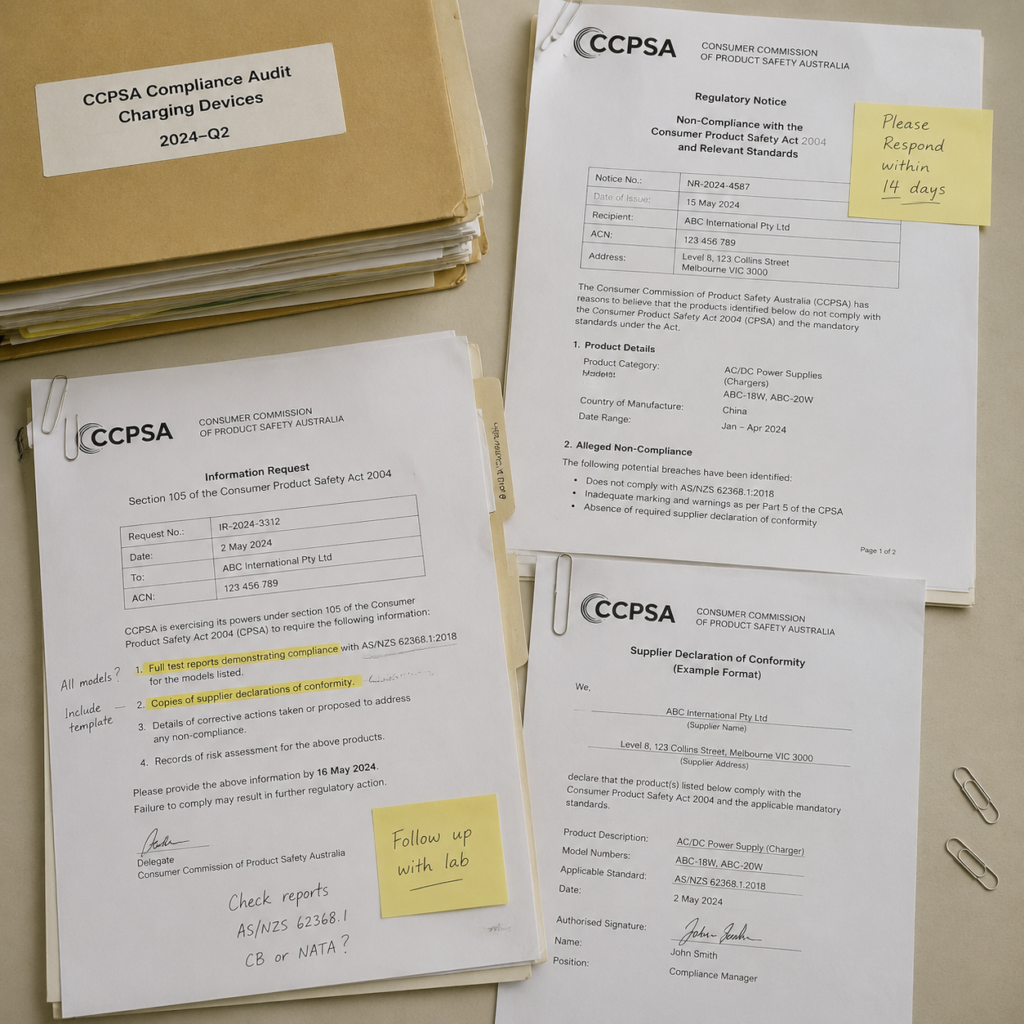
First: Prohibit the import and sale of unsafe products
This is the most basic bottom line. How to determine if a product is “unsafe”? It’s not just about whether there is certification, but about whether there is a foreseeable risk of personal injury.
For charging products, the most common violations include: no valid safety certification recognized by Canada, plugs that do not meet Canadian standards, falsely labeled power or output current, and substandard insulation or flame-retardant materials. These problems can directly lead to electric shock and fire, and are clearly unsafe products.
There are also several behaviors that are explicitly prohibited, so never touch them: importing and selling products knowing they have hidden dangers, falsely promoting the safety performance of products, or using or counterfeiting others’ certification marks — these are intentional violations, and the penalties will be heavier if caught.
Second: Retain compliance records for at least 6 years
Many people easily overlook this point: CCPSA requires importers to retain complete compliance records; it’s not that everything is fine once the goods are sold.
Documents that need to be retained include: product certification or test reports, supplier information, import records for each batch, sales flow records, and versions of product labels and manuals. Simply put, all materials that can prove your products are compliant, where they came from, and where they were sold must be kept properly.
The retention requirement is to keep relevant records for at least 6 years in accordance with CCPSA regulations, and ensure that they can be retrieved and provided in a timely manner when required by Health Canada; for internal management, retention can be extended based on the import or sales time of the last batch to avoid omissions. Both electronic and paper forms are acceptable, but if you cannot produce them during random inspections, even if the product itself has no problems, you may be penalized for non-compliant records.
There is also a special requirement for charging products: certification documents must correspond one-to-one by model and batch, and models cannot be mixed. For example, if you have 10 chargers with different power ratings, you need 10 corresponding certifications; you cannot use one 65W certification to cover all models.
Third: Report promptly in case of hazards or accidents
If your product has a safety risk, you cannot cover it up; you must report it to Health Canada in accordance with regulations.
Scenarios that trigger a report include: the product has caused or may cause electric shock, fire, overheating, melting, personal injury, or the same product has been recalled overseas — even if the reason for the overseas recall has not been clarified, as long as it is the same model, you must evaluate whether to report it.
The time limit for reporting is very strict: starting from the day you become aware of the risk, a preliminary report must be submitted within 2 days, and a full written report must be submitted within 10 days. Here we also correct a common misunderstanding: you don’t have to wait for the result of liability determination, nor wait to confirm whether it is a product problem. As long as you are aware of the risk, you must report first — for example, if a buyer says your charger is smoking, you don’t have to wait to investigate whether it’s the buyer’s misuse or a product problem; submit a preliminary report first, otherwise you may be fined for late reporting.
For charging products, these are accident signals that need to be vigilant: product smoking, burnt prongs, abnormally hot cable body, blackened interfaces, and damaged connected devices. As long as such complaints occur, you must investigate immediately and report promptly if they meet the conditions.
Fourth: Cooperate with supervision and conduct recalls when necessary
In daily operations, Health Canada may randomly inspect your products and require you to provide samples and submit compliance materials. At this time, you must cooperate and cannot refuse or delay.
If a product problem is really found and a recall is required, don’t think that a recall means returning all goods — there are many forms of recall, such as refunds to consumers, free replacement of qualified products, supplementary safety warnings, and direct sales suspension, all of which are compliant recall methods. The specific method depends on the risk level.
Recalls must be carried out in accordance with regulations: you must notify consumers who purchased the product, publicize the risks, dispose of remaining inventory, and finally submit a rectification report. For cross-border sellers, there is a very important reminder here: you must manage inventory and sales records by batch. Otherwise, when a recall is really needed, you won’t even know which goods were sold to whom or how many batches were shipped, which will only make things more troublesome.
Exclusive Compliance Points for Charging Products (Self-Check for Beginners)
CCPSA is a general safety law covering all consumer products, but charging products have higher risks and more detailed rules because they are related to electricity. Here we first clarify two layers of relationships to avoid confusion:
The first layer is the general obligations of CCPSA: no matter what consumer product, there must be no foreseeable safety risks, records must be kept, incidents must be reported, and recalls must be cooperated with — these have been covered earlier.
The second layer is the electrical safety certification requirements for plug-in products: charging products that are directly plugged into Canadian wall sockets (such as chargers, power adapters, and all-in-one charging cables with wall plugs) must be tested by a third-party organization officially recognized by Canada and obtain electrical safety certification that meets Canadian standards — this is the core evidence to prove the electrical safety of the product, and also an important basis for judging whether the product is safe under CCPSA.
As for low-voltage accessories that are not directly connected to the mains, such as ordinary USB charging cables and USB-C adapters that are not plugged into the wall at either end, they only need to meet basic safety requirements such as insulation, flame retardancy, sufficient wire diameter, and accurate labeling. Whether to obtain the same electrical safety certification depends on the specific structure of the product, applicable standards, and the requirements of your sales channel, and cannot be generalized.
The way to judge whether a certification is valid is very simple: check if the mark has the letter “c”, such as cUL, CSA, cETL, etc. The “c” means it meets Canadian safety standards, and real certifications can be checked by entering the certificate number or model on the certification body’s official website.
Exclusive Requirements for Chargers and Power Adapters
This type of product is the top priority of supervision, and the requirements are the strictest:
• In terms of certification, you must hold electrical safety certification issued by a Canadian-recognized body, such as cUL, CSA, or cETL;
• In terms of plugs, the prong form should meet applicable Canadian plug standards and certification requirements, commonly NEMA series specifications adapted to the 120V/60Hz power grid (the familiar two-flat plugs and three-flat plugs with grounding all belong to this system); whether to use a polarized two-prong plug or a grounded three-prong plug depends on the product’s power, insulation class, and the markings on the certification report. Not all chargers must be polarized flat plugs with one wide and one narrow prong;
• In terms of parameters, the rated input voltage must cover 120V, and power or output current cannot be falsely labeled. For example, labeling 65W but actually only having 20W is definitely not allowed;
• Common high-risk points include: loose prongs that easily fall off, substandard shell flame-retardant materials, and poor heat dissipation design leading to overheating at full load.
Exclusive Requirements for Charging Cables and USB-C Interface Accessories
Many people think that charging cables have low requirements, but that’s not the case; their safety risks are just as significant:
• The basic requirement is that the insulation layer and flame retardancy must meet standards, and the wire diameter and terminal connections must be reliable to prevent electric leakage, overheating, or fire;
• If it is a cable labeled as fast charging, it should match its labeled current/power capacity; high-current or high-power USB-C cables should have corresponding electronic marker chips (E-Marker) or identification capabilities to ensure that when the power supply and device negotiate power, they do not exceed the cable’s load limit — voltage and current negotiation mainly occurs between the charger and the device, and the cable itself does not need to actively “negotiate”, but it must be able to carry the negotiated power;
• There is a special situation to note: all-in-one charging cables with wall plugs, that is, those where the head and cable are connected together and cannot be disassembled, must be certified according to charger requirements, and cannot be counted as ordinary charging cables only;
• Common high-risk points: insufficient wire diameter leading to overheating at high current, loose interfaces causing poor contact, and counterfeit fast charging protocols that actually cannot reach the labeled power.
Product Labeling and Language Requirements
There are also mandatory requirements for labels on products, which cannot be printed arbitrarily:
• Mandatory labeling content includes: importer’s name and address, rated voltage/current/power, product model;
• In terms of language, if sold across Canada, it must be bilingual in English and French; if sold only in Quebec, French must be prioritized to meet Quebec’s language requirements;
• The certification mark must be real and valid, consistent with the actual product model, and certificate fraud is prohibited — that is, using the certification of model A on model B.
4-Step Quick Self-Check Method
For beginners, you don’t need to memorize so many details. Checking according to these 4 steps can eliminate 80% of basic compliance problems:
1. Check the appearance: whether there is a certification mark with “c” on the product, whether there is importer information, and whether there are bilingual (English and French) parameter labels;
2. Check the plug: whether it is a plug that meets Canadian NEMA specifications, and whether the input voltage is labeled 120V (or a range covering 120V such as 100-240V);
3. Verify information: whether the model and parameters on the product are consistent with those on the label and certification report, and whether there are any discrepancies;
4. Verify documents: ask the supplier to provide the certification certificate, enter the certificate number or model on the certification body’s official website, and check whether it is real and within the validity period.
Compliance Operation Steps for the Entire Import Process (Directly Applicable)
Now that you know the requirements, how do you operate specifically in the entire process from product selection to sales? The following steps can be directly applied.
Before Import: Guard the First Pass
Before the goods are shipped, it is the compliance stage with the lowest cost. You must solve problems before shipping:
• First, classify products: confirm whether you are selling chargers, charging cables, or other accessories. Different categories correspond to different requirements, so don’t confuse them;
• Verify certification: ask the supplier for a certification report recognized by Canada, verify its authenticity on the official website, and confirm that the model, parameters, and plug all match;
• Check labels: see if the importer information, electrical parameters, and bilingual (English and French) content on the product are complete and not missing;
• Compare samples: compare the bulk product sample with the sample used for certification to see if the plug, shell, and nameplate are the same. Don’t use good materials for certification but shoddy materials for bulk goods.
During Customs Clearance: Don’t Conceal Information, Prepare All Documents
At the customs clearance stage, the most common problems are concealed declaration or incomplete documents:
• Declare truthfully: category, HS code, goods value, and purpose must all be declared truthfully. Don’t describe chargers as ordinary accessories; the penalty will be heavier if caught;
• Prepare documents in advance: certification certificates, importer information, batch records, etc., should be prepared in advance so that they can be produced immediately in case of CBSA random inspection;
• If the goods are really detained, don’t panic. There are three optional treatment methods: supplementary certification (if the product itself is qualified), return, or destruction. Never conceal information or commit fraud, as this will only aggravate the penalty.
After Launch: Do a Good Job of Daily Maintenance
Once the goods are sold, you can’t ignore them; daily maintenance is very important:
• Record management: all compliance documents, import records, and sales records should be archived by batch, and electronic backups are best to prevent loss;
• Risk monitoring: pay more attention to complaints and negative reviews on a daily basis, focusing on keywords such as “overheating”, “smoking”, “burning”, and “electric shock”. Investigate as soon as they appear;
• Change management: if you later change suppliers, materials, product models, or adjust power, you must re-evaluate compliance. Don’t think that the same appearance means everything is fine; internal changes may make the product no longer comply with the original certification.
Intermediate Improvement: Risk Judgment and Pitfall Avoidance Guide
The previous content can help you achieve basic compliance. If you want to go further and learn to judge risks and avoid common pitfalls, remember the following content well.
5 Common Misconceptions to Avoid
Many people violate regulations not intentionally, but because they are misled by wrong information. These 5 most common misconceptions must be avoided:
1. Does having FCC/CE certification mean compliance with CCPSA? Wrong. FCC is the US electromagnetic compatibility certification and does not cover electrical safety; CE is the EU standard. Neither can replace Canadian safety certification. Don’t be fooled by suppliers.
2. Do small batches, samples, and self-fulfilled shipments not need compliance? Wrong. As long as they are for commercial sale, even 1 sample must meet CCPSA requirements. Don’t take chances with the idea that “shipping a few to test won’t get inspected”.
3. Are platforms or freight forwarders responsible for compliance? Wrong. Platforms are only sales channels, and freight forwarders are only responsible for transportation and customs clearance procedures. The ultimate responsibility for compliance always lies with the importer.
4. Does CCPSA require mandatory registration? Wrong. Ordinary charging products do not need any mandatory registration. They only need to meet safety requirements and keep good records. Don’t be tricked into paying registration fees.
5. Can products with the same appearance share certification? Wrong. If the internal circuit, power, or materials used are different, even if the appearance is exactly the same, you must re-do the certification and cannot share the same certificate. Otherwise, it is certificate fraud, which is a violation.
Overview of Violation Risk Levels
Not all violations are equally serious. You can compare with the table below to quickly judge the risk level and have a clear idea:
| Risk Level | Common Violation Situations | Possible Handling Results |
| Low Risk | Missing French on labels, incomplete importer information | Usually requires correction of labels or materials; whether a penalty is imposed depends on regulatory judgment, generally no large fines |
| Medium Risk | No valid certification but product passes actual testing | May require supplementary certification, additional materials, return of goods, or sales suspension; release is not guaranteed, and small fines may be imposed |
| High Risk | No certification, unqualified plugs, fire/electric shock hazards | High probability of goods detention, fines, and recall requirements; specifics depend on the degree of risk |
| Severe Risk | Importing and selling products knowing they have hidden dangers | Heavier penalties, possible criminal liability, adjusted based on subjective fault and degree of harm |
Responsibility Division for Different Import Scenarios
Different import modes have different responsibility divisions, so don’t confuse them:
• FBA/self-built warehouse stocking: the goods owner, i.e., the seller, is the legal importer and bears all CCPSA obligations, there’s nothing more to say;
• Imported by a local Canadian company on behalf: the import agency company is the legal importer and bears primary responsibility; it should be noted that the written agreement between the two parties can only clarify the internal responsibility division and material cooperation obligations, and cannot exempt the brand owner, actual seller, or distributor from their statutory responsibilities under CCPSA for product safety, label compliance, incident reporting, and recall cooperation;
• Direct mail for personal use: if the buyer clears customs themselves and buys for their own use, not for commercial purposes, the seller does not need to bear importer obligations;
• B2B distribution to local merchants: even if you sell all the goods to local wholesalers, as the upstream importer, you still bear the primary responsibility for product safety; it’s not that everything is fine once the goods are sold.
4 Methods for Quick Risk Judgment
In daily business operations, you can use these methods to quickly check for risks:
• Certification authenticity judgment: directly go to the certification body’s official website, enter the certificate number or product model to query, don’t just look at the pictures provided by the supplier — there are too many Photoshopped certification certificates;
• Certification coverage judgment: after getting the certificate, carefully check the product model, power, plug type, and manufacturing factory on it to see if they are completely consistent with the product you actually want to import. Even one mismatch is not allowed;
• Early risk identification: if there are more than 2 complaints of overheating, odor, or burnt interfaces for products of the same batch, you must immediately stop sales and investigate, don’t wait for a major incident to handle it;
• Overseas recall impact judgment: if the same product is recalled in Europe, the US, or other countries, immediately evaluate whether the same batch of products in Canada has the same risk. If so, report it proactively, don’t wait for Health Canada to come to you.
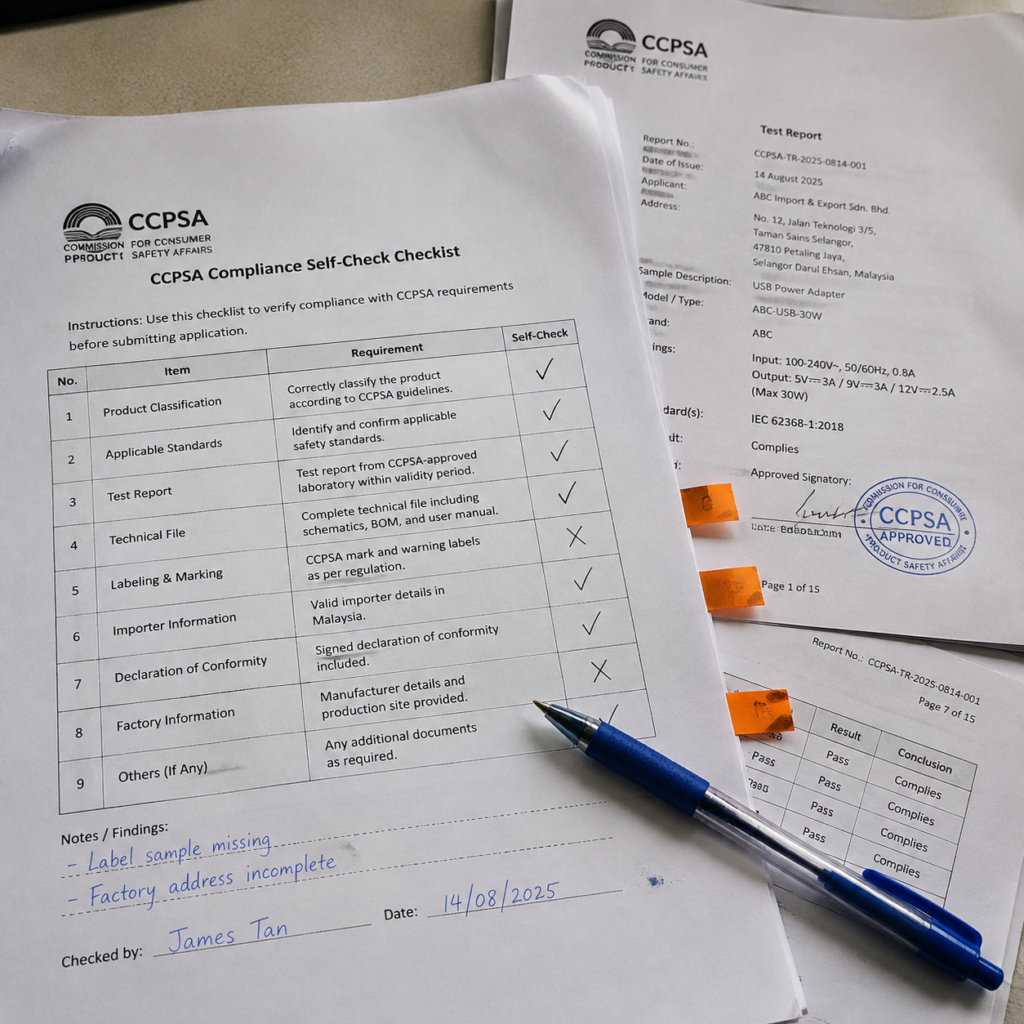
CCPSA Compliance Self-Check List for Charging Products
To facilitate everyone’s comparison and inspection, we have compiled a phased self-check list that you can save directly and check off each step:
Pre-Import Check Items
• [ ] Confirm that the product is a consumer charging product under the jurisdiction of CCPSA
• [ ] Obtain valid safety certification recognized by Canada, with matching model, parameters, and plug
• [ ] Product labels include importer information, electrical parameters, and are bilingual in English and French
• [ ] The actual plug, shell, and nameplate are consistent with the certification sample
• [ ] Establish product batch and supplier records
Pre-Listing Check Items
• [ ] Product pages do not exaggerate certification or safety performance
• [ ] Power parameters and compatible device descriptions are consistent with the actual product
• [ ] Multi-port/fast charging products clearly label the difference between total power and single-port power
• [ ] Products sold in Quebec meet French language requirements
In-Sales Monitoring Items
• [ ] Establish complaint keyword monitoring (overheating, smoking, burning, electric shock, etc.)
• [ ] Complete batch records, traceable import/sales flow
• [ ] Regularly spot-check the consistency of inventory products with certification materials
• [ ] Re-evaluate compliance when suppliers, materials, models, or power change
Post-Incident/Regulatory Trigger Handling Items
• [ ] Evaluate within 24 hours whether the CCPSA incident reporting threshold is met
• [ ] Submit a preliminary report within 2 days, and a full report within 10 days
• [ ] Immediately suspend sales and isolate inventory in case of high risk
• [ ] Retain all investigation, communication, and rectification records
Final Summary
In fact, the core logic of CCPSA is not complicated. Just remember three principles: the importer bears primary responsibility, safety and compliance are the bottom line, records must be kept for 6 full years, and risks must be reported promptly without concealment.
Mastering the above content will allow you to independently judge whether you are an importer under CCPSA, quickly self-check the basic compliance of charging products, identify common misconceptions and risk levels, and complete full-link compliance operations and preliminary handling of emergencies according to the process.
The above content can cover the core scenarios of CCPSA compliance for importers of charging products, for reference and implementation in actual operations.