
If you intend to purchase or sell products such as chargers, charging cables, and power adapters in Canada, you will almost certainly encounter the three terms CCPSA, CSA, and cUL at the same time. Many people mix them up: some think CCPSA is a type of certification, some believe that having the CSA/cUL mark means 100% compliance with all requirements, and others take US UL certification to sell products directly in Canada, only to have their goods detained. In fact, the three have completely different positioning: one is the safety baseline set by federal law, and the other two are officially recognized third-party compliance credentials. Clarifying their relationship can help both ordinary consumers avoid pitfalls and sellers carry out compliance work with fewer detours.
First, Understand the Three Core Concepts
Let us first clarify the identities of the three terms to avoid the most basic confusion.
CCPSA: Canada’s Consumer Product Safety Law
The full name of CCPSA is the Canada Consumer Product Safety Act, which is a federal-level consumer product safety law in Canada. All consumer products sold within Canada (including the chargers, power adapters, charging cables, accessories with charging ports, plugs, etc. that we commonly contact) must comply with it.
Its enforcement is led by Health Canada, with the Canada Border Services Agency cooperating to conduct random inspections and detain goods at the border. Its core regulatory goal is to prevent foreseeable safety risks such as electric shock, fire, and overheating.
Here, we must first correct a most common misconception: CCPSA is a law, not a certification, and has no exclusive certification mark. You will not see the so-called “CCPSA certification mark” on products. It is the safety baseline that all consumer-facing products must meet, not an optional certification.
CSA Certification: Canada’s Most Mainstream Third-Party Safety Certification
CSA is the abbreviation of CSA Group (Canadian Standards Association), which has both standard development business and testing and certification business accredited by the Standards Council of Canada (SCC, the official unit in Canada responsible for supervising certification bodies). The CSA certification for charging products such as chargers and power adapters is usually tested and evaluated in accordance with applicable electrical safety standards in Canada.
For charging products, the coverage of CSA certification includes core safety items such as insulation performance, overload protection, plug size compliance, shell flame retardancy, and operating temperature rise. Products that have passed certification or the corresponding certificates are usually marked with verifiable information such as the certification mark, file number/certificate number, and model. You can check the model covered by the certification, manufacturing factory, valid status, and applicable standards through the official CSA database or the information provided by the certificate holder; the publicly queryable fields may vary depending on the certification program.
cUL Certification: Canadian Safety Certification Under the UL System, Equivalent to CSA
Many people know that UL is a well-known US safety certification body, and cUL is a safety certification issued by UL Solutions under its Canadian certification system, in accordance with applicable Canadian standards and within the scope of SCC accreditation, and is specifically applicable to the Canadian market.
cUL and CSA have exactly the same regulatory recognition—because both are conformity assessment bodies authorized by the SCC, they belong to the same level of certification. There are two common cUL marks: the pure cUL mark is only applicable to the Canadian market, and the cULus mark, within the scope of the model, factory, parameters and applicable standards covered by the certificate, can be used as the basis for electrical safety certification for both the US and Canadian markets at the same time.
Special attention should be paid: only UL marks with the “c” prefix are recognized in Canada. Ordinary US UL marks (without c) only meet US requirements and cannot be used as proof of electrical safety compliance in Canada.
The Hierarchy of the Three: The Relationship Between Law, Standards, and Certification
If we use the familiar analogy of an exam, the relationship between the three is very easy to understand:
• CCPSA is the passing line: the minimum safety requirement stipulated by law, and failing to meet it is illegal;
• Canadian safety standards are the exam syllabus: they break down the principled requirements of the law into specific technical indicators, such as how many volts the insulation must withstand, and how much the temperature rise cannot exceed;
• CSA/cUL certification is the pass certificate issued by a third party: a third-party institution recognized by the official tests according to the syllabus (standards) to prove that the product has reached the passing line (the core safety requirements of CCPSA).
Simply put, CCPSA is the “requirement that must be met”, and CSA/cUL is the “common credential to prove that you have met it”.
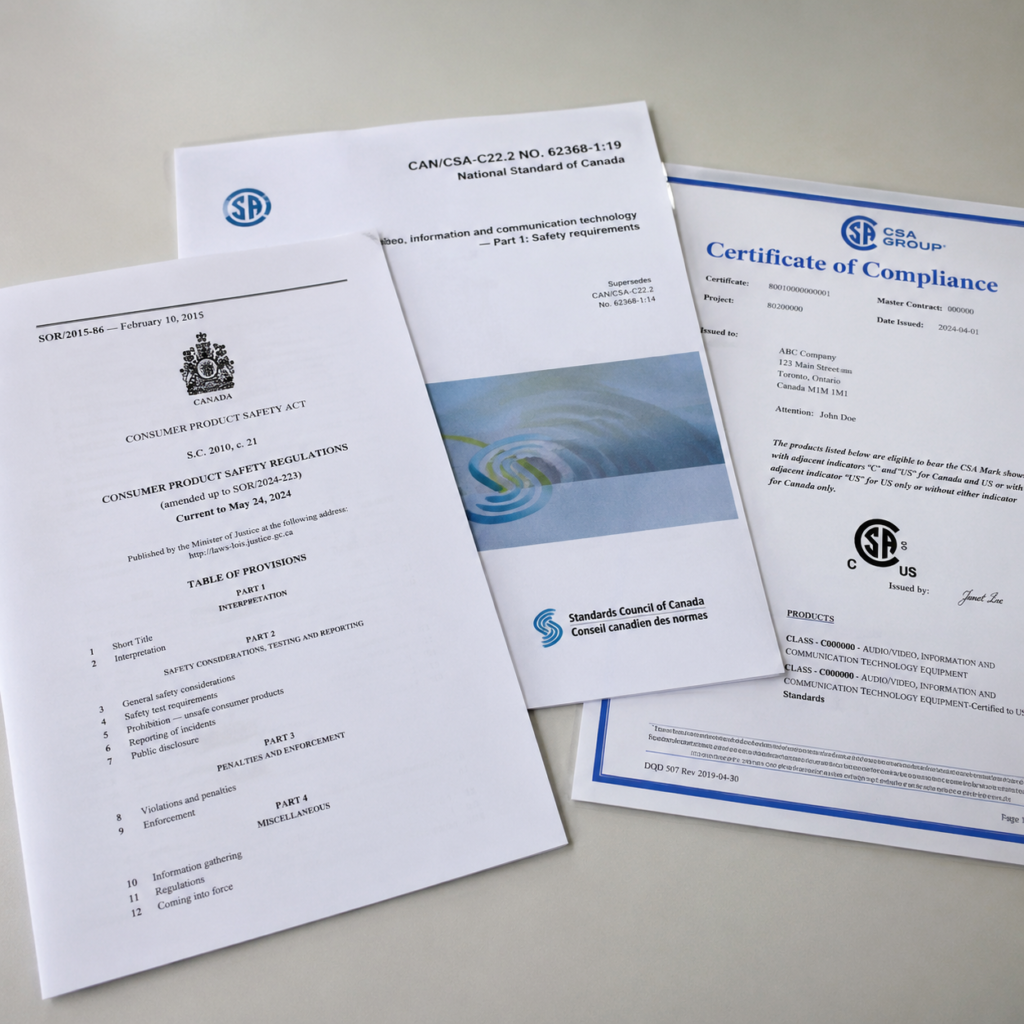
Core Relationship: Legal Requirements and Compliance Certification Tools
Many people will ask: since CCPSA does not mandate third-party certification, why do almost all charging products need CSA/cUL to be sold? This requires clarifying the essential difference between the two, and why the charging category binds certification and legal compliance so closely.
Essential Positioning: One is the Rule, the Other is the Proof
First of all, we must clarify the core difference between the two:
• CCPSA is a mandatory safety rule: violating it will result in penalties such as goods detention, fines, and product recalls, which is a hard baseline;
• CSA/cUL is a third-party compliance certificate: it is not a rule itself, but just a tool to prove that the product meets the rules.
The two are in a relationship of “target requirement” and “certification path”, and cannot replace each other at all.
Why Are Charging Products Always Bound to Both?
Although the federal CCPSA does not mandate third-party certification, charging products are high-risk categories, and in practice, CSA/cUL certification is almost always required by default, mainly for three reasons:
First, regulatory priority verification: charging products are key targets for random inspections by border and market regulators because they are prone to risks such as overheating, fire, and electric shock. CSA/cUL has the highest recognition, and when regulators see valid certification, they usually first default that the product is likely to be compliant, reducing a lot of communication costs;
Second, channel mandatory requirements: almost all mainstream e-commerce platforms and offline retailers in Canada require charging products to hold SCC-accredited certification before they can be listed, and without a certificate, there is no even entry qualification;
Third, supplementary provincial regulations: electrical equipment connected to the mains usually also needs to meet the “recognized/certified” requirements under provincial/territorial electrical safety regulations or electrical codes. The common compliance path is to obtain CSA, cUL and other certifications from SCC-accredited certification bodies; the specific scope of application needs to be checked according to the product category and the province of sale, which is equivalent to turning the “non-mandatory” at the federal level into a practical prerequisite in many scenarios.
Basis for Official Recognition
The core reason why CSA and cUL can become mainstream compliance credentials is official endorsement: both are conformity assessment bodies authorized by the SCC (Standards Council of Canada), so valid CSA/cUL certification can usually be used as core evidence that the electrical safety of products such as chargers and adapters meets applicable Canadian standards. In the process of law enforcement, regulatory authorities will give priority to recognizing these certifications, and enterprises do not need to submit a large number of basic test reports to prove compliance by themselves, which can greatly reduce the time and communication costs of compliance.
However, it should be noted that CSA/cUL certification cannot cover all obligations under CCPSA. For example, requirements such as record keeping, incident reporting, recall cooperation, and sales consistency still need to be implemented separately by enterprises.
Regarding the relationship between the two, there are two core boundaries that cannot be taken to extremes: first, having certification does not mean 100% compliance with all requirements of the Canadian market, and second, no certification does not necessarily mean it is illegal. We will break down the specific failure scenarios and practical limitations in detail in the misconception section later.
Charging Products: Correspondence Between CCPSA Requirements and Certification
You may still be curious: how exactly do the requirements of CCPSA correspond to the content of CSA/cUL certification? Let’s use the specific requirements of charging products to correspond, and it will be very clear.
Correspondence of General Safety and Traceability Requirements
CCPSA has two core requirements for charging products: first, there must be no foreseeable safety risks, and second, the products must be traceable so that recalls can be coordinated when problems occur.
The CSA/cUL certification process just covers the verification of core safety requirements: during certification, type testing and evaluation will be carried out in accordance with applicable standards, which may include items such as insulation withstand voltage, temperature rise, abnormal operation, overload/short circuit protection, and flame retardancy; the specific items depend on the product type and applicable standards. For example, USB-C power adapters usually focus on safety items such as output abnormalities, insulation withstand voltage, and temperature rise. At the same time, the certification will file the product model, manufacturer, and key material list. Through the certification information, it can help lock the corresponding certified model, production factory, and key product structure, providing basic information for traceability; but for complete batch traceability, importers and sellers still need to keep records of suppliers, purchase batches, sales flow, etc. in accordance with CCPSA requirements to achieve accurate positioning and recall.
Correspondence of Product Labeling Requirements
Many people regard all parameter labels on products as mandatory requirements of CCPSA, but in fact, the requirements of the two have their own focuses:
On the one hand, applicable electrical safety standards in Canada and the certification conditions of CSA/cUL usually require products to be marked with rated input and output parameters, model, certification mark and other information to ensure that the product will not be misused;
On the other hand, as a framework safety law, CCPSA emphasizes that foreseeable safety risks must not be caused by missing or misleading labels, and at the same time requires that the responsible party of the product be traceable and can be contacted quickly when problems occur.
If the parameters marked on the product are inconsistent with those filed in the certification, even if the certification has been passed, it will not only fail to meet the labeling requirements of the certification, but may also violate CCPSA due to misleading consumers. For example, a charger filed as 20W is privately changed to 65W, even if it has the CSA mark, it is illegal.
Certification Focuses of Different Charging Products
Different types of charging products have different risk points, and the testing focuses of certification are also different:
• Wall-plug chargers/power adapters: the key tests are plug size compliance, insulation performance, overload protection, shell flame retardancy, and operating temperature rise, which are the parts most likely to cause safety accidents;
• High-power charging cables: such as USB-C fast charging cables with E-Marker chips (supporting high-power transmission, with built-in chips to negotiate charging power), the key tests are current carrying capacity, cable flame retardancy, interface reliability, and parameter labeling, to avoid overheating caused by insufficient wire diameter or poor contact;
• Multi-port fast charging/power supply docking stations: the key tests are power distribution when multiple ports are used at the same time, temperature rise under multiple loads, and short circuit protection, to prevent power overload when charging multiple devices;
• Wireless chargers: the key tests are foreign object detection (for example, whether a coin dropped on the charging pad will overheat), operating temperature rise, and electrical safety, to avoid fire caused by foreign object heating.
Clarification of Common Misconceptions
Regarding the relationship between CCPSA and CSA/cUL, there are several very easy pitfalls, let’s explain them one by one.
Misconception 1: Having Certification Means 100% Compliance with Canadian Market Requirements
This is the most common misunderstanding. Having certification only proves that the sample at the time of testing meets the requirements of the corresponding electrical safety standard, but if the actually sold product has the following situations, it may still violate CCPSA or other market rules:
• Invalid certification status or invalid authorization to use the mark: for example, the certification is suspended or revoked, the subsequent factory inspection is not passed, the conversion is not completed in accordance with the standard update requirements, or the certification no longer covers this model;
• The product is inconsistent with the filing: for example, key materials such as transformers and wires are secretly replaced, or the circuit design is privately modified without re-certification;
• Insufficient certification coverage: for example, a separately sold charging cable uses the certification of the whole mobile phone, but in fact, the accessory sold separately needs to independently confirm the certification coverage;
• Other compliance requirements are not covered: for example, the French labeling requirements of Quebec, special label rules of provinces/channels, information of the responsible party in Canada, etc. These are not mandatory test items of CSA/cUL, but are compliance requirements of the Canadian market. If they are not done, even with certification, it may be non-compliant.
Misconception 2: No Certification Means It Must Violate CCPSA
Many people think that Canada mandates CSA/cUL certification, but that is not the case. The core requirement of CCPSA is “product safety”, not “must have third-party certification”. In theory, as long as an enterprise can produce sufficient test data to prove that the product meets safety standards, it can be compliant even without CSA/cUL.
However, in practice, the burden of proof for high-risk charging products is extremely high, and it is difficult for regulatory authorities to quickly recognize reports provided by enterprises themselves. Coupled with the fact that mainstream channels require certification to be listed, products without certification are almost impossible to sell normally in the Canadian market.
Misconception 3: US UL Certification Can Be Used Directly in Canada
Many suppliers will use US UL certificates to fool customers, saying that UL is an international certification and is also recognized in Canada. In fact, ordinary UL certification (without the c prefix) only meets US safety requirements and is not recognized by Canadian officials at all. Only UL certification with the “cUL” or “cULus” mark is the certification under the UL system that meets Canadian requirements.
When buying goods or selecting suppliers, you must check whether there is a “c” prefix on the mark, and do not use a US UL certificate as a Canadian one.
Misconception 4: CE/FCC/CCC Can Replace CSA/cUL
Some people think that since they are all safety-related certifications, CE (EU), FCC (US), and CCC (China Compulsory Certification) should also be universal. In fact, the standard systems and test requirements of these certifications are different from those of Canada, and cannot replace SCC-accredited electrical safety certifications such as CSA/cUL applicable in Canada.
Special attention should be paid to FCC: it mainly focuses on electromagnetic compatibility and radio frequency compliance, and does not verify electrical safety, so it cannot be used to prove the electrical safety performance of chargers and adapters at all.
Certification reports from other regions can at most be used as technical references or supplementary materials. To prove compliance with Canadian requirements, it is still necessary to check against applicable Canadian standards item by item and meet the relevant regulations of regulators and channels.
Misconception 5: Products of the Same Brand and Same Appearance Can Share Certification
Many people think that chargers of the same brand and the same appearance can share certification. In fact, certification is “one model, one certificate”, which only corresponds to the specific model, parameters, and production factory. Even if the appearance is exactly the same, as long as the power, internal components, or production factory change, the original certification will be invalid.
The most common pitfall is that 20W and 65W chargers with the same appearance, suppliers say they use the same certification, which is actually invalid, and there will be problems once inspected.
Misconception 6: Low-Voltage Charging Cables Do Not Need Safety Certification
Many people think that charging cables are low-voltage, have no safety problems, and do not need certification. In fact, for high-power USB-C cables, cables with E-Marker, or cable assemblies sold as independent products, it is necessary to check whether they fall within the scope of applicable electrical safety standards, cable assembly certification or channel requirements; even if separate CSA/cUL certification is not required, it must be proved that the current carrying capacity, temperature rise, flame retardancy, interface reliability and labeling meet the requirements.
Even low-power ordinary charging cables cannot be defaulted to be exempted, and should be judged according to their use, sales form and provincial requirements; at the very least, they must meet the general safety obligations of CCPSA, for example, they cannot break when pulled, cannot overheat and melt, and they will still be held responsible if there is a problem.
Practical Guide: Compliance Judgment and Self-Inspection Methods
After talking so much, whether you are an ordinary consumer buying charging products, or a seller/importer doing business in the Canadian market, you can use the following methods to make a preliminary compliance judgment.
Consumer Quick Judgment Method (Beginner)
If you buy chargers and fast charging cables in Canada by yourself and are afraid of buying non-compliant products, follow these steps:
1. Check the mark: prioritize products printed with CSA, cUL, cULus marks, and avoid those with only UL, CE, FCC marks;
2. Check parameters and plugs: the input parameters should cover Canadian mains conditions, for example, marked 100-240V~ 50/60Hz or clearly applicable to 120V, 60Hz; the plug should be North American Type A/B, and the parameter printing is clear without blurring or alteration;
3. Check the number: find the certification file number/certificate number next to the mark, enter the number on the official website of CSA or UL to check whether the model matches and whether the certification is in valid status; if the public information is incomplete, you can ask the merchant to provide a valid certificate as proof;
4. Check the appearance: the plug prongs are not loose, the shell is not cracked or has peculiar smell, and the thickness of the cable matches the power (for example, a 65W fast charging cable is much thicker than an ordinary 10W cable).
Seller/Importer Certification Selection (Intermediate)
If you are a seller or importer doing business in the Canadian market, you can choose certification according to the market:
• Only for the Canadian single market: both CSA and cUL are acceptable, with the same recognition. Just compare the certification cost and cycle to choose the one with high cost performance;
• For both US and Canadian markets at the same time: prioritize cULus or CSA certification with the us mark, which covers two markets with one certification within the scope of the certificate, saving a lot of cost and time.
Special attention should be paid: what you choose must be electrical safety certification. Performance certification and energy efficiency certification cannot be used as compliance proof for CCPSA, so don’t waste money.
Key Points for Checking Certification Validity (Intermediate)
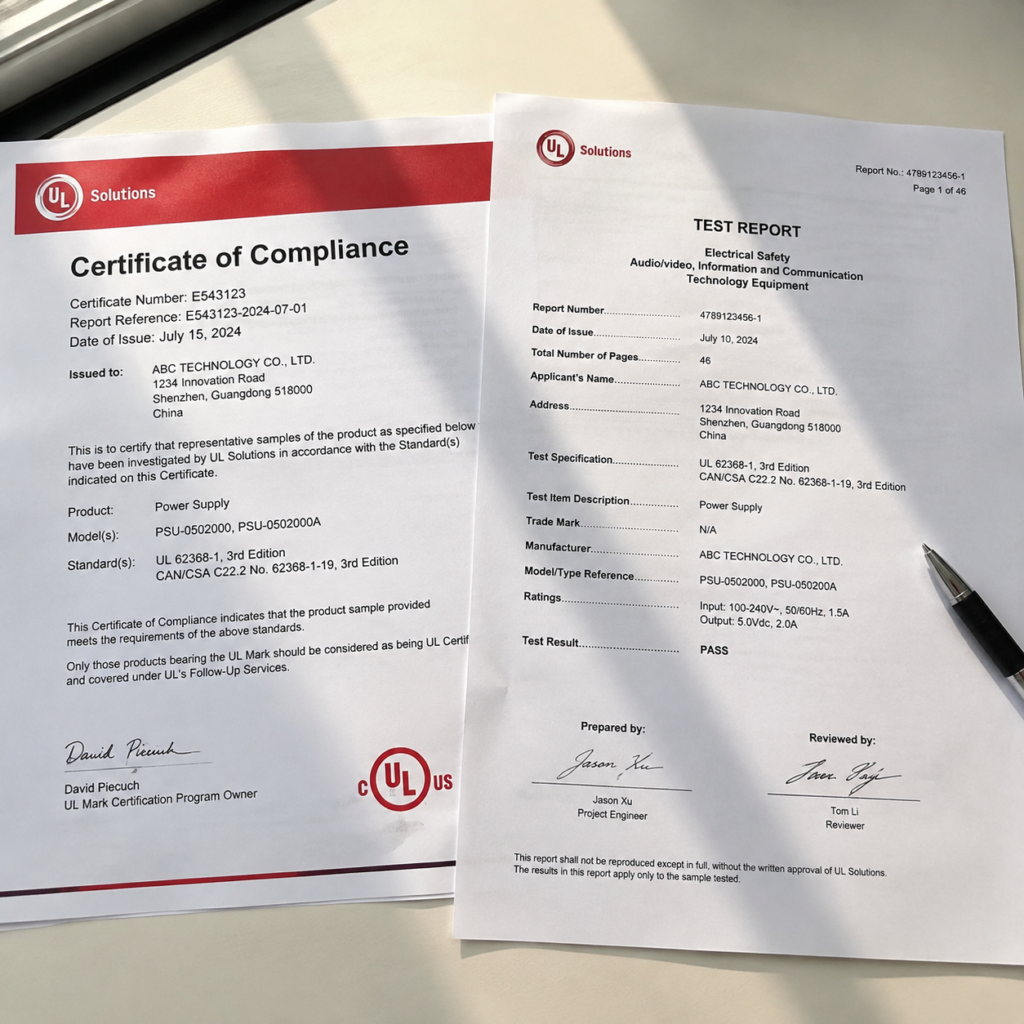
After getting the certification certificate, be sure to check two key points to avoid getting an invalid certificate:
1. Consistent information: the model, electrical parameters, production factory, and cable specifications on the certificate must be completely consistent with the actually sold product, and any item that does not match is not acceptable;
2. Valid status: the certification has not been suspended or revoked, the standard adopted is the current valid version in Canada, and the requirements for maintaining certification such as factory inspections have been met.
Supplementing Additional Requirements of CCPSA and the Canadian Market
In addition to the certification itself, it is also necessary to supplement other compliance requirements of CCPSA and the Canadian market to avoid non-compliance even with certification:
• Labeling requirements: safety warnings are best in both English and French. Among them, the French labeling requirement in Quebec comes from local language regulations and consumer information regulations, which is a mandatory requirement; although other provinces do not mandate French, bilingual labels are more recognized in law enforcement. If you do the national market, it is safest to do bilingual directly;
• Subject information: it should be ensured that there is traceable Canadian responsible party/importer information in the product, packaging, manual or compliance records, to meet the needs of record keeping, incident reporting and recall communication; which information must be marked on the product body or packaging should be checked in combination with applicable standards, labeling rules and the province of sale; you cannot only mark the overseas factory address that cannot be traced quickly;
• Consistency requirements: the model and parameters of the product body, packaging, and certification filing must be unified. It is not allowed to write 65W on the packaging and 20W on the product.
Reference for Risk Stratification of Charging Products
Different charging products have different risk levels, and the strictness of compliance requirements is also different. You can confirm according to this priority:
• High risk (prioritize certification confirmation): wall-plug chargers, power adapters, fast chargers of 65W and above. These are the key targets of regulatory random inspections, and it is necessary to ensure that the certification is valid;
• Medium risk (need to confirm compliance): wireless chargers, car chargers, USB-C docking stations with power supply function. These products also belong to the high-risk category and need to be confirmed to meet safety requirements;
• Low risk (need to meet general safety requirements): low-power charging cables, ordinary adapters, data cables. These products need to be judged whether they need separate certification according to the sales form and provincial requirements, and at least meet the basic safety requirements without potential safety hazards.
Boundaries and Exceptions: These Special Situations Need Attention
In addition to the general rules, there are several special boundary situations that are easy to be ignored.
Boundary Between Commercial/Industrial and Consumer Products
CCPSA only applies to charging products sold to ordinary consumers. If they are industrial-grade and commercial charging equipment specially sold to enterprises, other regulations apply. But note: you cannot arbitrarily label products sold to consumers as “industrial-grade” to evade CCPSA responsibilities. As long as the product is available and usable by ordinary consumers, even if it is called “industrial-grade”, it must comply with CCPSA.
Differences in Provincial Rules
There are slight differences in compliance requirements among Canadian provinces, and they are not only reflected in the label language: on the one hand, Quebec mandates that product labels must have French. Although other provinces do not mandate French, bilingual labels are more recognized in law enforcement; on the other hand, the implementation rules for “recognized/certified” electrical equipment also vary from place to place. If you do the national market, it is recommended to prepare directly according to the strictest label language requirements and the most reliable SCC-accredited electrical certification path, so as not to step on pitfalls in a certain province.
Differences Between Platform/Retailer Rules and Laws
The compliance requirements of many e-commerce platforms and offline retailers are higher than the legal requirements of CCPSA. For example, platforms may limit the list of acceptable certification bodies, require authorization from the certificate holder, additional test reports, product liability insurance or other documents. In this case, the platform’s refusal to list does not mean that the product is illegal, but it will affect sales. Therefore, before listing, you must first confirm the specific requirements of the corresponding category, and don’t just focus on the legal baseline.
Special Situations of Non-Independently Sold Accessories
If the accessory is sold together with the whole machine, it can be sold with the whole machine without separate certification only when it is clearly covered in the whole machine certification report or certification list. But if it is an independently sold accessory, the certification coverage must be independently confirmed, and the certification of the whole machine cannot be directly applied; if chargers and cables of different models, factories or specifications are replaced, the certification and compliance status also need to be reconfirmed as independent products.
Also note: even accessories that are gifts or for promotion must meet the requirements of CCPSA, and there is no exemption. For example, if the charging cable given away with headphones is non-compliant, it will still be punished.
Summary
To clarify the relationship between CCPSA and CSA/cUL, the core is to grasp the essential difference between “legal baseline” and “compliance credential”: CCPSA is a federal-level safety rule for consumer products, and CSA/cUL is a commonly used tool recognized by the SCC to prove that the electrical safety of products meets applicable standards. The two cannot replace each other, nor can they be directly equated.
Mastering this core logic, you can distinguish the different positioning of the three, recognize the certification marks recognized in Canada, know how to query the authenticity of certification, judge whether the certification is valid compliance evidence, and also choose the appropriate compliance path according to your own needs to complete the preliminary compliance self-inspection of charging products—whether it is ordinary consumers buying safe charging products, or sellers doing compliance for the Canadian market, you will not be confused by various terms.