
If you have engaged in European cross-border e-commerce, or purchased goods from the EU via overseas shopping, you must be familiar with the two letters “CE” on products or their packaging. But there are all kinds of claims about this mark: some say it is a quality certification of the EU, some say it is the pinyin abbreviation of “China Export”, and some think that as long as these two letters are printed, the product can pass unimpeded across Europe. Most of these claims are inaccurate, even completely wrong. This article will explain the CE mark thoroughly from basic definition to compliance judgment. Whether you are an ordinary consumer, a small cross-border seller, or a practitioner who has just entered the foreign trade industry, you can easily understand it and learn basic compliance identification methods.
1. Basic Knowledge of the CE Mark: What It Is and What It Is Not
You can understand the CE mark as a “compliance access declaration” for specific products in the EU market — note that it applies to “specific products” and represents “access compliance”, not a “quality excellence certificate” for “all goods”. It is not a quality grade certification, but a formal declaration made by the manufacturer: my product meets the minimum safety, health, and environmental protection requirements stipulated by the EU.
For products that fall within the scope of relevant EU harmonized regulations and are placed on markets that recognize the CE mark, the CE mark is one of the important compliance conditions for their legal circulation and for passing customs and market supervision inspections. Products without compliance support are very likely to be detained or penalized.
Many people are curious about the origin of the two letters “CE”. It comes from the French **Conformité Européenne**, which literally translates to “European Conformity”, but this is only the etymology of the name, not the legal definition of the CE mark. From a legal perspective, CE is a product compliance mark uniformly formulated by the EU. It is a visual proof affixed to the product after a complete set of compliance procedures is completed, and must be supported by a full set of compliance documents. It is by no means a standalone “certificate”, still less the pinyin abbreviation of “China Export” as spread in rumors.
A formal CE mark has clear style specifications, and must be produced in accordance with the pattern and proportion officially released by the EU. The general requirement is that it is clear and legible and not easy to erase, with a height usually not less than 5 mm. In the official pattern, the right end of the letter C and the left end of the letter E are indeed on the same vertical line, but this is only one of the style features, and you cannot judge whether the mark is compliant based solely on this point. If the product is particularly small in size (such as micro electronic components) and cannot be labeled on the body, it can also be affixed to the packaging or the accompanying manual in accordance with the requirements of the corresponding category regulations.
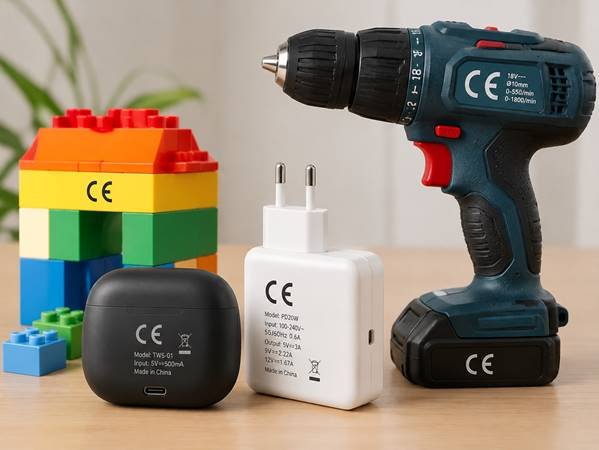
Speaking of this, we must first clarify four most common misunderstandings to avoid getting the direction wrong from the start:
First, CE does not mean that the product has excellent quality or good performance. It is only the minimum compliance red line, only requiring the most basic safety and health requirements to be met, and has no direct relationship with the product’s workmanship, number of functions, or service life.
Second, CE does not mean that the EU official has approved the product item by item, let alone that it is officially recommended. The EU’s supervision logic is post-event spot checks, not pre-event individual reviews. Affixing the mark is the manufacturer’s own commitment, not an “official certification seal” issued by the EU.
Third, CE does not mean that it can be used in all European countries. It is only valid in countries and regions that clearly recognize the CE mark. Some European countries have their own access requirements, which cannot be generalized.
Fourth, CE does not mean that affixing the mark makes it absolutely legal. The mark is only an external manifestation, and must be supported by complete compliance documents behind it. If the documents are incomplete or forged, no matter how standardized the mark is affixed, it is still non-compliant.
2. Applicable Scope of the CE Mark: Which Regions and Which Products Require It
After understanding what CE is, the next question that everyone is most concerned about must be: which places recognize CE? Does my product need to be affixed with CE? In fact, the core of the judgment is never “whether it is sold to Europe”, but whether the product falls within the scope of the EU’s unified harmonized regulations, and whether it is commercially placed in regions that recognize CE.
Regions That Recognize the CE Mark
The core effective area is the 27 EU member states, plus Norway, Iceland, and Liechtenstein in the European Economic Area. Although these three countries are not EU member states, they participate in the European single market, so the unified CE rules apply.
Whether non-EU countries such as Switzerland and Turkey accept CE needs to be checked one by one according to specific product categories, local current regulations, and mutual recognition arrangements. It cannot be assumed that all CE-compliant products can directly enter these markets.
Here we need to specifically explain the situation of the UK: after Brexit, the Great Britain region of the UK mainly promotes the local UKCA mark. The recognition scope and validity period of the CE mark completely depend on specific product regulations and the current arrangements of the UK official, and there is no fixed unified rule; Northern Ireland applies special rules, and official requirements need to be verified separately, and it cannot be assumed that CE is valid throughout the UK.
Which Products Need to Be Affixed with the CE Mark
Whether CE needs to be affixed, the core judgment basis is whether the product falls within the scope of one or more EU unified harmonized regulations, rather than being simply divided by “industrial products” or “consumer goods”. Most common categories that fall within the corresponding harmonized regulations usually require the CE mark:
Electronic and electrical products such as mobile phones, chargers, home appliances, Bluetooth headsets;
Among daily consumer products, toys, personal protective equipment, and some household hardware that falls within the scope of harmonized regulations such as machinery and construction products usually require CE obligation assessment; for example, household tools with mechanical structures, household protective gloves, etc. all fall into this category, while products such as ordinary screws and ordinary furniture hardware do not automatically require the CE mark just because they are used in household scenarios;
Industrial and professional categories such as general machinery, elevators, pressure equipment, building materials included in the Construction Products Regulation;
There are also some ordinary medical devices and in vitro diagnostic products in the medical category.
Clear Product Categories That Usually Do Not Require the CE Mark
There are also many products that usually do not use CE as the main access mark, but it is still necessary to check applicable regulations in combination with the specific attributes and functions of the product, and it is not ruled out that some products with other functions also fall within the scope of CE regulations:
The first category is food, ordinary cosmetics, pharmaceuticals, etc. Most of these are controlled by special EU regulations and are not subject to the general rules of the CE mark. However, if the product has functions covered by CE such as electronics and machinery, corresponding assessment is still required;
The second category is military products, antique works of art, and non-mass-produced R&D prototypes, which are usually not handled in accordance with the CE rules for ordinary commercial consumer goods, but it is still necessary to check the specific product use, whether it constitutes commercial placement, and whether it is explicitly excluded by relevant regulations; if the R&D prototype is subsequently converted to formal sales or public placement, the CE obligation should be re-judged;
The third category is a small number of non-commercial items for personal use, such as a small number of self-use items carried by individuals across borders, which usually do not trigger the CE labeling obligation for commercial placement. However, if the product itself is within the scope of CE regulations, it still needs to meet compliance requirements if it is subsequently used in circulation scenarios such as commercial sales and gifting;
Another category is products without corresponding EU unified harmonized rules, which usually do not need to be affixed with CE, but may still be subject to other product safety or environmental protection rules.
It should be specially noted that: “no need to affix the CE mark” does not mean “not bound by EU regulations”. Even if it does not fall within the scope of CE harmonized regulations, the product may still need to comply with EU general product safety, chemical restrictions, packaging and waste, energy efficiency labeling, labeling specifications, or special local rules of member states. In addition, the core of judging whether a product triggers CE obligations is “whether it is a market placement / market provision behavior defined by EU regulations”, and cannot be judged solely by whether a fee is charged — scenarios such as commercial gifting, resale, and re-sale after modification may be recognized as commercial placement, and compliance requirements need to be re-checked.
Boundary Judgment of Easily Confused Scenarios
In reality, there are several scenarios that are easy to confuse, which are specially explained here:
Commercially sold products sold to the EU through e-commerce platforms, even if they are drop-shipped by small sellers, must be affixed with CE as long as they are commercially placed and within the scope of CE regulations;
Not all customized non-mass-produced products are exempted. It is still necessary to judge according to the regulations of specific categories, and you cannot take it for granted that customized products do not need CE;
For second-hand goods sold commercially, whether re-compliance assessment is required depends on the way they are placed on the market, whether they have undergone substantial modification, whether the original compliance complies with current effective regulations, and the product safety status. The CE compliance conclusion of the original product cannot be directly applied unconditionally.
Three-Step Method to Quickly Judge Whether a Product Requires CE
If you are not sure whether your product needs to be affixed with CE, there is actually a simple three-step judgment method:
Step 1: First confirm whether the product is commercially sold or circulated in regions that recognize CE. If the product is not commercially placed in CE-recognized regions, it usually does not trigger the CE labeling obligation; a small number of items for personal use are generally not treated as commercial placement, but if they are subsequently resold, sold on platforms, circulated as gifts, or recognized by the regulator as market placement, applicable regulations should be re-checked.
Step 2: Check whether there are corresponding EU unified harmonized regulations for your product category. CE requirements are divided by category. If there are no corresponding rules, there is no need to go through the CE compliance process.
Step 3: Make a final confirmation against the applicable scope, exclusion clauses, product classification, and conformity assessment modules of the corresponding regulations. If after verification the product indeed does not fall within the coverage of any CE harmonized regulations, it usually does not need to be affixed with the CE mark, but it is still necessary to continue to check other applicable rules of the EU or member states. It should also be noted that the same product may fall under the jurisdiction of multiple CE regulations at the same time. For example, Bluetooth headsets need to meet multiple types of rules such as radio equipment, electrical safety, electromagnetic compatibility, and environmental protection at the same time, and you cannot draw a conclusion after checking only one item.
3. Regulatory Logic and Responsibility Division of the CE Mark
Some people may ask: Why does the EU have the CE mark? This brings us to its underlying logic.
In the early years, the product standards of each EU member state were different. If a product was to be sold in several countries, it had to be made compliant according to the requirements of each country, which was particularly costly. In order to open up the unified market, the EU formulated a set of minimum safety requirements covering the entire region. As long as the product meets this set of unified requirements, it can be circulated in all regions that recognize CE, without having to do certification country by country, which greatly reduces trade barriers. This is the original intention of the birth of the CE mark.
Here we need to mention two legal terms that are often heard. You don’t need to memorize them by rote, just know the difference: one is called “Directive”, which is the unified general direction given by the EU. Each member state needs to transpose it into its own domestic law before implementation, leaving a certain degree of flexibility; the other is called “Regulation”, which is a specific rule directly formulated by the EU, does not require transposition by each country, and the requirements are completely unified across the EU. Both of these can be used as the legal basis for CE compliance, and which one applies specifically depends on the product category.
Many people think that CE is directly managed by the EU official for all products, but this is not the case. Its core supervision principle is “manufacturers bear the main responsibility, and regulatory authorities conduct spot checks afterwards”. The EU level is only responsible for formulating a unified CE rule framework, and specific law enforcement is the responsibility of the market supervision departments of each member state. They will spot check products in the local market and impose penalties if non-compliance is found.
In the entire compliance chain, the responsibilities of different roles are very clearly divided:
The manufacturer is the first responsible party. The core obligations of the manufacturer include product design, compliance assessment, document issuance, and labeling.
Importers need to perform a number of statutory obligations, including checking whether the product’s CE mark, declaration of conformity, manufacturer and authorized representative information are compliant, saving compliance documents as required, and cooperating with regulatory investigations and recalls. The specific scope of responsibility is determined according to applicable regulations and member state laws, and is not a general “joint liability”.
Distributors shall not sell obviously non-compliant products, and shall also cooperate with the investigation work of regulatory authorities.
If the manufacturer is not located in the EU, an EU authorized representative needs to be designated as the domestic responsible person to connect with supervision when required by applicable regulations; the authorized representative does not replace the manufacturer’s main responsibility, and its specific duties are determined according to applicable regulations.
There is also the “Notified Body (NB for short)” that everyone often hears about, which is a third-party assessment body officially recognized by the EU. Whether its participation in conformity assessment is required is subject to the assessment modules, product classification, and exception clauses specified in specific regulations. Some medium-risk or high-risk categories may mandatorily require the involvement of a Notified Body, rather than being determined solely by a general risk label.
4. Complete Process of CE Compliance: From Product Design to Labeling
If you are a seller and need to do CE compliance for your products, the whole process is actually very clear, divided into five steps:
Step 1: Match the Corresponding Compliance Rules for the Product
You must first find the corresponding EU compliance rules according to the function and use of the product. For example, Bluetooth headsets usually involve multiple types of regulations such as radio equipment, electrical safety, electromagnetic compatibility, and environmental protection. It is very common for a product to apply multiple rules at the same time.
If you are not sure how to match, you can first refer to the original EU harmonized regulations corresponding to the product, the official product page of the European Commission, the officially released application guidelines, and the public information of the competent authorities of member states; when it cannot be directly determined, it should be checked item by item in combination with the product’s function, use, core components, and sales form to avoid missing or misjudging applicable rules.
Step 2: Confirm the Basic Safety Requirements to Be Met
The rules for each category clearly state the minimum requirements for health, safety, and environmental protection. You can use the “harmonized standards” officially recognized by the EU to simplify compliance certification. The harmonized standards here refer to technical standards that have been cited by the European Commission in the Official Journal of the European Union and whose citation scope covers the corresponding basic requirements. Only harmonized standards that meet these two conditions can produce a presumption of conformity within the corresponding scope, greatly simplifying the compliance certification process. When using, you should also check the version, restriction conditions, and effective date of the standard to avoid using outdated or mismatched standards.
If you do not use harmonized standards, you have to provide sufficient evidence to prove that the product meets the requirements, and the process will be much more troublesome. It should be noted that the presumption of conformity of harmonized standards cannot replace necessary processes such as risk assessment, technical document preparation, and declaration of conformity, and the steps that should be taken still need to be taken.
Step 3: Select the Conformity Assessment Path
The only basis for judging the assessment path is the requirements of applicable regulations and product classification, which has nothing to do with the price of the product or the scale of the manufacturer. It is not that expensive products must find a third party.
Here, “low risk” and “high risk” are just generalizations for easy entry-level understanding. The EU does not have a unified risk classification applicable to all products; whether the participation of a Notified Body is required must be based on the product classification, assessment modules, and exception clauses specified in specific regulations. Products for which some regulations allow manufacturers to self-declare (such as some low-risk household small appliances, ordinary consumer electronic accessories, etc., subject to applicable regulations) can be assessed by the manufacturer themselves; if applicable regulations require the participation of a Notified Body, a Notified Body with corresponding category authorization qualifications must be entrusted to conduct the assessment.
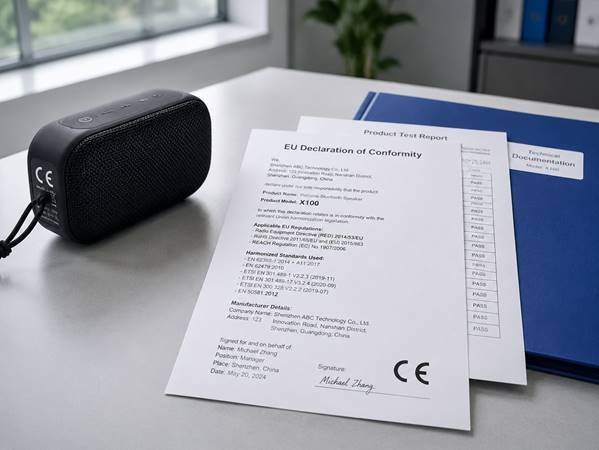
Step 4: Prepare Technical Documents and Declaration of Conformity
Technical documents are a complete set of materials proving product compliance, including product descriptions, design drawings, test reports, risk assessment reports, etc., which can fully prove that the product meets the requirements.
The EU Declaration of Conformity (DoC for short) is a formal legal document signed by the manufacturer or the responsible subject specified by the regulations. It needs to include core content such as product identification information, manufacturer information, applicable EU regulations, adopted harmonized standards or other compliance bases, Notified Body information (if applicable), signatory identity and responsibility statement.
The retention period of these documents depends on applicable regulations and product categories. Many regulations require them to be retained for 10 years from the date the product is placed on the market, but the specific duration must be subject to applicable rules, and they need to be available when regulatory authorities conduct spot checks.
Step 5: Affix the CE Mark in Accordance with Specifications
The core principle of affixing the CE mark is to prioritize affixing it on the obvious position of the product body or nameplate, so that consumers and supervisors can easily identify it. Only when applicable regulations explicitly allow, and the product cannot be marked on the body due to its size, material, or nature, can the CE mark be placed on the packaging, manual, or other positions specified by regulations; no matter where it is affixed, it must meet the basic requirements of being clearly visible and not easy to erase.
If applicable regulations require a Notified Body to participate in the conformity assessment, the 4-digit number of the corresponding Notified Body must also be marked next to the CE mark; products that do not require the participation of a Notified Body shall not mark the NB number at will.
5. Practical Methods for Quickly Judging CE Compliance
Whether you are a purchaser or an ordinary consumer, learning to quickly judge the risk of CE compliance can help you avoid many pitfalls. In fact, you don’t need to understand too complex regulations. You can check most problems by following three steps:
Step 1: Check Whether the Style of the CE Mark Itself Is Standardized
A formal CE mark must comply with the official EU pattern and proportion, usually with a height of not less than 5 mm, clear printing, and not easy to erase. Common non-standard marks often have out-of-proportion letters, such as E being particularly narrow, or font deformation, and can be scraped off with a hand.
However, it should be noted that: standardized style is only the most basic requirement, and does not mean that the product must be compliant. After all, counterfeiters can also print the mark correctly; but products with non-standard styles must have obvious compliance risks.
Step 2: Verify the Supporting Declaration of Conformity (DoC)
The manufacturer must draft and sign the DoC in accordance with applicable regulations and save it as required; importers, distributors, or purchasers shall obtain or verify the corresponding documents according to their own statutory obligations and transaction arrangements. The inability to obtain a copy of the DoC cannot alone prove that the product is substantially illegal in all scenarios, but if there are situations such as inconsistent document information and product model, missing applicable regulations, or unclear responsible subject, procurement should be suspended and further verification should be carried out.
After getting the DoC, you should focus on checking whether the issuing entity on it is legal, whether the product model and configuration are consistent with the actual product, and whether the applicable compliance rules and standards are accurate and complete.
Step 3: Additional Verification of Notified Body Number for High-Risk Products
If the product belongs to a category that requires the participation of a Notified Body in the assessment as required by regulations, there should be a 4-digit Notified Body (NB) number next to the CE mark. You can check the authenticity of this number and whether the corresponding institution has authorization for the relevant category through the official EU database.
However, I would like to remind everyone: most ordinary small household appliances and ordinary toys that have been assessed in accordance with harmonized standards usually do not have an NB number marked next to CE. Don’t think that no number means it is fake; but if specific regulations, product classification, or standard application conditions require the participation of a Notified Body, the corresponding 4-digit number should appear. On the contrary, be careful of products that clearly do not meet the marking conditions but randomly mark the NB number, which most likely have compliance problems.
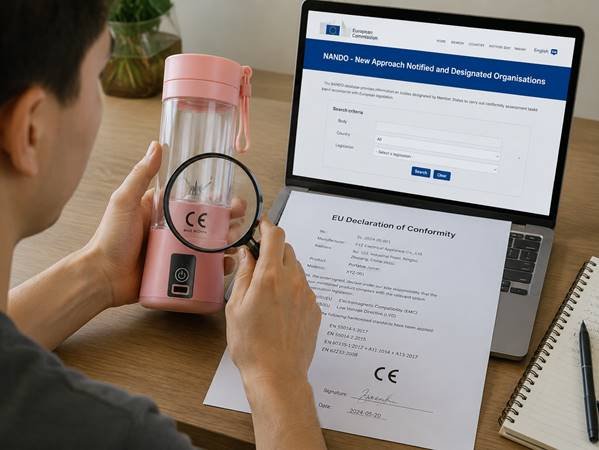
If you do cross-border procurement or often shop overseas, there are several practical pit-avoidance tips: don’t just look at the CE mark on the surface of the product, be sure to take the initiative to ask for the DoC and corresponding test reports; when encountering those who claim to “guarantee CE certificate passing” or “quick certificate issuance”, further verify the authenticity of the actual test, DoC, and technical documents; if applicable regulations require a DoC but the responsible subject cannot provide it, you should cooperate cautiously and further verify the compliance before making a decision.
6. Common Misconceptions and Non-Compliance Risks
There are several widely spread wrong perceptions about the CE mark. Here we sort them out clearly at one time. Each misconception is accompanied by corresponding verification actions to help you quickly avoid pitfalls:
Misconception 1: The CE Mark is a High-Quality Certification
**Wrong claim**: Products with the CE mark are products of good quality.
**Correct boundary**: CE is only the minimum safety compliance red line set by the EU, which only corresponds to basic safety, health, and environmental protection requirements, and has no direct relationship with quality attributes such as workmanship, durability, and function richness. For example, an ordinary children’s plastic toy that meets CE requirements only means that it meets basic safety conditions such as no easily falling off small parts and no excessive harmful substances in materials, and does not mean that it is drop-resistant or exquisitely designed.
**Verification action**: Do not use the CE mark as a basis for quality judgment. If you value quality indicators such as performance and durability when purchasing, you should separately check the corresponding product parameters and test results.
Misconception 2: All CE Products Require Third-Party Testing and Certification
**Wrong claim**: All products with CE have been tested by third-party institutions.
**Correct boundary**: Whether the participation of a third-party institution is required needs to be judged based on the conformity assessment module of specific regulations; the EU does not have a unified risk classification for all categories, and most ordinary low-risk products can be self-declared compliant by the manufacturer, and only categories clearly specified by regulations require the involvement of a Notified Body.
**Verification action**: First check the conformity assessment path of the corresponding regulations for the product. Do not be misled by the merchant’s marketing rhetoric of “third-party authoritative certification”, and do not default that CE without a third-party report must be non-compliant.
Misconception 3: Having a Test Report Equals CE Compliance
**Wrong claim**: If a product has a CE test report, it is compliant.
**Correct boundary**: The test report is only part of the CE compliance evidence chain. Complete compliance also requires materials such as the Declaration of Conformity (DoC), a full set of technical documents, and a risk assessment report. Even if the report itself is authentic, it is necessary to check whether the covered product model, configuration, version, test conditions, and applicable standards are completely consistent with the actually sold product, otherwise it cannot prove that the product is compliant.
**Verification action**: After getting the test report, first check whether the product information on the report matches the actual product, then confirm whether the test standards and scope of application of the report correspond to the requirements of CE regulations. Do not judge compliance just because “there is a report”.
Misconception 4: The CE Mark is Globally Applicable
**Wrong claim**: Products with the CE mark can be sold in any country in the world.
**Correct boundary**: The CE mark is only valid in the EU and countries and regions that recognize CE rules, and is not globally applicable. Each major market has its own mandatory access system, such as the FCC requirements in the United States, the CCC certification in China, and the PSE certification in Japan. These systems are independent of each other. Entering the EU does not require FCC, and entering the United States does not require CE.
**Verification action**: Before a product enters a certain market, first check the local mandatory access requirements. Do not use CE compliance to replace the exclusive compliance process of the target market.
Misconception 5: Buying a “CE Certificate” Allows Legal Labeling
**Wrong claim**: Spend money to buy a CE certificate, and then you can affix the CE mark on the product and sell it.
**Correct boundary**: CE is the final result of a complete set of compliance processes. There is no single “CE certificate” unified across the EU — the so-called “CE certificate” on the market is either a test report issued by a third-party institution or an assessment document issued by a Notified Body for high-risk products, neither of which can alone represent CE compliance. Labeling without completing the actual assessment and forging documents is an illegal act and will face severe penalties.
**Verification action**: Any service provider that claims “quick CE certificate agency”, “guaranteed pass without testing”, or “get the certificate directly by paying money” basically has the risk of compliance fraud. Do not choose such services.
The consequences of CE non-compliance are far more serious than many people think: the most common is that EU customs directly detain and return the goods, and the products cannot enter the market at all; if they are already sold on the market and found by the regulatory authorities, they will be fined and may be required to recall all of them; in serious cases, relevant enterprises may even be prohibited from entering the EU market, and the losses will be very large.
7. Differences Between CE and Other Common Market Access Marks
Many people often confuse CE with access marks of other countries. The following compares the core differences of several common access systems by applicable region, mandatory attribute, coverage scope, and assessment subject:
| Comparison Dimension | CE Mark | UKCA Mark | FCC (United States) | CCC Mark | GS Mark |
| Applicable Region | EU and countries/regions that recognize CE rules | Mainly Great Britain region of the UK, with special arrangements for Northern Ireland, subject to the current product regulations of the UK official | United States | Chinese Mainland | Germany (voluntary, recognition scope depends on scenarios) |
| Mandatory Attribute | Mandatory for products within the scope of corresponding regulations | Mandatory for products within the scope of corresponding regulations | Applicable to specific categories such as radio frequency equipment and electromagnetic compatibility related equipment, subject to FCC rules | Mandatory for products within the corresponding catalog | Voluntary application |
| Core Coverage Scope | Safety, health, environmental or other basic requirements specified by specific applicable harmonized regulations | Similar to CE coverage dimensions, adopts UK local standards, and the recognition degree of CE depends on specific regulations and periods | Requirements such as radio frequency and electromagnetic compatibility, not equivalent to a comprehensive access mark covering safety and environmental protection | Multiple dimensions such as safety and electromagnetic compatibility | Product safety related requirements, belonging to additional voluntary safety assessment, does not replace CE |
| Assessment Subject | Low-risk products can be self-declared by the manufacturer, and categories required by regulations require the participation of a Notified Body | Low-risk products can be self-declared by the manufacturer, high-risk products require UK-recognized assessment bodies | Most can be self-declared, some categories require certification by FCC-recognized institutions | Must be certified by Chinese designated institutions | Assessed by German recognized institutions (such as TÜV) |
It should be noted that FCC is not a “unified access mark” that is completely equivalent to CE. The United States has different compliance mechanisms for different categories of electronic and electrical products, including supplier’s declaration of conformity, recognized body certification, etc. Labeling requirements also vary by product category, and cannot be simply analogized by the logic of pattern marks.
Here we also need to specifically clarify the relationship between the GS mark and TÜV: GS is a local voluntary safety mark in Germany, usually carried out by recognized third-party institutions for safety assessment. It is an additional voluntary certification beyond the mandatory requirements of CE and cannot replace the mandatory compliance obligations of CE. TÜV, which is often heard, is a brand of institutions that provide testing and certification services, not an independent market access mark. The reports or assessment documents it issues can only be used as one of the evidences for CE compliance, and cannot automatically prove that the product has completed all CE compliance processes.
Finally, a question that everyone often asks: What is the relationship between CE and RoHS? RoHS is a harmful substance restriction regulation formulated by the EU for electronic and electrical products, such as restricting the use of heavy metals such as lead and mercury. For electronic and electrical equipment that falls within the scope of RoHS, RoHS compliance may form part of its CE conformity, which needs to be checked against the product scope and exemption clauses. RoHS is not an independent market access mark, usually does not require a separate RoHS mark, and cannot replace the CE mark.
Core Judgment Abilities You Can Master After Learning
After learning these contents, you have mastered three types of core CE judgment abilities:
The first is basic cognitive ability: you can clearly explain the legal positioning of the CE mark, and distinguish it from quality certification and access marks of other countries;
The second is scope judgment ability: you can quickly judge whether a certain type of product needs to be affixed with CE according to the logic of “placement region → commercial attribute → applicable regulations”, and can also identify the compliance boundaries of easily confused scenarios such as e-commerce sales, customized products, and second-hand goods;
The third is compliance judgment ability: you can quickly check common CE compliance risks through the three-step method of “mark style verification → DoC check → NB number verification (if applicable)”, to avoid pitfalls in procurement or product selection.
In general, to judge whether a product requires CE and whether it is compliant, you should always proceed in the order of “first confirm the placement region and commercial attribute, then check the applicable regulations, and finally verify the consistency of the mark and documents”, and do not be misled by a single mark, certificate, or oral promise. Clarifying the rule boundaries of CE can effectively avoid most compliance risks.