
Many people who export electrical and electronic products to the EU feel a bit confused when they first encounter RoHS: what kind of test is this exactly? What needs to be tested? How can test results be recognized? Will paid testing be a waste?
In fact, the core logic of RoHS testing is very simple: it verifies whether specific hazardous substances in products meet the EU’s entry limit requirements. This article starts from the most basic concepts, covering core contents such as testing method selection, report interpretation, scenario-based cost and risk control.
1. Basic Fundamentals of RoHS Testing: What It Is, What Is Tested, and Who Needs It
Before talking about specific testing methods, we first clarify the most basic concepts to avoid getting more confused later.
1.1 Plain-Language Definition and Core Function
In plain terms, RoHS testing detects the content of specific hazardous substances in electrical and electronic products and determines whether they meet the EU’s limit requirements. Its official full name is Restriction of Hazardous Substances (RoHS) testing. It is a necessary compliance step for products to enter the EU market, and proper implementation can greatly reduce the risk of product detention and fines.
A common clarification needs to be stated in advance: there is no official unified “RoHS certificate” in the EU. The common evidence chain for enterprises to prove product compliance includes test reports of homogeneous materials, product technical files (TCF), and the Declaration of Conformity (DoC) signed by the enterprise itself.
1.2 Scope of Application and Excluded Objects
RoHS has a clear product scope of control, and not all products need to be tested:
- Applicable products: Electrical and electronic products with a rated voltage not exceeding 1000V AC or 1500V DC. Common examples such as mobile phones, chargers, electronic toys, home appliances, cables, etc. all fall within this scope.
- Excluded or special objects: Military/aerospace equipment, implantable medical devices, temporarily imported exhibits, large stationary industrial installations, etc., are usually not within the routine control scope of RoHS.
It should be noted that the specific use of the product, voltage level, and method of placing on the EU market will all affect the applicability judgment. For special categories, it is necessary to check the official annexes of the RoHS Directive and the latest exemption list, and cannot be generalized.
1.3 Core Concept: Homogeneous Material (Minimum Unit of Testing)
Many people run into pitfalls when submitting samples for testing for the first time because they do not understand the concept of “homogeneous material” — it is the minimum calculation unit for RoHS testing.
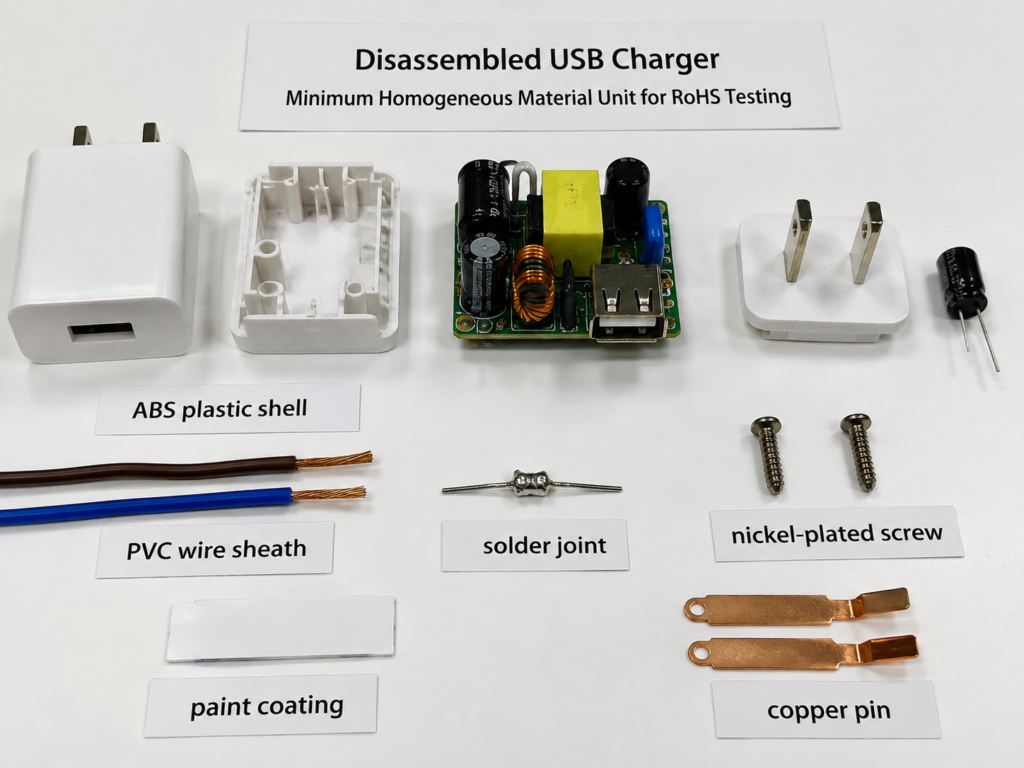
Explained in plain language, a homogeneous material is the smallest uniform material unit that cannot be further split by mechanical means (such as unscrewing, cutting, scraping, grinding). Common examples such as plastic shells, wire sheaths, solder, plating on the surface of screws, paint coatings, etc., all belong to individual homogeneous materials.
The reason this concept is important is that RoHS limits are calculated based on the weight percentage of a single homogeneous material, and the average concentration of the entire product cannot be used to dilute the non-compliant parts. For example, if the sheath of a certain wire exceeds the cadmium limit, even if the average cadmium content of the entire product is very low, it is still non-compliant. If the whole product is mixed together and sent for testing, it is very likely to cover up the non-compliance problem of small components, and such test results are not sufficient to support the final compliance judgment.
1.4 Current 10 Controlled Substances and Limits
Currently, there are 10 hazardous substances controlled by RoHS 2 (2011/65/EU), which can be divided into four groups by category and limit for easy memorization:
- Cadmium (Cd): It is the most strictly controlled substance at present, with a limit of 0.01% (i.e., 100ppm). Common sources include plastic pigments, metal plating, heat stabilizers, etc.
- Other three heavy metal-related substances: Lead (Pb), mercury (Hg), hexavalent chromium (Cr(VI)), all with a limit of 0.1% (i.e., 1000ppm). It should be noted here that hexavalent chromium is chromium in a specific valence state, not total chromium. Common sources are solder (lead), fluorescent lamps/specific switches (mercury), and metal anti-corrosion plating (hexavalent chromium) respectively.
- Brominated flame retardants: Polybrominated biphenyls (PBB) and polybrominated diphenyl ethers (PBDE), both with a limit of 0.1% (1000ppm). Common sources include flame-retardant plastics, circuit boards, adhesives, etc.
- Phthalate plasticizers (4 items in total): DEHP, BBP, DBP, DIBP, all with a limit of 0.1% (1000ppm). Common sources include flexible PVC cables, soft plastics, adhesives, paints, etc.
Here is a unit conversion tip: 1% = 10000ppm, 0.1% = 1000ppm. When reading the report, be sure to pay attention to unit consistency, and do not misjudge the result due to incorrect conversion.
1.5 Quick Distinction of Easily Confused Regulations
Friends who do export business often hear about the three regulations RoHS, REACH and WEEE at the same time, and many people get confused. In fact, the control directions of the three are completely different:
- Difference from REACH: RoHS only targets 10 specific hazardous substances in electrical and electronic products, and controls the limits of hazardous substances in products; REACH is a chemical registration, evaluation, authorization and restriction system covering all categories, with a much wider range of controlled chemicals.
- Difference from WEEE: RoHS controls the content of hazardous substances in the product itself, reducing the use of hazardous substances from the source; WEEE controls the recycling and treatment of e-waste, with the core being extended producer responsibility.
In practice, customers may require compliance certificates for all three at the same time, but the testing purposes, methods and judgment logic of the three are completely different and cannot be confused.
2. RoHS Testing Standard System: Corresponding Logic Between Regulations and Methods
Many people think that RoHS testing standards are EU regulations, but in fact the two are separate and each has its own function. Let’s first clarify this relationship.
2.1 Clarify First: RoHS Directive vs Testing Standards
- RoHS Directive is the official EU regulation, which governs the “rules”: which products need to be tested, which substances are tested, what the limits are, and which situations can be exempted. The current core version is 2011/65/EU, which is commonly known as RoHS 2.
- Testing standards are general technical specifications that govern the “methods”: what instruments and what steps are used to obtain accurate and repeatable results, equivalent to a unified “operation manual” for the industry.
A key logic to note here: even if an accredited testing method is used, it does not mean that the product is automatically compliant — it also depends on whether the product is within the scope of RoHS application, whether it meets the exemption clauses, whether the sample represents the mass production status, etc. Do not take it for granted that testing alone is sufficient for compliance.
2.2 Globally Accepted Core Standard: IEC/EN 62321 Series
Currently, the most widely recognized RoHS testing method standard in the world is the IEC 62321 series of standards issued by the International Electrotechnical Commission (IEC). The European standard system will issue corresponding EN or EN IEC versions. The specific version adopted and the release date shall be subject to the official standard catalogue, the laboratory’s accreditation scope, and the requirements of customers or regulators.
The EU does not mandatorily specify a single testing standard, but the IEC/EN 62321 series is a method standard specifically formulated for RoHS testing, and its results generally have a high acceptance rate.
It should be noted that IEC 62321 is a series of standards issued in separate parts. Different parts correspond to different test substances and material types, and each part has its own revised version. The effectiveness cannot be judged generally by the year of the entire set of standards. For example, the testing method for the four phthalates corresponds to the IEC/EN 62321-8 part, which was not included in the early series of standards. Therefore, if the test involves the four phthalates, it is necessary to confirm whether the version of the part used covers the corresponding substances and is within the laboratory’s accreditation scope. If the report still cites IEC 62321:2008 or an early full set of standards, special confirmation is required as to whether it covers the four phthalates; for the four phthalates, subsequent parts such as IEC/EN 62321-8 should usually be checked, and the specific part and version must be stated in the report.
Regarding cross-border recognition, a common misconception needs to be clarified: the International Laboratory Accreditation Cooperation (ILAC) itself does not issue testing qualifications to laboratories. The testing capabilities of laboratories are usually reviewed and accredited by national accreditation bodies of various countries in accordance with ISO/IEC 17025. If the accreditation body is a signatory to the ILAC Mutual Recognition Arrangement (ILAC MRA), then the test reports issued by the laboratory within the scope of accreditation generally have a high acceptance rate in cross-border scenarios, and it is not necessary to find a local EU laboratory.
2.3 Three Dimensions to Judge Whether a Testing Standard is Valid
If you get a report, or want to confirm whether the standard is compliant when choosing a laboratory, you can check from three dimensions:
- Check matching degree and version: The standard part used must correspond to the tested substance and material type. For example, part 62321-7-1 must be used for testing hexavalent chromium in metal plating, and part 62321-7-2 must be used for testing hexavalent chromium in polymers; at the same time, the version must be a valid version recognized by regulators or customers. There is no need to blindly pursue the latest version, as long as it is within the validity period of accreditation and covers the corresponding items.
- Check laboratory accreditation scope: The laboratory must have ISO/IEC 17025 accreditation qualification for the corresponding testing method, and the body issuing the accreditation qualification is a signatory to ILAC MRA; it is necessary to check whether the specific test items are within the laboratory’s accreditation scope, rather than only looking at the overall qualification of the laboratory or the logo on the front page.
- Check method applicability: The testing method must match the testing needs. For example, XRF is only suitable for screening total element content, and cannot be used for confirmation of valence states or organic compounds. If the wrong method is used, the results are not sufficient to support compliance judgment.
3. Rapid Screening Method: Uses, Boundaries and Result Interpretation of XRF
Many people start with XRF when they first come into contact with RoHS testing — it is fast, low-cost, and does not require complex sample preparation, but it is also the most easily misused. Let’s clarify its capability boundaries.
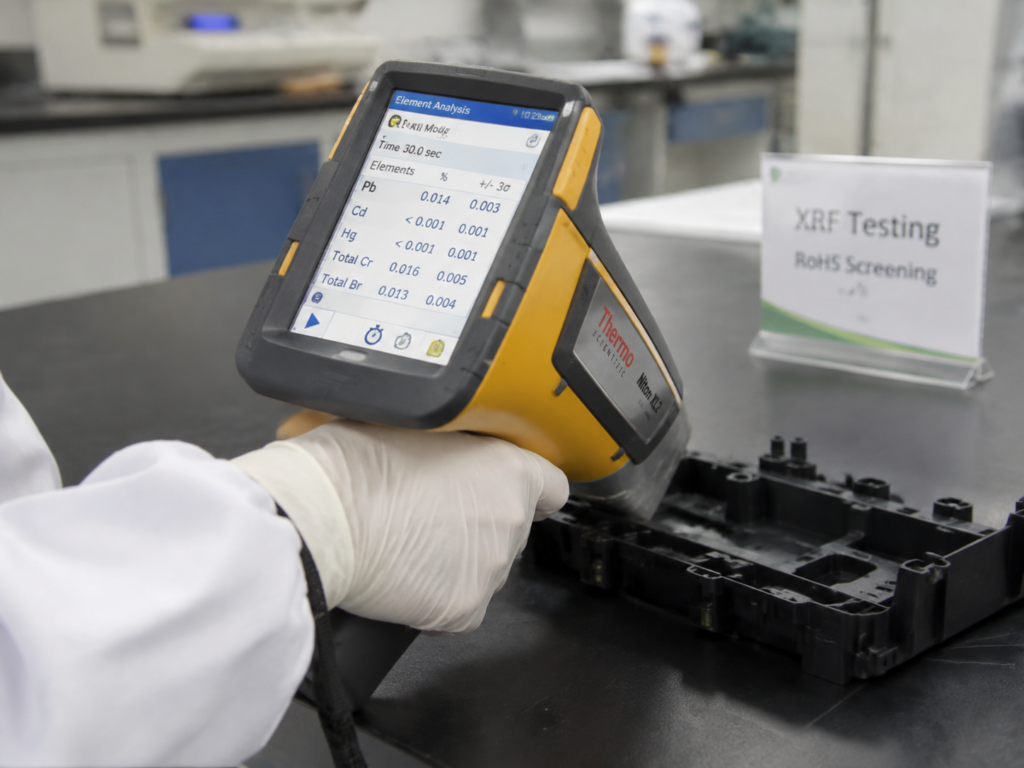
3.1 Corresponding Standard and Plain-Language Principle
The standard corresponding to XRF screening is IEC/EN 62321-3-1, which is the special screening part for RoHS.
Its principle is very simple in plain terms: when a sample is irradiated with X-rays, different elements emit different characteristic fluorescence. By identifying these fluorescence signals, the instrument can quickly calculate the approximate content of the corresponding elements in the sample, a bit like “scanning a code to check elemental composition”, and results can be obtained in tens of seconds to a few minutes.
It should be noted that the reliability of XRF screening results has prerequisites: the results are only of reference value when the sample is within the effective analysis range of the instrument, has sufficient thickness, a flat and uniform surface, a geometric shape suitable for detection, no strong matrix interference, and the instrument is calibrated in accordance with specifications. For thin plating, complex composite parts, small irregular parts, or non-uniform materials, the deviation of screening results may be large. If necessary, testing should be carried out after splitting, or chemical confirmation methods should be used instead.
3.2 Measurable and Non-Measurable Scope
The capability boundary of XRF is very clear. Don’t expect it to test all RoHS items:
- Substances that can be screened: Lead, cadmium, mercury, total chromium, total bromine — note that these are all total element contents, and cannot distinguish chemical valence states or specific compound forms.
- Substances that cannot be directly tested: Hexavalent chromium (only total chromium can be measured, and it is impossible to distinguish between toxic hexavalent and non-toxic trivalent chromium), PBB/PBDE (only total bromine can be measured, and it is impossible to distinguish whether they are restricted flame retardants), and 4 phthalates and other organic plasticizers (completely undetectable).
It has a wide range of applicable materials. Most electrical and electronic materials such as metals, plastics, coatings, and ceramics can be screened, but the reliability of the results must be judged in combination with the prerequisites mentioned above.
3.3 Advantages and Applicable Scenarios
The core advantages of XRF are obvious: fast testing speed, almost no damage to the sample (it can usually continue to be used after testing), low cost per test, simple sample preparation, and testing can be done directly by placing the sample on the instrument.
Therefore, it is particularly suitable for the following scenarios: supplier incoming material self-inspection, initial screening of large batches of materials, rapid overall product assessment, and supply chain risk investigation — first screen with XRF, and then conduct precise testing for abnormal items, which can save a lot of money and time.
3.4 Result Judgment Logic and Error Sources
XRF results cannot be directly used as final conclusions, and should be judged according to the following logic:
- If the test result is significantly lower than the limit, and the method is applicable, the sample is representative, and the instrument detection prerequisites are met, it can be initially judged as low risk;
- If the result is close to or exceeds the limit, comprehensive judgment is required in combination with measurement uncertainty and sample representativeness. Usually, retesting and confirmation with precise chemical methods are required, and it cannot be directly judged as qualified or unqualified;
- “Not detected” in the report does not mean that the target substance is completely absent, but only that it is below the detection limit of the instrument, so there is no need to worry too much about it.
In addition to the sample status mentioned above, XRF results are also susceptible to deviations caused by factors such as instrument calibration status, matrix interference, and operator proficiency.
Finally, it should be clarified that XRF is a screening method and usually cannot alone prove that all 10 controlled substances and their chemical forms meet RoHS requirements; formal compliance requires complete technical documentation, applicable test evidence at the homogeneous material level, and the enterprise’s DoC. Regulatory authorities may require supplementary confirmation evidence according to specific circumstances. Therefore, XRF is suitable for internal screening and risk diversion; when encountering EU customs, market supervision, customer factory audits, or platform spot checks, it is usually necessary to provide chemical confirmation reports at the homogeneous material level and complete technical documentation.
4. Precise Confirmation Methods: Corresponding Standards and Logic for Four Categories of Hazardous Substances
If formal confirmation is required for high-risk materials, items close to the limit, or items required by customers/regulators, chemical confirmation methods corresponding to the IEC/EN 62321 parts are usually required; the final compliance certificate must also form an evidence chain together with supplier declarations, technical documentation and DoC. Different categories of hazardous substances correspond to different standard parts. We have compiled a corresponding table for easy comparison:
| Controlled Substance/Category | Corresponding IEC/EN 62321 Part | Analysis Object | Screening Result That Cannot Be Directly Replaced | Key Applicable Materials |
|---|---|---|---|---|
| Lead, cadmium, mercury (total element content) | 62321-4 (mercury), 62321-5 (lead/cadmium, etc.) | Total content of corresponding heavy metal elements | XRF total element screening results | Various homogeneous materials such as metals, plastics, ceramics, coatings, etc. |
| Hexavalent chromium (specific valence state) | 62321-7-1 (metal plating), 62321-7-2 (polymers/electronic materials) | Content of hexavalent chromium in specific valence state | Total chromium screening results | Metal anti-corrosion plating, colored plastics, surface-treated parts |
| Polybrominated biphenyls (PBB), polybrominated diphenyl ethers (PBDE) | 62321-6 | Content of specific organic bromine compounds | Total bromine screening results | Flame-retardant plastics, circuit boards, adhesives |
| Phthalates (4 items in total: DEHP/BBP/DBP/DIBP) | 62321-8 | Content of 4 specific phthalate plasticizers | No corresponding general rapid screening item | Flexible PVC, wire sheaths, soft plastics, adhesives, paints |
Below we explain the logic and key points of each type of test clearly:
4.1 Precise Testing of Heavy Metals (Lead/Cadmium/Mercury)
The principle in plain terms is: the split homogeneous materials are converted into a detectable solution state through chemical sample preparation, and then the accurate content of harmful metals in them is measured with high-precision instruments.
There are two common testing instruments, so there is no need to blindly choose the expensive one: ICP-OES/ICP-MS is the current mainstream method, which can detect multiple elements at one time with high accuracy; AAS is a traditional method, which usually detects a single element at one time with relatively low cost. The specific method to use depends on the method validation results, detection limit requirements, sample matrix conditions, and the laboratory’s accreditation scope. As long as it meets the method requirements and is within the accreditation scope, the results can be used as a basis for compliance.
4.2 Precise Testing of Hexavalent Chromium: Total Chromium ≠ Hexavalent Chromium
This is one of the most common pitfalls: many people think that qualified total chromium equals qualified hexavalent chromium, but this is completely not the case.
What RoHS restricts is toxic hexavalent chromium, while total chromium includes non-toxic trivalent chromium and other valence states of chromium. Therefore, the screening result of total chromium cannot be used to directly deduce whether hexavalent chromium is qualified, and must be confirmed through special valence state testing.
Hexavalent chromium testing is divided into two dedicated parts: Part 7-1 is used for metal plating materials, and Part 7-2 is used for polymers and electronic materials. The principle is to use special chemical reagents to extract hexavalent chromium from the material, and then measure its accurate content.
Materials that require key hexavalent chromium testing include metal anti-corrosion plating, colored plastics, surface-treated parts, etc., which are high-risk sources of hexavalent chromium.
4.3 Precise Testing of Brominated Flame Retardants (PBB/PBDE): Total Bromine ≠ PBB/PBDE
Similar to the logic of total chromium/hexavalent chromium, the screening result of total bromine cannot be directly equated with the result of PBB/PBDE.
Total bromine is a screening result at the elemental level, and cannot directly identify the specific type of bromide. Total bromine may come from other compliant bromine-based substances (such as compliant flame retardants, pigments, etc.), and is not necessarily RoHS-restricted PBB or PBDE. Therefore, it is necessary to confirm the content of specific compounds through the chemical analysis method of Part 62321-6 before judging whether it is compliant.
Key test objects are materials that usually contain flame retardants, such as flame-retardant plastics, circuit boards, and adhesives.
4.4 Precise Testing of 4 Phthalates
The four phthalates are newly added controlled substances after the revision of RoHS 2, corresponding to Part 62321-8.
The testing principle is to extract phthalate plasticizers from the material, then perform separation and quantification. There are two commonly used testing methods: GC-MS (Gas Chromatography-Mass Spectrometry) is a conventional method, which usually requires solvent extraction of the sample first; PY-GC-MS (Pyrolysis Gas Chromatography-Mass Spectrometry) can directly test some solid plastic samples without prior dissolution and extraction.
The two methods have different applicable scenarios, and there are differences in requirements for material type, matrix characteristics, volatilization/thermal stability of the target substance, and calibration method. Whether they can be used as formal compliance evidence depends on the method validation status and the laboratory’s accreditation scope, and they cannot be interchanged unconditionally.
Key test objects are soft materials containing plasticizers such as flexible PVC, wire sheaths, soft plastics, adhesives, and paints, which are high-risk categories for phthalate non-compliance.
4.5 Risk Stratification Idea Based on BOM and Homogeneous Materials
RoHS testing does not need to test all 10 items every time. Test items can be selected in combination with the Bill of Materials (BOM) and the risk level of homogeneous materials to reasonably control costs. However, it should be noted that risk stratification is only a reference for cost optimization and cannot replace the compliance assessment required by regulations. The final test items shall be determined based on material composition, supplier evidence, product risk and applicable requirements.
Common risk stratification references are as follows:
- Pure metal materials: Usually the risk of organic hazardous substances (PBB/PBDE, four phthalates) is low, and priority can be given to heavy metals and hexavalent chromium in surface plating; however, if the metal has coatings, sealants or other organic attachments, the corresponding items still need to be evaluated.
- Soft plastics and cable materials: The risk of the four phthalates is relatively high, and can be used as key test items.
- Flame-retardant plastics and circuit board materials: The risk of PBB/PBDE is relatively high, and can be used as key test items.
- Metal plating and surface-treated parts: The risk of hexavalent chromium is relatively high, and can be used as key test items.
If you are not sure, you can first ask an accredited laboratory to evaluate the material risk before determining the testing plan.
5. Full Testing Process and Report Interpretation: From Sample Submission to Compliance Judgment
Many people don’t know what to prepare or how to read the report when submitting RoHS testing for the first time. In fact, the core logic is very clear.
5.1 Routine Steps of a Complete RoHS Test (User’s Perspective)
From the user’s perspective, a RoHS test is mainly divided into four steps:
- Confirm the testing scope: First communicate clearly with the laboratory about the product model, homogeneous materials to be tested, and test items. Don’t send samples right away, to avoid missing tests or testing unnecessary items.
- Prepare samples: Split into homogeneous materials as required and make corresponding labels. The specific sample quantity depends on the test part, material type, number of homogeneous materials, and the laboratory’s sample preparation requirements, and there is no unified statutory sample quantity; the most important thing is that the samples can represent the actual state of mass-produced goods, and “qualified samples” cannot be specially selected for testing, otherwise the test results will not be representative.
- Laboratory testing: After receiving the samples, the laboratory will complete sample preparation and instrument testing. This process usually does not require user participation, just wait for the results.
- Issue report: After the test is completed, the laboratory will issue an official test report.
Here is another reminder of the key principle: testing needs to be split to the homogeneous material level. If mixed testing is performed directly without splitting, local non-compliance may be covered up due to the dilution effect, and the results are not sufficient to support the final compliance judgment.
5.2 Beginner’s Version: Quickly Understand RoHS Test Reports
RoHS reports look thick, but in fact there are only a few key pieces of information, and even beginners can quickly check them:
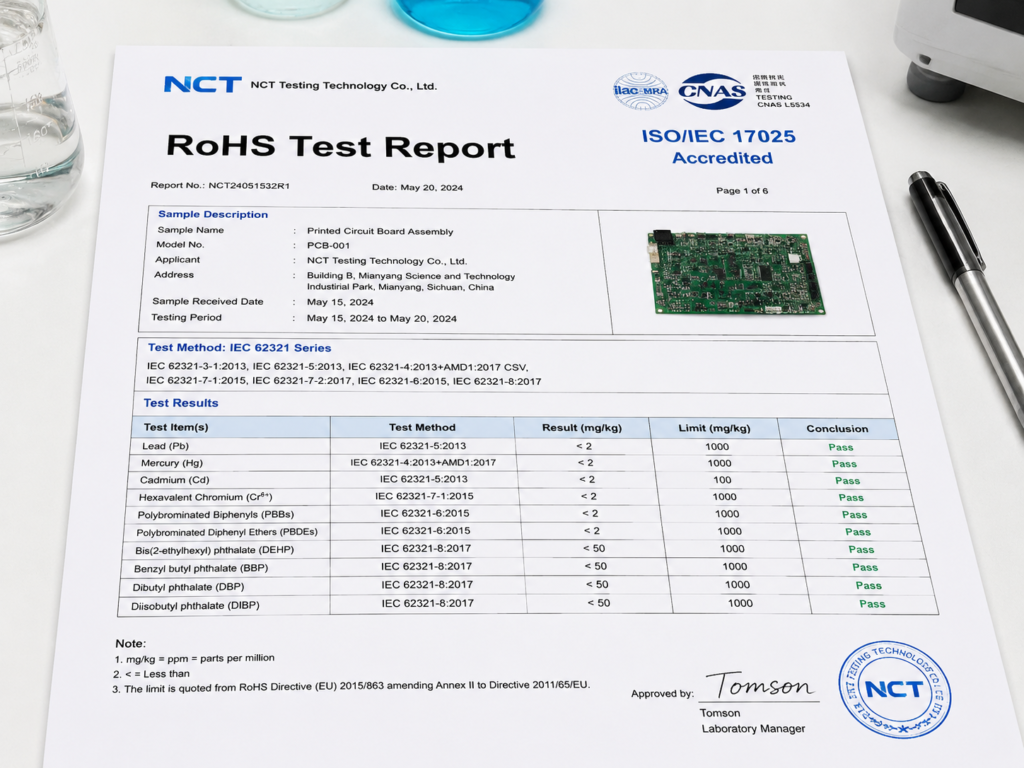
- Check the laboratory and qualifications: Verify the name of the laboratory issuing the report and the accreditation body, and confirm that the corresponding test items and standards are within the laboratory’s ISO/IEC 17025 accreditation scope; if the accreditation body is a signatory to ILAC MRA, the cross-border acceptance of the report is usually higher. Note that you cannot only look at the logo on the front page, you need to check the specific items in the annex to the accreditation scope.
- Check test methods and versions: Confirm whether the test standard part and version used match the tested substance and material type. For example, testing the four phthalates requires the corresponding Part 62321-8, and the version must cover the corresponding items.
- Check sample information: Verify the sample description, model, and batch, and confirm that each test result corresponds to a specific homogeneous material (such as “ABS plastic shell”, “solder alloy”), rather than a general “whole machine”, to ensure that the sample is representative.
- Check test items: Confirm whether all 10 required controlled substances are covered, with no missing items.
- Check results and limits: Pay attention to unit consistency (you can refer to the conversion relationship of 1% = 10000ppm), compare the test results of each homogeneous material with the corresponding limits (cadmium 0.01%, the other 9 are 0.1%), and initially judge whether they meet the requirements; at the same time, pay attention to the detection limit or quantitation limit marked in the report. “Not detected” only means that it is below the limit, not that it is completely absent.
- Check issuance information: Confirm that the report has the official issuance mark of the laboratory, the signatures of the tester and the reviewer, and the information is complete and traceable.
5.3 Common Causes of Result Errors and Abnormalities
If the test result is very different from your expectation, you can investigate the cause from the following aspects:
- Sample problems: Incomplete splitting of homogeneous materials leading to mixing with other materials, uneven samples themselves, and test samples not representing mass-produced goods — these are the most common causes.
- Method problems: The selected test method does not match the tested substance or material type (for example, using XRF to test hexavalent chromium or organic compounds), and non-standard sample preparation leads to loss or contamination of the target substance.
- Report problems: Inconsistent units without correct conversion, no marked detection limit or quantitation limit, and unclear correspondence between test items and materials.
5.4 Troubleshooting Ideas for Common Non-Compliant Results
If the test result is really non-compliant, don’t panic. First investigate according to the high-risk sources of the corresponding substance:
- Lead exceeding the limit: Prioritize investigation of components such as solder, lead-containing alloys, pigments, etc.;
- Cadmium exceeding the limit: Prioritize investigation of plastic pigments, metal plating, heat stabilizers, etc.;
- Mercury exceeding the limit: Prioritize investigation of components such as fluorescent lamps, specific switches, sensors, etc.;
- Hexavalent chromium exceeding the limit: Prioritize investigation of metal anti-corrosion plating, surface-treated parts, colored plastics, etc.;
- PBB/PBDE exceeding the limit: Prioritize investigation of flame-retardant plastics, circuit boards, adhesives, etc.;
- Four phthalates exceeding the limit: Prioritize investigation of flexible PVC, wire sheaths, soft plastics, adhesives, etc.
Troubleshooting steps: First check the material certification of raw materials and the supplier’s RoHS declaration to confirm whether it is a problem with the raw material formula; then replace the batch and sampling location, re-sample and retest to eliminate accidental sample errors or sampling problems. It should be noted that supplier declarations can only be used as a supplement to the evidence chain and cannot replace confirmation testing of abnormal samples.
6. Scenario-Based Testing Decisions and Common Pitfall Avoidance
This part is prepared for friends who need to make their own compliance decisions, to help you avoid common pitfalls and choose the most suitable testing plan for yourself.
6.1 Comparison Table of Common Method Misconceptions
We have compiled the 4 most common method-related pitfalls into a table for easy comparison:
| Common Misconception | Correct Judgment | Follow-up Action |
|---|---|---|
| XRF screening results can be directly used as formal compliance proof | XRF is a screening method that cannot alone prove the compliance of all 10 controlled substances and their valence states, and cannot be directly used as the final basis for compliance | For formal compliance, chemical confirmation testing at the homogeneous material level needs to be supplemented, together with complete technical documentation and DoC |
| The test result of the whole product without sample splitting can prove compliance | RoHS limits are calculated based on homogeneous materials. Mixed testing of the whole product may dilute local non-compliance, and the result is not sufficient to support compliance judgment | Before submitting for testing, samples need to be split to the homogeneous material level, or tested after professional splitting by the laboratory |
| Qualified total chromium = qualified hexavalent chromium | RoHS restricts hexavalent chromium, total chromium includes non-toxic valence states, and total chromium results cannot directly deduce whether hexavalent chromium is qualified | When involving high-risk materials such as plating and surface-treated parts, separate hexavalent chromium valence testing is required |
| Excessive total bromine = excessive PBB/PBDE | Total bromine is the total element content, which may come from compliant bromine-based substances, and cannot directly correspond to restricted PBB/PBDE | When total bromine is high, special compound testing and confirmation using the 62321-6 method is required |
6.2 Three Pitfall Avoidance Points for Standards and Reports
In addition to the misconceptions about testing methods, there are also many common pitfalls regarding testing standards and reports. Remembering three points can avoid most problems:
First, there is no need to blindly pursue the latest version of the standard. As long as the version used is a valid version recognized by regulators or customers and can cover the corresponding test items, there is no need to pay extra for the gimmick of the “latest version”.
Second, don’t just look at the logo on the front page of the report. The core of judging the recognition of a report is whether the specific test items are within the laboratory’s ISO/IEC 17025 accreditation scope, and the body issuing the accreditation qualification is a signatory to ILAC MRA. It cannot be judged solely by the laboratory logo or the seal on the front page.
Third, RoHS reports do not have a unified fixed validity period. The commonly said “valid for one year” or “valid for two years” on the internet has no official basis. As long as the materials, suppliers, formulas, production processes, regulatory limits, or exemption clauses change, re-evaluation or testing is required; if none of these change, the report can continue to be part of the evidence chain.
6.3 Testing Strategy for New Product R&D Stage
Considering RoHS in the R&D stage can save a lot of later rectification costs. The core idea is risk control in advance:
- First identify high-risk materials against the Bill of Materials (BOM), such as solder, electroplating layers, PVC cables, pigments, flame-retardant plastics, etc., which are categories with high incidence of RoHS non-compliance;
- Require suppliers to provide RoHS declarations or corresponding test reports for materials in advance, and eliminate high-risk materials at the selection stage, to avoid replacing materials after product mold opening, which increases additional costs.
6.4 Incoming Inspection and Supply Chain Control Strategy
If you have a stable supply chain, you don’t need to send each batch of materials for third-party precise testing, as the cost is too high. The core idea is rapid screening + regular confirmation to balance cost and risk:
- Before daily warehousing, use XRF to conduct rapid screening of key high-risk materials, and return abnormal materials in time to block risks at the front end of production;
- Every quarter or half year, samples of high-risk materials are taken and sent to a third-party laboratory for precise chemical testing to confirm the stability of supply chain materials and verify the authenticity of supplier declarations.
6.5 Scenario Strategy for Small Batch/Cross-Border E-Commerce/Traders
Small-batch sellers and traders may not be able to split homogeneous materials by themselves, or do not want to spend too much money due to small batches. The core idea is to ensure sample representativeness and meet basic compliance requirements:
- If the product batch is small and it is difficult to split homogeneous materials by yourself, you can send the whole machine to an accredited third-party laboratory for RoHS evaluation. The laboratory will formulate a sampling/splitting plan based on BOM, materials and high-risk components, giving priority to covering the highest-risk homogeneous materials; untested components still need to be supported by supplier declarations, material certifications or other evidence, and cannot be simply regarded as test-exempt. Costs can be reasonably controlled on the premise of meeting compliance requirements;
- Pay attention to keeping documents such as supply chain material declarations and test reports to form a complete compliance evidence chain to cope with regulatory or platform spot checks. It should be noted that the whole machine evaluation report is usually used for risk assessment. If formal DoC support is required, it is still necessary to ensure complete test coverage of high-risk components and a sufficient evidence chain.
6.6 Retest Judgment Logic After Product Changes
Many people don’t know whether retesting is needed after product changes. The core principle is: judge whether retesting or re-evaluation is needed based on the impact of the change on the content of hazardous substances in materials:
- Situations where retesting/re-evaluation is recommended: Replacing core materials, changing suppliers, adjusting product formulas/colors, changing production processes, etc. These changes may lead to changes in the content of hazardous substances, so it is recommended to retest or evaluate the compliance of corresponding components;
- Situations where full retesting is not required: When only the outer packaging changes and the packaging is not a constituent material of the product itself, whether testing is needed can be judged according to customer or regulatory requirements, and usually a full set of RoHS testing is not required.
Whether retesting is conducted or not, all product change records and relevant evaluation evidence need to be kept for future reference.
7. Post-Learning Summary: RoHS Compliance Testing Decision Checklist
After reading this article, you can independently complete the judgment and decision-making of most RoHS tests according to the following steps:
7.1 Three-Step Beginner Judgment
- First judge applicability: First confirm whether the product falls within the scope of RoHS application (electrical and electronic products with rated voltage ≤ 1000V AC / 1500V DC), exclude special categories such as military and implantable medical devices, and check the official exemption list if necessary; at the same time, be able to distinguish the different control directions of RoHS, REACH and WEEE.
- Then split the minimum unit: Clarify that testing must take homogeneous materials as the minimum unit, cannot use whole-machine mixed testing to dilute non-compliant items, and be able to identify common homogeneous material types.
- Understand core reports: Be able to check the qualifications, methods, sample information, test items and results of the test report, compare the limits to judge preliminary compliance, and distinguish the different uses of XRF screening and chemical confirmation.
7.2 Three Intermediate-Level Decisions
- Select the right testing methods and items: Be able to select appropriate testing methods according to your own needs (internal screening/formal compliance), determine test items in combination with BOM and material risk levels, and reasonably control costs.
- Judge the validity of standards and qualifications: Be able to check the part matching degree, version validity of the test standard, and the accreditation scope of the laboratory, so as not to be misled by invalid reports.
- Handle abnormalities and changes: Be able to investigate common causes of non-compliance and determine the direction of retesting or rectification; be able to judge whether retesting is needed according to product changes, and keep compliance evidence.
7.3 Handling Ideas for Complex Situations
If you encounter complex situations such as special materials/composite materials, suspected exempt products, or test results close to the limit, do not make blind judgments by yourself: first consult an accredited third-party laboratory, or check the latest official RoHS exemption list and guidance documents, and re-sample and retest if necessary to ensure the accuracy of the conclusion.
Mastering the above judgment logic, you can independently complete the basic decision-making of most RoHS tests and reasonably balance compliance costs and risks.