
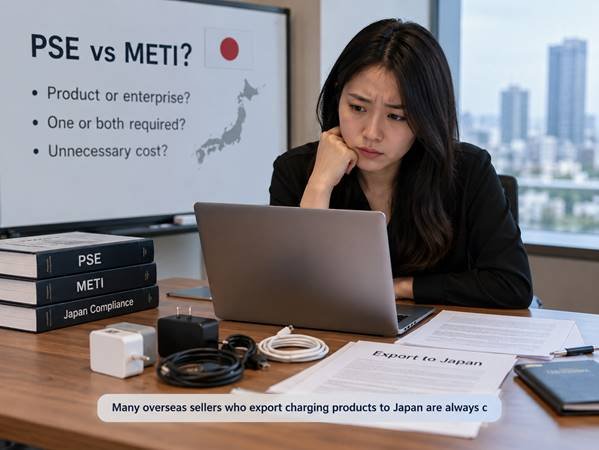
Many overseas sellers who export charging products to Japan are always confused by PSE certification and METI filing when they first come into contact with local compliance requirements: is it enough to do just one, or are both required? Which one regulates products, and which regulates enterprises? Will I end up spending money unnecessarily?
Actually, these two requirements are both related and completely different—they are supporting rules under Japan’s (abbreviated as the DENAN Act), **and they are not an either-or choice**. To use a common analogy: PSE is like a product’s “safety physical examination certificate”, proving that the charging product itself meets Japan’s electrical safety requirements and will not cause electric shock or fire randomly; METI filing (officially called “METI notification”) is like a merchant’s “responsibility registration card”, clarifying who will bear the corresponding responsibility if a product safety problem occurs. For charging products that are in the DENAN catalog, manufactured or imported by a notifying business operator, and sold in Japan, both the PSE technical compliance, inspection and labeling obligations and the notification of commencement of manufacturing or import business apply: the PSE mark must be affixed before sale or display for sale, and the notification of commencement of business must be submitted within the statutory time limit.
This article focuses on charging products (including wall-plug USB chargers, USB-C power adapters/cables, car fast chargers, AC power strips, charging sets, etc.), and explains the differences between the two requirements, judgment methods, and common pitfalls to help you go from beginner to being able to independently make preliminary compliance judgments. It should be noted that this article only covers requirements within the scope of the , and does not involve other regulations such as wireless, battery, energy efficiency, or transportation. This article takes consumer charging products sold in the Japanese market as examples; whether DENAN applies to industrial products, personal use imports, and non-sales samples shall be judged on a case-by-case basis based on whether they are in the cabinet order catalog, whether they constitute a manufacturing or import business, and subsequent sales arrangements.
Item-by-Item Comparison of Core Dimensions: From the Perspective of Charging Product Sellers
To help you more intuitively distinguish the differences between the two, we have compiled a core comparison table from the market access perspective that overseas charging product sellers care most about, and then break down the details item by item:
| Comparison Dimension | PSE Compliance | METI Notification (Filing) |
| Core Nature | Mandatory product-level electrical safety compliance | Enterprise-level administrative responsibility registration |
| Responsible Entity | Can be led by multiple parties, with ultimate responsibility borne by the Japanese notifying entity | Normally requires application by a company registered in Japan |
| Processing Time Requirement | Must be completed before product sale | Must be submitted within 30 days after the commencement of manufacturing or import business |
| Cost Composition | Testing, documentation, and third-party agency fees (only for diamond PSE) | No official fees, mainly service fees for Japanese agents/importers |
| Validity Period Rules | Diamond PSE has a fixed validity period and requires re-examination; circular PSE has no fixed term | Not a product validity document; must be updated in accordance with the law when notified matters change or business is suspended |
| Core Labeling Requirements | PSE mark (diamond/circular) affixed to the product body | Mark the name of the notifying business operator or the notified registered trademark, rated values and other items on electrical appliances as required |
Nature and Core Functions
PSE is the safety access threshold for products entering the Japanese market, solving the problem of “whether this product can be sold safely”, and is a mandatory legal obligation at the product level.
METI notification is the responsibility registration of business entities, solving the problem of “who to contact if there is a problem with the product”, and is an administrative declaration requirement at the enterprise level.
The essential difference between the two is the difference between “product compliance” and “entity accountability”.
Application and Responsible Entity Requirements
PSE compliance work can be led by multiple parties—overseas factories, brand owners, and Japanese importers can all take the lead in testing and preparing documents, but the ultimate compliance responsibility shall be borne by the Japanese domestic entity that has completed METI notification.
Under normal circumstances, METI notification requires application by a company registered in Japan. If you resell compliant products to downstream distributors, the downstream distributors do not need to submit duplicate notifications.
There is a very critical associated requirement here: **the name of the business operator marked on the product’s PSE label must be exactly the same as the entity of the METI notification**—this is also one of the most common reasons for review rejections on many e-commerce platforms.
Processing Requirements and Timeline Logic
The processing requirements and timeline for PSE depend on whether the product falls under diamond or circular PSE:
• For specified electrical appliances corresponding to diamond PSE, a conformity inspection agency registered in accordance with the law must conduct a suitability inspection and issue a suitability inspection certificate. The specific inspection scope includes applicable types, technical documents, and factory-related requirements. Whether sample submission is required and its process shall be subject to the requirements of the registered inspection agency.
• Circular PSE does not require third-party certification. It only needs to complete standard tests and keep self-inspection records on file. The progress mainly depends on one’s own self-inspection ability and document preparation speed.
METI notification shall be submitted in accordance with the forms and methods prescribed by METI, declaring matters such as the notifying business operator and the categories of electrical appliances operated; notification is not a per-product approval. The notifying business operator must still independently fulfill the applicable obligations of technical standard compliance, inspection, suitability inspection, and labeling before sale, and save or keep relevant documents as required.
Note on the timeline logic: PSE compliance (including affixing the mark) must be completed before the product is sold or displayed for sale. Products without the PSE mark cannot be placed on the market; the notification of commencement of manufacturing or import business shall be submitted within 30 days from the date of actual commencement of the business of manufacturing or importing electrical appliances. The specific start date shall be judged based on the fact of actual business commencement, not uniformly calculated from the first sale date.
Cost and Document Validity
The cost of PSE is affected by many factors: product category, power rating, number of interfaces, qualification of key components, and document completeness. For diamond PSE, the testing and certification fees of third-party agencies are also added, so the cost varies greatly among different products.
There is no official fee for METI notification. The cost is mainly the service fee of the Japanese agent or importer, and the specific amount depends on the service content and the number of products involved.
Regarding document validity:
• Diamond PSE certificates have a fixed validity period, which varies by product category, and requires re-examination upon expiration to continue use.
• Circular PSE compliance records have no fixed validity period. As long as the product itself and the responsible entity remain unchanged and the product always complies with current standards, it is valid for a long term.
• The notification of commencement of business does not have a certificate validity period set by SKU; however, in cases such as changes to notified matters or suspension of manufacturing or import business, a change or cancellation notification shall be submitted within the statutory time limit. The notification receipt is not equivalent to a product qualification certificate or product validity proof.
A special reminder here about the reuse rule: whether PSE documents can be shared by multiple SKUs must be judged according to the official “type classification” rules. **You cannot directly reuse documents just because the products look similar, have the same number of ports, or belong to the same series**, otherwise it is very likely to be non-compliant.
Labeling and Information Marking Requirements
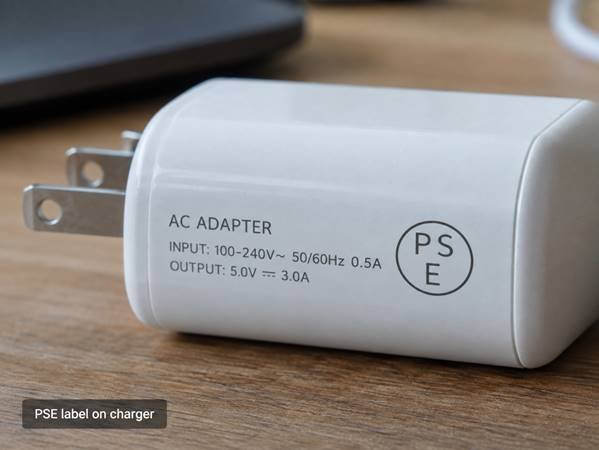
In accordance with Article 10 of DENAN and its enforcement regulations, applicable PSE marks, the name of the notifying business operator or the registered trademark notified in accordance with the law, as well as specified rated values and other items shall be marked on electrical appliances. In cases where the product is too small to be directly marked as required, the allowed alternative marking methods shall be confirmed in accordance with the enforcement regulations, and it cannot be simply understood that the minimum packaging or instruction manual can be used as a substitute.
Packaging, instruction manuals, or e-commerce platforms may additionally require marking of responsible entity information, addresses, or other content, but such additional requirements need to be confirmed separately and should not be generalized as a unified mandatory name and address marking obligation of DENAN for all products.
Compliance Responsibility and Supervision Intensity
Non-compliance with DENAN may result in METI taking administrative measures such as report collection, on-site inspection, sales prohibition, improvement, or recall, and corresponding penalties may apply; e-commerce platforms may also remove products from shelves in accordance with their rules.
Daily supervision mainly comes from market spot checks by market supervision departments, METI-related law enforcement, and qualification reviews by e-commerce platforms. Whether the customs clearance process is affected shall be judged based on the customs system and specific cases, and cargo detention or failure to clear customs cannot be regarded as an inevitable consequence of PSE or notification non-compliance.
Judge It Yourself: Which Requirement Applies to Your Charging Product
After reading the above rules, you may already want to match your own products to the requirements. Follow these three steps, and you can independently make a preliminary compliance judgment—of course, the final conclusion shall be subject to METI’s official catalog and case-by-case confirmation.
Step 1: First Determine Whether the Product Is Within the Scope of PSE Supervision
There are two simple judgment methods:
The first is to look at the core attribute: as long as it is a charging product connected to Japan’s household AC power supply (i.e., mains power), it is highly likely to be within the scope of PSE supervision.
The second is to check the issued by METI and confirm it in combination with the product’s structure and rated parameters. This is the most accurate method.
For charging products, we have compiled common judgment references to help you quickly get a preliminary understanding:
• Usually belonging to diamond PSE: wall-plug AC chargers, USB-C power adapters (generally evaluated as “DC power supply devices”).
• Cannot be directly judged: USB-C cables with E-Marker chips need to be judged in combination with the specific structure.
• Require case-by-case classification: charging power strips with AC plugs and USB power strips shall be classified according to the overall structure.
• Neither ordinary USB charging cables nor USB-C cables with E-Marker can be concluded solely based on whether they have a chip or whether they are connected to the mains. It is necessary to check whether they meet the specific definitions, structures, and rated conditions of items such as wires and plugs in the DENAN catalog; common low-voltage USB cables may not be catalog items, but must be confirmed on a case-by-case basis.
A special reminder here: **you cannot judge solely by product name or interface type**. You must confirm it in combination with the product’s internal structure, rated parameters, and input type, otherwise it is easy to make a wrong judgment.
Step 2: Determine Whether METI Notification Is Required
After determining the scope of PSE, look at the sales model:
• Cases where it is mandatory: sales in Japanese offline physical stores, sales on formal e-commerce platforms, commercial sales with bulk customs clearance—as long as it is commercial sale for the Japanese market and the product is within the scope of PSE supervision, it is mandatory.
• Cases where it is not required: mailed items for personal use, non-sales samples, products not in the PSE supervision catalog.
The core logic is simple: **only products that are within the scope of PSE supervision and are for commercial sale in the Japanese market require METI notification**; if either condition is missing, it is not required.
Step 3: Clarify Compliance Priorities and Timelines
Finally, clarify the order to avoid delaying market launch:
• Must be 100% completed before market launch: PSE technical compliance, self-inspection, third-party inspection if it is a specified electrical appliance, and the PSE mark affixed to the product—if these are not done well, the product cannot be sold on the market.
• Must be completed within 30 days after the commencement of manufacturing or import business: METI notification of commencement of manufacturing or import business—the specific start date shall be judged based on the fact of actual commencement of manufacturing or import business, and shall not be uniformly calculated from the first sale date.
Practical Tools for Implementation: Compliance Process, Self-Check List, and Verification Methods
Finally, we provide you with a set of directly usable practical tools to help you implement compliance requirements.
Japan Access Compliance Process for Charging Products
Follow these steps, and you will basically not miss any items:
1. First confirm the specific specifications and sales model of the product, and determine the responsible entity for METI notification.
2. Determine which PSE category the product belongs to (specified/non-specified), prepare technical documents, and start testing.
3. If it is a specified electrical appliance, a conformity inspection agency registered in accordance with the law shall conduct a suitability inspection and issue a suitability inspection certificate.
4. Complete statutory self-inspection, and produce PSE labels, packaging, and instruction manuals that meet requirements.
5. Recheck the consistency between the physical product and documents before market launch, and archive all compliance records (for at least 3 years).
6. The responsible entity shall submit the METI notification of commencement of business within 30 days from the date of actual commencement of the business of manufacturing or importing electrical appliances.
Pre-Market Launch Quick Self-Check List
Check these 5 items before market launch to avoid 80% of common problems:
□ Confirm the PSE supervision attribute and category of the product (specified/non-specified)
□ Confirm whether the sales channel requires METI notification
□ All PSE compliance obligations have been completed (technical compliance, inspection, labeling)
□ Statutory marking items on the product body such as PSE mark, name of the notifying business operator or notified trademark, and rated values meet requirements, and additional requirements for packaging, instruction manuals, and platforms are separately confirmed
□ The business operator on the PSE mark is exactly the same as the METI notification entity
Required Compliance Document Package and Change Control
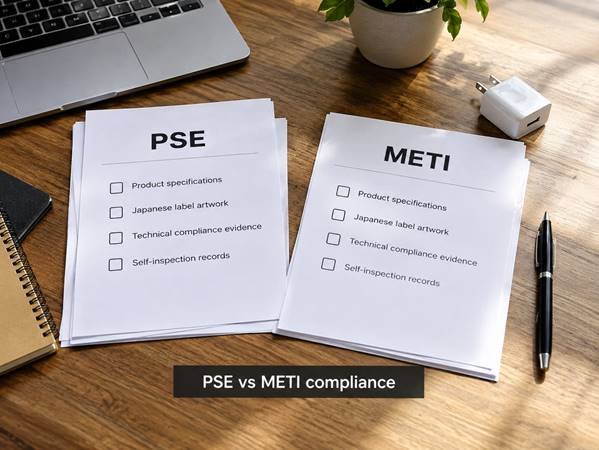
The core compliance documents you need to save include: product specifications, Japanese label artwork, suitability inspection certificate (only required for diamond PSE), technical compliance evidence, and self-inspection records.
If the product undergoes the following changes, the compliance validity must be re-evaluated: change of manufacturing factory, change of input/output rated values, change of power supply topology, change of insulation/protection components, change of plug structure—these changes may affect the validity of PSE compliance, and previous documents cannot be directly used.
Compliance Authenticity Verification Methods
If you hired a service provider to handle compliance, or need to verify a supplier’s qualifications, you can use these methods to initially judge the authenticity:
• PSE compliance verification: First check whether the shape of the mark on the product is correct (diamond/circular), and whether it is marked with business operator information and rated parameters; if it is diamond PSE, also check the valid certificate issued by a conformity inspection agency registered in accordance with the law, as well as the type and applicable scope of the certificate.
• METI notification verification: You can check the notification receipt and the information of notifying business operators publicly disclosed by METI in accordance with the law, but this information cannot prove that a specific product has complied with PSE.
• During verification, judgment shall also be made in combination with the statutory marking on the physical product, product classification, rated values, and the scope of the certificate when applicable. Self-inspection records and technical documents shall be saved or kept by the notifying business operator in accordance with the law, and the fact that they are not disclosed to the public cannot be used as a basis for determining non-compliance.
• Several warning signs: only the PSE logo on the product without business operator information, the physical marking does not match the product classification or rated value, the scope of the diamond PSE certificate is inconsistent with the actual product, and claims of a universally searchable METI filing number—you must be extra cautious when encountering these situations.
Final Summary
In general, PSE and METI notification are two sets of supporting requirements under Japan’s . One regulates the electrical safety compliance of products, and the other regulates the responsibility registration of business entities. They are not an either-or choice. For products that are in the catalog, manufactured or imported by a notifying business operator, and sold in Japan, both types of obligations may apply.
For overseas sellers of charging products, first make a preliminary judgment based on product attributes and sales models, then complete compliance according to the timeline: complete PSE-related product compliance and labeling before sale or display for sale; complete the notification of commencement of business within 30 days from the date of actual commencement of the business of manufacturing or importing electrical appliances. Only in this way can most access risks be avoided.
After learning the content of this article, you should be able to distinguish the essential difference between the two and not be misled by bad service providers; be able to initially judge by yourself whether a charging product requires PSE and whether it requires METI notification; be able to avoid common compliance pitfalls for charging products; and be able to initially verify the authenticity of compliance qualifications. If you encounter products with ambiguous boundaries, it is best to find a professional agency or directly consult METI’s official window for final confirmation.