
For charging products sold in the Japanese market, almost everyone encounters the two terms PSE and “TELEC certification”, and many people get confused: both are mandatory compliance requirements, why can’t we just do one? Why do some products need to handle both? Even many people don’t know that “TELEC certification” itself is a common name that easily leads to pitfalls.
Let’s start with the most easily misunderstood point: the “TELEC certification” we often refer to has the official name **Technical Conformity Certification**, and is commonly called “giteki”. TELEC (Telecom Engineering Center) is one of the registered certification bodies registered by the Minister of Internal Affairs and Communications of Japan that can carry out services such as Technical Conformity Certification; it is not the only institution, let alone the name of the certification itself. To judge whether a product has obtained giteki certification, you need to check whether it has the “giteki mark + certification number”, not just whether there is a “TELEC” label. In contrast, PSE is Japan’s official mandatory electrical safety mark, and its name has no ambiguity.
Next, we will thoroughly explain these two systems for chargers, USB-C cables, power adapters, and charging products with wireless functions, from basic positioning to practical judgment — you don’t have to slog through dry regulations, and you can judge most situations by yourself after reading this.
To help you quickly grasp the key points, we first compile a brief table of core differences, and then expand on the details item by item later:
| Comparison Dimension | PSE Electrical Safety Certification | Giteki Certification (commonly known as TELEC in the market) |
| Core Regulatory Focus | Electrical safety (electric shock prevention, overheating, fire prevention) | Wireless spectrum compliance (interference prevention, compliance with Japanese frequency bands) |
| Competent Authority | Ministry of Economy, Trade and Industry (METI) of Japan | Ministry of Internal Affairs and Communications (MIC) of Japan |
| Primary Judgment Focus | Whether it is an electrical appliance listed in the Electrical Appliance and Material Safety Act | Whether it is a specified wireless device stipulated by the Radio Act, or subject to other radio systems |
| Regulatory Classification | Diamond PSE (specified electrical appliances), Circular PSE (non-specified electrical appliances) | Construction Design Certification, Technical Conformity Certification |
| Processing Period | The law does not stipulate a unified time limit, which needs to be confirmed according to the specific product | The law does not stipulate a unified time limit, which needs to be confirmed according to the specific product |
| Validity Period | No fixed term, but must continuously meet applicable requirements | Generally, there is no general rule for regular renewal every 3-5 years; reconfirmation may be required when the product is changed |
Item-by-Item Comparison of Core Dimensions (Charging Product-Specific Criteria)
Regulatory Attributes and Responsible Entities
PSE is a mandatory access system mainly based on filing, and is divided into two categories according to the product items listed in the regulations:
• Diamond PSE: For “specified electrical appliances”, a conformity certificate issued by a registered conformity assessment body is required.
• Circular PSE: For “non-specified electrical appliances”, the manufacturer or importer shall confirm compliance with technical standards, complete relevant notifications, and label them in accordance with the law.
The responsible entity for PSE is the “notifying entity” in Japan — simply put, it is the person responsible for reporting product information to the regulatory authorities in Japan, usually a local Japanese importer or distributor.
Giteki is a mandatory compliance system under the Radio Act, and common pathways include:
• Construction Design Certification: Suitable for products that are continuously produced according to the same certified construction design, and is a common handling method for mass-produced products.
• Technical Conformity Certification: A certification method for specific wireless devices.
The responsible entity for giteki is the certification holder, usually the manufacturer or brand owner of the product.
For charging products, whether a wall charger or AC adapter requires PSE should first be confirmed according to the specific items and product structure listed in the Enforcement Order of the Electrical Appliance and Material Safety Act. Whether it is Diamond or Circular PSE is also determined by the corresponding statutory product item; an increase in power may affect the applicable technical requirements or test plan, but does not constitute a threshold for Diamond/Circular classification. Situations such as mass production or single-unit equipment may affect which giteki pathway is suitable.
Applicable Product Scope
We directly map common charging products, which is easy to understand at a glance:
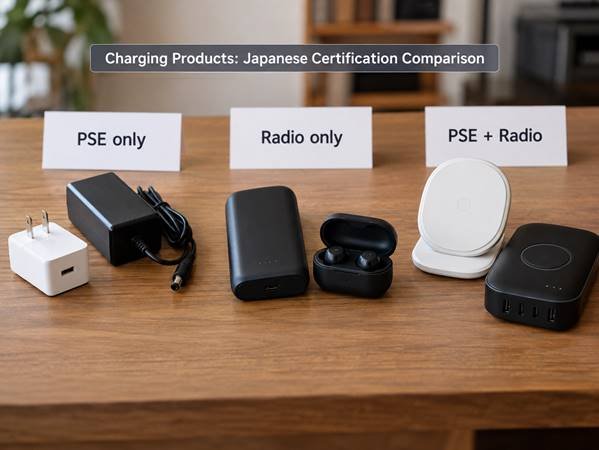
• **May only require PSE**: Ordinary wall chargers and power adapters without wireless functions, if they fall under PSE statutory items, usually need to be handled in accordance with PSE requirements.
• **May only require giteki or other radio procedures**: Pure battery-powered charging products with Bluetooth or Wi-Fi functions usually do not involve PSE when not connected to mains power; but whether the wireless part requires giteki depends on whether it is a statutory specified wireless device.
• **May need to handle both sets of requirements**: Wall chargers with wireless communication functions such as Bluetooth or Wi-Fi, wall-mounted wireless chargers with communication functions, and charging sockets with wireless functions may involve both PSE and compliance requirements under the Radio Act.
When judging the boundary, connection to mains power is only a primary screening factor for PSE, and cannot replace the statutory item judgment; common products such as wall chargers and AC adapters usually require further confirmation of whether they fall under statutory items.
The wireless part cannot be simply understood as “as long as there is active transmission, giteki is required”. For functions such as Bluetooth, Wi-Fi, NFC, and wireless charging, it is necessary to confirm respectively whether they are specified wireless devices stipulated by the Radio Act, or whether other systems such as low-power radio stations or high-frequency utilization equipment apply. For pure magnetic induction wireless charging products in particular, conclusions cannot be drawn directly based solely on power or operating frequency band.
Core Test Content
The focus of the two is completely different, and the essential difference is: PSE governs “electrical safety”, while giteki governs “whether wireless devices meet the technical requirements of the Radio Act”.
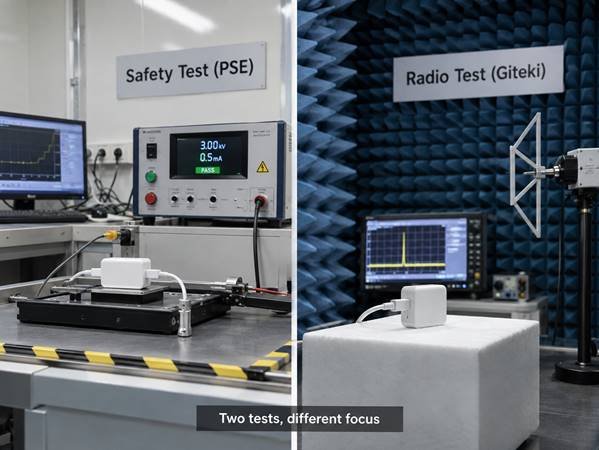
PSE confirmation revolves around “no electrical safety accidents”, and common items for charging products include: whether the insulation performance is sufficient to prevent electric shock, whether the shell material meets requirements, whether there is necessary over-temperature and over-current protection, whether the plug is resistant to plugging and unplugging, etc.
Giteki confirmation revolves around whether wireless signals meet Japanese requirements, and common focus items include: whether the operating frequency band is applicable, whether the transmission power meets limits, whether it will cause interference to other wireless devices, etc.
Generally speaking, the PSE confirmation content will vary depending on product power, structure, and applicable standards; the more complex the wireless function and the more frequency bands involved, the more content usually needs to be confirmed for the wireless part.
Processing Procedure and Period
The following are common compliance approaches; the actual process will vary with product category, data completeness, and institutional requirements.
For non-specified electrical appliances, the manufacturer or importer shall confirm compliance with technical standards, complete business notification, and label in accordance with the law; for specified electrical appliances, a conformity certificate issued by a registered conformity assessment body must also be obtained. Testing can be completed by laboratories with corresponding capabilities, but should be confirmed according to product category and applicable standards.
Specified electrical appliances must undergo statutory conformity assessment by a registered conformity assessment body; whether and how to conduct factory or quality management audits shall be determined according to product category and certification rules, and cannot be simply understood as all Diamond PSE products require a fixed “additional factory inspection”.
The common process for giteki is: confirm technical requirements according to wireless functions and applicable systems, complete necessary testing and document preparation, then the registered certification body will review and issue the corresponding certificate or certification. Whether wireless charging devices are subject to giteki also needs to be confirmed first according to the specific solution; some products may involve other radio systems.
If the product uses a certified wireless module, it should be verified whether the complete product fully complies with the certified construction design, antenna, and usage conditions of the module. When the certified conditions are exceeded, or when the antenna, radio frequency parameters, module design, or installation conditions are changed, it is necessary to confirm with the registered certification body whether re-certification or re-assessment is required.
Neither PSE nor giteki regulations stipulate a unified processing time limit such as “Circular PSE takes a fixed 2-4 weeks” or “giteki takes a fixed 3-6 weeks”. The actual period should be confirmed with the testing laboratory or registered certification body based on the specific product, frequency band, applicable standards, data situation, and scheduling.
Validity Period and Renewal Requirements
PSE has no fixed validity period, but the premise is that the product continuously meets the applicable technical standards and statutory requirements. After the revision of PSE technical standards, the conformity of newly manufactured or imported products shall be confirmed in accordance with the effective date and transitional arrangements announced by METI; whether re-testing is required depends on the revision content and product status, and it is not that all existing products automatically need re-testing as soon as the standard is updated.
For giteki, there is generally no general rule for regular renewal every 3-5 years. The certification holder shall continuously ensure that the product is consistent with the certified construction design, frequency, power, antenna and other conditions; when changes that affect conformity occur, re-assessment or re-certification shall be carried out in accordance with the Radio Act and certification rules.
Whether it is PSE or giteki, as long as the product design, applicable standards, or wireless conditions change, the compliance of the product should be reconfirmed.
Product Labeling Requirements and Authenticity Verification Methods
For ordinary sellers or consumers, understanding labels and being able to verify basic information is the most practical skill.
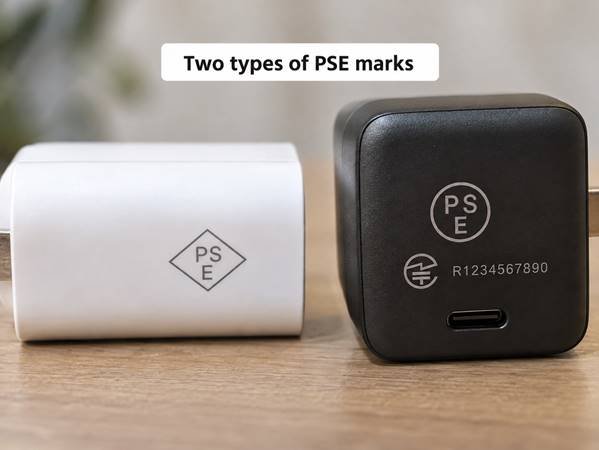
PSE labels are divided into two types: Diamond and Circular. The specific labeling content shall comply with statutory requirements according to the product category, including the PSE mark, the name or logo of the notifying operator, and rated information, etc.; specified electrical appliances also involve labels related to the registered conformity assessment body. The PSE mark of charging products is generally printed on the side of the plug or the bottom of the product.
It should be noted that Circular PSE is not a per-product certificate system, and there is usually no way for consumers to check the authenticity in a unified product database using the so-called “PSE number”. When verifying, judgment should be made in combination with the notifying operator, statutory labeling, product item, and relevant compliance documents, and cannot rely solely on a number.
The giteki label is the 「技適マーク」 (giteki mark), with a certification number attached next to it. In principle, the giteki mark shall be displayed on the device itself; when meeting the conditions stipulated by MIC, electronic display and other methods can be used. Information on packaging or instructions cannot automatically replace the statutory giteki label that should be on the device itself.
A special pitfall to avoid here: PSE-related labels, giteki certification numbers, test report numbers, and e-commerce platform product numbers are all completely different things and cannot replace each other; do not use test report numbers as certification numbers.
Consequences of Non-Compliance
The competent authorities and regulatory focus of the two systems are different. When a product does not meet relevant requirements, it may face consequences such as sales restrictions, platform delisting, and administrative penalties; if the same product involves both electrical safety and radio compliance issues, both customs clearance and sales processes may be affected.
If PSE does not meet requirements, it may cause problems such as the goods being unable to circulate normally, platform delisting, and administrative penalties.
If giteki or other applicable radio requirements are not met, the wireless function may be required to stop being used, and the product may also face regulatory action or platform delisting.
It should also be noted that after the revision of Japan’s product safety-related laws, eligible overseas operators selling regulated products in Japan may need to designate a domestic administrator; the specific applicable products, sales methods, and effective requirements shall be confirmed in accordance with METI announcements. This system cannot be generalized as a unified rule for all overseas direct mail products or giteki products.
Common Misconceptions and Charging Product-Specific Pitfall Avoidance
Many sellers who are new to the Japanese market are prone to fall into some cognitive pitfalls, and many are specific to charging products. We have compiled the most common categories.
General Cognitive Misconceptions
The first and most common one: “I have CE/FCC/UL certification, can it replace PSE or giteki?” The answer is **cannot be directly replaced**. The CE, FCC, and UL marks themselves cannot replace PSE or giteki; conformity must be obtained in accordance with Japan’s applicable technical standards and statutory procedures. Whether existing overseas test data can be used depends on its standard version, test scope, traceability, and the acceptance requirements of the notifying entity or registered certification body.
Second: “If I have done one certification, I don’t need to do the other, right?” Wrong. The scope of regulation of the two systems is completely different. As long as the product falls under both the PSE statutory items and the applicable scope of the Radio Act, they must be handled separately; there is no such thing as “doing one covers the other”.
Third: “Are Diamond PSE products better quality than Circular ones?” Wrong. Diamond and Circular are different regulatory requirements divided by regulations according to product items, and have no direct relationship with the quality of the product itself — just like airport security is stricter than train security, not because people who fly are more dangerous, but because the corresponding scenario requires stricter regulation.
Fourth: “It’s just a sample for sales, so no certification is needed, right?” This cannot be understood that way. As long as the product enters the links of sales, transfer, or public display, it should be confirmed whether it needs to meet applicable requirements; whether special cases apply for R&D, testing, or display purposes also depends on the specific purpose, quantity, circulation method, and requirements of the competent authority.
Charging Product-Specific Pitfalls
First pitfall: Wall-mounted wireless chargers only get giteki, missing PSE. This is a high-incidence misconception — many people think wireless chargers are wireless products, so they only confirm the wireless part, forgetting that wall-mounted products also need to confirm electrical safety requirements according to PSE statutory items, which easily causes problems in platform or regulatory inspections.
Second pitfall: All separately sold USB-C charging cables do not need PSE. Incorrect. Whether a USB-C cable is subject to PSE cannot be judged solely by whether it has an E-Marker or its rated power; it should be confirmed based on whether it meets the definition of corresponding wires, cables, or other items in the Enforcement Order of the Electrical Appliance and Material Safety Act.
Third pitfall: If a certified wireless module is used, the complete product doesn’t need any further confirmation. Incorrect. When using a certified wireless module, it should be verified whether the complete product fully complies with the certified construction design, antenna, and usage conditions of the module; if the antenna, installation conditions inside the housing, or other RF-related designs are changed, it is necessary to confirm with the registered certification body whether re-certification or re-assessment is required.
Fourth pitfall: Charging cables with E-Marker chips need giteki. Completely wrong. E-Marker is a wired protocol chip in USB-C cables, used to declare cable capabilities and negotiate power supply-related parameters. It has no wireless transmission function and has no direct relationship with giteki.
Ongoing Compliance Pitfalls
First pitfall: Certification is valid for life once done. Incorrect. PSE has no fixed validity period, but the product must continuously meet applicable requirements; giteki also generally does not require renewal at fixed intervals, but requires ensuring that the actual product continuously complies with the certified construction design and wireless conditions. Situations such as replacing the power board, wireless module, or antenna all require reconfirmation of whether compliance is affected.
Second pitfall: It is compliant as long as the certification mark is printed on the packaging. Incorrect. First, the requirements of PSE and giteki for the device itself and statutory labeling items must be met; packaging, instructions, and web pages must also comply with applicable platform rules and other consumer protection and product labeling requirements. Marks on packaging or web pages cannot replace the statutory labeling that should be on the device.
Third pitfall: Overseas direct mail to Japan does not require certification. You should not have such a fluke mentality. After the revision of Japan’s product safety-related laws, eligible overseas operators selling regulated products in Japan may need to designate a domestic administrator; the specific applicable scope shall be subject to METI announcements and relevant legal requirements, and cannot be simply judged generally by “overseas direct mail”.
Summary
After reading this article, you will master at least four practical skills, which are sufficient to deal with most Japanese certification issues for charging products:
First, you can accurately distinguish the positioning of the two: PSE governs electrical safety, and giteki is a compliance certificate for specified wireless devices under the Radio Act; the two systems are independent and cannot replace each other.
Second, you can quickly judge the confirmation direction for ordinary charging products: wall mounting or mains connection is only a primary screening clue for PSE, and the final judgment depends on whether it falls under statutory items; for products with wireless functions, you need to confirm whether they are specified wireless devices, or subject to other radio systems.
Third, you can understand product certification labels: you can tell the difference between Diamond and Circular PSE, find the giteki mark and number, and know that you cannot judge authenticity solely based on packaging, web pages, or test report numbers.
Fourth, you can avoid the three most common pitfalls: do not directly use overseas certification marks to replace Japanese requirements, do not miss PSE item confirmation for wall-mounted wireless chargers, and even for certified wireless modules, verify whether the complete product is still within the certified conditions.
If you encounter borderline products that you are unsure about, the safest way is to check the official information of METI and MIC, or consult a formal certification body with Japanese qualifications — spending a little time confirming in advance is much more cost-effective than having goods detained or products delisted.