
When you shop for Japanese-made chargers or do business in charging products for the Japanese market, you may have seen two differently shaped PSE marks — one in a diamond frame, the other in a round frame. Many people’s first reaction is: Is the diamond one better in quality and higher in grade? Is the round one voluntary and has lower requirements?
In fact, this is the most common misunderstanding about PSE. The difference between the two types of PSE has nothing to do with quality grade; they only correspond to product categories with different risks, and both are statutory compliance requirements in Japan. Today, we will thoroughly explain the differences between the two types of PSE from basic definitions, core differences, compliance processes to practical verification, and provide specific judgment methods especially for the most commonly contacted charging products (wall chargers, adapters, power banks, cables, etc.).
Basic Introduction: First Understand What PSE Is
PSE is the market access mark for electrical products in Japan, with its legal basis being Japan’s (abbreviated as DENAN in English, no need to memorize the abbreviation specifically). Its core purpose is to control electrical safety risks such as electric shock, fire, and abnormal heating, and the competent authority is the Ministry of Economy, Trade and Industry of Japan (abbreviated as METI). Most charging-related products we usually contact, such as wall chargers, GaN adapters, power banks, and extension cords, are within the scope of PSE regulation.
Many people think that diamond PSE is the “premium version” and round PSE is the “basic version”, which is completely wrong. The classification basis of the two types of PSE is the product risk classification in the attached schedule of the cabinet order of the , and has nothing to do with quality level:
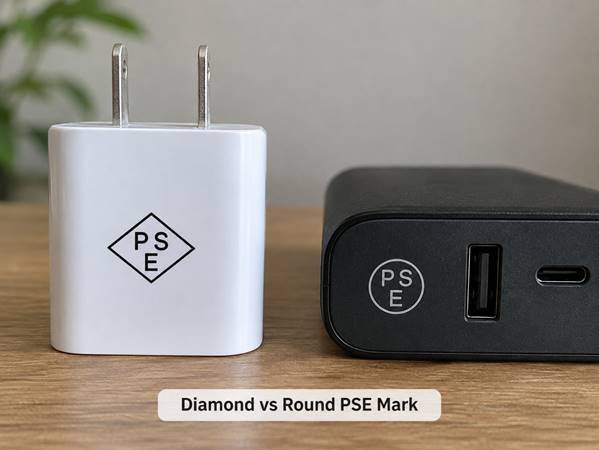
• Diamond PSE corresponds to “specified electrical appliances and materials”, that is, high-risk categories in Schedule 1. For example, AC-DC adapters directly plugged into the mains are classified as high-risk because they directly contact high-voltage alternating current, and problems can easily cause electric shock and fire.
• Round PSE corresponds to “electrical appliances and materials other than specified electrical appliances and materials”, that is, medium and low-risk categories in Schedule 2. For example, compliant power banks have relatively lower risks because of their low-voltage output.
Both are mandatory compliance marks required by Japanese law, with no difference in grade, only applicable to different types of product risks.
Of course, not all electrical products require the PSE mark. The final judgment basis is the official product category catalog issued by METI, and comprehensive judgment should be made in combination with the actual structure, rated parameters, and usage methods of the product. Some products are not regulated by the . For example, pure low-voltage signal transmission cables may be subject to other regulations such as the Radio Law and battery safety regulations, so they do not require PSE. If you encounter uncertain and difficult categories, you can apply for an official pre-classification opinion from METI, and the official interpretation shall prevail.
Core Comparison: Full-Dimensional Differences Between the Two Types of PSE
To let you see the difference between the two more intuitively, we have first compiled a core comparison table, and then we will explain each dimension in detail later:
| Comparison Dimension | Diamond PSE (Schedule 1 · High Risk) | Round PSE (Schedule 2 · Medium and Low Risk) | Common Requirements |
| Statutory Mandatory Requirement | All are mandatory; non-compliant products are not allowed to be sold | Mandatory for those included in the Schedule 2 catalog; not required for those not included | Both are statutory compliance marks, with no difference in grade |
| Compliance Path | Requires a conformity inspection certificate issued by a registered inspection body | Enterprises conduct self-inspection and keep records; no third-party inspection is required | Both require notification (todoke) to METI by a domestic Japanese notification business operator |
| Mandatory Mark Elements | Diamond PSE mark + notification business operator information + registered inspection body information | Round PSE mark + notification business operator information | The mark must be affixed to the product body; packaging/instructions alone cannot replace it |
| Validity Period | The validity period of the conformity inspection certificate is 3/5/7 years (depending on the category) | No fixed validity period; remains valid as long as the product structure remains unchanged | Both are subject to METI supervision, and may be subject to random inspections and penalties |
| Ultimate Responsible Subject | Domestic Japanese notification business operator (overseas factories can be used as production locations) | Domestic Japanese importer/seller (notification business operator) | The ultimate legal responsibility is borne by the domestic Japanese notification business operator |
Statutory Classification and Mandatory Requirements
All high-risk categories in Schedule 1 corresponding to diamond PSE are statutory mandatory requirements, and non-compliant products must never be sold in the Japanese market.
For the Schedule 2 categories corresponding to round PSE, only those included in the official catalog are mandatory. Products not included in the catalog do not need to affix the PSE mark at all, and there is no such thing as “voluntarily applying for round PSE”.
No matter which category it is, as long as it is not in the DENAN regulation catalog, it is not subject to PSE constraints, and there is no need to forcibly affix the mark.
Compliance Path and Strictness
The difference in strictness between the two types of PSE mainly comes from the different compliance paths:
• For products with diamond PSE, in addition to the domestic Japanese notification business operator (that is, the legally responsible enterprise, which you can understand as the first responsible person for compliance recognized by the Japanese government, and must be a company located in Japan) conducting technical standard confirmation and self-inspection, a third-party registered inspection body registered with METI must also conduct conformity inspection and issue a certificate.
• For products with round PSE, the notification business operator only needs to complete technical standard confirmation and self-inspection by itself, and keep all records well; there is no need to find a registered inspection body for third-party inspection.
But note that both must complete the “todoke (notification)” procedure — that is, submit a compliance declaration to METI and obtain an acceptance certificate, to be considered as completing the legal procedure. It is not that round PSE only needs self-testing.
In addition, many people think that the higher the power, the higher the compliance cost and the longer the cycle, which is actually wrong. The cost and cycle mainly depend on product complexity, test items, factory qualifications, and model classification methods, and have no direct relationship with power. For example, a 5W wall charger and a 100W wall charger both belong to diamond PSE in Schedule 1. If the test items are not much different, the cost and cycle will not be much different.
Mark Style and Labeling Requirements
The marks of the two types of PSE have common mandatory elements, as well as clear differences:
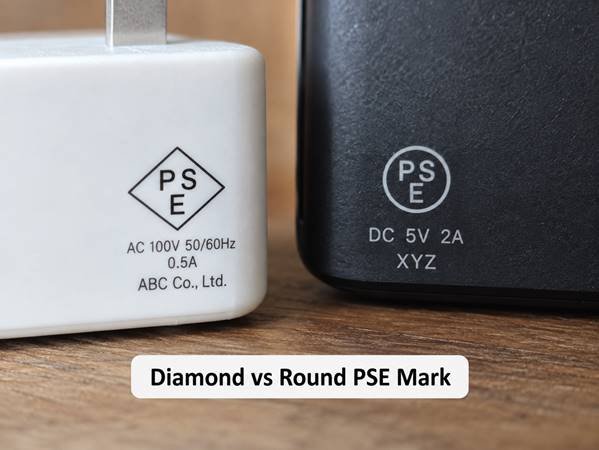
• Common requirements: There must be a PSE mark of the corresponding shape, and the name, registered trademark, or officially approved abbreviation of the notification business operator must also be marked — that is to say, next to the PSE mark you see, there must be the name or trademark of a Japanese enterprise, which is a statutory requirement.
• Additional requirements for diamond PSE: The name, registered trademark, or approved abbreviation of the registered inspection body must be marked near the PSE mark. For example, the marks of common institutions such as JET and JQA will be next to the diamond PSE mark.
Many people ask: Is it mandatory to mark rated parameters? In fact, there is no unified mandatory requirement. Different categories can be labeled according to the technical standards of the corresponding product items. For example, some products need to mark input and output voltage and current, while others only need to mark power.
There is another common pitfall: if the product is too small and the surface space is not enough to print the mark, can it be printed on the packaging or instructions? The answer is no. Unless you confirm that this category is subject to the “simple mark rule”, the mark must be printed on the product body, and packaging and instructions cannot replace the body mark.
Validity Period and Supervision Rules
The conformity inspection certificate for diamond PSE has a validity period, which is 3 years, 5 years, or 7 years depending on the category. If you need to continue manufacturing or importing the applicable model after the expiration, you must re-obtain a valid certificate in accordance with the requirements of notification and conformity inspection certificate; whether existing inventory can be sold should be specifically judged in combination with its manufacturing or import time, notification, and regulatory requirements.
Round PSE has no fixed validity period. As long as the product design and structure remain unchanged and the compliance records are complete, it can remain valid indefinitely without regular renewal.
But whether it is diamond or round, both are subject to METI supervision. The authorities may conduct random inspections of products on the market at any time. If non-compliance is found, they will order rectification, even impose fines and prohibit sales. It is not that round PSE has loose requirements and no one supervises it.
Statutory Responsible Subject
The ultimate legal responsibility for both types of PSE is borne by the “notification business operator” in Japan — that is to say, even if the product is produced by an overseas factory, if there is a compliance problem, the Japanese notification business operator will be held responsible first.
The slight difference is:
• For products with diamond PSE, overseas factories can serve as production locations and participate in document management such as conformity inspection and quality control; however, DENAN notification must be handled by domestic Japanese manufacturers or importers.
• For products with round PSE, Japanese importers or sellers generally act as notification business operators, who need to keep all compliance records for random inspection.
There is another exception: if it is a component sold in B2B, that is, only sold to downstream manufacturers and not directly to consumers, PSE cannot be automatically exempted just because of this. It should be judged on a case-by-case basis according to whether the component is subject to DENAN, whether it meets statutory exclusion conditions such as being only used as a component, and the forms of manufacture, import, and sale.
Full Compliance Process: How to Do It From Classification to Labeling
If you are a seller or brand operating in the Japanese market, you may need to understand the complete compliance process. We have broken it down into 7 steps, and following them in order will not go wrong:
1. **Determine the domestic Japanese notification business operator**: This is the first step and also the prerequisite — the notification business operator should be the entity actually engaged in manufacturing or import business in Japan, which can be a legal person or an individual. Without a domestic Japanese compliance responsible entity, it is impossible to do PSE compliance at all.
2. **Product category classification**: First determine whether the product is subject to DENAN regulation, then see whether it belongs to Schedule 1 (diamond) or Schedule 2 (round). This step is the most critical; if classified wrong, all subsequent work will be in vain.
3. **Confirm the technical standard requirements of the corresponding product item**: Different product items have different safety test standards. For example, the test items for AC-DC adapters and power banks are different. You must first figure out which requirements your product must meet.
4. **Complete product testing/self-inspection**: Conduct testing according to technical standards. For products with diamond PSE, you also need to find a registered inspection body to conduct conformity inspection and obtain certification documents.
5. **Submit notification procedures to METI**: Handle the notification in accordance with the statutory format. Technical standard compliance materials, self-inspection records, conformity inspection certificates, etc. shall be kept by the notification business operator, and are not submitted together as a full set of approval materials for the notification.
6. **Affix the PSE mark of the corresponding shape according to the rules**: According to the marking requirements, print the PSE mark, notification business operator information, (and inspection body information for diamond PSE) in a suitable position on the product body.
7. **Keep compliance records and implement change management**: All test reports, notification certificates, and bill of materials must be kept well. If there are changes to the product, compliance must be re-evaluated in a timely manner.
List of Required Compliance Documents
Throughout the process, you need to keep these documents for METI random inspection:
• **Notification category**: Information of the notification business operator, notification acceptance certificate issued by METI.
• **Technical category**: Technical standard compliance certificate, test/self-inspection records, product bill of materials (BOM) and details of key safety components.
• **Exclusive to diamond PSE**: Valid conformity inspection certificate issued by a registered inspection body.
• **Marking category**: Layout design of product labels, description of marking position.
Change Management: These Changes Require Re-evaluation of Compliance
Many people think that doing PSE once is a once-and-for-all solution, and you can change the product at will, which is not the case. If the product has the following changes, compliance must be re-evaluated: change of plug type, adjustment of input rating, change of output specification, modification of isolation/protection design, replacement of key safety components, change of production factory.
After the change, first check whether the product category classification has changed, then see whether the original compliance documents can cover the new design. If not, you need to re-test and re-submit the notification.
Exclusive for Charging Products: How to Quickly Determine the PSE Type
For the charging products that everyone contacts most frequently, we have compiled a three-layer judgment method. From rough to detailed, you can determine which PSE the product needs step by step:
1. **First layer: First determine whether it is subject to DENAN regulation**: For example, accessories that are pure low-voltage and have no electrical conversion function (such as ordinary USB cables, which only transmit power and signals, without voltage transformation or rectification) are not regulated by DENAN and do not require PSE.
2. **Second layer: Determine whether it belongs to Schedule 1 (high risk/diamond) or Schedule 2 (medium and low risk/round)**: For example, AC-DC adapters directly plugged into the mains are high-risk and belong to Schedule 1; compliant power banks are medium and low-risk and belong to Schedule 2.
3. **Third layer: Check the rated conditions, structure, and usage method of the product to match the specific product item definition**: For example, even for chargers, wall-plugged ones and car ones are different. You can’t just look at the name; you have to look at the actual input and output, and structural design.
Here is a reminder: whether it is connected to AC mains cannot alone determine the shape of the PSE mark; it must be classified according to the cabinet order schedule, specific product item definitions, rated parameters, and structure, and ultimately you still need to check the official METI catalog.
PSE Classification of Common Charging Products
We have compiled the classification of the most frequently asked types of charging products for your direct reference:
• **Wall-plug chargers/AC-DC adapters (including PD, GaN fast chargers)**: Belong to high-risk categories in Schedule 1, and must apply for diamond PSE, regardless of power level.
• **Ordinary USB/USB-C charging cables (only low-voltage transmission, no electrical conversion)**: Most are not subject to DENAN regulation and do not require PSE marks, which does not mean they are non-compliant.
• **Car chargers**: For car chargers with only low-voltage DC input, the classification cannot be determined solely by name; you need to check the specific product item. If it is a set with an AC-DC module (such as a wall adapter + car charger head), the type of each component must be determined separately.
• **Extension cord sets (pure extension cords with AC plugs)**: Belong to high-risk categories in Schedule 1 and require diamond PSE.
• **Desktop sockets/wiring devices**: Must be determined according to specific product items, and cannot be directly equated with extension cord sets. For example, desktop sockets with USB charging ports also need to be judged by disassembling the internal charging module.
• **Power banks**: Those that simultaneously meet the conditions of “external power supply for electronic products, lithium batteries not easily removable, meeting statutory energy density, and no use exemption” belong to Schedule 2 categories and require round PSE.
How to Judge Composite Products/Sets/Components
Now many products are of composite design or sold in sets. When judging, follow this order: first look at the overall attributes, then disassemble the internal regulated components, and finally confirm the sales form.
• **Integrated composite products**: For example, power strips with USB power supply ports should be judged according to the specific statutory product items of their wiring devices and USB power supply modules respectively; only when they actually contain and meet the statutory definition of a power bank lithium-ion battery unit, will it be further judged whether round PSE applies.
• **Detachable sets**: For example, for a “charger + charging cable” set, each separately sold component is judged separately, and all applicable marks must be labeled when sold as a set. Note that you cannot mislead consumers with the statement “the whole set has PSE”, making people think that all components have PSE — for example, cables do not need PSE at all, and you cannot use the set’s mark to confuse.
• **B2B component supply**: If the product is only sold to downstream manufacturers and not directly to consumers, PSE cannot be automatically exempted just because of this. It should be judged on a case-by-case basis according to whether the component is subject to DENAN, whether it meets statutory exclusion conditions such as being only used as a component, and the forms of manufacture, import, and sale.
Practical Verification: 3 Steps to Check Whether the PSE of Charging Products Is Compliant
Whether you are an ordinary consumer buying a charger or a seller inspecting goods, you can use these three steps to quickly judge whether the PSE mark is compliant:
Step 1: Check Whether the Mark Shape Matches the Product Type
First look at what type of product it is, then check whether the shape of the mark is correct:
• For products that should have diamond PSE, such as wall chargers and AC adapters, if only round PSE is affixed, it is most likely non-compliant.
• Ordinary low-voltage USB cables without PSE marks are not necessarily non-compliant. First confirm whether they are subject to DENAN regulation — if they are not required at all, it is normal to have no mark.
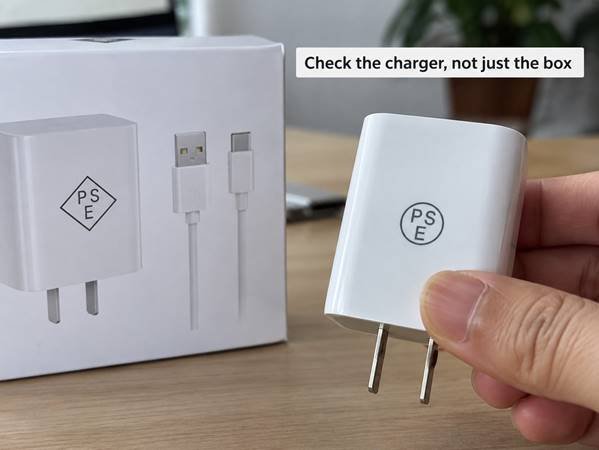
• For composite products or set products, don’t just look at the mark on the outer packaging. Check the body marks of the core regulated components separately. For example, check whether the charger in the set has the correct mark affixed, don’t just look at the box.
Step 2: Check Whether the Mandatory Mark Elements Are Complete
After the shape is correct, check whether the mandatory information is complete:
• What both types of PSE must have: PSE mark of the corresponding shape, name/registered trademark/approved abbreviation of the notification business operator. If there is only a PSE mark without any enterprise information, it is definitely non-compliant.
• Diamond PSE also requires additional: the name/trademark/abbreviation of the registered inspection body next to the PSE mark. If it is a diamond mark but there is no inspection body information next to it, it is also wrong.
Common incorrect marks also include: wrong shape, blurred notification information, and treating other certification marks such as CE and UL as PSE-related information.
Step 3: Check Whether the Parameters Are Consistent with the Product
Finally, check whether the parameters on the mark match the actual situation of the product:
• The input rating shall be marked according to the technical standards of the applicable product item and the actual specifications of the product, and shall be applicable to the power supply conditions in Japan; marking a rated range such as 100–240V is not automatically non-compliant, but it must still meet all PSE requirements of that product item.
• Power value: Power level does not directly determine the shape of the PSE mark. For example, 10W and 100W wall chargers both have diamond PSE. Don’t think that low power can use round PSE.
In addition, note that the labeling of rated parameters is based on the requirements of the corresponding product item, and there is no unified mandatory standard. Do not apply the parameter requirements of product A to product B.
Frequently Asked Questions
Is Round PSE a Voluntary Certification?
No. As long as the product is included in the DENAN Schedule 2 catalog, it is a statutory mandatory requirement, and must be compliant to be sold, just like diamond PSE. Products not included in the catalog do not need to affix the PSE mark at all, and there is no such thing as “voluntarily applying for round PSE”.
The Higher the Charger Power, the More It Needs Diamond PSE?
Wrong. The shape of the PSE mark is determined by product category classification, and has no direct relationship with power. As long as it is an AC-DC adapter, whether the power is 5W or 200W, it belongs to the high-risk category in Schedule 1 and must apply for diamond PSE.
Why Do USB-C Charging Cables Usually Have No PSE Mark?
Ordinary pure low-voltage USB-C charging cables are only responsible for power or signal transmission and have no electrical conversion function (such as voltage transformation, rectification). Most are not subject to DENAN regulation, so they do not need to affix the PSE mark, which does not mean the product is non-compliant.
Can Other Certifications Such as CE/UL/FCC Replace PSE?
No. PSE is Japan’s exclusive statutory market access requirement, and certifications from other countries or regions cannot replace it. It is necessary to separately confirm that the product meets Japan’s electrical safety requirements and complete the corresponding compliance procedures.
Decision Priorities for Different Roles and Core Summary
Different people focus on different priorities. We have compiled the core decision points for three groups of people for your reference as needed:
• **Ordinary consumers (purchasing for personal use)**: No need to understand complex product category classification. Just focus on checking the diamond PSE mark and notification information of wall chargers and adapters. Don’t fret over whether ordinary charging cables have PSE; most of them don’t require it anyway.
• **Cross-border sellers (selling to Japan)**: The core is to grasp three things: the product category classification of each SKU must be accurate, the notification business operator must have legal qualifications, and all compliance documents must be kept completely. Don’t judge by experience, for example, thinking that all charging products are diamond PSE, or that power banks do not need PSE.
• **Brands/purchasers (mass development)**: The focus is to check whether the actual structure, parameters, and compliance documents of the product are consistent. When there are any safety-related changes to the product, be sure to simultaneously evaluate whether the original compliance documents can still cover it. Don’t change the design without redoing compliance, which will cause the previous PSE to become invalid.
Quick Memorization of Core Conclusions (Exclusive for Charging Products)
Finally, we have condensed the most core conclusions into a few sentences for your quick memorization:
• Diamond PSE = Schedule 1 high-risk category + conformity inspection by registered inspection body required + statutory mandatory
• Round PSE = Schedule 2 medium and low-risk category + self-inspection with records kept + statutory mandatory
• Quick judgment logic: first determine whether it is subject to DENAN, then check product category classification, and finally verify structural parameters
• Quick memorization of common charging products: wall-plug AC adapters need diamond PSE, most pure low-voltage cables do not need it, compliant power banks need round PSE
In general, the two types of PSE are like two different “access passes”, corresponding to electrical products of different risk levels. There is no distinction between high and low grades, and both are statutory requirements that must be complied with in the Japanese market. Whether you are buying or selling products, as long as you figure out the actual attributes of the product and follow the rules, you can avoid most compliance pitfalls. If you encounter uncertain categories, the safest way is to check the official METI product category catalog, or apply for an official pre-classification opinion, and do not make decisions based on experience.