
If you plan to sell portable power banks in the Japanese market, whether through platforms like Amazon Japan, Rakuten, or your own independent site with direct shipping, the first access requirement you need to understand is PSE certification. Many sellers easily fall into pitfalls when they first encounter it: some think it is a high-end quality certification, some feel that printing a mark casually can get away with it, and others ask right away if they can get diamond-shaped PSE – in fact, these are all common cognitive biases.
This article will start from the most basic concepts, help you quickly determine whether your product needs PSE, choose the right certification type, understand the core compliance requirements, avoid various pitfalls during application and after listing, and finally help you distinguish the difference between PSE and other common certifications.
1. First, Understand What PSE Is: 3 Most Common Cognitive Pitfalls
1. What Exactly Is PSE
PSE is a mandatory safety access system for electrical products in Japan, valid only within Japan. Its competent authority is the Ministry of Economy, Trade and Industry of Japan (abbreviated as METI), and it is based on Japan’s . It does not regulate whether the product is easy to use or how fast it charges, but the most basic safety issues – such as whether it will cause electric shock, fire, or explosion. It is the minimum safety threshold that all electrical appliances sold in Japan must cross.
2. Why Power Banks Must Have PSE Certification
First of all, this is a legal requirement. According to Japanese regulations, electrical products that have not passed PSE compliance cannot be sold or even given away within Japan, even if they are directly mailed to Japanese consumers by cross-border e-commerce from overseas. Violators may face customs detention, fines, or even more severe penalties.
Second is platform requirements. When listing power bank products, mainstream e-commerce platforms such as Amazon Japan and Rakuten will require sellers to provide PSE compliance qualifications. If the review fails, you cannot list the product at all.
Finally, there is the actual safety value. PSE test requirements cover common risk points such as cell short circuit and overheating. Compliant products can greatly reduce the probability of fire and explosion. In the event of a safety accident, the responsibility division can be clarified based on compliance documents to avoid unnecessary losses.
3. 3 Most Common Initial Cognitive Misconceptions
The first misconception is treating PSE as a quality grade certification. Many sellers write “PSE certified high quality” on the detail page, but in fact, PSE is only the minimum safety access threshold. Passing the certification only means that the product will not have safety problems casually, and does not represent how good its performance indicators such as charging speed, battery life, and conversion efficiency are.
The second misconception is thinking that pasting a PSE pattern on the product counts as compliance. In fact, PSE compliance is a complete process: there must be a test report for the corresponding model, a responsible entity within Japan must file with METI, and there are clear requirements for the content, format, and position of the mark. Just printing a logo does not count at all, and if found, it will be treated as non-compliant.
The third misconception is thinking that all power banks need diamond-shaped PSE. In fact, ordinary USB/USB-C output power banks use the circular PSE mark. Diamond-shaped PSE is for high-risk “specified electrical products”, and ordinary consumer-grade power banks do not belong to this category at all. Looking for a service provider to do diamond-shaped PSE right away is either a waste of money or encountering an unprofessional service provider.
4. Which Power Banks Does This Article Cover?
The power banks we refer to here are portable chargers specifically for charging consumer electronics such as mobile phones, tablets, and earphones, including those with USB ports, USB-C ports, or wireless charging functions.
However, several types of special products are not within this scope: industrial energy storage devices, car emergency jump starters, chargers using disposable dry batteries, etc. These products have their own compliance requirements and cannot directly apply the PSE rules for power banks.
2. Quick Judgment: Does Your Power Bank Need PSE Certification?
The first question many people care about most is “does my product need PSE?” In fact, you can quickly judge by comparing several conditions, no need to ask people everywhere.
1. 3 Core Conditions That Require PSE (Must Be Met Simultaneously)
All three conditions must be met at the same time for PSE to be required; if any one is missing, it is not needed:
The first is the sales scenario: your product is to be sold or given away within Japan, including cross-border e-commerce direct shipping – even if you operate entirely overseas, as long as the recipient is in Japan, it is considered sales within Japan and requires compliance.
The second is product attribute: the product has a built-in rechargeable lithium-ion cell or battery pack, and its main purpose is to be a portable power source for charging consumer electronics.
The third is the battery threshold: the volumetric energy density of a single cell is ≥400Wh/L. You don’t need to worry too much about the value here. The vast majority of ordinary lithium battery power banks on the market have energy density far exceeding this standard, so as long as it is a conventional lithium battery model, it basically meets this condition.
2. Situations Where PSE Is Not Required
There are several typical exemption situations where PSE is not required:
If your product is only sold and used outside Japan and does not enter the Japanese market at all, you naturally do not need to comply with Japanese regulations.
If it is a small number of power banks carried into the country for personal use, such as 1-2 units, customs will generally judge them as personal items and do not require PSE certification – the specific quantity is subject to the on-site judgment of Japanese customs, do not bring too many.
Power banks with built-in disposable dry batteries, or non-consumer-grade products for industrial or vehicle emergency use, also do not fall within the regulatory scope of power bank PSE.
3. How to Judge Boundary Products
Some products have complex functions, and you may not be sure if they count. Remember one core principle: as long as it has the function of charging consumer electronics, this part must comply with power bank regulations.
For example, an outdoor energy storage power supply with AC output does not belong to ordinary power banks and must be separately compliant according to the corresponding category of energy storage products; separately sold cells or battery packs are also not counted as power banks and have their own regulatory requirements.
If it is a power bank with wireless charging function, the battery part needs PSE certification, and the wireless charging function must also comply with Japan’s radio regulations, which is commonly known as TELEC/Giteki certification. The two are separate.
4. Common Judgment Misconceptions
There are two points that many people get wrong, so you must pay attention:
First, the core of judging whether PSE is needed is battery energy density and product use, which has nothing to do with mAh capacity. Even a 2000mAh mini power bank, as long as it is lithium battery and sold to Japan, needs PSE. Don’t think that small capacity means no compliance is needed.
Second, cross-border e-commerce direct shipping also needs to comply with PSE requirements. Moreover, starting from December 2025, all cross-border e-commerce electrical products for Japanese consumers must clearly mark the Japanese domestic manager. Without it, it will be judged as non-compliant.
5. Quick Judgment Checklist (Can Be Used Directly)
If you are still unsure, you can answer these four questions by yourself. If all four are “yes”, you must do PSE:
• Do you plan to sell or give away products to consumers in Japan?
• Does it have a built-in rechargeable lithium-ion cell or battery pack?
• Is it mainly used as an external power source for consumer electronic devices such as mobile phones and tablets?
• Does the single cell energy density meet the standard and does it not belong to clearly exempted uses such as industrial or vehicle use?
3. Choose the Right Type: Difference Between Circular PSE and Diamond-Shaped PSE
When many people first come into contact with PSE, they are confused about the difference between circular and diamond-shaped ones. Choosing the wrong one will not only waste money but may also be non-compliant.
1. Circular PSE: Mainstream Choice for Ordinary Power Banks
The vast majority of consumer-grade power banks on the market use circular PSE, which corresponds to “non-specified electrical products” in Japanese regulations, that is, medium-risk regulated electrical appliances.
Its compliance logic is: a qualified third-party laboratory conducts safety tests, issues a test report after passing, and then the importer or responsible entity within Japan makes a self-declaration and files with METI. No factory inspection is required, the process is relatively simple, and the cost is lower.
2. Diamond-Shaped PSE: Only Special Products May Involve
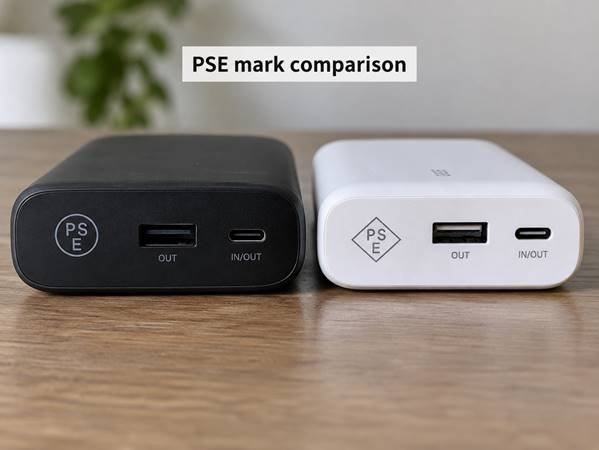
Diamond-shaped PSE corresponds to “specified electrical products”, that is, high-risk electrical products. These products are clearly listed in the METI catalog, and ordinary USB output power banks are not in this catalog at all, so there is no need to do diamond-shaped PSE.
The requirements for diamond-shaped PSE are much stricter: testing must be done by an organization designated by the Japanese government, factory inspection is also required, and finally the official certificate is issued. The process is long and the cost is high. Only a very small number of cross-category products with special high-voltage functions may involve it.
3. Comparison of Core Differences Between the Two Types of PSE
To help you quickly distinguish, we have sorted out the core differences into a table:
| Comparison Dimension | Circular PSE (for ordinary power banks) | Diamond-Shaped PSE (for high-risk products) |
| Applicable products | Ordinary consumer-grade power banks (USB/USB-C/wireless charging) | High-risk cross-category products in the METI catalog, ordinary models are not involved |
| Factory inspection | Not required | Mandatory |
| Compliance entity | Third-party laboratory test report + Japanese importer METI filing | Official certificate issued by Japanese designated agency |
| Mark appearance | Circular PSE mark | Diamond-shaped PSE mark |
4. When Will the Classification Change?
It is not that circular PSE can be used forever once obtained. If the product or regulations change, the compliance type may need to be adjusted:
For example, if your product adds AC output or high-voltage output functions, it may change from an ordinary power bank to a high-risk product, and needs to be re-compliant according to the corresponding category.
In addition, if Japan’s METI updates the regulated product catalog and classifies a certain type of power bank as specified electrical products, then it must also be changed to diamond-shaped PSE.
Also, if the use of the product changes from consumer-grade to industrial-grade or medical-grade, then the PSE rules for power banks no longer apply, and it must follow the regulations of the corresponding industry.
4. Core Requirements: What Must Be Met for Power Bank PSE Compliance
Now that you know which certification to apply for, the next step is to figure out what specific requirements must be met to avoid the certification being non-compliant.
1. Core Requirements for Safety Testing (Plain Language Version)
PSE test items seem to be many, but the core is actually two major parts, plus additional requirements for special functions:
The first part is battery safety. It mainly tests the protection function of cells and battery packs: during overcharge, overdischarge, and short circuit, the protection circuit must work normally and must not catch fire or explode; also, under extreme scenarios such as extrusion, drop, and high temperature, the battery must not have safety problems.
The second part is whole machine safety. For example, the interface must have good insulation and must not leak electricity; during normal operation, the temperature of the shell and interface must not exceed the standard limit; the shell material must be flame retardant, and the fire must not spread too fast; even if abnormal situations such as output short circuit or component damage occur, they must not trigger dangers such as electric shock or fire.
If the product has special functions, corresponding items must be additionally tested: for example, for those with wireless charging, the safety and compatibility of the wireless module must be tested; for multi-port fast charging, the power distribution when multiple ports output simultaneously must be tested, and overheating due to power overload must not occur.
Here we also want to remind you of a latest change: after December 28, 2024, the transition period for the lithium battery overcharge voltage monitoring requirement will end. Products with old designs before must reconfirm whether they meet the new requirements, otherwise they may fail the test.
2. Product Marking and Packaging Requirements
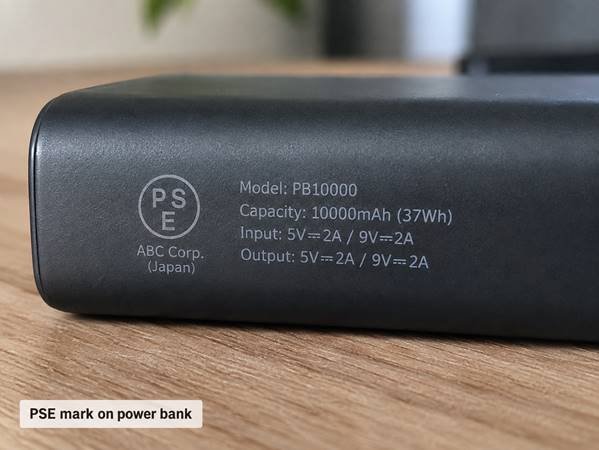
Many people pass the test but finally fail on the marking. You must pay attention to this part:
First of all, there must be clear markings on the product body, either printed or laser engraved, not a sticker that falls off easily. The marking content includes: circular PSE mark, name of the responsible entity within Japan, product model, rated energy/capacity, input and output parameters.
Then the capacity labeling must not be random: you must distinguish between cell capacity and actual output capacity, and must not falsely label; total energy must be expressed in Wh (watt-hours). The conversion method is very simple: Wh = nominal voltage × capacity (Ah). For example, a common 10000mAh (i.e. 10Ah) power bank with a nominal voltage of 3.7V has a rated energy of 37Wh.
In addition, the product packaging and instructions must have a Japanese version, which must be marked with safety warnings and certification information. Just putting a PSE picture on the e-commerce detail page is not considered compliant. The corresponding mark must be on both the product body and the packaging.
3. Compliance Documents That Must Be Retained
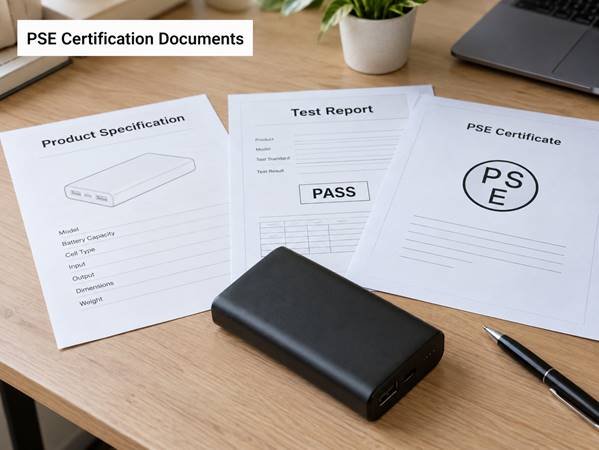
Compliance is not over when you get the report. These documents must be properly kept for random inspection by customs, platforms, or METI:
The first is the product specification, which must include detailed cell parameters, circuit design description, structure description, etc.
The second is the qualified test report issued by a third-party laboratory, which must completely correspond to the model you sell.
The third is the METI filing record of the Japanese importer or responsible entity, proving that it has been officially registered.
The fourth is the consistency certificate between mass production and test samples, that is, the products you produce in bulk are the same as the samples sent for testing, and components are not changed casually.
4. Compliance Requirements for Supporting Accessories
If your power bank is sold as a set, for example with a charger or charging cable, each regulated accessory must be separately compliant and cannot share the PSE certification of the power bank:
The AC charger included in the box belongs to “specified electrical products” and needs separate diamond-shaped PSE certification, which cannot be replaced by the power bank’s report.
The USB/USB-C charging cable included in the box must be judged for compliance requirements according to the corresponding category of the cable, not just any cable can be sold together.
In short: each regulated component in the set must have its own compliance documents, and none can be missing.
5. Method to Quickly Check the Validity of Test Reports
Many sellers ignore the report after getting it. In fact, you should first check whether it is valid, otherwise it will be too late when you find it is invalid during random inspection. There are three main points to check:
First, check the basic information: whether the standard version used in the report is the latest, whether the test date has expired, and whether the model and specification of the sample are completely consistent with what you actually sell – if the model is different, the report is invalid.
Second, check the core components: whether the cell model, protection board model, and shell material written in the report are the same as those you use in mass production. Because the PSE test report is only valid for the samples sent for testing, if you change the cell or protection board, the original report will no longer be valid.
Third, check the laboratory qualification: whether the laboratory issuing the report has the qualification for PSE testing. Not any laboratory can issue a valid PSE report.
5. Practical Application: Process, Cost and Pitfall Avoidance
Next, let’s talk about the practical issues that everyone cares about most: how to apply, how long it takes, how much it costs, and how to avoid pitfalls.
1. Preparations Before Application
Before formal application, doing these things first can save you a lot of detours:
First, confirm whether the product is within the regulatory scope, using the judgment method we mentioned earlier, don’t waste your effort.
Second, determine the responsible entity within Japan, that is, the importer or compliance agent. If you are a cross-border seller without a local Japanese company, you can find a regular service provider to act as your Japanese responsible entity.
Third, prepare the required documents in advance: product specification, detailed cell parameters, label design sketch, draft Japanese instruction manual. The more complete the documents, the faster the application process.
2. Core Application Steps for Circular PSE
Ordinary power banks all apply for circular PSE, and the process is actually not complicated, with a total of four steps:
Step 1: Choose a third-party laboratory with PSE testing qualification, send your product materials to inquire about the price, and confirm the cycle and cost.
Step 2: Send representative samples that are completely consistent with mass production to the laboratory for testing. If the test fails, you need to rectify and retest. After passing, you can get the official test report.
Step 3: The responsible entity within Japan completes the business filing with METI and keeps the full set of documents properly.
Step 4: Affix the correct PSE mark on the product body and packaging according to the requirements, and then you can ship and list the product.
3. Common Range of Cycle and Cost
Many people ask “how much does it cost to do PSE” right away. In fact, there is no unified price. The conventional situation in the market in 2024 is as follows:
In terms of test cycle, ordinary single-port or dual-port USB-C power banks can generally be completed in 2-6 weeks; if they have complex functions such as wireless charging, multi-port fast charging, and digital display, there are more test items and the cycle will be longer.
In terms of cost, it ranges from several thousand to tens of thousands of RMB, mainly affected by several factors: the more complex the product function, the higher the cost; if the documents are incomplete and need to be supplemented, there will be an extra charge; if the test fails and rectification is needed, there will also be an extra charge. In addition, laboratories with different qualifications have different charges. Don’t believe the publicity of “all-inclusive for a few hundred yuan”, which is most likely a fake report or non-compliant.
4. Common Reasons for Test Failure (Key Pitfall Avoidance)
Many people fail the test the first time, but in fact, most of them are these types of problems, which can be avoided if you pay attention in advance:
The first type is battery and circuit problems: insufficient protection circuit design, no required overcharge and overdischarge protection; cells have no qualified safety test records, and basic safety does not meet the standard; overcharge, overdischarge, and short circuit tests fail directly, which is the most common reason for failure.
The second type is structural material problems: the plastic used for the shell has insufficient flame retardant grade, is easy to deform or even catch fire at high temperatures, and cannot pass the flame retardant test.
The third type is document and marking problems: missing Japanese content on the label, the size and format of the PSE mark do not meet the requirements, and the instruction manual has no Japanese safety warnings. These seem like small things, but they can also lead to non-compliance.
5. Practical Tips for Reducing Cost and Speeding Up
If you want to spend less and get the certificate faster, you can try these practical tips:
First, design according to Japanese safety requirements during the R&D stage. For example, the protection circuit should be complete, and the shell should be made of flame retardant materials. Don’t wait until the test fails to modify. The cost of rectification is much higher than designing in advance.
Second, choose regular cells that have passed the J62133 safety certification – J62133 is the corresponding lithium battery safety standard in Japan. Using cells that have passed this certification will make the battery part of the test much smoother and reduce the probability of rectification.
Third, prepare technical documents, Japanese labels, and Japanese instruction manuals in advance. Don’t wait until the laboratory asks for them to piece them together. Incomplete documents will only slow down the cycle.
Fourth, don’t casually change the product design or components after sending samples. Even changing the shell material or cell supplier may cause the original test to be invalid, requiring retesting, which wastes time and money.
6. Post-Listing Compliance and Authenticity Identification
Getting the certification and listing the product is not the end. Subsequent compliance maintenance is also very important. You also need to learn to identify genuine and fake certifications to avoid being cheated.
1. Post-Listing Compliance Maintenance Requirements
After the product is listed, it is not all smooth sailing. You should pay attention to these things:
First, if the product design or supply chain changes, such as changing the cell, protection board, shell material, or production address, you must re-evaluate the compliance and confirm whether re-testing and filing are needed.
Second, the full set of compliance documents must be kept for at least 1 year after the product is discontinued, for random inspection by customs, platforms, or METI. It will be very troublesome if they are lost.
Third, if a safety accident such as fire or smoke occurs to the product, it must be reported to the Japanese responsible entity and relevant departments in time. If necessary, it must be actively recalled and removed from the shelves, otherwise it will face more severe penalties.
2. Common Risks of Non-Compliance
Don’t take chances and think you won’t be caught. The risk of non-compliance is actually not small:
First is the risk of customs and platforms: goods may be detained and returned by Japanese customs, resulting in additional logistics costs and losses; if the platform finds non-compliance, it will directly remove the product from the shelves, and even restrict the permissions of the seller’s account.
If you are randomly inspected by the market supervision department or complained by consumers, you will also face administrative penalties.
The most serious thing is that if a safety accident occurs to the product, the seller must bear full legal responsibility because there is no compliance qualification, and the compensation amount may be very high.
3. 3 Steps to Quickly Identify the Authenticity of PSE Certification
There are many fake PSE reports on the market now. Learning these three steps can basically avoid most fake certifications:
Step 1: Look at the product body. Ordinary power banks must have a circular PSE mark. If what you are shown is a diamond-shaped mark, there is a high probability of a problem; also check whether the mark is clear, whether it has the Japanese responsible entity, model, rated parameters and other content. Be careful if it is printed blurry or only has a logo.
Step 2: Verify the documents. Ask the other party to provide the complete test report and METI filing information, and check whether the model, cell model, and parameters on the report match the actual product. If the model is wrong, it must be fake.
Step 3: Check officially. You can query through METI’s official database or the official website of the issuing laboratory by entering the filing number or report number. Only if the corresponding information can be found is it genuine.
4. Identification of Common Fraud Routines
There are several common fraud routines that you must be alert to:
The first is “mark but no report”: the product is printed with a PSE mark, but there is no corresponding test report and filing at all, just a casually printed logo to deceive people.
The second is “passing off another’s product as one’s own”: using the PSE report of a single lithium battery to impersonate the report of the whole power bank – passing the cell does not mean passing the whole machine, which also needs to test circuits, structure, etc.
The third is “expired/used fraudulently”: using expired or cancelled reports or numbers, or using reports from other manufacturers or other models to impersonate, the model and manufacturer do not match at all.
The fourth is “only page display”: only putting a PSE picture on the e-commerce detail page, there is no mark on the product body and packaging at all. This is not only non-compliant, but also likely to be a fake certification.
7. Boundary Clarification: Difference Between PSE and Other Common Certifications
Many cross-border sellers will come into contact with various certifications and easily confuse their functions. Here we clarify the difference between PSE and several common certifications.
1. PSE vs UN38.3
Many people confuse these two, but in fact they regulate completely two links:
PSE regulates the electrical safety of the sales link in the Japanese market, and is the threshold for whether products can be sold in Japan.
UN38.3 regulates the transportation safety of lithium batteries. No matter which country you sell to, as long as you transport lithium battery products by air, sea, or express, you need a UN38.3 report, which is a requirement of the logistics link.
So these two certifications cannot replace each other. Power banks exported to Japan need both.
2. PSE vs CE (EU)
CE is a mandatory access certification in the EU, similar in function to PSE, but the applicable regions and standards are different:
PSE is Japan’s market access, based on Japanese safety standards, and the responsible entity is within Japan.
CE is the EU’s market access, based on EU standards, and the responsible entity is within the EU.
There is some overlap in the test items of the two, but the specific standard limits and test methods are different, and they cannot be directly replaced. Products that have passed CE still need to do PSE if they are to be sold in Japan.
3. PSE vs UL (North America)
UL is a common safety certification in North America, with even greater differences from PSE:
PSE is Japan’s mandatory safety access, which must be implemented in accordance with Japanese regulations. Without it, products cannot be sold.
UL is a voluntary certification in North America (although many platforms and channels require it), based on US/Canadian standards, with different processes and requirements.
The standards and processes of the two are very different and cannot be used interchangeably at all.
4. PSE vs Wireless Certification (TELEC/Giteki)
The regulatory scope of these two is completely different:
PSE regulates electrical safety, and all power banks within the regulatory scope need it.
TELEC (also called Giteki certification) regulates radio functions, and only power banks with wireless functions such as wireless charging, Bluetooth, and WiFi need it.
If your power bank has wireless charging function, you need to apply for both PSE and TELEC certifications, neither is dispensable.
Summary
After reading this article, you should have mastered the core competencies regarding power bank PSE certification:
The first is compliance judgment ability: you can quickly judge whether your power bank needs PSE, distinguish the applicable scenarios of circular and diamond-shaped PSE, and will not be fooled by service providers.
The second is compliance application ability: you know the core compliance requirements of PSE, understand the basic application process, and can check whether the test report is valid by yourself.
The third is risk identification ability: you can quickly identify the authenticity of PSE certification, identify common non-compliance problems and fraud routines, and avoid unnecessary pitfalls.
The fourth is certification differentiation ability: you can distinguish the difference between PSE and common certifications such as UN38.3, CE, UL, and TELEC, and will not confuse the requirements of different markets.
If your product plans to enter the Japanese market, you must do PSE compliance in advance. Don’t take chances, otherwise when you have to remedy after the goods are detained or removed from the shelves, the loss will be much greater.